
Updated 9/26/2023
Intellectual property was so important to the founders of the USA than they put it right in the first section of the Constitution (Article 1). The founders wrote that their rational was “To promote the progress of science and useful arts”.
So the whole point of copyright law is to increase the production of books, music, and other media so that there is more available for people to enjoy. If copyright is too weak, then there is little incentive to make an expensive move or produce an expensive satellite image because there will be no way to recoup the expenses by selling copies. If copyright is too strong, that will stifle creativity and freedom of speech because all expression depends on prior art that we copy from other. I cannot write this sentence without language that someone else created and a computer interface that someone invented (keyboard & mouse). If people could claim copyright some of these particular phrases, it would stifle my ability to express myself and if someone patented the computer keyboard, then they could charge extra fees for every computer and that would make computing excessively expensive and reduce computer use rather than increasing it.
Copyright is hurting book production
In the realm of book publishing, a new paper found that copyright is too strong for optimal creation of books and should be shorter because copy-written books are rarely available at all after a few years and then disappear from the market entirely which is bad for everyone. Once copyright expires, they tend to reappear on the market again. Here is a snippet that Freakonomics highlighted:
Influential copyright lobbyists presently circle the globe advocating ever longer terms of copyright protection based on this under-exploitation hypothesis–that bad things happen when a copyright expires, the work loses its owner, and it falls into the public domain. By analyzing present distribution patterns of books and music, this article tests the assumption that works will be under-exploited unless they are owned and therefore questions the validity of arguments in favor of copyright term extension…
[Our research] collects data from a random selection of new editions for sale on http://www.amazon.com (“Amazon”) and music found on new movie DVD’s for sale on Amazon. By examining what is for sale “on the shelf,” the analysis of this data reveals a striking finding that directly contradicts the under-exploitation theory of copyright: Copyright correlates significantly with the disappearance of works rather than with their availability. Shortly after works are created and proprietized, they tend to disappear from public view only to reappear in significantly increased numbers when they fall into the public domain and lose their owners. For example, more than twice as many new books originally published in the 1890’s are for sale by Amazon than books from the 1950’s, despite the fact that many fewer books were published in the 1890’s.
It turns out that books from the 19th century are much easier to find than books from the 20th century because more recent books are copyrighted! Freakonomics comments that:
Heald’s findings speak to a disconnect between politics and economics in copyright law. There are clearly some 20th century works that are quite old (think Mickey Mouse), that have enduring commercial value, and for which their owners (think Disney) carefully study how best to exploit them in a 21st century market. But for the typical older work, no one is paying any attention because demand for the work in the market is low. Books from the 1940s, for instance, are very often out of print and while they may be available in some libraries and in the occasional well-stocked used book store; you or I would have a very hard time tracking one down for purchase.
An economically-rational copyright policy would balance these sorts of works against the very rare works that maintain high demand over long periods of time. Instead, our copyright policy in Congress is driven by the interests of copyright owners such as Disney, for whom longer terms are better and the best copyright term (for their own works, at least) is infinite. At their behest, copyright terms have grown longer and longer—now life of the author plus 70 years. Yet, as Heald suggests, availability to consumers has diminished.

Patents killing innovation
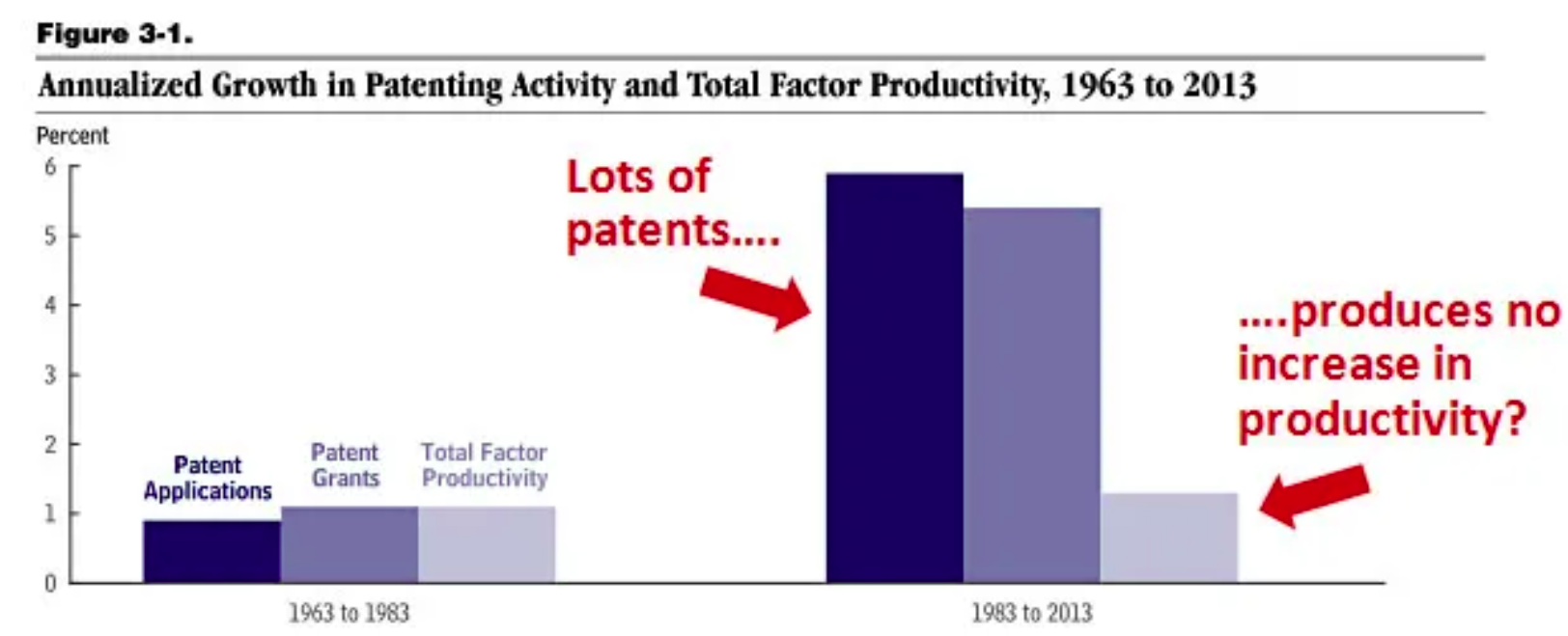
Just as the whole point of copyright is to encourage more publishing, the whole point of patents is to increase innovation, but research shows that more patents isn’t associated with more innovation as Kevin Drum reports:
Via James Pethokoukis, here’s a chart from a new CBO report on federal policies and innovation… It shows the growth since 1963 of total factor productivity (roughly speaking, the share of productivity growth due to technology improvements), and there are lots of possible reasons that TFP hasn’t changed much over the past five decades. At a minimum, though, the fact that patent activity has skyrocketed since 1983 with no associated growth in TFP suggests, as the CBO report says dryly, “that the large increase in patenting activity since 1983 may have made little contribution to innovation.”
The CBO report identifies several possible innovation-killing aspects of the US patent system, among them a “proliferation of low-quality patents”; increased patent litigation; and the growth of patent trolls who impose a substantial burden on startup firms. The report also challenges the value of software patents:
The contribution of patents to innovation in software or business methods is often questioned because the costs of developing such new products and processes may be modest. One possible change to patent law that could reduce the cost and frequency of litigation would be to limit patent protections for inventions that were relatively inexpensive to develop. For example, patents on software and business methods could expire sooner than is the case today (which, with renewals, is after 20 years), reducing the incentive to obtain those patents. Another change that could address patent quality, the processing burden on the USPTO, and the cost and frequency of litigation would be to limit the ability to obtain a patent on certain inventions.
Another option would be to use Posner and Weyl’s idea to impose a property tax on intellectual property and base the amount on how much the companies themselves value the property. At least that would reduce some of the orphaned copyright and patents that are only being held in case there is a future opportunity for litigation.
Copyright can suppress our cultural heritage
Selma was a movie about Martin Luther King Jr. that deliberately misquoted MLK which is a pity because his actual words are so poetic and memorable. Legal scholar Jonathan Band says that they couldn’t use he words because of copyright law.
Selma director Ava DuVernay may well have taken more license than artistically necessary in the confrontational scenes between Martin Luther King Jr. and President Johnson. But inaccuracies in other significant parts of the film were forced upon DuVernay by copyright law. The film’s numerous scenes of King delivering powerful speeches regarding civil rights all had to be paraphrased, because the MLK estate has already licensed the film rights in those speeches to DreamWorks and Warner Bros., for an MLK biopic Steven Spielberg is slated to produce.
the King estate is famously litigious, having sued both USA Today and CBS for quoting his “I Have a Dream” speech without permission… [Copyright gives] the descendants of historical figures veto rights over how they are portrayed in print and film. Works that meet with the King family’s approval can include excerpts from King’s famous speeches, works that don’t, can’t.
And the King family is far from the only example of an estate using copyright to police how a public figure is depicted. In one famous case, the grandson of James Joyce used legal threats to squelch biographies that cast his grandfather in a negative light.
The ultimate solution, as Band notes, is for copyright terms to be shorter. Prior to 1976, the maximum length for copyright protection was 56 years. If that rule were still in effect, “I have a Dream” would fall into the public domain in 2019. After that, anyone could use the speech without worrying about copyright. But Congress has retroactively extended copyright protection in 1976 and again in 1998. As a result, Band says, King’s works won’t fall into the public domain until 2039.
The King estate is using copyright to make money and also to promote their version of history because they own parts of history and don’t let people use it if they don’t like how the history is being told.
The song, Happy Birthday was copyrighted and owned by Warner Music. By one estimate, it was the highest-earning song in history! That finally changed in 2016 when a federal court ruled that the copyright was invalid and it finally went into the public domain in the US. In the European Union, its copyright expired on the first day of 2017. The tune was originally published in 1893 by The Summy Company, and the copyright was eventually sold to Warner Music which earned about $2m/year in royalties. It would still be under copyright in the US if not for a lawsuit that held that the copyright was invalid! Warner ended up having to pay $14m back to people who had paid for the right to play the song in public.
You can even copyright or trademark colors. For example Maia Mindel writes,
In 2014, renowned artist Anish Kapoor (of “the Chicago Bean” fame) bought the exclusive rights to Vantablack… a pigment that produced (at the time) the darkest shade of the color black possible, which trapped a then unprecedented 99.965% of light.
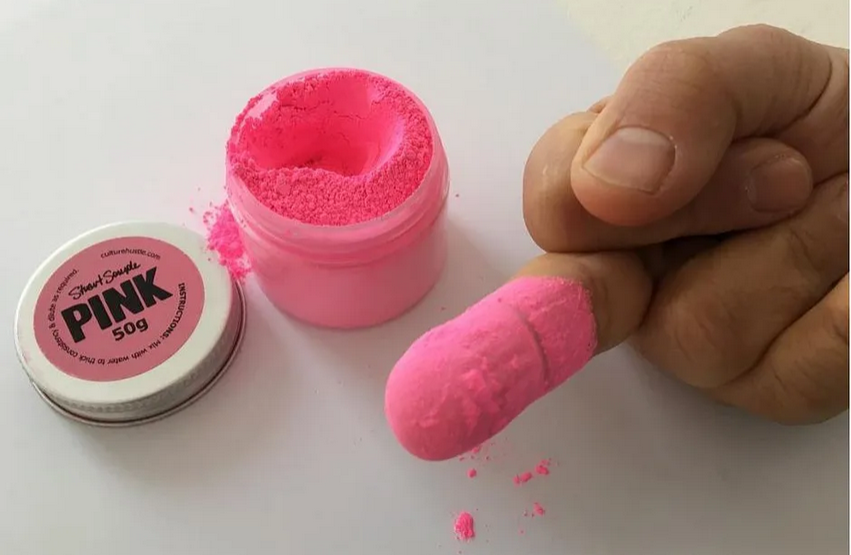
This did not sit well with many people, most notably fellow artist Stuart Semple who… decided to deny [Kapoor] the privilege of painting with a unique pigment. Thus, Semple created The World’s Pinkest Pink, a trademarked pink color that was allowed for free use to anyone – except Anish Kapoor specifically, to the point that, before buying this [color], you had to sign a waiver promising you’re not Anish Kapoor, affiliated with him, or planning to share the pink paint with Kapoor in any capacity… Prince’s estate has a pending lawsuit to exclusively own the use of the color purple in any live music events… T-Mobile sued a random lemonade company over a completely different shade of magenta.
Here is a photo of the trademarked pink color that demonstrates the artist’s sentiments about owning a color:
Cartier tried to trademark the word “love”! Time Warner owns the rights to the image of anti-establishment protest! I cannot show it to you here without paying, so take a look at the link. This is ridiculous.
Copyright doesn’t help musicians that much
Connolly and Krueger… [found] that musicians, as opposed to the industry, never made much money from recordings. C&K tell us that in 2002 – which was close to the peak of the golden age of CDs – the biggest bands made more than 7 times as much from touring as they did from royalties. Basically, for musicians it has always been about live performance.
It is amazing to me that more musicians don’t just give away their recordings like the Grateful Dead and Chance the Rapper. Anything that gets more fans to go to concerts is going to increase revenues and the marginal cost of giving away digital music is $0 nowadays.
Copyright could prevent car owners from fixing their own cars
Timothy B. Lee also explains how the Digital Millennium Copyright Act (DMCA) of 1998 reaches right into our homes:
Since 1998… companies have been invoking the DMCA in ways Congress couldn’t have anticipated, like preventing customers from taking their cellphones to competing providers and preventing online gamers from using software “bots” to automate repetitive tasks. And now, carmakers are threatening to invoke it to prevent people from modifying the software in their cars.
Today’s cars are full of special-purpose computers that control everything from fuel injection to airbag deployment. If you want to tinker with a modern car, you sometimes have to tweak the car’s software.
And under the DMCA, that might be illegal. Car companies say they own the software inside their cars, and that changing it violates their copyrights. But that’s ridiculous. Car companies shouldn’t have the power to decide what their customers do with their cars. And while tinkering with car software could raise legitimate safety concerns, copyright law isn’t a good way to deal with them…
In theory, that means carmakers could invoke the DMCA to shut down third-party diagnostic tools, shut out independent mechanics, and prevent customers from repairing their own vehicles…
If modifying car software is treated as a violation of copyright, it will give carmakers a stranglehold over the market for third-party car repair equipment, which might be good for carmaker profits but is unlikely to be good for consumers.
Detroit is far from the only industry that’s abused the DMCA in an attempt to control how its products are used. A printer manufacturer once used the DMCA to try to ban third-party toner cartridges. A garage door opener manufacturer tried to use the DMCA to prevent the creation of third-party remote controls.
Many farm equipment manufacturers are taking advantage of the DMCA to force farmers into only getting repairs at high-cost dealers.
Intellectual property is too strong
Copyright is meant to encourage more creativity, not squelch it, but it is a monopoly and when a monopoly is too strong, it reduces competition too much and hurts the public. We need to fix intellectual property so that it helps everyone and not primarily the big corporations. One way to improve it would be to impose what Glen Posner and Eric Posner and Glen Weyl call a Common Ownership Self-assessed Tax (COST). Owners of intellectual property would have to self-assess the value of their patent or copyright and pay a tax on that value. The tax rate should gradually increase over time and anyone who doesn’t pay their tax will lose their intellectual property just like people who do not pay their real estate tax lose their real estate.
The first few years could be tax free, but the tax rate would gradually ratchet up until nobody wants to pay the tax after a certain number of years and will gladly see the property go to the public domain.
A COST fee on intellectual property would solve the problem of orphaned copyright and reduce the problem of patent trolls. It would allow for more allocative efficiency as patents would go to the companies with the highest value for them and generate revenues for public benefit. All license fees should also be published so that licensing is a transparent market as well.




 Medianism
Leave a Comment