Government debt hits all-time record. You now owe $63,000!

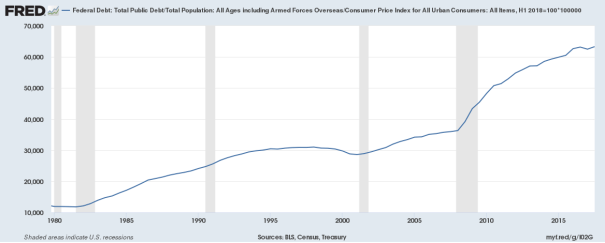
Although Forbes magazine regularly  opines  that US government debt is at crisis levels, most Americans don’t seem to care these days. If we divide up the total government debt by the population and adjust for inflation (using the 2018 value of the dollar), your share of the debt is currently worth over $63,000 as you can see on this graph. For a family of four, you would owe $252,000 for your household (if we divided the debt equally)!

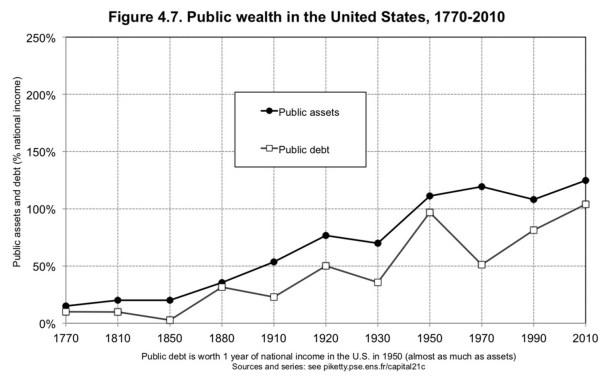
Although I agree with Forbes that this is bad timing to increase the government deficit, I’m not at all worried about a debt crisis for various  reasons  mentioned  earlier. I just noticed data from Thomas Piketty that provides another reason. The value of public sector assets in the United States has been rising almost as fast as public sector debt and if you subtract the total debt, the government still has an enormous net wealth: exceeds the value of public debts by a substantial margin.

Matt Yglesias notes that the government assets are not managed optimally and could generate more money for Americans. He explains a proposal by  Matt Bruenig and others to put public wealth into a corporation that could generate higher income for all citizens. Putting public assets into a corporation would be a bit like a privatization which conservatives would like and the dividends would go to all Americans equally (like the sovereign wealth fund in Norway and the Alaska Permanent Fund) which liberals would like, so there might be support from across the ideological spectrum if only the US weren’t so darn tribalistically partisan. Add this to the list of radical ideas that will probably never become popular enough to overcome opposition from entrenched special interests.

Posted in Public Finance

International trade and immigration have been getting more popular since Trump was elected

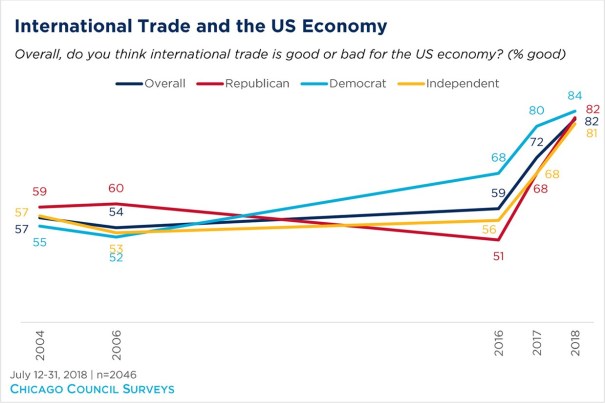
Today Trump and his allies on Fox News claimed to have replaced NAFTA. In reality, his deal only affects a tiny amount of NAFTA trade and legally only Congress can repeal NAFTA. But Trump’s announcement demonstrates his desire to show how anti trade he is. Although it plays will with Trump’s diehard fans, it doesn’t seem like a political winner in general. The Chicago Council on Global Affairs published a recent poll showing that support for international trade has been skyrocketing under Trump!

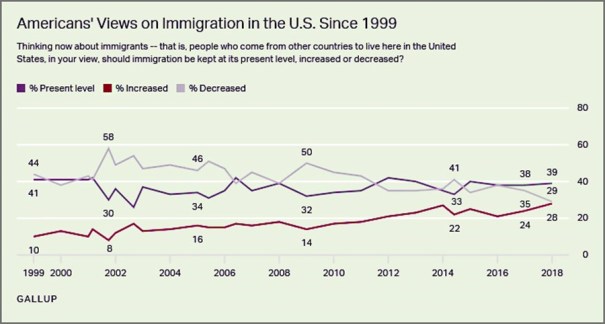
Similarly, Gallop polls show that support for increased immigration is higher than it has been in at least 20 years!


Hat tip Kevin Drum.

Posted in Globalization & International, Labor

Radical political ideas that could make the world better but can’t get political support

Henry George promoted a revolutionary plan for the tax system that economists generally agree would be more fair and efficient, but 120 years after his death, still (almost) nobody cares about his great idea.

Pigouvian taxes are another idea beloved by economists on both the right and the left that never captures the popular imagination.

Although most people claim to love democracy, few people ever think about the nuts and bolts of what kind of machinery of democracy works best.  Nearly all voting experts agree that our voting system is the worst possible. There are many alternatives that are fairer and better (like Range Voting), but most people don’t care.

One of the essential parts of the machinery of capitalism is our laws that make corporations possible, but this framework is rarely examined by the public. Now there is another interesting proposal that will probably go nowhere because wealthy interests will oppose it and voters won’t care because it is too wonkish to appeal to the popular mind.

require any corporation with revenue over $1 billion — only a few thousand companies, but a large share of overall employment and economic activity… to consider the interests of all relevant stakeholders — shareholders, but also customers, employees, and the communities in which the company operates — when making decisions. That could concretely shift the outcome of some shareholder lawsuits but is aimed more broadly at shifting American business culture out of its current shareholders-first framework… Business executives, like everyone else, want to have good reputations and be regarded as good people but, when pressed about topics of social concern, frequently fall back on the idea that their first obligation is to do what’s right for shareholders. A new charter would remove that crutch, and leave executives accountable as human beings for the rights and wrongs of their own decisions.

Under current law, corporate executives are required to do whatever is most profitable for shareholders even if it pollutes then environment, addicts users (a particular problem in the tobacco, alcohol, and painkiller industries), or harms employees. If CEOs do something that is good for society at a cost to profits, they can be sued by shareholders and held personally liable. This new proposal would eliminate that legal threat. This is famously associated with Milton Friedman’s widea that “The Social Responsibility of Business Is to Increase its Profits.”

Additionally, the proposal would 40 percent of the membership of their board of directors to be elected by employees. This is roughly how corporations are run in many other nations like Germany and employees generally don’t let CEOs extract as much money out of corporations as they do in the US. As Yglesias notes, “Consequently, German executives earn only about half as much as their US counterparts, even as major German firms like BMW, Bayer, Siemens, and SAP produce world-class results.” Employees also have insider knowledge of how well the management is working which outside board members lack which can help improve corporate governance.

Yglesias argues that this tweak of American corporate charters could help reduce inequality and boost productivity:

The shareholder value era has pretty clearly brought about an explosion in inequality in the United States. It succeeded, for starters, in greatly increasing the value of shares of stock in the English-speaking countries where Friedman’s doctrine has been most influential.

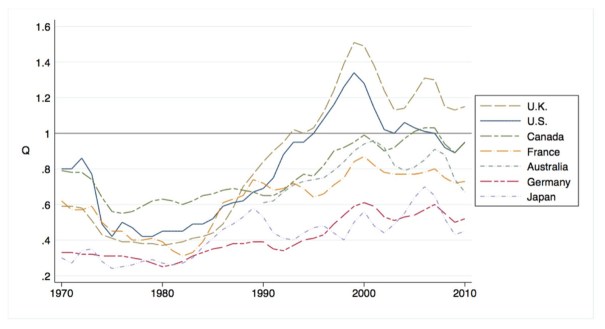
You can see this in the evolution of a ratio known as Tobin’s Q — the value of all the shares of stock outstanding divided by the book value of everything publicly traded companies own.

Historically, this ratio was well below 1, and it remains below 1 in Germany and Japan, where shareholder value does not reign supreme. But in the US, Britain, and Canada, the Q ratio has soared — meaning the financial value of corporate ownership has risen faster than the actual growth of the underlying enterprises — leading to huge increases in wealth for people who own shares of stock.
Thomas Piketty

Since 80 percent of the value of the stock market is owned by about 10 percent of the population and half of Americans own no stock at all, this has been a huge triumph for the rich. Meanwhile, CEO pay has soared as executive compensation has been redesigned to incentivize shareholder gains, and the CEOs have delivered. Gains for shareholders and greater inequality in pay has led to a generation of median compensation lagging far behind economy-wide productivity, with higher pay mostly captured by a relatively small number of people rather than being broadly shared.

Investment, however, has not soared. In fact, it’s stagnated.

And a range of scholars believe shareholder capitalism is to blame. Dong Wook Lee, Hyun-Han Shin, and René Stulz find that firms enjoying high Q now invest in share buybacks rather than reinvesting in business. Heitor Almeida, Vyacheslav Kos, and Mathias Kronlund find that companies strategically time buybacks to manage earnings per share metrics in line with Wall Street expectations and that “EPS-motivated repurchases are associated with reductions in employment and investment, and a decrease in cash holdings.”

Germán Gutiérrez and Thomas Philippon empirically test seven possible causes of decreased business investment, and find that changes in corporate governance (along with reduced competition and a shift to intangible goods becoming more important) is a major factor.

The heterodox economist William Lazonick of the University of Massachusetts puts the thesis very squarely, arguing that “from the end of World War II until the late 1970s, a retain-and-reinvest approach to resource allocation prevailed at major U.S. corporations.” But since the Reagan era, business has followed “a downsize-and-distribute regime of reducing costs and then distributing the freed-up cash to financial interests, particularly shareholders.”

Although these ideas are worth pursuing, they will probably go nowhere because rich shareholders will spend political money to oppose it and wonkish ideas about corporate charters just can’t be captured in a populist slogan, so these ideas won’t be able to overwhelm the concentrated financial interest groups that oppose them.

Posted in Managerial Micro, Public Finance

Policing crime vs immigration?

Do you fear crime? Do you fear terrorism? Do you feel safe? It turns out that the government is much more afraid of immigrant groundskeepers and farm workers than terrorists or violent criminals:

Congress… has elected to spend more than twice as much money on the two federal law enforcement agencies charged with stopping illegal immigrants, Immigration and Customs Enforcement and Customs and Border Protection, as they spend on the FBI. But the FBI’s mission includes counterterrorism and counterintelligence, organized crime, and a range of other responsibilities. Obviously it is well understood that despite their fairly lavish budgets, ICE and CBP have not, in practice, succeeded in creating a situation where all unauthorized immigrants are caught, detained, and removed. That state of affairs is frequently portrayed as a kind of urgent national crisis requiring even harsher crackdowns, even more money, and all the rest.

ICE and CBP are charged with getting undocumented immigrants, not people who have committed any frauds, terrorism, violent crime or anything else. That’s the FBI’s job. In addition to investigating terrorism and violent crime, the FBI is charged with investigating white collar crime like the crimes that brought about the 2008 housing crisis and economic crash. The government prosecuted nobody related to the 2008 economic crisis not because all the investment bankers were innocent, but because almost no resources go into prosecuting white collar crime.

One of the lessons of the Trump era is that the FBI doesn’t normally prosecute white collar criminals. Numerous Trump associates like Paul Manafort and Michael Cohen are being charged with millions of dollars worth of white collar crimes. In their defense, they are claiming that nobody usually prosecutes the kind of white collar crimes they committed and they would have never been charged if not for the investigation into Trump’s obstruction of justice in the investigation of his collusion with Russia. This is true, and they would have gotten away with it if Trump had not produced the Mueller investigation, but should they go free despite their guilt simply because the FBI normally doesn’t investigate their kind of crimes? Or should the FBI start investigating more white collar crime?

Meanwhile, Malcolm Gladwell reports in his podcast that immigration enforcement really only began in the 1980s for the first time in American history. Before that, the US had a completely porous southern border (and northern border too, but most Americans don’t worry about the hordes of Canadians yearning to breathe free and work here in the US). The US didn’t award citizenship to undocumented immigrants, but we didn’t try to stop them from coming in any serious way. That meant that most undocumented immigrants from Latin America would come and work for a little while and then leave. When the US started making it difficult to cross the border, the immigrants were forced to stay if they wanted to work because they couldn’t come and go at will and so many more became permanent immigrants rather than temporary immigrants and the entire effort to keep them out completely backfired and created massive net immigration from Latin America for the first time in US history.

Posted in Labor, Public Finance

Rising dominance of fewer corporate behemoths.

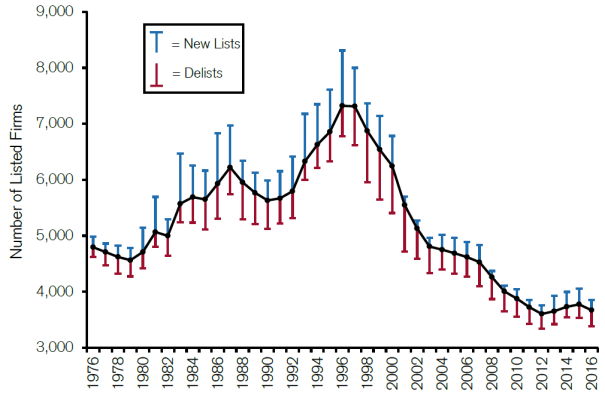
The number of publically traded corporations used to grow with the US population as you might expect. More people means more customers and more workers which creates opportunities for more corporations. But the number of public corporations peaked in 1996 and today there are about half as many corporations on US stock exchanges as there were.

As a consequence of this trend, industries are more concentrated and the average company that has a listed stock is bigger, older, more profitable, and has a higher propensity to disburse cash to shareholders.

There are half as many corporations, but their average value has approximately quintupled, so the total size of the stock market has approximately doubled. In fact, the value of these companies (and their profits) have been growing much faster than the rest of the US economy. The entire stock market value was less than half of GDP in 1976 whereas today it is closer to 150% of total GDP.

As Jeff Sommer points out, there are a couple problems with this kind of increasing market concentration. As corporations get bigger, they get more monopoly (and monopsony) power which creates inefficiency and reduces economic growth. This also increases economic inequality and with less equal economic power comes less equal political power as corporations get more and more power to manipulate government relative to the median citizen.

Posted in Managerial Micro, Public Finance

Info technology has made land use data fun

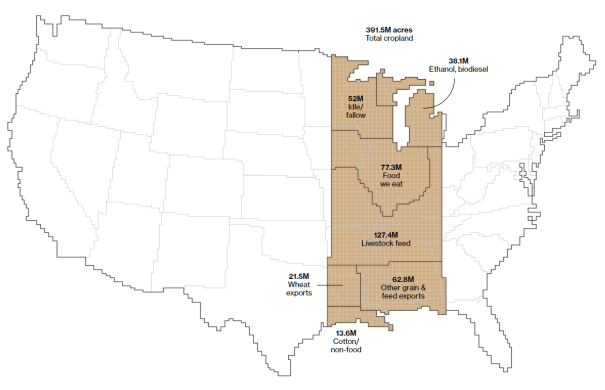
Dave Merrill and Lauren Leatherby wrote a wonderful article at Bloomberg with a set of maps showing land use in the USA. They did a great job of taking public datasets and displaying the information in a fun way that helps answer all sorts of questions. For example, for people interested in questions about whether we will run out of food, it helps answer the question of whether the US would be able to grow enough food if our population doubled? Absolutely. The US has more land devoted to exporting food than to growing the food that we consume directly.

And more land is devoted to feeding livestock, 41% in total, than to any other purpose in the US.

It also shows that the US has more land in military bases than in state parks:

As you might expect, “According to The Land Report magazine, since 2008 the amount of land owned by the 100 largest private landowners has grown from 28 million acres to 40 million, an area larger than the state of Florida.”

See the whole article for more glorious maps.

Posted in Public Finance

Data proves July is the best month to buy apparel online!

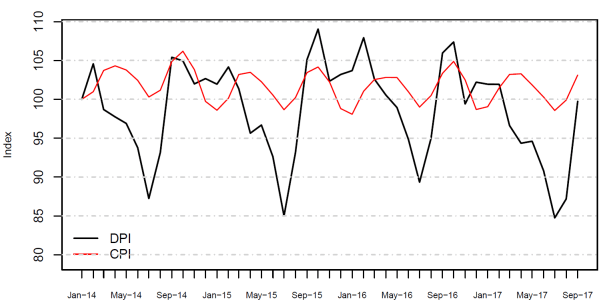
Austan Goolsbee and Peter Klenow compared overall inflation (red line) with inflation for goods that are sold online. They controlled for the fact that many goods like housing and fresh produce cannot be easily delivered by online vendors by matching the kinds of products that are sold online with similar products that are sold in stores and found that prices have tended to fall online more than in stores. The black DPI line below is their digital price index which they compared with similar goods in their offline CPI in red.

More useful for the average consumer is their finding that the best month to buy stuff online is July because prices drop the most in July with a smaller price drop in November. One possible reason online prices are lower in July than other months is that Prime Day is in July.  That is Amazon’s big sale day which rivals anything in November.

However, the authors didn’t look at every single item that is sold online, so perhaps the apparent reductions in prices in July is mostly due to the large drop in prices for apparel. Their work makes it absolutely clear that the best month to buy apparel online is July and the worst months are September and October.

Bricks and mortar apparel stores have much less price volatility and have two peaks and troughs each year rather than the one large price drop seen for online apparel. They also have data on recreational goods which go on sale in November online:

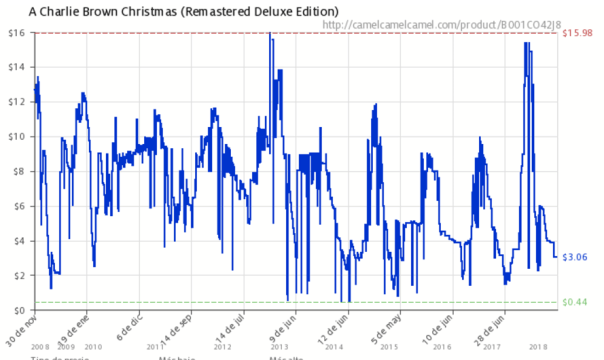
You can also check the price cycles for each product that Amazon sells by checking out the data on Camelcamelcamel.com.  Amazon changes prices on their website 2.5 million times per day and sometimes you can see patterns in the data such as the following graph showing the price of A Charlie Brown Christmas which fluctuates annually between about $16 and $2.

charlie brown

The best time to buy it is generally in the summer.  That is some serious price discrimination.  Keepa offers a similar service, but I haven’t bothered because they want users to register to fully use the service.

More importantly, if you pay any attention to online reviews, you should always check fakespot.com first before believing any ratings on Amazon.com.  ReviewMeta has a similar service.  I’ve become a lot more cynical about Amazon reviews after seeing more data about them.


Posted in Managerial Micro

Enter your email address to follow this blog and receive notifications of new posts by email.

Join 75 other subscribers
Blog Archive
Pages