Updated December 20, 2018
Mark Kleiman has done some of the most insightful policy analysis of illegal drugs available. He argues that home grown marijuana should be legal (and polls show that the majority of Americans have agreed for some time already), but large-scale farming of marijuana should continue to be illegal. Does that make any sense?
Kleiman’s analysis suggests that if factory farms produced marijuana, and Walmart distributed it, marijuana would be so cheap that it would be given away for free at restaurants and convenience stores like ketchup or salt. His analysis suggests that high quality pot would be cheaper than ketchup and low-quality pot would be cheaper than salt.
Kleiman estimates that low-quality marijuana would have production costs that are similar to the cost of producing hemp which is grown in Canada and many other nations. Hemp is illegal to grow in the US because it is exactly the same species as marijuana, but with more fiber and less psychoactive THC so that it is not generally smoke-able. Marijuana and hemp are two varieties of the same species just like a golden delicious apple produces very different fruit than an ornamental crab apple even though they are both the same species. Hemp supposedly can have such low levels of psychoactive chemicals that it can be useless for getting high. For this reason hemp was legally grown in the US through the end of WWII and was so important to the war effort that the government gave out draft deferments to grow it.
Yglesias says that hemp costs around $500 per acre to produce in Canada where it is legal. If farmers simply switched varieties and grew marijuana instead of hemp, they could produce 800 joints (at .5g/joint) for only 20 cents! Twenty cents isn’t the price per joint, it is the total price for enough marijuana to roll 800 joints. That kind of low-quality marijuana has cost thousands of times more money when marijuana was illegal because of the high costs that illegal growers have faced when they were unable to use modern agricultural techniques. With mechanization, one farmer will be able to plant and harvest hundreds of acres of marijuana and chemical processing plants will be able to extract the psychoactive ingredients cheaply from truckloads of raw material.
At the other end of the quality spectrum, the highest-quality marijuana probably has production costs that are similar to that of grafted greenhouse tomatoes which cost up to $20,000 per acre. That means that the very best quality marijuana would only cost under $20 per pound which translates to a little over 2 cents per joint. Marijuana would be the very cheapest intoxicant in history and would likely be given away for free like packets of sugar for coffee. Sugar & Splenda packets cost about 2 or 3 cents each when purchased in bulk. That price is just extrapolating from current technology and it could get cheaper with more research. Agricultural science has revolutionized the productivity of corn, soybeans, cotton, milk, and most other crops, so once it is legal for Cargill and our university Ag labs to apply their proven research techniques in the marijuana business, costs will likely decline rapidly from there. Get ready for a future of genetically-modified, extra-potent, Roundup-Ready marijuana that is field-grown like hay and harvested by machines for THC extraction in factories the size of sugar mills. Technological innovation should eventually be able to produce super-joints for less than one cent apiece.
Is it realistic that agricultural technology could reduce the price of producing a commodity that much? Absolutely. Think about black pepper. It used to be worth its weight in gold. The quest for black pepper launched Columbus’ voyage of discovery across the Atlantic where he found a spicy plant that he tried to pass off as a variant of black pepper even though it is completely different, but the name stuck. Black pepper is now so cheap that restaurants and convenience stores give it away for free. Marijuana prices will also fall as agribusiness begins investing in better technology.
Although marijuana has been legalized at the state-level, because it is illegal at the federal level, no companies that are regulated by the federal government can get involved in the industry and that includes most of our large corporations that operate across state lines. In particular, US banks have not been willing to even let marijuana businesses open up checking accounts, much less get loans to expand. That has meant that marijuana businesses have had to operate on a cash basis which has severely limited growth so far despite high profits. Just allowing marijuana businesses access to interstate banking would create enormous economies of scale and many marijuana advocates fear that the industry would quickly become monopolized by big corporations.
Allowing our Fortune 500 corporations to invest in the marijuana industry would completely change the economics of intoxicants. For example, bar owners often give out free salty snacks because salt makes patrons thirsty and makes them to spend more on high-profit beer. Marijuana would help corporations sell more food because it stimulates appetite. Free marijuana would be a much cheaper and more effective loss leader than the products and services that Taco Bell currently provides for free like tap water, packets of salsa, and parking. If pot were legalized, Taco Bell might give away free smokes perhaps using hookahs, so patrons don’t take the drugs elsewhere and benefit other food vendors. Doritos are apparently are the food of choice for potheads and marijuana could be given away for free, taped to the side of every package of Doritos. Already there have been several media reports of enterprising young Girl Scouts selling cookies next to the front doors of legal marijuana stores who have brought in hundreds of dollars per hour from marijuana customers with the munchies. This is what one of the Girl Scouts looked like in an Instagram post by the marijuana dispensary.
https://www.instagram.com/p/BetbYbtlNEH/?utm_source=ig_embed
If marijuana were truly legalized, then companies like tobacco giant Phillip Morris would produce joints and companies like Walmart and Taco Bell would sell it. Kleiman opposes the marriage of Taco Bell and marijuana because he fears the power of professional marketers to change our society and the power of a marijuana lobby to influence our government.
A legal cannabis industry, like the legal beer industry, the legal tobacco industry, …and the legal gambling industry, would do everything in its power to expand its sales, including taking political action to weaken whatever regulations and minimize whatever taxes were imposed.
Well, again, why not? What’s wrong with persuading someone to engage in what would be a perfectly lawful behavior?
Nothing, if the behavior is harmless as well as lawful. Everything, if the behavior predictably inflicts harm on the person being persuaded.
But cannabis use (like drinking, eating, and gambling) is harmless to most of the people who engage in it. Is it wrong to suggest that someone start [it] simply because it might turn into a bad habit?
Might. “Aye, there’s the rub.” To the consumer, developing a bad habit is bad news. To the marketing executive, it’s the whole point of the exercise. For any potentially addictive commodity or activity, the minority that gets stuck with a bad habit consumes the majority of the product. So the entire marketing effort is devoted to cultivating and maintaining the [abusers. Addicts are] a gold mine to the industry.
Take alcohol, for example. Divide the population into deciles by annual drinking volume. The top decile starts at four drinks a day, averaged year-round. That group consumes half of all the alcohol sold. The next decile does from two to four drinks a day. Those folks sop up the next thirty percent. Casual drinkers – people who have two drinks a day or less – take up only 20% of the total volume. The booze companies cannot afford to have their customers “drink in moderation.”
The relationship is obvious once you think about it. One of what the beer commercials of my youth called “real beer drinkers – people who drink a case or more of beer a week” is worth two dozen people who only consume a drink a week, which is roughly the national median.
Not everyone in those top two deciles has a diagnosable drinking problem; you could have four drinks every day and never be actively drunk. But that’s not the typical pattern. Most of those folks have an alcohol abuse disorder. And they [have always been] the target market. “An innkeeper loves a drunkard,” says the Yiddish proverb, “except as a son-in-law.”
Since the alcoholic beverage industries are as dependent on alcohol abuse as a chronic drunk is on his wake-up drink, they fiercely resist any effective policies for curtailing it, starting with higher taxes. (Contrary to myth, taxation takes most of its bite out of heavy drinking rather than casual drinking, because alcohol is a much bigger budget item for heavy drinkers.)
[We could almost eliminate drunk driving if we would have liquor store] clerks and bartenders check customers against a list of people who had lost their legal drinking privileges as a result of a criminal conviction for drunk driving or drunken assault. …Would the industry hold still for it? No way.
So the prospect of a legal cannabis industry working hard to produce as many chronic stoners as possible, and fighting hard against any sort of effective regulation, fills me with fear. …The [giant] cannabis companies that would emerge from full commercial legalization would have all of the tobacco outfit’s morals…
The rate of problem use among cannabis users [has been] lower than the rate of problem drinking among drinkers (lifetime risk of about 10% v. lifetime risk of at least 15%) but that’s under conditions of illegality and high price. The risks of chronic heavy cannabis use aren’t as dramatic as the risks of chronic heavy drinking – the stuff doesn’t kill neurons or rot your liver, and generates less crazy behavior than beer does – but that doesn’t make those risks negligible. Ask any parent whose fifteen-year-old has decided that cannabis is more fun than geometry. Of the 10% of cannabis smokers who become heavy daily smokers for a while, the median duration of the first spell of heavy use (not counting the risks of relapse) is 44 months. That’s not a small chunk to take out a lifetime, especially a young lifetime.
Cannabis isn’t harmful enough to be worth banning. But that doesn’t mean that it’s safe to give America’s marketing geniuses a new vice to peddle.
Marijuana doesn’t reduce lifespan nearly as much as tobacco and it doesn’t cause reckless behavior as much as alcohol, but it does cause dependence and it reduces productivity. These are the primary problems of marijuana use. Although a little pot doesn’t kill as many neurons as a little alcohol does, pot use does make people stupider so it isn’t benign. As Jonathan P. Caulkins says:
Marijuana might better be described as a performance-degrading drug…
The drug’s misleading reputation for harmlessness is based largely on two defining patterns of marijuana use. First, most people who try marijuana never use much of it; perhaps only about one-third of those who try it go on to use it even 100 times in their lifetimes, the common threshold for determining whether someone has ever been a cigarette smoker. Trying marijuana is not dangerous, but using it is. Those who use marijuana on an ongoing basis face a much higher likelihood of becoming dependent than lifetime smokers do of developing lung cancer. Marijuana dependence is neither fatal nor as debilitating as alcoholism, but it is real, harmful, and far more common than is generally acknowledged.
Second, marijuana use is highly concentrated among the growing minority who use daily or near-daily. Adults who use fewer than ten times per month and who suffer no problems with substance abuse or dependence account for less than 5% of consumption. More than half of marijuana is consumed by someone who is under the influence more than half of all their waking hours. Most marijuana users are healthy; most marijuana use is not…
Of those admitting any use, 45% reported consuming on fewer than 12 occasions in total; only about one-third reported using on more than 100 occasions. By comparison, tobacco researchers often don’t count someone as ever having smoked unless they have used on at least 100 occasions… it is crucial to recognize that almost no one whose lifetime exposures total to fewer than 100 occasions of use becomes dependent. So the dependence rates among those who do go on to use on more than 100 occasions [is about 27% to 45%]. In short, merely trying marijuana isn’t very dangerous, but using it on an ongoing basis can be risky.
A large percent of regular marijuana users admit that they have a problem. As Keith Humphreys said:
In large national surveys, about one in 10 people who smoke it say they have a lot of problems. They say things like, ‘I have trouble quitting. I think a lot about quitting and I can’t do it. I smoked more than I intended to. I neglect responsibilities.’
According to the National Survey on Drug Use and Health (NSDUH), nearly 11 percent of the 37.6 million people 12 and older who admitted using marijuana in 2016 suffered symptoms of marijuana use disorder.
Jonathan P. Caulkins estimates that 21% of current marijuana users meet the diagnostic criteria for abuse or dependence whereas only 13% of current alcohol users who meet the criteria for alcohol abuse or dependence. This is despite the fact that the definition of alcohol dependence is wider which makes it easier to meet the criteria for alcohol abuse. According to this data, marijuana use is 62% more likely to cause addiction than alcohol use and if we use the stricter diagnosis of dependence, then marijuana is 133% riskier for the population of current users. Because this data is self-reported, the true incidence of abuse is undoubtedly higher since denial is a common feature of addiction. For example, my uncle died of alcoholism, but he denied he had any problem with it.
The small fraction of people who use marijuana regularly have a higher chance of reporting a problem than regular alcohol drinkers and these are exactly the most profitable users. A 2014 study of Colorado’s legal pot market found only the 30% heaviest pot users bought 87% of the drug. Over half of marijuana is consumed by the small fraction of users who consume it daily and who are thought to consume an average of 3-4 joints per day and spend over half of their waking hours under the influence.
All corporations care about customer lifetime value (CLV). That is a prediction of how much net profit will come from an entire future relationship with each customer. Beer companies don’t really care about the CLV of the median beer consumer or even the 80% of drinkers who drink responsibly. They care about the CLV of approximately 20% of drinkers who have a drinking problem and consume 80% of all the beer. They only care about the rest of us insofar as we all have the potential to develop a drinking problem and dramatically increase our CLV for the seller. Sellers of addictive products have a massive incentive to try to encourage the kind of risky behavior that could move some of us towards the tipping point of becoming the alcoholics who generate 80% of their revenues.
All corporations have an incentive to focus marketing on young people who have the biggest potential CLV. But drug marketers might have an additional reason to focus their commercials on encouraging binge drinking among the young. That age demographic (up to age 25 as the brain is still developing) is the easiest to influence and are the most susceptible to becoming alcoholic. Nineteen-year-olds have the highest hazard rate of becoming alcoholic (despite being below the legal drinking age) due to their malleable growing brains. In particularly, corporations have an incentive to encourage bingeing consumption patterns because large doses are the most effective for permanently altering the physical structures of the brain.
Marketing binge drinking is an effective way to convert youth into alcoholics and it seems to be working. The CDC reports that, “About 90% of the alcohol consumed by youth under the age of 21 in the United States is in the form of binge drinks.” Among all the rest of drinkers who are above 21, eighty-percent of them rarely drink more than one or two drinks and they more commonly consume it with a meal which reduces the effect. There is much less incentive to aim marketing at the 80% of drinkers who drink moderately because they won’t produce enough high-CLV alcoholics.
To prevent the median American from becoming a pot addict, Klieman argues we need to prevent the kind of economies of scale that will create concentrated financial interests (like Coors and Philip Morris) that will spend billions of dollars devising devious ways to influence us to become addicted.
This is a good idea, but there are other problems with only legalizing home-production of marijuana. Due to the lack of economies of scale, it has bad environmental costs, and millions of tiny, inefficient producers are harder to tax and regulate. It is much easier to tax an industry when a few behemoth corporations dominate some aspect of the supply chain like the cigarette corporations dominate the tobacco industry.
Similarly, if cigarette smokers directly bought tobacco from backyard producers, the government wouldn’t get much tax revenue and tobacco cigarettes would be even less safe because there would be less regulation and quality control with thousands of small producers. But tobacco would be a lot more expensive, and there would be much less marketing and lobbying which would help reduce smoking.
I’d argue that a better way to handle addictive drugs is to give the government a monopoly on their production and sale. It would be hard for a monopoly producer to be less efficient than marijuana farmers currently are because of the inherent economies of scale, but there isn’t any problem for society if the government turns out to be somewhat inefficient at producing addictive substances. In fact, we want the government to be very inefficient at marketing their use and the government has more incentive to place people’s health over profits since there it has very little incentive to prioritize making money off of drugs given that it can just print money.
The economics of legalized marijuana are hard to predict.
The world has never known an intoxicant that is so cheap that it will be given away for free and that could change the economic incentives. If Doritos is giving away free pot with every bag of chips they sell, you might think it would reduce marijuana industry profitability too much for Philip Morris Corporation to spend money hiring marketers to promote marijuana usage. And if the government imposes high taxes that make marijuana costly, that would squeeze down producer profits more. Sugar and salt might be similar industries because both are given away in restaurants for free and you don’t see Domino Sugar and Morton Salt spending much money on marketing their products because these commodities have such low profits that producers can’t afford to spend much on marketing.
However, consumers are particularly irrational about spending money on mind-altering substances. That is why the alcohol, tobacco, and sugar industries spend such a large percentage of their money on advertising. Sugar is only mildly addictive and although I just mentioned that sugar manufacturers don’t spend much on marketing, the soda, candy and sugary cereal industries spend a massive amount.
Legalizing marijuana will likely cause a similar outcome. Boutique brands will figure out how to charge huge markups just like the sugared cereal industry, and they will do it by marketing a mystical pizzazz of their particular brand. Other addictive substances also spend a lot on marketing which produce profitable markups. For example, the tobacco industry spent more than $240 on marketing per each U.S. adult smoker in 2015. Restaurants with an alcohol license typically make most of their profit on the alcohol because drinkers pay irrationally large markups on alcohol that nobody would pay on the food. Even caffeine is mind-altering enough to get customers addicted to $2 daily cups of Starbucks that contain less than 25 cents of actual Starbucks coffee. That is approximately how much it costs to buy Starbucks coffee beans from the company and make your own cup of Starbucks coffee. The markup they extract from their coffee addicts seems irrationally large compared with markups in other industries.
When marijuana achieves predictable economies of scale it will revolutionize recreational drugs by providing such a cheap option. Similarly, fentanyl is also much cheaper to produce and smuggle than other opioids (or cocaine or methamphetamine) and that is revolutionizing the drug industry in a similar way. It could cause the end of Latin American drug cartels.
Most research suggests that pot is a substitute for alcohol consumption, so more pot could reduce the consumption of alcohol and that is why the alcohol lobby has been against legalization because of worries about competition from marijuana. Now that they have lost that battle, the world’s largest alcohol corporations are investing heavily in marijuana according to AdAge magazine. They must see economies of scope that will bring synergies between the two industries, but they will be fighting with Big Tobacco corporations which are investing billions in the industry.
If Kleiman is right, and marijuana abuse is less harmful than alcohol abuse, then IF the total amount of substance abuse does not rise significantly, then a dramatic drop in the cost of marijuana could create a net benefit for society if it just converts alcoholics into potheads without creating many new addicts. Similarly, contrary to the Trump administration, marijuana is not a complement for opioid addiction and more marijuana use is likely to help reduce that epidemic.
Marijuana abuse probably imposes fewer externalities upon innocent bystanders than alcohol because it seems to produce fewer driving accidents and less violence than alcohol abuse. Although both substances impair driving by reducing physical coordination, alcohol also makes people more reckless and overconfident. In contrast, potheads tend towards paranoia which helps make them more fearful of getting into an accident. Kleiman argues that America would be better off decriminalizing marijuana (with heavy taxes and regulation) and also making alcohol harder to get by raising alcohol taxes. He argues that alcohol is, “the country’s number one drug abuse problem.” His research suggests that increasing the alcohol tax back to the level it was at in the 1950s would:
prevent 800 homicides and 1500 accidental deaths per year, reduce healthcare costs, reduce teenage pregnancy, decrease domestic violence, protect fetal health and shrink the Federal deficit by $20 billion… [but] not a single politician in Washington has even dared to mention that change, largely in deference to one of America’s most powerful lobbies [the alcohol industry]. …Tripling the alcohol tax would increase the price of each drink by about 20%. …This would reduce total drinking by about 10%, and in turn reduce [total] homicide and automotive accidents by about 5% each.
Again, for the 80% of alcohol users who drink less than 20% of the beer, a 20% increase in price won’t affect their total recreation budget much, but for an alcoholic who spends a large portion of his income on alcohol, it is a major problem that forces big lifestyle changes and going from eight drinks a night to six drinks would be a huge improvement for them.
Marijuana legalization would create a powerful new lobby and that could cause unpredictable new health problems. Doritos might put free joints in bags of chips as an addictive loss-leader strategy to increase sales of their unhealthy chips which could boost obesity. Adding an addictive drug to the package would give a whole new meaning to their slogan: “You can’t eat just one.”
Although past research has indicated that marijuana abuse has been less harmful than alcohol addiction, that research comes from a context where marijuana was illegal and much more expensive compared to alcohol. Legalizing marijuana might cause an explosion of addiction and that could create much greater harm than we have under marijuana prohibition. Even if corporate marketing campaigns to promote pot are banned, if pot is legalized, there will still be a grass-roots (so to speak) campaign by enthusiasts to promote pot culture. Personally, I would rather avoid being around more of that idiocy. Legalized pot will cause more stupid, half-baked movies and idiotic t-shirts that are only funny to people who spend their time dazed and confused. If free marijuana becomes the new opiate of the masses, the potential cultural changes are hard to predict.
For example, Robert VerBruggen had always had the libertarian view that recreational drugs should be fully legalized, but the effect of corporations promoting prescription opioids caused him to rethink what would happen if opioids were completely free market:
In 1999, Americans had fatal drug overdoses at a rate of 6 per 100,000. In 2014, that number stood at 14.8 per 100,000 — a rise of 8.8 per 100,000. To put this in perspective, America’s famously high homicide rate is about 5 per 100,000. And the overdose spike is apparently driven by a policy change much gentler than full legalization.
All of that was caused by new patents on a couple opioid painkillers that gave the pharmaceutical companies a new incentive to market what had been a generic molecule. Most of the epidemic is in the US because patented pain killers, like all patented pharmaceuticals, are the most profitable in the US. For example, the US and Canada account for 83% of the worldwide consumption of oxycodone, which caused the biggest overdose and addiction problems. This is all due to the fact that the US government gave an incentive to drug companies to market what had been an unprofitable commodity by awarding a patent monopoly for a slightly different flavor that probably wasn’t any better, but that they marketed as a revolutionary new brand. Plus, the US allows much more pharmaceutical marketing and does not limit the prices that can be charged like most rich nations. For example, only the US and New Zealand allow any direct to consumer marketing of prescription pharmaceuticals.
According to the FiercePharma industry newsletter,
OxyContin sales put Purdue’s Sackler family on Forbes rich list… the Sacklers… are worth a “conservative” $14 billion, ranking their fortune at No. 16 on the list of America’s largest. And it’s all because of OxyContin.
Just like a street drug pusher, Purdue gave out free samples to 34,000 new customers to help get them hooked. Art Van Zee’s published a critique of Purdue’s overzealous marketing campaign in the American Journal of Public Health in 2009 and their small investment in Oxycontin marketing had a huge effect on addiction and created the current epidemic. (Contrary to Donald Trump, it wasn’t caused by Mexican immigrants.) Opioid deaths and addiction rose with legal sales of the newly branded opioid painkillers.
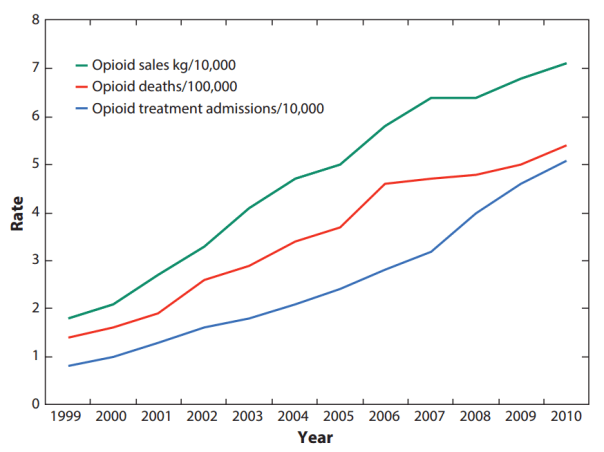 Like the alcohol corporations who mostly profit from abusers, the Sackler family made a lot more money from the Oxycontin addicts than from the median user so they had perverse incentives to create opportunities for abuse. The opioid epidemic made them into the 16th richest family in America by 2015 and that that wealth gave them tremendous political power through access to politicians and lobbying. I hope they use their power and influence wisely.
Although total opioid prescriptions peaked in 2010 and have been falling ever since, German Lopez writes that they are still a big problem:
In 2016, there were enough pills prescribed to fill a bottle for every adult in the US. And in 2015, the amount of opioids prescribed per person was more than triple what it was in 1999, according to the CDC.
Lopez elaborates that:
A forecast by STAT concluded that as many as 650,000 people will die over the next 10 years from opioid overdoses — more than the entire city of Baltimore. …As Stanford drug policy expert Keith Humphreys previously noted, “Consider the amount of standard daily doses of opioids consumed in Japan. And then double it. And then double it again. And then double it again. And then double it again. And then double it a fifth time. That would make Japan No. 2 in the world, behind the United States.”
The profit motive makes it extraordinarily tempting for sellers of addictive substances to engineer ways to get more people addicted because the Pareto principle shows that that is where at least 80% of the profits are and drug pushers are addicted to profits which can cause them to lie to sell more drugs. As Kleiman told Annie Lowry:
…the legalization movement [has a] mantra about how [marijuana] is a harmless, natural, and non-addictive substance… And it’s a lie.”
Thousands of businesses, as well as local governments earning tax money off of sales, are now literally invested in that lie. “The liquor companies are salivating,” Matt Karnes of GreenWave Advisors told me. “They can’t wait to come in full force.” He added that Big Pharma was targeting the medical market, with Wall Street, Silicon Valley, food businesses, and tobacco companies aiming at the recreational market.
Already in Washington State, after legalizing medical marijuana, 80% of total consumption is by daily or near daily users, so the vast majority of the industry’s profits come from people who either have a substance abuse problem or are heading towards one.










 Medianism