
Updated December 14, 2019
Here are three views of the Chicago skyline. The top photo is a rare day with high air pollution in the 1990s, but that was a typical scene in the 1970s and the third is how Chicago looks today:

All big American cities used to have a reputation for being very polluted because they used to be very, very dirty and Chicago in 1970 probably wasn’t even the worst. Here is an actual 1973 photo of the Clark Avenue Bridge in Cleveland. This was one of the major Cleveland bridges over the heavily polluted Cuyahoga River near downtown. (This bridge was torn down and today the site is near the Interstate 490 bridge.)

And another photo

That picture is so grey, it is shocking that it is a true-color photo! It is hard to tell there was any color in that world because the pollution made everything look black and white, but there is a red stoplight barely visible through the haze in the middle of the road.
In the early 1970s, it was completely legal for anyone to spout any sort of toxic waste into America’s air. Below is a 1972 photo of smoke from burning lead-acid car batteries in Houston to extract the lead for recycling. The lead (a potent neuro-toxin) in the batteries is bathed in sulfuric acid (also inherently toxic) and this witch’s brew is encased in the thick plastic battery exterior which produces carcinogenic dioxin when burned. A leaking battery is toxic enough, so burning car battery is extremely toxic which is why this kind of business was banned shortly after this photo was taken. Now Americans have to pay a deposit when buying a lead-acid car battery to give a financial incentive to bring used batteries back for safe recycling.

There was also unlimited freedom for anyone to dump any sort of toxic waste in our lakes and rivers. Here is a photo of Cleveland’s 1953 Cuyahoga river fire. The river caught fire in a major way at least 13 times. The last fire was in 1969 which had flames reportedly reaching five stories high. News reports about that fire went viral nationwide and helped inspire the establishment of the Environmental Protection Agency in 1970 and the Clean Water Act in 1972.

Americans had been so accustomed to rivers being choked with pollution that the idea of rivers catching fire hadn’t even seem newsworthy before the 1960s. This sort of thing never made national news before 1969 because it was just boring, local news. For example the 1952 fire pictured here was one of the most damaging river fires and an earlier fire is said to have taken three days to put out but those fires weren’t newsworthy outside of the neighborhood in Cleveland because they were so routine. It was no more newsworthy outside of the neighborhood for the Cuyahoga river to catch fire than for a business to catch fire today. It was just a normal part of industrial pollution in cities across America.
American pollution had been growing imperceptibly slowly month by month without anyone noticing that there was a problem until there was a sudden awakening of the environmental movement in America. Practically nobody cared about how much lead pollution was dumped in our air and water in the 1950s, but that suddenly began to change. Today Americans freak out when a miss-judgement of our government officials causes even just slightly raised lead levels in the drinking water of any of our cities (like Flint Michigan). Whereas Americans used to believe that everyone should have the freedom to pump toxins into the air, Americans now believe that we should have the freedom from being poisoned by our factories. Lead pollution is now a crime.
Today, due to EPA regulations, fish live in the Cuyahoga River again. The EPA recently announced that enough toxins have washed out or stabilized that it is finally safe to eat limited quantities of fish from the river without poisoning yourself if you can get over the yuck factor embedded in the river’s history and sediments.
For all of human history until the mid 20th century, cities had always been sick, dirty places where average life expectancy was lower than in the countryside, but when cities started regulating pollution, urban life expectancy improved rapidly and today city dwellers tend to have longer life expectancy than rural people in rich countries around the world. This history should give us some optimism about our capacity to deal with future environmental problems.
(For more, Andrew Small wrote a fantastic history at CitiLab about how the EPA radically transformed life in American cities and led to their renaissance. One egregious story is about the Hooker Chemical Company that buried toxic waste in the Love Canal neighborhood of Niagara Falls, New York, covered it with a thin layer of clay and sold the toxic timebomb to the school board which built elementary schools on it and about a thousand homes. The toxic waste started seeping out after a few years and caused death, illness, and malformed babies until the EPA spent $400million on clean up the mess.)
Most people think that economic development inevitably brings pollution as a necessary byproduct and there is some truth to that, particularly for poor nations, but economic development also makes people richer which causes them to want to live in cleaner, healthier places and richer people can afford to spend money to achieve that.
The relationship between economic development and pollution is often called the environmental Kuznets Curve. Although the curve in the graph below is less clear for the US than for France and Germany, sulfur pollution rose with industrialization in all these countries until the advent of the environmental movement in the 1970s and then they all began regulating their air quality which rapidly brought pollution back down again. The United States is a bit of a “pollution haven” in comparison with most other rich countries like France and Germany, but at least pollution has been getting better in the US than it used to be here.

Although the Kuznets Curve idea has validity for most of the visibly obnoxious local pollutants like brown, smelly air and rivers that catch fire, there is no evidence that it applies for other environmental problems that aren’t immediately visible in the urban areas where most environmentalists live such as species extinction and global warming. For these problems, so far economic development has just made them worse. For example, CO2 emissions tend to rise with income.

The reason why CO2 emissions haven’t followed the Kuznets Curve so far is due to political will. Although Americans are passionate about preventing our rivers from catching fire and avoiding smog and brown skies in our cities where American elites like to hang out, we just aren’t as passionate about global warming (yet) so we have not made as many efforts to stop the emissions of greenhouse gasses as we have made to reduce noxious-smelling pollutants like sulfur dioxide.
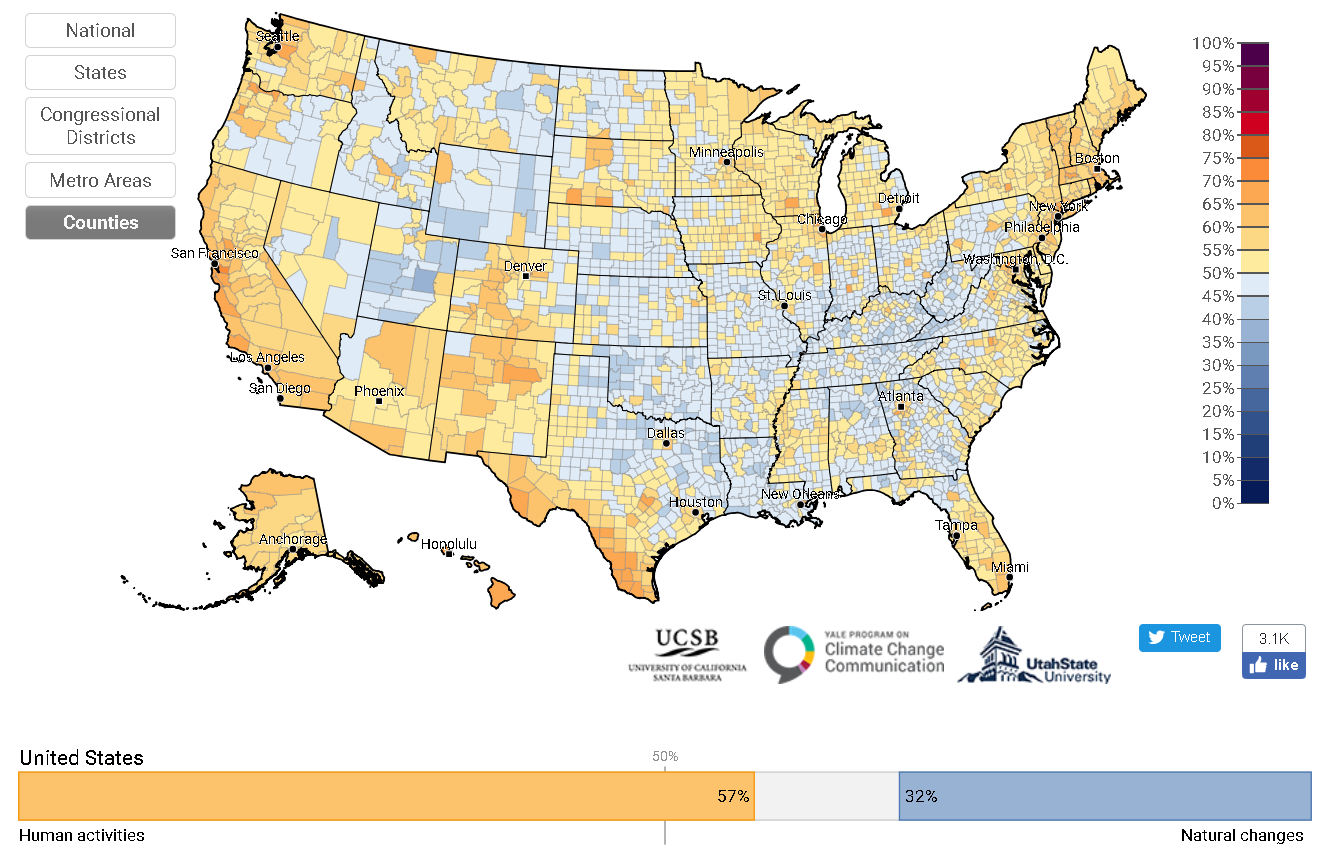
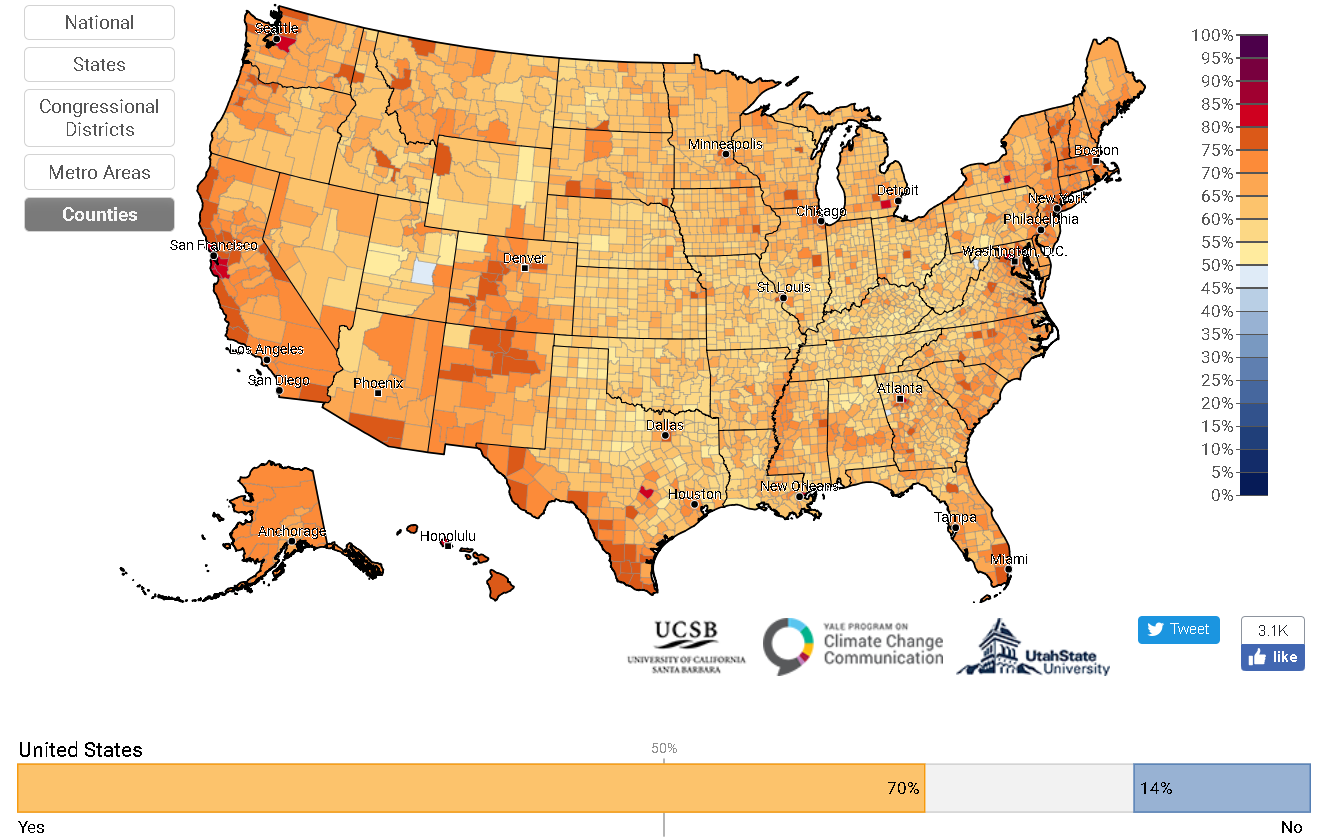
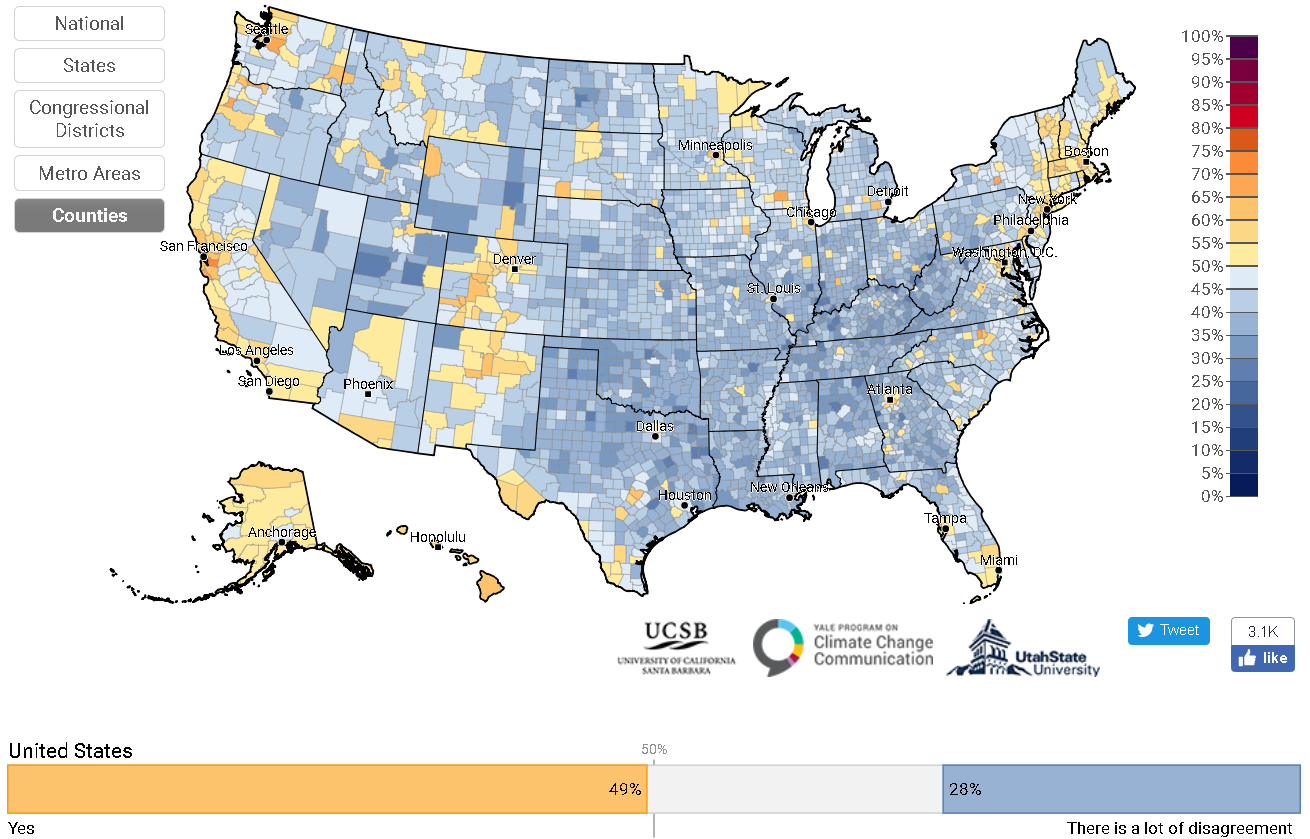
But most Americans do worry about global warming and have been concerned for decades:

So the problem of inaction is NOT that the majority of Americans don’t care about global warming. Although polling is never perfectly accurate, many other polling agencies have found the same thing. Furthermore, they show that a majority of both Republicans and Democrats currently agree that global warming is a problem we need to address. This is one of the rare areas of broad, bipartisan agreement at the grassroots level of politics in an increasingly politically divided America.

Although there is a surprisingly large minority of Americans who distrust science and believe (like Donald Trump) that climate change is a conspiracy, at least a slight majority of Americans have always trusted the scientific consensus.
Republicans are unfairly stereotyped as not caring about global warming and it is true that most Republican national political leaders are climate change skeptics, but the majority of Republicans at the grassroots agree with the vast majority of Democrats on this issue. Here is another poll:

More recent polls show that a majority of Republicans in nearly every congressional district support policies to mitigate climate change and an overwhelming 74% want more funding for renewable energy research.

So the real question is, if the majority of Americans of both parties are worried about global warming and want to reduce carbon emissions, why don’t our political leaders listen to popular will and take action? This is particularly true of elite Republican politicians who actively fight to block action, but elite Democratic politicians also make big talk about fighting climate change without actually doing much of anything.
For example, President Obama talked a lot about global warming during his first year in office when Democrats controlled the presidency, House and Senate. They controlled all branches of the federal government except the Supreme Court, but Obama did not take action on the issue. Instead Obama prioritized economic stimulus programs first and then healthcare reform took up most of the Democrats’ attention for over a year. By the time they got around to start working on climate change, the Republican party had taken over control of the House and not much gets done in Washington when there is divided government nowadays.
The fact that American political party elites have become so ideologically sorted into opposing camps on the issue of global warming is an odd quirk of American politics that isn’t shared in any other democracy in the world. In other democracies, the major political parties agree that global warming is happening and that there is a need to take action.
It is also odd that the American fossil fuel industry has overwhelmingly thrown its lot in with only one party. Most industry lobbies try to buy both parties fairly equally so they can have influence regardless of which party is in control, and that was true of the fossil fuel companies for most of history until the mid 1990s when the fossil fuel industry began increasingly focusing donations mostly towards the Republican party.

This sort of ideological sorting often happens with culture-war social issues like abortion, guns, and gay marriage, but business lobbies usually avoid culture-war issues and try to buy allies on both sides of the political spectrum so they can have influence regardless of who is in control of Washington.
The American partisan divide over fossil fuels is also a fairly recent phenomenon that follows the money. The leaders of the Republican Party were speaking out about fighting climate change from the 1980s through John McCain’s 2008 presidential campaign. As Chris Hayes explains:
…During the 1988 vice-presidential debate, Dan Quayle argued that “the greenhouse effect is an important environmental issue. It’s important for us to get the data in, to see what alternatives we have to the fossil fuels…. We need to get on with it, and in a George Bush administration, you can bet that we will.”
That wasn’t quite the case, but in 1989, Newt Gingrich was one of twenty-five Republican co-sponsors of the Global Warming Prevention Act, which held that “the Earth’s atmosphere is being changed at an unprecedented rate by pollutants resulting from human activities, inefficient and wasteful fossil fuel use, and the effects of rapid population growth in many regions” and that “increasing the nation’s and world’s reliance on ecologically sustainable solar and renewable resources…is a significant long-term solution to reducing fossil-generated carbon dioxide and other pollutants.” In 1990, President George H.W. Bush said at an IPCC event, “We all know that human activities are changing the atmosphere in unexpected and in unprecedented ways.”
While his son did little to curb carbon emissions when he took his turn at the presidency, he did at least give it lip service. Speaking ahead of the 2005 G8 Summit, George W. Bush said, “It’s now recognized that the surface of the earth is warmer, and that an increase in greenhouse gases caused by humans is contributing to the problem.” As part of the 2007 Energy Independence and Security Act he signed into law, minimum efficiency requirements [would] begin to phase out the use of incandescent bulbs in 2012. (A law that would, in the Obama era, become a top [Tea Party] target, as the Tea Party rallied to support the incandescent bulb as if it were a constitutionally enshrined right.)
And in 2008, somewhat miraculously, John McCain’s platform featured support for a cap-and-trade bill that would have effectively put a price on carbon. But even by that year, you could already feel a seismic shift in the rhetoric. I sat in the Xcel Energy Center in St. Paul in 2008 and watched Sarah Palin lead thousands of people in a thunderous chant of “Drill, baby, drill!”
After Obama’s election, things moved quickly: McCain dropped support for his own legislation to regulate carbon pollution. In 2010, Bob Inglis, a conservative congressman from South Carolina, was soundly defeated by a Tea Party challenger in the Republican primary, due chiefly to Inglis’s refusal to deny the science on climate change. A year later, Gingrich called his appearance alongside Nancy Pelosi in a 2008 ad urging action on climate change the “dumbest single thing I’ve done in years,” recanting his acceptance of the science and embracing denialism. He was not alone—in fact, outright denialism is now more or less the official Republican line. In 2011, and again in January of this year, Republicans on the House Energy and Commerce Committee voted to block the EPA from regulating carbon emissions and against amendments that would acknowledge that climate change is, in fact, happening.
Hopefully America’s partisan political leaders will be able to return to our former bipartisan consensus about the dangers of climate change again soon because conservation is fundamentally a conservative idea and burning up our resources is a gamble. Risking that we won’t have future problems with climate change is not conservative. It is libertine. So it is odd that the liberals are not chanting “burn baby burn”.
(Bipartisan note: Although the elites at the top of the Republican Party have allied themselves with fossil fuel interests in recent years, that wasn’t the case until recently and Democratic Party elites have always been in hock to various powerful interests too. For example, organized labor always favors more liberal parties and a particularly embarrassing alignment of US Democratic Party elites is their consistent relationship of support with trial lawyers over the decades. It is hard to be less popular than fossil fuel barons, but lawyers are about the least popular occupation so the Democrats have politically embarrassing alliances too.)
Although the majority of both Republicans and Democrats believe in global warming, the biggest political problem (as explained below) is that most people in both parties don’t care enough to make any sacrifices now and they are more concerned about other issues like the economy, terrorism, immigration, or healthcare. So politicians of both parties focus on higher-priority issues. That is a bipartisan problem. When most voters don’t care enough to make it a top reason to vote whereas a small minority cares a lot (fossil fuel industry supporters), the small passionate group tends to dominate political battles over the majority in a democracy. This is particularly true in a democracy like America’s which is so dominated by moneyed interests.
How much of global warming is your fault versus the fault of large corporations?
According to the 2017 IPCC report, just 25 multinational corporations accounted for half of all global emissions of greenhouse gases so although you probably buy products from these corporations and thereby bear some responsibility, you don’t deserve nearly as much blame as the people who have gotten rich by controlling these companies.
|
% of global emissions 1988-2017 |
|
|
25 worst corporations→ |
50% |
|
100 worst corporations→ |
71% |
Only a few dozen global corporations are responsible for such a large amount of greenhouse gasses because fossil fuel corporations comprise a disproportionate share of the world’s largest corporations. And many of the rest of the world’s biggest corporations are in industries that indirectly rely on fossil fuel consumption such as automobile production. The table below shows that the majority of the 18 biggest corporations in the world (measured in 2018 revenues) are corporations that produce fossil fuel or directly depend on fossil fuel consumption to sustain their entire business model.
|
1 |
Retail |
$514,405 |
|
|
2 |
Oil and gas |
$414,649 |
|
|
3 |
Oil and gas |
$396,556 |
|
|
4 |
Oil and gas |
$392,976 |
|
|
5 |
Electricity |
$387,056 |
|
|
6 |
Oil and gas |
$355,905 |
|
|
7 |
Oil and gas |
$303,738 |
|
|
8 |
Oil and gas |
$290,212 |
|
|
9 |
Automotive |
$278,341 |
|
|
10 |
Automotive |
$272,612 |
This ranking uses revenues, but these firms are also highly profitable. Saudi Aramco was by far the world’s most profitable company in 2018.
Those are the ten biggest companies in the world, but there is a whole lot more money in the thousands of smaller fossil fuel companies too. Even relatively small fossil-fuel companies that most people have never heard of, like Koch Industries, are run by billionaires and the political expenditures of Bill Koch alone has had a big effect on American environmental policy.
If America started a modest carbon tax of $20 per ton, the nonpartisan Tax Policy Center estimates that the hardest-hit quintile of Americans would only pay about 0.8% of their income and eighty percent of Americans would pay less. This is miniscule in comparison to what we pay in the rest of our taxes. in 2016 according to the Peterson Foundation the median-income quintile paid 13.5% of income in federal taxes alone. So it would be easy to prevent a carbon tax from raising taxes at all for most Americans. We could just cut payroll taxes by an equivalent amount since revenues would be coming in from the carbon tax instead.
A carbon tax would not hurt American consumers much because burning carbon isn’t a big part of our budgets and many of us would avoid the tax by switching to renewable electricity and electric cars. But there are one hundred rich corporations that account for 71% of global carbon emissions and they would be hit very hard by a carbon tax because that industry can’t avoid losing millions of millions of dollars each year. Sure they would pass on some of the tax to consumers by charging higher prices, but most Americans wouldn’t pay much because we can avoid the tax through conservation and clean substitutes. By shifting to clean substitutes for fossil fuels, most people could avoid the brunt of the tax and that is why fossil fuel corporations would lose most of their income! So they have a big incentive to manipulate our political system and try to distort public information to get their way. This is a classic concentrated interest group problem.
A modest revenue-neutral carbon tax could increase most Americans’ disposable income
A revenue-neutral tax increase is one that is exactly offset by reductions in other taxes or by tax rebates–checks sent to Americans in compensation for the tax increase. This is the plan supported by the largest public statement of economists (including myself) in history. The carbon tax revenues could be perfectly offset by reducing the tax burden from the payroll tax which is by far the biggest part of the tax burden on the median-income American or by sending every American a check for the average amount of the tax revenues. Then only people who burn more carbon than average would be hurt (which tends to be people who are richer than average) and people who burn less would get a net benefit from the carbon tax.
The people who would pay the biggest price by far are the people in the fossil fuel industry and because they would pay a lot more than average, most Americans would get a net financial benefit. Plus, a carbon tax would be more efficient than the payroll tax because the carbon tax discourages pollution whereas the payroll tax discourages working. Thus, a revenue-neutral carbon tax could increase economic efficiency now, reduce inequality, and help save the planet’s future. Almost everyone wins!
Of course, this is based on a relatively modest carbon tax and if you wanted to rapidly reduce carbon more dramatically, it would require shared sacrifice by everyone (and most fossil fuel companies would be completely destroyed), but we gotta start somewhere and some baby steps like a modest carbon tax could be implemented without any sacrifice by most Americans.
But even a modest carbon tax and rebate that benefits most Americans would be catastrophic for the profits of the 50 corporations that emit half of the world’s emissions. They would pay an enormous amount. It is impossible to reduce greenhouse gasses without hurting them.
So a small group of rich fossil fuel interests would pay most of the costs whereas the benefits would be more diffuse. In addition to a healthier, more productive planet that benefits everyone, there are also some some concentrated interest groups in the form of about 106 clean energy corporations worth about $220 billion according to Bloomberg that would directly profit from higher demand for their products.
Which side of the debate has more power?
So most taxpayers would see little change in their overall tax burden and would see benefits from a healthier planet and a bunch of small alternative energy corporations would see their profits skyrocket whereas the main costs would be borne by a few enormous fossil fuel companies. Worldwide in 2014 there were about 1,469 private fossil fuel corporations worth about $4,650 billion (plus some enormous government-run fossil fuel producers that aren’t included in this accounting.) The main cost at stake in the climate debate is estimated to be worth over $4 trillion to those private corporations. How much is $4 trillion? Imagine a pile of a million dollars. A stack of $100 bills worth $1 million would be 3.5 feet high and weigh 22 pounds. Now imagine a million piles of a million dollars. Now multiply that times four and you have the $4 trillion that is at stake. A stack of $100 bills worth $4 trillion would be 2,520 miles high. That is a lot of money that the fossil fuel corporations have at stake in the climate change debate. In addition there would also be costs to other industries like the automobile corporations that would have to completely reinvent their businesses to produce electric vehicles.
Most people’s long-run wealth could be made richer by an optimal carbon tax, especially young people who will see the most future benefits. Globally we are subsidizing the fossil fuel industry to the tune of at least $540 billion (because the industry is skilled at bribing politicians to get favors), so just eliminating the government subsidies would save the rest of us a lot of money. A carbon tax would raise additional government revenues that could be used to reduce income/payroll taxes that burden ordinary American workers. It is unlikely that a carbon tax could be implemented optimally, but even a poorly designed carbon tax could be implemented in a way that still benefited the majority of Americans. Only the small minority of Americans who get most of their income from the fossil fuel industry would find it costly. It would be extremely costly for them, especially the wealthy elites who control most of the capital in the industry.
So there are two sides to the global warming debate. One side thinks it is a real problem that we should at least start to do something about and the other side that wants to ignore the issue and burn unlimited fossil fuels. Which side do you trust more?

Which side has more power? Although the side that wants to fight climate change has a lot more American people than the pro-fossil-fuel side of the debate, the fossil fuel industry has a LOT more money to spend and so far the money has been winning.
Fossil-fuel industry supporters like former Senator Rick Santorum like to claim that climate science is corrupt because, “a lot of these [climate] scientists are driven by the money that they receive.” But most scientists are incentivized for producing convincing results and are not paid more for supporting a particular ideology and the more important question is what ideology has more funding backing it? Is there more money in climate science or climate denialism? There just aren’t any enormous global corporations that have an interest in exaggerating the risks of climate change whereas the fossil fuel industries (and dependent industries like air transport) spend a LOT more money on lobbying than environmental organizations which also worry about water quality and whales and recycling and national parks and many other concerns:
|
|
2019 Total |
|
|
1 |
$228,149,734 |
|
|
2 |
$119,190,792 |
|
|
3 |
$117,358,812 |
|
|
4 |
$92,244,920 |
|
|
5 |
$88,428,527 |
|
|
6 |
$86,149,006 |
|
|
7 |
$79,143,595 |
|
|
… |
|
|
|
? |
Environmental Organizations (Most of which do not focus on climate change at all.) |
$14,400,000 |
And that is just the money that we can track because it is used for political influence in ways that require public disclosure. The money we can track may just be the tip of the iceberg now that Citizen’s United made it easier for corporations to influence America’s political system without accountability. Dark money has been pouring in and political influence is being bought. Plus, fossil fuel companies also spend hundreds of millions more on PR efforts, media campaigns, school programs, and hiring a few climate scientists who are willing to publish a little climate skepticism to sow doubt.
It is a good idea to follow the money and see where it leads. Given the trillions of dollars that the fossil fuel industry has at stake and the fact that this is an extremely wealthy industry, they could easily find the spare change to hire all the climate scientists in the world to change the scientific consensus, but they haven’t. Why not? They hire a huge percentage of all PhD geologists. Perhaps one reason geologists seem to be more likely to be climate skeptics than other scientific disciplines is that the fossil fuel industry is their dominant employer. But even in geology, the climate skeptics are a small minority.
I work in economics and I have seen private money pour into economic debates. Wealthy interest groups hire lots of economists to research issues at think tanks and interest groups pay grants to academic researchers at universities to direct their research in particular directions. When it is possible to fund scientific research that would be profitable for corporations, they are happy to fund it lavishly. Similarly, industry money has tried to corrupt public health research in order to promote the sale of sugar and patented opioids and tobacco.
Below is a photo of the heads of the big American tobacco companies swearing in before the US Congress in 1994. Even after decades of research showing the adverse health effects of tobacco, they were still testifying under oath that the basic science is wrong!
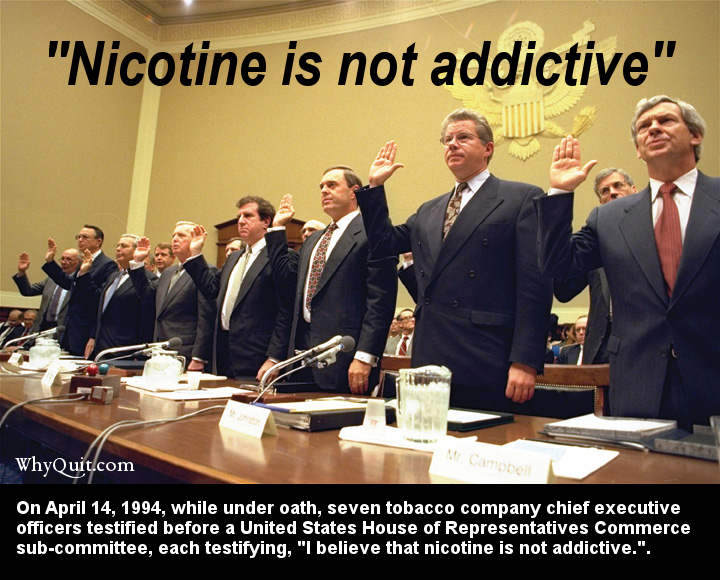
The fossil fuel industry has a lot more money than the tobacco industry and if you track the vast amount of money that the fossil fuel industry spends on influence, you’ll see that they give a lot directly to politicians plus a lot more to PR efforts in schools and the media, but very little money on actual climate science research. This fact is why I came to believe that the global warming skeptics don’t have a scientific case to be made. If you follow the influence money, it is clear that one of the world’s wealthiest industries completely gave up on the scientific debate decades ago. Ironically, Exxon-Mobile climate scientists pioneered discoveries of global warming back in the 1970s and later tried to bury their own research.
Although the industry pays a few individual scientists to research climate change, they don’t aim it at convincing scientists but instead mostly just use it in their PR effort to help create the impression in the media that there are “two sides” to the scientific debate. They mostly pay scientists to critique and criticize other scientists’ work rather than do any actual primary research on the climate. They haven’t funded any academic conferences of climate skeptics nor academic journals for alternative climate scientists. This is odd to me as an economist because it doesn’t take much money to establish these sorts of scientific institutions and there are lots of think tanks, journals, and conferences that all sorts of wealthy interests have established in economics to support widely divergent perspectives about how the economy works.
In climate science, the fossil fuel industry isn’t even trying to convince the scholars. All the institutes, journals, schools, academic societies and conferences are dominated by scientists who say climate change is real and who are simply debating how bad they think it will get. On the climate skeptic side there are individual scientists but they have not bothered to join together to create any of the organizational infrastructure that would be necessary to succeed in a competitive intellectual marketplace. It is as if the fossil fuel industry knows the evidence in support of climate change is so overwhelming that they have given up any attempt to fool the scientists they have not already bought. But it is easier to fool the general public and the politicians have the real power so the industry has decided that it is more cost effective to buy politicians rather than scientists.
The oil and gas industry plus the coal industry have together been spending between $125 million and $190 million on documented lobbying every year for for the past decade plus dark money we cannot track and even larger donations for public relations campaigns to influence public opinion and create doubts about climate change among the public. One study estimated that advocacy groups that promote climate skepticism got an average of $900 million per year in the 2000s. That could have paid for a lot of science!
One way their PR campaign manipulates the American media is by paying for climate skeptics who advance the narrative that there are “two sides” to the climate science. The news shows oblige by showing doubters along with consensus scientists because journalists like to appear balanced with presenting two sides of any contentious issue. This is a bit like a news program giving equal time to the view that the earth is flat and the view that the earth is round.
In reality, “97% of climate scientists have concluded that human-caused climate change is happening” and a lot of the other 3% are either unsure (and a lot of scientists have a natural skepticism) or are funded by the fossil fuel industries. All the major scientific bodies agree.
This is an amazing amount of consensus when you consider the fractious culture of science. Scientists are famous for doubting each other and probing each others’ work. When scientists name the people they admire most in all of history, they don’t name rich and powerful people. They name great scientists who showed why everyone else was wrong and revolutionized how people understand the world. Most scientists would secretly love to be able to discover a truth that has eluded everyone else and the natural skepticism that attracts people to science also makes many of them question consensus whenever there is any possibility that the consensus is wrong.
The real center of the climate science debate is arguing about how bad it will get. I have met a lot more climate scientists who think global warming will result in hundreds of millions of human deaths than who doubt whether it is happening, but you almost never see the news present the climate debate as one about whether it will merely cost future generations trillions of dollars or whether it will cause the earth to become uninhabitable. This is closer to the real center of the debate among actual climate scientists, but the public almost never hears about this, the real climate science debate.
A lobbying case study
In 2018 there were several small ballot initiatives that would have hurt Big Carbon companies a little bit and they all lost except one. That one passed because it was relatively trivial and it was supported by another long-established state industry lobby that wanted to protect the salmon industry rather than to protect the global climate.

If you follow the influence money you immediately see that it simply isn’t a fair fight. The Washington State ballot initiative was the by far most expensive ballot initiative of any sort in Washington history and probably the most expensive climate change fight in American history. Here are the top donors who opposed it:

They are all fossil fuel companies and all of them are based outside of Washington State except for one. The Washington State tax would have had a trivial effect on most of them since only a small amount of their business is done in Washington State, but they were willing to invest millions of dollars nonetheless.
Below are the top donors on the other side, in favor of the Washington State carbon tax. Which group of donors do you trust more?

These proponents of the carbon tax were mostly Washington residents plus a few out-of-state environmentalists.
The fossil fuel industry blanketed Washington’s media with propaganda about how devastating a carbon tax would be and scared voters into rejecting the initiative. This kind of propaganda effort is sometimes compared with the disinformation campaign that the tobacco industry used to do to try to convince Americans that tobacco is healthy and cast doubt on the scientists who were coming to the consensus that it causes cancer and other illnesses. The fossil fuel industry has many times more revenues available than the tobacco industry and whereas the tobacco industry has remained extremely profitable even after they lost the PR effort over the science of the harms of tobacco, for the fossil fuel industry, this issue is an existential battle. They will be utterly destroyed if they lose.
That is why the fossil fuel industry spends 10 to 30 times more money on lobbying than the renewable energy sector and environmental organizations combined according to research by Robert J. Brulle.

Mancur Olson’s theory of political economy
In Mancur Olson’s theory of political economy, a minority group like oil producers can conspire to rob resources from the majority of the people even in a democracy. For example suppose there is a country with 10,000,000 people and a special interest group of 1,000 oil-corporation owners. If the oil owners can conspire to get a subsidy worth $5 on average from each person in the country, it will be worth $50,000,000 in total and if the oil owners divide it up equally, they will each get $50,000. So the oil owners have more financial incentive ($50,000) to lobby politicians in favor of the subsidy than the other voters will have to oppose it ($5 each).
The rational voter won’t care about the oil-industry subsidy because it only costs $5 per voter and literally hundreds of other issues are more important to each individual like healthcare, tax rates, unemployment insurance, abortion, policing, racial issues, gender issues, foreign policy, etc. But for the oil owners, the subsidy is probably their number one issue because probably none of the above issues are worth $50,000 per year.
Concentrated interest groups have additional advantage when you consider the transactions costs of organizing people together into a political coalition. Any organization of people requires resources for group communications (newsletters and mailings), pooling finances (fundraising and accounting for donations), and management (prioritizing activities and accounting for expenditures). Suppose it costs $10 per person to coordinate an interest group. That would make it impossible for the diffuse group of ordinary citizens to finance an interest-group lobby (because $10>$5) whereas the oil owners would still have $49,990 left to gain after paying for the transactions costs of managing their political coalition.
In addition, there is a learning curve for any political organization and enormous fixed costs in establishing and growing organizations. Any new industry is going to have a harder time organizing a coalition than an old, established industry that has been slowly investing in organizational capacity building and social capital within the group over many decades.
This gives the oil industry in the US another advantage over the new clean-energy industries. The oil industry first began in 1859 in America and the US was the world’s leading producer for most of history (although sometimes dropping as far as third place behind Saudi Arabia and/or Russia between 1976s and the present). The US oil companies developed economies of scale and technologies that enabled them to become the biggest oil multinational corporations producing oil around the world in other countries too. And American thirst for oil was even more extreme that our prodigious domestic production and American was the world’s biggest oil importer for most of the years between the mid 1970s and the present too.
This history means that oil companies in the US have more money than oil companies in all other nations and a longer history of working together as an industry and this has made the oil special interest group more politically formidable in the US than in any other democracy. This is why the US is the only democracy that joins with autocratic petrostates like Saudi Arabia and Russia to oppose international agreements that would reduce carbon emissions like the Paris Climate Accord which even the petrostates eventually joined and the US is the only government that has not (despite the fact that nearly 80% of Americans want the US to commit to the Paris Accord).
Politicians need votes but they also need money (especially in the American political system), so if there is an issue that the majority of voters don’t know or don’t care about and a small minority of voters cares so much about that they will vote solely based on this issue and more importantly, they will donate thousands of dollars to politicians, then the rational politician will quietly support a subsidy that takes money from the majority of people and transfers it to a wealthy minority.
The four keys for this to work are
- The minority has to be wealthy enough to be able to effectively bribe politicians. Wealthier people are always more powerful in any political system.
- The wealthy minority has to appeal to the apathy, ignorance, and/or affinity of the majority group. For the fossil fuel industry, they cannot rely on apathy in regards to the issue of climate change so they have to spend a lot of money on PR to keep enough of the majority ignorant or fearful of any efforts to slow down the growth of burning carbon to help the politicians they bribe resist the popular will.
- There cannot be another wealthy interest group that can fight back with equal power.
- Political-influence investments must be more profitable than other kinds of investments.
Michael Munger made the point that economists assume diminishing marginal productivity of investment in everything and at some point, the marginal productivity of investment in engineering, capital, or research and development will fall below the marginal productivity of investment in political corruption. Munger noted that mature industries have lower marginal productivity of investment in engineering than young, growing industries which means that mature industries like fossil fuels are more likely to spend money on political influence than new industries like solar energy.
The internet-technology sector is an example of a young, growing industry that has spent relatively little money on lobbying compared with more mature industries like the oil and gas and electric utility industries. According to Munger’s theory, companies like Microsoft generally spend little money on the political influence game partly because they have to stay focused on spending their resources engineering better products to keep up with competitors at other tech companies and so they prioritize that kind of productive investment. Oil companies have much worse prospects for increasing their productivity because as oil is gradually depleted, productivity inevitably drops over time, so they have more incentive to shift their invest dollars towards political influence instead. Karam Kang studied the profitability of the oil industry’s lobbying efforts in 2007-8 and found that it was wildly profitable with average returns from lobbying expenditures estimated to be over 130%.
This is why the fossil fuel industry has spent a lot of money on PR to manufacture political support for more burning and to sew doubt about environmental concerns. In nations with a bigger fossil fuel industry, like the US, the industry has more resources to buy political power and shape public opinion. Pew’s research below shows that in countries with bigger fossil fuel industries, concern about global warming is lower.

Although most Americans are worried about climate change, the level of concern is lower here than in all but a few nations such as China (which is now by far the biggest emitter of carbon gasses). One reason the US public is less concerned about climate change than most nations is undoubtedly the enormous economic power of the fossil fuel industry in shaping US public opinion. America’s fossil fuel industry simply has more resources (and a longer history) than in any other democracy.
There are also economies of scale in developing political power that take years of investment to build up the fixed cost infrastructure of influence. Older industries have an advantage simply because of having had more time to invest in lobbying organizations and media contacts that take time to develop. New money just isn’t as effective as the connections of the old money interests due to those past fixed cost investments in influence.
Concentrated media power also explains much of the divide within the Republican party over climate change. The Republican media ecosystem is split between the 40% who primarily get their news from Fox News versus the rest of Republicans who get news from a variety of other sources.

Fox News is staunchly opposed to alternative energy and promotes climate denialism. Fox News’ dominance over 40% of Republican voters helps explain much of the divide within the party over the issue of global warming according to Navigator Research which found that, “non-Fox News watching Republicans are twice as likely as other Republicans to believe in human-caused climate change.”

Is Mancur Olson’s theory of conspiracies just like other conspiracy theories?
Short answer: no.
Most conspiracy theories are ridiculous because they are unsupported by both evidence and theory. For example, consider the conspiracy theory promoted by top American politicians that climate scientists are engaged in a hoax paid for by the Chinese. There is no evidence that the Chinese government has paid any of our climate scientists and there is no plausible theory for why the Chinese would have a motive to do this. As mentioned above, China is the biggest greenhouse gas emitter in the world, so has the least reason to want to restrict greenhouse gasses. The Chinese government strictly censors all information (including the entire internet) in China in order to manipulate public opinion and they have achieved even more skepticism of global warming than we have in America. China and Russia and Saudi Arabia are among the very least likely nations to fund climate scientists to raise alarms about global warming. If their influence expenditures weren’t secret, we should expect to see them funding denialism.
This is a version of the common conspiracy theory is that climate scientists can make a lot of money by fabricating evidence for global warming, but this lacks evidence that scientists are fabricating evidence and it lacks evidence that anyone is paying them money for fabricated results and it even lacks evidence that there are big-money donors that have this kind of agenda. That is why the conspiracy theorists have had to make the ridiculous claim that China is funding it!
There isn’t any organized wealthy interest group that would have the motive to pay for fabricated research promoting the idea that global warming exists, but there IS an enormously wealthy interest group with a clear motive to finance the denialism. So theory strongly supports the idea that there should be industry money flowing to climate skeptics and it turns out that, unsurprisingly, the tiny fraction of climate researchers who support fossil-fuel-friendly ideas do get financial support from the fossil fuel industry. But the big money doesn’t go to scientists. Most of the money gets spent on lobbying like the political corruption that promoted bill HB6 to subsidize Ohio’s coal-fired utilities.
Scientists can certainly get things wrong, but that is usually due to intellectual fads and a conspiracy is different from a fad. A conspiracy theory requires a motive and a means in order to be plausible and we should also have evidence. Whenever seeking evidence, we should require more extraordinary evidence to accept more extraordinary claims. Given that there has never been an organized conspiracy among any large group of scientists to defraud the public, we should require extraordinary evidence to believe that climate scientists are currently engaged in such a conspiracy.
Another reason to require extraordinary evidence is when there are claims that large numbers of people are involved in a conspiracy over a long period of time. The more people are allegedly involved in a conspiracy and the more time there is, the greater the chance of someone leaking about the conspiracy, particularly if there isn’t anyone with a lot of power who can provide big incentives to keep everyone quiet. This is another factor against the alleged conspiracy of climate scientists. There are probably tens of thousands of climate scientists around the world and the scientific consensus about global warming began to develop at least a half century ago. It would take a miracle to keep all those people quiet about some sort of conspiracy.
My son’s Bluffton Middle School science teacher was teaching about the conspiracy theory that the moon landing was faked (which Fox News claims is almost as bad as the climate science conspiracy!) There simply isn’t any motive for the tens of thousands of NASA rank-and-file employees to conspire together to fake the moon landing just as there is no motive for scientists to fake evidence that the world is round. Plus, we trust these same people for their expertise in the operation of GPS, hurricane tracking, and the global air-traffic control system, so why wouldn’t we trust them that the earth is round or that the moon landing was real?
If scientists discovered a vast asteroid hurtling towards Earth, the conspiracy theorists would scream “hoax” and urge us to ignore it by claiming that asteroids don’t exist and scientists just are a big group of pranksters who just like to defraud the public for some reason. Belief that scientists are hoaxing us about climate change is similarly dangerous.
In contrast, it is easy to see evidence of the fossil fuel industry’s conspiracy to fight action about climate change if you simply follow the money. There is vast amounts of influence money they are spending that is in the public record. There is also plenty of dark money in politics that we cannot easily trace, but we don’t have to just rely on guesses about how much dark money they are using to conspire against climate science because some kinds of political spending must be recorded in public and even just that amount is already enormous.
There is also lobbying money being contributed by environmentalists in favor of taking action on climate change, but it is a pittance in comparison with the millions that the fossil fuel industry spends. Plus, most environmentalists like to take credit for donating to environmental causes so they don’t have much self-interest in hiding dark-money expenditures unlike the fossil-fuel billionaires who claim to be concerned about climate change but fund denialism. Environmental causes have popular support that is bipartisan at the grass-roots level which engenders openness and that openness makes it different from a conspiracy which only works for a small group of people because a conspiracy tries to avoid openness and publicity by definition and it is hard to get a large group of people to keep a secret. To put it crudely, environmentalist donors tend to like to boast about their contributions to their cause which makes it the opposite of a conspiracy. The fossil-fuel interests have more reason to be ashamed of their conspiratorial spending.
Scientists have fallen prey to intellectual delusions in the past. Could climate science be another mistake?
Yes anything is possible, but climate science is more robust than most of the science we rely upon every day in medicine and business and yet doctors and business people must use the best available information to inform what we do. The same is true of climate policy.
Widespread intellectual delusions are usually caused by inherited cultural myths and traditional practices and climate change is the opposite of that. In fact climate science has to battle our traditional cultural ideas about the climate because global warming is a much newer idea in the history of the world which only started to become widespread among some groups of scientists about 50 years ago.
Narrow intellectual delusions can also be a problem withing academic specialties because of the natural human tendency to engage in groupthink within a circle of friends and there are many examples of problems in science when a group of friendly intellectuals reinforces one anothers’ mistakes. This can happen in any social group that shares a common identity. It is commonly known as an intellectual fad.
But climate science is unlikely to be a narrow intellectual fad because it has a track record of over a half century and it spans multiple disciplines. Normally in science, even though scholars may not realize some of the intellectual fads within their own discipline, they feel free to critique the foibles of other disciplines. Physicists critique economics in the areas where the two disciplines have overlap and economists and anthropologists have savaged each others’ work. There is even a discipline of science studies which critiques all other scholarly disciplines.
Climate science is unlikely to be an intellectual fad because it is interdisciplinary and numerous kinds of scientists have found completely separate evidence that confirms the same basic story. There is evidence that is studied by geologists, atmospheric scientists, physicists, paleontologists, chemists, and many other specialties. They could all be wrong, but then we would have to abandon not just climatology, but vast swathes of the science that we rely upon for weather forecasts, satellite imagery, biology, and even engineering.
Financial markets believe the scientists
Even if you think that tens of thousands of climate scientists across the glob are conspiring to produce fake science, there are financial markets that track the climate and those markets make predictions that are very close to what the climate models are predicting. If you think you can do better at predicting climate change, you can make money betting against them. Since 1999, the Chicago Board of Trade has operated a market for utility companies to help them hedge their risks of an unusually hot summer (high electricity demand for air-conditioning) or an unusually cold winter (high demand for energy for heating). This futures market essentially allows speculators to bet on what the average temperatures in America will be in the future. It turns out that the financial markets’ predictions (green line) are extremely close to what the climate scientists predict (blue lines show two common models) which do a good job of predicting the actual weather (red and pink lines show two different measures).

According to a recent paper, the markets and the climate scientists have been in close agreement and they have both done a pretty good job predicting rising temperatures in America.
All the biggest fossil fuel companies SAY they agree with the climate scientists too!
At the same time as fossil fuel interests are lobbying to prevent action that would hurt their business, they publicly admit that climate change is real and we need to reduce carbon emissions to prevent bad outcomes. (Note: Feel free to skim over these quotations because they all say about the same thing–they all recognize that global warming is real and caused by carbon emissions and we have a duty to combat it.) Listed in the order of company size:
Climate change is a major global issue for all humankind. As a responsible energy and petrochemical company, Sinopec regards it as its due responsibility to fight against climate change… We are speeding up study on commercial test of CO2 recovering, in order to reduce GHG emissions and better prepare to combat climate change.
Shell Global’s climate change page:
The world needs to adapt to the extreme weather events linked to climate change, particularly flooding and water shortages caused by droughts… A key role for society – and for Shell – is to find ways to provide much more energy with less carbon dioxide.
Saudi Aramco’s climate initiative page:
We believe the key to combating climate change is to focus on reducing emissions as well as implementing abatement measures such as natural sinks that absorb CO2. Meeting global emissions reduction targets requires the prompt and coordinated action of governments, the business community, NGOs, and individuals to all play an active part in helping to curtail rising levels of green house gas emissions.
China National Petroleum Corporation:
Supporting the Paris Agreement and promoting carbon emission reduction in the oil and gas industry… actively supports and participates in the international communities’ efforts to address climate change.
Our strategy is… consistent with the climate goals of the Paris Agreement, which calls for the world to rapidly reduce greenhouse gas emissions
We believe that climate change risks warrant action and it’s going to take all of us — business, governments and consumers — to make meaningful progress… the company supports policies to limit climate change.
ExxonMoblie is notable for being a pioneer in global warming research, particularly in the 1970s and80’s. Their website boasts of the climate science they have discovered showing the effect of carbon on global warming:
ExxonMobil’s four decades of research in climate science has resulted in nearly 150 publicly available papers, including more than 50 peer-reviewed publications… Our scientists have participated in the U.N.’s Intergovernmental Panel on Climate Change since its inception in 1988… ExxonMobil scientists have been selected by the IPCC as authors of the past four major assessment reports, and National Research Council boards and committees covering global change.
We believe climate change is real and human activity contributes to it… We recognize the findings of the Intergovernmental Panel on Climate Change (IPCC) that the use of fossil fuels contributes to increases in global temperatures… We see the Paris Agreement as a step forward to meeting this global challenge.
If you didn’t know better, you would think that these statements were coming from GreenPeace or the Sierra Club. However, these fossil fuel corporations are hypocrites who have been funding efforts to stop action on climate change. ExxonMobil is notable for funding a global effort to promote denialism and prevent international actions, particularly in the 1990s and 2000s.
All the biggest oil companies SAY they accept the science, but it looks like it is greenwashing because most of them actually put their money into the opposite. They are funding efforts to promote doubt and fight any attempts to do anything about the climate.
Some companies like Valero and Marathon Petroleum boast about their efforts to reduce greenhouse gas emissions and discuss how they are planning to deal with the problems of climate change like rising sea levels and stronger storms that threaten their refineries, but they don’t explicitly say that they support any efforts to reduce greenhouse gasses unlike the biggest companies listed above.
I couldn’t find any oil company that is willing to publicly deny the science of climate change. The closest thing I could find was Koch Industries which simply avoids the topic altogether on their website while massively funding denialism efforts behind the scenes. (You can search their website for yourself using their search function or using Google’s site search function for “global warming” and “climate change.”) They never mention the topic, and they even manage to studiously avoid it on their “environmental performance” page, but they are also an outlier in that it is not a publicly-held corporation and so it does not have to be transparent with shareholders and doesn’t provide nearly as much public information of any kind.
The US defense department agrees with the climate scientists
As Abrahm Lustgarten wrote in the NYT:
In 2010… the U.S. Department of Defense’s Quadrennial Defense Review warned that climate change “could have significant geopolitical impacts,” contributing to poverty, starvation, drought and the spread of disease, all of which would “spur or exacerbate mass migration.” By 2014, the Defense Department had applied the term “threat multiplier” to climate change, describing how it would make many of the security establishment’s greatest nightmares even worse.
Those assessments were made under President Obama and the military’s concerns under President Trump have not changed.
It is difficult to get a man to understand something, when his salary depends upon his not understanding it.
Chris Hayes explains the existential desperation of the fossil fuel industry by comparing it with the political battle over the expropriation of slave wealth.
The leaders of slave power were fighting a movement of dispossession. The abolitionists told them that the property they owned must be forfeited, that all the wealth stored in the limbs and wombs of their property would be taken from them. Zeroed out… Today, we rightly recoil at the thought of tabulating slaves as property. It was precisely this ontological question—property or persons?—that the war was fought over. But suspend that moral revulsion for a moment and look at the numbers: Just how much money were the South’s slaves worth then? A commonly cited figure is $75 billion [in today’s money] … In order to get a true sense of how much wealth the South held in bondage, it makes far more sense to look at slavery in terms of the percentage of total economic value it represented at the time. And by that metric, it was colossal… According to calculations made by economic historian Gavin Wright, slaves represented nearly half the total wealth of the South on the eve of secession. “In 1860, slaves as property were worth more than all the banks, factories and railroads in the country put together,” civil war historian Eric Foner tells me. “Think what would happen if you liquidated the banks, factories and railroads with no compensation.” …The scientific consensus is that human civilization cannot survive in any recognizable form a temperature increase this century more than 2 degrees Celsius (3.6 degrees Fahrenheit). Given that we’ve already warmed the earth about 0.8 degrees Celsius, that means we have 1.2 degrees left—and some of that warming is already in motion. Given the relationship between carbon emissions and global average temperatures, that means we can release about 565 gigatons of carbon into the atmosphere by mid-century. Total. That’s all we get to emit if we hope to keep inhabiting the planet in a manner that resembles current conditions. Now here’s the terrifying part. The Carbon Tracker Initiative, a consortium of financial analysts and environmentalists, set out to tally the amount of carbon contained in the proven fossil fuel reserves of the world’s energy companies and major fossil fuel–producing countries. That is, the total amount of carbon we know is in the ground that we can, with present technology, extract, burn and put into the atmosphere. The number that the Carbon Tracker Initiative came up with is… 2,795 gigatons. Which means the total amount of known, proven extractable fossil fuel in the ground at this very moment is almost five times the amount we can safely burn. …the work of the climate movement is to find a way to force the powers that be, from the government of Saudi Arabia to the board and shareholders of ExxonMobil, to leave 80 percent of the carbon they have claims on in the ground. That stuff you own, that property you’re counting on and pricing into your stocks? You can’t have it. Given the fluctuations of fuel prices, it’s a bit tricky to put an exact price tag on how much money all that unexcavated carbon would be worth, but one financial analyst puts the price at somewhere in the ballpark of $20 trillion. So in order to preserve a roughly habitable planet, we somehow need to convince or coerce the world’s most profitable corporations and the nations that partner with them to walk away from $20 trillion of wealth. …It is almost always foolish to compare a modern political issue to slavery, because there’s nothing in American history that is slavery’s proper analogue. So before anyone misunderstands my point, let me be clear and state the obvious: there is absolutely no conceivable moral comparison between the enslavement of Africans and African-Americans and the burning of carbon to power our devices. …[but] when you consider the math …you must confront the fact that the climate justice movement is demanding that an existing set of political and economic interests be forced to say goodbye to trillions of dollars of wealth. It is impossible to point to any precedent other than abolition. …[We] have reason to be suspicious of the fossil fuel companies. …Globally, the industry spends $1.8 billion a day on exploration. As one longtime energy industry insider pointed out to me, fossil fuel companies are spending much more on exploring for new reserves than they are posting in profits.
In addition to spending billions on exploration, the energy industry is also spending several billion dollars a year on the political fight to stay alive and stave off carbon taxes. But at some point fossil-fuel profits will peak and decline either because we will run out of oil or because we will develop substitutes that are cheaper than oil. We are probably already close to peak oil production. Then the political power could suddenly change dramatically.
What other industries have profits at stake in climate change?
I’ve mainly just compared the mammoth petroleum lobby with the puny alternative energy lobby and environmental lobby, but lots of other industries are also impacted by climate change. In particular, the four big freight railroad companies in the US have spent at least tens of millions of dollars over three decades to fight climate science. They paid people to engage in dishonest tricks like forging fraudulent letters to representatives. America’s railroads love coal because it is nearly a third of their total tonnage. Unions support fossil-fuels because the industry is much more unionized than alternative energy firms. The animal husbandry industry produces about 14% of greenhouse gasses, so the meat industry also spends millions of dollars to stop climate legislation.
McKenzie Funk investigated the business models of the global insurance industry, engineering firms, financial firms, and even the private prison industry and he found that all of those industries are betting that they can make more profit from a bleak climate future than they would make without it. As Funk documents in his Ted Talk, many businesses are thinking crisis = opportunity in planning for global warming. There are many businesses whose profit depends upon human misery.
Outside of electric cars, alternative energy, (and nuclear) there just aren’t many other major industries that think it would be profitable for them personally to avoid climate change. Even though most companies may lose some future profits from global warming, they don’t have enough financial interest in the issue to do anything now because all for-profit firms have a high discount rate and so they just don’t do the kind of long-run thinking that is required for mitigating climate change.
On the other hand, fossil fuel companies have a big incentive to prevent actions that could hurt their profits NOW. The alternative energy companies also fight against them to get legislation that could help their profits NOW, but all the other industries don’t care because the main costs are more than 20 years in the FUTURE and for-profit companies just don’t care about the future beyond about 20 years from now because their discount rate is too high to care about that far into the future. Most CEOs are more focused on quarterly profits than on what happens in two decades.
Can private business solve the problem?
Fortunately most of the people who run corporations are at least concerned enough to start talking about fighting global warming. Already in 2006, “87% of the Financial Times Global 500 companies [saw] climate change as posing some kind of risk to their company.” For example, Price Waterhouse Cooper celebrates the Transform to Net Zero initiative and the One World Alliance of airlines says they are committed to net zero by 2050. Amazon and Verizon are promoting The Climate Pledge to achieve net zero by 2040. The US Chamber of Commerce, the biggest US business lobby, abruptly reversed course in 2009 due to a pair of pranksters who embarrassed them and has been in favor of cutting greenhouse gasses ever since. Natural Capital Partners estimates that nearly a quarter of the world’s 500 biggest corporations have made a public pledge to reduce carbon output by 2030. In 2020, CDP listed 278 multinational corporations on their A-list of companies that are already working to fight climate change. Companies like Mercedes-Benz AG, Microsoft Corp., NIKE, Inc., Starbucks, Unilever, American Airlines, and many more are all committing to reduce their greenhouse emissions to zero despite the costs to shareholders.
But it costs almost nothing for the pencil pushers at an accounting firm like Price Waterhouse Cooper to go net zero and remain profitable. That doesn’t really do anything solve the real problem. It just helps them feel self-satisfied that they are harming the planet a little bit less than in the past. To really solve the problem will require investment in the transition to green energy and nobody is putting serious money into it. For example, venture capitalists invested much more money in climate-destroying cryptocurrency companies than in clean energy!
Venture capitalists, once cheerleaders of green energy, are more infatuated with cryptocurrencies and start-ups that deliver groceries and beer within minutes… even as the world faces the risks of climate change, money is flooding into less urgent developments in cryptocurrency, the so-called metaverse and the digital art collections sold as NFTs. Last year, venture capitalists invested $11.9 billion in renewable energy globally, compared with $30.1 billion in cryptocurrency and blockchain… Of the $106 billion invested by venture capitalists in European start-ups last year, just 4 percent went into energy investments, according to PitchBook.
The 2nd biggest political problem preventing climate action after fossil-fuel lobbyists is that most of us care but only a tiny bit.
Most voters, both Republicans and Democrats, believe in climate change. Most political leaders have said they believe in it at one time or another including President Trump. All the big oil companies publicly say that they believe in it (even though many simultaneously pour billions of dollars into efforts sewing doubts and confusion). The financial markets believe it. The military believes it. The insurance industry believes it. The scientists believe it.
Fighting climate change is politically popular among both the Republican and Democratic grass roots, so without the influence money the fossil fuel lobby spends, we would undoubtedly make a more progress, but possibly not that much because most Americans don’t care that much about climate change. In particular, most Americans don’t want to sacrifice much to solve climate change. They want to fight it, but only if it doesn’t cost much. Although about 57% of Americans would be willing to pay $1/month to combat climate change, less than 40% of Americans would be willing to sacrifice $10 per month.
The big reason we haven’t done much to tackle climate change is not just the fault of well-paid fossil fuel activists, but also the fault of the silent majority of inactivists. Climate apathy dominates on both the left and the right.
Conservatives may be less interested in gas taxes than progressives, but progressives also dislike carbon taxes because that is regressive and progressives fear the expanded use of nuclear power. The Obama administration did not prioritize climate change. It took a backseat to his economic stimulus plan and then his bid for universal health care. Bernie Sanders doesn’t prioritize it either. He probably talks more about free college than expensive carbon. Most Americans care, but not very much and that inactivism is the real political impediment rather than the knowledge of the science.
Last, but not least, if we want to get the fossil fuel industry to stop sabotaging our efforts to address climate change, it might require us to essentially bribe them into cooperating because it is almost impossible to get something done in America’s political system when so much money and lobbying opposes action. Similarly, when slavery was abolished, in most nations the slave owners were paid for the cost of freeing each former slave. It is distasteful, but sometimes it is politically easier to pay off powerful people to get them to stop doing bad things. The history of emancipation in America supports this rule. America did not pay slave owners to release their slaves. Instead we fought a civil war which cost well over three times the total value of all slaves in additional to the tragic loss of life. It would have been much cheaper to just pay slave owners to free all the slaves and avoid the war and that might have helped prevent the Jim Crow era too. But abolitionists in the North did not want to pay massive taxes that would go to the sinners who owned slaves and most of the slave owners hated the idea of free Blacks and wanted to preserve their way of life, so they might not have accepted payment to free the slaves.
Similarly, it would also be cheaper to pay off fossil fuel magnates than let global warming run amok, but this isn’t popular. Taxpayers already subsidize fossil fuels more than we subsidize clean energy and neither party wants to give wealthy fossil-fuel owners billions more dollars to stop extracting carbon and stop spending on political influence to subvert progress. But dealing with climate change will require significant sacrifices unless we get some unforeseen technological breakthroughs.
That is the problem. Most people just don’t want to make sacrifices now in order to increase the probability of reducing harms in an uncertain future.
For more about the economics of climate change or the political economy of the biggest global environmental success in human history, click on the links.



















 Medianism
