What about Honor?

I was chosen to be Bluffton’s Civic Engagement Day scholar for 2018 and so I’ll be lecturing about honor for Civic Engagement Day and at the Presidential Scholarship Competition next week.  I had to assign a reading about honor to the prospective students who will be competing for the scholarships, and although there are many interesting books about honor, I couldn’t find anything reasonably short that is also reasonably good, so I wrote an essay for students that I’ve posted here.

The essay is about honor codes, how institutions use honor to influence individual behavior, and how moral foundations theory helps explain both why different honor codes appeal to different people and why Bluffton’s academic honor code has worked so well.  I use a broad definition of honor.  It is any set of social norms and the specific norms vary over time and from group to group.  I contrast this with the narrow definition of some other authors who think that honor is defined as one particular set of ideal social norms.  Using a broader definition enables a richer analysis of how honor is used across societies and it helps set up the most important issue of all which is to always question and seek the ideal social norms.

Posted in Philosophy and ethics

The best marijuana policy is the least popular: decriminalization

Americans tend to be conservatives in the sense that we tend to be risk averse.  We don’t want to change our system unless there is a really good reason. But we are embarking on a radical social experiment in marijuana legalization due to vested interests who see a profitable new market to exploit. As Annie Lowry reports:

“The reckless way that we are legalizing marijuana so far is mind-boggling from a public-health perspective,” Kevin Sabet, an Obama administration official and a founder of the nonprofit Smart Approaches to Marijuana, told me. “The issue now is that we have lobbyists, special interests, and people whose motivation is to make money that are writing all of these laws and taking control of the conversation.” … “Here, what we’ve done is we’ve copied the alcohol industry fully formed, and then on steroids with very minimal regulation,” Humphreys said. “The oversight boards of a number of states are the industry themselves. We’ve learned enough about capitalism to know that’s very dangerous.”

There has been an overwhelming sense that the current federal policy of marijuana criminalization isn’t working.  We have been locking up too many people for marijuana use and it is only ruining lives.  Lowry reports that we still arrest more people for cannabis than for all violent crimes combined. Our jails take nonviolent drug users and by immersing them into a new life with a group of hardened criminals for years, they become more likely to develop a new kind of lifestyle that goes beyond simple marijuana use when they get out, particularly when employers actively discriminate against them as ex-felons.  So they gain new habits, skills, and social networks that make crime more productive and they lose opportunities to do legitimate work.

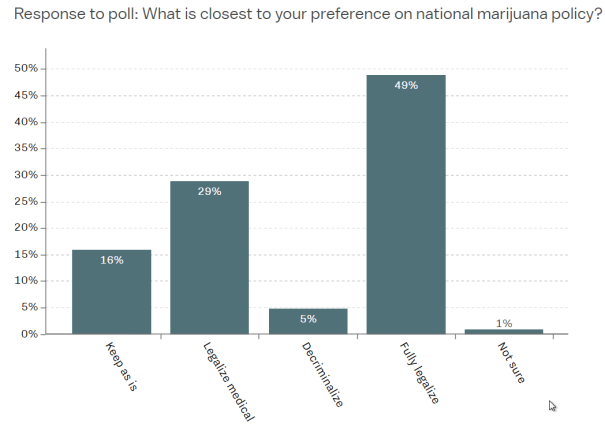
Unfortunately, Americans tend to have simplistic, fundamentalist views about drug policy and think that if statist criminalization doesn’t work, then the most radical polar opposite must be best: full-out free-market legalization.  They don’t see that a more conservative, incrementalist approach would be a better option: decriminalization.  That is what a recent Mason-Dixon Polling and Strategy survey found.  Vox made a graph showing the result:

The least popular option is decriminalization and I think that is because most Americans don’t understand what that means. That means that you treat marijuana more like tobacco, but with harsher regulations. You allow permits for legal medical use of marijuana, but rather than using jail time to penalize use, you just use financial penalties (fines) to prevent a marijuana industry from becoming profitable for corporations and lobbyists.

“Decriminalization” is a lousy term for this because it doesn’t mean that marijuana would lose all criminal sanctions; it only means that penalties would be reduced.  A better term would be “deprisonization” because it eliminates prison sentences while replacing them with fines, probation, community service, and drug treatment.  That would change drug penalties from being an incredibly expensive burden on taxpayers (jail time) into a moneymaker (fines) that can be used to help pay for rehabilitation (drug treatment).  Community service is also better for rehabilitation that jail time and more useful for the community.

Full legalization would make the drug problem worse whereas many decriminalization programs actually do a better job of reducing drug demand than jail time.  If marijuana is fully legalized, then Cargill will invest millions bioengineering more potent new varieties that will be grown on giant corporate farms. Phillip Morris will manufacture joints and vapes and hire Madison-Avenue corporations to market it on TV. Walmart will sell it at the check-out counters. With the economies of scale that these corporations can bring to the industry, marijuana will be the cheapest intoxicant in all of human history.  A potent dose will sell for a couple cents at most.  It will be about as expensive as the little sugar packets that restaurants give away for free with their tea and coffee.  For this reason, I don’t foresee new marijuana bars springing up around our college campuses, but restaurants might give it away as a loss leader because it is an appetite inducer and Doritos might even include free joints with each bag of chips to give people more munchies.

This drop in costs is already happening in Washington State, where after legalizing medical marijuana, “the cost per hour of cannabis intoxication ‘has fallen below $1, cheaper than beer or going to the movies.'” There is preliminary evidence that this is causing a rise in cannabis use disorder in states like Washington which have legalized recreational use.

The danger of fully legalizing marijuana is that it will dramatically change American culture a bit like the importation of tobacco changed Western society, but with potentially worse effects. America is permanently addicted to alcohol and tobacco because there is a concentrated financial interest (corporations) and a large group of users who fight to maintain these industries that each kill more people than all illegal drugs put together (although rapidly rising opioid deaths may have beat out alcohol for the first time last year) and cause numerous other social costs like illness and family breakups. If marijuana is fully legalized, it will essentially be given away for free and we have no idea how that will change society.

That is why the conservative approach to marijuana policy should be decriminalization first. Then if that goes well (and I’m sure it will be better than current policy), we will have more information to help us consider whether we should attempt full legalization. Going straight to full legalization might be better than the status quo (which the Trump administration is promoting), but it might be worse and decriminalization eliminates the horrible social cost of jailing so many able-bodied youth without creating a marijuana industry with the corporate resources to engineer a 180-degree change in American norms.

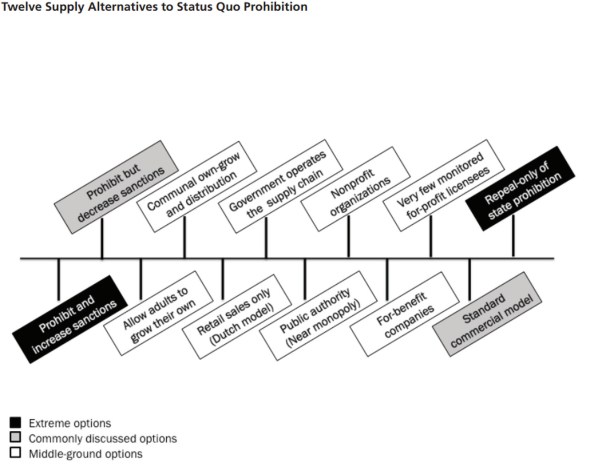
Rand Corporation created a chart showing a spectrum of marijuana policies between full out prohibition and full-out free-market legalization.  The least risky social engineering policies would be to gradually move down the chart rather than immediately swing all the way in a kind of shock therapy which will bring on future aftershocks.

As German Lopez points out, our most damaging drugs have always been our legal drugs:  “Excessive drinking is linked to 88,000 deaths a year, and tobacco smoking to 480,000 to 540,000 deaths a year.”  Even the opioid epidemic was entirely brought about by legal, prescription opioids.  Adding another addictive drug to the list of legal drugs might not help make America great again unless it is heavily regulated.

Posted in Health, Public Finance

Market failures in everything: Book publishing

Image result for books

© Jorge Royan / http://www.royan.com.ar / CC BY-SA 3.0

Markets are only efficient when they are close to perfect competition, and if they are efficient there should not be shortages and surpluses.  However, there are persistently large surpluses and shortages in the book publishing industry.  There is a particularly acute shortage of the Trump Administration expose, Fire and Fury and Constance Grady wrote an article explaining how an odd publishing industry tradion explains this market failure. The publisher only printed 150,000 copies which was a very optimisic initial print run that would easily put the book on the top ten list of bestsellers for the year and possibly even as high as third most popular book of 2018.

However, a few days before it was released to the market, the Trump administration came unhinged in  response to the book which boosted sales.  The book has already had numerous concrete effects on current events from the firing of Steve Bannon from Breitbart to Trump staging a televised conference with congresspeople to refute allegations in the book that he is going senile.  Trump was widely praised by supporters for making it through this nearly hour-long meeting with only minor gaffes (including one that was redacted “accidently ommitted” by the White House in their official written record of the meeting.  Due to Trump’s reaction to the book, it completely sold out within a couple days and the publisher is scrambling to print an additional million copies which will mean that it will probably be the number one bestselling book of the year if the additional books sell.  But it will take a couple weeks to get those books printed and out to stores, so in the meantime we have a shortage of hundreds of thousands of books that customers cannot buy. One reason for the shortage is a curious publishing tradition. Constance Grady again:


if a bookstore doesn’t sell all its copies of a book, it can return unsold copies to the publisher for full credit, regardless of their condition, and the publisher will pay the shipping costs.

“Imagine that Best Buy had the right to return all its flat-screen TVs to the manufacturer, at cost,” a publisher once told me bitterly, “and it didn’t matter if they all had their screens kicked in. And then the manufacturer was like, ‘Sure, we’ll pay for the trucks.’”

In practice, that means that the major booksellers, particularly Amazon and Target, will often over-order books on the off chance they might need them, and then return them a few months later to the publisher, having lost nothing but the cost of processing and briefly storing the books…

It’s a Depression-era policy that never quite got updated, NPR reported in 2008: “During the Great Depression, publishers were looking for a way to encourage booksellers to buy more books and to take a chance on unknown authors. So they offered bookstores the right to return unsold books for credit.”

Now the policy is thoroughly entrenched in the way publishers and booksellers do business. And that means that when publishers are figuring out how many copies of a book to print, they have to figure that roughly 20 to 30 percent of the books they print will come back to them as returns. So if you’re a publisher, you have to plan on eating the cost of two or threebooks for every 10 you sell — plus shipping — and then somehow figure out how to still make a profit…

All of this is to say that in an industry as quirky and illogical as book publishing — a business run by English majors — the incentive to lowball a print run is strong.

The depression-era norm probably worked fairly well when the industry was dominated by indy bookstores who had limited space and wanted to provide as much variety in that space as possible, but today the industry is dominated by large retailers with enormous distribution centers which have very cheap storage space for managing their inventory so the economics have changed.

Today it would be more efficient for retailers to just take responsibility for unsold books themselves like the norm in nearly every other industry.  That would reduce retailers’ moral hazard to buy excessive quantities and reduce the transactions costs of shipping unsold books back to publishers.  But institutions are hard to change and so we are stuck with this unique tradition in the book industry.


Posted in Managerial Micro, Public Finance

Innovative societies must have equality of opportunity

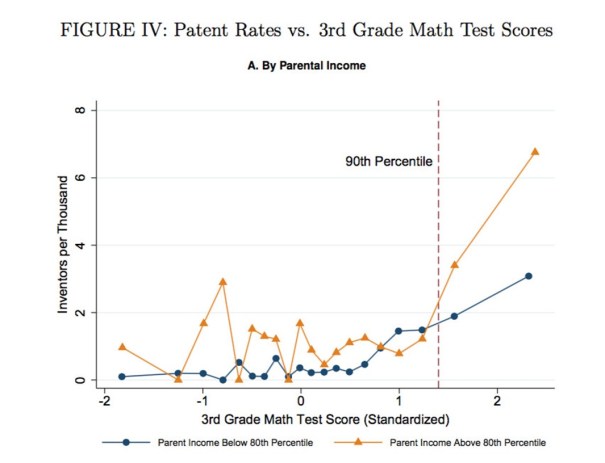
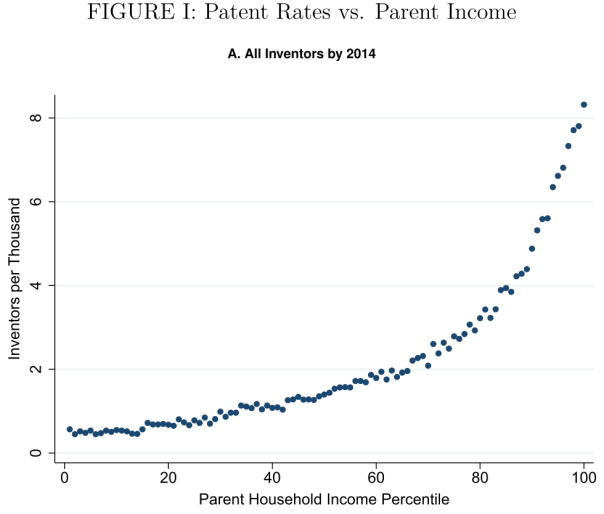
The current tax bill is largely motivated by the theory that if you give tax cuts to successful rich people, even though it increases inequality, it will be worth it because these elites will create jobs through innovation with the new money that the cuts hand them. This idea comes from the theory of the equity-efficiency tradeoff which claims that greater equity reduces economic productivity. The fatal problem for this theory is that highly unequal societies are not more productive. This is because there are many reasons why greater equity can increase efficiency. Because most people think that equity and efficiency are both good things, we should be doing a lot more research to figure out how we can get more of both. New research reported by Matt Yglesias is a start. It shows that we are wasting the talents of over 80% of high-performing kids because they are too poor to be able to innovate as well as the kids whose families are at least upper-middle class (top 20%):

  • Among affluent families, young kids who perform highly on math tests are much more likely to make successful inventions than low-ability kids.
  • But this isn’t true among low-income families. There, high-scoring and low-scoring kids alike are about equally unlikely to become inventors — suggesting that it isn’t a lack of aptitude that’s holding back poor kids; it’s that aptitude alone isn’t enough.

Some regions (the former slave states) are particularly bad at helping smart kids innovate:

To create more innovation, we don’t need more tax cuts for elites. We need to figure out how to create more equality of opportunity. Let’s figure out what they are doing right in Utah, Wisconsin, and Massachusetts.  The original paper is basically trying to figure out why parental income has such a big effect upon the ability of their children to get patents.

The fact that smarter kids don’t produce much more patents than their peers unless they came from rich homes means that rich kids’ success isn’t just caused by rich people have smarter kids.  Even when poor kids beat out the rich kids at academic achievement and IQ, they still aren’t able to turn their talents into innovation that produces patents.  (Rich kids are also also tend to get better test scores by some combination getting better nutrition, better schools, and better healthcare, and possibly better genetic luck, but that is not the crucial difference that explains their success.  The crucial difference is their parent’s money.)

Equality of opportunity is also better for your descendants’ future health.  Geneticists have found that the caste system of India has increased the problems of numerous genetic diseases by increasing inbreeding.  Before modern times, most people married their cousins and when there was a caste system, that impulse is even stronger.  That racist/tribalist impulse magnifies genetic problems over time.

Posted in Inequality, Public Finance

Monopoly power at the emergency room

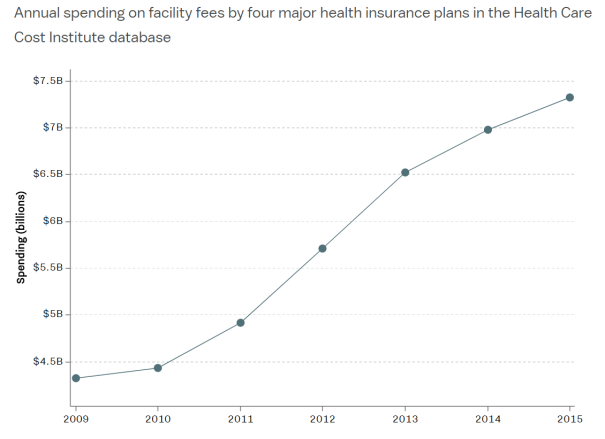
There is a lot of monopoly power in healthcare in the US, and it has been driving up prices by decreasing competition. Research shows that greater consolidation in the hospital industry causes higher prices, but it is hard to explain data showing that emergency room fees have risen by 2/3 in only six years:

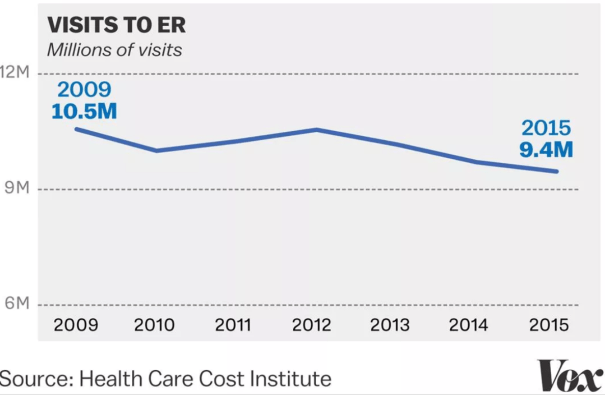
Rising prices means that fewer Americans are going to the ER:

Some of my students have said that they think the problem is that too many poor people are flooding emergency departments, but the available evidence shows that this isn’t happening.

One reason bills are so high is that consumers don’t have the resources to dispute the ridiculous bills.  You can help increase information for consumers if you share your ER bill here.

Posted in Health, Public Finance

Antitrust Regulation

Monopoly power (aka “market power” or “pricing power”) is simply the ability to raise prices without losing all customers. The US economy is increasingly dominated by large firms and all medium-to-large firms have some monopoly power. That is one of the reason bigger firms are more profitable than smaller firms, but even most small businesses also have some amount of monopoly power. About the only producers that do not have market power are tiny businesses that sell commodities (like small farmers) and most workers because most working stiffs are “price takers” who have virtually no ability to negotiate their wages nor the prices of the products they buy.  That doesn’t mean that the labor market is perfect competition however, because large employers have some amount of monopsonistic (buyer) power over workers.  Increasing monopsonistic power could explain why wages have not been rising as fast as labor productivity as shown in this graph from the EPI.

No firms larger than about 50 employees are in perfect competition in their output markets either. These markets are better described as monopolistic competition (if not outright monopoly). In monopolistic competition, there are many competing firms, but each firm makes their products slightly different from everyone else to avoid direct competition and raise prices. For example, Banana Republic and Urban Outfitters are both selling clothing to the same people and are often competing in the same mall, but they work hard to differentiate their products so that they are never selling exactly the same clothing. Product differentiation is the typical way for firms to get a little monopoly power. For example, there are over a million different restaurants in the US, but each firm offers slightly different food with different flavors, services, location, and branding. Product differentiation is what prevents restaurants from suffering from perfect competition in which they couldn’t raise prices on anything because competitors sell perfect substitutes.  There is still competition which means that profits aren’t very high, but without product differentiation, they could not survive at all.  

Monopolistic competition doesn’t allow monopoly profits because consumers can choose close substitutes, but it does create inefficacies because of lower economies of scale and wasteful efforts to differentiate products.  For example, toothpaste manufacturers spend vast amounts of money marketing the hundreds of different varieties of toothpaste that are available in the US in order to get some customers to pay a little higher markup on some of their brands. When firms use their market power to raise prices (and reduce output), it creates a deadweight loss for society unless they are investing their profits in ways that make society better off (such as by increasing productivity) rather than diverting profits for conspicuous consumption.

The inefficiency and unfairness of monopoly power has been recognized in law for thousands of years. It is why it is illegal for “competing” firms to conspire to raise prices such as:

In France, between 1997 and 2004, the top four laundry detergent producers (Proctor & Gamble, Henkel, Unilever, and Colgate-Palmolive) controlled about 90 percent of the French soap market. Officials from the soap firms were meeting secretly, in out-of-the-way, small cafés around Paris. Their goals: Stamp out competition and set prices.

Around the same time, the top five Midwest ice makers (Home City Ice, Lang Ice, Tinley Ice, Sisler’s Dairy, and Products of Ohio) had similar goals in mind when they secretly agreed to divide up the bagged ice market.

Contrary to popular belief, under U.S. laws, a monopoly is not illegal. In fact, the law grants monopolies for patented inventions in order to increase profits to give more incentive for innovation. Similarly, if a firm out-competes rivals by producing better products, that is not illegal. However, a merger that is intended to raise prices (and profits) by reducing competition is illegal because it hurts the economy (both the median income and per-capita GDP decline). But a big problem is defining a market to know whether there is monopoly power or not:

A monopoly is a firm that sells all or nearly all of the goods and services in a given market. But what defines the “market”?

In a famous 1947 case, the federal government accused the DuPont company of having a monopoly in the cellophane market, pointing out that DuPont produced 75% of the cellophane in the United States. DuPont countered that even though it had a 75% market share in cellophane, it had less than a 20% share of the “flexible packaging materials,” which includes all other moisture-proof papers, films, and foils. In 1956, after years of legal appeals, the U.S. Supreme Court held that the broader market definition was more appropriate, and the case against DuPont was dismissed.

…The Greyhound bus company may have a near-monopoly on the market for intercity bus transportation, but it is only a small share of the market for intercity transportation if that market includes private cars, airplanes, and railroad service. DeBeers has a monopoly in diamonds, but it is a much smaller share of the total market for precious gemstones and an even smaller share of the total market for jewelry. A small town in the country may have only one gas station: is this gas station a “monopoly,” or does it compete with gas stations that might be five, 10, or 50 miles away?

OpenStax’s Principles of Economics explains that anti-trust regulators began blocking mergers when the biggest four firms in an industry reached a certain concentration in the market, and later regulations began using the more sophisticated Herfindahl-Hirschman Index. However both measures share some weaknesses:

First, they begin from the assumption that the “market” under discussion is well-defined, and the only question is measuring how sales are divided in that market. Second, they are based on an implicit assumption that competitive conditions across industries are similar enough that a broad measure of concentration in the market is enough to make a decision about the effects of a merger. These assumptions, however, are not always correct. In response to these two problems, the antitrust regulators have been changing their approach in the last decade or two.

Defining a market is often controversial. For example, Microsoft in the early 2000s had a dominant share of the software for computer operating systems. However, in the total market for all computer software and services, including everything from games to scientific programs, the Microsoft share was only about 14% in 2014. A narrowly defined market will tend to make concentration appear higher, while a broadly defined market will tend to make it appear smaller.

There are two especially important shifts affecting how markets are defined in recent decades: one centers on technology and the other centers on globalization. In addition, these two shifts are interconnected. With the vast improvement in communications technologies, including the development of the Internet, a consumer can order books or pet supplies from all over the country or the world. As a result, the degree of competition many local retail businesses face has increased. The same effect may operate even more strongly in markets for business supplies, where so-called “business-to-business” websites can allow buyers and suppliers from anywhere in the world to find each other.

Globalization has changed the boundaries of markets. As recently as the 1970s, it was common for measurements of concentration ratios and HHIs to stop at national borders. Now, many industries find that their competition comes from the global market. A few decades ago, three companies, General Motors, Ford, and Chrysler, dominated the U.S. auto market. By 2014, however, these three firms were making less than half of U.S. auto sales, and facing competition from well-known car manufacturers such as Toyota, Honda, Nissan, Volkswagen, Mitsubishi, and Mazda. When HHIs are calculated with a global perspective, concentration in most major industries—including cars—is lower than in a purely domestic context.

Because attempting to define a particular market can be difficult and controversial, the Federal Trade Commission has begun to look less at market share and more at the data on actual competition between businesses. For example, in February 2007, Whole Foods Market and Wild Oats Market announced that they wished to merge. These were the two largest companies in the market that the government defined as “premium natural and organic supermarket chains.” However, one could also argue that they were two relatively small companies in the broader market for all stores that sell groceries or specialty food products.

Rather than relying on a market definition, the government antitrust regulators looked at detailed evidence on profits and prices for specific stores in different cities, both before and after other competitive stores entered or exited. Based on that evidence, the Federal Trade Commission decided to block the merger. After two years of legal battles, the merger was eventually allowed in 2009 under the conditions that Whole Foods sell off the Wild Oats brand name and a number of individual stores, to preserve competition in certain local markets…

This new approach to antitrust regulation involves detailed analysis of specific markets and companies, instead of defining a market and counting up total sales.

Basically, the new approach since the 1980s has been to try to predict whether a merger will be good for consumers by lowering prices or bad for consumers by raising prices (and reducing the quantity of production) rather than focusing on how much one firm controls a particular market. One problem with the new approach is that it is much more complex than a simple index of market concentration and analysis of theoretical benefits to consumers is more uncertain and thus subjective. Another problem is that the new approach cannot measure the effects of greater concentration of economic power upon politics (more potential for corruption and regulatory capture), wages (greater potential for inequality and an increase in wasteful conspicuous consumption), and innovation (which is suppressed by too much monopoly power). These issues can’t be determined in the short-run analysis of consumer benefits that currently dominate anti-trust analysis because they snowball over decades and are too hard to model. The old model for limiting monopoly power was probably better at preventing these long-run problems.

The old approach to anti-trust was simpler and more predicable.  The new approach requires extremely expensive court battles at a time when the regulators’ resources are falling relative to the growing might of our corporate behemoths.

the enforcement budget for antitrust actions was already stretched way too thin… That budget has been falling for years and is lower now than it was two decades ago. The entire antitrust division of the Justice Department and the F.T.C. are being forced to operate on less than a single company like Facebook brings in over a few days. In the last 10 years, the number of merger filings (which notify the authorities of an intended merger) has almost doubled, but the number of enforcement actions taken by the government has actually fallen.

Anti-trust regulation also bans particular business practices that big firms can use to compete unfairly with smaller rivals and it is hard for giant monopolies to avoid using their power to compete unfairly. This is why monopolies are occasionally broken up. Illegal business practices include:

predatory pricing occurs when the existing firm (or firms) reacts to a new firm by dropping prices very low, until the new firm is driven out of the market, at which point the existing firm raises prices again. This pattern of pricing is aimed at deterring the entry of new firms into the market. But in practice, it can be hard to figure out when pricing should be considered predatory. Say that American Airlines is flying between two cities, and a new airline starts flying between the same two cities, at a lower price. If American Airlines cuts its price to match the new entrant, is this predatory pricing? Or is it just market competition at work? A commonly proposed rule is that if a firm is selling for less than its average variable cost—that is, at a price where it should be shutting down—then there is evidence for predatory pricing. But calculating in the real world what costs are variable and what costs are fixed is often not obvious, either.

…The most famous restrictive practices case of recent years was a series of lawsuits by the U.S. government against Microsoft—lawsuits that were encouraged by some of Microsoft’s competitors. All sides admitted that Microsoft’s Windows program had a near-monopoly position in the market for the software used in general computer operating systems. All sides agreed that the software had many satisfied customers. All sides agreed that the capabilities of computer software that was compatible with Windows—both software produced by Microsoft and that produced by other companies—had expanded dramatically in the 1990s. Having a monopoly or a near-monopoly is not necessarily illegal in and of itself, but in cases where one company controls a great deal of the market, antitrust regulators look at any allegations of restrictive practices with special care.

The antitrust regulators argued that Microsoft had gone beyond profiting from its software innovations and its dominant position in the software market for operating systems, and had tried to use its market power in operating systems software to take over other parts of the software industry. For example, the government argued that Microsoft had engaged in an anticompetitive form of exclusive dealing by threatening computer makers that, if they did not leave another firm’s software off their machines (specifically, Netscape’s Internet browser), then Microsoft would not sell them its operating system software. Microsoft was accused by the government antitrust regulators of tying together its Windows operating system software, where it had a monopoly, with its Internet Explorer browser software, where it did not have a monopoly, and thus using this bundling as an anticompetitive tool. Microsoft was also accused of a form of predatory pricing; namely, giving away certain additional software products for free as part of Windows, as a way of driving out the competition from other makers of software.

In April 2000, a federal court held that Microsoft’s behavior had crossed the line into unfair competition, and recommended that the company be broken into two competing firms. However, that penalty was overturned on appeal, and in November 2002 Microsoft reached a settlement with the government that it would end its restrictive practices.

Although Microsoft was never subjected to much actual anti-trust penalty by the end of the case, the very fact that Microsoft was being investigated from 1992-2002 for anti-trust problems was healthy for competition in the tech industry. For example, without this anti-trust case, it is possible that we would not have Google nor Apple today. The growth of Google depended on an open internet and Microsoft was being investigated for using its control over computer operating systems to control the internet by monopolizing internet browsers. Without any constraints, Microsoft might have crushed the young Google Corporation just like it had crushed many other promising internet startups like Netscape (which was the focus for Microsoft’s anti-trust trial). During the court case, Microsoft had been arguing that they didn’t have a monopoly over personal computers because Apple Computer provided competition by producing a small fraction of the market for computers. Then Apple Corporation filed for bankruptcy! So Microsoft rescued Apple by buying $150m in Apple shares (which had been nearly worthless) and committing to develop key software like Microsoft Office for the Apple operating system, their main “rival.”

So without the anti-trust case motivating Microsoft to rescue Apple, the world would never have gotten the Ipod, Iphone nor any of the other consumer products that Apple subsequently developed.

Posted in Public Finance

Shoulda bought Bitcoin a year ago…

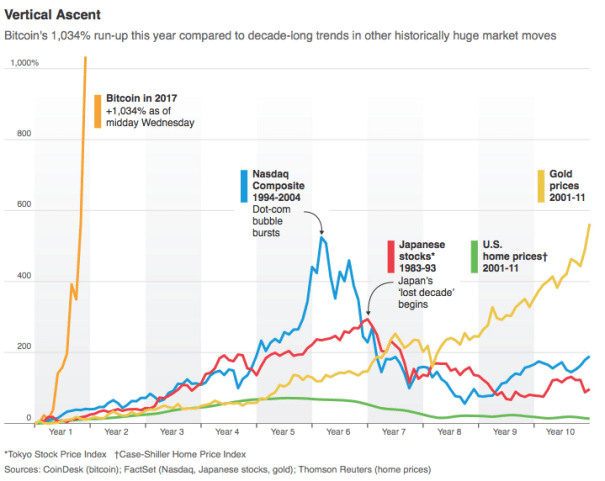
The WSJ found a great way to show how much bitcoin has risen this year:

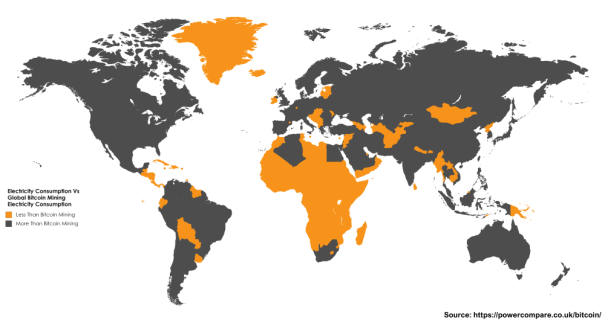
Their video is fun too. Many bitcoin fans argue that this price rise is based on the fundamental value of bitcoin. I agree with the WSJ that it is an enormous bubble. This bubble won’t be as damaging to the rest of the economy as any of the others shown on the graph, but bubbles are often wasteful and in this case, large amounts of electricity are being wasted as thousands of computers are running hot to “mine” additional bitcoins. The electricity used to mine bitcoin this year is bigger than the annual usage of 159 different countries! Here is a map of the countries of the world that use less total electricity than the bitcoin miners:

Not only does bitcoin waste lots of electricity in “mining” new coins, it is also extremely energy inefficient at making transactions.  Business Insider says:

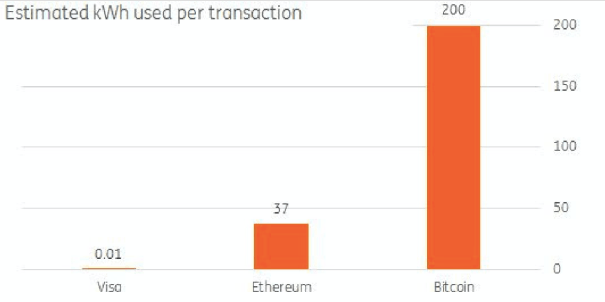
Bitcoin transactions use so much energy that the electricity used for a single trade could power a home for almost a whole month, according to a paper from Dutch bank ING.

…Not only does Bitcoin use a vast amount of electricity to complete transactions, it uses an almost exponentially larger amount than more traditional forms of electronic payment.

“Bitcoin’s energy costs stand in stark contrast to payment systems that have the luxury of working with trusted counterparties. E.g. Visa takes about 0.01kWh (10Wh) per transaction which is 20000 times less energy,” Brosens notes, pointing to the chart below:

This inherent inefficiency of bitcoins is one reason why I think it is eventually going to crash.  There are more efficient ways to make black-market payments and avoid paying taxes–like Ethereum for example!  And there will be newer technologies that work better than Ethereum.  If you are not buying illegal stuff nor trying to launder money, then credit cards are a much more efficient payment system for you.  My credit card pays me about 1% money back every time I buy something and it offers fraud protection and other services that no cryptocurrency can match.

Posted in Macro

Enter your email address to follow this blog and receive notifications of new posts by email.

Join 75 other subscribers
Blog Archive
Pages