The Democrats are out of control. #2: Health status.

The New York Times reports that President Clinton may have lied about her health during the campaign when she claimed that she only takes an aspirin and a single prescription drug. Her doctor revealed today that she has been taking two additional prescription drugs for cosmetic purposes. She takes a cancer drug that promotes her hair growth and an antibiotic to reduce her rosacea, a skin ailment that makes her look flushed and sometimes can resemble acne.

This contradicts the oddly-written statement she publicized during her campaign, which claimed that she only took an aspirin and one prescription drug which were both for cardiovascular health. Critics point out that she obviously knew that her earlier press release was lying. If she deliberately lies about issues for no particular reason like this, what else is she lying about that might give her greater personal gain?

Her personal doctor explained that he rushed off her official health statement in five minutes while her limousine waited outside. This could explain its errors, but it doesn’t explain she failed to correct them for over a year. The memo began with a typo and claimed that her blood pressure is “astonishingly excellent” and that she “unequivocally will be the healthiest individual ever elected to the presidency”, but unlike the comprehensive health information that previous presidential candidates released, the statement only gave two somewhat odd health measurements to evaluate these claims: her blood pressure and the blood level of one kind of enzyme which is dramatically low due to a side effect of the hair-growth drug. Were these numbers also untruthful, just like the number of medications that she takes? Why didn’t the Democrats insist that she produce more useful information about her health when she is the oldest president to take office in history?

Posted in Public Finance

Bad stories lead to bad healthcare policies

US Representive Phil Roe is considered an expert on healthcare by his peers. He co-chairs the Republican Doctors Caucus and the Republican Study Committee asked him to come up with a plan to replace Obamacare. In a recent interview about his plan, he revealed that he thinks moral hazard is one of the main problems with healthcare in America.  He illustrated the problem with this story:

If you go to a wedding …with a cash bar and you go to a wedding with an open bar, where is the most alcohol going to be consumed? Anytime it doesn’t cost anything, it’s overconsumed.

This story illustrates the concept of moral hazard; if something is free, people will overconsume it. But alcohol consumption is very different from healthcare consumption. Consider this alternative story:

If you go to a wedding with doctors injecting insulin for $10 and you go to a wedding with doctors injecting insulin for free, where is insulin going to be consumed badly?

In this case, free insulin won’t be overconsumed at either wedding because nobody is going to want it if they don’t need it and doctors have a moral and legal obligation to only give it to people who would benefit. If you go to a country where insulin is free versus a country where it is distributed by profit-maximizing companies, where are more people going to die prematurely from poorly managed blood sugar? The clear statistical answer is that diabetes is managed much better in nations with universal healthcare which means that it is free for anyone who needs it. You can do this for almost every kind of medical test or treatment:

If you go to a hospital with surgeons providing heart surgery for $100,000 vs. for free, where are heart surgeries going to be overconsumed?

There really isn’t a problem with overconsumption when surgery is free. In fact, there tends to be greater overconsumption of surgery when doctors have a profit motive to encourage overuse. That was one of Atul Gawande’s conclusions from studying why some cities consume more than twice as much health care than others. But what about something more addictive like the alcohol in the original story?

If you go to a hospital with doctors selling high-priced opioids vs. a hospital where doctors are handing out free opioids, where are they going to be over consumed?

There is little problem with prescription opioid addiction in societies that provide free painkillers because doctors have a moral and legal obligation to avoid over prescription. In fact, the prescription opioid epidemic is the biggest in the US where they are the most expensive because there is greater profit for drug corporations to encourage doctors to over prescribe in the US. There are many examples like this where Americans get too much healthcare, but they are usually explained by too much profit orientation among healthcare providers who overprescribe expensive treatments to make more money rather than by too much greed (a.k.a. moral hazard) by patients.  Why do so many smart people think that Americans always want to take more drugs and get more surgeries?

Yes, Americans do get too many caesarian section surgeries compared with other nations, but that isn’t because all American women secretly fantasize about getting cut open at great expense rather than giving a natural childbirth. It is because surgeries are often more profitable and convenient for providers than natural births in the American system. Even though caesarian sections are much more expensive than natural childbirth, they produce worse health outcomes except in the relatively few percent of cases where they are medically necessary so it looks like the American price system is giving the wrong incentives here.

Economists have done a very bad thing to the American healthcare debate by telling these simple stories whose moral is to suggest that America’s main healthcare problem is that our healthcare is too cheap and that is causing Americans to consume too much healthcare. American healthcare isn’t too cheap. We have by far the most expensive healthcare in the world. We should have the very least problem with moral hazard compared with all other rich nations because everyone else provides universal health insurance. Our main healthcare problem isn’t a problem with Americans having too much access to healthcare, but too little.

Would you rather go to a wedding and suddenly realize that you a life threatening illness and there are doctors who won’t help if you don’t have enough cash or would you rather go somewhere where the doctors are ready to treat everyone because they know that everyone in society has universal health insurance?

The very idea of moral hazard of healthcare is immoral because it implicitly assumes that poorer people’s lives are worth less money and shouldn’t get the same healthcare as richer people. We need better stories.

Posted in Health

The Democratic Party is out of control!

In an unexpected by turn of events, Hillary Clinton assumed the American presidency last week due to a narrow election win that surprised pollsters and most experts. There were mass protests by conservatives during the inaugural weekend as they feared what would happen now that Democrats have gained control of the Senate, House, Presidency, Supreme Court, and 2/3 of state governments in what is now a historic level of one-party dominance over American government. Many on the right see Clinton’s win as clouded by CIA, FBA, NSA, and foreign intelligence agency reports concluding that the communist Chinese leadership illegally helped her win the election by hacking Republican Party computers and releasing fake news through their English-language propaganda outlets. The intelligence agencies have also been investigating numerous well-documented financial and political ties between the Communist Chinese leadership and Clinton and her closest associates.

President Clinton has made US allies in Japan and South Korea very nervous by downplaying recent military aggression by North Korea and China and saying that our Asian security agreements for containing China and North Korea are obsolete. Clinton has suggested that the US could pull out of our security alliance with Japan, South Korea, and other Asian nations if they don’t pay more money to the US and these moves are being celebrated by the Chinese and North Korean leadership.

Clinton’s victory was aided by a surprise press statement by one of her supporters, FBI director James Comey. Shortly before the vote, Comey made an unprecedented (and possibly illegal) public statement publicizing an urgent new investigation of alleged new evidence that Trump had been engaging in criminal behavior. In the end, there was no evidence of wrongdoing, but Comey’s premature announcement in the press had a strong influence upon the few voters who were still undecided at that point and is likely to have made the difference of victory among the well under 1% of the vote in the closest battleground states that gave her the Electoral College victory. Upon seeing Comey for the first time after the election, newly sworn-in President Clinton immediately beckoned to him from across a large White House room in order to shake his hand and pull him close for what appeared to be an intimate whisper in the ear or a peck on the cheek while he blushed and her assembled supporters clapped. This is the man who is in charge of investigating Chinese election manipulation and Clinton’s shady ties with China.

Clinton has broken many decades of precedent in refusing to release her tax returns. Before the election she had been repeatedly claiming that she would release them at a future date, but after winning, her senior advisor reversed course and said that there is no need to release them because, “people didn’t care” even though 73% of registered voters, including a majority of her own party thought that she should release her tax returns like every other presidential candidate since before Nixon.

Clinton’s tax records are particularly concerning because she has taken her assets out of her blind trust and is now known to have her money invested in numerous companies doing business with foreign governments. She says that there is no conflict of interest because she has put her daughter Chelsea in charge of this hidden empire of business dealings, but she has also made Chelsea a senior political advisor and given her top security clearance to know every secret that the President knows and Chelsea is routinely invited to presidential meetings with foreign heads of state so there seems to be little separation between business and politics. Critics have sued Clinton over this conflict of interest because it is a violation of the constitution for government officials to receive personal favors from foreign governments, and without transparency there are constant opportunities for foreign governments to grant favors because they are paying Clinton’s businesses undisclosed amounts of money every day. There are additional opportunities for corruption with domestic business interests that are regulated by the president. Businesses can easily secretly pay bribes to Clinton’s business in order to curry favor. Without full financial disclosure there is no way to know how much bribery is part of routine business deals.

Clinton is already accused of favoring the countries in order to profit her business connections. By executive order, she imposed a “Muslim travel ban” which she claims is to prevent terrorists from entering the US, but she has exempted all the Muslim nations where she does business even though they are the nations that have produced almost all Islamic terrorist deaths in America whereas the majority Muslim nations that she has banned have never produced a single act of terrorism in the US.

Meanwhile, Clinton is making numerous Orwellian statements that are completely detached from reality. She insists that her inauguration crowd was the biggest in history despite ample evidence to the contrary. She even ordered her press secretary to make an easily refutable statement claiming, “This was the largest audience to ever witness an inauguration, period. Both in person and around the globe.” She claims that she would have won the popular vote except that she claims that 3-5 million noncitizens voted for Trump in what would be the biggest case of voter fraud in US history if it were true. Despite the massive scale of the alleged fraud, she is sure that “not one” person voted illegally for her. Oddly, she has been reluctant to call for an official investigation in order to prosecute the massive voter fraud that she claims helped her opponent. One of her senior advisor objects to media reports calling these fabrications lies and claims that Clinton is merely using “alternative facts.” Meanwhile, the Chair of the House Science Committee says that Hillary Clinton is the only source of unvarnished truth and advises that Americans should ignore the media and “get your news directly from the president”. This is an ominous sign for science in the Clinton era because Clinton has already frozen scientific grant funding and ordered that government scientists be muzzled from speaking to the public.

How would you respond to press reports like this?

Posted in Public Finance

NAFTA not a big deal overall, but huge for a few Americans.

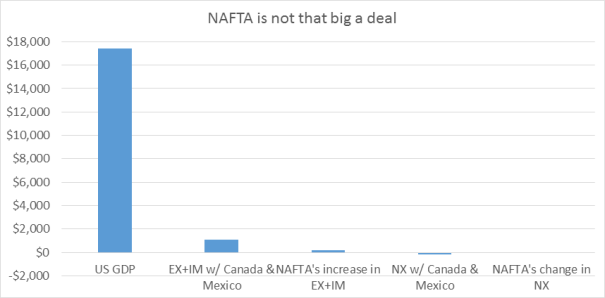
Kevin Drum wrote that NAFTA isn’t a big deal and produced a graph similar to the one below except that he used an inflated measure of trade: gross imports plus exports. Net exports (NX) is a better measure of the effect of NAFTA upon the US economy. For example, if you are worried about NAFTA sucking jobs out of the US economy, the increase in exports tends to boost American jobs, but the increase in imports tends to shrink jobs in the short run so they have opposite effects. Of course, in the long run, there isn’t any effect, but if the effect on jobs is what you are worried about, then you should look at NX at the right side of the graph.  The bars are so tiny, you might have to squint to see them.

Total net exports with Mexico and Canada were only 1% of GDP in 2014 and if NAFTA produced 20% of that as analysts suspect, then we are talking about a fifth of a percent of GDP. That is pretty small and it only has short term effects on employment anyhow, so at this point I would guess that approximately zero percent of our unemployment is due to the shadow of NAFTA’s passage nearly a quarter century ago.

Trade deals also have other effects such as producing inequality, and for thinking about that a better measure would be to average imports and exports, but this is rarely done even though it is better than adding imports and exports together. Adding both together is double counting and greatly exaggerates the effect of trade.

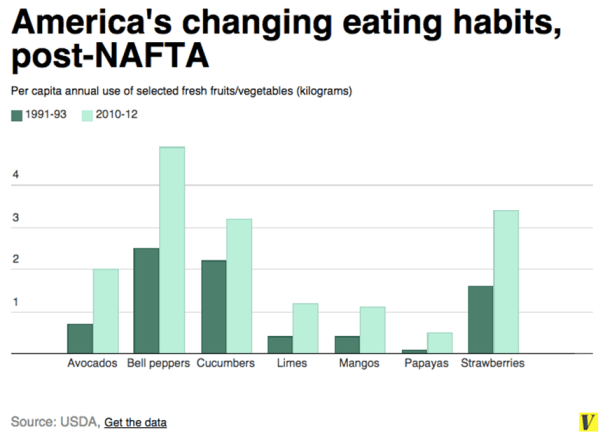
Even though NAFTA has very little impact on the American economy overall, it has had a radical effect on particular sectors of the economy. For example, Mexican imports of avocados had been banned previous to NAFTA and now thanks to NAFTA, Americans eat three times more avocados and limes than we did before.

NAFTA also increased US corn exports to Mexico by about 600% which is why the US farm lobby loves trade deals like NAFTA. If Trump follows through in his promise to put tariffs on imports, the reduction in trade will end up hurting a lot of the rural voters who supported him because the US is the world’s largest exporter of grains. US grain production is so enormous, we are even the third largest exporter of rice despite having very few rice farmers. Have you ever even seen a rice paddy in the US? There are very few regions of the US that grow it.

NAFTA benefited some Americans and cost others, but the net effect is very modest. Dani Rodrik suggests that the gains were negligible:

A recently published academic study by Lorenzo Caliendo and Fernando Parro uses all the bells-and-whistles of modern trade theory to produce the estimate that these overall gains amount to a “welfare” gain of 0.08% for the U.S.

Brad DeLong argues that the gains were larger than that, but pretty much all economists agree that there was some amount of net gains to Americans from NAFTA even though many argue that the gains weren’t distributed fairly. Most of the costs of a trade deal like are caused by the transitional costs of adjusting to the new prices. For example, vegetable farmers in Ohio had to reduce their vegetable production and increased their corn production. That was costly to do because they cannot use the same equipment and skills for both kinds of production. If Trump ends NAFTA, there will be the same kinds of costs again as corn farmers in Ohio have to sell off corn equipment and buy more vegetable equipment, but this time there will be a net welfare loss and it isn’t at all clear if the losses will be distributed fairly this time either.

Posted in Globalization & International

Mass-shooter drills train students to become future mass shooters.

Here at Bluffton University, we just did our first annual mass-shooter drill. I think it is political theater at best and harmful at worst. The Washington Post wrote an article that puts the threat of mass-shooters in perspective.

People killed in mass shootings make up less than half of 1 percent of the people shot to death in the United States. …In 2015, more than 12,000 people have been killed by guns, according to the Gun Violence Archive.

For comparison, toddlers shot and killed more Americans than mass shooters did.

Americans seem to be particularly scared of mass shootings in schools, because this is where we focus our anti-shooter efforts, but schools have always been one of the safest places that students ever go. Only about 1% of the homicides of students happen on school grounds. The probability of dying in school is much lower than at home or in some other public area. As I wrote earlier, mass shootings at schools is an incredibly low-probability way to die. You should be more worried about deaths from lightening or drownings in bathtubs. At colleges, alcohol and suicides produce some of the biggest death risks that we should be more worried about.

Plus, there is no evidence that mass-shooter drills have any beneficial effect and they may cause harm. These drills train students to become future shooters just as much as they train the future victims. Seventy percent of mass shooters in our K-12 schools are minors who presumably participate in the drills along with their future victims.  We are training an entire generation of students to strategize about mass shootings every year in some of the safest places where Americans ever gather. The tiny fraction of students at the fringe end of the bell curve who have a tendency towards mass shootings are going to be stoked by the annual mass shooting rituals at their schools and it is going to make the idea much more salient for a lot of impressionable young minds.

Public health officials realize that mass shootings in schools are a form of epidemic and if the bug can be caught from exposure to press reports about mass shooters it can probably be caught from participation in mass shooter drills too.

Fire drills (and earthquake drills on the west coast and tornado drills in Kansas) are useful because they train everyone to be safer and calmer in a real emergency.  Active shooter drills aren’t like that at all because they train active shooters how to be more dangerous.  Fires and tornadoes cannot learn from participating in drills how to kill more people, but people can.  For example, the drills in Parkland Florida, may have helped the shooter plan.

Marjory Stoneman Douglas High School, had an active-shooter drill just last month. The suspect had been through such drills, and may have used them to his advantage.

Every year they are going to see how trivially easy it is to defeat the pathetic countermeasures we play at in the drills. A smart future shooter will be spending the time the students spend huddled in silence in darkened classrooms with shades drawn thinking about all the obvious vulnerabilities such as disabling the automatic sprinklers and igniting gasoline (like smoking-out rabbits). Or thinking about a good sniper nest for a massacre during a weekly ball game at the stadium. When schools do a mass-shooter drill in the middle of a packed ball game I will take them more seriously, but they won’t ever do it because administrators would never want to interrupt a nice sporting event for mass-shooter theater.  It is fine to interrupt classes, but we have our priorities.

Whereas fire drills make everyone feel safer.  Active shooter drills make us feel less safe because it feels pathetic and weak to have to wait in a classroom behind a thin wooden door and imagine all the ways that a real active shooter would be able to kill us:

  • Break the door and shoot us like sitting ducks. The Chicago Tribune wrote, “kicking doors in, …is an easy skill to learn. For some people, it’s recreation. There are YouTube videos on how to do it and assorted websites devoted to the fine points.”
  • Break in through a window.  Also, many classrooms have a glass panel in the door that can be broken and then the shooter can reach through and unlock the door.
  • Use some small bombs to kill directly and create openings into locked classrooms.
  • Use gasoline to set the door (and the rest of the building) on fire.
  • Pull a fire alarm and shoot the stream of people going outside.  Some mass shooters are already using this tactic.
  • Shoot in the halls between classes.
  • Shoot during an assembly, concert, athletic event, or during lunch.
  • Shoot students one by one outside of school.  That is how the vast majority of American are murdered anyhow.

In addition to increasing the salience of mass shootings among all the mentally unstable people in the general population, we may increase other risks by being paranoid about mass shooters in schools too. For example, fire doors are being propped open during office hours so that the door locks can be permanently engaged in order to allow them to be locked in an instant by just swinging the doors shut. That is going to increase the risk of fire deaths which kill many times more Americans than mass shooters. Not only do propped-open doors permit fires to spread, doors that automatically lock upon shutting will slow down firefighters and endanger both rescuers and fire victims.

Even worse, some schools are recommending that students wait to evacuate during a fire alarm because of the worry that mass shooters might pull fire alarms to make the students easier targets.

burn.PNG

The US has a much bigger burn-death problem than most rich nations and these deaths are much easier to prevent than mass-shooter deaths in a nation with a constitutional right to own unlimited quantities of machine guns. Whereas I don’t see any politically feasible way to reduce mass-shooter deaths in America, the only reason we have an enormous death-rate from fire is negligence. Fortunately fire deaths have been dropping due to actions spurred by press reports about fire deaths, and unlike mass shooters, fires aren’t inspired by the media to try to burn more people.  But US fire deaths are still much higher than most nations which means that most of these deaths are preventable.

There is nothing in our constitution that prevents action against fire deaths nor any organized political groups that are adamantly pro-fire risk.  There is actual evidence that fire drills save lives and fires kill many times more Americans than mass shooters anyhow, so why don’t we do more fire drills instead of so many mass-shooter trainings?

Why act out traumatic events that may never occur? …The U.S. has become obsessed with rehearsing crises as a means of preventing future mistakes. …And this new reality, one where false memories prime us to the idea that no place is truly safe, is exemplified by active shooter drills popping up in schools around the country.

Proponents argue the more realistic the drill is, the less likely students are to feel and act unprepared in a true scenario. Yet a growing number of parents and psychologists argue that this immersive approach in the country’s schools isn’t justified by worthy statistics. After all, the chance of any student dying in a school-related shooting is one in 2.5 million…

…Over 20 states require schools to have some sort of lockdown procedure in place… But six states (Oklahoma, Missouri, Illinois, Tennessee, Arkansas, and New Jersey) have taken lockdown to the next level; they mandate specific active-shooter drills in which armed police officers often bust down classroom doors, fake guns fully loaded…

[Other school districts are even more extreme.] This is where the ALICE Training Institute comes in…

ALICE—which stands for Alert, Lockdown, Inform, Counter, and Evacuate—is billed as the nation’s first active shooter response program, which has, according to Crane, trained 22 million people to use a menu of SWAT-like defense tactics in the event of an armed assault…

This past January, one middle school in Alabama sent a letter home to parents in advance of ALICE training telling them to equip each of their children with a can of food. “Our mission has been [that] there should never be an American who doesn’t know what to do when they’re under fire,” Crane said.

…he program often incorporates materials like Airsoft guns and air horns to replicate the sound of gun shots emerging from a hallway. “They can hear the air horn getting closer, which brings up their anxiety level,” Crane said…

Certain schools in states including Oregon, New Jersey, and Florida have started implementing unannounced active-shooter drills on the grounds that they better prepare kids for surprise attacks. Forget what you’ve learned about fake blood and Airsoft props on-site—in these schools, the word “drill” is a frightening misnomer; neither students nor faculty are given any advanced notice of them.

Last November, a middle school in Florida made headlines after students believed an unannounced drill, in which two gunmen barreled down the school’s hallway with a pistol and AR-15, was real. Turns out the shooters were local police officers yelling, “This is a drill!”—but that didn’t stop many students from texting their parents hysterically, telling them they feared for their lives…

[In another instance] local law enforcement …issued a “code red” emergency protocol after receiving reports of a student carrying a suspected weapon. That weapon turned out to be brass knuckles, and the student was soon arrested—but still, according to Joy, everyone reacted as if they were in the midst of an active shooter situation. “Some of my friends in the auditorium were put in a stage door closet. Other people were stuck in cabinets or the bathroom,” Joy continued. “They prepare us, but it’s nothing like the actual scenario.”

There is no evidence that any of this works.  For example, the ALICE company cannot point to a single example where its techniques have stopped a shooter.  Here is an example of what ALICE looks like:

Instead of preventing de-escalating our irrational paranoia about violence, we have been investing millions to make America more like a war zone.

in Texas, Camey Elementary School, which has never experienced a shooting, recently spent $21.5 million rebuilding a facility with bulletproof glass on the front doors, 50 security cameras, and a panic button… even bulletproof blankets made their way into naptime defense budgets…

The Washington Post reported about the multi-billion dollar school shooter preparedness industry:

But fear has long dictated what schools invest in, and although campus shootings remain extremely rare, many superintendents are under intense pressure from parents to do something — anything — to make their kids safer…

As Home Depot and Walmart market $150 bulletproof backpacks to frightened parents, administrators are being inundated with pitches from entrepreneurs pushing new concepts that make grand promises. One superintendent who responded to the survey said that within hours of a shooting earlier this year, her inbox was “flooded from vendors with some pretty disrespectful and tacky statements: ‘had you had this . . .’; ‘if you had this . . .’ ”

The industry is also rife with self-appointed experts and consultants who claim to know what safety measures are most effective, but given that so little government or academic research has been done on what insulates students from on-campus gun violence, it’s enormously difficult for schools to reach conclusions based in fact.

All this to make it easier to allow more Americans to have easier access to guns than in any other nation.  Especially for the kids:

The United States, home to 5 percent of the industrialized world’s population under 15 years old, accounts for 87 percent of its unintentional firearm fatalities involving that age group, according to a 2003 paper.

Preparing the kids to fight back is a sad illusion as this horrible video demonstrates:

Despite the preparation, over 228,000 American students have experienced a school shooting since the 1999 Columbine High School massacre.

Posted in Violence & Peace

We Pencils

Introduction: This essay is guest authored by a group of pencils.  Yes, we are a bunch of ordinary writing instruments.  Even though any one of us is very dumb, even a group of idiots can produce something much greater than the sum of their parts when they figure out how to work together.  Collaboration is what this essay is all about.  We think that Leonard Read’s famous 1948 essay, “I Pencil” was misleading about how collaboration works.  This is to set the record straight.

We Pencils

We are lead pencils–the ordinary wooden pencils familiar to everyone who can read and write. This is our story, our genealogy. You may wonder why we would write this genealogy, but we are a mystery–more so than a tree or even a flash of lightning. Sadly we are taken for granted as if we were without import, but imagine life without us.

We pencils, simple though we appear to be, should merit your wonder and awe, a claim we shall attempt to prove. In fact, if you can understand us—no, that’s too much to ask of anyone—if you can become aware of the miraculousness which we pencils symbolize, you can help save the prosperity that mankind could unhappily lose if we lose our appreciation for leadership and efficient bureaucrats. We have a profound lesson to teach and we can teach this lesson better than can an automobile or an airport because—well, because we are so simple.

Simple? Yet, not a single person on the face of this earth knows how to make one of us. This sounds fantastic, doesn’t it? Pick up one of us to look over. What do you see? Not much meets the eye— wood, paint, the graphite lead, a metal ferrule, and an eraser.

Innumerable Antecedents

Even though you are a distant cousin to everyone else on earth, you probably cannot trace your family tree back far enough to identify your relationship to more than a few thousand relatives at best. Just as it is impossible for you to name all your antecedents, so is it impossible for any of us to name and explain all of ours. But we would like to suggest enough of them to impress upon you the richness and complexity of every humble pencil.

Our family tree begins with actual trees, such as straight-grained cedars that grow in forests in Northern California and Oregon that are mostly owned by the federal government which manages 70% of the forests and 47% of all the land in states west of the Great Plains as you will see below.

Now contemplate all the saws and trucks and rope and the countless other gear used in harvesting and carting the cedar logs to the railroad siding. Think of all the corporations and the numberless central planners that managed their fabrication: Glencore Xstrata Corporation mining the ore, ArcelorMittal Corporation making the steel and its refinement into saws, axes, motors by Techtronic Industries; the corporate logging camps with their beds and mess halls, the cookery and the raising of all the foods. Why, untold thousands of persons working for Kraft Foods had a hand in the millions of cups of coffee the loggers have drunk!

Now contemplate the necessity of roads to get workers into the forests and get the wood back out. Without roads, most wood could never be harvested. US Forest Service workers managed our trees and State Transportation Department bureaucrats planned the roads to get them out to the railroad.

Can you imagine the individuals who work for GE Transportation in over 160 countries making the flat cars and rails and railroad engines and who construct and install the communication systems for the shipping containers that transport the wood for pencils?

Some of us were part of logs that were shipped to one of the 33 enormous sawmills in California that produce billions of board feet every year. Some of us were shipped to a facility in China like the California Cedar Products’s pencil slat mill in Tianjin.

Our cedar logs are cut by robots into small, pencil-length slats less than one-fourth of an inch in thickness. Other robots dry us in kilns and then tint our wood red for the same reason women put on makeup. People prefer that we pencils look pretty, not pallid white.

How many other robots in other factories made the lights, belts, motors and other equipment the pencil slat mill requires? Yes, although machines do most of the work in factories, there are people there among our ancestors too. There are engineers who programmed the robots and maintained the machines and janitors who swept the floors. There were construction workers who poured the concrete for the Communist-Chinese government Three Gorges Dam hydroelectric plant, the world’s biggest, which supplies the mill’s power.

Don’t overlook the ancestors present and distant who had a hand in transporting numerous containers of slats across the globe. Most of them will be replaced by robotic self-driving vehicles in the near future, but that creative destruction will just bring other corporate managers into our family tree.

Once in a Chinese pencil factory—hundreds of millions of dollars of robotic machinery and building, financed with capital accumulated in government-run Chinese banks—each slat is given eight grooves by a robotic machine, after which another robot lays leads in every other slat, applies glue, and places another slat atop—a lead sandwich, so to speak. Eight of us are robotically carved from this “wood-clinched” sandwich.

Our “lead” itself—it contains no lead at all—is complex. It begins with the world’s graphite deposits, nearly 80 percent of which are located in China and, like all land in communist Chinese are owned by the government. Consider the graphite miners and the workers who made their many tools. They are slowly being replaced by machines owned by multinationals just like the workers who used to load bags of graphite on ships. Even those who make large shipping containers in which the graphite is shipped and those making the ships are slowly being replaced by mechanization. Even the lighthouse keepers along the way who assisted in our birth have long-since been replaced by government-owned robotic lights. The harbor pilots will soon be replaced by corporation-owned robots too.

The graphite is mixed with kaolin clay from Georgia and wetting agents from a chemical factory. After passing through numerous semi-autonomous machines, the mixture is finally extruded like thin sausages, cut to size, dried, and baked for several hours at 1,850 degrees Fahrenheit, all untouched by any worker’s hands. To increase the strength and smoothness of the leads, robots then coat them with a hot treatment of waxes synthesized at petroleum refineries.

Robots then coat the naked cedar of our bodies with paint. Do you know all the ingredients of paint? Who would think that middle-eastern petroleum is the biggest part of it? That oil is chemically transformed into solvents like aliphatic and alicyclic hydrocarbons. Why, even the processes the AkzoNobel corporation uses to make our paint’s pigments a beautiful yellow involve the skills of many people that is too complex to explain.

Observe our labeling. That is a mixture of carbon black and polymer binders that is painted on and rapidly cured by heating. How does AkzoNobel make polymers and what, pray, is carbon black?

Our bit of metal—the ferrule—is aluminum. Think of all the robots of Rio Tinto Alcan Corporation who mine bauxite in Australia and the robots at UC Rusal who have the skills to smelt it and make shiny a sheet of alloy. It would take pages to explain just how one robot works and much more to explain how they make sheets of alloy.

Then there’s our crowning glory, inelegantly referred to in the trade as “the plug,” the part man uses to erase the errors he makes with us. It is made by corporations that distil crude petroleum into its different chemicals and crack them separately with catalysts into styrene and butadiene which are mixed back together with vegetable oil, sulfur, tints, heat, and many other inputs to chemically react into the final “rubber” that is extruded and cut into the desired shapes by robotic machines.

No One Knows

Does anyone wish to challenge our earlier assertion that no single person on the face of this earth would know how to make one of us without the help of many other people?

Thousands of corporations have a hand in our creation even though none of them knows more than a small fraction of the total that the others know. Now, you may say that we go too far in claiming in our creation the coffee corporations and food managers in far-off countries. This is an extreme position, but we stand by our claim. There isn’t a single employee in all the millions, including the president of the pencil company, who contributes more than an infinitesimal amount of know-how or effort to make one of us. The only difference between the contribution of the president of the pencil company and the logger in Oregon is in the type of know-how and the amount of political power they have in their organizational structures. Neither the president nor the logger can be dispensed with, any more than can a chemist in the factories or the workers in the oil fields. Even so, the company president will get a lot more money because of his political power as a central planner in the process and the scarcity of the knowledge that top central planners gather.

Here is an astounding fact: Neither the oil field employee nor the chemist nor the robotics engineer nor any who cuts the trees or mines the ores performs his singular task because he wants to make pencils. Each of these workers wants pencils less, perhaps, than does a child in the first grade. Indeed, there may be some among this vast multitude who never even saw a pencil nor would they know how to use one. Their motivation is other than pencils. Perhaps it is something like this: almost all of the millions of workers and robots are ordered to perform their tiny work by managers who control the salaries that they need to buy goods and services. We pencils may or may not be among these items.

Only the pencil company workers take pride in their contribution to us pencils, but they are a tiny fraction of the people and robots who are necessary for producing us. There are only three pencil factories in the U.S. which produce about two billion pencils a year. Of course, this was only 14% of the pencils sold in America in 2008 (86% being imported), but it is amazing how few of the world’s workers manage the machines that make all the pencils in the world and even more amazing how very few pencil company presidents there are to mastermind the process.

So Many Masterminds

There is a fact still more astounding: the numerous masterminds, dictating and to some degree forcibly directing the countless actions which bring us Pencils into being. They are involved in almost every step of every manufacturing process. The Invisible Hand is also important for giving managers incentives to help coordinate the work of multinational corporations, but markets merely intermediate between the boundaries of companies that are run by bureaucrats and MBAs, the unsung heroes of our story. It is a mystery why the bureaucrats aren’t more appreciated for the miracles they produce.

Everyone agrees that only God can make a tree because we realize that we ourselves could not make one. Indeed, can we even understand a tree? We cannot, except superficially. Even though we could describe the molecular configurations manifested in a tree, no one could record, let alone direct, all the constant molecular changes that transpire across the life span of a tree to produce its majesty. Such a feat would be unthinkable.

Similarly, we Pencils are complex combinations of the miracles that manifest themselves in nature: cellulose, petroleum, aluminum, graphite, and so on. But to these miracles an even more extraordinary miracle has been added: the configuration of creative human energies—millions of tiny know-hows cooperating under the direction of numerous human masterminds who manage large and small companies of employees working together. These companies simultaneously compete and cooperate with each other in response to market prices, government regulations, and negotiations among managers. Although only God can make a tree, he never made a pencil.  We insist that managers are required to coordinate the people to make us. Without managers, mere markets can no more direct the millions of individuals that bring us into being than they could put molecules together to create a tree. Markets help give managers guidance, but the managers are the real key to the process.

The above is what we meant when we wrote, “if you can become aware of the miraculousness which we Pencils symbolize, you can help save the prosperity that mankind is so unhappily losing.” For the citizens of the world have forgotten the interdependence that creates wealth and are voting for politicians who have been helping wealthy elites grab power away from middle class interests and cause the median income to stagnate as inequality has skyrocketed since the 1970s. This has stymied the aspirations, talents, and creativity of the masses of ordinary citizens.

If one is aware that managers are necessary to arrange individuals into creative and productive patterns in response to human necessity and demand—then one will possess an absolutely essential ingredient for freedom: a desire to work for better governance. Freedom is impossible without this desire because the absence of government is anarchy and chaos. There is no freedom in anarchy. Only poverty and violence.

That is not to say that all governance is created equal and all managers benign. Just the opposite. Bad managers love power for the sake of power or try to selfishly extract as much out of others as possible. Good managers set up conditions within which their people naturally and spontaneously flourish productively. All managers have some coercive power over others, but the best managers use it sparingly and rely more on inspiration to motivate their people to follow the better angels of their natures.

But even the worst governance is no worse than the absence of government because governance is leadership and people have always needed leadership to survive and prosper. Without governance it is impossible to accomplish complex creative production involving the coordination of multiple people. To give a trivial, yet ubiquitous example, consider the delivery of the mail. National mail delivery has stereotypically been performed by a government monopoly, and some governments are much more efficient at it than others, just like some corporations are managed better than others. Ironically, Scandinavian nations are usually considered more socialist than the US, but in Sweden and Denmark, private postal corporations compete to deliver mail and are efficiently regulated by the government instead of directly owned by the government. Regardless of whether mail is delivered by a government agency or a private corporation, the management issues are largely the same. Without hierarchy and management, there is no national mail service. Markets alone cannot provide it nor can individual men acting freely and independently of one another. Only bureaucracies led by masterminds with some amount of coercive power can deliver the mail anywhere in a nation within a few days for the tiny price of a stamp. That is another miracle if you stop to think about it. How much would you charge to deliver a letter across the country in less than a week?

Now, in the absence of faith in governance — in the unawareness that leadership is necessary to help individuals naturally and miraculously cooperate to achieve ends that are greater than any one person — the individual might reach the erroneous conclusion that mail can be delivered without any governmental masterminding. That individual might become an anarchist.

For although democratic capitalism manages the economy better than communist dictatorship, even communism works much better than anarchy. Pencils were produced in abundance even by the central planners of communism. Here are striking photos of the Soviet Union’s original pencil factory in 2012 that was still operating 86 years after it was founded! It outlasted communism and continued to work the same way under capitalism.  It looks quite similar to the stunningly beautiful photos Whereas we Pencils have been produced by communist central planners and corporate managers, we have never been produced in the absence of government nor coercive managers.

Testimony Galore

If we Pencils were the only products that could offer testimony on what men and women can accomplish when they are bound together under effective management, then those with little faith in governance would have a fair case. However, there is testimony galore: it’s all about us and on every hand. Mail delivery is exceedingly simple when compared, for instance, to the masterminds who manage the making of an automobile, airport, or Iphone.

Delivery? Why, in this area managers in large corporations and governments have delivered the human voice around the world. They deliver 150 passengers from Seattle to Baltimore in less than four hours. They deliver gas from Texas to one’s range or furnace in New York at unbelievably low rates. They spend millions of dollars per mile building roads to subsidize the delivery of people and millions of other things! None of this would be possible without governance at multiple levels of society.

The lesson we have to teach is this: To have a prosperous society we need managers to lead and bureaucrats to nudge people to work act in harmony with each other. Let society’s legal apparatus create useful obstacles like property rights, but not be excessive. Some obstacles like patents are useful to create more creative energies, but too much intellectual property rights inhibits them. Let governments coercively extract taxes to pay for excellent schooling to encourage creative know-how and give everyone the opportunity to contribute back to society.

Know that inequalities of power are inevitable in every society, but that some societies manage to produce more benefit to the median individual than others. Be skeptical of powerful people who claim to be self-made because just as every pencil is the creation of millions of people, every billionaire and dictator is too. Elites can only accumulate power by limiting other people’s freedoms. Because all power ultimately derives from control over others, powerful people should contribute back to society in proportion to the power that they have. Because all power ultimately comes from others, greater power should also bring greater responsibility to serve others too.

A manager who realizes that she has a duty to give back to her people will have happier, more productive workers and that may even make her richer than if she tried to use her power to selfishly maximize the amount that she takes from them. This is one reason why most dictatorships are so poor. Most dictators are too selfish and don’t give back enough to their people to enable them to flourish. Democracies are better because they limit the ability of the ruling elites to leverage their power to selfishly extract resources. Unfortunately, democratic sentiments can be warped by elites who spend fortunes marketing myths to the people about how economic elites need less responsibility and more control because, they say, the invisible hand of God has blessed them with the divine right of wealth. Wealth is property which always involves some amount of coercion. Not all coercion is unjust, but libertarian elites are happy to cynically take advantage of the coercive force of government that is necessary to create and maintain property rights for them while they object to government coercion that would limit their power and help less wealthy citizens.

We Pencils, seemingly simple though we are, offer the miracle of our creation as testimony that good management is a necessity of prosperity and wherever there are groups of humans, some form of management is as inevitable as the sun, the rain, and the good earth. Given the natural resources at our disposal, the only difference between a shared cornucopia and an unjust famine is the quality of governance.

*Postscript:

We are writing this in response to Leonard Read’s essay “I Pencil” which he wrote because he thought Americans placed far too much faith in government and didn’t recognize the miracles of everyday markets. He worried that the invisible hand is so hidden that most people didn’t realize its power and put more faith in socialism. He had good reason to be worried because he was writing during the heyday of the Cold War when the Soviet Union was becoming a superpower and communist movements were popular around the world. Twenty-eight nations around the world adopted communism at some point during Read’s life and dozens more became overtly socialist. The vast majority of the population of the world lived under socialist rule for at least half their lifespans (more than thirty years) during this era.

Today socialism is unpopular and we may be in danger of a new problem that is in some ways similar to socialism and in other ways the exact opposite.  Today, people put too much faith in the myth of unfettered capitalism because they think capitalism is being directed by the invisible hand of God when in actuality an increasing share of our daily existence is shaped by the invisible powers of corporate management. Corporate power has been rising for decades and it has transformed our societies.  For example, Gabaix (2016) reports that fluctuations at large corporations explain about 1/3 of the fluctuations in GDP in the US and 1/2 in France.  In other words, large corporations are now the primary drivers of recessions.  Elite capitalists now have far more control over society than was the case in 1948 when Read wrote his essay. Stock market capitalization has been steadily growing faster than the economy as a whole because large corporations are have been growing increasingly dominant and taking over more of the economy. Even government-printed money is being replaced by electronic payments that are increasingly managed by two corporations: VISA and Mastercard.  Luigi Zingales (2017) says rising corporate power has even been reshaping democracy:

Among the largest corporations in 2015, some had private security forces that rivaled the best secret services, public relations offices that dwarfed a US presidential campaign headquarters, more lawyers than the US Justice Department, and enough money to capture (through campaign donations, lobbying, and even explicit bribes) a majority of the elected representatives.

According to the census, 64% of Americans now work for the biggest 2% of America’s firms. Most people now work for managers rather than markets. The BLS estimated that in 2012, only 6.7% of American workers were self-employed entrepreneurs or unpaid family members. In 1950, 25% of workers were self-employed and large corporations were much less important. Although markets had been expanding their influence across greater and greater areas of life for two centuries, information technologies are now giving managers greater power to control ever greater spheres of influence and along with demographic changes, this is causing markets to slowly retreat. Markets have probably already peaked and we are slowly moving into a post-market era.

The coming rise of artificial intelligence will only accelerate that trend by devaluing the skills of more and more classes of workers while raising the income of a few elite owners. Industrial capitalism has only existed for a couple hundred years in Europe and a few decades in the much of the rest of the world. It developed as the result of the technological changes that brought the industrial revolution.  The developing nations of the world are still waiting for this revolution to come. The whole point of economic development in the third world is for poor countries to figure out how to copy the industrial revolution that made the industrialized world rich. Now many scholars think that we are entering a post-industrial age that is often called the information age. What kind of economic and political system will that bring?

Every technological era has brought changes in economics and politics. The hunter-gatherer era had tribal government which was so loose that some scholars argue that it isn’t government at all, but there was always an important role for tribal leadership and management. The agricultural era brought civilization and monarchy became the predominant form of government. The industrial revolution has brought mass democracy. What system of governance will the information revolution bring?

As an information age sequel, we’d like an Iphone to write, “I Iphone” about its family tree, but Tim Harford made a 7 minute podcast about the story and Mariana Mazzucato wrote about it in The Entrepreneurial State, chapter 5.  She explains that the 12 most important technologies that the Iphone combined into a single device were invented using government funding at crucial early stages.  That includes everything from the internet to Siri.  Obviously, pure government (communism) didn’t build the Iphone, but even the communists of China contributed a lot more than self-employed individuals coordinated by free markets.  In the 1940s there were a lot of starry-eyed leftists who thought that all we need is to get rid of (or minimize) markets to achieve prosperity.  Today there are a lot of starry-eyed rightists who think all we need to do is get rid of (or minimize) the government.  Both are wrong.

Most people understand that strong corporate governance is essential to modern capitalism, but smart national government is essential too because neither corporations nor capitalism itself can exist without a strong national government providing a minimum set of regulations so that courts can arbitrate disputes. Successful stock markets require detailed accounting regulations and corporations require limit liability protections and research and development require patents and public education funding and insurance companies require insurance regulations. Some nations have regulations that encourage stronger markets than others, but none of these essential institutions of capitalism arise independently of the regulations and other government actions that nurture them. The key to capitalist prosperity is getting the regulations right. That is good management.

The West, beloved by cowboys, is the most socialist region of the USA.

When people talk about how the western states’ geography feels free and open without restrictions, they are talking about how it is mostly owned by the government.  That is why there is relatively free access in the west. Most of the land in the eastern states is privately owned and there are much greater restrictions on recreational use because property rights are the right to exclude others. That is the whole point of private property. This map shows the distribution of federally owned land.

Here is another way to show it:

Because these maps only show federal ownership, they leave out vast additional territories owned by the state governments. For example, the federal government owns nearly 3/4 of Alaska and then the state government owns another quarter of the state of Alaska leaving less than 1% of Alaskan territory owned by private citizens!

That makes a big difference in the east where state and local governments own a much bigger share of land relative to the federal government including roads, parks, schools, state forests, and rivers, but public wilderness in the East is more divided with private property which doesn’t give such an expansive sense of freedom that the vast national forest or BLM territories give.

Ironically, the socialist land management of western states makes people there feel freer there than in the east. It encourages libertarian sentiments and some libertarians get extremely upset when the government tries to act like a private landowner and exclude them from abusing public land such as by overgrazing. Public ownership reduces exclusions which is why our socialist road system is so incredibly popular despite its mind-bogglingly high cost to build and maintain.

This expensive system connects all of the most important places together as you can see in this a map of nothing but the roads in Florida. The most valuable regions pop out visibly because they have more roads. (This map and many other states are available for purchase from Fathom).
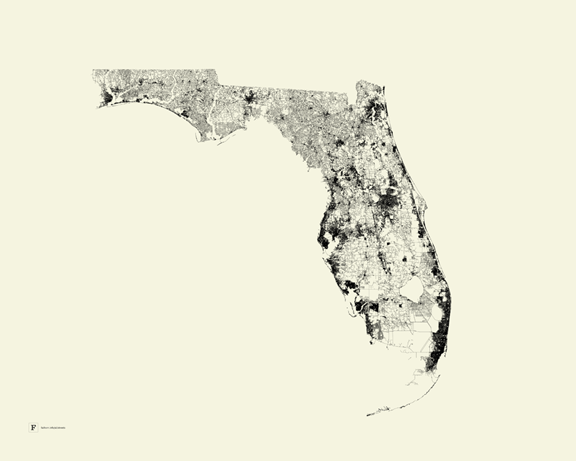
Local government ownership is much more valuable than most privatly-held real estate because roads are extremely valuable, particularly in urban areas where road density is concentrated. The cost of a newly paved road starts anywhere from a minimum of about $2 million per mile in rural areas to more than $10 million in urban areas. Maintenance is also very expensive. Merely the routine resurfacing of a 4-lane road costs about $1.25 million per mile.  Despite this cost, we call our most expensive roads freeways.

A private investor would pay big bucks to be able to completely control our busy private roadways because they could charge high tolls that would more than recoup the costs of building and maintaining the roads.  Of course this isn’t politically popular and voters prefer free roads and get politicians to regulate the tollways to keep prices down.

Although the Chinese government have adopted numerous capitalist reforms, which they call the “Chinese characteristics” of Marxism” they still claim to be communist.  Socialism/communism is usually defined as the government ownership of the means of production and one area where China has continued the communist tradition is the public ownership of all land. Everyone in China must rent any land that they want to use privately. The western states of the USA have a similar tradition.

A last word for lovers of pencils.

Leonard Read wrote “I Pencil” about a miraculous supply-chain of globalization in 1948, and the world has become a lot more globalized since then. He traced the network of inputs to make a “Mongol 482” pencil made by the Faber-Castell Pencil Company, the largest and oldest pencil manufacturer in the world. It is headquartered in Stein, Germany, and still operates 14 factories in 10 countries around the globe. This brand was bought by Staedtler in 1978 and then by Sanford, a division of Newell Rubbermaid in 1994. They shut down their US production, but the Mongol 482 brand is still produced in Venezuela for sale in South America and the Philippines.

When Leonard Read wrote “I, Pencil” in 1948, the US had dozens of pencil companies running dozens of small factories across the nation.  By the year 2000, 86% of us Pencils sold in America were imported, mostly from China.  There are now only three pencil factories in the US (although two of the factories mostly just assemble pencil parts made overseas. These three factories produce two billion of us Pencils each year.

In 1948, the US pencil industry employed many more workers but, the dozens and dozens of US pencil factories in 1948 produced 25% fewer pencils per year than our three factories do today.  In an era when pencil companies were smaller and more numerous, market competition was more important relative to corporate management, but management has always been more essential than markets.  That is why the Soviet Union could produce pencils, whereas markets alone–without lots of central planners–cannot.

Leonard Read did a great job of illuminating the undeniable miraculousness of markets and international supply chains when he wrote “I Pencil,” but effective management has always been more important and is increasingly so in the information age.

We Pencils were inspired by a libertarian organization who mailed a book about “I Pencil” to the owner of this blog in 2016 as part of an effort to spread libertarian ideology among university professors. They recognize that markets don’t work well enough to disseminate their ideology, so they give away their propaganda like a government handout. Other libertarian managers have made the story into a cheesy movie that was also distributed more like a welfare program than a market product. We encourage you to compare this essay with the original (naturally available as a free handout).

Posted in Globalization & International, Managerial Micro, Public Finance

Mmutilitarianism: The accidental ethical foundation of economics and business.

ethics-2991600_1280 (1)

Everyone has some sort of moral philosophy whether they realize it or not.  The three major schools of ethics are deontology, consequentialism, and virtue ethics.  Deontology is an ethical system based on legalistic rules that impose a duty on everyone’s actions.  Consequentialism or teleological ethics judges actions based on whether they produce good outcomes.  The most influential school of consequentialism is utilitarianism which aims to maximize the average utility (happiness or wellbeing) of all people.  Utilitarianism is the idea associated with Jeremy Bentham who argued that we should try to achieve “the greatest happiness of the greatest number” of people.  Virtue ethics says that people should act in ways that demonstrate virtues and/or improve their character.  Christian ethicists have  tended to favor deontological and virtue ethical reasoning, but all three systems are sometimes used by nearly everyone in different kinds of contexts.

When push comes to shove, and people are faced with an immediate decision that requires action, most people throw out these systems of moral reasoning and act according to how their gut or emotions are pushing them. at the time.  Because people’s emotions are inconsistent, we tend to act inconsistently and that makes us look like moral relativists.

Moral relativism isn’t really a moral philosophy because it is the negation of each moral system (such as listed above).  It is the idea that there is no ethical system that universally applies in all circumstances to decide right from wrong.  Many ethicists criticize moral relativism as nhilism, but even if it isn’t an attractive goal, it is a pretty good way of describing how people usually behave.  Most people decide what is right and wrong based on their contemporary feelings, personal circumstances and social pressures.

For one dramatic example, the official position of the Southern Baptist Church is now staunchly anti-abortion, but it was markedly pro-choice until years after the landmark 1973 Roe v. Wade ruling.  The contemporary Baptist church press praised the ruling at the time, but by 2003, the church had changed and they officially apologized for their earlier position.  This might look a lot like moral relativism to a critic, but the Southern Baptists have always been trying to follow the word of God and as context changes, all humans are prone to be influenced and change our moral judgements.  The Southern Baptists reversed their policy because they are humans and everyone takes self-contradictory ethical stances at different points in their lives so it shouldn’t be surprising and many Christians have gone the other direction in their moral reasoning.

In my experience, most Americans are inconsistent in their moral reasoning regarding abortion from minute to minute depending on how circumstances are described.  Furthermore, most Americans seem to prefer to have some ambiguity in the matter and are actually uncomfortable with the moral absolutists on both sides who are always consistent and don’t nuance their moral judgements from situation to situation.

Most people simply go with whatever their gut tells them is right or wrong.  People’s guts often lead them to make morally relativistic judgments that are bigger than the various flip flops on abortion.   The Bible teaches that we are all sinners and cognitive dissonance theory teaches that we tend to go to great lengths to try to justify our moral sentiments and feel good about ourselves.

Economists are moral relativists like everyone else, but two philosophical schools combined into the history of economic thought to produce a peculiar result.  Today many economists and business scholars are unwitting followers of mmutilitarianism which is the bastard child of classical utilitarianism and positivism.

First neoclassical economics was founded within utilitarianism in the 1800s.  But many elites hated utilitarianism because of the law of diminishing marginal utility of money.  This is the idea that an additional dollar gives more bang for the buck for poor people than for rich people.  For example, if a twenty-dollar bill was blowing down a street where both a homeless guy and Bill Gates were walking, who would be more excited to run after it?  To most people, it is obvious that the homeless guy would value the money more because it could alleviate his hunger pangs for days whereas it would just add an unnoticeably small amount to what Bill Gates is already giving away to philanthropies every day.   Bill Gates has so many billions of dollars that he would hardly notice any marginal benefit from yet another $20, and it probably would not even be worth his time to chase it down in the wind.  That demonstrates diminishing marginal utility because the amount of utility (or value) that an additional dollar produces diminishes the more dollars of wealth that the person already has.

The sum of global utility would thereby increase if Bill Gates lost a $20-bill and the homeless guy found it.  This is why diminishing marginal utility has always been such a politically controversial idea.  Some elites consider the discussion of the concept to be tantamount to class warfare because it gives a clear justification for progressive taxation and safety-net social programs to help the less fortunate.  Diminishing marginal utility is so controversial that the few people who still identify as utilitarians mostly seem shy about discussing the political implications of diminishing marginal utility.

Plus, utilitarians also have additional worries about redistribution.  They worry about whether taking $20 from Bill Gates would reduce his incentive to work and produce new goods that would benefit the poor.  They worry about how to redistribute money fairly so that it doesn’t create corruption and inefficient dependency.  But diminishing marginal utility is a powerful reason to think about economic class differences so that resources can get the most bang for the buck.

Elites attacked utilitarianism from the beginnings of its rise to prominence in the early 1800s, and they finally succeeded in driving it out of economics in what became known as “the ordinal revolution” of the 1930s and 40s.   They were aided by the contemporary fashion in philosophy called logical positivism that was nihilistic towards ethics.  The logical positivists simply rejected all ethics as unscientific and rejected utilitarianism on this ground.  They suggested that economics should be split between normative economics and positive economics.  And then they argued that normative economics is unscientific because it has to do with ethical goals and that academics should focus on positive economics which is true science because it only describes how the world actually works and not how it should work.

This false dichotomy between positive and normative economics is a mistake known as the positivist fallacy.  It is impossible for scientists to avoid ethics.  When economists tried to avoid ethics, they ended up developing an accidental ethical system: mmutilitarianism.   For example, the positivists’ own argument against normative reasoning was itself based on normative reasoning. They said that ethics is bad for science which is ironic because ‘bad’ is an inherently normative judgement.

Mmutilitarianism is an abbreviation for “money-metric utilitarianism” that is just like utilitarianism except that it is simpler.  One of the problems of utilitarianism is that nobody (except God) can really measure how much utility different people are getting, so all we can do is guess about what would maximize utility.  Mmutilitarianism simplifies things by assuming that utility can be perfectly measured in dollars which everyone can observe.  That also solves the problem of diminishing marginal utility because a dollar is always a dollar.  Under mmutilitarianism, it doesn’t matter if Bill Gates or the homeless guy gets the dollar.  All that matters is that somebody gets it.

Mmutilitarianism is the byproduct of a torturous intellectual history.  Utilitarianism was the dominant ethical system until the logical positivist intellectual fad of the 1920s rejected normative (ethical) concerns as metaphysical and unscientific.  That led economists to try to eliminate ethics from economics and the result illustrates the impossibility of eliminating ethics from human endeavors. Instead of eliminating ethics from economics, the positivists unwittingly turned economists into disciples of mmutilitarianism, which filled the ethical vacuum.  All communities need some kind of ethical basis to be able to organize around and build common agreements, and mmutilitarianism filled this niche in economics.  It has been encroaching on business schools, legal judgments, and public sentiment ever since.

The positivists also disliked subjectivity.  For example, they attacked psychology for trying to study cognition and perception because these are inherently subjective and only measurable from a 1st-person perspective.  The positivists argued that subjective experience is unscientific because scientific evidence must be verifiable to 3rd parties.  They attacked the entire concept of utility for being a form of cognition and perception that they considered unobjective like psychology.

The economists who attacked utilitarianism in the ordinal revolution ended up developing what they called the “new welfare economics” which is mmutilitarianism.  It greatly simplified economic prescriptions.  They unwittingly assumed constant marginal utility of money which means that all we have to do to achieve “the greatest happiness of the greatest number” of people is to count up the total amount of money that people earn every year.  This is what gross domestic product (GDP) is.  Mmutilitarianism is the moral philosophy which gives GDP so much heft and GDP became by far the most important measure of economic welfare in the world.  Oddly mmutilitarianism was more satisfactory for the positivists perhaps because, unlike utility, everyone agrees that it is possible to fairly objectively measure money.  They were able to overlook the obvious normative problems of the “new welfare economics” partly because counting money just seems a lot more objective than arguing about how much utility it produces for different people.

But nobody likes the name mmutilitarianism.  Even though it is a mutation of utilitarianism, self-described utilitarians completely reject mmutilitarianism because they reject the idea that a dollar gives the same amount of utility to everyone.  Economists who are unwitting devotees of mmutilitarianism reject the term because it reminds them of an ethical system (utilitarianism) that they thought that they rejected when they became positivists over a half century ago. They don’t realize that they using any ethical system when they make judgements based on “efficiency” and cost-benefit analysis.  But economists are always using mmutilitarian criteria to make normative judgements.  For example, more than 95% of economists (including myself) use mmutilitarian reasoning to judge that free trade is generally good, rent control is generally bad, monetary stimulus during a recession is good, and raising gas taxes is good.

Ethics is particularly important for a social science like economics whose ideas have, in Robert Heilbroner‘s words, “shattered empires and exploded continents;  they buttressed and undermined political regimes; they set class against class and even nation against nation.”  ¡¿Yep, nothing ethical about that.  Move along now!

Instead of using the term mmutilitarianism, economists talk a lot about “efficiency”.   When economists talk about efficiency, they are usually talking about maximizing money-metric utility (or mmutility).  I call it mmutilitarianism to honor its roots in utilitarianism, and because that is exactly what utilitarians would believe if they thought that money is the best measure of utility with constant marginal utility of money.  That is really the principal difference between the two schools of ethics.  Utilitarians believe that utility is difficult to accurately measure in large part because of diminishing marginal utility of money.  Mmutilitarians believe that utility is fairly easy to accurately measure because there is constant marginal utility of money and so we can simply add up dollars to seek the greatest sum of mmutility.  Someone’s worth is literally measured using their ability to pay in dollars.  And because a homeless guy’s dollars have the same mmutility as Bill Gates’ dollars, that means that the billion poorest guys on the planet are literally worth less than Bill Gates when deciding what is good for the economy.

In mmutilitarianism, the value of any government action is determined by estimating the willingness to pay of all people involved and subtracting off the dollar costs.  This is called cost-benefit analysis.  The wellbeing of any group of people is measured by adding up all the dollars that they get for the final goods and services that they produce and dividing by the number of people in the group.  This is mean GDP, the holiest measurement of mmutilitarianism.

Ethical egoism is a philosophical justification for selfishness that some economic and business pundits ascribe to.  It is one of the more extreme consequences of mmutilitarian thought.  If every dollar is worth the same to everyone, then selfishness is justified because it doesn’t matter who gets the money and the only thing that matters is increasing the total money value of the economy (max GDP).  Some mmutilitarians think that selfishness is an excellent motivation for maximizing the production of GDP which is one reason why they promote the morality of selfishness.

Furthermore, many mmutilitarians conflate selfishness with rationality and imply that altruism is irrational or bad.  Altruism is making a sacrifice for the benefit of someone else and under an ethical egoist worldview, it is impossible to improve the world by sacrificing for someone else.  For example, if one person has something he values at $100 and another person values it at $200, then a selfish market transaction will make both people better off.  Many mmutilitarians would even say that if the original owner gave the book to the other person, it would be bad because he would make himself worse off whereas a market transaction could make both people better off (and when nobody is made worse off, mmutilitarians call it a “Pareto efficient” change).

Economics imperialism spread mmutilitarianism to other social sciences, business schools, and even enshrined its values into our legal system.  In political science, realism is akin to mmutilitarianism.  Business schools teach that maximizing profits is the moral responsibility of business because  maximizing profit = maximizing mmutility = morality.

This is unfortunate.  Both national economies and businesses work best when people work together for mutual benefit.  Pure selfishness is generally counterproductive.

Nobody defends mmutilitarianism as an ethical ideal either from religious nor philosophical principles because it is based upon false assumptions that systematically lead to ethical errors, but it is better than nothing.  It fills a practical purpose for guiding decisions about what is good for “the economy” because it is a convenient, simple ethical system that helps avoid wasteful errors that societies would (and did) make without it.  Society needs some kind ethical system to guide economic policy, and mmutilitarianism has filled this important niche.

Medianism.org seeks to make a tiny improvement to economic thought by replacing some of our mmutilitarianist measures of the economy like mean GDP with measures based on medians.  The median person is a useful focal point for thinking about “the economy” and the economic wellbeing of people.  Economic policy should focus more on measuring the median individual rather than the mean dollars.  Businesses should think about how they are impacting the median stakeholder in addition to thinking about profits which mostly accrue to elites.

Posted in Medianism, Public Finance

Enter your email address to follow this blog and receive notifications of new posts by email.

Join 75 other subscribers
Blog Archive
Pages