The rust belt isn’t as rusty as the cotton belt.

Trump won the election by swinging several rust belt states. Several  pundits  have written about the economic struggles of the rustbelt and how that contributed to Trump’s win there. Yglesias argues that these narratives are misleading because the rustbelt isn’t actually struggling compared with the South. I live in the rust belt and I can attest that it is relatively prosperous. Kevin Drum colored the standard census map to highlight the counties with the lowest median income in pink.

This shows clearly where the really struggling, depressed counties are located. It would be even better if it showed where the people are rather than where mostly empty land is, but clearly most poor Americans are in conservative states that were completely uncompetitive politically and so the electoral college system ignores them.  The electoral college gives more incentive for the president to favor industrial policy for a factory in Indiana because that signals concern for the rust belt which happens to be full of swing states. The the electoral college distorts the machinery of democracy by focusing on swing states and ignoring states that are dominated by either Republicans or Democrats.  Democracy should not care where voters live because it should favor the median voter, but the electoral college currently prioritizes relatively wealthy rust-belt states.  That political attention attracts articles by journalists who try to make them seem particularly deserving when they are not.

Posted in Public Finance

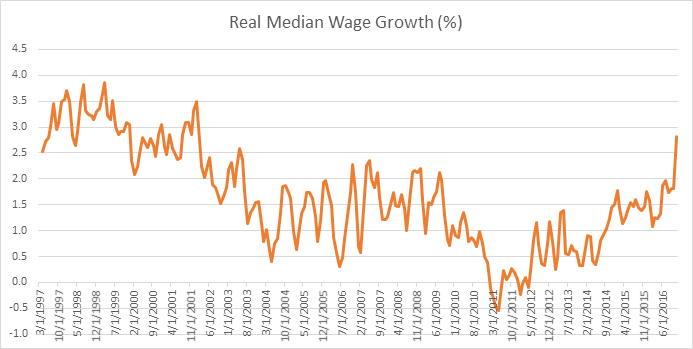
Real median wage growth highest in 15 years

The Atlanta Fed regularly publishes a measure of median nominal wage growth for several interesting demographics, but for some reason, they don’t publish any measure that is adjusted for inflation, so I created one using a running 2-month average of the Trimmed Mean PCE Inflation Rate.

As you can see, real median wage growth was stronger in November than it has been in 15 years. If this persists, Trump will preside over another golden age of growing wages like we had in the late 1990s. Voters who selected Trump because they wanted change may have been upset by low-low wage growth under Obama, but things are finally looking up recently.

This is a bad measure of overall wellbeing because the majority of Americans have a wage of zero dollars per hour because they don’t do market work. But everyone consumes market goods in order to live, so what we need to measure wellbeing is a measure of median consumption like MELI. During the recession a lot of low-wage workers were laid off which kept the median wage growth fairly steady until after the recession officially ended. Median consumption fell because of the large rise in unemployment.

This graph is just a measure of how well the labor market is performing to help the median worker.

Posted in MELI & Econ Stats

Fixing the machinery of democracy

The goal of medianism.org is to focus less on a minority with elite power and more on the vast group of people in the middle or even below the middle. In economics, that means focusing more on the median income, and in politics, that means focusing on the median political view. That is just another word for democracy. Most people think that the USA is a democracy in which the majority rules, but we aren’t.

Like most democracies in the world, our democracy is flawed in a way that becomes obvious after you think about it for ten minutes.  We are have a plurality voting system, not a majoritarian voting system.

Our main flaw is shared with most election systems around the world. It is that they are pluralistic, not majoritarian. They elect NOT the choice of a majority, but the choice of the biggest plurality.

I was first introduced to the plurality problem in an election for the German Club President in High School.  There were about 10 girls and only about seven boys in the club and the girls stuck together and voted for girls and the boys voted for boys.  That meant that the political potential for us boys seemed hopeless until Darren Friesen figured out how to rig the election by introducing spoilers.

He led a conspiracy among the boys to unify around one boy candidate and then various boys each nominated about four of the girls.  The girls who got nominated by boys were very flattered that we would nominate them until after the election when they discovered it was just a plot to use them as spoilers who would assure victory for the boy candidate.

In the election, the boy got seven votes and each girl only got a couple votes, so the boy won even though a majority of the electorate preferred any of the other four candidates over the winner.  That flaw in the electoral system made the girls quite cynical about the “democracy” just like it leads to cynicism about democracy in national elections.

A plurality voting system is problematic any time there are more than two candidates which is why it always causes problems during presidential primary elections.  For example, Trump should never have been selected as the Republican candidate because a majority of Republicans opposed him throughout the primaries. Because Trump’s opposition was split until near the end, he actually only got a fairly small minority of Republican votes in the primary. Less than 15% of eligible Americans showed up to vote in the Republican primaries, and a minority of them chose Trump, so only about 6 percent of eligible American voters actually selected Trump in the primary which is 4% of all Americans. Trump developed a very enthusiastic following of 4% of Americans who showed up to rallies and supported him in the primaries, but that was a tiny minority of Americans that selected one of the two candidates that we were all limited to voting for in the general election. Although Trump had higher negatives and lower overall support than any other Republican candidate during the primary, he won states because he had a small plurality of enthusiastic supporters who loved the unusual features that separated Trump from the rest of the Republican field.

Amartya Sen and Eric Maskin explained:

In the early contests, Mr. Trump attracted less than 50 percent of the vote… a majority of voters rejected him. But he faced more than one opponent every time, so that the non-Trump vote was split. That implies he could well have been defeated in most (given his extreme views on many subjects) had the opposition coalesced around one of his leading rivals. In such a scenario, he might have been out of contention long before he could ride his plurality victories toward his first outright majority win…

American primaries are not the only recent elections to produce winners lacking the support of a majority of voters. In India, the Bharatiya Janata Party received only 31 percent of the vote in the last general election, but got a majority of parliamentary seats. (Even including political allies, their vote share was no more than 39 percent.) The B.J.P., a right-wing party with a Hindu ideology for which only a minority of Hindus voted, has been running the government since, which is fair enough, given the electoral system. But it has also been persecuting political dissent as “anti-national.” Even majority support doesn’t give leaders in a democracy a right to stifle dissent. Invoking the battle cry “anti-national” in the name of the entire nation seems especially pernicious from a government without majority support.

As with the Republicans and Mr. Trump’s flirtations with fear and violence, India now suffers the ill effects of a serious confusion when a plurality win is marketed as a majority victory.

… Replacing plurality rule with majority rule would improve American primaries. More broadly, an understanding of the critical difference between a plurality and a majority could improve politics around the world. In an open letter to Prime Minister Narendra Modi in India, Gopal Gandhi, Mahatma’s grandson, wrote that “69 percent of the voters did not see you as their savior,” adding that they also “disagreed on what, actually, constitutes our [country].”
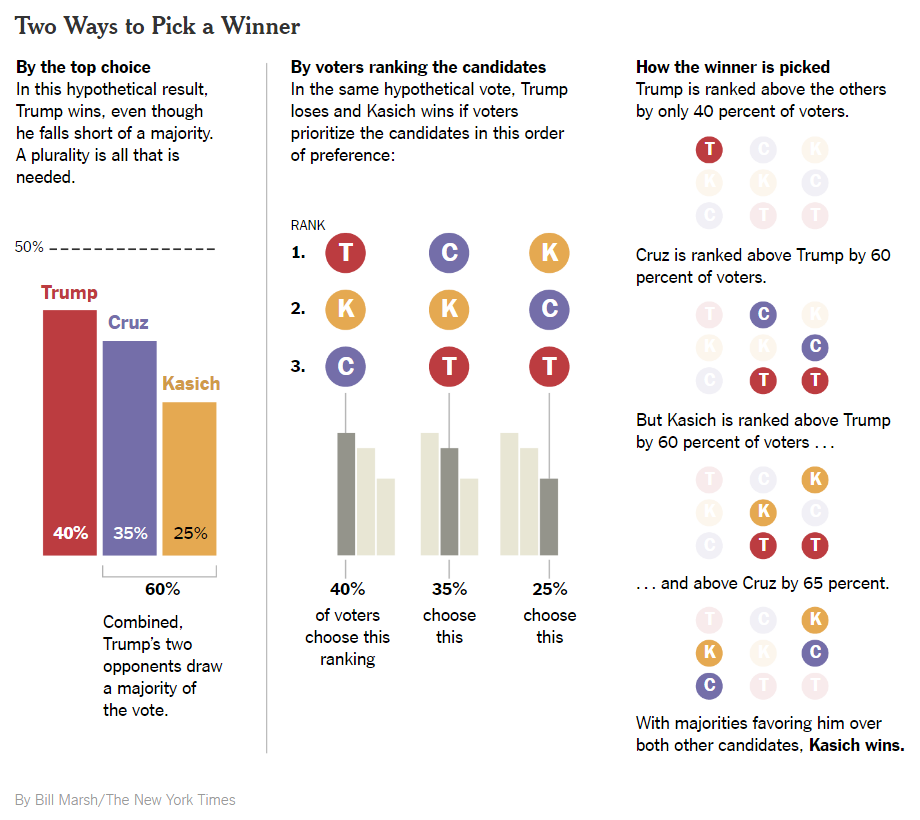
Sen and Maskin propose a voting system that is much better than our plurality voting system, but their article has some subtle errors because they promote a system that isn’t as good as Approval Voting or Score Voting. But I like it better than the popular instant runoff voting (IRV) system.  That system would have elected Cruz because it would eliminate the candidate with the fewest first-place votes (Kasich) and then see who those voters prefer (Cruz).  If you want a fun, in-depth explanation of all these voting systems, read Gaming The Vote by William Poundstone or for a shorter read, see Nicky Case’s website.

Poundstone shows how bad our voting system has been for the presidency (page 91). Here are all 19/49 presidents who won with less than a majority since the worst election in US history in 1824.

Presidential Winner

Vote

Turnout

1824

John Quincy Adams

30.9%

27%

1860

Abraham Lincoln – led to war!

39.7%

82%

1912

Woodrow Wilson (former Republican president sabotaged the Republican.)

41.8%

59%

1992

Bill Clinton (a Republican billionaire sabotaged the Republican)

43.0%

58%

1968

Richard Nixon

43.4%

63%

1856

James Buchanan

45.3%

79%

2016

Donald Trump

46.0%

59%

1892

Grover Cleveland

46.0%

76%

1848

Zachary Taylor (former Democratic president sabotaged the Democratic Party)

47.3%

73%

1888

Benjamin Harrison

47.8%

81%

2000

George W. Bush (a consumer advocate elected his nemesis.)

47.9%

54%

1876

Rutherford Hayes

47.9%

83%

1880

James Garfield

48.3%

81%

1884

Grover Cleveland (Prohibition Party helped elect an “ally of the saloon.“)

48.9%

78%

1996

Bill Clinton

49.2%

52%

1916

Woodrow Wilson

49.2%

62%

1844

James Polk (an abolitionist spoiler elected a slave-owner.)

49.5%

79%

1948

Harry Truman

49.6%

52%

1960

John Kennedy

49.7%

64%

Most Americans recognize that America’s unique electoral college system is undemocratic, but that is far from the worst part of our system.  Only five elections were solely mangled by the electoral college. In contrast, 19 out of 49 presidential elections were won by a candidate with a minority of the vote due to spoilers. Some of them might have been elected with a better voting system, but that is a overall failure rate of up to 39%.  Poundstone writes, “Were the plurality vote a car or an airliner it would be recognized for what it is — a defective consumer product, unsafe at any speed.” 

A lot of these presidents were disasters.  Even though I love Lincoln, and he was a great president, the 1860 election that gave us Lincoln also gave us the Civil War which killed a larger percentage of the US population than any other war so that election was hardly a pure success.  

The fact that our elections are being won by plurality minorities who aren’t popular is one reason democracy itself isn’t very popular right now. But a lot of the so-called failures of democracy are not really failures of the popular will. They are really examples of how voting systems are not democratic because they elect politicians that the majority rejects. As a result, democracy is becoming so unpopular that voters have essentially rejected it in some nations by voting for authoritarian rulers! It could happen in the US too.  Here is a scary chart by the New York Times showing how support for democracy has plummeted around the world among young people.
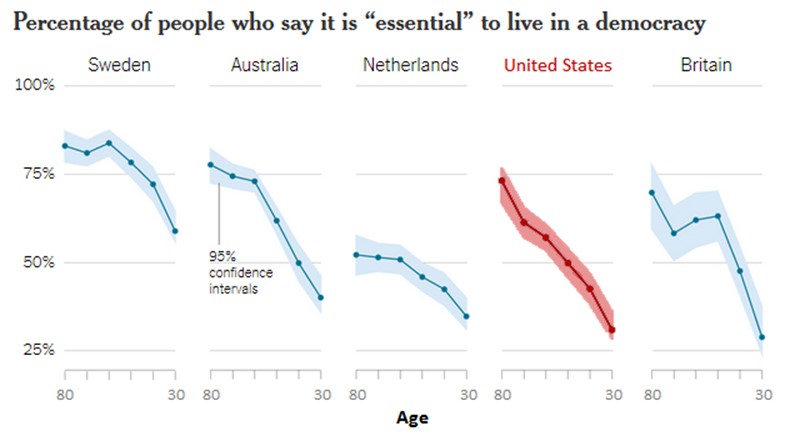
Less than 30 percent of American millennials think it’s essential to live in a democracy and millennials are our future. Although this data predates the Trump’s election, Trump is uniquely unpopular among millennials (compared with all other presidents on record), so they have probably become even less enthusiastic about our “democracy” since it again elected a candidate that they do not like. Whereas Trump has had the lowest approval overall rating in US history at around 41 or 42% on average, his approval ratings are much lower among young people.  And Trump has been disparaging our voting system (despite the fact that he presided over it for four years) so his supporters have dramatically reduced their approval of American democracy too.  These are dangerous trends.

Democracy is supposed to be a system in which a leader must get the approval of the majority of the population, but plurality voting plus the electoral college gave us Trump who has never achieved the approval of the majority of Americans?  Gerald Ford is the only previous president who began his presidency below 50% approval, but he wasn’t elected.
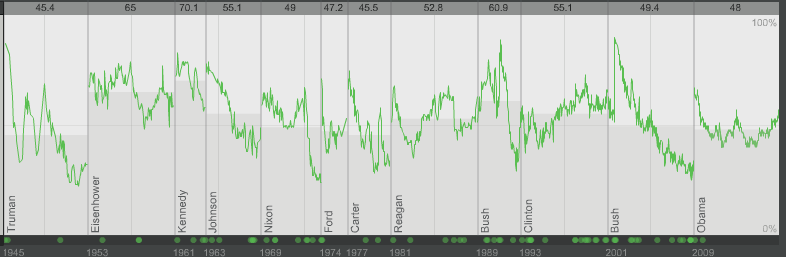
(The faint, continuous horizontal line in the graph shows 50% approval and the shaded area marks the average approval rating for each president.)

A 54% majority did not vote for Trump.  His claims to have won a majority are completely baseless.  Although Trump hasn’t done anything disastrous as president, there are numerous examples throughout history when a terrible person was elected because a plurality election system gave the power to a passionate minority to select a leader against the will of the majority. For example, Hitler won an election where he seems to have been opposed by vast majority of the electorate.

Hitler’s rise wasn’t a failure of bad judgement of the German people. His election was a failure of the democratic machinery to recognize the popular will. There are numerous examples of plurality “democratic” machinery selecting unpopular candidates like this throughout history. Recently in India the extremist Hindu Bharatiya Janata Party won with only 31 percent of the vote, and has been running the country with the sort of extremist policies that this small minority wants. Mohamed Morsi won in Egypt with similar levels of support from a minority of extremist Muslims.  His unpopularity later led to his deposal in a military coup.

The machinery of our democracy was put into place at a very undemocratic time when only a tiny percent of Americans were allowed to vote and slave-owners got extra voting power for owning more slaves even though slaves could not vote. Indeed, slavery is one of the reasons the Electoral College was instituted. It gave slave states more power than they would have had under a popular vote and there is still an element of this.  Bill O’Reilly supports the Electoral College partly on the basis of wanting to preserve “white privilege“, but this is fighting against the flow of American history.  Since the Constitution was first written, our democracy has changed from something that only a few rich white male elites enjoyed to something that most Americans enjoy.  Here is a list of selected improvements to US democracy.

  • 1810: State religious requirements mostly eliminated
  • 1850: Property ownership requirements eliminated
  • 1870: Former slaves can vote (15th Amendment)
  • 1920: Women can vote (19th Amendment)
  • 1924:  Native Americans can vote
  • 1961: Residents of DC (Bigger than WY) can vote for president (but still not for House and Senate).
  • 1962: Limited extreme gerrymandering.  Previously states could pack all the people they wanted to disenfranchise into a single district and give more representatives to all the other areas.
  • 1965: Blacks and Native Americans can’t be restricted from voting: Voting Rights Act — expanded in 1970, 1975, and 1982.
  • 1968: Last undemocratic selection of presidential candidate. Primaries get official nominating power in 1970s.
  • 1973-79:  Women cannot be excluded from juries.

As a result of these kinds of changes, the percent of Americans who vote has dramatically risen over the years:
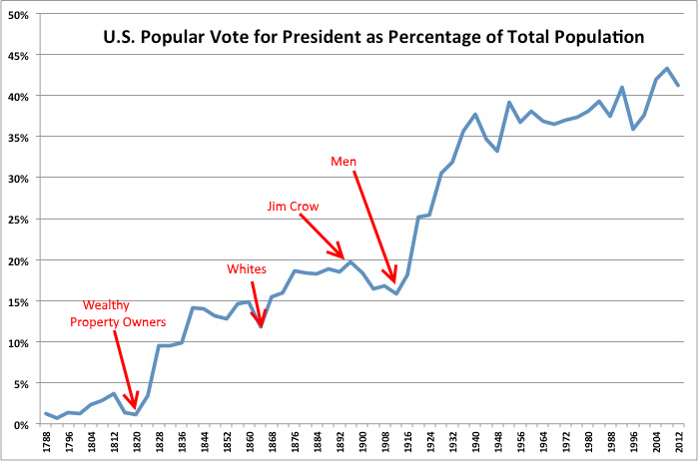
votingrights

Mass democracy is a very new thing in the history of the world. There were zero nations where a majority of the adult population could vote in 1900. Today the majority of the nations of the world at least aspires to have universal suffrage. More progress should be expected in the next century to make democracy work better at representing the will of the majority. Anti-democrats often rail against democracy by calling it a dictatorship of the majority, and that is the worst possible way to think about it.  But any other political system would be a dictatorship of a minority which is even worse. America’s system regularly gives a dictatorship to a minority to select our president against the will of the majority. A simple solution would be to eliminate the electoral college and use approval voting or score voting instead. Instant runoff voting is an alternative that has gotten a lot more attention, and although it isn’t as good as range voting, I’d still be thrilled to adopt instant runoffs because it too would be a big improvement over our plurality voting system.

Posted in Public Finance

Lions, tigers, bears, and deer. Oh My!

Earlier I wrote about the terrorism that is brutally killing 38,000 Americans this year in nightmarish fashion. I have now identified a group is responsible for 200 of these deaths and they are not even legal American citizens. What group sounds more lethal, the sharks, the snakes, the snakes, the wildcats or the deer? The deer should be the name that strikes terror into your heart. According to Brian Resnick:

every year, deer are involved in 1.2 million motor vehicle collisions, resulting in around 200 deaths, according to the Insurance Institute for Highway Safety. That makes deer deadlier than predators like the North American grizzly, great white sharks, and all venomous snakes combined.

Resnick argues that we could reduce this problem by more hunting or, more controversially:

a reestablished cougar population decreases the number of deer-vehicle accidents by 22 percent. The estimate is based on the assumption that “a single cougar would kill 259 deer over an average 6-year lifespan,” the paper notes. Each cougar, then, would yield a $37,600 savings in auto insurance claims. In total, the paper argues, a reestablished cougar population would save about five human lives a year and prevent 680 injuries…. the increased cougar horde would only injure around five people a year, and maybe cause one death.

Here is a more comprehensive article about deaths due to animals.

Update: Paul Neufeld Weaver wrote to point out that the first two sentences were muddled, so I hopefully clarified them now. Thanks Paul!

Posted in Public Finance, Violence & Peace

Zero debt would be an economic disaster.

I often see articles that claim that rising debt is an inherently bad thing. For example, Erik at data-driven thoughts appears alarmed:

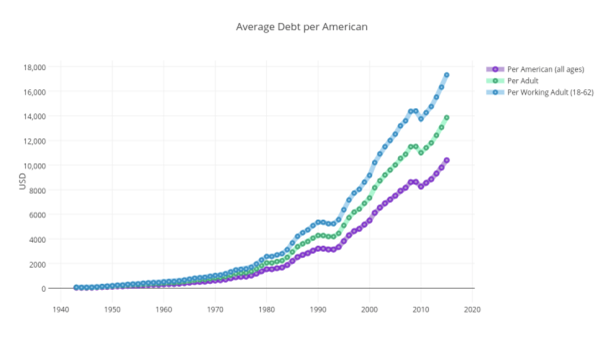
The average debt that an American holds has increased by 200x since 1943, from ~50 dollars to ~10,300 dollars. However the population includes all individuals, even those who probably don’t hold debt (children and possibly elderly). The chart below accounts for debt holders by visually showing debt per American, debt per adult*, and debt per working adult**. Average working Americans have about $17,500 in debt.

This is misleading because it doesn’t adjust for the growth of the economy. Furthermore, debt is not inherently bad for the economy. The absence of debt would be the absence of finance because all financial instruments are forms of debt and all debts are contracts. Nobody knows what the ideal quantity of debt is, but zero debt would be an economic disaster.

One person’s debt is always another person’s savings, so if debt is bad, then savings is bad. Most people think of their checking account as an asset, but it is also a debt that a bank owes to you. A bond is a debt that an organization owes to the bond owner who considers it savings. Some financial assets include physical collateral which is not a financial instrument, but a claim of ownership. For example, a mortgage is a debt that a home buyer owes to a bank with the house as collateral. Some people see a mortgage as a form of home ownership, but the payment contract is clearly a debt. A share of corporate stock is usually seen as ownership of a piece of a company, but it is closer to a form of debt than a form of ownership. It is a collateralized perpetual bond with a variable repayment rate that is tied to the profitability of the company. Unless you own a big enough fraction of a company’s stock to have a real say in how it is run, the company’s CEO and board of directors have much more ownership power than you and you are more like a lender.

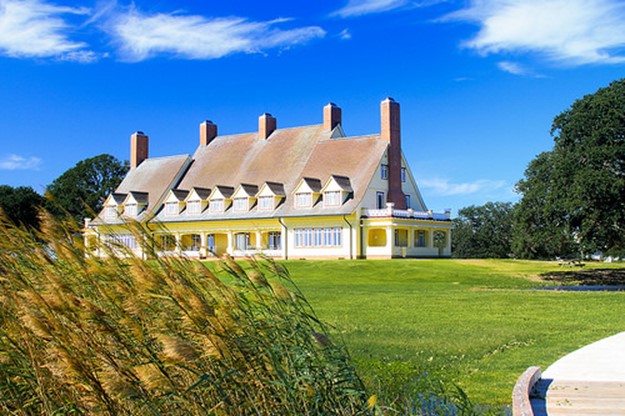
Image: ‘Whalehead‘ Found on flickrcc.net

Ownership is a property right and a property right is the power to exclude others from something. CEOs and corporate boards have this power. Banks often have more ownership control over companies than most shareholders do. For example, German corporations often have representatives from banks that lend to them on their board of directors. So there is often some overlap between debt and ownership that blurs the line between these categories.

Although most people want to think of their cash as their ownership of a solid asset, cash is really the most liquid form of pure debt. My $100 bill is like a debt that the rest of the world owes me $100 worth of goods and services. I can take it almost anywhere to get repaid. Of course, when I exchange it for groceries, the $100 debt hasn’t disappeared. It is just transferred benefits to the grocer and now the world owes the grocer $100 worth of goods and services. Even commodity money under the gold standard was mostly pure debt because almost nobody used pieces of actual gold as money. They used paper money and bank checks just like today. In fact, for decades under the gold standard, it was illegal for private citizens to have gold coins and bars because the banks needed to keep as much of it as possible for running the back-room operations of the banking system. The banks only had enough gold to represent a small fraction of the value of all the money was circulated which they kept as a kind of collateral, but it was never very good collateral because there was never enough for everyone to collect on it anyhow.

Where did debt originate? Debt is created out of nothing when a zero is split into a debt and a credit.  For most individuals’ debts, it is usually created based on the estimated value of future labor.

Buying and selling real estate is a relatively new financial innovation compared to the hundreds of thousands of years humans have roamed the earth. Little by little more and more land has come into the market economy, but today there is still much land in developing nations that isn’t clearly owned by its residents and cannot be formally sold. That realization was Hernando de Soto’s most famous contribution to economics.

Consider a village with traditional rights to family property, but without markets for buying and selling real estate. This is how all of humanity lived for millennia and millions still do. Land is simply kept in families by tradition and there is no need to buy or sell it.  Then a bank comes along and offers to lend money to young generations to buy the family properties from the older generations. The end result will be the same thing because the younger generation always gets land when the older generation dies, but this changes the economic power dynamics.

The older generation might like this new way to pass on land because it formalizes the traditional family social compacts that had always helped motivate the young to work the land and care for their elderly. The new financial arrangement, debt, gives the older generation more flexibility. They no longer have to live with their kids on their property to get cared for in retirement. Now they could take the money the younger generation paid and retire anywhere and hire help from anyone they can buy it from.

This process would create a massive amount of debt out of nothing. Suppose that the debts are all eventually repaid. Then everyone owns their own real estate again, and the debt disappears into nothing again. The real estate that it was based upon never changes, but in exchange for the land, the new owners end up doing a lot of work for the previous owners.  All debts based upon durable collateral like gold, silver, or real estate are like this. Another kind of debt is purely based upon contracts for labor. For example, we could create a debt if I work for you for an hour and you offer to pay me back in kind by working for me. An hour for an hour.

Economists think that the creation of debt tends to encourage economic production and the destruction of debts tends to discourage it, but that isn’t always true. For example, the idea of bankruptcy is intended to eliminate debt so that there are more incentives to produce again.

Fiat money is a kind of debt created out of nothing too. Whereas money is a kind of debt that pays zero interest, most debt contracts do involve interest. Interest adds a labor component to debt because it implies that there is a flow of production involved in the loan and all production requires some amount of labor. A house provides valuable services to its residents that enables them to work in a particular location which allows them to pay back a mortgage loan with interest. In this case, more economic activity is created by the destruction of the debt than by the creation of the debt because the interest encourages production.

This helps explain the empirical regularity that credit usually expands when GDP is rising and falls when GDP is falling (a recession). Because all interest-bearing loans require some labor to repay, the reduction in credit means less repayment and less motivation to work. And why would credit fall in the first place? I’m not sure, but one problem is a rise in default rates. When loans default and people give up on repayment, then debt can disappear without any labor. And if loans default, lenders will have less to lend out which means less future repayment and less motivation to work.

Posted in Macro

Terrorists are expected to kill 38,000 Americans this year in brutal crushing deaths!

Set the terrorist alert level to red! I’d say that anyone who physically crushes a random American with a heavy metal instrument is a terrorist. Others might just dismiss these deaths as routine traffic accidents, but you should be much more terrified of traffic than of Jihadists.

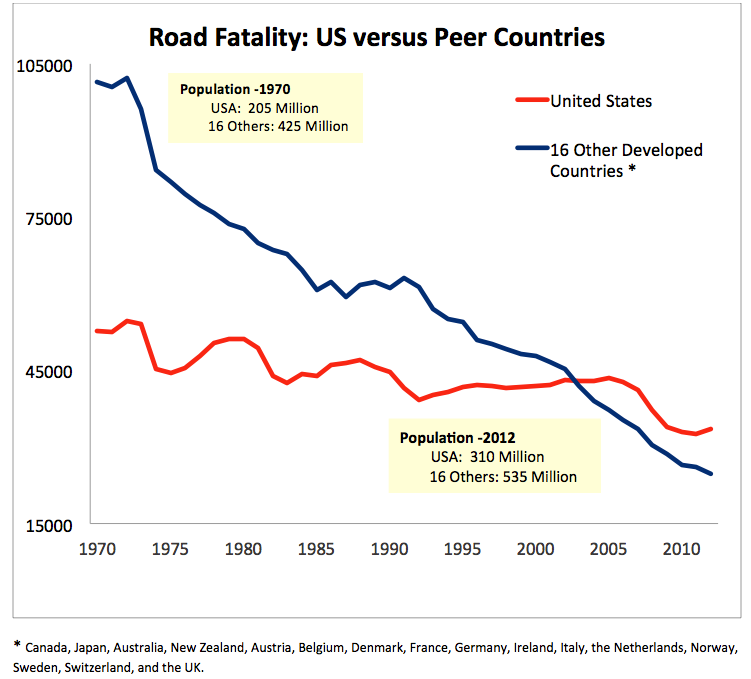
The good news according to a VOX article by researchers at the Sustainable Cities Research Group is that American traffic safety has improved over the past 40 years when it was the best traffic safety record in the world. YEA! Unfortunately, they say that:

A jump in traffic fatalities over the past two years has brought well-deserved media attention to this tragic aspect of American life. Such deaths are up 7 percent in 2015, and 10 percent for the first six months of 2016 — a phenomenon news outlets are describing as “surprising,” “sudden,” and “unexpected,” an unpleasant departure from the historic trend toward greater safety. We are on track to kill 38,000 vehicle occupants, motorcyclists, bicyclists, and pedestrians in 2016….

[Americans] now have traffic fatality rates per person that are three to four times greater than those in the best-performing peer countries — including Sweden, the UK, and the Netherlands.

Here is a graph of the data. It should use fatality rates rather than absolute numbers, but the relative trends would still be true.  Plus, one reason for the decline in fatalities is the improvement in medical treatment.  The number of severe injuries is many times the number of deaths.

In contrast, according to the New America Foundation, in the fifteen years after 9/11, jihadists have only killed 94 people inside the United States. If Islamic terrorism were plotted on this graph it would look like a line at zero except for a tiny blip (relative to traffic deaths) in 2001 due to the 9-11 attack.

The Sustainable Cities Research Group gives three reasons why all other rich nations are doing better at avoiding traffic fatalities than the US:

a) they live more compactly,

b) their road design favors more vulnerable users such as bikers and pedestrians, and

c) they have enacted laws and regulations that also favor these vulnerable road users.

Some of the blame for the second two problems is due to the first. Americans live less compactly partly because of the heavy hand of government: American zoning laws force Americans to live farther apart from each other than in any other rich nation, and subsidized roads, infrastructure, and real estate tax subsidies also bribe Americans to favor sprawling subdivisions.

82% of Americans live in cities which is a larger percentage compared to many other rich nations, so it isn’t the unavoidably vast space in rural America that causes American to drive so much.  It is mainly the sprawling design of American cities where most Americans live and drive to work. Americans don’t drive more because we are a bigger nation.  America is more urbanized than many other rich nations including Italy, Switzerland, Germany, Norway, and Britain. America is about as urbanized as the Netherlands, one of the most densely populated nations on earth. The big difference is that American cities are much more sprawling than in other rich nations and this forces Americans to drive farther to work each day which encourages road designs that are more dangerous and laws that favor higher vehicle speeds rather than safety.  Even Canada and Norway have more compact cities despite the fact that they have much lower overall population density than the US.

Sprawling urban planning also helps explain why Americans are more obese than people in any other rich nation. We walk and cycle less than in other countries because our streets are more dangerous and less pleasant for walking and cycling. You can even find evidence for this within America because American are less obese in cities like New York City with higher ratios of pedestrians to automobiles.

This is one more reason to change zoning laws and stop forcing Americans to live in sprawling communities.

Posted in Public Finance, Violence & Peace

1% of Indians pay income tax

The BBC’s Justin Rowlatt wrote that India published income tax data this year showing that only 1% of Indians paid tax in 2013, while 2% filed a tax return. He quoted Indian Prime Minister Narendra Modi saying:

publishing the data was a “big step towards transparency and informed policy-making”.…Just six individuals were in the top-earning tax bracket – declaring an average income of $10.4m (£7.1m). However, India has at least 84 billionaires, according to Forbes magazine, suggesting a huge shortfall in the amount of income tax paid by the very rich in India.

This amount of tax evasion is a symptom of the pervasive corruption in India. So much of the economy is below the table using cash to avoid taxes that the government announced a few weeks ago that it banned 86% of the cash in circulation! This economic experiment isn’t going well so far, but it is a massive problem and if this really solves it, then it could be worthwhile.

Imagine if only 1% of Americans paid taxes on their income. Although only about 50% pay what we traditionally call the “income tax”, all Americans who get a paycheck pay a tax on their income that is also paid to the IRS that we call the payroll tax even though it is just another kind of income tax. If only 1% of Americans paid these taxes on income, we would have no Social Security and Medicare. The defense budget would be shrunken to… well to the kind of amount that India can afford; a tiny fraction of the amount that America spends, and every government program would have to shrink, from education, to police to road maintenance.

Although these kinds of cuts would be very unpopular politically, it would produce a libertarian paradise for the 3% of Americans who voted libertarian!

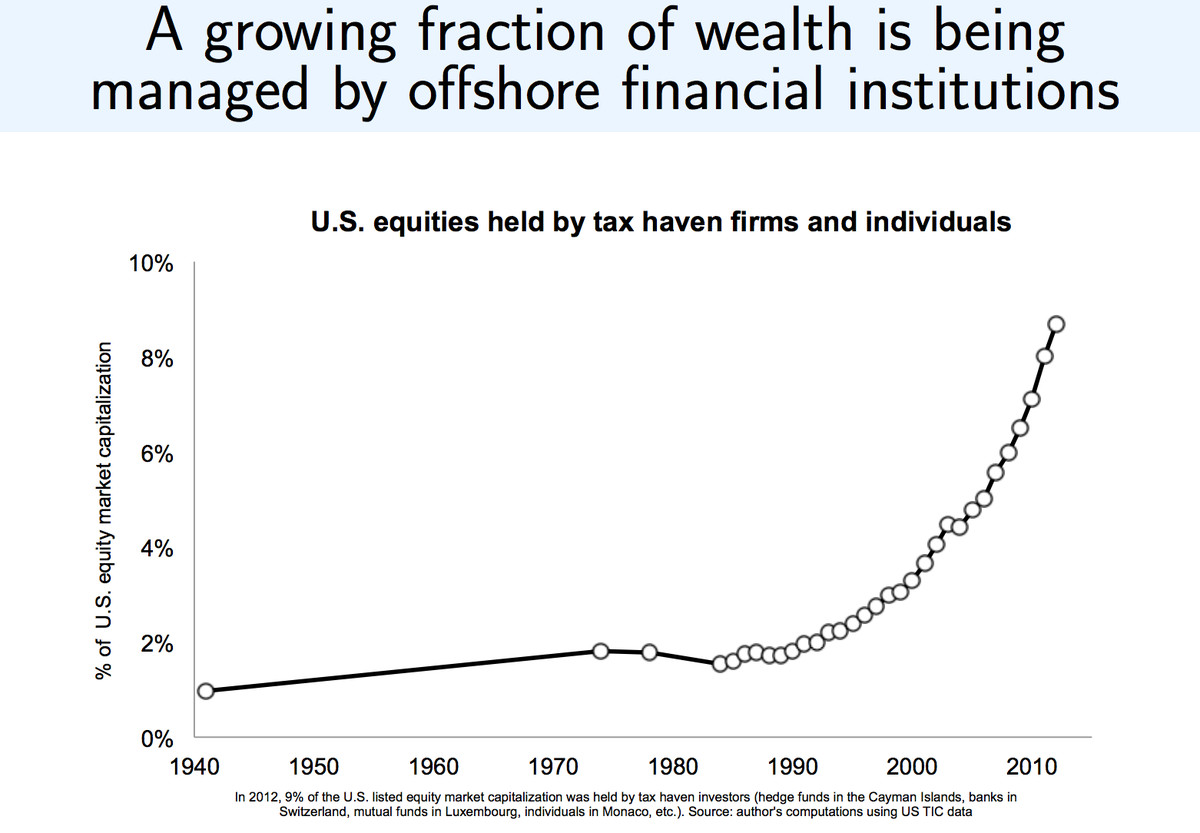
Recently the world has been becoming more like India.  Gabriel Zucman’s research produced this estimate:

zucman

Oxfam found that “Corporate tax dodging costs the US an estimated $100 billion each year, a gap that the average American taxpayer would have to shell out an extra $760 to cover”.

As Matt Yglesias points out, the US State Department routinely pressures foreign government to obey the interests of powerful American interests, but it isn’t in their interest to clamp down on global tax evasion:

American negotiators typically put a high priority on inducing foreign countries to changing their domestic laws to more closely conform to US practices and the interests of big US-based firms.

America’s bilateral trade promotion agreement with Panama is no exception to this, with the US Trade Representative’s Office touting “important disciplines … related to intellectual property” that are included in the agreement.

Tax enforcement is a low priority

As part of the negotiation, the US did also reach a bilateral tax transparency deal with Panama that will make it somewhat easier for the US Treasury Department to catch egregious cases of illegal tax evasion using Panamanian shell companies. But these tax information exchange agreements are relatively weak tools. As IRS Commissioner Douglas Shulman has explained:

“This is not to say that treaties and TIEAs are some sort of silver bullet; they have their shortcomings. It often takes a long time to get the requested information from partners; and …you may have to jump through a lot of hoops to get the information you need.”

This isn’t nothing. But it falls well short of what trade deals normally demand of US partner countries in terms of legal reforms to protect multinationals’ intellectual property, or the way domestic legal processes are circumvented to protect American investments abroad.

The nature and extent of global economic integration is deeply driven by elite priorities, and cracking down on tax evasion isn’t that high of a priority.

In the specific case of Panama, it’s worth recalling that back in 1989 the United States sent a small military force to invade Panama, depose its president, extradite him to the United States, and put him on trial for drug trafficking charges. If there were a strong bipartisan consensus in favor of coercing Panama into changing its laws regarding taxation or shell companies, we could get the job done.

The Panama Papers provide more evidence that elite tax evasion in offshore havens hasn’t been a priority of elites in government.

Posted in Development, Public Finance

Enter your email address to follow this blog and receive notifications of new posts by email.

Join 75 other subscribers
Blog Archive
Pages