Millionaire Superheroes: the International Rice Research Institute (IRRI)

Justin Rowlatt at The BBC celebrates the 50th birthday of IR8, a strain of rice developed by the IRRI in the Philippines that more than doubled rice productivity.

It is thought that IR8 saved many millions of lives and transformed the lives of hundreds of millions of people.

Back in the 1950s it was obvious that Asia, home to half the world’s population, faced an impending food crisis.

Rice accounts for 80% of the calories consumed in the region and you only needed to plot population growth against rice production to see that, within a few years, there would not be enough to go around.

Something needed to be done and in 1960 two American charities, the Ford and Rockefeller Foundations, joined forces to found the International Rice Research Institute (IRRI) in the Philippines.

… Dr Gurdev Singh Khush tells me… “Normally we get 1 or 2% yield increase every year,” …IR8 was different. It married a tall high-yielding strain from Indonesia (PETA) with a sturdy dwarf variety from China (DGWG) with astounding results.

“There was never any instance in the history of the world where rice yields doubled in one step,” says Dr Khush, clearly still amazed by what his team achieved.

In fact, according to some studies, IR8 yields in optimal conditions could be as much as 10 times that of traditional varieties. He says the “miracle” lay in the fact that the hybrid was short. “Much more of the energy from the sun went into producing the grain,” Mr Morell explains, “So there was more grain per plant and secondly it didn’t grow taller and fall over when fertiliser was applied.”…

IRRI played a key part in the development of the controversial so-called “Golden Rice”, a genetically-engineered strain designed to address vitamin A deficiency, which is estimated to kill 670,000 under-fives a year.

And now the Institute is also working on varieties that help combat the effects of having too much food.

Diabetes is a huge problem in Asia and IRRI has helped develop strains of rice with a low glycaemic index. That means once digested the rice releases its energy slowly, keeping blood sugar levels more stable – a crucial part of diabetes management.

IR8 dramatically reduced the price of rice which allowed everyone to eat more, but it also increased the real wage gap between urban and rural work because it lowered the wage of farming and increased the real wage of urban life because food was the majority of the budget for most urban households during the Green Revolution. It was still nearly 40% of household budgets in the major rice-consuming nations in 2008. In contrast, food was less than 7% of the average household budget in the US.

The FAO estimated that increased productivity decreased the price of rice 40% over the four decades after the introduction of IR8. Since rice accounted for 80% of calories in Asia, and food was well over half the average household budget, that meant that real urban wages could have risen by something like 16% merely due to the longstanding decrease in the price of rice. That helped increase rural migration to cities where productivity growth was greater and cities reduce fertility rates which slowed down population growth to a more sustainable level. Smaller families also helped increase economic development.

The IRRI is a superhero that probably saved millions of lives by increasing the productivity of rice.

Posted in Development, Millionaire Superheroes

Economic fundamentals models predicted Trump’s win

Most people didn’t predict Trump’s win. I didn’t, the Polls didn’t, the financial markets didn’t (stocks, foreign exchange, etc.), the betting markets didn’t, and most experts didn’t. However, there is a group that did predict a trump win using statistics that has consistently worked well at predicting presidential elections:  econometrics models.  This literature was started by Yale University economist Ray Fair back in the 1970s. These models largely predict who will win based upon growth in GDP. It turns out that when GDP has been growing well, the incumbent president is much more likely to be reelected. Other models that have used this methodology include Vox.com, Time-for-change, Lewis-Beck & Tien, and Trial-heat.

These models predicted that a generic Republican should have won the popular vote and that Donald Trump significantly underperformed the fundamental political landscape that he was given by fate. Even though he won, the econometrics models still judge him to be a somewhat weak candidate because his vote share was considerably smaller than what they predicted.  Unfortunately, the models use GDP rather than median income. Median income would be the best data for predicting the median voter, but the models use GDP instead because it is much easier to get timely GDP data than median income data and the latter data is noisier due to cheaper, smaller sample sizes.

Indeed, given how badly GDP correlates with the wellbeing of the median voter, it is amazing that it helps predict elections at all (and 538’s Nate Silver argues that it has little value). Consumption would also be a better measure of economic wellbeing in theory, but it might not matter much for the political economy models in practice because GDP is a fairly good proxy for US household consumption in the short-run. (The two are highly correlated in the short-run because consumption is the biggest component of GDP and is causally interdependent with the other components.)  But consumption should produce better political predictions than gross GDP.

Nate Silver (538) agrees with me.  His 538 election model uses personal consumption expenditures and real personal income rather than GDP, but 538’s prediction model gradually reduces the weight placed on economic variables as the date gets closer to Election Day. On Election Day, they completely discarded the economic fundamentals information and just use polling data. That helps explain why their prediction was worse than the other econometrics models that stuck with the fundamentals and ignored the polls. It wasn’t a problem with using consumption data. The problem was that they gradually discarded information about it from their model and increasingly just used polls which turned out to be way off.

One reason nobody paid much attention to the econometrics models is that they usually give similar predictions as the polls give. This election they contradicted the polls and most people trusted the polling data more than the economic fundamentals which they ignored.  Even many of the people creating the economic models tended to discount their predictions this time around.  For example, Vox’s Andrew Prokop said:

Abramowitz publicly disavowed his own forecast’s projections, arguing that it applied for “mainstream” candidates and not for Trump. “Donald Trump is far from a mainstream candidate,” he told Vox’s Dylan Matthews in an email. That’s not to beat on Abramowitz here — I also was aware of what these models showed and yet rarely wrote about them, since I shared the opinion that they were probably going to be “off” this year because Trump was just so strange.

In the end, it turned out that Trump was indeed less popular than the economic models predicted, but not by much.  I suspect that if we had good enough data about median income to use that in our econometric predictions we would see that Trump underperformed the economic conditions even more than was indicated by the models based on GDP.  We just don’t have good enough data to know.

For example, although the Census Bureau announced the biggest increase in median income in recorded history just before the election, their announcement was about data that was already a year old, so it was too old to be useful for political predictions based on what we know from the GDP models.   Median income is so neglected by the government that there is no official measure that is up-to-date, but Sentier Research posts the most up-to-date measures and their data shows median income was down in 2016.

Plus, even if we used more up-to-date data, some of the apparent increase was just a statistical illusion created by changing work hours and a change in the survey methodology.  The new survey increased their measure of household median income by 3.2% so that could account for most of the apparent increase.  The true change in median income was highly uncertain given the ongoing noise in the data caused by small sample sizes and the methodological change.  You can see the noise in the data in the jumpiness of the red line above.  Most of that is an illusion too.  We need better data!

Posted in Public Finance

Anyone who is a true advocate for the middle class must accept a little class warfare

The American Enterprise Institute, a conservative think tank, wrote a position paper arguing that Americans are saving a lot more for retirement than a Pew study showed. The AEI objected to the sort of media reports about the Pew study saying, “Retirement insecurity shows decline of the middle class.”  The AEI argued that this is wrong, but the problem with the AEI’s lengthy response is that it ignored the middle class.  Instead, the AEI just looked at aggregate numbers which include wealthy people who have much more retirement security than the middle class.  Even when the AEI showed everyone all lumped together, the nation still looks mediocre, but if we actually looked at the middle class, retirement security would look much worse.

The AEI objected to the Pew survey which found that only 34% of Americans reported participating in a retirement plan. AEI points out that tax records showed that 46% were actually taking part. That is still pretty dismal, but neither statistic actually sheds much light about middle class retirement insecurity because richer people have a lot more retirement security than the middle class and rich people are harder to survey, so they don’t show up as much in surveys like Pew did.

The AEI loves to talk about the middle class and how much its policies will benefit the middle class, but as is often case, they did a bait and switch and gave misleading evidence about the total rather than the middle. The AEI has an ideological difficulty with giving data about the middle class because they hate class warfare, but if they really prioritized the middle class, that would actually be a form of class warfare. Their stated ethical priorities are in conflict and their compromise is to just talk about the middle class without actually measuring it or even defining it consistently. That way they can say that they are helping the middle class without having to give any actual evidence and they never have to confront any data that might indicate that some of the policies that would help the middle class would be construed as class warfare against the rich by their funders.

Many people at the AEI seem to believe that higher inequality makes the nation more efficient. (This idea is particularly explicit in the recommended reading they cite at the bottom of the linked article.) That might lead them to think that higher inequality would always help the middle class. But there are many examples where lower inequality benefits the middle class and many examples where more equality boosts economic growth too. If they really prioritized the middle class, they would want data about the middle tercile to show what has worked and what hasn’t, but that would be “class warfare”, so they don’t check.

Posted in Inequality, Middle class

The State of The USA is mmutilitarian

The State of The USA is an organization that receives federal funding with the mission to measure “the nation’s progress… with the best quality measures and data on the most important issues facing the country” by creating a “Key National Indicator System.”   Unfortunately, the organization is anti-medianism.  Not only do they ignore the median income, they incorrectly opine that its virtues are actually flaws.  They begin by recognize that “some economists” prefer median income:

Some economists emphasize the usefulness of median statistics to measure income. Doing so, they say, gives a better picture of more people’s living conditions by using traditional per capita income measures to avoid giving undue weight to those at the top of the income spectrum.

And then they try to knock this down by arguing that rich people deserve added weight in measuring wellbeing!

…using the median statistic minimizes the importance of extreme values in the income spectrum, and it may be that an added weight to those values is desired.  In the median income example, it could be argued that using median income paints an economic picture that is perhaps grimmer than it actually is, as the fact that people have a chance to obtain high incomes is arguably downplayed. …using the median doesn’t take into account the positive effects of having some people with very high incomes.

This sentiment is simply wrong.  First, who ‘desires’ that the rich should deserve “added weight”?  In a democracy, everyone should get the same weight and the median does a much better job (albeit still imperfect) than the mean income at treating people equally rather than weighing people according to their wealth.  What reason is there to valorize the rich over the median?  Second, there is diminishing marginal utility of wealth.  Adding $10,000 to a billionaire’s income makes an unnoticeable difference in his life.  Adding $10,000 to someone with the median income is an incredible bonus.  Third, what are “the positive effects of having some people with very high incomes” if it doesn’t trickle down to help the median income?  The usual argument that supports higher inequality is that it will be great for everyone including the poor, but if it is great for everyone, then the positive effects should help the median income too and the median income will rise in correlation with the fortunes of the rich.

Fourth, they claim that mean income is “unbiased” which is also false.  A mean is only unbiased for data with a normal distribution, but even in this case the median is just as unbiased as the mean because mean is exactly equal to the median for normal data.  However, most of the income distribution is lognormal and most statisticians argue that the median is less biased for lognormal data.  Finally, economists have often claimed that the utility (welfare generation) of money can only be measured ordinally and it is impossible to use a mean for ordinal data, but a median works fine.  Only a mmutilitarian who thinks that money=utility=wellbeing would claim that mean income is less biased than the median.

I searched The State of The USA for “median” and only found 35 hits, so they don’t use it much because they prefer mean GDP.  Most people neglect median income because it is hard to find good data about median income, but The State of the USA neglects it because of their mmutilitarian philosophy.  They just simply prefer mean GDP.

In Jon Gertners  excellent survey of GDP at the NYT he wrote why the income of high-income people are less important for wellbeing than the middle class:

 “There’s an enormous inequality of suffering in society,” Daniel Kahneman told me recently. By his estimate, “if you look at the 10 percent of people who spend the most time suffering, they account for almost half of the total amount of suffering.” Kahneman suggested that tremendous social and economic gains could therefore be made by dealing with the mental-health problems — depression, say — of a relatively small fraction of the population. At the same time, he added, new measures of emotional well-being that he has been working on might soon give us a more enlightened perspective on the complex relationship between money and happiness.

Currently, research suggests that increased wealth leads us to report increased feelings of satisfaction with our lives — a validation, in effect, that higher G.D.P. increases the well-being in a country. But Kahneman told me that his most recent studies, conducted with the Princeton economist Angus Deaton, suggest that money doesn’t necessarily make much of a difference in our moment-to-moment happiness, which is distinct from our feelings of satisfaction. According to their work, income over about $70,000 does nothing to improve how much we enjoy our activities on a typical day. And that raises some intriguing questions. Do we want government to help us increase our sense of satisfaction? Or do we want it to help us get through our days without feeling misery? The two questions lead toward two very different policy options. Is national progress a matter of making an increasing number of people very rich? Or is it about getting as many people as possible into the middle class?

Median expected lifetime income won’t completely solve these issues, but at least it is a step in the right direction.

Posted in Medianism

The State of the USA is… Unclear

Jon Gertner wrote a great article about the history of GDP and other social welfare indicators on the New York Times.  The occasion for the article was a new “challenge to the G.D.P. …known as State of the USA” which was bringing an eponymous website online at the time (2010).  Their mission is to “assess the nation’s progress… at all levels, with the best quality measures and data on the most important issues facing the country.”  Six years later, you probably have not heard about the State of the USA replacing GDP as the primary social indicator.

Although the State of the USA received assistance from prominent organizations like the National Academy of Sciences, the Hewlett, MacArthur and Rockefeller foundations, plus $70 million in federal government support, their “key national indicators” system has done nothing to rival GDP.  Instead, they tried to gather a collection of existing data rather than creating anything new, but even that effort is pathetic compared to what the Federal Reserve Economic Database (FRED) already does.  The home page currently displays links to data about job growth and the portrayal of smoking in movies, but there is nothing there that gives any hint of challenging GDP.

We need a statistic that is as clear as GDP before we can replace GDP.  GDP is the total annual income of a group.  That is a simple concept to understand.  When the total income goes down from one year to the next, that is a recession and the government responds by lowering interest rates, cutting taxes, and extending unemployment benefits.  When discussing whether tax cuts for the rich are desirable or not (as Pikketty & Saez examined), the issue centers around whether or not GDP grows faster when the top tax rate changes.  But why should the rest of us care if the growth of high incomes causes aggregate income (GDP) to rise if incomes for the rest of us are not growing?  As I posted earlier, this has been the case in the ‘recovery’ from the 2008 recession until median income finally started growing in 2013.  The recession officially ended in 2009 because the income of the wealthy increased enough to outweigh the drop in median income and that dynamic continued for four years without improvement for the majority of American households.

Posted in Medianism

History of GDP

In 2010, Jon Gertner at the NYT published an excellent history of the idea of GDP and its deficiencies.  One paragraph mentions that median income is better than GDP, but  the article focuses more on a “willfully obscure” initiative called The State of The USA, which is still just as obscure today, six years later.

the governments of the world have long held the view that only one statistic, …gross domestic product, can really show whether things seem to be getting better or getting worse. G.D.P. is an index of a country’s entire economic output …It’s a figure that compresses the immensity of a national economy into a single data point of surpassing density. The conventional feeling about G.D.P. is that the more it grows, the better a country and its citizens are doing.  …All the same, it has been a difficult few years for G.D.P. For decades, academics and gadflies have been critical of the measure, suggesting that it is an inaccurate and misleading gauge of prosperity. What has changed more recently is that G.D.P. has been actively challenged by a variety of world leaders, especially in Europe, as well as by a number of international groups, like the Organization for Economic Cooperation and Development. The G.D.P., according to arguments I heard from economists as far afield as Italy, France and Canada, has not only failed to capture the well-being of a 21st-century society but has also skewed global political objectives toward the single-minded pursuit of economic growth. “The economists messed everything up,” Alex Michalos, a former chancellor at the University of Northern British Columbia, told me recently when I was in Toronto to hear his presentation on the Canadian Index of Well-Being. The index is making its debut this year as a counterweight to the monolithic gross domestic product numbers. “The main barrier to getting progress has been that statistical agencies around the world are run by economists and statisticians,” Michalos said. “And they are not people who are comfortable with human beings.” The fundamental national measure they employ, he added, tells us a good deal about the economy but almost nothing about the specific things in our lives that really matter.  …

The Canadian Index of Well-Being is an interesting attempt to replace GDP, but it is too complicated and because people don’t understand it, it gets ignored.  Plus, it goes too far at downplaying income and lifespan as a measure of economic prosperity.  Median Expected Lifetime Income (MELI) would have a better chance at becoming influential.

For now at least, G.D.P. holds almost unassailable sway, not only as the key national indicator for the economic health of the United States but also for that of the rest of the world’s developed countries, which employ a standardized methodology — there’s actually a handbook — to calculate their economic outputs. And, as it happens, there are some good reasons that everyone has depended on it for so long. “If you want to know why G.D.P. matters, you can just put yourself back in the 1930 period, where we had no idea what was happening to our economy,” William Nordhaus, a Yale economist who has spent a distinguished career thinking about economic measurement, told me recently. “There were people then who said things were fine and others who said things weren’t fine. But we had no comprehensive measures, so we looked at things like boxcar loadings.” If you compare the crisis of 1930 with the crisis of 2008, Nordhaus added, it has made an enormous difference to track what’s happening in the economy through indexes like G.D.P. Such knowledge can enable a quick and informed policy response, which in the past year took shape as a big stimulus package, for example. To Nordhaus, in fact, the G.D.P. — the antecedents of which were developed in the early 1930s by an economist named Simon Kuznets at the federal government’s request — is one of the greatest inventions of the 20th century. “It’s not a machine or a computer,” he says, “and it’s not the way you usually think of an invention. But it’s an awesome thing.”

Our ability to measure GDP has helped us develop policies to fight recessions.  But GDP also misleads us into giving up on fighting recessions too early and letting unemployment persist.   Efforts to fight the recession (and thereby fight unemployment via Okun’s Law) ended when GDP turned around, but median income kept plummeting for years.  That means that the majority of Americans were still in a recession and still needed continued policies to fight the recession.

G.D.P. statistics are calculated a dozen times a year… For an entire day, the suite of offices where [the] group works is placed under… “lockup.” Cellphones are handed in; land lines and Internet connections are cut off; curtains are drawn tight. Only certain personnel are allowed in and out. The men and women …then spend the day following a process that has been refined over the past 50 years. It is a complicated affair, involving the convergence of some 10,000 streams of data that describe recent economic activity in the U.S., but the group’s goal is fairly simple: to arrive at a single number and then explain it in a press release. By tradition, no one in the room says the final number aloud — a throwback to the old days, apparently, when the fear of hidden microphones prompted silent acclamation. The finished press release is photocopied a couple of hundred times and then locked up, except for a single copy delivered at the end of the day to the chairman of the president’s Council of Economic Advisers. Anyone who knows the figure at this point is forbidden to reveal it, lest its premature unveiling roil the global financial markets. Not until 8:30 the next morning will [the Bureau of Economic Analysis] release the G.D.P. number to the rest of the world.

Government statisticians …do not push any equivalency between an expanding G.D.P. and national progress. For them, G.D.P. is what it is and nothing more: a description of total national production that can be helpful when setting economic policy. The longtime tendency of politicians to use G.D.P. as a proxy for national well-being is not a practice the Bureau of Economic Analysis endorses or could necessarily control, even if it wanted to. That the Obama administration, for instance, has pointed to rebounding G.D.P. numbers rather than our unusually high unemployment numbers reflects a political calculation rather than a case of economists beating a drum for the glory of G.D.P.

Although unemployment is a better measure of recessions, the US political system is inherently biased towards prioritizing GDP mmutilitarianism over unemployment because our political elites’ fortunes are measured more accurately by GDP than by unemployment.  The elites who run our media, government, and businesses feel like unemployment statistics are out of touch with their reality because unemployment among highly-educated (and well-connected) elites is much lower than for the average American.  In contrast, GDP is heavily influenced by high-income earners because it reflects their incomes much more than the incomes at the median to say nothing of the poor.

Posted in MELI & Econ Stats

Rising house sizes are NOT an accurate measure of wellbeing

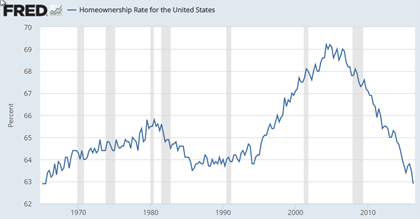
AEI employees, James Pethokoukis and Mark J. Perry, both wrote separate arguments that Americans are “substantially better off” now than in the 1970s because, as Pethokoukis titles his essay, “The median US home is 61% larger than 40 years ago.” But his title is misleading. His data actually shows the median NEWLY CONSTRUCTED home is bigger. That is NOT the median home that Americans live in. The housing market has been focusing on upper-income Americans. In the 1950s, American home builders seem to have been more focused on building new homes that the average American could afford because the median size of new home construction was about the same as it was in the 1920s. That is no longer the case. Americans near the median are lucky to be able to afford a house at all, much less a brand new house. Less than 63% of American households own their residence which is the lowest rate since the Census Bureau began keeping records in 1965. If housing is getting better, why are fewer Americans able to buy houses? More Americans near the median are renting.

Furthermore, new housing is very unrepresentative of all housing. Only about one percent of American households move into a newly constructed house in any given year and they are quite different from the average American household. Below is the data that the AEI writers think paints an optimistic picture of American prosperity:

Here is Mark Perry’s bottom line:

We hear all the time about stagnating household incomes, the decline of the middle class, rising income inequality, and lots of other stories of gloom and doom for Americans. But when it comes to the new homes that Americans are buying and living in, we see a much brighter picture of life in the US. The new homes that today’s generations are buying are larger by 1,000 square feet compared to the average new homes our parents might have purchased in 1973, and are almost double in living size today adjusted for household size compared to 40 years ago.

Unfortunately the Americans that Perry is talking about are fairly elite. We don’t have data about the income of brand new home buyers, but it is clearly well above the median income today. This data doesn’t make a brighter picture of life in the US for anyone but the upper class and upper-middle class at best and there is no dispute that they have done well during this era of rising inequality.

Posted in Medianism

Enter your email address to follow this blog and receive notifications of new posts by email.

Join 75 other subscribers
Blog Archive
Pages