Who Is Dependent Upon Whom?


David Landes wrote:

“Why are we so rich and they so poor?” …most answers to the question … fall into one of two lines of explanation. One says that we are so rich and they so poor because we are so good and they so bad; that is, we are hardworking, knowledgable, educated, well-governed, efficacious, and productive, and they are the reverse. The other says that we are so rich and they so poor because we are so bad and they so good: we are greedy, ruthless, exploitative, aggressive, while they are weak, innocent, virtuous, abused, and vulnerable. It is not clear to me that one line of argument necessarily precludes the other, although most observers and commentators have a strong preference in the matter.

This year I discovered that Bluffton University has had a long tradition of teaching about dependency theory as a paradigm for economic development.  This was surprising to me because I’m a PhD economist and I had never heard of the term.  It is simply not used in mainstream economics.

Dependency theory is the idea that rich nations have mainly gotten rich by stealing resources from poor nations and the global economy is basically a zero-sum game.  Although it is true that some parts of the economy are zero-sum, many parts of the economy are positive-sum and can benefit everyone.  In the big picture of economic development since 1800, most of the dynamics that made rich people rich have been positive-sum interactions because that is the only way to explain the fact that the world has about 9 times more people now than in 1800 and yet about 90% of the world’s population today is richer than the richest people in the world in 1800.  Plus, every nation in the world has a much longer life expectancy than the longest-lived nation in the world in 1800. These economic miracles cannot be explained by a zero-sum game.

Below is a bubble chart showing every nation in the world in the year 1800 and you can see that the maximum life expectancy in the world was about 40 and the average income of the rich nations of Europe and North America was about $2500 per person. 

life_incometop

Compared with the year 2020 (below), every nation in the world was much less healthier and all nations grew much richer.  Today, the poorest nations in the world are almost as rich as the richest nations in the world in 1800 despite the fact that the populations of the poorest nations today are well over ten times larger than they had in 1800.  

life_income2top

The reason that the whole world has grown richer and healthier is mainly the growth in technologies that have made us a lot more efficient at producing wealth and health for everyone.  Plus, voluntary trade between any two partners always has a strong positive-sum dimension because it always makes both parties better off (or they wouldn’t voluntarily do it) and trade has exploded over the past two centuries. 

But the zero-sum world of dependency theory can also be a useful concept IF we apply it carefully.  For example, the concept originated in 1949 which happened to be near the end of a long colonial era.  One of the incentives of colonial economics was for rich countries to extract resources from native peoples.  That was not voluntary trade, so there is no reason to think that it was positive sum. 

Unfortunately, dependency theorists extrapolated from colonialism to claim that the only reason poor nations are poor is because rich nations have stolen their resources.  Thus, rich nations are rich because their income is dependent upon stealing from poor nations.  This is mostly not the case.  If all of the populations of poor countries completely disappeared, the economies of rich countries would suffer only slightly because rich nations only trade a small amount with poor nations and mostly trade with other rich nations. 

For example, only 1.5 percent of U.S. exports went to sub-Saharan Africa in 2015.  If Africa refused to buy American exports, 98.5% of the income America makes from selling exports would still remain.  America trades more with tiny Switzerland (and is more dependent upon Switzerland) than with all of sub-Saharan Africa.  In 2019, the US imported less than 1% of total imports from Africa which is about a tenth of one percent of total annual US income.  About 90% of imports from Africa is crude oil which is much easier to substitute than the kinds of medicines, computers, and machinery that Africa imports from the US. 

Thus if the populations of rich nations disappeared, poor nations would suffer more than vice versa because it is harder to replace the high-tech manufacturing that rich nations export than to replace the commodities that poor nations export.  If all trade with all of Africa completely ceased, the US would get along without noticing much difference because the US is much more dependent upon rich nations as trading partners. And US trade with Africa is disproportionately heavy with the relatively rich African nations like South Africa and Egypt.   

Both rich nations and poor nations benefit from trade with each other. 

Stealing cannot account for two centuries of economic growth because stealing destroys productive capacity and reduces long-run economic growth.  As Dierdre McCloskey explains:

Nearly forever, from the caves until about two centuries ago, the average human, …dragged along in today’s prices on less than $2 a day. Try living on $2 a day. Some people still do: South Sudan. Then, from 1800… to the present, a Great Enrichment, …made the average human 25 times richer. The number nowadays in the same prices is about $50 a day. Think China, Brazil, and Botswana. And Finland, Ireland, and Iceland, once miserable and colonized, stand well above $100 a day. At $50 or $100 a day, people get food instead of famine, long lives in­stead of parasites, Ph.D.s instead of illiteracy, high-rises instead of hovels.

Every nasty jerk in history has stolen, and usually gotten away with it. As Gibbon said in 1776, “history is little more than the register of the crimes, follies, and misfortunes of mankind.” So stealing by imperialism and enslavement caused the Great Enrichment, yes?

No. Do the numbers. If you seized your neighbor’s house and her stuff and enslaved her husband, you might get 20 percent richer. Maybe 50%. Call it 100%. Great for you. “Foreigners shall rebuild your walls,” said the Lord to Jerusalem through His prophet Isaiah, “and their kings shall be your servants. . . . Your gates shall be open continuously . . . that through them may be brought the wealth of nations and their kings under escort.” Good for Jerusalem. In the zero-sum world before 1800, stealing and enslaving got the jerks 20, 50, even 100 percent richer. Hallelujah.

But the Great Enrichment has been two-and-a-half thousand percent. …Blimey. Stealing can’t come remotely close to accounting for it. Stealing from the wretched of the earth doesn’t even sound like a good criminal plan. And anyway, stealing from Peter to pay Paul can’t enrich both, and certainly not by 2,500 percent.

…After all, the historical problem with the hypothesis of stealing for enrichment is that stealing is historically commonplace [for thousands of years], yet it never resulted in a Great Enrichment.

…If stealing from colonies explained the Great Enrichment, then Sweden, which had a trivial overseas empire, would be poorer than Britain, which had the largest one in history. If slave-stealing did, then Canada, which had no slaves, would be radically poorer than the U.S… If Jim Crow had been good for the U.S. South, it too would be richer. The countless conquering and enslaving societies following on the Sumerians, the Olmecs, and the Shang Dynasty would have produced a Great Enrichment be­fore the Great Enrichment.

Some of colonialism was stealing which is inexcusable, but there was also considerable trade which is completely different from stealing.  For example, consider Uzbekistan, a poor nation whose total exports in 2012 were about $15b.  That is nothing by rich-world standards.  For comparison, Boston alone had a total GDP that was 20 times bigger than Uzbekistan’s total exports.   If Uzbekistan stopped exporting, rich nations would hardly notice.  But if rich nations stopped trading with Uzbekistan, Uzbekistan would suffer tremendously because Uzbekistan is very dependent upon rich nations who supply most medicines, electronics, and machines in exchange for Uzbekistan’s exports (mostly commodities).  Uzbekistan clearly benefits from trade with rich nations and the benefits are mutual.

tashkent-1634109_1280

Dependency theory doesn’t work at all to explain the inequality between, say the US and Uzbekistan, but it does work pretty well for explaining much of the inequality within nations.  For example, it helps explain the inequality within colonialism in which a single government encouraged the extraction of resources from poor colonies to enrich the motherland. 

Dependency theory also explains inequality within modern countries like Uzbekistan.  The elite of Uzbekistan really are dependent upon the average workers of Uzbekistan.  If the elite of Uzbekistan disappeared, the Uzbekistani people would probably be much better off materially, whereas if the common workers of Uzbekistan disappeared, the elite of Uzbekistan would suddenly become very poor.  The elites would suddenly have to pick their own cotton and wash their own laundry.  The wealth of Uzbekistani elites is entirely dependent upon the work of their poor citizens.  As the Bible says in Proverbs 14:28, “without subjects a prince is ruined.” 

Daron Acemoglu and James Robinson’s recent book,  Why Nations Fail, explains:

…take Uzbekistan. Why does it have 1/15 of the US income per capita? Perhaps it is because of “human capital” — Uzbekis having less education and education and skills? Well there’s a surprise, Uzbekistan has close to complete primary and secondary school enrollment, and close to 100% literacy. But look a bit deeper, and you’ll see something a little unusual going on in Uzbeki schools.
The basis of Uzbekistan’s economy is cotton which makes up 45% of exports. The cotton bolls start to ripen and are ready to be picked in early September, at about the same time that children return to school. But as soon as the children arrive, the schools are emptied of 2.7 million children (2006 figures) who are sent by the government to pick the cotton. Teachers, instead of being instructors, became labor recruiters. In the words of Gulnaz, a mother of two of these children:

At the beginning of each school year, approximately at the beginning of September, the classes in school are suspended, and instead of classes children are sent to the cotton harvest. Nobody asks for the consent of parents. They don’t have weekend holidays [during the harvesting season]. If a child is for any reason left at home, his teacher or class curator comes over and denounces the parents. They assign a plan to each child, from 20 to 60 kg per day depending on the child’s age. If a child fails to fulfill this plan then next morning he is lambasted in front of the whole class.

The harvest lasts for two months. Rural children lucky enough to be assigned to farms close to home can walk or are bused to work. Children farther away or from urban areas have to sleep in the sheds or storehouses with the machinery and animals. There are no toilets or kitchens. Children have to bring their own food for lunch. In the spring, school is closed for compulsory hoeing, weeding, and transplanting (see here).
So …children aren’t learning all that much in Uzbeki schools. They are instead being coerced to work. This type of coercion is actually all too common, and is indicative of the sorts of institutions that not only fail to impart human capital to children, but are at the root of much more widespread economic and social failure.

Why Nations Fail, Uzbekistan Part 2:

So why are millions of Uzbek schoolchildren out in the fields picking cotton?
Uzbekistan gained its independence when the Soviet Union collapsed in 1991. Ismail Karimov, …became, and since then has remained, president through fraudulent elections and repression.
After independence, farmland that was previously under the control of state-owned firms was distributed to farmers. But they weren’t suddenly free to plant and sell what they wished. The government introduced regulations that determined what they should plant and how much they should sell it for. For cotton, that meant they would receive a tiny fraction of the world market price. For many, it wouldn’t make sense to grow cotton at these prices. But the government dictated that they had to. Before independence, much of the cotton was picked by combine harvesters. Yet given these rewards, farmers stopped investing in or maintaining farm machinery. So coerced child labor was Karimov’s cost-effective method of picking cotton.
Part of Uzbekistan is also ideal for growing tea. Interspan, a US company, invested heavily. But by 2006, Karimov’s daughter, Harvard graduate and international jet setter, Gulnora Karimova, had taken an interest in this market. Gulnora is a woman of many talents as you can see from her web page… For example she hangs out with rock stars like Sting and even duets with Julio Iglesias… Gulnora’s interest meant taking over Interspan’s assets and business. And …not …by making an attractive offer. The company reports that men with machine guns, allegedly working for the Uzbek intelligence services, entered its offices and warehouses, and seized its assets… Its personnel were arrested and tortured. By August 2006, the company pulled out of Uzbekistan, and tea was now a Karimov family monopoly. The tea market is not the only one which Gulnora Karimova is said to have used coercion and expropriation to have taken control of. She has allegedly acquired shares in the Coca-Cola bottling franchise and in the oil sector through similar means, …controls the largest mobile phone operator, and has major interests in several other sectors, including cement and nightclubs. (Ironically, one of Karimov’s other daughters, Lola, is a “campaigner for the rights of children”!).
Government-imposed prices at which you’re forced to sell; coerced labor; expropriation of assets by the intelligence services and the president’s family. These are just some of the examples of what we call extractive economic institutions — economic institutions designed to extract resources from the population …for the benefit of a narrow elite.
Like almost all nations that are poor, Uzbekistan fails because its people [live] under extractive economic institutions, which provide few incentives for investment or technological ingenuity, and force people to engage in [unproductive] activities …such as farmers being forced to grow crops that they don’t want and children being forced to pick cotton rather than learn in school…
And the important point is this: these extractive economic institutions are not there by mistake. They have been designed this way for the benefit of the elite. There was no coerced child labor in Uzbekistan when cotton was produced by state-owned firms. This economic institution was introduced when Karimov and his cronies realized that at the prices they were imposing on farmers, cotton production was going to plummet.

The moral dilemma for rich countries is whether we help perpetuate this unjust situation by doing business with Uzbekistan.  If we embargoed trade with Uzbekistan, it probably would hurt the median (and poor) more than the elites.  A way to encourage change without hurting the poor would be to publicize the moral shame of Uzbekistan’s elites.  In particular, Sting, Harvard University and Julio Iglesias have social connections with Gulnora Karimov and so they have a special responsibility to use their social influence to expose her moral failings and help her become a better person.  Selfish elites like her tend to be narcissists who crave social prestige more than money, so perhaps if her social circles realized that her money is morally tainted, Karimov would change her ways.

Curtailing the corrupt dependency of elites will require a change in developed nations’ culture too.  We will need to adulate the selfish accumulation of wealth and opulence less and adulate people more who selflessly give of their gifts to help others.  Karimov is admired for her wealth and power, but she should be shamed for using it to further enrich herself and her inner circle by harming the people of her country.

Dependency theory also helps explain inequality within corporations.  Walmart has much higher inequality between workers than Costco because different corporate governance policies distribute company profits differently.  In any company, every worker is dependent upon every other worker, so the only way one worker at a company can get extremely rich is by depending upon everyone they do business with and they are primarily dependent on the work of other people in the company.

One of the reasons why the US has higher inequality than any other rich nation is because the US has higher inequality within our corporations than in any other rich nation.  In Germany and Japan, profits are distributed more equally among workers within companies than in America.

But dependency theory fails when people try to argue that the wealth of rich nations is dependent on exploiting poor countries through international trade.

Countries that trade more tend to be richer. Even within a nation, the places that trade more tend to be richer. Landlocked nations are cursed because being landlocked makes it harder to trade. All the biggest economic development success stories of the past half century achieved their success largely through a strategy of export-oriented growth, not developing internally. The modern era of maximum globalization has also been the era of convergence.   

One big caveat is the resource curse. Countries that are dependent upon a single natural resource like oil do not benefit from trade nearly as much as countries that have no natural resources. A big part of the resource curse is that local governments are corrupted by foreign oil companies. There are certainly examples of multinational companies taking advantage of poor nations, but the local elites always have to be complicit too. Local government elites have a lot of power over multinationals as can be seen in the case of China which requires government approval for any foreign direct investment or even North Korea which dramatically curtailed multinational involvement. 

The best case for how foreign corporations (and their governments) have exploited foreign countries is by putting corrupt governments in power and enriching corrupt local elites. The responsibility for the exploitation is then shared between local and foreign elites. 

Another caveat is colonialism, but that wasn’t really international trade.  Colonialism mostly promoted intranational trade because colonial powers tried to restrict trade from colonies so that they mostly traded within the empire and colonies were not autonomous in being allowed to trade equally with everywhere on the globe.  

Finally, there is a strong case to be made that the colonialism of the Americas helped boost European income and science which gave a boost to the industrial revolution and the Europeans really did steal vast amounts of resources from the Americas, so again there is some truth in the idea that the modern world owes a debt to the American conquest, but that is a completely different story than the naïve story of dependency theory. 


Posted in Development, Medianism

The Youngest Generation of Workers Are Well Below The Median… And Are They Falling Behind Faster?

The last recession officially ended in the beginning of 2009 because incomes recovered for wealthy elites and their incomes have continued to grow rapidly ever since.  But the bottom half of Americans has hardly seen any recovery at all and are still near the depths of the recession, so the “economic recovery” has only been a robust recovery for a minority of Americans, but they are rich enough that their rapidly rising incomes pulls up the mean American income. 

A recent NYT editorial highlighted this and notes that the economic recovery is only particularly weak for the millennial generation.  This is the smartest, best educated generation in American history, and they are saddled with high debts, high unemployment, and lower real incomes than the previous generation (“generation X”) or their parents’ generation when the previous generations were their age. 

Is this the wave of the future?  Is this a sign that the newest generation of workers will see even higher inequality than the generations before them?  That is what the trend looks like so far. 

The median income only captures a little bit more of this sort of generational inequality than the statistics that US economy currently obsesses about–mean income.  But medianism at least promotes examining these kinds of income distribution issues. 

P.S.: The editorial also notes that the Fed does not care and the politicians have not cared about economic stimulus ever since profits returned for the elites on Wall Street back in the beginning of 2009. 

Posted in Medianism

Tax Freedom For Whom?

The Tax Foundation is a mutilitarian organization that tries to get Americans to vote for lower income taxes by promoting “Tax Freedom Day” every year.  But they are misleading because income taxes are progressive.  The median American does not work for 33 days of the year to pay income taxes.  That was the whole point of Romney’s famous leaked “47 Percent” speech to a group of elite donors.  He was so appalled that he even repeated it twice: “Forty-seven percent of Americans pay no income tax.”  Most Americans do pay all the other taxes, but most other taxes are either flat or regressive, so elitist groups like the Tax Foundation like them better than the income tax.  If we were going to calculate a tax freedom day for the median American, the income tax would be close to zero and the social insurance taxes would be closer to 50 days because they are regressive taxes on labor that exclude most of the income of the wealthiest Americans.  The median tax freedom day would look completely different from the version that the Tax Foundation promotes.   A chart of the median tax burden would be much more useful for the average American to think about taxes in America.  The mutilitarian version (below) is ridiculously skewed towards wealthy elites.

Unfortunately, nobody puts many resources into measuring the wellbeing of average Americans, so I can’t post a median tax freedom day chart.  I’ll post the pretty mutilitarian version that the Tax Foundation created here, but you should realize that it would look completely different for the median American.  For starters, the light blue federal income tax days would nearly disappear and the navy blue social insurance taxes would nearly double.

Image

Nearly everything else would change too, but tax incidence is complicated and it would take a lot of work to figure it all out.  The median “Tax Freedom Day” would probably come a bit earlier because our overall tax system is slightly progressive, but we have plenty of regressive taxes (like the “Social Insurance Taxes”) that hit the median American harder than the richest households.

Posted in Medianism, Public Finance

Richer Kids Have Different Priorities

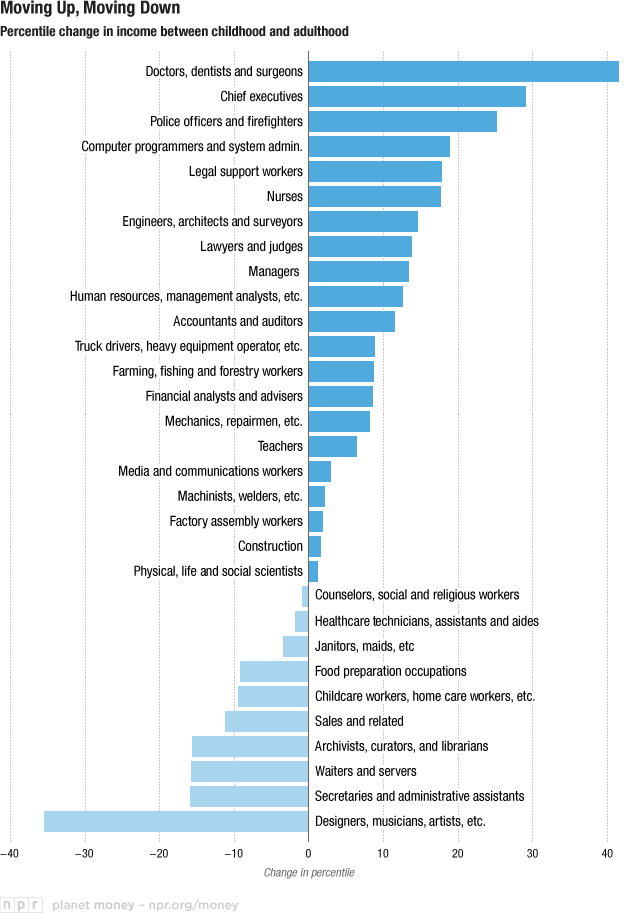
On NPR, Quoctrung Bui asked, Who Had Richer Parents, Doctors Or Artists?:

A few weeks ago, we were sitting around the office arguing over this simple question: Who had richer parents, journalists or people working in finance? Doctors or artists? More generally: What’s the link between household income during childhood and job choice during adulthood?… A government survey has tracked more than 12,000 people for decades. It allowed us to look at the same group of people in 1979 and 2010 — from a time when most were teenagers to the time when they were middle-aged and, for the most part, gainfully employed.

Image

Overall, richer parents tend to have kids that choose wealthier occupations.  But there are some big differences.  It turns out that artists had richer parents than doctors!  That is probably because rich parents are more likely to give advice that encourage artists more than parents below the median income.  For example, British mogul Richard Branson’s top ten tips for success in life include:

1. Follow your dreams…

4. Have fun…

7. Spend time with your family…

10. Do what you love and have a sofa in the kitchen

These are all great things, but it is easier for a rich man like Branson to have these priorities and give this kind of advice.  His children can afford to “Do what you love and have a sofa in the kitchen.”  The children of fishermen, food-preparers, and janitors probably can’t.  They may have to work just to make ends meet.  And we need menial food-preparers, and janitors (especially someone like Branson probably employs a lot of food preparers and janitors), but not as many people follow their dream into those occupations compared with artists and musicians.  The economy does not demand as much work from artists and musicians compared with police and doctors (at least relative to the supply).  So some occupations create much more upward mobility than others:

Image

The most universally applicable advice that Branson gives is his second tip.  It is something that everyone can do regardless of whether their parents were rich or what occupation they do:

2. Make a positive difference and do some good.

That is a good way to make your life meaningful… even if you can’t afford a kitchen large enough for a sofa.

Posted in Inequality, Labor

Don’t Let The BETTER Be The Enemy Of The GOOD, Especially If You Don’t Know Anything Better

I got an email yesterday from Nobel Laureate, Vernon Smith, on behalf of an organization called EconomistLetter.com.  They want me to join 150 other economists in signing a letter to stop the proposed minimum wage hike.  EconomistLetter.com points out that the US economy has not been working for most Americans.  Whereas elite Americans’ incomes started rising back in 2009 and now have never been higher, most Americans are still in an economic recession because, they say, “median income has fallen …unemployment remains elevated, and… poverty is  a serious, complex issue that demands a comprehensive and thoughtful solution.”  EconomistLetter.com says that the minimum wage is “a poorly targeted anti-poverty measure” that would give little help to the poor.  As evidence, EconomistLetter.com cites the CBO study which estimated that under 20% of workers who would benefit are in households below the poverty line.

I agree with all of the above and these are the reasons why I support the minimum wage hike.  It helps most Americans including millions of people in households below the poverty line.  It isn’t the best anti-poverty measure, but it is the most politically feasible because it is  popular with a majority of people in both parties.  EconomistLetter.com is a good example of the lack of feasible alternatives.  Their letter doesn’t have any suggestions whatsoever.  Instead, they end the letter saying that they want “creative, comprehensive policy solutions that truly help address poverty, boost incomes from work, and increase upward mobility”, but they don’t have any suggestions at all.  None.

I don’t know who is funding EconomistLetter.com, but until somebody like them is ready to start spending some serious money to promote laws that will work better than the minimum wage, I’ll still support the minimum wage.  It isn’t perfect, but it does some good.  There are better policies for helping the poor and the median American, but better policies are not feasible and only a misguided utopian would make people suffer while perpetually waiting for a chance at perfection. Don’t be the kind of utopian who lets the better become the enemy of the good when the good is the only feasible option.


Update: I looked up who registered the website for the “Economist Letter” and found that it is registered to Sandra Swirski who describes herself as, “one of Washington’s top lobbyists”.

Update 3/14: Peter Coy at Businessweek contacted Swirski and discovered that the letter is funded by the National Restaurant Association.

Update 3/18: I haven’t had time to write recently, but Michael Hiltzik at the LA Times digs even deeper into the influence peddling in the above situation.

Posted in Medianism, Public Finance

When is equity efficient? Usually.

Updated January 15, 2024

Economics textbooks have been overly obsessed with the idea that greater equity (fairness) usually leads to less efficiency (production of goods and services).  Economists typically measure equity as equality of monetary wealth because the typical economist is a mutilitarian who measures The Good (also known as utility) in money.  It is true that if a society tried to guarantee absolute equality of income it would be inefficient, but perfect equality of income would also be unfair.  That is why nobody has ever tried to achieve exact equality of income.  People who support higher inequality to benefit elites like to bring this up as a strawman argument against greater equality, but it just a reductio ad absurdum that has never been anyone’s real goal, not even under communism.  Governments (and other social institutions like businesses and families) actively work to reduce inequality, but most of these actions create higher efficiency not less because more equity often creates greater efficiency.

For one thing, the creation of every public good (as the term is formally defined) creates greater equality and public goods generally increase efficiency or else economists would not call them goods.  A public good is non-excludable by definition which means that everyone has equal access.  Examples include most roads, the lights from streetlights, public parks (which are usually more efficient at producing enjoyment for the median person than walled-off private parks), knowledge, clean air, etc.  Fire and police protection could be excludable in theory, but most societies today attempt to provide universal protection which is more efficient at producing benefits than nearly all historic examples of inequitable private provision.

But even government programs that seem to mostly give private benefit to individuals like universal healthcare and universal education lead to more equitable and efficient outcomes.  Both increase a nation’s human capital and productivity and without universal education democracy doesn’t work.  My former advisor, Joe Persky, used to say that public education was by far the biggest welfare program in the US. When measured by government spending, it was the biggest social welfare program in the US for most of US history, but today healthcare spending is bigger.    medical ed

According to a 2012 article in BMC Public Health, there is no equity-efficiency tradeoff for universal health insurance.  It dramatically reduces health inequities and all the universal health systems are more efficient at producing better outcomes at a lower cost than less equitable health systems.  Among poor countries, Cuba is the only example with universal health insurance. Although Cuba’s system is worse than healthcare in rich countries, it is excellent compared with most poor nations.  Medical care is one of very few things that Cuba does better than most countries in the world.  It is so successful that Cuba exports doctors to other countries around the world.  Among rich countries, only one nation does not produce universal health insurance, the US, and the US has the least cost-efficient health system in the world.  The US is a huge importer of foreign-educated doctors because we cannot even produce enough doctors to meet our own needs and the small number of doctors in the US contributes to our high healthcare prices and waiting times to see doctors.

Matt Yglesias argues that easing up on medical licensure would increase both efficiency and equity:

A longstanding proposal from economist Dean Baker is to eliminate the rule that foreign-trained doctors must complete a U.S. residency program before practicing in the United States. If you or a loved one got sick in Lithuania, you probably wouldn’t feel any profound doubts about a Lithuanian doctor’s ability to treat you. Even without any specific information about Lithuanian medical training rules or EU regulatory standards, most of us would assume that whatever’s going on there is probably okay…

We should have an objective training and licensing standard that can be met by residents of any country — Lithuania or Mexico or Bangladesh or Nigeria — who are then allowed to come to the United States and work. That’s how free trade in goods works. Importing children’s toys isn’t a deregulated free for all, but the rule is that if a toy complies with Consumer Product Safety Commission rules then it can be made in China or Vietnam or wherever.

Medical training should work the same way. This would reduce doctors’ income, but grow real wages for the majority of Americans…

The same logic could be applied to dentists. And also to scope-of-practice rules that make it hard for dental hygienists to clean dead teeth without working for a dentist [link] and to rules that make it hard for a nurse practitioner to provide routine medical care services. These are all ideas that would build a more egalitarian, more prosperous economy without increases in taxes or explicit welfare payments.

Equity of rights is also good for efficiency because society cannot be productive without considerable equity in basic rights like the freedom of speech, and freedom of association. If only one person has freedom of speech, ideas will be suppressed and governance will be corrupt.

I’m not sure if the right to free speech can be too equal, but property rights can be too strong or too weak. Excessively weak property rights is anarchy which is very equal, but unfair and inefficient. Excessively strong property rights are monopolies that are highly inequal and also inefficient.

There are many ways that equity can enhance efficiency.  Nicholas Gruen says that Toyota’s production system created greater efficiency by decentralizing authority and making the system more equitable.

Likewise early childhood intervention programs [can] save those at risk of leading horrible lives and get them to lead much less horrible lives – to the benefit of the people immediately involved and all those around them – including their governments, who are more likely to be receiving more revenue and paying out less in doles and/or prison capacity.

Mel Lorenzo Accad argues that equality of opportunity is a case where equity increases efficiency.  He gives the example of women’s liberation:

When women were given equal chance to have the education, career, and political powers they want, imagine that the country could at most double its national output because of the additional labor and productivity.

There is also an extensive empirical literature that often finds that more equal nations are indeed more efficient.  More equal nations have less government corruption (good for business) and less expenditures on police and monitoring employee theft.  It looks like there is a bigger problem of nations erring on being too far to the left side of the inequality-equity curve:

Equality-Efficiency CurveIf anything, we should try to err on the side of too much equity because the alternative is more dangerous.

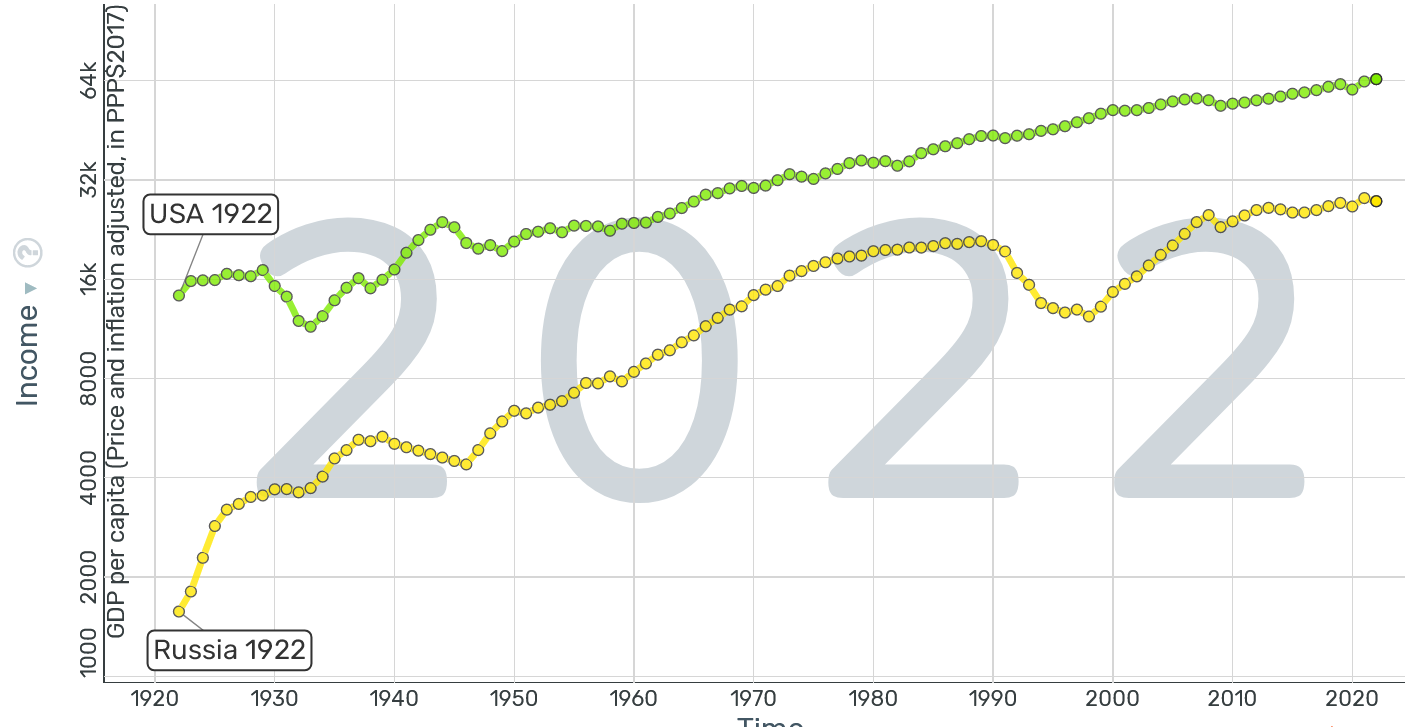
Many critics of equality give the example of Soviet Russia as an example of a society that was too equal, but the Soviet Union did not collapse due to any economic crisis.  It was a political decision to abandon communism and that subsequently caused an economic collapse during the 1990s as inequality soared.  Soviet Russia actually had some of the fastest economic growth in the world for the first half century of communism and that is how the former backwater nation rapidly rose to become a superpower.  From the beginning of communism until the mid 1970s, the only period when their economic growth was slower than the US was during WWII when the Soviets did the bulk of the work defeating the Nazis who destroyed much of Russia’s industrial heartland whereas the US economy was pumped up by building war machines to export to Eurasia.

Communist Russia was much more equal than the US from the 1920s to 1990 and so excessive inequality was not a problem.  It was mismanagement that led to Russian stagnation in the mid 1970s and 1980s. And the dramatic spike in Russian inequality in the 1990s has been a disaster for their economy.

Many textbooks assume the US always has excessive inequality (on right side of the curve),  but there is little empirical support for this.  Arthur Okun wrote an entire book that worried about too much equality titled “The Big Tradeoff”, but we should be more worried about making sure we exhaust all policies to get us as far up the left side of the curve as possible before we worry about how far down the right we want to descend.

Elites have disproportionate political power in every nation and elites know that they can get richer by increasing inequality.  History demonstrates that most elites care more about increasing their selfish status than about increasing efficiency and that means that politics typically causes inequality to be inefficiently high.  The exception is when there is a existential crisis that forces a nations leaders to maximize efficiency and, as Walter Schiedel shows, elites then usually implement policies that increase equality.

There is a lot of cost-benefit analysis and it is hard to  find evidence for the tradeoff anywhere.  One likely place is the pensions and healthcare for the disabled and old people.  It would be more efficient to just let everyone die when they stop working, but nobody wants to live in that kind of society so we are all comfortable with a little tradeoff in this case.

Personally, I think we should strive to reduce efficiency enough to maximize median lifetime income.  That is only a little tradeoff, and I think it is a good tradeoff to aim for. I don’t think it would involve much sacrifice for elites and it would benefit the vast majority of people.

Posted in Inequality, Macro, Medianism, Public Finance

It is an equity-efficiency CURVE, not a tradeoff

Economists are obsessed with efficiency which means* the maximum production of goods and services as measured at market prices.  Maximizing GDP is the most common form of efficiency worship.  The most popular economics textbook, by Greg Mankiw begins by laying out “Ten Principles of Economics [which] offer an overview of what economics is all about.”  The first principle is, “People Face Tradeoffs.”  One of the first examples is the tradeoff “between efficiency and equity” (page 5).  Mankiw generally comes down on the side of greater efficiency at the expense of equity.  Matt Nolan agrees and gives a philosophical claim for why economists should focus on efficiency over equity: “the idea of equity is normative… [This is] why economists ignore it and focus only on the aspects of ‘efficiency’.”  He claims that we have to distinguish “objective measures of efficiency” from “subjective measures of equity”.

This is completely wrong.  First of all, efficiency is just as much an ethical goal as equity.  When Matt says things like, “the ‘efficient’ solution is the optimal solution,” he is making a normative judgement about what is “optimal.”  Secondly, he claims that inequality is subjective, but we can measure inequality just as objectively as we can measure GDP which is a peculiarly subjective measurement of efficiency.  For example, the protocols that rule GDP measurement make the ethical judgement to not value the negative effects of pollution.  Economists are simply wrong to claim that efficiency is a less normative criteria than equity.  Thirdly, normative judgements are impossible to avoid, so you have to be suspicious of anyone who claims that they have “better” judgement for no other reason than being more objective.  Objectivity itself is subjective!

The idea that there is a tradeoff between efficiency and equity was the subject of an influential book (1975) by  Arthur Okun in which he labeled it “The Big Tradeoff.”  Mel Lorenzo Accad wrote that “The classic trade-off between efficiency and equity predates humanity itself.”  This is a misleading false dichotomy.  Obviously a tradeoff is inevitable at one end of the equality spectrum where there is perfect equality of income.  If everyone had exactly the same income regardless of what they did, there would be little incentive to do difficult work for others and very little work.  So absolute equality of income is inefficient (and it isn’t fair either, so it doesn’t really fit the dictionary definition of ‘equity’**).   But at the other end of the spectrum, if there were absolute inequality, the economy would also be incredibly inefficient.  Everyone would starve to death except for one person.  Of course, if the one person could own everyone else as slaves, that could help because he would want to keep his slaves alive.  But a slave society is still much less efficient than a free society because slave societies don’t invest enough in human capital and innovation.

Equality-Efficiency_Curve

The misconception that there is an inevitable tradeoff between equality and efficiency is even perpetuated by people who argue for greater equity.  For example, by far the most popular YouTube video about inequality focuses solely upon fairness and ignores the efficiency problems even though it is anti-inequality.  The most popular YouTube video that is in favor of inequality says that it increases efficiency.  This idea is endemic in mainstream (mmutilitarian) economics.  Fortunately, there isn’t always a tradeoff between efficiency and equity because inequality can get inefficiently high.

Every government does things to increase equity that also increase efficiency.   The economics textbooks almost completely ignore this, but almost all of our public goods, from roads to basic sanitation to NOAH weather forecasts increase efficiency and equity.  Universal public education, healthcare, and police protection are both efficient and equitable in rich nations.  Even progressive taxation is efficient because it would be impossible to afford important public goods without it.  For example, America would have lost WWII if we had had a flat or regressive tax because we simply couldn’t have raised enough money to pay for the war without raising taxes on the wealthy who had most of the money.  The top tax rate was raised to over 90% to pay for the war and stayed there for decades as the war debt was paid down.

On the other hand, there are also some policies like Social Security that do pose a tradeoff which increases equality and reduces efficiency.  After all, Social Security increases retirement which is inherently inefficient. It would be more mmutilitarian efficient if people would just die once they stop producing goods and services. It is arguable whether Social Security is less efficient than a privatized pension system, but even in the worst-case argument, it doesn’t produce enough inefficiency to prevent it from being one of America’s most popular government programs.

Markus Brückner and Daniel Lederman found that higher inequality reduces efficiency in high-income nations by reducing investment in education and other forms of human capital.  Gary Becker argued that human capital is the main form of wealth in rich nations and high inequality reduces the opportunity of poor and middle-income people to afford education.  On the other hand, they find that poor nations with higher inequality have had higher growth, so according to their study, poor nations have been on the right side of the curve and rich nations have been on the left.

I’ll follow up with more examples in my next post.


*Economists sometimes like to pretend that they define ‘efficiency’ as Pareto efficiency, which is less objectionable in theory because it literally means that nobody objects.  But it is useless for any real-world application because someone always objects.  Pareto efficient should be renamed ‘status-quo efficient‘ because it is the idea that the status quo is “optimal” if anyone has any objection to change, no matter how minor.  That makes Pareto efficiency useless for any real-world application because it requires universal assent to change the status quo and if everyone already agrees, then economists can’t offer any additional expertise to help sort things out.  That is why economists always use the mmutilitarian definition of efficient for all real-world applications.

**Perfect equality of income is unfair because workers should be compensated for doing particularly unpleasant, difficult work.  This is easily illustrated with utilitarian logic.  Utilitarians are often wrongly accused of advocating for perfect equality of income, but what some of them really wanted was perfect equality of utility, not income.  If some workers lose utility by doing difficult work rather than something more pleasant, the utilitarians thought they should be compensated with greater income so that they could recoup the foregone utility in other areas of life.

Posted in Inequality, Macro, Medianism, Public Finance

Enter your email address to follow this blog and receive notifications of new posts by email.

Join 75 other subscribers
Blog Archive
Pages