No Matter How You Torture The Data, Median US Male Income Screams As It Falls Behind The Elites

The government neglects data about median income, so private researchers sometimes step in to the vacuum to investigate important issues.  In 2011, Michael Greenstone and Adam Looney of the Hamilton Project crunched the data to find that

Over the past 40 years, a period in which U.S. GDP per capita more than doubled after adjusting for inflation, the annual earnings of the median prime-aged male have actually fallen by 28 percent. Indeed, males at the middle of the wage distribution now earn about the same as their counterparts in the 1950s!

They are competent researchers, but they are not experts on median income statistics and don’t have the resources to do a perfect job.  They published 19 similar reports the same year that they did the median income work. Now Scott Winship has published a skeptical new take on Greenstone and Looney’s work.  He did numerous adjustments that can boost the median male earnings over this time period and concluded his essay with his best-case analysis:

The adjustments yield the result that men’s compensation rose by 14 percent between 1969 and 2011. From 1969 to 2007, a peak year, the increase was 20 percent.

Kevin Drum notes that this is still pretty depressing.

I think we can assume this is the most optimistic possible reading of the data. And yet what does it tell us? During a period when real GDP per capita increased 108 percent, men’s median total compensation has gone up only 20 percent. Even if Winship is right, it means that men’s income has been devastated over the past four decades. Given this, arguments over the technical merits of various measurement methods should be entirely secondary. No matter who’s right, the big questions we should be asking ourselves are how this happened, why it happened, and where all the money went. That’s what matters.

To me, the amazing thing is that this discussion is almost completely ignored in the Media and in Washington.  The median American deserves more attention.  Instead of think-tank staffers crunching numbers in their spare time, there should be official government statistics that track this kind of median income data carefully so that pundits and politicians could track our economic progress better.


Posted in Medianism, MELI & Econ Stats

Fed Rebels Fight The Evil Empire

Earlier I had posted my prediction that the Fed is hopelessly always going to be dominated by banking interests due to regulatory capture.  Fortunately, there are sometimes public servants in government who feel an obligation to do what is best for America even if it might hurt the banks.  Today Federal Reserve governor Donald Tarullo said that the Fed will raise reserve requirements on the eight largest American banks to 6% of their debts.  This is a tremendous step towards reducing systemic risk and eliminating the problem of too-big-to-fail banks.  It could be due to public spirited public servants at the Fed, or it could be due to the smaller banks having enough political clout to reduce the large banks’ advantage for being too-big-to-fail.  It would be interesting to find out the political machinations that led to this result, but in any case, this is welcome news.  Raising reserve requirements was seldom mentioned a year ago, but partly thanks to Anat Admati, Martin Hellwig’s recent book, it has rapidly become the conventional wisdom about how to regulate the banking system to prevent a repeat of the 2008 financial crisis.  It is amazing how fast economics is changing today.  Nobody was talking about raising reserve requirements a couple years ago and it may soon become the law of the land.

Tagged with:
Posted in Macro, Medianism

The Fed Ignores Its “Dual Mandate.” Its True Purpose Is Helping Banks.

As I posted earlier, the Fed does not care that the majority of Americans are still in the depths of a recession because the Fed doesn’t even bother to track data about the median American.  But this is just showing that the Fed has the common mutilitarian bias and the Fed is even worse than that.  All the textbooks and the Fed’s own website claims that the Fed has a “dual mandate.”  The alleged mandate is to maintain “maximum employment, [and] stable prices.”  But everyone realizes that the Fed generally ignores unemployment and focuses too much on maintaining low inflation.  If you do a Google search for “Fed dual mandate,” most of the recent blog posts mention that the Fed has missed its own unemployment AND inflation targets for almost five years and yet its policies have mostly continued to reinforce missing both of its own targets.  The revealed preferences of the Fed is that it must really like unemployment that is too high and inflation that is too low because it has rarely taken any steps to reverse them.  There have been three periods of monetary easing since the beginning of the 2008 recession, but the Fed ended them before they had significant impact on unemployment.   Even the Fed’s own internal research shows that it has never cared about helping unemployment.

Officially, last December, for the first time in Fed history, the Fed said that it would actually target unemployment in its most recent round of monetary easing, but it recently prematurely communicated that it is “tapering” its easing despite little improvement in unemployment rates and Krugman notes that this is having the effect on expectations that are eliminating the potential for improving unemployment.

One of the reasons that the Fed ignores half of its “dual mandate” is that it has never really had a dual mandate.  As Wikipedia accurately reports, if you actually look at the Fed’s charter, it says that the Fed’s monetary policy objectives are to, “promote effectively the goals of [1] maximum employment, [2] stable prices and [3] moderate long-term interest rates.”  So right there the Fed actually has a triple mandate, but somehow the third part of the mandate is universally ignored by the press and educators, but it is not ignored by the Fed’s main constituency, the banks and financial institutions who like stable interest rates.

Furthermore, this is only one small part of the Fed’s charter.  If you look at the Fed’s mission, the “dual mandate” (that is really a triple mandate) is only one small part of its four bigger goals.  The other three goals are all about serving the banks and financial institutions.  Serving the banks is the part of the Fed’s mission that dominates its actions.  Forget the “dual mandate.” If the banks are in trouble, it will help the banks first and then think about inflation (because the banks like it low) and only maybe think about unemployment after that IF the Fed can help unemployment at zero cost to the banks.

The dual mandate is really a triple mandate, but the three parts form a hierarchy of needs.

  1. First, the Fed does all of the things that “maintain the stability [and profitability] of the financial system.”
  2. IF the financial system is secure, then the Fed works to maintain low inflation because that is another way of serving the interests of the financial system.
  3. IF all is well with the above missions, then the Fed might do something about unemployment IF it is costless to the financial system.  But in practice, the Fed does nothing about unemployment that are not a simple byproduct of supporting the financial system.  I think that more actions to lower unemployment would probably benefit the financial system too, but the leaders of the financial system have cognitive biases that cause them to ignore unemployment when their profits are good as has been the case for the past four years since the recession officially ended.

Surprisingly little has been written about the political economy of the Fed, because it is the most powerful economic institution in the world and it is extremely undemocratic and relatively secretive.  If you see any good work on the politics of running the Fed, please let me know.  Unfortunately its bias towards prioritizing the banks over the median American are baked into the cake of its institutional structure.  The seven board members of the Fed who are nominated by the president are often people with strong banking-industry ties.  This is a case of regulatory capture of the political process.  If you want to find an expert on the banking system to regulate it, it is hard to find someone who isn’t already a card-carrying member of the banking system.  Who else will have enough knowledge of the system to be able to run it?  Secondly, the banks (and large financial institutions) are directly in charge of appointing other leadership of the Fed.  They appoint all members of both the Federal Advisory Council, and the Community Depository Institutions Advisory Council and they directly elect most of the members of the board for the regional Fed Banks.  This is how the Fed is mostly run by the banks for the banks and that is why the Fed doesn’t care about unemployment.  The Fed’s political appointees (like the Chairman, Ben Bernanke) are supposed to fight unemployment, but they are embedded in a management structure that works for the banks and it is difficult to get the rest of the Fed to care about unemployment unless the banks think that unemployment is a problem for their profits.

And they don’t care.  Banking profits have been good, so they ask why they should rock the boat with monetary policies that will help the unemployed and the median American.  The Fed’s leaders are all people whose earnings and sensibilities are way above the median American and tied more to the banking sector than to main-street America.

The Fed is an essential institution as long as we have a banking system and a banking system is useful for the median person, but the Fed should regulate the monetary/banking system to specifically benefit the median American rather than to benefit the Bank elites.  It is time to end the Fed charter and redraw it with a medianist mission.  To accomplish medianist goals, the management structure must change to reduce the dominance of the banking elites over Fed policy.  At the very least, we need more democratic appointments and fewer banking industry appointments.  There will always be some problem with regulatory capture, but the current system is directly captured by the banking industry and it would be simple to reform the Fed leadership to make it more democratic and aligned with the interests of the median American.   Unfortunately, this simple management change would be fought by powerful moneyed interests who will consider it a radical political change against them and they would happily put the machine gun turrets (mentioned in earlier post) back up in the Fed banks before they submit to more democratic governance.   And almost nobody currently even cares about the real problems with Fed governance, so the revolution is a long way away.   So spread the word.  Reform the Fed.  Make it more medianist.

Tagged with:
Posted in Macro

Mutilitarianism At The Fed

The US Federal Reserve (Fed) is the one and only institutions that is specifically in charge of fighting recessions and lowering unemployment.  It used to be such a controversial institution that it was prepared for rioting.  The Chicago branch of the Fed had a fortified machine gun nest cemented into a perch over the entry lobby providing a clear shot of the entire floor.  But today, only the libertarian wingnuts still want to end the Fed, and the machine gun nest was recently remodeled away.  Unfortunately, the wingnuts want to end the Fed for all the wrong reasons.  The rest of us should care much more about the Fed.  Most people blame the president for bad economic policies, but the president’s main influence over the economy is though his weak influence over the Fed and the masses don’t get that at all.  The president only has indirect effect over the economy through fiscal policy which is dominated by congress and through monetary policy which is independently controlled by the Fed.

Unfortunately, the Fed is a mutilitarian institution.  It’s glossary of economic terms defines “Standard of living” as “A measure of the goods and services available to each person in a country; a measure of economic well-being. Also known as per capita real GDP (gross domestic product).”  Its glossary does not even mention median income anywhere.  No wonder it lets median income stagnate.  What often happens during recessions is that the income of the wealthy elites recovers earlier than the median American and that quickly pulls per capita GDP (income) up because their income is so large compared with the half below the median.  So the Fed thinks that the recession is over even though more than half of Americans are still in a deepening recession.  As the median income keeps dropping, the Fed starts worrying about slowing the growth of incomes because the incomes at the top are growing so fast.  This is because the Fed cares deeply about low inflation and cares nothing about the majority of Americans.

The Fed needs to start worrying more about the real incomes of the majority of Americans and less about the banks and inflation. That would serve most Americans better than its traditional policies which are overly biased towards serving elites.

Unfortunately, the American government does not even track the kind of median income data that the Fed would need to have to be able to serve the average American better.  The Fed publishes over 83,000 different data series, from the Anchorage Alaska House Price Index to the Z-score for Uganda’s Banks, but it doesn’t have any data about the average American (median).  The Census does track median household income, but that data is always out of date because the government does not care enough about it to keep it current.  Fortunately, a private company has been bringing median household income more up to date.  Sentier Research has reported that real median household income is still 7.3% lower than it was at the beginning of the recession and it has not significantly recovered from its low point in 2011. This is something that the Fed should be paying attention to rather than mean (per capita) GDP.  The majority of Americans are still in the depths of the recession.  The median income is 5.6% lower than it was in June 2009 when the Fed says that the recession officially ended.

median income

Median Household Income in Red

The longer-term trends are even more depressing.  Sentier Research’s data only begins in 2000, but this graph shows that most Americans were much richer 13 years ago than they are today.

With economic results like this, it is surprising that the majority of Americans aren’t protesting in the streets.  Perhaps it is because most people don’t know that this is happening.  There is a sense of economic unease that has led to the Tea Party movement and the Occupy Wall Street movement, but both movements lack economic theories to explain their unease with the economy.  If they understood more about how the economy works, the Chicago Fed might have to reinstall its machine gun turret in the lobby.  It doesn’t even have the kind of carbomb protection that the Chicago Federal building has a couple blocks away.

In an personal note, the Chicago Federal building updated their carbomb barriers after the 9-11 terrorism and they put the old blocks of granite in a vacant lot near where some of my friends, the Dyrsts, live.  The Dyrsts got permission from the city to haul off a few of the 3-ton blocks and they just installed them this week in their back yard as retaining-walls.  The result is beautiful, but it was so expensive to have the massive blocks moved that nobody else seems to be interested in copying them.

Tagged with:
Posted in Macro

Medianism and Property Rights

Earlier I had posted about the usefulness of medianism for determining appropriate property rights.  I had asserted that most state-enforced property rights actually come into being for consequentialist reasons.  I have reviewed more literature about the epistemology of property rights and the non-consequentialist theories are pretty weak.  For example, LexisNexis has a Law School Review of property rights.  The theories that they list are as follows in bold:

Deontological Theories:

  1. First Possession: Whoever first occupies or possesses something becomes the owner.  Is there really ever a case where this actually happened?  If so, then it is pretty rare in history.  Most land was occupied well before anyone invented individual property rights and even land like Antartica that wasn’t previously occupied is not really owned by the first person to “posses” it.
  2. Labor-Desert Theory:  Property rights are created when people mix their labor with property.  This can be identical to the first possession theory because if you define ‘possession’ to mean, ‘do something with’, then the two theories are the same.  There are a few cases in history where this has happened, but most of the time when labor is mixed with property, it does not confer property rights.  For example, what happened to the labor deserts of the slaves?  This theory is a strong justification for reparations for slavery, but I have never heard proponents of this theory support reparations.  The Homestead Act would seem to be an application of this theory, but the US government already had property rights before it gave the property to homesteaders, so it isn’t really a perfect example.  And the amount of land given was not proportional to the amount of labor produced.  It was fixed and predetermined.  The Homestead Act was justified by its supporters based on the good consequences it would produce, not some deontological fantasy of deserts.

Consequentialist Theories

  1. Utilitarianism:  This is often cited as a theory of property rights, and LexisNexis Area of Law Outlines says that it is “the dominant theory underlying American Property Law,” and William Fisher at Harvard Law agrees.  But if anyone ever actually used it in legal arguments, I would be surprised.  It is likely that lawmakers think about it as an ideal and imagine that this is what they are doing, but nobody can measure utility.  That is why medianism is a useful alternative in practice even though it would be a worse alternative in theory if we were in a utopian world that could really measure utility.  What happens to utilitarian reasoning is that it mutates into mutilitarianism.  This really IS important in the courts for deciding property rights.  It is the next item:
  2. Utilitarianism: Law and Economics Approach:  That is what LexisNexis calls it, but I call it mutilitarianism.  “This view essentially assumes that human happiness can be measured in dollars.  Under this view, private property exists to maximize the overall wealth of society.”  The wealth of society is theoretically measured by adding up “willingness to pay,” but GDP is also often used.  This is a goofy ethical system and no philosophers try to justify it as a first-best system, but it is prominent because it is relatively easy to measure, and perhaps because it is skewed to benefit the wealthy classes and so it has a ready-made special interest group with concentrated financial support that backs it.
  3. Liberty or Civil Republican Theory:  This is the idea that private property is necessary for democratic government.  LexisNexis says, “the influence of liberty theory has waned” so I won’t add any commentary except to note it as a historical curiosity.
  4. Personhood Theory:  Some items are so intimately tied to a person’s identity that they are essential to the person’s psychological welfare and emotional stability.  This theory goes back to Kant and Hegel.  Property rights help individuals fully flourish as human beings.  This has the same problems as Utilitarianism.  It is impossible to measure the emotional development of personhood for a population in the face of competing desires for the same property.  Medianism allows for actual measurement.  This might have been an important rationale for tribal property rights, but I am unaware of any example of property rights that have come out of this rationale since tribal times.  A major problem with this theory is the diminishing marginal utility of wealth.  There are myriad examples where property rights maintained the property of the rich who get relatively little emotional development from it and excluded the poor who would develop much more.  If you take the personhood theory of property seriously, then you gotta worry about redistribution and the diminishing marginal utility of wealth.
  5. William Fisher at Harvard Law surveyed theories of intellectual property rights and he adds another consequentialist theory to the LexisNexis list, but this approach is, “less well established and recognized than the other[s]… It does not even have a commonly accepted label.”  He calls it “Social Planning Theory” and says it is also known as “Propreitarian Theory”.  It is like utilitarianism, except that it adds more factors to the measurement of “social welfare”.  Property rights should, “help foster the achievement of a just and attractive culture.”  Unfortunately this is even more vague than utilitarianism and even harder to measure.  Everyone has a different conception of, “a just and attractive culture”, so it will be even harder to use this for guiding social policy than utilitarianism.  Instead we will use simpler rules like mutilitarianism and medianism is a better guide.

Rick Warren gives a theological perspective:

We never really own anything during our brief stay on earth. God just loans the earth to us while we’re here. It was God’s property before you arrived, and God will loan it to someone else after you die.

Update: See more about NFTs and property.

Posted in Medianism

The Fundamental Value of All That Glitters

What drives the fundamental value of art?  NPR reports that it has risen in line with the S&P 500 over the past 60 years but this is odd.  The S&P 500 has risen because the firms have become more productive and therefore more profitable.

Why invest in art? One reason, Price says, is that fine art has a proven track record as a good choice during hard times. “It outperforms in times of economic turmoil and trouble. It has outperformed during all of the wars of the 20th century. It’s outperformed during the last 27 recessions.”

Like any other asset, the market for art goes through ups and downs. Over the past 60 years, the total return on art has been very similar to the return on the S&P 500-stock index, says Mike Moses, a retired New York University business school professor who co-created the Mei Moses World All Art Index. The index tracks repeat auction sales of fine art.

“If you use the last 30 years, the S&P substantially outperforms art,” Moses says. “If you look at the most recent eight [to] 10 years, art has outperformed the S&P.”

But art is more like gold.  It is something pretty and scarce. It turns out that gold has also risen at a similar rate as the S&P500 over the long run (if PricedinGold.com is reliable) and like art, gold also outperforms the stock market during recessions and has outperformed the S&P during the most recent eight to ten years.

And here is art versus stocks:

It appears that pretty things like art and gold rise in value along with ability to pay that comes from productivity as measured by the stock market.  The stock market does not influence the ability to pay (income) of the median American, but it does reflect the ability to pay of the elites who own most stocks.  Elites also drive the prices of art and gold.

The more surprising thing is that both art and gold tend to outperform the S&P during recessions.  Stocks clearly have irrational volatility that is oversensitive to swings in the business cycle, but why would gold and art be any different?  The answer must lie in the psychology of the elites and since I come from a more median background, it is hard for me to fathom.  When unemployment is rising, and uncertain economic conditions are making stocks plummet is not exactly the kind of time when I would start thinking about expanding my investment in art, but that seems to be what is happening.

Many economists (like Nobel laureate Robert Lucas) say that economists should not focus on the distribution of income, but it is impossible to answer questions about the art market without thinking about the elites who buy art and the struggling artists who produce it. Changes in inequality must be important for understanding this market, but I don’t know how.  Let me know if you figure it out.

Posted in Macro

Taxation = Theft = Property

On the political right, libertarians like to talk about how taxation is theft and on the radical left some people like to say that property is theft.  They are both right in a way, but neither side really believes their own rhetoric in the usual sense of the word ‘theft’.

Libertarians don’t believe that taxation is theft or they would move to a jurisdiction with a lower tax=theft rate, but very few move to Alaska where they could avoid all state taxes.  Imagine if thieves predictably robbed you by force every single year for thousands of dollars because of the house that you live in (property tax), you got held up every time you went to the store (sales and excise tax), and you even get robbed simply for working (income tax).  That sounds like a very bad neighborhood to live in.  I have lived in high-crime inner-city neighborhoods, but none of my friends and neighbors lost more to private theft than they paid in taxes (a couple neighbors were murdered, but that is not a property crime).

A neighborhood with large amounts of actual theft has very low property values.  Taxation has a completely different effect.  States and cities with high taxes tend to have high property values, so markets clearly don’t think taxation is the same thing as theft.  People care about the amenities that their tax dollars buy in high tax cities like San Francisco and New York, not about the absolute amount of taxation.  High taxation is correlated with neighborhoods that have high public amenities whereas high theft is correlated with neighborhoods that have few public amenities.

Libertarians don’t behave like they really believe that theft=taxation because ordinary theft is emotionally traumatic and few libertarians fear taxation nor do they even take the simple step of moving to the jurisdictions with the lowest tax rates.  They don’t object to driving on freeways that were paved with ‘theft’=taxes nor to calling the police whose salaries and guns were paid for by ‘theft’=taxes.

What is a property right?

A property right is the right to exclude other people from a property.  It is the ability to restrict the freedom of any or all other people from enjoying a good in some way. This is why leftists say that property is theft.  It is the theft of others’ freedom. But leftists don’t behave like they think that all property is theft.  They are typically willing to call the police to protect their private property from theft too.  And most leftists don’t want to eliminate all property rights any more than libertarians want to eliminate all taxes whereas both would probably agree that they both want to eliminate all theft by the ordinary sense of the word.

Although I haven’t personally met anyone who claims that property is theft, I have met a lot of people who have claimed that taxes are theft including my sister.  Last week I dialoged with a libertarian who considered property rights to be natural and taxes to be immoral theft.  But taxation and property rights are both based upon exactly the same moral standing.  Both are based on government force.  If property rights are moral, then so is taxation and vice versa.  And neither property rights nor taxation exist without government in the usual sense of these concepts.

A history of government, property rights, and taxation

Here is Mancur Olson’s stylized history of government.  The story begins in the state of nature which is anarchy.  There is no government and roving bandits steal as much as they can from everyone they encounter.*  In anarchy, both taxation and property rights are minimal.  There is no taxation because there is no government but neither are there property rights because outsiders keep raiding and stealing anything they want including sex and slave labor. Anyone was vulnerable to being kidnapped and forced into slavery.

Anarchy is so bad that honest farmers would prefer to ask one of the strongest bandits to settle down and become a stationary bandit because that would end the unpredictable predations of anarchy.  A stationary bandit would want a monopoly on theft and keep the other bandits away.  This makes life easier for the bandit because it reduces his travel costs and a willing population is easier to steal from.  There is also going to be more to steal because the farmers will invest more in their production if the theft rate is less uncertain.  In this way, warlords became dictators (or monarchs) and this arrangement is better for both the farmers and the bandit. This is how theft becomes taxation.  But in the same manner, property rights are created.  In anarchy there is so much predation that nobody wants to invest in creating surpluses (property) because property is too likely to be stolen.  Why bother?  Property rights don’t exist if property can be stolen by anyone who comes along with more coercive  force, so there is no point creating property.  And markets are pointless if one can get goods by using weapons (which are necessary for defense anyhow) and thereby get something for nothing.

A stationary bandit (a dictatorship) is an improvement over anarchy because the theft becomes taxation.  Taxation is predictable and whatever is not taxed is secure from theft.  That security is what becomes a property right.  Property rights are, in effect, the residual after taxation is taken.  In complete anarchy, everything could be taxed/stolen at any time, so there are no property rights.  Taxation is really just a predictable theft and it creates property rights by limiting the amount that is stolen/taxed.  Libertarians like to talk about limited government, but government always places limits on itself out of self interest.  Even a dictator needs to limit the taxation rate to stay on the productive side of the Laffer curve.  Simultaneously, taxation makes possible the institutions that protect property from all the other bandits out there.  No taxation, no protection, no property–except for stuff that nobody wants to steal.  Your collection of boogers might be safe even without taxation, but if nobody else wants it, then there is no point fussing over a property right because the definition of a property right is the ability to exclude others from a good.

Taxation begets property rights and rights beget the creation of property itself.  Without property rights, there is no incentive to create property.  The security of property rights gives individuals the incentive to create property and to invest in greater productivity.  The dictator has an incentive to limit his tax/theft rate because he wants individuals to increase their productivity in order to grow his economy and get richer in the future.  Furthermore, the dictator has an incentive to invest in the public goods that will increase the productivity of his people.  Why else would a megalomaniac like Saddam Hussein spend so much of his money on roads, public health, and education for his people when he could have spent the money building more palaces and statues of himself?

So property rights and taxation have the same ethical foundation as one another.  The above parable seems to put them both on a social contract foundation, but that is a mistake.  Social contract theory produces fictional histories that are appealing to the human desire to understand the world through story, but it is more common in history for a strong warlord to simply take over control of a region because he can and because his self-interest results in a dictatorship because that is more productive for him than his life in anarchy.  And because dictatorships are more productive than anarchies, they had more economic resources to build armies and conquer neighboring regions of anarchy if those regions were  productive enough to produce tradeable goods (which are the same thing as stealable goods).

Although democracy can produce something like a social contract, property rights (and taxation) have always pre-dated democracy and were originally imposed by the ruling class.  For example, Hammurabi’s code produced the first known written guarantee of property rights, and it was imposed by a dictator without asking the consent of his subjects.  According to the Mancurian theory explained above, Hammurabi must have decided that he could grow his economy (and wealth) faster by committing to property rights in writing, thereby assuring his people that they could invest and produce without fear of capricious taxes or other liabilities.  And perhaps he was also motivated by noblesse oblige and he thought that his people would be better off too.  In either case, this was no social contract with consent of the governed.

There is no guarantee that government will achieve better outcomes than anarchy.  For example Walter Scheidel argues in his book, The Great Leveler, that the people of Somalia are better off since the collapse of its central government because their government had been so terrible and he claims that Somalia is in a state of anarchy.

Although Somalia is closer to a state of anarchy than any other region on the globe today, I wouldn’t categorize it as anarchy.  Many call it warlordism in which there are many small-time dictators who rule over individual city-states and rural counties.  Although there is violent competition between different warlords, there are not rampant roving bandits who steal everything as in anarchy.  There is a decentralized system of small fiefdoms which extracts less taxation from ordinary people than the central government that they overthrew.

Since the rise of agriculture, true anarchy is rare and unstable because people naturally organize to align with others for mutual defense and that quickly becomes a form of political government.

The ethical justification for property and taxation

The three major ethical systems that could provide a basis for property rights and taxation are consequentialism, deontology, and virtue ethics.  Many on the political right like to assert that there is property rights come from a deontological system like natural law.  But they are wrong because property rights cannot be natural when they did not exist for most of the millennia of human existence. The closest possibility for a natural basis for property rights might have been if early humans lived in territorial bands, but some primates are territorial and some are not and anthropological evidence suggests that some foraging tribes are territorial and some are not, so it must not be innate.  Furthermore, territorial hunter-gatherers have no sense of the territory belonging to any individual and don’t have the notion that permanent ownership could be sold or traded because they don’t understand the modern notion of property rights.

The idea of buying and selling land is a fairly recent idea in most of the world as Hernando de Soto’s research demonstrates and intellectual property rights spread even later (and are still not considered valid in much of the world).  Copyright was only first invented in England in 1710.  Patents were systematically awarded a bit earlier, beginning in the 1400s in Venice.  But patent monopolies were different than they are today.  They were routinely awarded to people simply because they were favored by the crown or to people who simply paid the crown for a monopoly and even merchandise like salt was patented, so a patent was often just a reward for political favor.

But it was (and is) a property right and it is easy to see why people would have considered it to be a form of theft when someone got the property right to a monopoly on salt.

The best ethical foundation for property rights and taxation is consequentialism because that is the only way to explain how the ideal property rights and taxation levels could change over time as technology and institutions change.  Deontology and virtues do not change with technology, but consequences do change.  And this is why consequentialism is the best way to explain the moral foundation for property rights and taxation.  Property rights and taxation create better consequences for society than are possible in their absence.

There will always be a struggle to determine what the optimal property rights and taxation schemes are.  That ongoing struggle cannot be informed by deontological rules, virtue ethics, nor contract theory because the optimal rights and taxation will continually change with technology and institutions.  Virtues and ‘natural’ laws do not change with technology and institutions, but consequences do change dramatically and so do the most useful property rights and taxation.  For example, governments used to rely more on tariffs because it was cheap to monitor goods coming in to ports, but that is less efficient than payroll taxes which were infeasible before computers.  Similarly, most intellectual property rights are brand new compared with the full scope of human history, but they are justified because they help incentivize the creation of more ideas.

What could be a more basic property right than the ability for individuals to buy and sell land?  And yet as mentioned above, this is a relatively new institution in human history.  This basic property right still has not reached much of the world.  Hernando de Soto claims that there is $10 trillion of “dead capital” that is de-facto owned by poor people and squatters around the world who do not have the de jure property rights.  Thus they cannot formally sell it nor use it as collateral and their informal use of the land is  vulnerable to expropriation.  De Soto persuasively argues that formalizing their property rights would have beneficial consequences for them and increase economic growth generally.  The people in many of these lands have never previously thought that it was natural nor virtuous for individuals to have the formal property right to buy and sell the land that they live on, but people are increasingly persuaded by de Soto’s arguments because they promise good consequences.

Similarly, when Kennedy cut the top tax bracket from 91% down to 70% and when Reagan cut it from 70% down to 28%, they justified these changes by promising good consequences for the nation.  The problem is that they were promising good mmutilitarian consequences.  They promised that it would be good for the economy, whichthey measured using GDP and similar derivatives.  It is debatable whether the consequences really were good for the economy as measured with GDP, but we really need a better kind of consequentialism for guiding our property right and taxation policies.  A simple improvement would be to focus more on median consumption rather than GDP.  That could help guide our economic policies better.

*Note that this stylized history is incorrect because it begins with an agricultural society whereas the real state of nature was composed of hunter-gatherers where there was very little to steal and there was such low population density, that there was probably very little theft. Plus, foraging societies didn’t even have much notion of private property so theft was probably a very different conceptual matter than we think of it today.

However, the story gets right the fact that there was a tremendously high amount of violence according to the evidence Stephen Pinker compiled.  Utopians have long imagined that primitive human societies were peaceful, but even if most people were peaceful and only a tiny 1/2% of a population was sociopathic, they would mess up everything for everyone else and even with normal people there was plenty of inter-tribal violence.  There was little need for formal government in hunter-gatherer societies because there were so few people in each tribe to deal with and there was so little stuff to produce and divide up.  Instead of government, tribal authority tended to follow kinship structures that rarely exceeded Dunbar’s number of 150.  Even simple tribal government only began when societies began to produce enough surplus to produce significant potential for theft and trade and taxation.

Mancur Olson’s stylized history can only begin after the invention of agriculture when government first became the normal way to organize societies.  It was only after humans domesticated plants and animals that wealth accumulation became the norm and with that came the potential for theft which also created the desire for taxation because that is necessary to provide the collective action that can secure anyone’s property rights.  And when governments arose, they created public goods like property rights that encouraged investment and monetary systems that helped finance investments and roads which helped encourage trade and all of these things increased wealth which increased the potential for theft and the cycle continued:
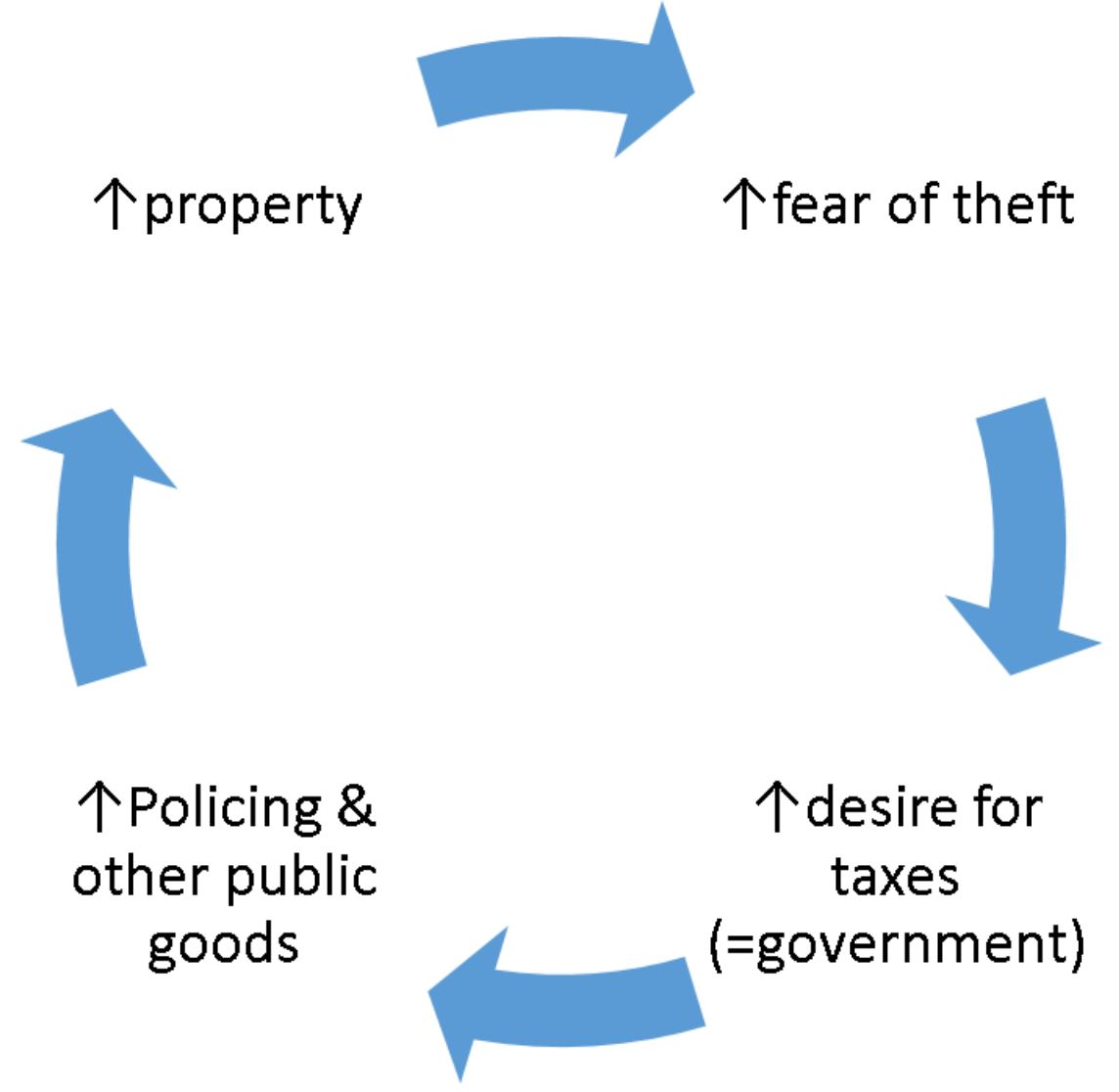

cycle of tax and property

Posted in Medianism

Enter your email address to follow this blog and receive notifications of new posts by email.

Join 75 other subscribers
Blog Archive
Pages