Updated Aug/13/2024

What is the liberal arts? The word arts means ‘subjects of study’ and today the word liberal in this context is usually taken to mean “wide-ranging” and “broad-minded”, but that wasn’t the original meaning of the term. The liberal arts is an concept that can be traced back to ancient Rome and Greece. Although academics have a reputation for being politically liberal, they are actually extremely conservative about conserving academic traditions and the liberal arts is one of our most conservative academic traditions, but the way that we define ‘liberal’ has changed from the original meaning which is fortunate because the original meaning reflected some of the intrinsic ugliness about ancient societies. The phrase originally meant the kind of study (or “arts”) that free men need as opposed to unfree men. The word “liberal” came from the Latin word for freedom and a the concept of the liberal arts has roots going back to Ancient Greece where slaves greatly outnumbered citizens. Aristotle defended slavery partly because their work liberated slaveholders to be able to pursue the elite arts, like philosophy and science, that were said to be “worthy of a free man”. Greeks like Aristotle focused on ‘man’ because he considered all women to also be a kind of ‘natural slave.’ Many ancient Greeks justified slavery by claiming that slaves were incapable of making their own decisions.
Although the meaning of, ‘the liberal arts’, has changed, the original meaning illustrates how pervasive slavery used to be. It was endemic in all early civilizations and many foraging societies. James C. Scott’s book, Against The Grain, argues that slavery was worse in large empires than in small-scale societies. One study found that only 24% of hunter-gatherer societies had hereditary slavery which is far less than in the agricultural societies that replaced them. Scott quotes V. Gordon Childe’s book, Man Makes Himself which claimed that early civilizations saw domesticated animals as being just like slaves.
“men as well as animals can be domesticated. Instead of killing a defeated enemy, he might be enslaved; in return for his life he might be made to work. This discovery has been compared in importance to that of the taming of animals… By early historic times slavery was a foundation of ancient industry and a potent instrument in the accumulation of capital.”
In modern civilizations, the state takes resources by taxing a share of the money that flows through the economy. In early civilizations, there was relatively little money and a lot smaller proportion of production was traded in markets. Plus, most people barely eked out survival above subsistence. The poverty and scarcity of monetary transactions made taxation difficult. Scott argues that grain production enabled the rise of taxation and therefore the rise of states because it was a standardized unit of production that was relatively easy to measure and confiscate. In essence, grain often served as a kind of money for the purposes of measuring the value of production that states could tax and more taxation means bigger states which causes an increase in hierarchy which increases both the means and the motives for slavery.
[A] peasantry… will not automatically produce a surplus that elites might appropriate, but must be compelled to produce it. Under the demographic conditions of early state formation, when the means of traditional production were still plentiful and not monopolized, only through one form or another of unfree, coerced labor—corvée labor, forced delivery of grain or other products, debt bondage, serfdom, communal bondage and tribute, and various forms of slavery—was a surplus brought into being.
Each of the earliest states deployed its own unique mix of coerced labor, as we shall see, but it required a delicate balance between maximizing the state surplus on the one hand and the risk of provoking the mass flight of subjects on the other, especially where there was an open frontier.
Only much later, when the world was, as it were, fully occupied and the means of production privately owned or controlled by state elites, could the control of the means of production (land) alone suffice, without institutions of bondage, to call forth a surplus. So long as there are other subsistence options, as Ester Boserup noted in her classic work, “it is impossible to prevent the members of the lower class from finding other means of subsistence unless they are made personally unfree. When population becomes so dense that land can be controlled it becomes unnecessary to keep the lower classes in bondage; it is sufficient to deprive the working class of the right to be independent cultivators”—foragers, hunter-gatherers, swiddeners, pastoralists.
It was difficult to prevent slaves from escaping and returning to their home communities when they came from nearby. Male slaves were often chained or imprisoned in a work site at a mine or on a galley of a ship. Slaves were separated from their relatives and mixed with unrelated individuals often from other tribes that had no history of trusting one another. Differences in racial appearance could help the dominant race identify slaves and work together to dominate them such as in the American South, and there is some evidence that race played a role in the enslavement of hunter-gatherers by the first agricultural populations of Europe. But in most of the ancient world there was usually little difference in physical appearance between slaves and owners and so race has rarely been a part of slavery. But tribalism and accent were often used as identifying factors at least for first-generation slaves until speech patterns assimilated in subsequent generations. Seafaring powers like Athens and Rome typically brought slaves from multiple places across the Mediterranean which made escape back to home virtually impossible.
For slave raids closer to home it was common practice that:
The towns and villages of the defeated peoples were generally destroyed so that there was nothing to go back to. In theory, the plunder belonged to the ruler, but in practice the loot was divided up, with the generals and individual soldiers taking their own livestock and prisoners to keep, ransom, or sell.
For similar reasons, it was hard for European colonists to enslave Native Americans in North America. They had an easy time slipping away back to native populations (plus, they were susceptible to numerous Old World diseases and kept dying off). Native Americans were the first slaves but African slaves had a much harder time escaping and finding refuge in native communities and they were already resistant to disease so African slavery displaced Native American slavery in the South although there were still some Native American slaves into the 1800s. The Spaniards had an easier time taking over the slave traditions of the Aztec and Incan empires where conscripted labor was already a well-established institution of empire. Egypt had an easier time preventing runaways because it was surrounded by desert.
Scott says that early warfare was more often about capturing slaves than capturing territory. One obvious advantage of capturing slaves was that territory is harder to control than just some of the people of a territory and slaves were easier to transport than physical goods and furthermore, captured slaves were used as beasts of burden to carry goods too.
Warfare in [Mesopotamia] beginning in [3,500] and for the next two millennia was likewise not about the conquest of territory but rather about the assembling of populations…
Oddly, I was never taught in world history class about just how central slavery was to civilizations across the world. For example, many ancient thinkers that we respect, like Aristotle and the Apostle Paul, thought that slavery was natural and necessary, perhaps because it was common everywhere they looked. Because slavery is mentioned throughout the Bible, slaveholders used the Bible to justify slavery for centuries. Although the Catholic Church was generally very progressive about eliminating the slavery of Christian Europeans in the Middle Ages in favor of serfdom (which was a more benign form of slavery), Pope Nicholas V authorized the consignment of pagans to “perpetual servitude” in the Dum Diversas papal bull. Although the church deserves enormous credit for fighting to reduce pagan slavery and Christian serfdom in Europe, European Christians revived slavery in their colonies. Many parts of the Church owned slaves in colonial outposts.
Scott continues:
Slavery was not invented by the state. Various forms of enslavement, individual and communal, were widely practiced among nonstate peoples… [But it] would be almost impossible to exaggerate the centrality of bondage, in one form or another, in the development of the state until very recently. As Adam Hochschild observed, as late as 1800 roughly three-quarters of the world’s population could be said to be living in bondage. In Southeast Asia all early states were slave states and slaving states; the most valuable cargo of Malay traders in insular Southeast Asia were, until the late nineteenth century, slaves…
How could Hochschild estimate that 3/4 of the world’s population was living in bondage? He may be overestimating, but he is also using a very broad definition of slavery: people who are forced to work and cannot leave. Americans tend to define slavery narrowly as the kind of chattel capitalist slavery that was practiced in America, but that was an unusual form of slavery in the scope of world history. Scholars of slavery typically define it more broadly to include all forms of involuntary servitude including corvée labor (seasonal slavery), serfdom (peasants who were unfree to leave the unpaid service of their lords), indentured servitude (contractual slavery which expires after a predetermined number of years), and debt peonage (forcing debtors into bondage).
American slavery was unusually harsh in that:
- It was supercharged by capitalism’s financial system which encouraged market trading and speculation. Capitalism created competitive international slaving companies and increased buying and selling that often split apart slave families.
- It was race-based. Most slave societies were more equal-opportunity because it was too expensive to travel large distances to get slaves and most slaves were taken from local populations. For example, early in US colonial history, the majority of white immigrants were indentured servants and many free blacks owned slaves. Sometimes whites were even enslaved by African-Americans. Slavery only slowly became exclusively associated with race, partly due to new pseudo-scientific theories as explained in The Myth of Race by Robert Sussman. By the time of the Civil War, slavery had become more infused with racism than it had been in the beginning.
- Children inherited slave status from their mother even if their father was her white owner. Of course, arguably the situation was worse in some Malthusian societies where slaves were so disposable that they were not allowed to divert their energies away from profitable work towards raising children.
- Manumission (granting freedom) was rare. Like many aspects of American slavery, this gradually got harsher as Southern slaveowners reacted to threats of slave rebellion and criticism from abolitionists. In the early days of US slavery, manumission was relatively common, and some former slaves even became slaveowners themselves. But by the eve of the Civil War, it had been greatly restricted or prohibited by slave states.
Slavery has taken many different forms in different societies, but using a broad definition, it was nearly ubiquitous across agricultural societies until modern times. Most of the early Islamic nations which conquered territory from Spain to India were reliant upon slave armies made up of children who were stolen from their parents. In many examples enslaved soldiers achieved tremendous political status in Islamic nations even though they were formally considered slaves. Slave soldiers even took over Islamic empires including Egypt, Iraq, northern India, Syria, Iran, and often established their own ruling dynasties.
Scott again:
Moses Finley famously asked, “Was Greek Civilization based on Slave Labour?” and answered with a resounding and well-documented yes. Slaves represented a clear majority—perhaps as much as two-thirds—of Athenian society, and the institution was taken completely for granted; the issue of abolition never arose. As Aristotle held, some peoples, owing to a lack of rational faculties, are, by nature, slaves and are best used, as draft animals are, as tools. In Sparta, slaves represented an even larger portion of the population. The difference… was that while most slaves in Athens were war captives from non-Greek-speaking peoples, Sparta’s slaves were largely “helots,” indigenous cultivators conquered in place by Sparta and made to work and produce communally for “free” Spartans…
Imperial Rome… turned much of the Mediterranean basin into a massive slave emporium. Every Roman military campaign was shadowed by slave merchants and ordinary soldiers who expected to become rich by selling or ransoming the captives they had taken personally. By one estimate, the Gallic Wars yielded nearly a million new slaves, while, in Augustinian… Italy, slaves represented from one-quarter to one-third of the population. The ubiquity of slaves as a commodity was reflected in the fact that in the classical world a “standardized” slave became a unit of measurement [of value].
Thus slaves were so common in the Roman marketplace that they served as a form of money for wealthy Romans. Slaves were a common measure of status and wealth.
…If the elite households of Greece or Rome are any indication, a large part of their claim to distinction was the impressive array of [slaves who worked as] servants, cooks, artisans, dancers, musicians, and courtesans on display.
We have very little information about what percent of the population of ancient Mesopotamia was enslaved because slaves were considered more akin to domesticated animals than people. Officials made no effort to record a census of domesticated animals and the same goes for slaves. Scott says slaves were, “wholly equivalent to domestic animals in status.” Surviving written documentation of Mesopotamian slave populations is scarce after thousands of years, but one of the few records that exists is for the city of Uruk
Slavery [in ancient Mesopotamia] …was crucial for three reasons: it provided the labor for the most important export trade good, textiles; it supplied a disposable proletariat for the most onerous work (for example, canal digging, wall building); and it was both a token of and a reward for elite status…
The most unambiguous category of slaves was the captured prisoner of war. Given the constant need for labor, most wars were wars of capture, in which success was measured by the number and quality of captives—men, women, and children—taken…
[In Uruk there were] state-supervised workshops producing textiles that engaged as many as nine thousand women. They are described as slaves in most sources but also may have included debtors, the indigent, foundlings, and widows—perhaps like the workhouses of Victorian England. Several historians of the period claim that both women and juveniles taken as prisoners of war, complemented by the wives and children of debtors, formed the core of the textile workforce. Analysts of this large textile “industry” stress how critical it was to the position of elites, who were dependent for their power on a steady flow of metals (copper in particular) and other raw materials from outside the resource-poor alluvium. This state enterprise provided the key trade good that could be exchanged for these necessities. The workshops represented a sequestered “gulag” of captive labor that supported a new strata of religious, civil, and military elites. Nor was it insignificant demographically. Various estimates put the Uruk population at around forty thousand to forty-five thousand in the year 3,000 BCE. Nine thousand textile workers alone would represent at least 20 percent of Uruk’s inhabitants, not counting the other prisoners of war and slaves in other sectors of the economy…
slaves and prisoners of war… were not well treated. Many are shown in neck fetters or being physically subdued. “On cylinder seals we meet frequent variants of a scene in which the ruler supervises his men as they beat shackled prisoners with clubs.”21 There are many reports of captives being deliberately blinded, but it is impossible to know how common the practice was. Perhaps the strongest evidence of brutal treatment is the general conclusion by scholars that the servile population did. not reproduce itself. In lists of prisoners, it is striking how many are listed as dead—whether from the forced march back or from overwork and malnutrition is not clear. Why valuable manpower would be so carelessly destroyed is, I believe, less likely to be owing to a cultural contempt for war captives than to the fact that new prisoners of war were plentiful and relatively easy to acquire…
Plus, brutality was a way to motivate slave labor and a tool of control to prevent slave rebellion.
[In China, both the Qin dynasty and the Han dynasty had] markets for slaves in the same way as it had markets for horses and cattle. In areas outside dynastic control, bandits seized whomever they could and sold them at slave markets or ransomed them. The capital of both dynasties was filled with war captives seized by the state, by generals, and by individual soldiers. As with most early warfare, military campaigns were mixed with “privateering,” in which the most valuable loot comprised the number of captives who could be sold. It seems that much of the cultivation under the Qin was carried out by captive slaves, debt slaves, and “criminals” condemned to penal servitude…
slavery, [usually] in the form of war captives… had several advantages over other forms of surplus appropriations. The most obvious advantage is that the conquerors take for the most part captives of working age, raised at the expense of another society, and get to exploit their most productive years. In a good many cases the conquerors went out of their way to seize captives with particular skills that might be useful—boat builders, weavers, metal workers, armorers, gold- and silversmiths, not to mention artists, dancers, and musicians…
Women [of reproductive age] and children were particularly prized as slaves. Women were often taken into local households as wives, concubines, or servants, and children were likely to be quickly assimilated, though at an inferior status. Within a generation or two they and their progeny were likely to have been incorporated into the local society—perhaps with a new layer of recently captured slaves beneath them in the social order. If manpower-hungry polities like, say, Native American societies or Malay society historically are any indication, it is common to find pervasive slavery together with rapid cultural assimilation and social mobility. It was not uncommon, for example, for a male captive of the Malays to take a local wife and, in time, organize slave-taking expeditions of his own. Providing that slaves were constantly being acquired, such societies would remain slave societies, but, viewed over several generations, earlier captives would have become nearly indistinguishable from their captors. Women captives were at least as important for their reproductive services as for their labor. Given the problems of infant and maternal mortality in the early state and the need of both the patriarchal family and the state for agrarian labor, women captives were a demographic dividend. Their reproduction may have played a major role in alleviating the otherwise [high mortality rate of Malthusian societies]…
As earlier captives and their progeny were incorporated into the society, the lower ranks were constantly replenished by new captives, further solidifying the line between “free” subjects and those in bondage, despite its permeability over time.
One reason for the fluid nature of class structure in which slaves could become free was the common interbreeding between elite men and their female slaves. Polygamy was the norm and when elite men took a particular fancy to a slave woman and wanted exclusive sexual access, she could be elevated to the status of concubine or wife. The increased status meant much better living conditions, but wives were just another form of property, so arguably all wives were just a type of slave that could not be bought and sold. Plus, elite property owners were always wanting more laborers and slaves died off at a fast rate in given that average life expectancy for most of history was in the low 30s, so forced pregnancy helped to replace laborers who died off from malnutrition, sickness, and abuse.
I cannot resist the obvious parallel with the domestication of livestock, which requires taking control over their reproduction. The domesticated flock of sheep has many ewes and few rams, as that maximizes its reproductive potential. In the same sense, women slaves of reproductive age were prized in large part as breeders…
As for male slaves, they were often separated from the women and children and sent to do other work:
in the Greco-Roman territories they were deployed as a kind of disposable proletariat in the most brutal and dangerous work: silver and copper mining, stone quarrying, timber felling, and pulling oars in galleys. The numbers involved were enormous, but because they worked at the sites of the resources, they were a far less visible presence—and far less a threat to public order—than if they had been near the court center. It would be no exaggeration at all to think of such work as an early gulag, featuring gang labor and high rates of mortality. Two aspects of this sector of slave labor deserve emphasis. First, mining, quarrying, and felling timber were absolutely central to the military and monumental needs of the state elites…
There is a good chance that any time you see a monumental work of architecture or from the ancient world that it was mostly constructed with slave labor. Remember that the next time you see the Acropolis of Athens, pyramids of Giza, the Great Wall of China, Roman ruins, Venetian palaces, or any other tourist attraction that was built before the 19th century. Nearly all the wonders of the ancient world were built with slave labor.
The luxury of having a disposable and replaceable [workforce] is that it spared one’s own subjects from the most degrading drudgery and thus forestalled the insurrectionary pressures that such labor well might provoke, while satisfying important military and monumental ambitions. In addition to quarrying, mining, and logging, which only desperate or highly paid men will undertake voluntarily, we might include carting, shepherding, brick making, canal digging and dredging, potting, charcoal making, and pulling oars on boats or ships.
Thus, a slave population also secured the ruling elites in their power by simultaneously elevating a class of supporters who owned the slaves and although they might have to pay taxes or tribute to the elites at the top of the hierarchy, at least they were spared the drudgery of producing the tax by having their own slaves.
Max Weber’s concept of “booty capitalism” seems applicable… “Booty capitalism” simply means, in the case of war, a military campaign the purpose of which is profit. In one form, a group of warlords might hatch a plan to invade another small realm, with both eyes fixed on the loot in, say, gold, silver, livestock, and prisoners to be seized. It was a “joint-stock company,” the business of which was plunder. Depending on the soldiers, horses, and arms that each of the conspirators contributes to the enterprise, the prospective proceeds might be divided proportionally to each participant’s investment. The enterprise is, of course, fraught, in as much as the plotters (unless they are merely financial backers) potentially risk their lives… In many cases—in early Southeast Asia and in imperial Rome—war was seen as a route to wealth and comfort. Everyone from the commanders down to the individual soldier expected to be rewarded with his share of the plunder.
In my American history classes, slavery was treated as a peculiarly American phenomenon, but as Thomas Sowell, Stanley L. Engerman and many other scholars have pointed out, slavery was practiced on every inhabited continent throughout history. In fact, most people accepted slavery as natural or inevitable until a couple centuries ago when global culture finally took a decisive turn away from the institution. Slavery took many different forms in different societies. The North Atlantic slave markets were unusual in that capitalism was just taking off for the first time which created new kinds of slavery businesses and the racist chattel slavery that arose was harsher than many other forms.

But many slave societies were even more brutal in other ways. Roman slaves were routinely forced to kill each other for the entertainment of their masters in gladiator contests and Aztec slaves were routinely killed in ritual human sacrifice. There is a lot of competition for the harshest slave society in history.
Chattel slavery is defined as slavery that involves the buying and selling of slaves. Chattel slavery is often condemned as being harsher than slavery without slave markets, but anything that can be bought and sold is much more valuable to its owner than something that cannot be sold. Because slaves were so extremely valuable in chattel slavery, that increased the incentive to care for their physical welfare as long as they were able to work. (Retirement was rarely something that any slave could hope for.)
For example, Jeremy Black argues that the non-chattel slavery used by the USSR and Communist Cambodia was worse in some ways there than under chattel slavery. The communists made widespread use of state-sponsored slavery through their gulag “work camps” where prisoners were forced to work without pay, and many without hope of manumission. Because the prisoners could not be sold, they were less valuable than chattel slaves and they were more likely to be mistreated to death. Similarly, after slavery was banned in the US, the Jim Crow South re-enslaved a remarkable percentage of their Black community by imprisoning them, often on false pretenses, and using prisoners for forced labor. Although these prisoners were not called slaves, their average treatment may have been worse than the average treatment of chattel slaves.
Today slavery is illegal everywhere for the first time in human history
Luke Muehlhauser writes that the abolition of slavery is a surprisingly modern phenomenon:
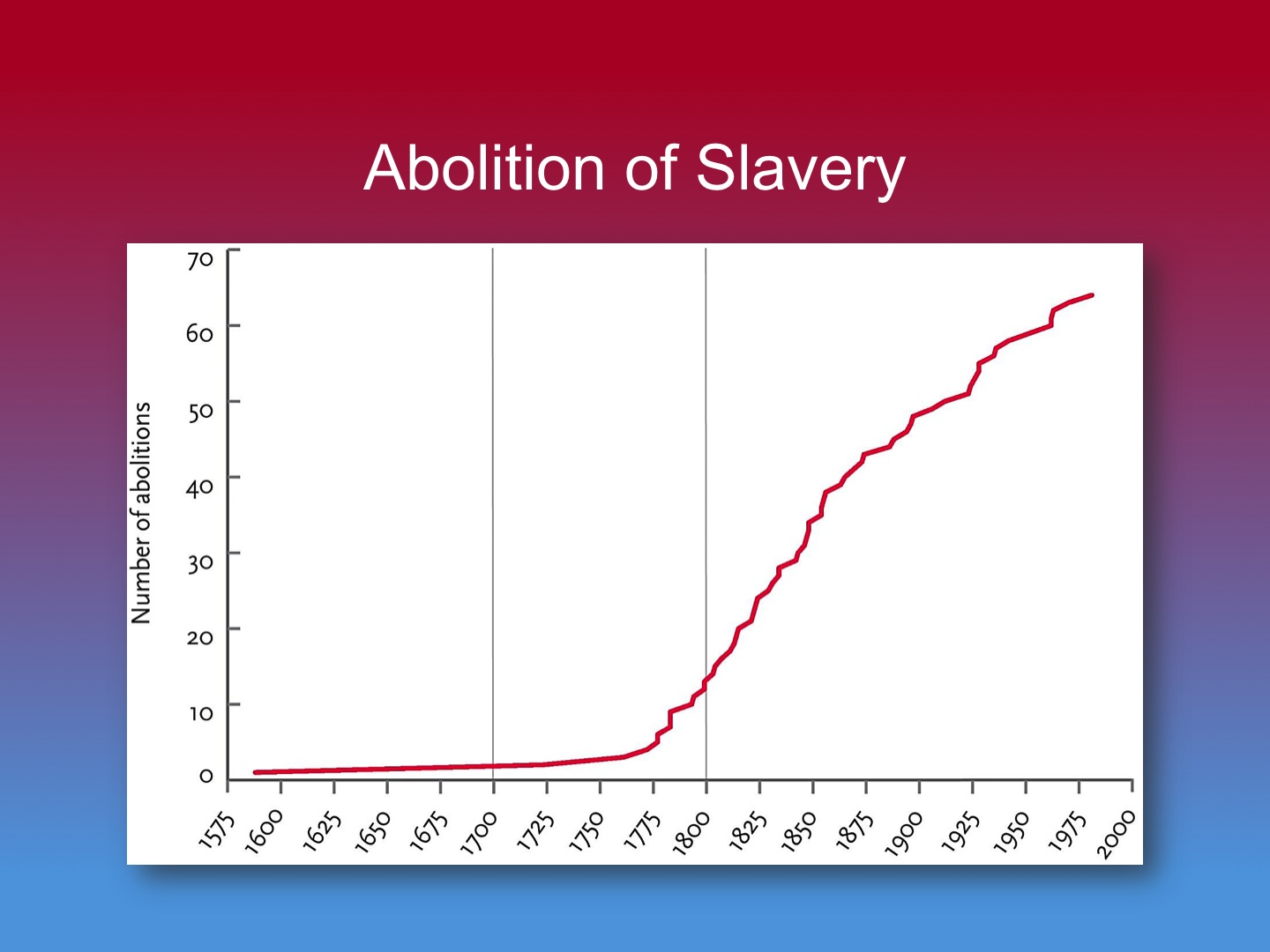
Iceland was the first state to abolish slavery, in 1117. But progress on abolition continued to be extremely slow until about 1775, during the industrial revolution. Then, the number of states abolishing slavery rose quickly up to 1981, when Mauritania became the last country on Earth to abolish slavery…
The global antislavery movement more-or-less began with the British abolitionists, circa 1800-1840… Britain was thereafter the primary global exporter of antislavery, sailing around the world and pressuring countries all across Africa and Asia to abolish the slave trade and slavery in general. Most slavery abolition around the world seems not to have been “home-grown” (as in Britain and the USA), but in fact was exported by Britain and (later) some other European states to their colonies and the rest of the world.
The last countries to abolish slavery were Saudi Arabia and North Yemen in 1962, Trucial Arabia in 1964, South Yemen in 1967, Oman in 1970, and Mauritania in 1981. This graph by Stephen Pinker shows when it happened:

There have always been some individuals who have had moral qualms about slavery, but it was considered good or at least normal by the most powerful people in nearly every country in the world until a couple centuries ago.
Although slavery is officially condemned today, it still lives on because many communities still accept it and bans are not always enforced. For example, although Mauritania was the last country to officially ban slavery in 1981, they didn’t enforce the law and slavery lived on. Maruritania took another step in 2007 when they also criminalized slavery in order to enforce the ban. Several nations have also taken the additional step to criminalize slavery since then including the Sahrawi Arab Democratic Republic in 2010, and Chad in 2017.
According to the National Geographic, illegal slavery is still rampant in the 21st Century.
There are an estimated 27 million men, women, and children in the world who are enslaved — physically confined or restrained and forced to work, or controlled through violence, or in some way treated as property.
Therefore, there are more slaves today than were seized from Africa in four centuries of the trans-Atlantic slave trade [which comprised 11 million total slaves, and about 450,000 (or 4%) of those slaves were brought to the United States]. The modern commerce in humans rivals illegal drug trafficking in its global reach—and in the destruction of lives.
This map shows where slavery is the most prevalent in the 21st century:

In theory slavery should be more profitable today than ever before because wages are MUCH higher than the cost of subsistence whereas for most of history it cost about the same amount to pay for a subsistence wage laborer as to feed a slave (unless the slave was being worked to death which was also common). In some impoverished societies, there was little danger that slaves would run away because in many cases, they would starve to death. The fact that market wages in the slave states of the US were among the highest in the world was one of the economic incentives that made slavery so valuable. The fact that wages are so much higher today than in Malthusian times helps explain why slavery still exists despite universal approbation. Slavery saves a lot of money relative to paying a wage.
Why did slavery finally get banned everywhere in the world?
Mr. Black argues that capitalism ultimately led to a dramatic reduction in slavery, but this is misleading because capitalism enthusiastically exploited slavery and made it more entrepreneurial, monetized, and globalized. Before capitalism, slavery was usually more about one’s place in a social hierarchy. In tribal-based societies, someone who didn’t have strong connections to a family might need to be a slave just to survive, but slaves could eventually rise in status (like in the Biblical story of Jacob) by proving loyalty and worth to the family. A slave’s status often functioned on a continuum with higher roles in a family hierarchy. Some male slaves achieved higher status than “free” women in some societies where wives and daughters also had low status. In some societies, high-status slaves could themselves own other slaves!
So if capitalism did not lead to the global abolition movement, what did? Ultimately it was the increase in bargaining power of workers to demand greater wages and rights. The same factors that eliminated slavery also caused rising wages and working conditions for ordinary people. What increased the bargaining power of workers?
1. Physical capital accumulation.
Mr. Black gets partial credit for naming capitalism because capitalism did help produce capital accumulation, but capitalism also produced the vast international slave trade and massive monocultures of chattel slavery in the production of American cotton, sugar in the Caribbean and Brazil, dates and pearls in the Persian Gulf, and many other examples.
To understand how capital led to the abolition of slavery, we have to define capital in a specific way. The broadest definition of capital is simply wealth and slaves were the dominant form of wealth in wealthy slave societies, so the accumulation of wealth alone did not cause the abolition movement. For example, slaves accounted for almost 1/3 of the total wealth of the United States at the time of the American Revolutionary War and approaching half of total wealth in the slave states.

The definition of capital I’m using here is “PHYSICAL capital” (as opposed to human capital or financial capital or natural capital, etc.). Physical capital is something that is produced at a sacrifice that makes you more productive. In other words it is our tools, machinery, and infrastructure. Physical capital is valuable in proportion to the difficulty of producing it and it is always easier to destroy it than to create it (due to the 2nd law of thermodynamics).
That ease of destruction gives workers more bargaining power. A new bulldozer that costs $200,000 can easily be sabotaged by disgruntled workers with a little sugar in the gas tank or a little sand in the gearbox or a little nick on a radiator hose which can result in tens of thousands of dollars in repair costs and it will be very hard to figure out who caused the problem. Valuable physical capital gives workers more leverage because owners really don’t want disgruntled workers with nothing to lose.
2. Complex work
The more complex an economic system is, the more decisions each worker must make. Decisions require autonomy which is the opposite of slavery. Plus, psychologists have known since 1908 that too much extrinsic pressure leads to worse decisions because people clutch. The only kind of work that responds well to extrinsic pressure is routine work like digging ditches. When even rudimentary cognitive skill or creativity is required, extrinsic pressure tends to lead to worse performance.
A counterexample to this theory is the fact that slaves ascended to powerful management positions in the Roman bureaucracy, so it is possible for slaves to do complicated work, but I suspect that the elite slaves in those positions had much cushier lives that most ‘free’ Roman citizens, so it was their high status and compensation that motivated them (just like ordinary wage labor) as much as the fact that their owners could put them to death if they made too many mistakes.
3. Interdependent work with potential to sabotage a production process
When a cotton-picking slave does poor work, it has little effect on the productivity of anyone else. But when one assembly-line worker does poor work, it reduces the productivity of all the other workers on the same line by the same amount. For example, the speed of an entire assembly-line is determined by the slowest worker and if anyone slows down, that slows everyone down. Similarly, if just one person makes an error which causes the product to be defective, it doesn’t matter if everyone else does perfect work. The product is still worthless. Each person whose job is a kind of bottlenecks in a production process has leverage for bargaining for more money.
4. Difficult to measure performance
In many jobs, it is hard to measure whether someone is working hard or not. When it is impossible to monitor someone’s work, it is impossible to use extrinsic motivation and intrinsic motivators become more important.
Scott points out that the difficulty in measuring output was the reason why empires could only begin in places with highly-productive grain agriculture because it was too hard for central management to tax other kinds of production. Scott says grain production was uniquely easy to tax in the ancient world (although woven textiles were similarly easy to tax) and these activities were also amenable to slave production because output was relatively easy to measure and extract.
5. Other management methods have become more efficient
Powerful people can use force (slavery), payment or ideology (such as religion) to motivate their followers in a social hierarchy. In primitive economies with little monetary exchange, payment was difficult to arrange, and leadership persuasion was limited to the number of people who could listen in the same physical space, so force & slavery was relatively more important than today. For example, Glyn Davies claims that because ancient Egypt lacked money, they were dependent upon slavery for managing large projects:
In the absence of money, or given the limited range of monetary uses in certain ancient civilizations, it is little wonder the completion of large-scale and long-term contracts was usually based on slavery. Thus the building of the Great Pyramid of Ghiza, the work of 100,000 men, and a logistical problem commensurate with its immense size, was made possible at that time only by the existence of slavery
Of course, slavery didn’t get banned globally until thousands of years after money became widespread, but better technologies for motivating workers is certainly part of the reason for eliminating slavery and money didn’t become abundant enough to become part of everyday life for the median worker until after industrialization and the revolutions in finance that brought.
But the increasing monetization of economic activity has changed everything. It made it feasible to tax more and more activities which has facilitated the growth of governments, and in parallel, it has also made it possible to create large hierarchical organizations like corporations that motivate workers through monetary wages. Money is a better motivator for most modern production than slavery.
Nassim Taleb argues that Roman elites preferred slaves for important tasks like taking care of large estates because slaves could be tortured if the task wasn’t done well and employees literally had less skin in the game. But there are additional technologies for motivating workers nowadays and it has never been clear that torture is ever a particularly effective way to motivate workers. That is why some slave owners didn’t torture their slaves; some even paid their slaves a wage.
The advent of mass communication technologies beginning with the printing press have made it easier to influence and coordinate masses of people through verbal persuasion too. Educational systems create habits of obedience and norms of compliance in workers. Mass communication technologies and monetization created alternate routes of influence that diminish the utility of using force.
When slavery was legal, its profitability in some occupations and unprofitability in others helped explain why it was more likely to exist in some places and occupations than others. For example, David Friedman argued (in chapter 15) that slavery wasn’t profitable in Britain and France during the period when it was taking off in the American colonies and even in the American colonies, it was only profitable for some crops like cotton and much less profitable in others like tobacco.
Britain tried using prisoners to do forced labor in maintaining the Thames River, but the value of their labor was less than the cost of maintaining the prisoners. Whereas France succeeded in using forced labor for galley rowers, when they tried using slaves in the arsenal at the port of Marseilles, the experiment wasn’t profitable enough to be emulated elsewhere in France. Wages in Europe were lower than in the Americas at that time which meant that slave labor was more valuable in the Americas, but slave labor was only profitable if it was cheap to keep slaves from escaping (such as on the galley of a ship) and easy to measure and incentivize their output (simple for picking cotton). In most occupations, it was cheaper to just hire someone for a wage. Indeed, slave owners sometimes paid their slaves a wage in addition to the threats of violence because wages provided better motivation to get them to work harder.
In the northern part of the United States, slavery didn’t work as well because there was more physical capital in factories and motivating using force didn’t work as well in northern industries as in the cotton industry in the South. In the US, cotton and sugar cane were the main industries that employed slaves and you can cotton production alone explains most US slaves as is shown by the geographic correlation between the two:
 US Slave Population:
6. Cultural change
The institution of slavery varied widely from time to time due to cultural forces. For example, China banned chattel slavery during the Han dynasty due to Confucian cultural influence, but continued Corvée slavery until relatively recently and prisoner slavery continues to this day. The first big change in global ideology began in the late 1700s when the abolition movement spread across rich nations along with the concept of human rights. This rights revolution helped lead to women’s rights and democratic rights and the abolition of slavery was part of that ideological revolution. It isn’t clear what caused that revolution in ideology.
One of the motivations for slave owners was profit, but the social status of being a slave owner was also an important motivator. This helps explain why people kept trying to use slave labor for industries in which wage labor was more profitable! A slave was a potent symbol of status given that a single slave was often as valuable as an average farm.
The $400 average slave price in 1850 can also be thought of as a signaling device of status in a period where the annual per capita income was about $110. Relative earnings can be viewed as the ability to purchase expensive goods. Today, the middle and upper-middle classes aspire to goods and services such as a second home, and an expensive car as a way of showing others that they have “arrived”– that they have achieved some status in the economy. The average slave price in 1850 was roughly equal to the average price of a house, so the purchase of even one slave would have given the purchaser some status…
Relative Earnings of Owning a Slave in 2020 Prices

Plus, no other possession could possibly give the same feeling of dominance as a slave for people who like to feel power over others and Christopher Brown says that a large proportion of slaves throughout history were women and children who were coveted not because they were productive, but for the consumption value of owning humans that were treated like very expensive pets. Slaves have always also been used for sex and sex trafficking is a persistent form of slavery that continues across the globe today.
Christopher Brown says that it was the ideological change that began to disparage slavery and stopped slaves from being a status symbol that ended slavery. Wherever slaves became unfashionable, the practice started to disappear, but he argues that it could still be profitable today if not for the historical accidents that caused the cultural change that eliminated legal slavery.
7. Other explanations?
I favor the structural changes in society that made slavery less productive relative to other ways to organize hierarchies, but I included the cultural change hypothesis and if you have another explanation for why slavery suddenly got abolished everywhere on the globe after so many millennia, please send me an email or leave a message in comments.
Do white Americans owe reparations to African-Americans because whites have slave owners in their family tree?
Because most African slaves were transported to the USA before 1808 (when the import of new slaves was banned) and because most Europeans immigrated to America well after the Civil War, the average African-American has a much longer and deeper American heritage than the average white American (or Asian or Hispanic). In this way, African-Americans are more American than any other group other than Native Americans.
We do owe a debt of gratitude to our forebears for what they have left us, but there is no evidence that anyone is better off today specifically because of slavery except individuals who directly inherited slave wealth and only a minority of Americans ever owned slaves at the peak. In 1860, only “5.67 percent of the free population of the confederacy were slave owners”. Of course, that only includes male property owners because women didn’t have any rights, but even with the most expansive definition, if we expand the definition of slaveowner to include all people whose family members owned slaves, then 30.8% of the free population in the South were part of a slave-owner family (and to complicate the picture even more, thousands of these slave owners were free Blacks who were often themselves descendants of slaves). Because the confederacy only contained 24% of the free population of the US in 1860, only about 7.2% of American families owned slaves in 1860. Given that about 10% of American men enlisted to fight in the Civil War, a larger percent of white American families fought in the Civil War to end slavery.
Furthermore, the majority of Americans alive today are descended from immigrants who arrived after 1860 without any direct lineage to antebellum America. For example, in 1900, 35% of Americans were first or second generation immigrants and massive immigration continued over the next 122 years. Still today about 14% of Americans are foreign-born first generation immigrants including about 9% of Black Americans. Although there has been some intermarriage between descendants of slaveowners and later immigrants, most Americans have married other people of a similar ethnic, religious, and class background due to homophily. As a result of massive immigration since the Civil War, today I’d guess that close to zero percent of Asian-American and Hispanic-American families can trace ancestry back to slaveholders, and maybe 3% of white American families, so very few Americans have benefitted from an unbroken chain of inheritance from slave wealth that directly passed down to today.
In a horrible irony of American history, although most whites Americans are not descended from slave owners, most African-Americans probably are! That is because about 24% of African-American DNA comes from European who were probably mostly slave owners. Although we don’t know exactly how much of that DNA came from slave-owners, one of the common perks of having total control over slaves was the ability to have sex with them and southern society actively discouraged or even banned consensual inter-racial dating.
Although there are some wealthy Americans (perhaps including some wealthy African-Americans) whose families directly inherited slave wealth and they literally owe a tremendous debt to slavery, slaveowners were always only a tiny fraction of Americans because they were only the elites of the southern states and rich elites are always only a tiny fraction of the population. So the only way that slavery could have increased anyone else’s wealth would be if slavery had been much more productive than wage labor and most evidence says the opposite – that slavery is bad for economic development.
Was slavery so highly productive that we owe a debt of gratitude to slaves?
Adam Smith was one of the first to argue that slavery is less productive than free labor. He believed that violence is a worse motivator than a personal desire to support one’s family and improve one’s lot in life. Plus, violence requires expensive paid overseers who are inefficient because they do not produce anything but violence.
The idea that slavery was more productive than wage labor was first promoted by slave owners themselves as part of their justification for owning slaves. During the American Civil War, they warned that the world’s textile industry would collapse without the cheap cotton that slave plantations produced. That didn’t happen. Yes, there was a dramatic spike in American cotton prices during the war. But post slavery, prices plummeted back to the same as before and the global textile industry just kept chugging along.

The destruction and dislocation of the Civil War destroyed productivity which was hard to recover from, but by the 1870s, US cotton farmers had already become a lot more productive than they ever were during slavery.

It turns out that whereas wage labor (and small farm output) was less profitable for the rich plantation owners, it didn’t have much effect on cotton buyers because slave labor wasn’t more productive.
Instead, a history of extractive institutions like slavery reveals that it created a lingering curse. Areas that had more slavery tend to be poorer today than areas that abolished slavery sooner. That is true of states in America as well as regions of the globe. For example, when Russia abolished serfdom (a medieval form of slavery), productivity soared.
My former professor, Dierdre McCloskey, argues correctly that if slavery was the key to American prosperity as some people claim today, then societies that had slavery for longer should be even more prosperous than America, but that isn’t the case:
outright slavery was the practice of African kingdoms long before the British or even the Portuguese knew anything about them. True, the Atlantic slave trade gave the African kings a profitable market in which to sell their fellow Africans… The East African slave trade, note, was as large as and lasted longer than the West African one. Yet it did not cause an enriching “capitalism” to flourish in the Middle East. The Barbary pirates and their North African allies and competitors enslaved European sailors or the victims of coastal raids in large numbers for hundreds of years, yet no Great Enrichments ensued there. The very word “slave,” of course, comes from “Slav,” those enslaved on the east side of the Holy Roman Empire and seized by Mongols in the Golden Horde north of the Black Sea and sold into the markets of Constantinople/Istanbul. No Enrichment…
[Slaves were never that profitable in America because they were not particularly cheap labor.] To think so is to get the accounting and the economics wrong. Slaves required food [shelter and clothing], as a tractor requires fuel. A slave in Charleston in 1860 sold for three times the average workingman’s annual income… So, as economic historians pointed out long ago, the profits from the West African trade stayed in Africa.
Obviously not all slave profits stayed in Africa, but McCloskey’s point is that, for example, when the King of Benin sold slaves to Western traders, that was very profitable for him (and other African slave dealers) because he stole the slaves without compensation. McCloskey argues that it was this initial enslavement that was the most profitable part of the supply chain because the initial enslavement meant stealing free people and selling them for a high price. By the time slaves were bought by Southern plantations, their enormously expensive price meant that there was only an average return on investment.
For example, the average price of a slave in 1850 was roughly equal to the average price of a house, so it would require a massive amount of work to break even on that enormous investment given the low-productivity work that slaves did. Basically when someone bought a slave, they were paying all the lifetime wages up front. That was impossible for any but the wealthiest Americans to finance.
In 1860 the average price of a slave was about $800 which is the equivalent of over $200,000 today relative to the wages of unskilled workers which is the best comparison for the opportunity cost of a slave. If one would buy a slave for $200,000 today, it wouldn’t be particularly profitable because in addition to the initial outlay, you’d still have to spend a lot of money on supervision, food, healthcare, shelter and other costs. For most occupations it would be a lot cheaper to just hire an employee and pay a wage. The same was true in the 1800s. Slaves were extremely expensive and for most types of jobs other than cotton and sugar cane, it was cheaper to just pay a wage.
If slavery had been a major source of American prosperity, then other places that practiced slavery in the 1800s like the Caribbean, Brazil, Africa and the Middle East should also be prosperous today, but they are not. The biggest accomplishment in all of economic development was the industrial revolution and that originated in England because of high wages, not the low wages of slavery. If slavery had not been banned in England on the eve of the industrial revolution, there would not have been the incentive to have the industrial revolution there because slaves might have been cheaper than machines. England had some of the highest wages in the world at the dawn of the industrial revolution and that created a big incentive to produce labor-saving machines there. High wages also meant that ordinary people had more money to invest in wide-spread education and experiments which helped boost the scientific revolution too. None of that would have been likely to happen if England had been a slave society like the American South where aristocrats spent their time worrying about how to prevent slave revolts rather than worrying about how to apply new engineering technologies to save money on high labor costs. Slavery helps explain why the American South lagged behind the North in education, science, and productivity.
Indeed, one of the theories for why the Roman Empire didn’t have an industrial revolution is because it was so dependent upon slavery which meant that Roman entrepreneurial talent focused more upon how to extract more work from slaves rather than thinking about developing technologies that reduce the work of laborers.
And one of the theories for why Europe did invent the industrial revolution before anywhere else was the cultural change in which the Catholic church gradually banned the chattel enslavement of Christians in Europe. European elites then adopted a milder form of slavery called serfdom, but church leaders kept discouraging that in favor of wage labor. Partly as a result, northern Europe ended up having some of the highest wages in the world which helped motivate entrepreneurs to figure out how to enslave wind power, water power, and then coal power partly because they were restricted from enslaving human power.
The American South had plenty of ability to produce cotton without slavery in the 18th and 19th centuries, so slavery only changed the distribution of resources in slave societies without significantly increasing production. But we have inherited a few benefits of slavery that would not exist today without the pernicious institution. For example, many of world’s ancient monuments probably would not have been built without slavery because they were too extravagant to justify the cost without free labor. Similarly, we might not have all of our Greek art and philosophy without slavery because the Greek elites wouldn’t have had so much time and money to spend on the “liberal arts” without the “slave arts” producing all their necessities. But by the renaissance, slavery was no longer necessary to achieve monuments like the Cathedrals and arts like Michalengelo’s statue of David. The greater efficiency of wage labor led to the prosperity we have today.
The legacy of slavery is underdevelopment, not wealth. Some proponents of race-based reparations for slavery argue that we all owe a debt of gratitude to slaves of yore for bequeathing us the prosperity we have today. But there is no reason to pretend that slavery was an awesomely productive economic system to justify reparations. For example, European Jews got reparations without resorting to the argument that the holocaust was an awesomely productive economic system!
Slavery definitely hurt poor countries, particularly in Africa
Above I explained how slavery probably hurt rich countries and definitely didn’t help them get rich, and it definitely hurt poor countries which were generally slower to abolish slavery than most rich countries. As you can imagine, if you lived in a nation where people were routinely kidnapped and enslaved, that would not lead to your nation’s prosperity. Although this has happened around the world at different times in history, it was particularly pernicious in Africa.
Brad Delong (2022, p.346) estimates that whereas the slavers of North Africa kidnapped perhaps 1.5million Europeans into slavery in the millennium before 1800, and between 1400 and 1800, perhaps 3 million Slavic people were enslaved and sold in markets south of the Black Sea, this pales in comparison with the booming African slave exports of 13million across the Atlantic to the Americas (1600-1850), 5million across the Indian Ocean between 1000-1900 (mostly to the Middle East) and 3million carried north across the Sahara from 1200-1900, plus untold millions more who were enslaved by African elites an remained in Africa.
There is a LOT of evidence that the African slave trade was horrible for African culture and institutions and these durable, extractive institutions continue to hold Africa back from achieving its economic potential.
Summary
Slavery was nearly universal for most of history (societies that left a written record) and we are all descendants of slaves if you go back far enough. There have been many forms of slavery and some were worse than others. The abolition movement that suddenly gained momentum in the 1800s finally resulted in slavery being banned everywhere in the world in the 2000s although forced labor lives on to this day either through illegal private actions or through government incarceration. Slavery is NOT the source of modern prosperity. If it were, then Egypt would be fabulously wealthy with its string of slave-built ancient monuments and long history of slavery stretching back from Biblical times until the 1930s, but Egypt is a poor nation. If anything, a recent history of slavery is a curse that is associated with reduced modern prosperity.












 Medianism