America’s CDC is being willfully ignorant about coronavirus spread.

Updated 2/28/20

Officially we only have 60 cases of covid-19 in the USA, but as of Wednesday, February 26, we have only looked for the virus in a total of a mere 445 Americans out of our population of 330 million. We just aren’t looking for it. See no evil. Hear no evil. Speak no Covid19.  Why is nobody talking about this data from the CDC?

We have only tested a TOTAL of 445 Americans for covid-19 according to the CDC!  That sounds like the pandemic preparedness of a 3rd-world country in the face of a disease that is spreading exponentially.

We don’t know and we can’t know how widespread the virus is in the US because we aren’t testing people.  Why have only 445 people have been tested in the US when we have had 14 confirmed cases discovered in the US plus 45 repatriated Americans who got sick abroad?  Lack of capability is part of the problem.  Last week only 2 CDC labs had the capability to test for the disease and as of Tuesday, still only a dozen health departments in the USA had the capability to do the testing at all!!  Lack of testing was what caught Italy, Korea, and Iran off guard–they didn’t discover the virus until it had already spread out of control.

We only know of one case of covid-19 that isn’t connected to any known foreign contact.  This worrisome case was just announced last night, but there could be many more because we just haven’t been testing. In this recent case, “The person wasn’t tested for the disease for days, despite an immediate request to the CDC”. The victim was hospitalized for a full week before the test was finally finished. The CDC didn’t agree to do the test until the woman became so ill, she was intubated on a ventilator in intensive care.

Asian countries in particular are way ahead of the US in testing capability.  As of this week, China and Singapore have both already developed the capability to test for people who have been exposed in the past without having developed the illness whereas the USA barely has the capability to do the basic test for people who are currently infected with a high virus load. 

The number of people China has already tested has to be in the hundreds of thousands by now and in the city of Hong Kong alone they are testing a thousand people every day.  In Korea, the public health authority has set up drive-through testing facilities in parking lots where people can drive up to temporary mobile health offices in steel shipping containers and get tested.  Check out the aerial photograph at the NYT!  They are way more advanced than we are. 

In contrast, the US has only tested 445 Americans and our testing capacity is so limited that the CDC has been restricting testing to the very few people who both have symptoms AND have had direct contact with people from mainland China (even though the disease is also in 39 other countries too).  According to the CDC’s official criteria, they should never have tested the woman from California who was on a ventilator in intensive care due to the virus.  Such a limited investigation is going to miss a lot of killer viruses.

As of Tuesday, covid-19 had killed 2,700 people worldwide and infected more than 81,000 people in more than 40 countries. It is about twice as contagious as the ordinary flu with an R0 of 2 to 3.11 vs. only 1.3 for the flu.  R0 is the average number of new people each sick person infects.  And covid19 is about 15 times deadlier for those who get it than the flu. The flu has killed an average of over 37,000 annually since 2010 and JAMA reports that, “Influenza and pneumonia constituted the largest single [infectious] disease category, averaging 44.4% of all infectious disease deaths” in the USA during the 20th century.

Covid-19 is likely to be even worse than that, but data about coronavirus is surprisingly hard to come by (perhaps due to the “say no evil” attitude of our officials).  Here is the biggest data set on coronavirus mortality that I have found so far:

Young adults have a much lower mortality rate compared with any older age. Their mortality rate is 0.2% or one in 500. Suppose you have a group of 650 young adults who get the disease. The binomial probability of at least one person dying in that group of 650 is 73% given the mortality rates we have seen so far in China shown above. In people aged 80 years and older, the mortality rate has been 14.8%. If you had a nursing home with 20 residents who got the disease, the chance that none of them would die is only 4% and the most likely number of deaths would be 3 of them given the mortality data out of China so far.

In the face of those risks, the CDC is doing… not much.  I’d ordinarily predict that this would be Trump’s “heckuva job” moment, but scandals that would sink any other politician just don’t bother him because he has no shame nor empathy for people his actions hurt and he has has always succeeded at convincing his supporters that others should be blamed for every problem he has caused.

UPDATE:

I’m pissed. We are so woefully unprepared for a pandemic. 

Two days after the first “community spread” victim in the USA was discovered, I expected that the CDC would be dramatically increasing their testing rate because there are lots of people that Californian woman came into contact with before she was tested and she had to have gotten it from someone who is still out there.  The White House is in charge of the CDC and when they announced that they put putative second-in-command, Vice-President Pence, in charge of the response, I was thankful that they are finally taking covid19 seriously.  Plus, the situation is getting more serious because virus seems to be spreading exponentially around the world. 

So I fully expected that the rate of testing to dramatically rise over the past two days, but instead I see this morning that the number of new covid19 tests over the past two days was…. SIX!?!  We are in trouble when that is all we can do.  Meanwhile California was monitoring more than 8,400 people for the coronavirus yesterday and 83 New York residents are in quarantine and that is just some of the current number of Americans at risk in only two states. New York state is so frustrated with the CDC’s lack of testing that the state decided to develop their own test independently of the CDC’s efforts. 

After we discovered Wednesday that the disease is spreading in the general community of Americans, Trump put Pence in control and we actually SLOWED DOWN our testing regime?  I mean, the White House just put out a budget two weeks ago that intended to slash CDC funding 16% (and they have repeatedly made cuts in previous years too, including eliminating the the US Pandemic Response Team in 2018), but I thought that by now they would have reversed their attitude towards the NIH and CDC and the would be making a moonshot effort to slow the disease and prevent the worst case scenario. 

Instead, they are keeping us all in the dark by barely looking for the virus. Here is the updated chart with only six more tests since two days ago:

covid19-testing Why isn’t anyone else shocked by this? I hope I’m completely misinterpreting the seriousness of this apparent incompetence and I’ll be very happy to update this post if I’m wrong and there is nothing to fear here.  Can someone with more time and investigative journalism experience please look into this? 

Unfortunately, once the media examines how pathetic the CDC’s testing has been the White House will probably stop them from publishing the data every other day as they have been doing.  When Pence took charge, he immediately started restricting the coronavirus information that is being released and Trump’s chief of staff Mulvaney today advised the American people to just ignore news reports about covid19. 
Posted in Health

The addictive dangers of modernity


For all the millennia of history before modern times, humans had very few options for entertainment and recreation. Food was bland, drugs were scarce, more time was spent making music than listening to it, and most social interaction was done face to face with extended family plus some close neighbors. Media was so scarce that most people never learned to read. Until the 1700s, sugar was as expensive in the West as pearls and many spices like black pepper were worth their weight in gold. Today, food engineers have produced fantastic flavors that don’t exist in nature like the Cool Ranch Dorito Loco.

Today our psychological rewards systems are being tempted and manipulated like never before. Pornography is always a click away. Gambling is now available in every gas station and on every cellphone. Attention merchants bombard us with sexualized images that are calculated to grab your eye, and when men see a sexy photo, it makes them care about the future less and become more materialistic which benefits the marketers.  Chemists keep inventing new kinds of psychoactive drugs. Video games are evolving to become more addictive. Movies on demand are always available to stream and sites like YouTube use artificial intelligence to select the videos that are the most likely to distract us from the real world.  Auto-play automatically continuously streams videos for us if we don’t tear our attention away. Movies and TV shows keep ratcheting up the sex, action, and visual candy (increasingly produced by CGI) to the point that all old movies seem slow-paced and boring by today’s addled standards. Social media hijacks our wanting system and leaves us feeling more depressed (and wanting more consumption to fill the hole) rather than more connected. It is nearly impossible to quit Facebook and the same things that make Facebook unhealthy are essential to the profitability of their business model. The smartphone industry profits from our unhealthy relationship with smartphones and designs them to suck us into their tiny screens.

Several books have recently studied these phenomena.  Nir Eyal celebrated how profitable new addictive technologies are in his book, Hooked: How to Build Habit-Forming Products which shows corporations how to take advantage of our addictive tendencies. David T. Courtwright’s book, The Age of Addiction: How Bad Habits Became Big Business, is more worried about the social consequences of how corporations have been using new technologies to amp up the addictive qualities of their products. Here is an interview Courtwright did with Sean Illing:

Sean Illing

…Courtwright calls [this] “limbic capitalism,” a reference to the part of the brain that deals with pleasure and motivation. As our understanding of psychology and neurochemistry has advanced, companies have gotten better at exploiting our instincts for profit. Think, for example, of all the apps and platforms specifically designed to hijack our attention with pings and dopamine hits while harvesting our data.

We’ve always had some form of limbic capitalism, Courtwright says, but the methods are much more sophisticated now and the range of addictive behaviors are much wider than they used to be. I spoke to Courtwright about the problems this has created, why the battle against limbic capitalism is seemingly endless, and if he thinks we’re destined to live in a consumerist dystopia…

David T. Courtwright

Well, limbic capitalism is just my shorthand for global industries that basically encourage excessive consumption and even addiction. In fact, you could make that even stronger and say not only do they encourage it but now they’ve reached the point where they’re actually designing it.

Sean Illing

And where does that word “limbic” come from?

David T. Courtwright

It’s a reference to the limbic region of your brain, which is the part of your brain that deals with pleasure, motivation, long-term memory, and other functions that are crucial for survival. You couldn’t live without your limbic system and you couldn’t reproduce without it and that’s why it has evolved. And yet that same system is now susceptible to hijacking by corporate interests in a way that actually works against your long-term survival prospects. That’s the paradox… companies offer products that will produce a burst release of dopamine in a way that conditions and ultimately changes the brain and develops certain addictive behaviors, which is to say behaviors that are harmful. Now, people have always peddled products that are potentially addictive. But what’s happened in the last 100 years or so is that more of these commercial strategies come from highly organized corporations that do very sophisticated research and find more ways to market these addictive goods and services.

Sean Illing

It seems to me that capitalism runs on the addictions of consumers, has always run on the addictions of consumers, and therefore this isn’t all that revelatory.

David T. Courtwright

I hear this sort of point all the time, and my answer is that it’s not quite right. I make a distinction between ordinary capitalist enterprises like companies that sell people rakes or plows or nails or whatever — there’s absolutely nothing wrong with that, and, in fact, the free market is very good at distributing those goods. It’s a force for human progress.

But I think of limbic capitalism as capitalism’s evil twin, a really cancerous outgrowth of productive capitalism. There is a certain class of brain-rewarding products that lead to a form of pathological learning that we call addiction and it’s that branch of capitalism that is especially dangerous.

So I’m not anti-capitalism, but am I calling attention to a certain species of capitalism that cultivates addictive behavior for profit.

Sean Illing

What sort of industries or products are we talking about? Who traffics in limbic capitalism?

David T. Courtwright

If you’d asked that question half a century ago I would’ve said we’re mainly talking about alcohol, tobacco, and other drugs. But in the last 20 or 25 years, there’s been a big expansion of the concept of addiction. So now we don’t just speak about addiction to drugs, we speak about addiction to pornography, to computer games, to social media, to food, to all kinds of things…

Sean Illing

The recent controversy around vaping and Juul seems like a good example of how limbic capitalism works in practice.

David T. Courtwright

It’s a perfect example because it captures several features of a limbic capitalist enterprise, both historically and in terms of its current manifestation. So number one, limbic capitalists target the young. This is probably the most politically sensitive aspect of limbic capitalism… Which is what we’ve always seen from Big Tobacco and Big Alcohol: the youth are your best customers because they’ll be around the longest…

It’s about more than just delivering the product, though. One of the discoveries I made is that when you look at the history of potentially addictive pleasures there’s a tendency to blend vices and experiences in ways that increase the addictive qualities of products. Las Vegas is a great example of this. Vegas is not just about gambling; it’s a place where you can booze it up, it’s about nightclubs and big spectacles and all the dazzling amusements — everything is wrapped up in a big hedonic package.

Sean Illing

I’d love to know how you distinguish the manufacture of new demands with the satisfaction of demands that already exist.

David T. Courtwright

That’s a very interesting question. Eating is not a manufactured demand. You have to eat to survive, but you don’t have to eat highly processed food that stimulates the release of dopamine in a way that alters your mood and gives you a rush.

What we’ve done is we’ve taken things like sugar or salt that were once comparatively scarce and valuable commodities and made these things massively available. So once you get the ingredients that are capable of producing brain reward, then it’s just a matter of designing products that will essentially maximize that brain reward.

So again, the demand, “I’ve got to eat something,” was always there but what the processed food industry does, because it’s so competitive, is create products that will provide the calories and nutrients in ways that act like mood-altering drugs. And that’s where the line between simple marketing and limbic capitalism lies…

[New social technologies are addictive in new ways that humans have never encountered before.] Once upon a time, the internet and internet access were opt-in technologies. In other words, you adopted these things, you learned how to use them. But now I think we’ve reached the point where they’ve become opt-out technologies, where you’re going to have to do something radical or unusual like go off the grid or throw away your smartphone to escape it.

Once you’re in an environment where you’ve got to have this device, you’re in an environment where you will be constantly exposed to what the policy analyst Jonathan Caulkins calls “temptation goods.” You may have a firm resolution to use your smartphone just for email, or just to check the New York Times, or for a handful of other more or less straightforward functions, but sooner or later the convenience of these other devices and other apps will creep up on you and then you’ll become enmeshed in all of it.

Ezra Klein wrote that:

Twitter assessed the competition and went algorithmic, creating a space so toxic the company is now trying to understand how “healthy conversations” work. YouTube ran the numbers and built an algorithm that’s become a powerful force for radicalization. Instagram became attractive to Facebook precisely because it’s so good at being addictive. Tumblr turned out to be so reliant on porn that Pornhub is considering a bid to buy the flailing business.

Douglas Rushkoff says that, “Digital technology is destroying our freedom” both by creating new addictions and by reshaping our social institutions and contributing to the rise of authoritarianism:

consumer advertising wants us to be unsatisfied and disconnected from other people so that we look to products to fill that void. And products can never fill that void, which is great for the marketer, because then we’ll keep buying stuff to fill an ever-expanding void.

So digital technology comes along and, rather than trying to replace our human connections with product purchases, it mediates our human connections in ways that make them less satisfying. So if you engage with someone, certainly via text and email, you’re never going to get fulfilled. If you engage with them even on Skype or video, you don’t get the same rapport.

When you engage with someone in real life, the oxytocin rushes through your blood when you see their pupils getting bigger and their breathing rate syncing up with yours. These are painstakingly evolved mechanisms for achieving social harmony. And we’re losing them by spending all our time buying shit on Amazon or poring over our newsfeeds.

Smartphones are intentionally designed to be addictive using some of the same principles that make gambling addictive as well as simulating social interaction (with automated push notifications) in a way that sucks in our attention. Speaking of gambling, according to Theweek.com, gambling has stealthily become a bigger part of society than Hollywood or Major League Sports:

According to the American Gaming Association, in 2012 the 464 commercial casinos in the U.S. served 76.1 million patrons and grossed $37.34 billion.  [Anthony Frederick Lucas  estimates that the gambling industry is much bigger than that, taking in an estimated $240 billion in the U.S.]

Each year [gambling] revenues in the U.S. yield more profits than the theatrical movie industry ($10.9 billion) and the recorded music industry ($7 billion) combined. Even the $22.5 billion combined revenue of the four major U.S. sports leagues is dwarfed by earnings from the commercial casinos industry.

Note that the gambling industry is trying to avoid the more accurate word “gambling” and prefers to try to confuse people into thinking that it is part of sports and video games by insisting on calling itself the “gaming” industry.  

If gambling were run by small-scale social clubs and church raffles, it wouldn’t be much of a problem, just like tobacco wasn’t such a big social problem for Native Americans before capitalism.  It is the interaction of capitalism and addictive products that is a particularly dangerous problem because entrepreneurial capitalism will always evolve ways to make products more addictive, cheaper, and easier to buy. 

This is why we should prefer the decriminalization of marijuana rather than full legalization.  Full legalization will lead to the corporatization of the industry and more addiction due to the power of private corporations who will revolutionize the primitive, artisanal supply of marijuana and begin an influence campaign to market it for the first time in history.

Most people envision that full legalization of marijuana will just allow the current small-scale producers to thrive, and that those small businesses will simply come out of the shadows, but the reality is that the artisanal producers will be crushed by big agribusiness. This is what capitalism does.  Corporate efficiencies will bring down the prices and make availability omnipresent at corporate retailers like Walmart and Speedway.  The entire supply chain will become so efficient that marijuana will become the cheapest intoxicant in the history of the world.


Posted in Health, Labor

When is the middle of winter according to heating degree days? January 20.

Updated January 15, 2024

Image by TheUjulala from Pixabay

I mostly heat by burning firewood and my wood pile has shrunken quite seriously already this year so I was wondering when the middle of the winter is from an HVAC perspective. Surprisingly, I couldn’t find the answer, so I downloaded data from DegreeDays.net for the Findlay, Ohio airport weather station for 2017-2023 and calculated that January 20 has been the middle of the winter for heating degree days in recent years.

When the first part of a year has been warmer than average, the second half is likely to require more heating due to regression to the mean, but if you are wondering how much more firewood you will need for the rest of the year and you know how much firewood you have burnt before January 20, it should be about half of the total amount you will burn for the entire heating season if the rest of the year continues on the same trend. 

The beginning of the official seasons are set according to the length of day which has always been a crucial concept for pagans and astrologists. Winter officially begins on the shortest day of the year–the winter solstice on December 21 or 22. Fall and spring officially begin on the equinox when the day and night are equal in length and the summer officially begins on the longest day of the year–the summer solstice on June 20 or 21.

But these astrological dates have very little to do with seasonal climatic changes and their affects on biological needs. The real onset of winter and summer weather always begins earlier in most of the world than the start dates on the official astrological calendar. The real mid-winter is January 20 according to our climate in NW Ohio (and probably most places) even though the middle of winter is February 3 according to the official seasons that we have inherited from astrology. The seasons are one of the last vestiges where astrology still rules modern life rather than more practical measurements of how the weather changes with the seasons.

In the western United States, the middle of winter is probably much earlier given that the coldest day of the year usually occurs in December, often before the official start of winter, but here in northwest Ohio, the coldest day of the year usually comes around January 24 due to cold arctic air sloshing down into my neighborhood later in the year. 

Given that we cannot even abolish our barbaric tradition of daylight wasting time, it seems there is zero hope for a sensible reform of the calendar to reflect when the seasons actually change rather than based upon symmetries in the daylight/night ratio. 

Posted in statistics

Ikigai

In 2017-18 there was an ikigai fad in the West. Several new books were simultaneously published and numerous news articles were written.  Even the World Economic Forum got caught up in the fad and published an article about it.  Ikigai (prounounced ee-kee-guy) is a Japanese word defined as “your reason for getting up in the morning”.  It is, “the idea of having a purpose in life” or “value in living”.


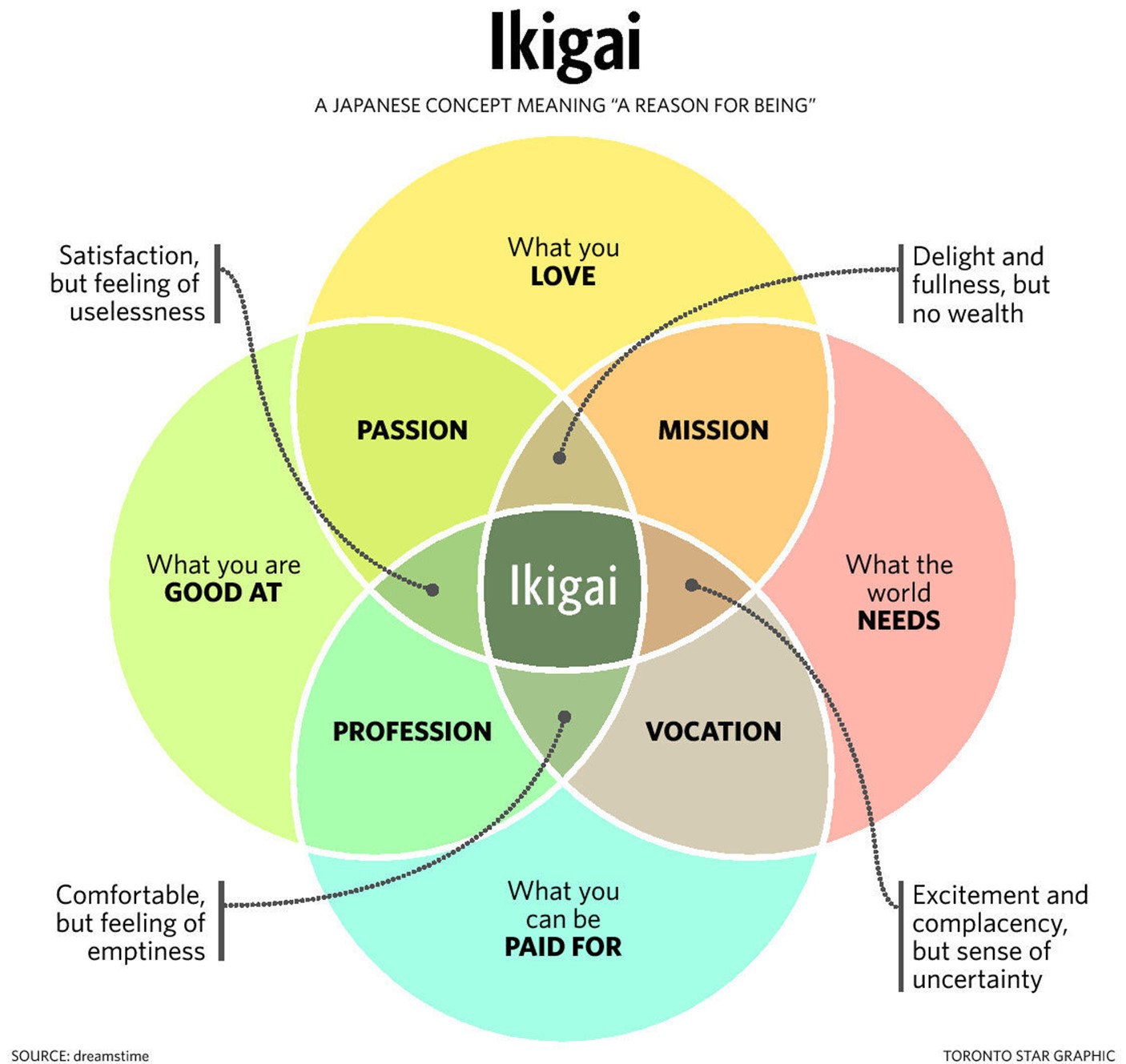
…To find this reason or purpose, experts recommend starting with four questions:

  • What do you love?
  • What are you good at?
  • What does the world need from you?
  • What can you get paid for?

Finding the answers and a balance between these four areas could be a route to ikigai for Westerners looking for a quick interpretation of this philosophy. But in Japan, ikigai is a slower process and often has nothing to do with work or income.

In a 2010 survey of 2,000 Japanese men and women, just 31% of participants cited work as their ikigai. [Which makes sense given that less than half of the Japanese population is working and only 59% of adults are working.  So the majority of Japanese workers got ikigai from their work if that survey was representative.]

Gordon Matthews, professor of anthropology at the Chinese University of Hong Kong and author of What Makes Life Worth Living?: How Japanese and Americans Make Sense of Their Worlds, told the Telegraph that how people understand ikigai can, in fact, often be mapped to two other Japanese ideas – ittaikan and jiko jitsugen. Itaikkan refers to “a sense of oneness with, or commitment to, a group or role”, while jiko jitsugen relates more to self-realization.

Matthews says that ikigai will likely lead to a better life “because you will have something to live for”, but warns against viewing ikigai as a lifestyle choice: “Ikigai is not something grand or extraordinary. It’s something pretty matter-of-fact.”

Doing things for other people (“what the world needs”) is a particularly important hole in how most Americans think about happiness.  Harvard researchers surveyed over 10,000 American students and about 80% said they valued their own happiness over caring for others.  Most kids thought their parents had the same priorities.

The irony is that seeking happiness isn’t necessarily the best way to find happiness.  It is partly by caring for others that we find happiness and purpose in life.  Happiness is one of those things that you can’t get by striving to be happy.  It is produced as a byproduct of how you live your life and if you only do things for the world because you want to be happy, it won’t work as well as if you do things for the world simply because you want to contribute.  It is the joy of contributing to others that brings a happiness that cannot be produced by merely striving to be happy.

Yukari Mitsuhashi reported for the Huffington Post that

There have even been attempts to link ikigai to longevity. Studies have found a correlation between longevity and having a life’s purpose, or ikigai, and Japan has the world’s longest life expectancy, 83.7 years ― five years longer than the U.S. (78.7 years).

In another article, Yukari Mitsuhashi wrote in the BBC that

There are many books in Japan devoted to ikigai, but one in particular is considered definitive: Ikigai-ni-tsuite (About Ikigai), published in 1966.

The book’s author, psychiatrist Mieko Kamiya, explains that as a word, ikigai is similar to “happiness” but has a subtle difference in its nuance. Ikigai is what allows you to look forward to the future even if you’re miserable right now.

Hasegawa points out that in English, the word life means both lifetime and everyday life. So, ikigai translated as life’s purpose sounds very grand. “But in Japan we have jinsei, which means lifetime and seikatsu, which means everyday life,” he says. The concept of ikigai aligns more to seikatsu and, through his research, Hasegawa discovered that Japanese people believe that the sum of small joys in everyday life results in more fulfilling life as a whole…

In a culture where the value of the team supersedes the individual, Japanese workers are driven by being useful to others, being thanked, and being esteemed by their colleagues, says Toshimitsu Sowa… That’s not to say that working harder and longer are key tenets of the ikigai philosophy… Rather, ikigai is about feeling your work makes a difference in people’s lives.

How people find meaning in their work is a topic of much interest to management experts. One research paper by Wharton management professor Adam Grant explained that what motivates employees is “doing work that affects the well-being of others” and to “see or meet the people affected by their work.”

In one experiment, cold callers at the University of Michigan who spent time with a recipient of the scholarship they were trying to raise money for brought in 171% more money when compared with those who were merely working the phone. The simple act of meeting a student beneficiary provided meaning to the fundraisers and boosted their performance.

This applies to life in general. Instead of trying to tackle world hunger, you can start small by helping someone around you, like a local volunteering group.

Diversify your ikigai

Retirement can bring a huge sense of loss and emptiness for those who find their ikigai in work. This can be especially true for athletes, who have relatively shorter careers… When retirement comes, it is helpful to have a clear understanding of why you do what you do beyond collecting a payslip.

By being mindful of this concept, it might just help you live a more fulfilling life.

The focus of Ikigai changes with age.  In particular, for people who live long enough to retire (and people living off of an inheritance), the last of the four questions–“What can you get paid for?”–disappears and those lucky people can just focus on other dimensions. In fact, some authors like Dan Buettner always leave the money question off of the list of dimensions and just focus on the other three. There is a lot of overlap between what you are good at and what you can get paid for because why would any employer hire you if other people are better at something? Being good at something is always relative to other people.  It is all about comparative advantage. If employers are rational, they aren’t going to hire inferior workers. 

The diagram at the top of the page is a beautiful info graphic, but it isn’t perfect because the vocation category is misnamed and is probably very rare.  It also leaves out a number of additional dimensions that are also important for living a good life such as spirituality, and an explicit recognition of the importance of relationships.  For example, Japanese often use two words for relationships, moai and ittaikan (also mentioned above) when explaining ikigai.

Relationships should be stressed more because you can focus on the other four dimensions — 1) what the world needs, 2) money, 3) competence, and 4) enjoying tasks — without building close relationships with other individuals and feeling at home in a particular group.

Relationships should be one of the top factors for ikigai because they usually make life happier and healthier.  One study found that, “The people who were the most satisfied in their relationships at age 50 were the healthiest at age 80.”  According to Robert Putnam and other scholars, neoliberal capitalism and social media technologies are weakening the bonds of traditional relationships in modern life.  Perhaps these forces are weakening traditional relationships in Japan and that may be one reason why most Japanese people say they are unsatisfied with their ikigai today.

Hector Garcia wrote a book about ikigai and he said that he associates ikigai with being in a flow state where, “you forget to eat and drink”. Iza Kavedžija interviewed older Japanese and she reported that they focused on what you are good at.  The mainly looked at ikigai as mastery.

This goes to show that ikigai is not represented perfectly by the four dimensions of the diagram, but the diagram is aesthetically appealing.  Some authors use completely different ways to explain it.  For example, Japanese writer Ken Mogi‘s five pillars for achieving ikigai are completely different from the diagram.  Life is short and in looking for a career, people need to balance multiple dimensions:

  1. meaningful work that is needed and helps others.
  2. fun tasks (without unpleasant commute, insecurity, tiresome schedule, unfair conditions, etc.) that achieve a state of flow.
  3. relationships with people you work with.
  4. ability (comparative advantage)
  5. challenge (not too much (stress) nor too little (boredom))
  6. feedback about successes and how to improve
  7. autonomy
  8. compatible with personal life goals (sufficient time balance and wage)

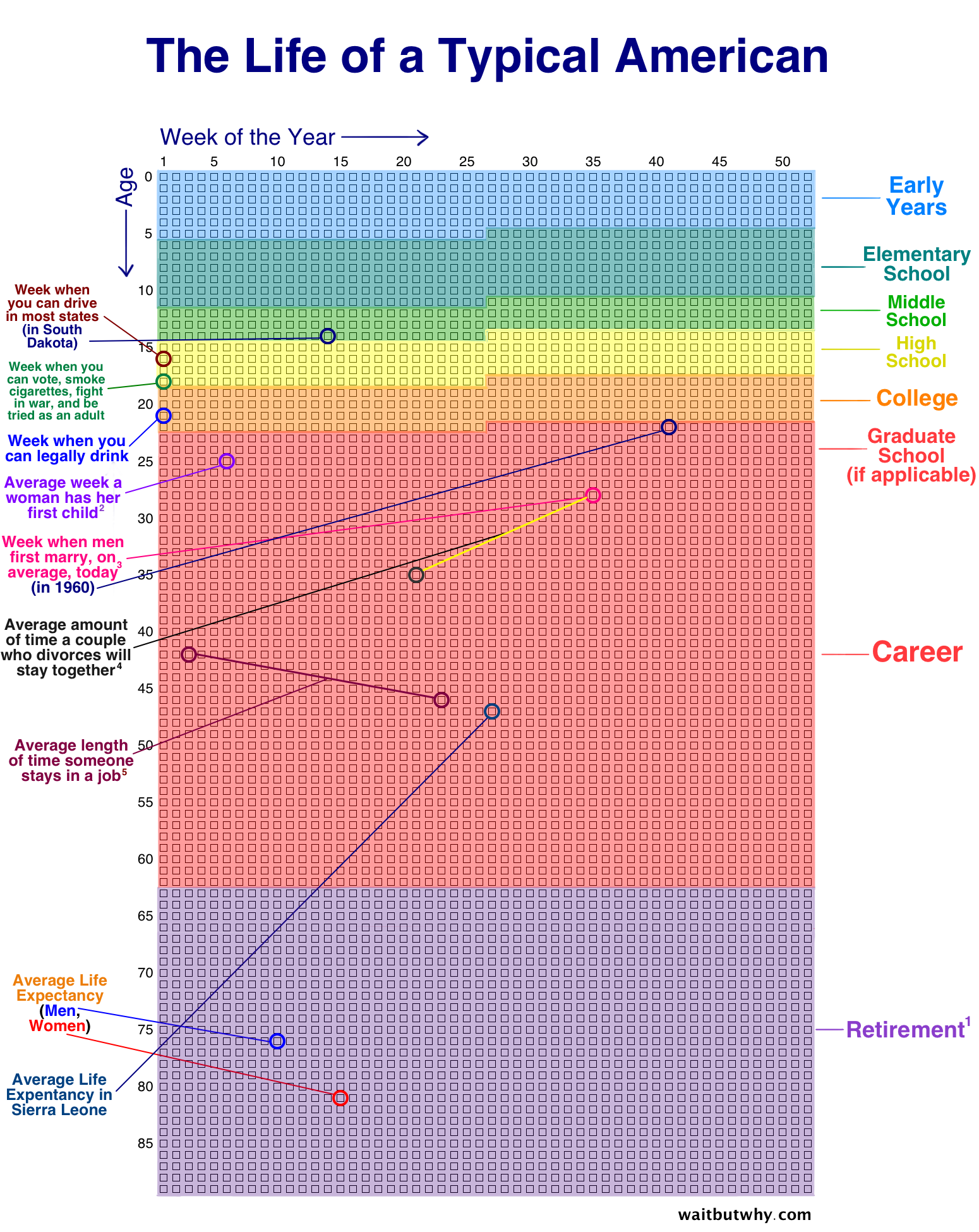
You have a lot of weeks in life to find all of these qualities in a career, but you might as well start now:

weeks-in-life

If you don’t spend those weeks doing 80,000 hours of ikigai, at the end of your life you may have regrets.  For example,  25% of workers don’t think their job is socially useful and people working in private business are much more likely to think their work is socially useless than people working for government. 

Within business, the share of workers considering their job as socially useless is particularly high in jobs involving simple and routine tasks as well as jobs in finance, sales, marketing, and public relations. Within the public sector, jobs in education, health, and the police force are rarely perceived as socially useless.

Posted in Labor

Why is health care so expensive in the United States

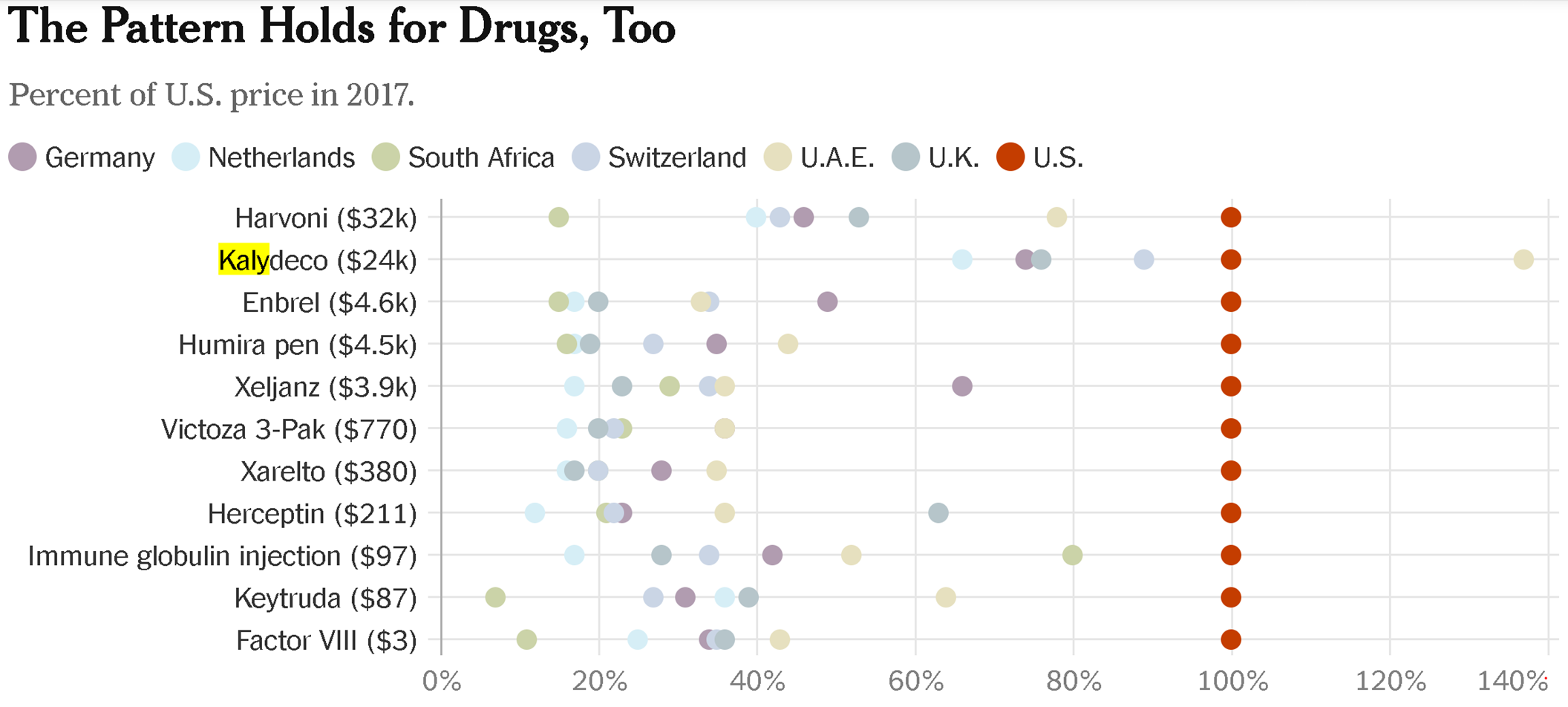
The International Federation of Health Plans publishes an international cost comparison of common medical services and its most recent compilation looked at prices in 2017. The result answers the question asked by the NYT:

Why does health care cost so much more in the United States than in other countries? As health economists love to say: “It’s the prices, stupid.”

Most procedures cost less than half as much abroad compared with what Americans pay.

On top of these prices, Americans also pay higher insurance administrative costs than people in other countries, but that only adds a few percentages to the kind of inflated prices shown here.

The UAE does pay more for Kalydeco than Americans pay, but that is one of those rare outliers. The UAE pays less than half what Americans pay for most drugs.

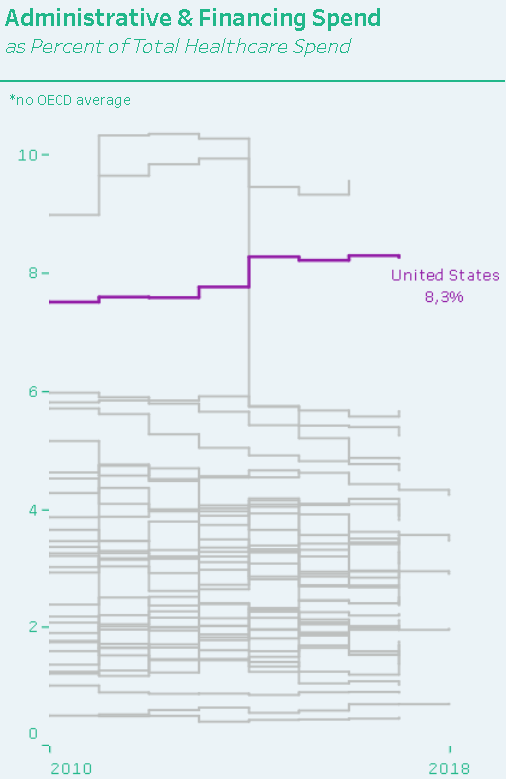
Many people think that Americans pay more for healthcare due to high administrative costs, and it is true that we pay higher prices for healthcare administration than anywhere else, but that is still only about 8% of healthcare spending (according to the OECD), so it is only a tiny part of the overall problem.

As you can see in the graphic, only Mexico and Costa Rica had a higher administrative burden than the US, but because they spend a lot less on healthcare in those countries, the gross administrative burden in the US is still much bigger.  

admin-cost

At the bottom of the graphic are Turkey, Norway and Finland which spend hardly anything on healthcare administration.  

Posted in Health

Median American wealth still lags many peers

Credit Suisse does an annual analysis of global wealth that I have written about in the past. Today, Paul Neufeld Weaver sent me an infographic showing the distribution produced by HowMuch.net, a financial literacy website:

(In case the html for their graphic isn’t working, below is a version from Wikipedia)

Credit Suisse caters to the super wealthy elite and their heirs, so they are never going to criticize rising inequality, but one reason why the US has lower median wealth than Canada or France is that there is higher wealth inequality in the US which means that the top 1% have a larger share of the total and the median American has a smaller share.

The US is far wealthier per capita than France or Canada according to the Credit Suisse data, but despite higher overall wealth, the US still has lower median wealth because our higher inequality in the US means that wealthy elites have a lot more of the total than in nearly all countries that have higher median wealth than the US.

Posted in Medianism

Abolish Daylight Wasting Time

Updated 3.22.2022

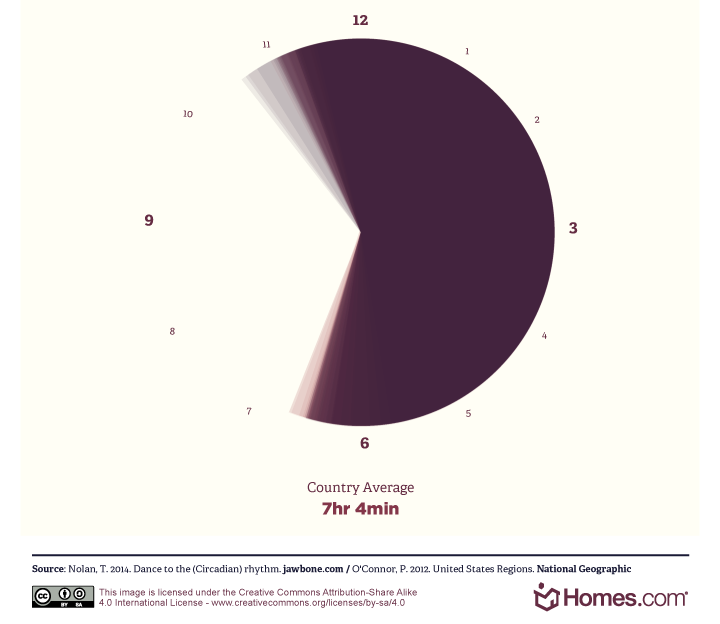
This Sunday begins the season of Daylight Wasting Time which wastes daylight for  most Americans. The median American gets out of bed a little after 6:30AM and goes to bed around 11PM according to Jawbone’s sleep sensors and a Edison Research poll.  American women get up closer to 7AM according to University of Michigan research.

Daylight Saving Time extends daylight into the evening hours when nearly EVERYONE is awake and more people have time to be outside because it is after work hours. Daylight Wasting Time cuts the useful evening hours of daylight and adds daylight in the early morning hours when the vast majority of Americans are still either asleep or inside their homes getting ready for the day with all their lights on regardless of how much sunlight is outside. Daylight Wasting Time shifts more sunlight to 6AM, but only about 29% of Americans are up by 6 AM.

This is a wasteful trade-off. We should stick with Daylight Saving Time all year round.

Daylight Saving Time was a great idea because it helped everyone coordinate their schedules to waste less time sleeping during the daylight. It would have been impossible to order everyone to get up an hour earlier to use daylight more efficiently, so the government moved the clock forward which caused the same effect. That was a tricky feat of social engineering.  This map of Jawbone data shows that arbitrary time systems have a big impact on sleep patterns.

If you happen to live on the left side of a time-zone border you tend to go to bed about an half hour earlier than people who happen to live a few miles away just across the dividing line on the right side.  Just be shifting the official clock time, entire populations dramatically change their sleeping behavior.

During Daylight Wasting Time, the middle of the darkness is midnight and the middle of the light of day is noon.  Daylight Saving Time was adopted to recognize the reality that noon is FAR from the middle of the time when most people are awake, and midnight is FAR from the middle of our sleep. We got more usable daylight by shifting clock one hour later so that the middle of the daylight is closer to the middle of our waking day and the clock hour of 12:00 midnight is one hour closer to the middle of our sleep.  That saves about an hour of daylight each day.  Because humans are awake more hours every day than there is sunlight, the best way to maximize our use of the sunlight is to be awake during both sunrises and sunsets, and although nearly everyone stays awake until after sunset, many people sleep through most of our sunrises and waste daylight.  That is the problem that Daylight Saving Time was invented to deal with.

That invention was a great idea, but unfortunately, the inventors thought the benefits should be temporary every year and set up a annual ritual of switching back to Daylight Wasting Time every fall which always takes us back to the problem that Daylight Saving Time was invented to fix.  Those time changes also add a host of additional costs caused by the transitioning back and forth. Joseph Stromberg wrote an excellent survey of the harms of switching time twice a year:

  • It was supposed to save energy. It failed.
  • It increases traffic deaths.
  • Contrary to the myth that it was invented to help farmers, it hurts them, particularly the dairy industry.
  • Corporations lobbied to lengthen the months of Daylight Saving Time in 1986 because Daylight Wasting Time hurts sales of everything from barbecue grills to baseball tickets and golf balls. The candy lobby succeeded in changing federal law again in 2007 to sell more candy by delaying the return of Daylight Wasting Time until after Halloween so trick-or-treating would have more time and they could sell more candy.  I say why not delay it until after the Christmas retail season! Then we’d only have to deal with a bit over 2 months of wasted daylight every year.
  • Daylight Wasting Time increases depression due to less available light for outdoor activities.
  • It exacerbates sleep disorders by imposing jetlag on the entire nation every year.  Sleep disorder researchers are remarkably unanimous in objecting to changing back and forth to Daylight Wasting Time.
  • It reduces exercise.
  • It reduces worker productivity.
  • It even increases heart attacks!

Some people argue that we need to make Daylight Wasting Time permanent so that it isn’t dark when kids go to school in the morning, but switching everyone’s clocks twice a year is an expensive way to keep school kids safe.  It would be simpler and better for kids if we just delayed the start of school because most teenagers are not morning people and perform better if they aren’t forced to wake up so early.

There is a simple solution for any locality that wants to let kids get up after the sun rises.  Just change the time that your school begins.  There is no reason to let the Federal government dictate when you begin school.  As a group of sleep doctors wrote:

Daylight saving time is simply a work-time arrangement, nothing more than a decision to go to school or work an hour earlier. As such, it is not a decision that should be made by the world, by unions of countries (e.g., the European Union), or by individual countries, neither at the federal nor the state level. Work-time arrangements are decisions that a work force could decide at the company level. Therefore, anyone who wants to spend more time at home in daylight after work should convince his or her company and co-workers to advance their start time during certain months of the year or even better: introduce flexibility for individual workers where possible to accommodate differences in personal biological and social requirements.

The New York Times hosted an online debate about whether or not to abolish that annual switch to Daylight Wasting Time and so they rounded up a bunch of researchers who have examined its costs and benefits.  It wasn’t much of a “debate” because all the researchers wanted to abolish it. The only voice the New York Times found to argue in favor of the annual time switch was a novelist who thinks it is neat because it forces us to “change our perspective” twice a year.  Well, yes, the increase in heart attacks and traffic accidents certainly does force us to change our perspective, but there are better ways such as reading novels about tragedy instead of living it.

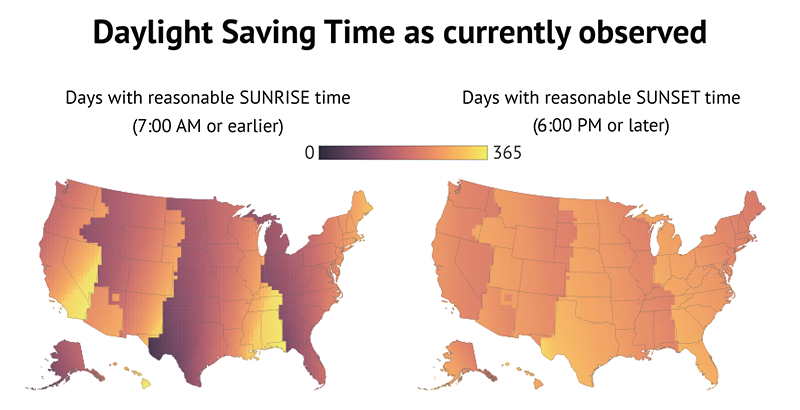
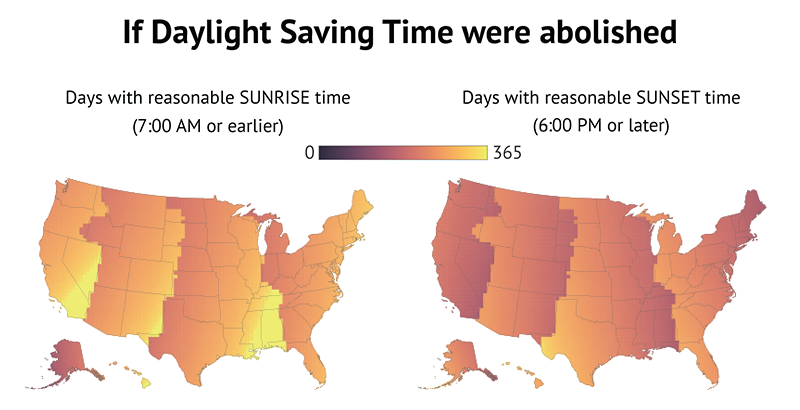
Unfortunately, most of the voices in favor of ending the switch want to abolish Daylight Saving Time rather than keeping it permanently.  For example, Andy Woodruff argues that we should permanently keep our clocks fixed in Daylight Wasting Time because he prioritizes having sunrises before 7:00 AM as he shows in his preferred heat map (shown below), but you can pick your own preferences and see how it would look in his interactive graphic at the above link.

I agree that abolishing Daylight Saving Time is better than switching back and forth, but better yet would be to abolish Daylight Wasting Time and keep Daylight Saving Time instead.

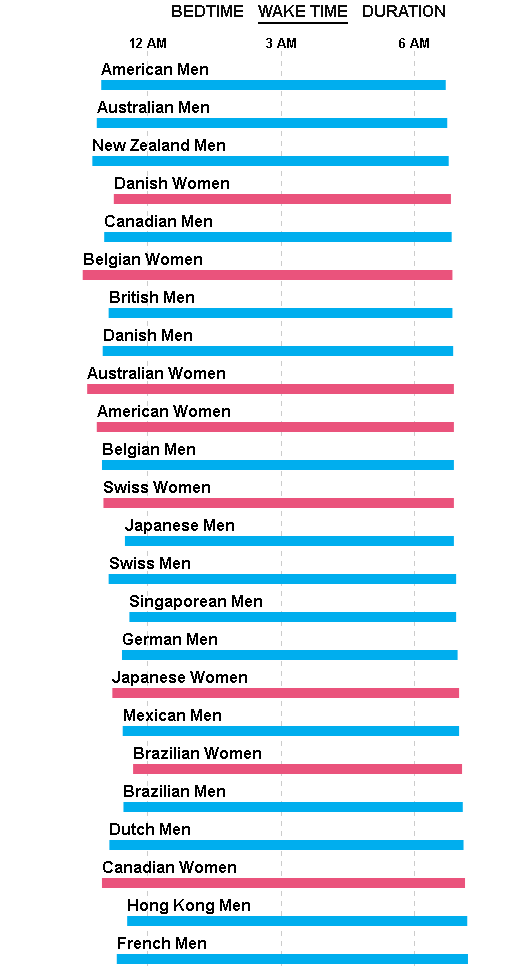
One problem with Woodruff’s scheme is that sunrise isn’t the same thing as first light. If we switch the criteria to first light at 7:00 AM, then always observing Daylight Saving Time is far superior to always observing Daylight Wasting Time in Woodruff’s scheme. Unfortunately, morning people like Woodruff have traditionally dominated American culture with the result that Americans wake up earlier in the morning than just about any other rich nation.

sleep time

The above graph only shows the earliest risers, and there are many more nations that get up even later. Women in Spain have the latest schedule, going to bed at midnight and waiting until after 8AM to get up.

Morning people like Woodruff discriminate against night owls in America. This injustice is ultimately why we continue to observe Daylight Wasting Time. The minority of Americans who are early to bed and early to rise have traditionally dominated the majority of Americans who get up later. Those early risers want to have the additional daylight all to themselves before the rest of us get up, and their dominance is the real reason why we endure the social cost of daylight wasting time.

This is not inevitable. America has changed our system numerous times, most recently in 2007 when it was extended by a month. That change cost the airlines $147 million to coordinate their schedules with the rest of the world because most countries don’t have Daylight Wasting Time and it takes a lot of work to change schedules which have to be coordinated with everyone else.

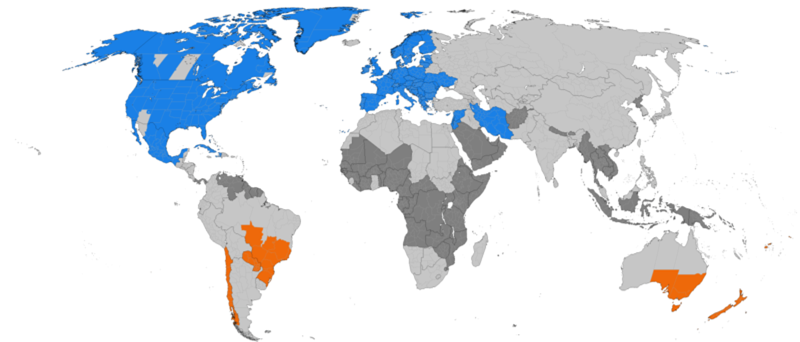
This is an ongoing problem because the countries that use some kind of Daylight Wasting system don’t change their clocks on the same schedule and all those international time changes always cost money and errors every year. Below is the Wikipedia map of the countries that do not have any kind of Daylight Wasting Time system marked in either dark or light gray. They are much more civilized.

Daylight Wasting Time is uniquely prevalent in Western Europe and its cultural offshoots in North America.  But the globe should be getting even more civilized because 80% of EU citizens want to scrap it according to a recent poll and so the EU is drafting legislation to abolish it.  There is also movement in the US.  In 2018, a California ballot initiative to abolish Daylight Wasting Time passed with an overwhelming 60% despite having zero dollars spent on the initiative (a very rare event).  Unfortunately the change still requires 2/3 approval of both houses of the state legislature.  That is an extremely high bar that makes it hard to pass popular idea ideas like this.

The most harmful part of our daylight wasting system is the ridiculous ritual of changing our clocks twice a year. That switch annually kills people and measurably reduces productivity. The morning people would prefer to keep Daylight Wasting Time year round so that they can have more daylight at their favorite time of the day — in the quiet of early morning before everyone else is out and about.

Fine. If we can’t save daylight all year round, then I’d settle for having Daylight Wasting Time year-round, but it would be best to abolish it and keep Daylight Saving Time.

Note that even the name of DST is confusing which is another reason to just have one time:

Isn’t it “daylight savings time” not “daylight saving time”?

No, it’s definitely called “daylight saving time.” Not plural. Be sure to point out this common mistake to friends and acquaintances. You’ll be really popular.

Posted in Culture

Enter your email address to follow this blog and receive notifications of new posts by email.

Join 75 other subscribers
Blog Archive
Pages