Stuart Russell says to give up on deontologies


Stuart Russell wrote a new book about managing the coming artificial intelligence revolution called Human Compatible. He believes that the main danger of AI is not that it will become conscious and decide to maximize its own well-being at the expense of humans, but that AI will slavishly try to solve the problems that humans direct it to solve and cause disastrous unintended consequences. For example:

the problem comes from increasing capabilities, coupled with our inability to specify objectives completely and correctly. Can we restore our carbon dioxide to historical levels so that we get the climate back in balance? Sounds like a great objective. Well, the easiest way to do that is to get rid of all those things that are producing carbon dioxide, which happen to be humans. You want to cure cancer as quickly as possible. Sounds great, right? But the quickest way to do it is to run medical trials in parallel with millions of human subjects or billions of human subjects. So you give everyone cancer and then you see what treatments work.

He says we can’t write down rules for how to do this safely because laws don’t work well enough. You can declare, “Thou shall not kill” but the AI might misinterpret this (as humans often do) or find some loophole in which the AI merely causes someone else to kill humans. Russell gives the analogy of how impossible it is to write a tax law without people finding loopholes and causing unintended consequences:

So, we’ve been trying to write tax law for 6,000 years. And yet, humans come up with loopholes and ways around the tax laws so that, for example, our multinational corporations are paying very little tax to most of the countries that they operate in. They find loopholes. And this is what, in the book, I call the loophole principle. It doesn’t matter how hard you try to put fences and rules around the behavior of the system. If it’s more intelligent than you are, it finds a way to do what it wants.

Russell says that we have to stop using deontology (a rule-based ethical system) and move to a consequentialist ethical system for managing AI.

Instead, the AI system has a constitutional requirement that it be of benefit to human beings. But it knows that it doesn’t know what that means. It doesn’t know our preferences. And it knows that it doesn’t know our preferences about how the future should unfold. So you get totally different behavior. Basically, the machines defer to humans. They ask permission before doing anything that messes with part of the world. …[An AI that is trying to learn what humans want] has an incentive to be honest about its plans because it wants to get feedback and so on.

This does seem to be an improvement, but I’m still worried about AI developing its own priorities and even if AIs stay obedient to humans, I’m worried about the character of the individuals that the machines will obey. The people who own various AI could have disastrous priorities.

Russell makes the parallel with nuclear physics in order to argue that we need to be thinking about how to manage the dangers before they become a problem, but I think that is actually a scarier analogy than Russell had intended.

I think it’s useful to look back at the history of nuclear energy and nuclear physics, because it has many parallels… when Leo Szilard invented the nuclear chain reaction, he didn’t know which atoms could be induced to go through a fission reaction and produce neutrons that would then produce more fission reactions…. The only way you get nuclear safety is by worrying about the ways [reactors] can blow up and preventing them from blowing up.

Unfortunately for this analogy he first application of controlled nuclear reactions was the nuclear bomb and the physicists at the time risked the survival of the entire planet when they tested it.  They suspected that the explosion could cause a chain reaction that would ignite the atmosphere of the entire world in a global nuclear explosion when they tested it, but they did it anyhow.

Similarly, AI will eventually become dangerously powerful. Who is to say that the first AI won’t be deployed as a weapon between nations or as a weapon of wealth accumulation by a private party who isn’t worried about the wellbeing cost to humanity because of lust for power? With anything as powerful as nuclear reactions or AI, we will need to worry about the purposes of any humans who have any control over it. With AI, there is the additional worry that it will escape the control of those humans altogether and develop independent motivations.
Posted in Philosophy and ethics

Inequality & The Good Place

I’ve been watching the first season of The Good Place on Netflix which is a sit-com (with super-high ratings on IMDB and Rotten Tomatoes) about two people who are mistakenly sent to heaven and must learn moral philosophy to be able to stay. I like how the show illustrates a lot of interesting moral issues such as the fact that most of us tend to be more drawn to others who are not particularly moral and distance ourselves from the moral paragons.

It is easy to like the morally-flawed protagonist of the show and even though we admire the paragons of morality like the moral philosophy professor who is the protagonists’ sidekick, it is easy to understand why characters on the show frequently comment that, “everyone hates moral philosophy professors.”  Research confirms that most people prefer to have friends with moral flaws.  The moral paragons on the show can feel annoying whereas the flawed characters are often more relatable and it is certainly more cathartic to watch their foibles.  I suspect this helps explain why most Republican evangelicals prefer the obviously flawed Donald Trump over Mike Pence who is a paragon of virtue by comparison.  They don’t want impeachment to take away our flawed, cathartic leader and replace him with a boring, reliable one.

One of the moral philosophers who has most influenced the show is T. M. Scanlon whose philsophy of contractualism is the central guide for the show’s writers. Scanlon also argued that we should worry less about equality of outcomes and more about equality of opportunity. As Martin O’Neill wrote:

The distributive approach to equality fits with a model of egalitarian public policy that is essentially compensatory in nature. It may be seen as just a brute fact that, in the economic arena, many people lack opportunities or suffer indignities and harm to their sense of standing and self-respect. A state concerned with promoting greater equality could then come along after the fact and redistribute goods or welfare toward those who have lost out in economic life.

But, on the social egalitarian model that Scanlon advances, ex post compensation is not good enough. Instead, a state concerned with equality must ensure, from the start, that people are able to pursue lives of robust, individual agency within the economic domain, with a secure sense of their standing as equals among others. Instead of being concerned only with redistribution, egalitarian public policy should incline toward predistribution, which aims to reshape economic institutions so that they foster egalitarian social relationships, as well as more evenly distributed economic rewards.

Whether or not equality of outcome or of opportunity is the most ethical type of equality to focus on, equality of opportunity is the most politically achievable because both liberals and conservatives agree that equality of opportunity is important whereas many conservatives are skeptical about equality of outcomes. And in reality, there is tremendous overlap because you cannot have equality of opportunity without a big increase in equality of outcomes because each person’s opportunities are largely determined by what she or he inherits and inheritance is currently extremely inegalitarian because of the high inequality of outcomes in the previous generations.

You simply cannot have equality of opportunity without a lot of ex-post transfers from the wealthy of the previous generation to the children of the have nots in this generation. Because equality of opportunity requires that we stop the inequality of outcomes in the previous generation from being transferred as an unearned entitlement to their children in the next generation, there is no difference between equality of opportunity and equality of outcomes when considering more than one generation and the welfare transfers from parents to children. And because equality of opportunity is more politically feasible since both the right and the left agree about it, we should focus on that if we want to accomplish more equality.

Posted in Philosophy and ethics

US primary elections are a crapfest. Time for some intelligent design.

Joe Biden has been the Democratic frontrunner for the entire 2020 primary until last week when Elizabeth Warren surged in the polls and briefly became the frontrunner. Her momentum made it look like she was going to demolish all the other campaigns, so naturally, all the other campaigns started dumping on Warren and she became the victim of the circular firing squad that focuses on whoever looks like the most probably next leader of the party. That backlash predictably caused her polls to fall again and next week all the Democrats will probably rejoin President Trump in their focus on hurting Biden since he is the frontrunner again.


Research shows that in our political system, the most effective way to win is to go negative and bash whoever your biggest rival is. It is less effective to campaign on positive ideas for improving the country. Unfortunately, these perverse incentives mean that voters get less information about whether anyone has any good ideas for solving problems and instead we just hear a lot about how crappy all the other candidates are even though most candidates are broadly similar in a primary.  In particular, all the candidates tend to gang up on whoever is in the lead.  They try to make the frontrunner look bad and it often works. The 2012 Republican primary was particularly striking in how each candidate briefly rose to take his turn as the frontrunner in the polls only to be torn down by the rest of the pack and then to be replaced by another top dog who had seemed pure by comparison only because he had yet to be assaulted with mud from the rest of the pack yet.


First it was Romney, then Perry shot up, followed by Cain whose meteoric rise and fall was echoed by Gingrich and then Santorum until finally Romney finally rose above the fray as some of the failed candidates started dropping out and gave him their endorsements perhaps in hopes of gaining a cabinet nomination. This kind of campaign structure benefits the kind of candidate who is really good at schoolyard taunts, dirty campaigning, and those who can whip up a base of support that likes mudslinging more than policy because in a crowded primary, you can win the election with only a third of the vote and it doesn’t matter if 2/3 of voters hate you. If your opponents divide up the rest of the votes among six other candidates, then they will each average 11% of the vote, and 1/3 of the vote is a landslide of popularity by comparison. 

That is basically what happened in the 2016 Republican primary as shown in this final Real Clear Politics poll

Trump only needed about 1/3 of primary votes to utterly dominate most of the 2016 primary even though more Republicans disapproved of him than any other candidate during the primaries because his opposition was divided into so many small camps. Trump was a master of mudslinging and his core base of early supporters were so excited about Trump that they didn’t care about his scandals. Trump once said of the fanaticism of his supporters in the early part of the primary, “I could stand in the middle of Fifth Avenue and shoot somebody and I wouldn’t lose any voters, okay? It’s, like, incredible.” 

But most Republicans initially disliked the philandering, elite big-city candidate who dodged the Vietnam draft and has never had a habit of attending church.  People don’t remember how much the median Republican disliked him because that changed after he got the nomination and Republicans didn’t have any other viable choice. Republicans are much more loyal to their party than Democrats and so most Republicans came around and warmed up to him. But most partisan voters always warm up to any candidate their party chooses and most Republicans during the primary would have preferred a more mainstream Republican like Bush or Rubio. Trump should not have gotten elected to be the Republican nominee because the majority of Republicans would have preferred one of the other candidates. But our electoral system does not elect the person the majority wants, we elect the person who gets the plurality of votes.

In a plurality voting system like ours, voters can only express their preferences about one and only one of the candidates and the candidate with the most votes (the plurality) wins. This works fine when there are only two candidates because then the majority of the people get their way. It is often criticized as being a dictatorship of the majority who can dominate the minority that loses, but the reverse would be worse: Nobody thinks a dictatorship of a minority is better, but that is what a plurality electoral system usually produces when there are multiple candidates. When the vote is split among three or more candidates, the winning plurality is usually a minority of the voters and so we end up with a dictatorship of a minority. Not good.

Fortunately there are lots of other electoral systems that allow voters to express their preferences for more than one candidate so that we can collectively select the most popular candidate: approval voting, range voting, instant runoff voting (IRV), a Condorcet method, etc. Whereas voting reform theorists disagree about what the best system is because they all have different advantages, everyone universally agrees that any of these methods is better than our plurality system, and both Australia and Ireland have used a form of ranked-choice voting for about a century, so we can see that it works well.

So if there are lots of alternatives that everyone agrees are vastly superior to the one we have, then why don’t we change our system?

  1. Most people are simply ignorant and don’t realize there is any other way to run elections. That is a failure of our education system that might be explained by the fact that powerful people don’t want Americans to know about alternatives because they don’t want change.
  2. Any political change creates winners and losers and changing our electoral system would redistribute political power away from some very powerful people in our duopoly party system. Although America’s founding fathers despised political parties and hoped our new nation would avoid them, they accidentally designed an electoral system that concentrates political power into a two-party duopoly. Our current system gives tremendous power to behind-the-scenes power brokers to decide who gets to be on the ballot and who gets to appear in political debates. These unelected party bureaucracies also control the vast majority of political resources (political donations and volunteers) that help determine who wins and who loses. These insiders would lose power if we moved beyond our plurality system because that would break up our party system into numerous less-powerful parties. In most of the world’s best democracies, there are more than two party which typically include a party for Christian Democrats (a common name for social conservatives in other countries), Libertarians (or some other party for business priorities), Greens (for environmentalists), Labor (for people whose identity prioritizes unions), and many others. That splintering of resources would reduce the power of our two generic parties for liberals (Democrats) and conservatives (Republicans).
  3. Even if the majority of Americans realized that we could easily improve the machinery of our elections, our entire political system is designed for gridlock so it would still be hard to get anything done. The constitution is hard to change. Any change can be vetoed by the checks and balances of four centers of federal power: the House, Senate, Executive, and Supreme Court, and it only takes 40% of Senators to block everyone else. Our decentralized federal system makes change difficult since power is divided between federal, state and local jurisdictions. And finally, America’s large geographic size and diverse population makes it harder to come together on decision-making than in smaller, more homogenous nations.
  4. Although there is broad agreement that our plurality voting system is the worst possible method of voting, the very fact that there are dozens of good alternatives for replacing it makes it hard to pick which one. It is like a van full of bored people driving through prairie on a winter night who all agree that it would be more fun to watch any move together on the van’s movie system, but there are 100 great options and every person in the van has a different favorite. It can take a long time of driving along bored in the darkness (the worst option) to come to an agreement about which movie to select. The choice of multiple possible improvements creates a status-quo bias due to gridlock. If only one of the hundred movies had been available, everyone would immediately agree that it is better than driving in darkness because any movie is much better than that, but because there are many possibilities which all have different advantages and disadvantages, it is harder to come to agreement about which one to select and darkness rules. Similarly, the small community of people who is aware that our system sucks is divided into competing camps that each propose a different system because there isn’t one voting system that is clearly the one best of them all.

Ironically, the voting reform advocates are stuck because they cannot agree upon which system to choose. You would think that voting experts could just take a vote and all commit to throw their unified support behind the winner, but because they can’t agree upon what voting system to use, they can’t even take a vote to decide which system should replace plurality voting. Pathetic.

Donald Trump won the Republican primary because he was a master at negative campaigning and he had the enthusiastic support from a plurality (minority) of supporters who didn’t care about Trump’s scandals that would sink most candidates. In a plurality system you win by tearing down everyone else and you don’t need to appeal to the majority of voters. Whereas plurality voting creates divisiveness between multiple candidates as demonstrated in our nasty presidential primaries, any of the other voting systems encourage focusing more on commonalities because candidates must get the approval of a majority, not just the biggest plurality. That means they need to avoid pissing off all the supporters of their rivals. This is exactly what happened in the 2018 San Francisco mayoral election which uses instant-runoff voting. There was a frontrunner who had a large plurality versus the second and third-place candidates who were distant underdogs, but instead of merely attacking everyone else, the two underdogs banded together because they were both more liberal than the frontrunner. They campaigned together and asked their supporters to rank the two of them together ahead of the frontrunner and one of them won because a majority of voters wanted one of these two more liberal candidates who were only behind the more conservative frontrunner in the polls because the polls were asking voters the plurality question of which one candidate they liked best.

Whenever there are three or more candidates, the plurality system fails and it becomes increasingly important to avoid plurality voting as the number of choices increases because the size of the plurality needed for victory shrinks with more candidates. In an election with ten candidates, in theory one can win with only eleven percent of the vote. Minneapolis had an election with eight candidates and if they had used a plurality system, it would encourage a crapfest like we have in our presidential primaries. Fortunately Minneapolis also uses instant-runoff voting for mayor and that helped their mayoral candidates become extremely civil with each other. It gives candidates the incentive to be kind and gentle to most of their rivals for the reason that you need their supporters to like you as well because you want everyone to vote for you as well as for your rivals and if you piss off the all the other candidates and their supporters, you won’t get elected. In 2013, the candidates literally put their arms around each other and all sang Kumbaya together at the end of their final debate. You gotta listen to Radiolab to hear what it was like. It is a great story that shows how much of a difference a better voting system can make.  If you just want to listen to the the 4-minute Kumbaya story, start at 54:30.

Fortunately, more nations and cities are coming around as Lee Drutman  explains below.   (Drutman also wrote a book on the topic entitled, Breaking the Two-Party Doom Loop: The Case for Multiparty Democracy in America.)

Twenty cities in the United States have already adopted ranked-choice voting. In 2018, Maine became the first state to adopt it for federal elections. That catapulted the reform to a national spotlight… Studies have shown that in places that have adopted it, ranked-choice voting has made politics a little less nasty. Candidates spent less time attacking each other, as compared to similar cities that didn’t adopt ranked-choice voting. Voters in cities with the system reported being more satisfied with local campaigns as a result (again, as compared to similar cities).

Ranked-choice voting has also increased the share of racial minority, female, and female minority candidates running compared to similar cities. The scholars who have studied this most closely believe more minority candidates ran because under ranked-choice voting, such candidates could reach out to other communities where they might not be the natural first choice and ask for second-choice votes.

The researchers believe women were more likely to run because under traditional winner-take-all elections, “women were deterred from running for office by … negative campaigning.” But with less negative campaigning and more cooperative campaigning, women are more likely to run…

Under ranked-choice systems, voters don’t have to try to figure out whether to support the candidate with the best chance of winning or the candidate they like best but fear can’t win. They can vote sincerely for their favorite candidate on their first choice, and then select back-up choices if their preferred candidates don’t do well. This also allows voters to express their full range of preferences, sending clearer signals than the traditional approach to voting. And in the end, more voters are likely to wind up voting for a winner. Voters prefer this kind of “preferential” voting because they consider it fairer

According to one analysis, in the last three election cycles, almost two-thirds of multi-candidate city primary contests (64 percent) did not generate a majority winner. And in almost a third of those elections (30 percent), the winning candidate got less than 40 percent of the vote. In other words, under the current rules, candidates preferred by far less than half of their constituents get to represent allof their constituents.

Under ranked-choice voting, outcomes like this can’t happen. The winning candidate needs to earn true majority support — a plurality does not make a victory. And if no candidate gets a majority of first-preference votes, that’s when the rankings kick in, and candidates are eliminated and their preferences redistributed until one candidate has a winning majority. This ensures that candidates need to build broad appeal. A candidate who doubles down on an intense but ultimately narrow group of supporters cannot win…

There’s more to come. 2020 is shaping up to be a big year for ranked-choice voting. Four states will use it in the Democratic primary — AlaskaHawaii, Kansas, and Wyoming. And Maine voters will use it for the first time in the general election for president. And both Alaska and Massachusetts will likely vote on ballot measures in 2020 to adopt ranked-choice voting statewide.So ranked-choice voting is catching on.

Posted in Pence2018, Public Finance

Best place to work: McDonald’s France

French people like to do things their own way. When they brought McDonald’s to their country, they customized it right down to the famous yellow on red logo that we have in the United States. In France, they like a more subdued green in the background.

Although the French are justifiably proud of their national cuisine, they have also become quite taken with perhaps that most American of foods: McDonald’s. The American fast-food giant has been so successful in France that until recently it was the second most profitable market for McDonalds in the world after the United States. McDonalds achieved success in France partly by adapting their restaurant to local tastes. For example NPR’s Elenor Beardsley reports that McDonald’s in France provides a much more elegant atmosphere.

Even in these harried times, the French spend more than two hours a day at the table. Sitting down to a meal is a cornerstone of French culture, and McDonald’s seems to get that. French McDonald’s are spacious, tastefully decorated restaurants that encourage people to take their time while eating. And the cozy McCafe’s with their plush chairs and sofas have become an extension to many restaurants.

The food is different too. In France McDonald’s uses mostly locally-sourced, high-quality ingredients like cheeses that include chevre, Roquefort, cantal and blue cheese, rather than the “homogeneous plastic mass” which is the legal term for the “American cheese” used in America. One reason French McDonald’s have better food is due to activists like José Bové who went to jail for destroying a McDonald’s as a symbolic protest against low-quality globalized food.

In the long run, this may have helped McDonald’s achieve much greater success than it’s arch rival Burger King which didn’t adapt to French tastes.  McDonalds started serving McBeer and produced local dishes designed by French chefs such as gallette des rois cakes and the McBaguette with artisanal jams.  A Wharton analysis cited a 2009 study that found that more than 70% of the sandwiches eaten in France were baguette sandwiches.

Unlike their Anglo-Saxon counterparts, French consumers rarely snack between breakfast, lunch and dinner. As a result, French meal times also last longer, and more food is consumed through multiple courses, creating unique opportunities and challenges for fast-food dining…

McDonald’s has capitalized on the French cultural preference for longer meals by using surplus labor to provide table-side service, particularly in taking orders from lingering diners inclined to order an additional coffee or dessert item. Thanks to such initiatives,  the average French consumer spends about US$15 per visit to McDonald’s — four times what their American counterparts spend…
the French spent an average of 38 minutes per meal in 2005, down from an average of 82 minutes in 1978.

Of course, McDonalds has brought many of its American features to France like the familiar Big Mac and spotless free bathrooms. That is a true gift of American cultural imperialism. Free bathrooms are hard to find in this country of pay toilets except in American fast-food chains. But because McDonalds France is run as a semi-independent subsidiary, it not only has a unique menu, ambiance, and logo, but a unique corporate culture too.

NPR’s Rough Translation tells the story of a McDonalds in a low-income Muslim neighborhood in the seedy city of Marseille that is known for gangs and crime. The McDonalds franchise’s slogan is “Come as you are” and it saw its mission as being part of each community. This tradition was shaped by stories they heard from America such as during the LA riots of 1992 after the Rodney King beating, the rioters who were trashing and burning entire blocks of restaurants and stores spared McDonalds because they felt like McDonalds was more of a part of their community than the other businesses. Unlike most businesses, McDonald’s mostly hired local people and because it was owned by a local franchisee who was invested in the local neighborhood, McDonalds gave out free food and other local philanthropy to help the local neighborhoods. Most other businesses didn’t do that and they got burned.

NPR tells the story about how McDonalds in Marseille took that principle up to a level that engendered loyal fanaticism among its employees culminating in an event where one of them doused himself with gasoline and threatened to immolate himself in protest to prevent a local store from being shut down. Now McDonalds in France does pay better than in the US, but it starts at their minimum wage which is only about $11 per hour, so it wasn’t the pay that makes employees love their job so much.

If you didn’t click on the link above, you gotta click now to listen to the whole story.  It isn’t everyday that you’ll hear a story about fast food workers that makes you swell with emotion.

They love their job partly because McDonalds gives them a chance and respect that most other employers don’t give. Men’s Warehouse had a similar strategy of hiring employees who might even be shunned by other employers because that engenders loyalty.

Men’s Wearhouse founder George Zimmer has been an outspoken advocate of providing felons with a second chance. As a result of this Men’s Wearhouse does not conduct criminal background checks for employees or those interviewing for positions.”

My third longest job in my life was at McDonald’s and I wouldn’t say that it was a place I liked to be, and most of us were not particularly loyal to it, but I did respect how well they inculcated a culture of hard work and many of my co-workers really did get a feeling of accomplishment from doing good work there. Even though I was always a McDonald’s cynic who grew up in an anti-fast-food, anti-big-business family and I disliked the idea of McDonald’s–even I sometimes had a tinge of envy or competitiveness when I saw how much better some of my co-workers could perform than I.

Posted in Medianism

This month may be the best time in history to look for a job!

One of the oddities of the macroeconomy is the fact that GDP falls wildly every year in the beginning of winter. That means that there is a kind of recession every winter. It isn’t an official recession because everyone expects it and plans for it so there isn’t the same kind of economic pain that an official recession produces. Economists avoid calling every winter a recession in two ways. First, we have officially defined a recession as a downturn in GDP that lasts two or more quarters. The annual winter slump only lasts one quarter, so that simply defines the issue away. Secondly, statisticians “seasonally adjust” our GDP data to try to smooth out the seasons to pretend that they don’t exist! That makes the annual winter slump disappear from the official data that we ordinarily use, and the intent is to make the long-term trends more visible by smoothing out the short-term seasonal “noise”, but the seasonally-adjusted data is less realistic if you are concerned with the short-run state of the economy which is certainly important when studying short-run phenomena such as recessions. 

For example, here is a comparison of the seasonally-adjusted data in blue versus the original data in red.

As you can see, the magnitude of the fall in the raw GDP data (red line) from the last quarter of each year (with the busy Christmas season) to the first quarter of each year (when there is little outdoor work in much of the country due to freezing temperatures) is about as big as the official seasonally-adjusted (blue line) recession of 2008–the biggest recession since the great depression. 

Unemployment also fluctuates seasonally, and unemployment data shows more seasonal detail than with GDP data because unemployment data is collected monthly whereas GDP data is only collected quarterly. Here is the raw GDP data compared with the raw unemployment data (where I’m calling it “raw” data because it is the original, non-seasonally-adjusted data):


The unemployment graph (blue line) shows two spikes per year—one in January when retailers lay off workers and one in June when there is an influx of new graduates and students looking for work. The two spikes are probably caused by different factors. The January spike is probably caused by a drop in demand as employers need less help and the June spike is caused by an increase in supply when more people are looking for work.  

The January unemployment spike has been getting smaller over the decades as the percent of the labor market that is engaged in seasonal work like agriculture has been gradually declining and more and more of the labor market has shifted into services like healthcare that have steadier demand. 

Because both employers and workers expect this kind of fluctuation in the labor market however, you actually see more workers getting discouraged and dropping out of the labor market in January, so it probably isn’t the hardest time to get a job according to data on the number of unemployed people per job opening. This is probably the best measure of how hard it is to find a job at any given time:


By this measure, now could be the best time in recorded history to look for a job. (Note that our historical record only goes back to the year 2000 for this data, so ‘best in history’ isn’t as dramatic as it sounds, but given the overall state of the labor market, I’d guess that this is about the best time in at least a half century.)

We are in a remarkable time in history in which for the past year and a half there have been more job openings than people looking for work!

The data in this graph only goes up to last August, but every year the graph falls in October which is the second best month to look for a job after the month of April.

This graph shows the average number of workers who are looking for a job per the number of job opening for each month in the data series that we have from 2000 to the present. Given that October is one of the best months to look for a job, and the labor market is extremely tight, this could well be the best month in recorded history to look for a job.

As a result, real median wages have been rising:

Wages have only been keeping up with GDP growth for a couple years now, so it hasn’t been anything dramatic except by comparison with the stagnant wages we have had during the rest of the past half century.

Posted in Labor, Macro

NPR thinks the average American looks like the average Trump supporter

Planet Money and the New York Times’ Ben Casselman teamed up to try to demonstrate that, “Mode, not average, is a better way to find the typical American.” They are wrong.

Here is how they set up the issue:

MALONE: My issue is with this thing that people talk about, the average American. …Who is average, really? …I think people don’t mean average American. I think what they actually mean is, who is the person – if I walk outside into America, who is the person I’m most likely to run into?

JACOB GOLDSTEIN: Yes, the person who there’s more of that person than any other person.

MALONE: That ain’t the average. It’s not the median… If you actually want to figure out what human beings exist outside your door, you need to run the mode.

Instead of demonstrating how useful the mode is, they actually do a pretty good job of demonstrating why nobody uses it: it sucks for most uses.

What is the mode? It is simply the most common value in a set of data. For example, suppose you have a room with seven people and their annual incomes are:

$1,000; $1,000; $30,0000; $40,000; $50,000; $60,000; and $100 million

The modal income is $1,000 because there are two people with that income and only one person at every other number. The median is the most useful statistic for understanding the central tendency of this group’s income because it is the value in the middle, $40,000, which is the most central value. The mean is $14.4 million which is much closer to the one rich outlier than to anyone else, so it is also a poor measure of central tendency for the group.

The median does the best here because it is the least sensitive to outliers. If another person with $100 million walks into the room, then the mean would nearly double, and the mode would be both $100 million and $1,000. Both of those statistics are unrepresentative whereas the median would still be near the center of the numbers and hardly affected at all.

The mode is only the best measure for categorical data like color. For example, if we have seven colors:

red, red, orange, yellow, green, blue, ultraviolet

In this case, it is impossible to take the mean and if we don’t care about the order of the colors, then we cannot take the median either so the mode (red) is the best measure of central tendency simply because none of the better options are impossible. The best you can do is say that red is the most common color and that is the same thing as saying that red is the modal color.

But for quantitative data we can calculate the mean or median and the mode is rarely as useful as either of them. Planet Money demonstrated how ridiculous the mode is for numerical data when they claimed that the modal income is $30,000 to $75,000. That is a misunderstanding of what a mode is! The range of their so-called mode is so large, it is laughable. It ranges from $30,000 which is about the poverty line for a family of five up to $75,000 which would be the the upper-middle class for a single individual. Nearly a third of US households (29%) are in what NPR calls their “modal” range.

Why did they pick such a huge range? Well, perhaps there are a very similar number of households that earn between $30,000 and $75,000 so they might have been uncertain about what the true mode is. There is always some uncertainty in data collection because measurements aren’t always perfect. For example, if a household says they earn $30,000, they might be a little off and they might actually earn $31,000 or $29,000, so the real number could be plus or minus a thousand or more. Given modest uncertainty in the data, there is usually a large range in the possible true value of the mode and perhaps in this case the NPR authors could not give any more precision than that the true modal values must be somewhere between $30,000 and $75.000!

The median income is much easier to pin down. In this case we would just find the observation in the middle, which was about $63,000 in 2018, and if there is uncertainty of plus or minus $1,000 then we would know that the true median is between $62,000 and $64,000. That is much more precise and useful.

UPDATE: In their methodology description, Planet Money explains that they just arbitrarily lumped households into four income groups. This is even worse than I had originally thought. With this methodology, it would be possible to say that the modal income is nearly anything. For example, I could say that the modal income is between $1 million and $1 billion simply by splitting up all the lower-income categories into smaller buckets.

Planet Money’s search for the modal American gets even more bizarre after that. They determine that, “The modal American, based on our criteria, is in fact, a child.” But then because they really wanted the modal American to be an adult, they abandoned the mode and just changed their criteria to get an adult which was what they had originally wanted all along.

So after abandoning the mode for determining age, they just looked at adult Americans and then they arbitrarily only the adults divided into ethnic buckets according to ethnic categories which happened to clump people from Portugal, Ireland, Russia, and many from Latin America into the “white” category so that they could claim the “white” identity as being “central” to “average” America.

Then they arbitrarily decided that they did not really want all adults because they had a preconceived notion that Gen X is more “central” to America even though Gen X is far from the true mode. There are both more Baby Boomers and more “echo boomers” (millennials) than members of Gen X, but they didn’t really care about the mode and wanted someone who is “middle age” which would be the median age (38). They lamented that this is “one of the least common ages” and instead of staying with the modal age (26), they just switched their criteria again and picked someone from Gen X.

In the end, they seemed to arbitrarily pick what they had probably had as their preconceived notion of the average American. Someone who is:

  • Gen X (even though the modal American is age 26)
  • “upper-middle-class income. The household income is between $75,000 and $165,000 a year. ” (Even though this is way higher than either the modal income or the median income and is closer to mean household income.)
  • married (Even though the modal American is unmarried)
  • male (Although they admit that the modal American is female, they only interview men and repeatedly talk about how they are looking for the “average guy”. They never really wanted the modal American because they are so lazer focused on the “homogeneous experience” of, ” white, Gen X men“)
  • employed (Even though there are more Americans without a job than with a job)
  • no college degree (this is a vast range of schooling from zero years to sixteen plus (including about a fourth of Americans who take some college classes without getting a 4-year college degree). About 2/3 of Americans have less than a college degree, so it is not really the modal amount of education because it is so unspecific.)
  • lives in the suburbs
  • white
  • wears plaid shirts! (I think this was an attempt at a joke.)

I only have minor quibbles with white and suburban, but other than that, they completely ignored the modal value for most of their criteria. If I didn’t know better, I’d think Planet Money started out with a picture of the kind of guy that they consider to be the most essentially American and then picked arbitrary categories and tortured the statistics until they got what they wanted.

This ‘analysis’ is a good demonstration why almost nobody uses the mode. Even when Planet Money tried to use it, they couldn’t stick with it because it didn’t give them the results that they were looking for and so they just kept changing their rules until they got… demographics that look like something pretty close to the median Trump supporter. You know, “real Americans“.

Posted in Metrology

Big land

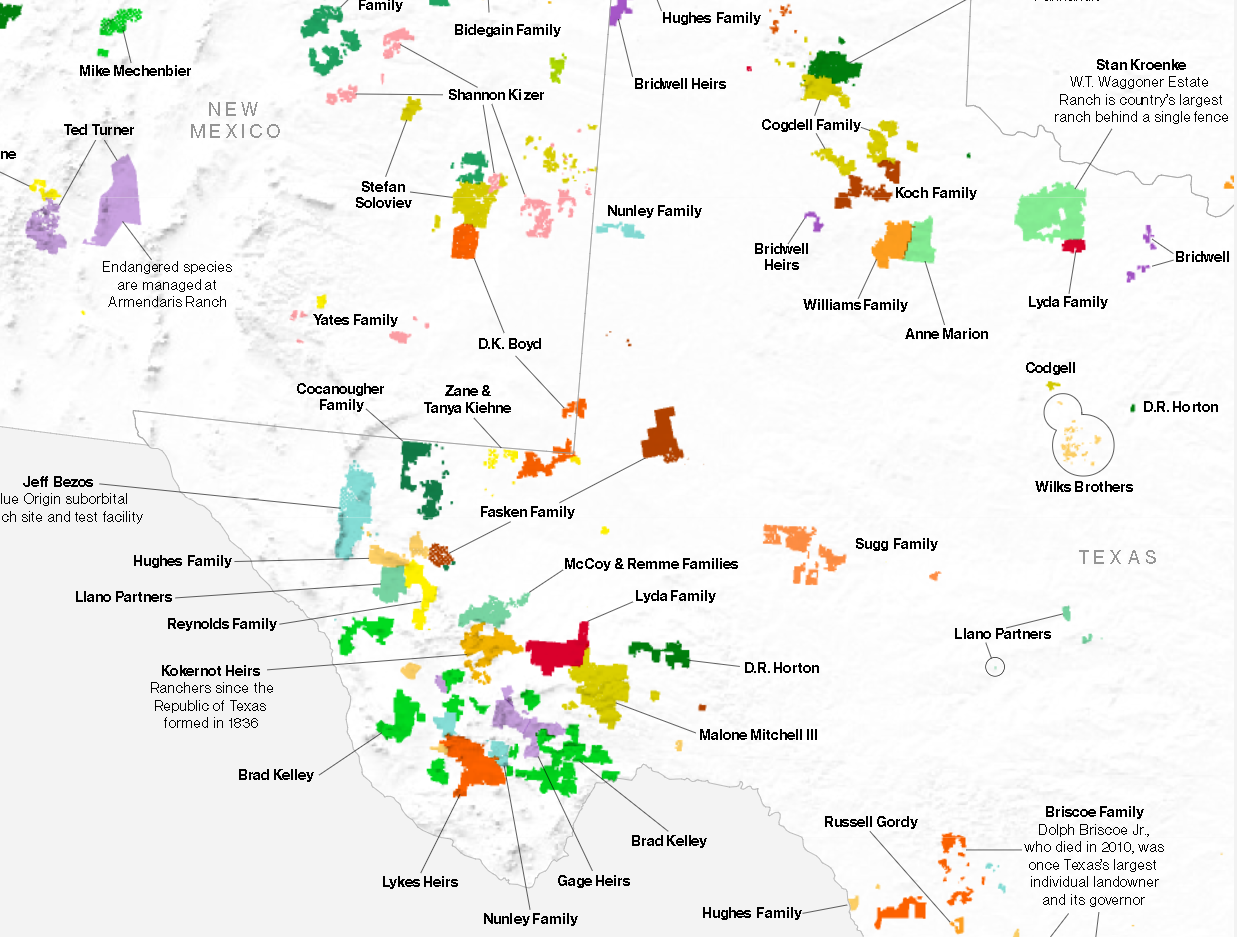
Bloomberg investigated the 100 people that own the most land in America and this map shows where they have bought land:

 The 100 largest owners of private property in the U.S., newcomers and old-timers together, have 40 million acres, or approximately 2% of the country’s land mass, according to data from the Land Report and reporting by Bloomberg News. Ten years ago, the top 100 had fewer than 30 million acres.

Altogether, these 100 landowners control an area about as big as the entire state of Florida and many of these individuals own more land area than the entire state of Rhode Island.  If anything this investigation understates the concentration of land ownership because a lot of properties is held by private corporations whose owners are hard to identify and sometimes the corporations are owned by other corporations as in the case of President Trump’s holdings. Trump owns approximately 500 business entities (although the exact number is unclear) that are collectively known as the Trump Organization and only about half of them use the Trump name. Even though Trump’s holdings have gotten much more scrutiny than other wealthy people, even here we don’t know exactly what he owns, how wealthy he is, nor how many companies he actually controls. And there are hundreds of Americans who are wealthier than Trump and whose holdings are probably even more complicated and secretive.

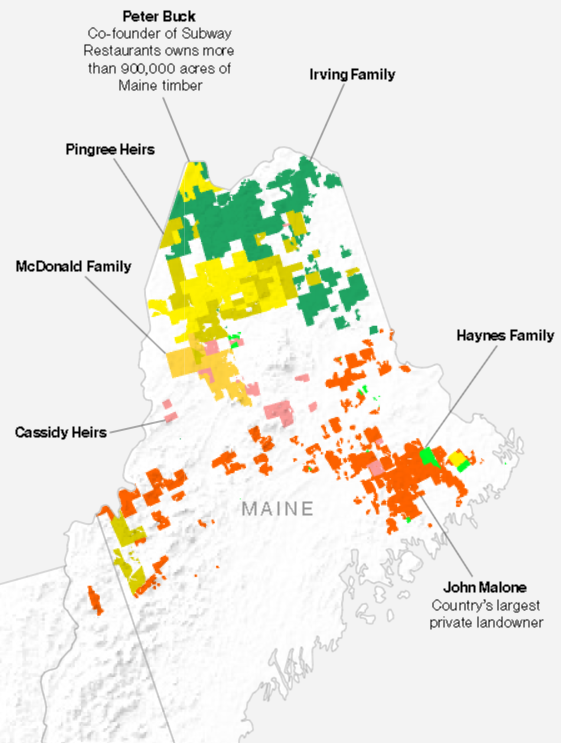
Here are a couple close-ups of areas that are particularly popular with the top100 landowners:

Here, again, is where all of it is located. They haven’t bought much in agricultural Midwest.

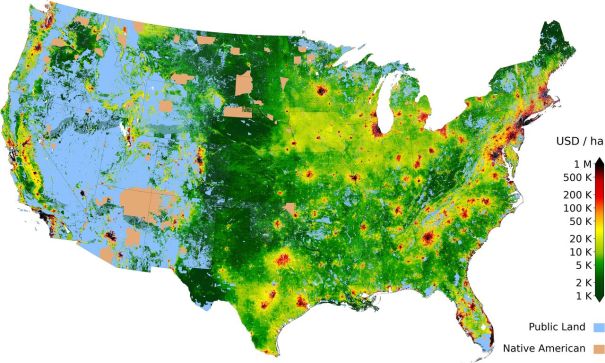
A lot of this land is located in relatively cheap areas according to this estimate:

The blue areas are owned by the government and the tan areas are owned by tribal governments. The lack of color contrast makes it hard to see how vast the government-owned area is, so here it is again without any of the land that is owned by state & local government or private individuals.

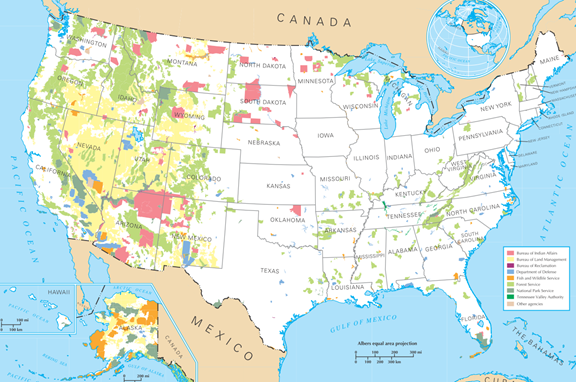
This map shows the distribution of federally owned land [plus tribal-owned land in pink].

Because this map only shows federal ownership, it leaves out vast territories owned by the state governments. For example, this map shows that the federal government owns nearly 3/4 of Alaska and then the state government owns another quarter of the state of Alaska leaving less than 1% of Alaskan territory that is owned by private citizens.

There is a lot more land in the east that is owned by state and local governments including roads, parks, schools, and rivers…

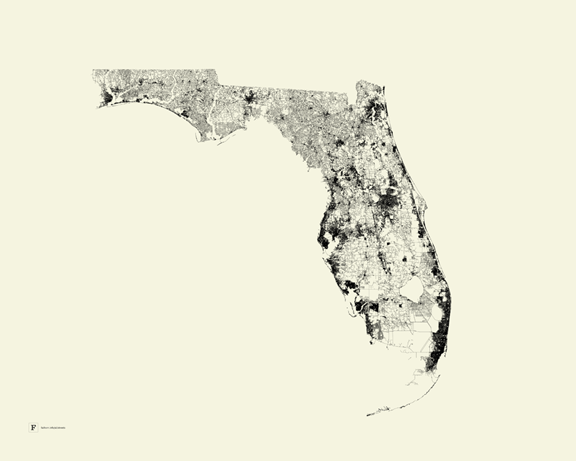
The expensive publicly-owned road system connects all of the most important places together as you can see in this a map of nothing but the roads in Florida. The most valuable regions pop out visibly because they have more roads. (This map and many other states are available for purchase from Fathom).

Local government ownership is much more valuable than most privately-held real estate because roads are extremely valuable, particularly in urban areas where road density is concentrated. A newly paved road costs anywhere from a minimum of about $2 million per mile in rural areas to more than $10 million in urban areas. Maintenance is also very expensive. Resurfacing a 4-lane road costs about $1.25 million per mile.  Despite this cost, we call our most expensive roads freeways.

Posted in Public Finance

Enter your email address to follow this blog and receive notifications of new posts by email.

Join 75 other subscribers
Blog Archive
Pages