Makers, Takers and the Wealth of Nations

Updated Feb/25/2023

There are only two possible ways to get wealth inequality: some people either make more or they take more. Making is positive sum creation and taking is zero-sum redistribution at best or destructive at worst.  Plus there are also two other important kinds of economic interactions for society. The opposite of taking is not making but giving and without giving, humans would not exist because giving is the foundation of the family, and without families, humans would have died out as a species.  Furthermore, the main foundation of the wealth of nations is reciprocating.

Everyone starts life as a taker

It is a fact of biology that all parents are givers and all children are takers in all species that reproduce. Human children are especially needy as they grow up. Few species take more resources as they develop into adults than humans.  Ernest Thompson Seton’s father gave him an invoice on his 21st birthday for every penny the family had spent on Ernest including the fee charged by the doctor who delivered him.  The total bill for Ernest’s childhood added up to $537.50 which was a princely sum for a penniless young man. The year was 1882, and if a college graduate in 2021 got an equivalent bill it could cost about $160,000.  This bill motivated Ernest to leave his family and, according to some accounts, he never spoke to his father again.  Ernest was indignant, but compared to the average explicit cost of raising children today ($310,605), plus the enormous amount of time and worry most parents spend, Ernest could have considered himself lucky that he got by so cheaply.

The purest example of a maker (who neither gives nor takes) is an isolated hermit

Once a person is old enough to be self-sufficient, it is possible to live without giving nor taking, but it is extremely rare for anyone to be able to exist for more than a few weeks without economic interactions.  The purest maker is the sort of pure hermit who lives alone without interacting with anyone has to make all the wealth he acquires.  There are very, very few examples of people who lived the life of a pure maker for more than a year.  One of the few documented examples is the famous “Lone Woman of San Nicolas Island” who lived alone on an island for 18 years after the rest of her tribe was wiped out.

Another challenge for pure makers is the fact that everyone, including hermits, is a taker of natural resources. We all consume natural resources that we cannot make. It is possible that an isolated hermit might only take natural resources that nobody else wants. Many philosophers of property rights justify the taking of unwanted resources on the theory that they would otherwise just get wasted. So if a hermit never takes natural resources in a way that prevents anyone else from using them, then an isolated hermit would not be a taker in this sense.

Very few people in history have ever lived self-sufficiently like a pure hermit for more than a few months at a time because it is a life of poverty, risk, and loneliness. Plus, even those who manage to live as hermits for years without interacting with anyone else are not really pure makers because everyone is a taker in childhood. Everyone develops a massive deficit on the karmic balance sheet when growing up, so a hermit that does not give back to society is a massive net taker over his lifespan.

So nobody can be a pure maker and few people ever even try for short periods of time.

The purest examples of a taker

Whereas it is impossible for anyone to be a pure maker for life, and rare for anyone to be a pure maker even for short periods of time, being a pure taker is much easier.  We all start out life as pure takers and we can all think of people who manage to live their entire lives without making much of anything for anyone else. Taking comes naturally in childhood and most people gradually reciprocate more and more until they become adults.  Indeed, adulthood in traditional societies is typically seen as the transition out of being a net taker.

There are two kinds of takers, the lucky taker and the sick taker.  Someone who is lucky enough to take the willing gifts of givers is a lucky taker and we are all lucky takers at times because everyone is a lucky taker in childhood.  Some of us are born into situations that are much luckier than others, but nobody would survive without being a lucky taker.

One way to stay a taker for life is to inherit vast wealth. Any wealthy heir can live a life of leisure like a Peter Pan who never needs to work. Such a scion remains in a kind of dependency their entire life. In fact it is very hard to have a positive karmic balance sheet if you inherit billions of dollars because a vast inheritance gives tremendous power to consume without any necessity to ever make anything in return. Perhaps Jesus had this kind of taker in mind when he said it is as hard for the wealthy to enter the kingdom of heaven as for a camel to pass through the eye of a needle.

A sick taker is someone who does not reciprocate and takes from people who are unwilling to give.  Sick takers steal what others have made using force, fraud, and/or stealth.  Sick taking is pathological for society, but it is a part of life and we all do it sometimes because we are all sinners.  For most of history it was common to steal people’s labor by forcing them to make stuff through the institution of slavery.

Owning a natural resource like land is taking if the community is not sufficiently compensated.

Followers of Henry George argue that it is theft to own natural resources without compensating the rest of the community. People cannot make natural resources and most natural resources, including most of the privately-owned land in the world, were taken at some point in history by force, fraud, and/or stealth. Whereas the present owners likely paid fairly for the property, the chain of ownership always ultimately goes back to an original taking which taints the whole enterprise of owning the natural resources that God made.  But regardless of how natural resources (like land) came to be owned, according to the Georgists, a natural resource should only be owned if the owner pays fair compensation, in the form of an annual tax (or rent), to everyone else who might have wanted to use it.

John Locke and his followers argue that people can own natural resources (like land) by mixing their labor with the natural resource, but the Georgists counter that people only own the value-added by their labor.  Georgists believe that the underlying value of natural resources cannot be owned unless people pay an annual tax or rent to the community for the exclusive right to use the natural resource.  So a building can be owned because it is mostly made by humans, but the land upon which a building stands should ideally be taxed to the point where it has no economic value.  Then only the value-added–the building standing on the land–is worth owning.

The purest examples of a giver

The opposite of a taker is a giver, and pure giving is not going to make you wealthy. Some of our saints, like Mother Theresa, are as close as we can get to examples of pure givers who lived austere lives and tried every day to selflessly give as much as they could to help others.  It is no accident that she called herself a “mother” because parents are always givers to their children.

Giving is a basis of family and church life and much military heroism.  Anthropologists say that traditional-societies were mostly gift economies where people interacted based upon mutual giving rather than an exact accounting of debts and credits.  So giving seems to have been the basis of most social interaction before the advent of hierarchical states.  No society can survive without it and most giving is good for society.  The one exception is when giving is one-sided AND encourages sick taking behavior in the recipient. It is harmful to both parties for a giver to develop a codependent relationship which enhances narcissistic sociopathic taking.

Reciprocation is always a mix of giving, taking, and symbiotic making

In addition to making or taking there is also a third way to get rich: reciprocating. Reciprocating involves making, taking, and giving all at once because reciprocating is an exchange whereby people make value by each both giving and taking. Reciprocation is so engrained in daily interactions that it is as hard to notice as a fish trying to explain water. There are many kinds of reciprocation, but here are two paradigmatic examples:

1. Market exchange: If I have some fruit that I value at $10 and my neighbor values at $22, then we can agree to reciprocal exchange. I’ll take money from him and give him the fruit which will make us both better off. For example, he could give me $16 which makes me $6 richer and he will get fruit that is worth $6 more to him than what he paid so we can both become $6 richer. We are both giving and taking and making value symbiotically. The exchange is symbiotically making $22-$10=$12 of symbiotic value.

2. Collective action: In the classic folktale of the Giant Turnip, Opah cannot pull the turnip out of the ground, so he asks Omah and even working together they cannot do it. So they keep asking a menagerie of characters to help until finally they ask a small mouse and with the mouse’s help working together with everyone else, they are finally able to pull up the giant turnip. Everyone gave to the communal effort to harvest the giant turnip and in the end, everyone can take a portion. Again, everyone in the story gives, and takes and makes symbiotic value. This is the reason why firms exist—people are usually more productive working together in a firm than working independently.  In the folktale, Opah takes the leadership to coordinate the group’s work and some sort of hierarchical leadership is a typical organizational structure. Organizations are usually more productive at group tasks when there is some form of hierarchy with some people taking leadership roles to accomplish collective action and others following.

Reciprocation is hard-wired into the human psyche. It is why gratitude is a universal emotion. When someone does something nice for you, it generally causes you to feel some obligation to reciprocate in some way unless you have a narcissistic or antisocial personality disorder. Some people even believe that the universe itself operates on reciprocity. This is the idea behind karma and the maxim, “You reap what you sow.”

Because reciprocity always involves giving, taking, and symbiotic making, it is harder to analyze than any one of its three components. Adam Grant wrote a good book about it called Give and Take: Why Helping Others Drives Our Success, but he had a difficult time disentangling the different styles of reciprocity to pinpoint what is most successful. Most of the examples of successful “givers” in his book were successful because they were good at finding other “givers” who had a natural desire to reciprocate and avoided interacting with “takers.” Although “givers” only become rich when they reciprocate, Adam Grant warns that an excessive focus on reciprocation can be harmful. He recommends a spirit of giving because he says an excessive focus on ‘bean counting’ in  our relationships is often harmful because it prevents optimal reciprocity.  He calls an excessive focus on the tit-for-tat accounting of our interactions the “matcher” style of reciprocation. Matchers create relationships that are more transactional than emotional and emotional ties based upon warmth and respect are more powerful motivators of symbiotic reciprocity than transactional ties based upon a mental accounting of who is obligated to whom.  The emotional ties of unconditional giving produce better relationships when everyone has a similar amount of emotional desire to give. Unsurprisingly, marriages that are based upon a conditional tit-for-tat exchange are less healthy than marriages based upon an emotional desire to give.

Reciprocation can lead to inequality because taking is part of reciprocating

Taking often happens due to unequal power where those with more power take from those with less power which exacerbates inequality. Although voluntary reciprocation should benefit each party involved, reciprocation can also lead to inequality because in every reciprocal exchange, there is always a tension between giving and taking. For example, in the market exchange example above where I have fruit that I value at $10, I could try to sell it to my neighbor for $22, and then I would be taking all of the value that is created in the exchange. In this reciprocal relationship, although I am not technically stealing because I am not leaving my partner worse off, I am taking all of the net benefit in the relationship, so I am giving nothing and taking all of the symbiotic value we make through trading. On the other hand, I could give the fruit to my neighbor for only $10 and then I am being a giver because even though I have lost nothing, I am giving him all of the value our relationship is creating symbiotically.

All governments take and reciprocate. Some are much worse than others.

We all reciprocate and we all have both a desire to give and a selfish desire to take, so it is often impossible to separate the three.  For example, even the most sociopathic taker has a selfish motivation to reciprocate with other takers because a gang of takers can take a lot more by banding together than they can as individuals.  Very few thieves live like hermits and reason most sociopaths prefer to live in societies is either because they can steal more “Giant Turnips” by banding together or because it is often easier to trade for what they want than to steal what they want and reciprocating enhances their selfish consumption.

Most anarchists believe that government is inherently a pure sick taker.  Although this is wrong, they have a point in that most governments throughout history have been run by sick elites who reveled in taking from their people.  But 99% of people are not anarchists because we are thankful that government provides public goods for society that increase our wellbeing by creating public health, safety, transportation infrastructure, education, a justice system for adjudicating and preventing disputes with takers.  One of the benefits of modern constitutional democracies is to prevent sick elites from doing the kind of egregious taking that authoritarian nations typically experience.

Just like thieves benefit from reciprocating, governments do too and Mancur Olson explained why governments have even more incentive to reciprocate than roving thieves.  Suppose there is a society in anarchy.  In anarchy, selfish takers much more freedom to steal because there is no threat of police or jailtime.  So the takers who are good at using violence to rape and steal will become roving bandits that plunder all they can from each maker household until there it nothing worth stealing and then they will move on to plunder the next maker.

But makers aren’t stupid and they are likely to band together to fight off takers and that is one way that a democratic government could arise.  But takers aren’t stupid and they will also band together to overcome the maker communities.  The takers have two advantages.  First, the takers can devote all their resources to specialize in violence whereas the makers are also devoting time to making so the makers resources are divided unless they form a big enough government to hire full-time specialists in violence.  Secondly, it is easier to destroy than to create (due to the second law of thermodynamics!) so takers always have the ability to threatening the makers with ruin because the makers have to invest in productive capital (tools, buildings, inventory, etc.) whereas the takers only need weapons as capital which are inherently more dangerous to try to take and/or destroy than a building or herd of animals.

For most of history, it was impossible for communities of makers to form a democratic government that was big enough to create enough military and police force to stop the roving bands of takers.  In this case, then they will have a self-interest in asking the strongest roving bandit to stay put to defend them from other roving bandits.  This is because a stationary bandit will have completely different incentives from a roving bandit in that a stationary bandit won’t want to steal everything from his people and destroy their capital goods because then there will be little to steal next year.  A stationary bandit will want his people to not only survive, but thrive and build more capital goods so that there is more to steal next year.  In fact, he will want to build public goods that make his people more productive in the future.  It is his self-interest to reciprocate even if he is a narcissistic psychopath.  This is what dictatorships are like.  Even though a narcissistic dictator wants to take as much as possible, if he is sure he will be in power next year, then his selfishness leads him to reciprocate by investing his resources to create roads, hospitals, schools and other public goods that directly benefit his people to increase his future income. Most importantly, every government tries to constrain most of the sick takers in society.  It only takes one sick taker to make society miserable for everyone else and a key role of government is to help us restrain those selfish impulses which all of us have to some degree, and a few people have in psychopathic abundance.

Democracies have incentives that work better for the median person because the worst possible democracy is a dictatorships of the majority which maximize the wellbeing of the majority of the population (at the expense of a minority) rather than taking from everyone to just maximize the wellbeing of a dictator.  Thus, democracies have the incentive to preserve more people’s property rights and proved public goods to a broader swath of society and a democracy operates with the consent of (at least) the majority which is a much greater equality of power than other forms of government.

The biggest problem of “democracy” is that most “democratic” governments are not very democratic and elites still dominate politics, but the more inclusively power is shared, the better the incentives for government to increase the wellbeing of a broader swath of people.

Bargaining power determines individual earnings

Whether an exchange between two people is equally beneficial or whether one takes most of the symbiotic gains of exchange is determined by power differentials in the relationship. Organizational hierarchies are the main source of power differential which determines how resources are divided. For example, in the 1980s and ’90s, corporate CEOs gained more power in America and they started taking about 10 times more of the total revenues than before (relative to their average worker).
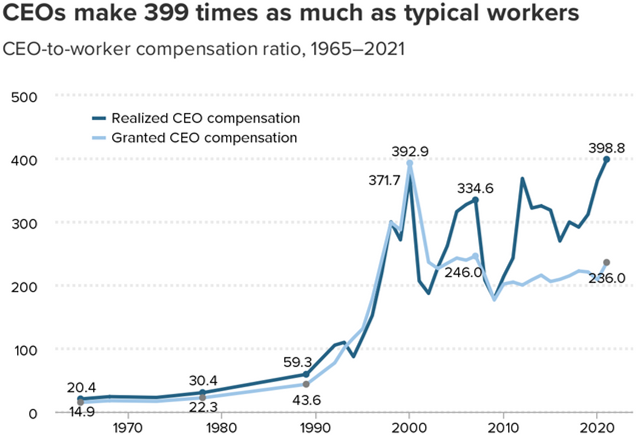
Then other interests got more power within corporations and dramatically cut CEO pay at the turn of the century, and there has been a power tug-of war ever since with CEO pay jumping up and down relative to their workers (and their shareholders!). Most critics of high CEO pay, like the people who created the above graph, complain that the CEOs are taking money away from workers, and that that is true, but economic theory predicts that CEOs are mostly taking money away from their shareholders when CEOs dramatically raise their own pay and in the American system, corporate boards are legally supposed to represent the shareholders. Although American corporate boards reined in skyrocketing CEO pay in the 2000s, American CEOs still make much more money than foreign CEOs running the same kind of corporations because American CEOs have more influence over their boards and more power over their workers than CEOs in other countries where CEOs have less power over board members and workers have both more union power and more representation on boards.

When people are working together in a team, it is impossible to say exactly how much each person makes because production is symbiotic. When one gear of a machine transfers energy to another gear, we cannot separate out how much of the machine’s production is done by any single gear because the machine would not work without all its gears and a machine requires all its parts to be useful.  Any part that isn’t needed, isn’t really a part of the machine and is likely to be scrapped.
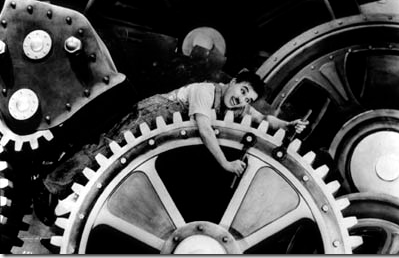
Similarly, every worker in an organization is like a cog in the machine.  Saying that a CEO produces 10% of a corporations’ profit is as silly as saying that your brain produced 10% of your body’s success in winning a marathon. In reality, all the people within a corporation work symbiotically like the organs of your body. The CEO would produce nothing and the corporation would go bankrupt without the rest of the company’s workers just like your brain would die without the rest of your body’s organs. Productivity is only one of several factors that determine individual pay within organizations. Pay is distributed within a hierarchy according to how much bargaining power each person has. Productivity helps increase one’s bargaining power, but organizational politics determines who is in different levels of power in the hierarchy and hierarchical power is more important for determining pay than productivity.

Another quality that gives workers bargaining power is the ability to sabotage the company. The CEO has tremendous sabotage ability and this helps explain high CEO pay. Nobody else in a corporation could make it lose money faster than its CEO and with that ability comes great bargaining power. Unions get bargaining power from the ability to strike which is another kind of sabotage ability because a strike sabotages the company’s profits. Other than CEOs and a few other employees with large power over organizations, most workers do not have much ability to sabotage their organization and so they get most of their bargaining power from their opportunity cost. This is what a worker would get paid in their next best job. So a taxi driver in New York City gets paid many times more money than a taxi driver in Guatemala not because the New York driver is more productive at driving, but because the New York driver could be working in another industry (like a factory) where workers really are many times more productive than Guatemalan workers. New York taxi drivers are also able to take more from their riders because their average rider is more productive than the average rider in Guatemalan taxis.

So American taxi drivers are richer than Guatemalan taxi drivers not because of differences in the productivity of individual drivers, but because of differences in how much bargaining power drivers have to take money from their riders. American taxi drivers have more bargaining power because they have a higher opportunity cost because they could be working in highly productive jobs which pay well. The opportunity cost wage is a backstop which prevents taxi driver wages from falling below their opportunity cost. Plus, the fact that the average productivity of American passengers is higher than the average productivity of Guatemalan passengers means that American passengers have more average income which gives them a greater ability to pay for taxi fares.

Finally, another important reason why some people earn more than other individuals is the luck or bargaining power that brings ownership over valuable stuff that others helped create (including God in the case of natural resources).  When Steve Jobs died, the main reason why Bill Gates was over 6 times richer was not that Gates was 6 times more productive in life. Gates earned more money because he had more bargaining power or luck which got him 6 times more corporate shares.  By every other measure, Jobs was a far more productive entrepreneur than Gates.

In a purely meritocratic world, people’s pay would be determined by their productivity, and everything else the same, that is often true, but in most cases everything else is not the same. It is differentials in bargaining power caused by ownership of hierarchical power or ownership of other scarce resources that explains the fact that inequality between individuals far exceeds productivity differences.

Some inequalities of power are useful for increasing the wellbeing of societies because they provide useful incentives that motivate productivity.  Other power inequalities reduce social wellbeing because they incentivize takers to use their power to perpetuate their tribe’s power like the elites who want to perpetuate an aristocracy of inheritance for their codependent heirs.

Making mainly determines why some nations are richer than other nations.

Above I gave examples showing that productivity differences (making) does not explain most of the differences between how much different individuals earn. For each person, our income is mostly determined by the productivity of the people that we reciprocate with and our bargaining power vis-à-vis those people. Individual productivity helps increase bargaining power, but other factors like hierarchical power are much more important.

But it is the productivity of nations and not their bargaining power that mostly explains why some nations are richer than other nations. Whereas it is impossible for a prosperous individual be a self-sufficient hermit for life, large nations are pretty close to self-sufficient. Small nations are usually very far from self-sufficient and extremely interdependent with many trading partners, but small nations have very little hierarchical power over other nations, so they are cannot be takers and must reciprocate for everything they get.

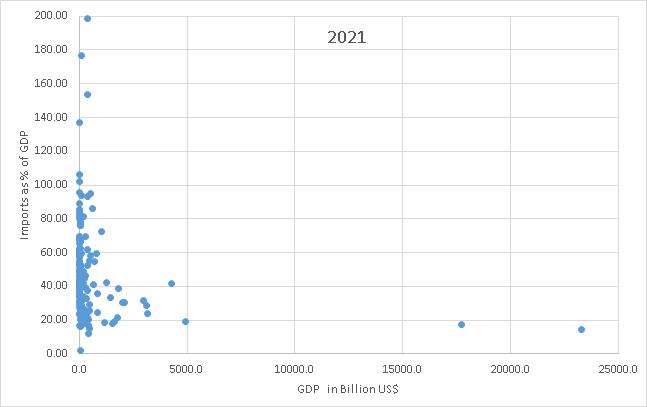
GDP is the most popular international measure of total national income. Big nations mostly produce their own income and import a small share of GDP. None of the nations with GDP larger than the Netherlands have imports that are worth more than 43% of GDP. Very few of the nations of the world have imports that are smaller than 20% of GDP, but all three of the biggest economies in the world have imports that are less than 20% of GDP.  The three biggest are Japan, China, and the US, shown respectively on the bottom right of the graph.

Whereas small countries cannot possibly be prosperous without a lot of foreign trade, large countries have to be relatively self-sufficient because the bigger the nation, the fewer outsiders there are to interact with and the more the insiders. For example, suppose a single country took over the entire world. That country could not trade at all and could only get wealthier by increasing productivity. The wealth of the world is solely determined by the productivity of the world because there is nobody else to take from. Using up natural resources could boost consumption temporarily, but it destroys wealth because natural resources are a form of wealth and whereas spending down wealth can feel like income, it is really just a temporary consumption boost that is stealing from the future.

The US, China, and Japan are so large that their economies cannot primarily rely upon taking resources from other nations and that is why their imports are relatively small at less than 20% of their income (GDP). Furthermore, that 20% is a reciprocal relationship and although it is impossible to say whether the symbiotic gains of trade are divided equally, most nations probably reciprocate about the same value that they import. Most of the reciprocation is in the form of exports but there is also reciprocation through selling off national assets and/or international borrowing for later reciprocation plus interest. Large nations also give a small amount of international aid like the recent support for Ukraine.  This is pure gift without expectation of reciprocation, but it is only a small amount of income.  Gift outflows are usually less than half of one percent of GDP, so it is very small compared with reciprocation. So most nations today probably take approximately 0% of GDP from other nations (in net) because of strong reciprocity in modern international trade.

All individual humans start out life as takers during our long childhoods.  Although nations do not have a childhood, if you go back far enough, the history of most nations also full of an extraordinary amount of taking too.  Empires, by definition, are extreme takers that constantly plotted to send armies to steal from other nations. They stole precious metals, slaves, land, and anything else they could profitably exploit. Colonialism was the last major phase of many millennia of conquests and then colonialism abruptly started unravelling.  Since World War II, most nations have decided that it is less profitable to take than to reciprocate because war is bad for business and it is more profitable to trade with foreign people than to try to occupy their lands.  As a result, wars of conquest have greatly diminished for the first extended period of time since the dawn of history. There are still some pariah nations that explicitly try to build empires of conquest, like Russia repeatedly invading Ukraine, but today it is harder to get rich by taking through force than in previous centuries.

The last era when nationalist taking was profitable was the colonial era and colonialism became increasingly unaffordable the 20th century, as colonial possessions started to cost more money than they generated. Russia’s conquest of Ukraine is an excellent example that demonstrates how unprofitable imperialist wars are nowadays. Russia could have increased its prosperity by reciprocating with her neighbors instead of by spending vast amounts of resources attempting to take over her neighbors by force.

Tragically, Russia is controlled by an absolute dictator who cares more about power than prosperity and is willing to sacrifice the lives of hundreds of thousands of people and trillions of dollars of their resources in order to expand his imperial power over a small, impoverished neighboring country. Even if he eventually succeeds at conquering Ukraine, it will be a hollow victory because he will have conquered a broken nation he just destroyed. He will never be able to take enough resources away from Ukraine to make the invasion economically profitable for Russia. He would have earned far more prosperity by reciprocating with Ukraine and keeping Russia open for business with the entire world.

Indeed, the biggest punishment the West initially imposed on Russia was to withhold reciprocation.  The trade sanctions the West imposed are a kind of economic warfare that is painful for both the West and Russia.  Unfortunately, Russia has managed to soften the blow by dramatically increasing reciprocation with China, Iran, India, and other nations that prefer profits over principled sanctions.

Conclusion

The four modes of economic interaction are giving, making, taking, and reciprocating. People cannot accumulate wealth by giving, but the other three modes increase one’s wealth. Although giving does not increase one’s selfish wealth, it is essential for the human species because it is the basis of family and without giving, no babies would ever have survived and the human species would perish, so giving is an inherent human instinct which is important for numerous human relationships. Neglect giving at your peril!

The main way that large groups of people (like nations) get rich today is by making.  Reciprocation (trade) is also important for national prosperity, but the gravity equation of trade demonstrates that nations that make more also reciprocate more. This is different from the way some individuals get richer than others. Individual inequality within hierarchical economic networks like firms and nations is explained by differences in both bargaining power and individual productivity.  People with higher productivity generally have more bargaining power, but income is only partially related to individual productivity because individual wealth is almost completely interdependent with other people. Individual productivity is impossible to measure in organizations because co-worker productivity is symbiotic like the productivity of the organs of your body.  So a big reason some people earn vastly more than others is more bargaining power to take more of their society’s production.

The main reason wealthy elites are wealthy is because of their ability to take from the community that they live in. Without a community to reciprocate with and take from, no person would be wealthy. For example if a wealthy person like Bill Gates lost all the other people in the world, (like in the TV series, The Last Man on Earth) he would suddenly have to live like an impoverished hermit who has to solely rely upon what he can make rather than what he can take. For a while he would be able to use up the stores of foods and goods that other people had previously made, but food eventually spoils and nothing could replace the services of countless laborers that we all use on a daily basis. Wealthy individuals are much more dependent upon the labor of other people than the rest of us.

Most of us (except hermits) would also be poorer if all the other people in the world suddenly disappeared (perhaps in a rapture!), but the poorest people people in society would see their material standard of living rise for a time until the stores of food begin to spoil or they need services that are no longer available without any other people.

Posted in Development, Globalization & International

The Economics of International Trade Textbook Chapters

I am teaching International Trade this semester and there are two models of trade that are important to teach, but there weren’t any resources that teach all the main intuitions without excessive complexity so I wrote my own “textbook” chapters to teach about a:

Model economy if people can’t change jobs

And the ever important:

Heckscher-Ohlin (H-O) model with physical capital

I’ll add more links to resources for international trade here, but I don’t intend to post most of this stuff on my blog because it is too wonkish for casual readers!

Update: The cost disease of services is easy reading!

Posted in Medianism

Is Wokeism bringing back a colorblind aristocratic class consciousness?

Updated March 29, 2023

Matt Yglesias argues that the old British class system had a lot of features that were eerily similar to recent trends in political correctness. For example, educational institutions, particularly at elite levels, have embraced DEI, but there is no evidence that DEI programs reduce racism, so the main thing that they can teach is inclusive language and behavior. Inclusive language is  evolving into an increasingly complicated system, much like the highly-refined etiquette of the old European aristocracy.

In fact, one of the main reasons that aristocrats sent their children to elite schools was to teach them the complicated mannerisms that were required to be considered upper class. Style was more important than substance to a remarkable extent in that newly rich people who didn’t follow the complicated mannerisms of the established upper class were considered gauche and frowned upon whereas upper-class individuals could loose most of their money and continue to be seen as elite because their manner of speech and tastes conformed to the elite norms. Of course, money could buy access to elite places, and wealthy people are always tolerated in elite circles, but it was one’s style of behavior that distinguished one as a discriminating member of the upper class and not money.

And money was key to maintaining elite status because wealth was necessary to gain access to the places where their children could learn elite behavior.  Those who lost all their money would have difficulty keeping their offspring in the elite social class if they couldn’t afford to raise their children in elite circles, but style was the ultimate key to being accepted as an aristocrat. The aristocratic norms were always changing and very difficult to learn which was why places like Oxford and elite boarding schools for youths were so valuable. They were worth paying the tuition in order that youths could learn how to be accepted in elite society and what behaviors to reject as low class. People who couldn’t afford to grow up soaked in that milieu simply couldn’t hope to pretend.

Similarly, Yglesias argues, “inclusive” language is becoming a marker of class because as elite schools increase their investment in DEI training, “inclusive” behavior is becoming ever more complex. Recently, one university tried to ban the word “field” as being racially insensitive and suggested “practicum” as a woke alternative.  Yglesias gives some examples of the kind of language that is currently woke and if you don’t know these nuances, you probably haven’t been educated in the right schools:

I am quite fluent in why we don’t characterize non-white people as “minorities” anymore, and even why affirmatively characterizing them as “people of color” is in favor rather than saying “non-white,” which tends to center whiteness. I know what it means to “center” something. I know that URM stands for under-represented minorities, and that we tend not to spell it out because “minorities” is out of favor. I also know what URM means (not Asians), and how URM is distinguished from BIPOC. I don’t talk about third-world countries… Elite institutions and codes of manners are not egalitarian… because their purpose is to be inegalitarian. Changing “field” into “practicum” doesn’t include more people — it’s a new means of excluding people whose information is out of date.

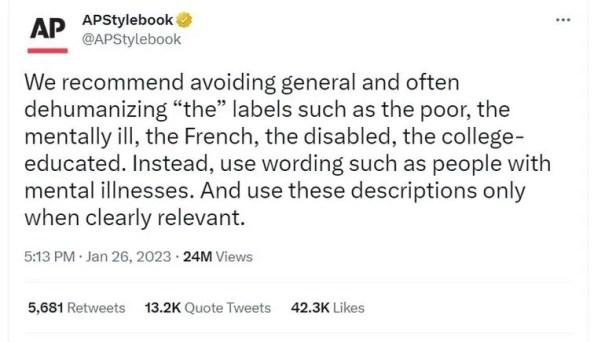
Similarly, the AP recently decided that calling them “the AP” is dehumanizing because the word “the” is bad, so instead of talking about “the French”, we should instead write, “people of French nationality”:

(This will come as a surprise to the highly-paid consultants who convinced The Ohio State University to officially add The to its name and trademark the “the” last year!)

The complexities of wokeism may be bringing our society back to being segregated by social class like aristocratic Europe rather than by race. One of the symptoms of its success is the growing political polarization by education across Western nations at the same time as wokeism has become a core mission of educational institutions across the West. It would be ironic if an ideology that is hyper-focused upon racial identity would morph into a colorblind class consciousness that is focused upon in-group etiquette just like the aristocracies of old.

Of course, I’m all in favor of etiquette that serves the purpose of helping everyone communicate more respectfully and feel better about themselves, but highly baroque styles of etiquette exist purely to reinforce tribalism and make some people feel more fashionable than other people. For example, last summer I heard a white college student profess to feel harmed when he heard another white person pronounce the n-word, not in a racially insensitive way, but simply in discussing how the use of the n-word has changed in recent history. The same student enjoyed listening to rap music where African-American rappers use the n-word as a racial epithet, so the student likes hearing Black people rap the word, and just objects to hearing a white person utter the sound.

So it is woke to listen to rap that uses the n-word as a racial epithet but harmful to hear a non-Black person pronounce the sound in an academic discussion about race? Modern wokeism is producing an increasingly baroque set of etiquette rules.  For example, a professor was suspended for saying a common word in Chinese that sounds like the n-word. I lived in China for almost two years where I heard people constantly use that word. It means “that”, but it is also what Mandarin-speakers say instead of “um” when there is a pause in their thinking, so they tend to repeat it over and over in situations where English speakers would say uuuuummm.  It sounds a lot like the n-word with a Chinese accent because Chinese vowel sounds are slightly different. Making that sound is enough to lose one’s job even when everyone agrees that the sound was made without any ill-will intended towards anyone.  Another school let an art professor go because she showed a famous 14th-century Islamic painting of the Prophet that some Muslims adore and other Muslims hate.  Not woke enough.

I’m fairly fluent in understanding most woke etiquette and evolving terms like BIPOC, because I read a lot and that is a good way to learn about what terms are de rigueur (although the above examples demonstrate that well-read professors do slip up badly sometimes).  I even understand that although woke liberals prefer the term “Latinix”, I avoid using it around Hispanics because they overwhelmingly do not like it. I know that people with disabilities dislike the term, “disabled person” because they prefer the person-first language whereas most deaf people tend to prefer identity-first language and although most autistic people also prefer identity-first language, a few prefer “people with autism”, so one must check with one’s audience about what terms they prefer.

All of language and ettiquette is hyperstitious.  “A hyperstition is a belief which becomes true if people believe it’s true.”  If people believe that a word is insulting, then it is.  So queer was a slur back when people believed it was a slur, but now it is a term of pride simple because most people have changed their mind about the term.

I want to call people what they want to be called and I want to be woke about being polite because I want to be able to work with people from all backgrounds, but some parts of wokeism are less about bringing us together and more about dividing the sheep from the goats. I once got reprimanded for saying the word “queer” in a children’s story because a parent questioned if I had a ‘gay agenda’.  Now the legitimacy of the phrase “knocked up” and the verb “master” are under assault.  When was/is the word “Negro” ok?  What pronouns should you use when talking about a new baby?  It is getting baroquely complex.

John McWhorter argues that languages tend to become more complex over time.  New languages are created when children are taught a pidgin and turn it into a creole language which have the simplest grammars and vocabularies.  As languages age, they evolve and unnecessary genders and irregular verb tenses agglomerate onto the grammar and vocabulary is added which increases complexity.  Some of the additional complexity is useful for separating people into different tribes within the group because new kinds of language are costly signals of in-group membership.  This is still happening today in the West where every generation of kids creates new vocabulary to separate themselves from the older generations and youth subcultures that desire more in-group identity commonly create new linguistic complexities to help signal separation than outsiders.

Some feel like racism has gotten worse in America over the past five or ten years, which, if true, would be ironic given that we have more woke rhetoric now than ever before.  Fortunately, if we expand our time horizon to the past half century, I think almost everyone agrees that America has become a lot more woke, and that the problems of racism, homophobia, sexism, transphobia, etc. while still problematic, have gotten better.  But over the same half century, economic inequality has soared within every racial group which means that problems of social class are getting worse while racial divisions have declined modestly. Sixty years ago, the achievement gap between Black and white students was roughly twice the size of the gap between rich and poor students, but today studies have found the reverse. If these trends continue, we should expect to see a new aristocracy of elites who are more multi-racial than past aristocracies, but like in most of history, they will likely be more focused upon excluding lower classes using a complex etiquette developed through expensive cultural upbringing rather than race for excluding the “other”.

A focus on wokeism is much cheaper than bringing greater equality of economic opportunity.  It doesn’t require much sacrifice of those who are inculcated in the woke milieu.  It is literally lip service.  Changing true economic opportunity would have a much bigger impact on people’s lives than wokeism, but increasing economic opportunity is expensive.  I tend to agree with Richard Kahlenberg and the Marxists who argue that race and identity politics are primarily used to divide the masses and distract them from the expensive stuff that really makes a difference.  I think Martin Luther King agreed and that is why he focused on solidarity among all working-class people. He didn’t focus on wokeness even though there was a much greater need for better racial etiquette when he lived.  Some of elite America’s excessive obsession with race is aligning the interests of rich people and creating racial animosity which ultimately hurts poor people who are disproportionately Black and brown.

Posted in Discrimination, Philosophy and ethics

There was no mass democracy before the printing press

In 1900, how many nations were democracies?    0%?   5%?   15%?    30?

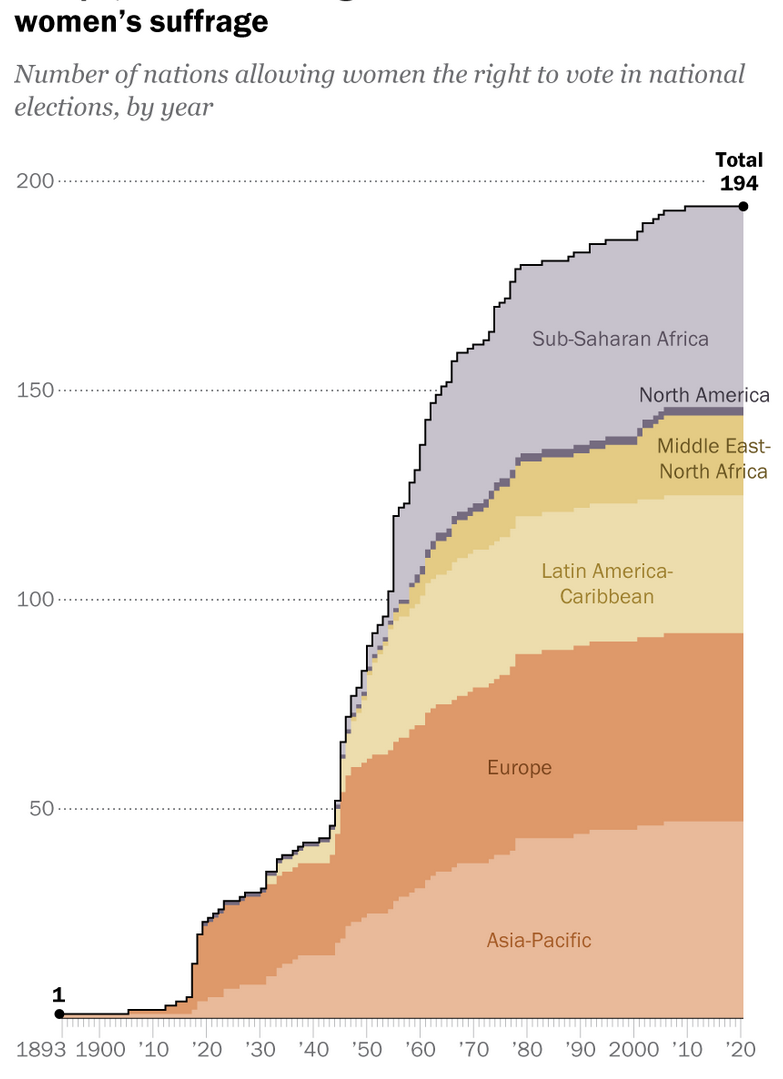
The correct answer is 0% of nations were democratic in 1900 according to our current standards of democracy. This is because there had never been any sovereign nation in all of history where the majority of adults had the right to vote in national elections. In fact, all Western nations deliberately disenfranchised a majority of adults–women–so there was no true democracy before women got the vote.  New Zealand likes to tout its primacy in granting universal suffrage to women in 1893, but it was just a colony at the time and does not claim to have been an independent country. So Norway really deserves some bragging rights for being the first sovereign nation to achieve universal suffrage in 1913. However, because New Zealand is now a sovereign nation too, many people recognize it as pioneering universal suffrage. That is what Pew decided in this graph:

So there was no nation in the world with mass democracy before either 1893 or 1913, depending on how you want to define a ‘nation’. Women’s suffrage marks the beginning of true democracy although some of these nations that have elections still are not very democratic.

One of the distinguishing hallmarks of all modern democracies that is distinct from ancient democracies is the massive scale of elections today. If we define a mass democracy as being a vote with more than 25,000 voters, then mass democracy only probably started to appear in the 1700s because an election is a kind of cooperative activity that requires a way of communicating with all the participants and that was nearly impossible to do before the printing press made mass communication cheap and fast. That didn’t happen until relatively recently in human history. For example, in 1820, the United States still only had 20 daily newspapers and a few hundred weekly newspapers and in 1776, during the beginning of the US Revolutionary War, the US only had a total of 71 magazines and newspapers in the entire country. In all of the southern colonies, there were only 8 cities that had any news publications at all:

Without abundant mass communication, mass democracy is impossible, and prior to the printing press, we do not have any evidence for any election surpassing even 25,000 voters. Unfortunately, ancient societies never bothered to record precise vote counts (which demonstrates how little they cared about this), so we can only estimate based on the time spent voting (given our knowledge of voting practices) and the capacity of the physical spaces used for voting:

Before the printing press, decisions could only be made by a group of people that was small enough that they could be in the same physical space and hear each other when they yell. In theory, the Roman Colosseum could have enabled a democracy of about 50,000 that could hear an orator screaming in the middle, but ironically, there is no evidence that the Colosseum was ever used for political speeches. Instead, the machinery of democracy took place just outside the Colosseum in the Forum which was a remarkably small, flat, rectangular plaza which would have limited communication to relatively small groups and in the spartan Ovile which was named after the wooden sheep pens that it resembled. At the end of the Roman Republic a larger structure had been in construction for voting, the saepta Iulia, but the importance of voting was greatly diminished after the fall of the Republic and although in theory the space is estimated to have had the capacity to hold more than 30,000 people, it would have been impossible for them all to communicate in the din of a dark, crowded ballroom with voices echoing off of the stone ceiling and well over 60 large stone pillars. Compared with the Colloseum or the Parthenon, it would have been a miserable space for organizing large groups to try to undertake cooperative decision making because it had terrible acoustics and lines of sight.

Similarly, in Athens, the Theatre of Dionysus was the largest theater and could seat up to up to 17,000 people for mass communication, but again there is no evidence that it was used for democratic purposes. Instead, the Athenian assembly met in a park on Pnyx Hill, a 6-minute walk away, with a capacity of only about 6,000 to 13,000 people and much worse acoustics.

Before the printing press, there is no evidence that any vote ever extended to even 25,000 people and most democracies only relied on a fraction of that number actually casting a ballot. A major problem was mass communication. There was no point trying to attempt political communication in a Colosseum or large theater because it only took a few noisy people to block mass oral communication so it was just as well to campaign in relatively small groups in a forum or a park.

In Rachel Feig Vishnia’s book, Roman Elections in the Age of Cicero, she writes that the only evidence we have for a vote in the saepta Iulia was an election in the year 45 which took five hours. Estimates of how many people could have voted in that amount of time using Roman methods yields an estimate that between 6,000 and at most 16,800 people could have voted in that election IF everything was working perfectly smoothly.

She writes that, “elections played a central role in the political life of the Roman Republic and were held every year for almost half a millennium,”(p. 106) but Roman elections were more of a ritual ceremony where elites competed for prestige than a democracy. People voted within their tribes and voting participation rates were estimated to be in the single digits because voting simply did not matter much for most Romans. Sometimes not a single person from an entire tribe would bother to show up to vote. In those cases, five members from other tribes were randomly selected to vote on their behalf! (Vishnia, p. 128) Rachel Feig Vishnia says, “Rome was neither a direct nor an indirect democracy, and had no such pretensions. It had no elected legislative assembly composed of the people’s representatives and no ideological political parties that competed for power. The voters did not choose between a failed leader and a successful one…” (p. 106)

Judged by today’s standards, the Roman Republic was an odd kind of oligarchy with voting that was merely ceremonial and that was the very best that we could expect given the communications technologies available before printing finally became fast and affordable in the late 1700s. The Republic was completely dominated by a class of aristocrats who were expected to use their wealth for bribery and to buy votes (Vishnia, pp.134-148).

The freedom of the press is required for large societies to accomplish democracy and without printing presses (or other forms of mass communication), there is no democracy.

Posted in Development, Public Finance

Anarchy, State, and Capitalism

Anarchy is the absence of central government and there are two kinds of definitions.

  1. A society without a large-scale government hierarchy that has a monopoly on legitimate force. By this definition, most tribal foraging societies and other small-scale societies have lived in anarchy. Although those societies had little hierarchy, they were still highly political and individuals were deeply constrained by norms and beliefs that are bizarre to outsiders because they were inculcated through extremely sheltered upbringing.
  2. A society of free individuals living without rules nor norms imposed by others. This is highly unstable and cannot last long because more organized societies are more productive and better at taking resources from “free” individuals and imposing rules upon them. When a government breaks-down, the social norms that had prevailed do not immediately vanish and rather than society descending into a chaos of free individuals, various forms of coalitions and gangs immediately organize.

Anarchists are utopians who generally idealize something like the first type of anarchy in which they imagine that consensus can organize social affairs. Anarchists unrealitically deny the coercive and violent nature of tribal societies and/or imagine that it might be possible to achieve an extreme form of direct democracy that eliminates coercion someday.  This is best viewed as a hypothetical idea because it has never existed outside of small-scale groups and it isn’t even particularly common nor durable in small-scale groups:

[“Anarchy”] mostly takes the form of an extremely slow-moving and highly rule-bound process of collective deliberation. Anarchy, paradoxically, means more rules, not fewer, and more collective responsibility, not less… The term “anarchy” literally means “without [a] ruler,” and not, as many believe, “no rules.” Although many anarchists want radical change, the change that most envision is not societal breakdown but rather people learning to collectively rule themselves (or in other words, direct democracy).

The basic premise guiding anarchist political philosophy is simple: Humans are fundamentally cooperative by nature and, when given the chance, flourish in …self-governance… in which every person has an unalienable right to participate fully in any political decision… and to leave any association that makes a decision they find unconscionable…

attempts at anarchist societies or collectives over the last two centuries have been numerous and persistent, if often short-lived. However, as anthropologists like to point out, humans organized themselves in stateless societies with great success for much of ancient history, and many continue to do so in various ways, without using the label “anarchy.” In fact, “state-level” societies have existed for only a fraction of the roughly 300,000 years modern humans have thrived—emerging an estimated 5,000 years ago—and should still be regarded as an experiment, with mixed results… meetings and planning sessions are characterized by complicated strategies and procedures aimed at establishing complete consensus.

There are several problems with this conception of human nature. Yes, humans are fundamentally cooperative by nature, but humans are also selfish at times and there are assholes that need to be coerced to prevent them from wreaking tragedy. Humans are also prone to cooperate in groups for the purpose of dominating other groups. This is one of the reasons that stateless societies have been mostly displaced by large-scale societies around the globe. Stateless societies cannot defend themselves from bigger and more productive societies. For a stateless society to be viable long term it has to be able to fend off domination from other societies like Russia that are run by imperialist assholes.

Thomas Hobbes famously claimed that life in stateless societies was “nasty, brutish, and short,” but he was 1/3 wrong. Tribal societies have always loved their way of life and clearly never considered it “nasty”. Although life was mostly pleasant for the short time tribal people expected to live, it was brutish and short with a high rate of violent death and brutally constraining tribal and religious social norms that shackled individual freedoms. People worried about witchcraft and evil spirits and endured numerous indignities of traditional initiations and small-scale hierarchy. There are abusive family relationships in all societies, but in tribal societies, family is all you have and it is much harder to escape an abusive relationship.

Modern people would not say that stateless societies were a “great success for much of ancient history”, because all stateless people have always endured lives of poverty and life expectancy in small-scale societies rarely exceeds the low 30s.  Stateless peoples have always had very little lifestyle choice because of extreme ignorance about the world and other possible ways of life.  Traditional peoples have had very limited knowledge about anything other than what they learn from the small number of people around them.  Although stateless people rarely leave to voluntarily join large-scale societies, that is partly due to their ignorance about other possibilities.  Nevertheless, across history there has been much more movement away from stateless societies than vice versa.  Today, almost nobody from a large-scale society would willingly trade places permanently with an average person in any small-scale society.

The other form of anarchy is in large-scale societies.  This can happen when governments break down, but the absence of government rules and enforcement is anything but liberating for most people because living standards plummet. In a long-term government breakdown, violence rises to the sort of high levels seen in tribal societies.  This doesn’t happen overnight because social norms and expectations take time to change so a temporary anarchy can be quite peaceful.  For example, when anarchy is temporarily caused by a natural disaster, humans commonly tend to be motivated to cooperate to help each other survive (although nonviolent looting is common). But in situations where people do not expect that the government will return, gangs and warlords typically arise to fill the political power vacuum.

Indeed, tribal societies are similar to gang societies, but tribal societies are typically spread out over a large geographic area which limits their opportunities for conflict. Rising population density increases the potential for conflict and hierarchies (governments) tend to arise to manage it.  Modern gang societies are different because they tend to originate in denser communities with towns and cities and they establish hierarchies to compete with other gangs and government forces.

In all the stable forms of social organization that have ever evolved, there is always some amount of hierarchy and rules that limit individual freedoms. There are three basic paradigms:

  1. Stable hierarchical national government.
    • Examples include all the modern nation states today that are members of the United Nations. Some are much better than others at producing health, prosperity, and individual freedoms. Some anthropologists argue that some early hierarchical chiefdoms arose before agriculture in some of the rare areas that supported high population density due to large concentrations of migrating salmon or other similarly dense food stocks.
  2. Unstable government where there is competition between warlords and/or gangs and/or stable neighboring governments. Critics of anarchy often point to this as an example of the problems of anarchy.
    • Examples include areas like Somalia that have no recognized national government or in parts of nations where there is weak government control such as in the jungles of Colombia where drug cartels operate with impunity.
  3. Tribal societies with low population density and little hierarchy, but strong constraints of social norms. Proponents of anarchy often idealize a sanitized version of tribal societies while ignoring problems like short lifespan.
    • Examples include nearly all of human history before the dawn of agriculture and many small-scale societies after agriculture. Today, tribal societies are rare and mostly only hang on in landscapes that have been incompatible with more intensive agriculture and which are still geographically isolated from major transportation and trade routes. Today, tribal societies exist within land that is formally claimed by national governments, but where there is very little actual government control.

In a way, all three of these paradigms are different forms of government. Every society is either a stable national government/chiefdom, a tribal government, or an unstable government/warlordism, or some combination of the three.

For example, the Italian mafia is an example of an unstable government because it arose as a substitute for weak government institutions in Southern Italy. Donald Cressey argues that that the US government recognizes that organized crime is a form of government because it has, defined territories, negotiated settlements and peace treaties with organized crime. Cressey says, “that because organized crime provides illicit goods and services demanded by legitimate society, it has become part of legitimate society.” US history arguably arose out of an unstable government according to John W. Tyler’s history of the Boston Tea Party. He claims that this group of patriots was a kind of loosely organized crime ring of tea smugglers and merchants who only became patriots rather than criminals when they won the war and were able to tell their history in a more favorable light.

Some regions of Colombia have been run by drug gangs for decades and those gangs fulfil many of the functions of government. They even use alternate forms of money because they don’t have enough government currency to run their economy:

…the only pharmacy in the stiflingly hot jungle town of Camelias, deep in southern Colombia, looks ordinary, with wide glass counters and shelves stacked high with medicines. Then the customer pays the bill.

The customer produces one of the clear plastic bags in which people here carry around coca paste. The pharmacist, Socrates Solis, scoops out a bit of the paste, weighs it on a digital scale and gives back change — the excess he had ladled out.

Welcome to the Caguan River valley, a swath of jungle towns and coca fields in …a part of Colombia with no government presence, only guerrillas. The economy is built on coca production, and coca paste has become a main currency.

In the pharmacy, for example, everything is priced in grams. Expensive antibiotics retail for 45 grams, worth roughly $36; a bottle of aspirin costs a little more than a gram, or $1; medical exams are given to prostitutes for 12 grams, or $10.

”I was speechless when people would drop by the pharmacy and pay for the doctor’s bills or their medicines with coca instead of money,” Mr. Solis, 35, [said]. ”The first three months I worked here [at the pharmacy] we collected six and a half kilos of base.” [Worth $6,500]

In this part of Colombia, the Revolutionary Armed Forces of Colombia run things, patrolling roads, punishing law breakers, even building bridges over creek beds. Perhaps most controversially, the rebels regulate and tax a thriving trade in coca leaves and coca paste. Traffickers buy the paste, process it into cocaine and ship it by the ton to quench the United States’ insatiable appetite for the drug. It is a business that …fortifies the rebel army and helps fuel Colombia’s brutal civil conflict.

But in … the region, coca paste is seen in much less nefarious terms. Paper money is in short supply, since conventional businesses are few. Instead, everything revolves around coca, as evidenced by thousands of acres of coca fields and the coca-processing laboratories in the jungles…

It feels quite normal for Wilber Rozas, 34, of Peãs Coloradas to spend 1.08 grams (worth 90 cents), for a large glass of juice at the Peñas Juicery. Or for villagers at the annual festival in Santa Fe to lug bags of coca paste to buy clothing from traveling salesmen or to bet in the cock fights. ”I would like to always take cash, but if I do not receive coca base I might as well shut down my restaurant,” said Selmira Vasquez, who owns the Buenos Aires restaurant in Peñas Coloradas.

As a currency, the coca paste is as good as gold. When traffickers arrive every few weeks to buy coca paste, they pay with a wad of bills — and soon money is flowing again. The merchants have cash. So do workers. The value of the paste, however, is unpredictable.

”The price of paste can go up or down…” explained Ms. Vasquez. ”When the dealers show up, the prices could be lower or higher than when I bought, so it is like gambling.”

The region’s bartering system does not mean the inhabitants themselves are cocaine addicts or gang members. The rebels keep the peace by prohibiting drug consumption. Those who violate the ban end up on road-paving or bridge-building duty.

The guerrillas also forbid those most susceptible to drug use — the young, single men who have come from across Colombia to pick coca leaves — to be paid in coca paste. They receive coupons they can cash once the traffickers arrive with money.

”That is the way it works in the Caguan river region,” explained Jose Sosias, 28, a villager. ”We are a coca culture. Our money, sometimes during the year, is coca base but we just use it as currency. No one here consumes the drug.”

The drug cartels sometimes impose the death penalty for disobeying their laws, including for drug addiction. During the coronavirus pandemic, the drug cartels imposed lockdowns to halt the spread of infection and they torched the vehicles or killed people who disobeyed. Other times they ordered sick people to leave:

“They have shut down transport between villages, and when someone is suspected to have Covid-19 they are told to leave the region or they will be killed,” one community leader in Colombia’s southern Putumayo province told the Guardian, on condition of anonymity for fear of reprisal. “And people have no choice but to obey because they never see the government here.”… The [Colombian] government has imposed lockdowns, both nationwide and locally, but they have never been as strict as those decreed by armed groups, and the consequences for breaking them nowhere near as grave.

Liberal anarchists vs. conservative anarchists

At the beginning of this essay I quoted a liberal anarchist who is inspired by diffuse tribal societies and hopes that someday our crowded cities can be ruled by pure consensus without any coercion. Confusingly, other anarchists have very different opinions about what true anarchism is because anarchists have a very difficult time achieving consensus about how to define anarchism nor even agree about common goals. Anarchists disagree about the fundamental nature of anarchy and it is hard to pin down what anarchists believe because anarchists have no central authority that could hope to define what they are about.

Communism was originally a form of liberal anarchism.  Communists believed that communism would cause the state to wither away until everyone just lives cooperatively without coercion. Today this sounds like a sick joke because the actual communists produced totalitarian societies that are as far away from anarchy as it is possible to get! Nobody ever achieved as much government coercion as communists (although some fascists came close).

Whereas the collapse of Soviet communism destroyed that particular utopian dream for many liberal anarchists, it boosted the utopian dreams of many conservative anarchists who call themselves  libertarians or anarcho-capitalists. Again, it is hard to pin down what libertarian anarchists believe because they are just as bad at reaching consensus as liberal anarchists, but conservative anarchists also dream that the state should wither away and leave only pure markets of capitalism.

Again, this is utopian because capitalism itself is dependent upon government to survive and there has never been a prosperous, innovative market society without a strong, stable government. Some libertarians recognize this and only want to minimize government in a way that they hypothesize would increase prosperity, but there has never been a libertarian paradise with as much prosperity as the US enjoys today with less government than what the US (or possibly Singapore) has.

Although libertarians are the polar opposite of communists, they both wish for the state to wither away.  Neither group can point to successful real-world societies that have a better economic record than places like the US, Canada, Singapore, and Switzerland.

The Banana Problem for anarchy

Could the free market get a banana to someone in Ohio in anarchy without government? There are many problems:

  • Without government there is no stock market and no limited liability corporation. Some argue that corporations are essential to capitalism, and this is one reason why capitalism requires government. Without corporations, who will produce, transport, and retail bananas?
  • Without government there are no public roads nor ports. How would we transport the bananas to Ohio?
  • Without government there is no electric power grid nor pipeline grid to bring the gas and electricity required to transport and refrigerate the bananas until they are ready to ripen at the store.
  • Without government there are no secure property rights to prevent bananas from getting stolen in route or to give entrepreneurs the confidence to build a supermarket.
  • Without government there are only mafias to provide finance, banking and insurance to help entrepreneurs amass the capital to build a supermarket and buy the refrigerated trucks to transport bananas. Mafias do produce these financial products, but they produce less than in any society with a stable government.
  • Without government there aren’t patents to give incentives to invent refrigeration, shipping technologies nor is there government research funding to do most of the basic agricultural research that has helped boost agricultural productivity.

I could go on and on, but the fact is that government-free markets couldn’t even get you a banana, much less support more complex economic activities like the automobile industry or public health innovations that have doubled life expectancy over the past century. Until an anarchist can explain to me how I can enjoy bananas in Ohio under anarchy, I’m not going to believe in anarchy.

Market failure IS government failure

Many liberals like to talk about market failures and many libertarians like to talk about government failures, but they are really one and the same.

Like the banana market, almost all markets depend upon government to exist, and that is why capitalism cannot exist without government. Even illegal markets like cocaine require airplanes and other machines that wouldn’t exist without capitalism and monetary systems that are created by governments and prosperous citizens in nations with stable well-run governments who can afford to buy cocaine. Without government, even something as simple as pencils would become nearly impossible to get.

Because capitalist markets depend upon governments, market failures are government failures. The markets wouldn’t fail without government because they wouldn’t even exist without government. Most people think pollution is a classic market failure, but there would be zero industrial pollution without governments, so it is really the government’s fault at root.

Posted in Development, Globalization & International, Public Finance

Yuval Noah Harari says a simple story can save the planet

NYT:

It’s important to have human enemies in order to have a catchy story. With climate change, you don’t. Our minds didn’t evolve for this kind of story. When we evolved as hunter-gatherers, it was never the case that we could somehow change the climate in ways which were bad for us, so it’s not the kind of story that we were interested in. We were interested in the story that some people in the tribe are conspiring to kill me. So we have a narrative problem with climate change. But the good news is that it’s not too late or too difficult to overcome. According to the best reports I’ve read, if we now start investing 2 percent of global annual G.D.P. in developing eco-friendly technologies and eco-friendly infrastructure, that should be enough to prevent catastrophic climate change. The beautiful thing about 2 percent is that even though it’s a lot of money, it’s completely feasible. If it was 20 percent then I would tell you forget about it, it’s too late. But 2 percent? The job of the average politician is to shift 2 percent of the budget from here to there. We know how to do it. We need to stay away from the apocalyptic thinking that it’s too late and the world is ending and move toward a more practical thing: 2 percent of the budget. That’s it.

Is shifting 2 percent of global G.D.P. a sufficiently compelling story? The thing about 2 percent of G.D.P., it’s not very impressive, but that’s the whole point. It’s hopeful. It’s not like we have to completely change the entire economy and go live in caves. We just need to shift 2 percent. That’s all. So I think it’s a powerful message. And there are other stories: If you look at movements like Greta Thunberg’s and the whole youth movement, what the young people are telling the world is that you are sacrificing us on the altar of your greed and irresponsibility. It’s no longer something hazy like CO2 in the atmosphere. It’s a human drama of the old sacrificing the young. That’s powerful.

Posted in Environment

You can’t get no satisfaction from reducing your own personal carbon footprint.

Almost all moral reasoning concerns ideas about how we treat one another (including other sentient beings). Hence, what is moral depends upon what other people do. Driving on the right side of a busy highway is moral (and driving on the left side immoral) in North America because that is what good people are socially expected to do for public safety. But driving on the left side is moral in the UK and Japan because that is the norm there. Whether it is moral to drive on the right or the left side of the road entirely depends upon what other people do. Similarly, whether it is moral to take something another person possesses depends upon whether that person obtained the possession morally or not. It depends upon that person’s actions and the effects upon other people. Even violence against another person can be moral depending upon the context. For example, forced imprisonment is a form of violence that is justified based on its effects on society. Even more extreme, it is moral to squeeze a tiny infant’s body so hard that her heart has difficulty beating, her skull deforms, and she cries from extreme physiological stress. This is a description of a routine natural childbirth which is painful for everyone involved and yet it is moral to cause such violence even though a C-section is an available alternative that would do less violence upon innocent babies.

Morality is a form of game theory in which the morality of any action depends upon the actions of other people. For example, suppose that I am the only person on earth who understands climate change and everyone else on earth is ignorant about the problem. Thus they will continue producing greenhouse gasses no matter how much greenhouse gasses I produce. Is it moral for me to continue to produce greenhouse gasses because my emissions have essentially zero effect on the planet by themselves? By comparison, it is clearly much more immoral for me to do nothing to spread information about climate change to others so that we might have a chance to collectively stop global warming. It would be better to produce massive carbon emissions flying across the globe every day to spread the information about global warming in that case because the only solution is to get billions of people involved in collective action to stop climate change. One jet-setter’s high carbon emissions would be negligible in comparison with the potential benefits of teaching the globe about climate change.

Unfortunately, this kind of ignorance problem is the main impediment to solving climate change today. Most people simply don’t care enough about climate change to make more than the tiniest sacrifices to solve the problem. They should care more and until we solve that problem, we won’t solve climate change.

Because most of the people on earth do not understand that we should invest more in averting global warming, climate change is mostly an information problem and individual sacrifices to reduce carbon emissions don’t matter except for how they affect other people’s behavior. Indeed, it is even possible for one’s personal sacrifices to make climate change worse if one’s self-righteousness about it makes other people feel inferior and causes them to reject the entire idea.

In a democracy, we need support for policies that can endure partisan changes in government because if an issue is only important for one side of the political spectrum, it can easily be overturned by the other side when elections shift power to the other side. Self-righteousness harms coalition building across partisan divides.  The impulse to achieve personal moral purity on climate change by eliminating one’s personal carbon footprint also risks alienating the people who haven’t yet been convinced that we should do anything at all.  Our most important job as environmentalists is to convince them.

It would be very different if we lived in a world where most people were making sacrifices for the climate. Then it would be moral for each individual to make personal sacrifices to reduce their own carbon footprint because that would help uphold the social norm.  (Plus it would have a negligible direct effect too, but and even a negligible effect is still an effect.)  What makes an action moral or immoral is the effect on other people and my personal carbon footprint, although it is larger than the global average, has a negligible direct effect on people compared to my political actions because I live in a society where most of my compatriots don’t care about making sacrifices to prevent global warming.

Unfortunately, the moral logic of global warming works against our evolved intuitions of self-righteousness. We tend to get a lot more satisfaction out of our personal actions than out of the moral sacrifices of others and this has led to the problem that many environmentalists spend a lot more money on minimizing their personal carbon footprint than on working for a collective reduction in carbon emissions. I know environmentalists who get tremendous satisfaction out of their personal achievements in approaching a zero-carbon footprint. But they shouldn’t get any satisfaction!

There are so many humans on the planet that if we all held hands in a line, we could circle the globe hundreds of times. Of course, we would also have to build millions of flotation devices to support humans across the oceans, but it is technically possible to do. Suppose someone has the goal of holding hands around the world and he decides to do his part to accomplish the goal by making a float and getting in the ocean with his arms raised up east to west with hands outstretched ready to hold hands with someone adjacent. Then he is stuck with an epiphany that gives him a sense of having accomplished something globally significant. His insight was that if every other person in the world would also make the same kind of effort that he did to reach out and hold hands, they could collectively hold hands and reach all the way around the globe hundreds of times. Then with great satisfaction having accomplished his part in the global effort, he proceeds to go about his everyday life having felt like he did his part to accomplish the collective goal.

The fight against climate change is like the goal to have all humans hold hand simultaneously around the world. Each individual’s footprint is insignificant by itself, and the main effect of individual actions is what effect we have on other people’s actions. There are some people who are responsible for millions of times more carbon emissions than the average human, but it isn’t due to their own personal consumption. It is due to their power over our collective actions. For example, our political leaders are responsible for policies that affect hundreds of millions of people’s carbon footprint and our fossil fuel lobbyists are responsible for manipulating said politicians as well as their direct influence on our public culture via their disinformation campaigns.

There is an asymmetry between the efforts of climate-change environmentalists versus big carbon. Environmentalists spend a lot of our moral resources to increase our personal moral purity and reduce our individual carbon footprint. On the other side of the political divide, big carbon doesn’t waste any resources on personal moral purity and so they can devote all their resources to influence the public spere to stop policies that would actually make a difference.

Big carbon loves the moral purity of a zero-carbon footprint. They wish environmentalists would entirely focus on our individual moral purity rather than on collective action to solve the problem. But don’t let them distract you into navel gazing about our own individual carbon footprints. That is just a distraction and one of big carbon’s strategies is to promote it. Even though big carbon doesn’t care what environmentalists do about their personal carbon footprints, they love to chastise environmentalists for hypocrisy when they have a positive carbon footprint and want our global carbon footprint to fall. This is a common critique of prominent environmentalists like Al Gore and even Greta Thunberg. Don’t let them distract you. Hypocrisy is often the first step towards morality and in this case, there really isn’t hypocrisy in both having a big carbon footprint AND wanting everyone to make more investment to reduce our collective footprint.

Greenhouse gasses have been produced for generations and even a high-emission person is unlikely to produce more than one-billionth of the total problem in the atmosphere. When an individual reduces his footprint and solves one-billionth of the problem, he should get only one-billionth of the satisfaction of achieving the goal. It is hard for ordinary people to sense just how trivially insignificant that it is. It is less than one strong stroke of an arm on a swim that circumnavigates the globe. People are hardwired to get enormous righteousness satisfaction out of our own personal actions relative to the actions of others, but our own carbon footprint really doesn’t matter. Getting satisfaction out of reducing one’s personal carbon footprint is just as logical as holding hands with one person and feeling the satisfaction of accomplishing one’s part to hold hands around the globe.

A collective goal cannot be accomplished without collective action. To have any chance of making real progress will require collective action that gets billions of people to change their actions for the common good. Nothing we do as individuals matters except insofar as it also influences others to join the cause.

Our own individual efforts to reduce personal carbon footprint are bad if:

  1. They divert our resources away from doing more important things that shift our culture. This is my primary objection to Bluffton University making big financial sacrifices to reduce our institution’s carbon footprint.  We have a comparative advantage in education and our biggest moral failure is that we don’t do more to teach the facts about climate change.
  2. They create moral license which causes us (or others) to burn more carbon in other parts of our mental accounting.
  3. They create a tribalistic partisan dynamic in which people on the other side of the issue just reject the whole issue. This is particularly problematic in the USA.

Otherwise, everyone should reduce our own personal carbon footprint because if it doesn’t harm the culture than it may be slightly better than nothing.

Posted in Environment, Globalization & International, Philosophy and ethics

Enter your email address to follow this blog and receive notifications of new posts by email.

Join 75 other subscribers
Blog Archive
Pages