
Fact checking Vox’s new product placement series. (They blew it on Pedialyte.)

Vox.com has a new series called The Goods whose first article has the kind of journalistic quality (or lack thereof) you would expect in a series that seems to be purely about product placement. The article, by Kaitlyn Tiffany, is about Pedialyte which happens to be a bit of a passion of mine because the simple technology upon which it is based has saved millions of lives and transformed the world more than perhaps any other medical treatment in history except antibiotics and vaccines. And unlike vaccines and antibiotics which everyone knows and understands–at least minimally–the miracle of oral rehydration therapy is unsung.

Unfortunately, Kaitlyn Tiffany misses most of the miraculous story and gets several details completely wrong.  First she says that “Pedialyte has been sold over the counter in pharmacies since the 1960s.” That can’t be true because Pedialyte didn’t even exist as a brand in 1960. The trademark for Pedialyte was filed in 1974 according to the US Patent and Trademark Office. Google shows that the word “Pedialyte” was never written in English publications until 1975. Then she says it is based on one of the oral rehydration therapies “invented by the World Health Organization in the 1940s”. That is also false because although there were numerous oral rehydration therapies used by all sorts of people for millennia, they were completely haphazard and most probably did more harm than good because the science was insufficient to actually know what worked (and how it worked) until around 1970.

There are still therapies that market themselves for “oral rehydration” that don’t actually work like Gatorade which makes a ton of money on dubious rehydration claims, so it is certainly true that there were therapies that claimed to work for oral rehydration in the 1940s (or 1640s), but they only accidentally worked sometimes when someone got lucky and happened to mix up a formula with the right ratios of electrolytes. It is hard to trust any of the rest of the article when it gets such basic facts wrong.

But the rest of the article is mostly about corporate marketing to push the recent Pedialyte fad for hangover cure, so if it isn’t perfectly accurate, it probably isn’t very important because it is a fascinating case study in marketing.  Oral rehydration therapy is a super important topic, and I’m thrilled to see journalists working on it but for a more accurate and more informative article than Vox’s, check out my primer.

One fact that I would have been really interested in learning is why Pedialyte is so ridiculously expensive. The profit margin must be enormous. The ingredients are all really cheap. They are nearly the same as the ingredients in Gatorade which sells for a fraction of the price. The main difference between the two is that there are more salts and less sugar in Pedialyte. So why the huge difference in price?

Christie Aschwanden wrote about Gatorade marketing at 538 which she believes has resulted in athletes dying of excessive hydration. The story of the backlash against over-hydration begins at the 1981 Comrades 90-kilometer ultramarathon in South Africa.

It was the first time that the event had provided drink stations every mile of the 56-mile course…  the runner [began] feeling really strange about three-quarters of the way through the race. Her husband pulled her off the course and delivered her to the medics. The first responders assumed she was dehydrated and gave her two liters of intravenous fluid, after which she lost consciousness. She had a seizure on the way to the emergency room.

At the hospital, doctors discovered that her blood sodium concentration was dangerously low. The ultimate diagnosis was a medical condition called “water intoxication” or hyponatremia — too little sodium in the blood. Contrary to what the medical crew at the race had assumed, the runner wasn’t dehydrated— she was overhydrated. She’d drunk so much fluid that her blood sodium had become dangerously diluted. Low blood sodium causes cells in the body to swell, and when it happens in the brain, the results can be deadly.

…the rush to prevent dehydration may have put exercisers at risk of the far more serious condition of water intoxication. In 1986, a research group published a paper in the Journal of the American Medical Association describing the experience of a medical student and a physician who’d become stuporous and disoriented during an ultramarathon. The men were diagnosed with hyponatremia, and they concluded that they’d developed the condition by drinking too much.

There’s never been a case of a runner dying of dehydration on a marathon course, but since 1993, at least five marathoners have died from hyponatremia they developed during a race.6 At the 2002 Boston Marathon, …samples showed that 13 percent of the runners had diagnosable hyponatremia, and three had critical cases… German researchers similarly took blood samples from more than a thousand finishers of the Ironman European Championship over multiple years and found that 10.6 percent of them had hyponatremia. …nearly 2 percent of the finishers had severe or critical cases. Although the findings indicate that hyponatremia is still a rare condition, what makes them especially concerning is that the early symptoms of hyponatremia are very easily confused with those of dehydration — weakness, headache, nausea, dizziness and lightheadedness.

Confusing hyponatremia with its opposite condition can lead to deadly treatments like the intravenous fluid injections.  It turns out that athletes should listen to their bodies rather than to marketers to decide how much to drink.  Healthy people don’t need to be reminded to sleep when they are not tired and similarly they don’t need to be reminded to drink when they are not thirsty.  Sick people, on the other hand, if they have serious diarrhea and are too sick to realize what they need should be reminded to drink oral rehydration therapy.  Unlike athletes, people with diarrhea do die of dehydration even when there are plenty of fluids available for them to drink.
Posted in Development, Health

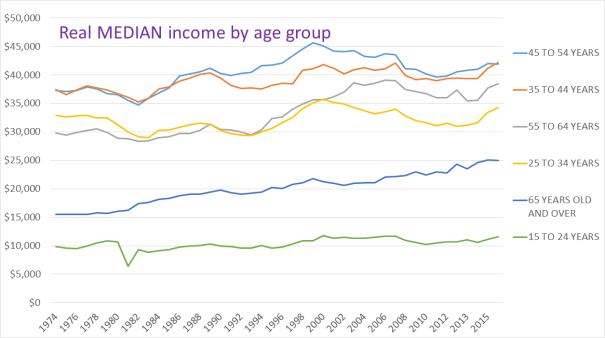
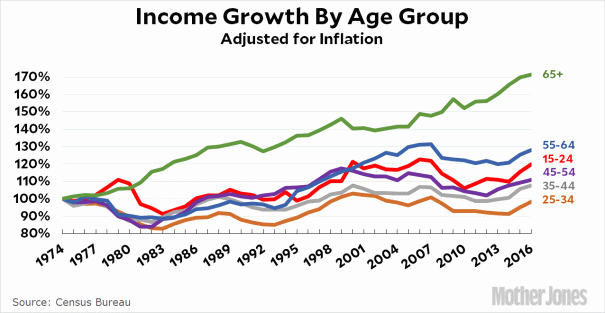
Income growth for different age groups in America

The distribution of income deserves more attention. One reason why college seems less affordable is that average real wages for young people have fallen since the 1970s whereas tuition has risen. A lot. Of course, the average college student doesn’t even pay off their college loan until around the age 34 and that is when the average American finally sees some real wage growth, but even this is skewed toward the elites in each group because this is using mean income.

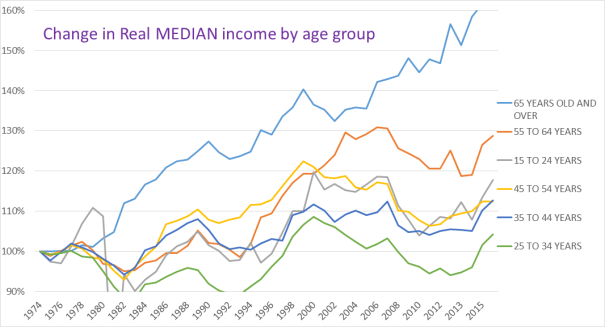
The Census also has official median income data for the same people. Surprisingly, it tells almost the identical story except it is slightly more optimistic. Median income has risen slightly faster than in the Mother Jones chart above! I wish I had time to get the data and try to replicate the above chart too.

Whereas the Americans over 65 look like they are doing great financially, they have actually just been catching up with everyone else above age 24:

Median income looks very different than percent change of income. Now the over-65-year-olds don’t look so lucky.

Posted in MELI & Econ Stats

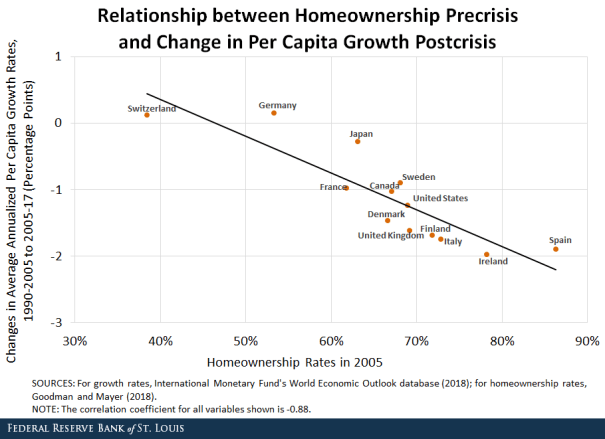
Homeownership rates and severity of financial crisis

The St. Louis Fed produced the above graph showing that nations with higher homeownership rates were hit harder by the 2007 financial crisis and are still dealing with greater aftereffects today. Nations with the most rental properties like Switzerland and Germany have grown faster after the financial crisis than they did before. Nations with the highest homeownership like Ireland and Spain saw the biggest drop off in economic growth.

One of the most interesting things about this graph is the dramatically different homeownership patterns in different rich nations.

National Homeownership Rates (Percent)


1990

2000

2005

2010

2015

Canada

62.6

65.8

67.1

69.0

67.0

Denmark

54.5

51.0

66.6

66.6

62.7

Finland

67.0

61.0

71.8

74.3

72.7

France

54.4

54.8

61.8

62.0

64.1

Germany

37.3

41.3

53.3

53.2

51.9

Ireland

80.0

78.9

78.2

73.3

70.0

Italy

64.2

69.0

72.8

72.6

72.9

Japan

63.2

64.9

63.1

62.4

64.9

Spain

77.8

82.0

86.3

79.8

78.2

Sweden

41.0

67.0

68.1

70.8

70.6

Switzerland

31.3

34.6

38.4

44.4

51.3

United Kingdom

65.8

69.1

69.2

65.7

63.5

United States

63.9

66.8

68.9

66.9

63.7

Median

63.2

65.8

68.1

66.9

64.9

In Switzerland in 1990, only 31% of households owned their own home whereas in Ireland it was at 80%! Spain eventually reached 86% homeownership. In the 1970s and 1980s, the American home building and financing industries marketed the idea that owning a home is the American dream, and the US achieved above average homeownership rates. But in the aftermath of the financial crisis, American homeownership rates have been below the median for rich nations, so is it time to redefine the American dream to reflect the reality of declining home ownership?

Posted in Macro, Real Estate

Republicans hate “Obamacare” but love the policies whereas Democrats love it more than the actual policies deserve

NBC News did an experiment in 2014, four years after Obamacare was enacted. They polled half of their sample of Kentucky voters about what they thought of “Obamacare”, and asked the other half about “Kynect”, the Kentucky implementation of Obamacare. The result, 22% of those asked about Kynect regarded it unfavorably whereas 57% of those who were asked about Obamacare viewed it unfavorably. So registered Kentucky voters liked what Kentucky’s version of Obamacare was doing, but disliked the national program.

This bias could partly be due to our national problem with partisanism clouding our judgements about reality. Similar experiments have found that Americans like the Affordable Care Act a lot better than they like Obamacare even though both are names for the same thing.

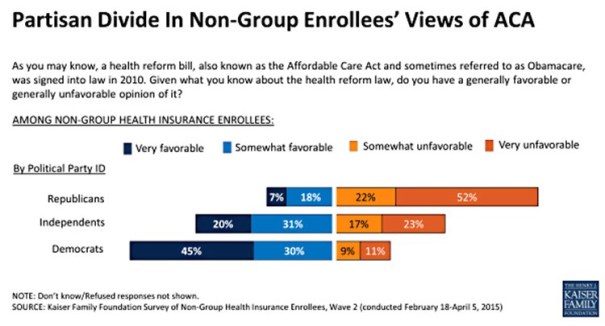
A 2015 poll found that 25% of Republicans were favorable towards Obamacare whereas 75% of Democrats were favorable.

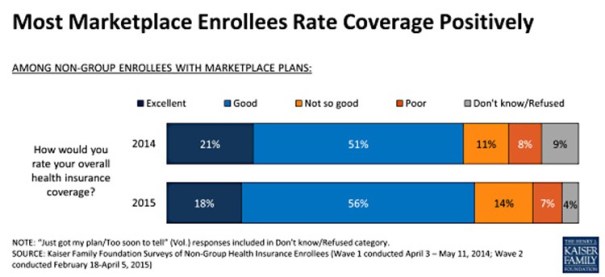
However, that is certainly a partisan bias in both parties that is causing this difference. Enrollees in Obamacare are fairly evenly split between Republicans and Democrats and the enrollees are the people who are most directly affected. They overwhelmingly like the insurance they are getting through Obamacare. However Democrats say they like Obamacare more than people who actually have it like it and Republicans say they like Obamacare much less than people who actually have it:

So people like Obamacare a lot more if it isn’t called Obamacare and the people who have it like it about as well as people with private employer-based insurance.

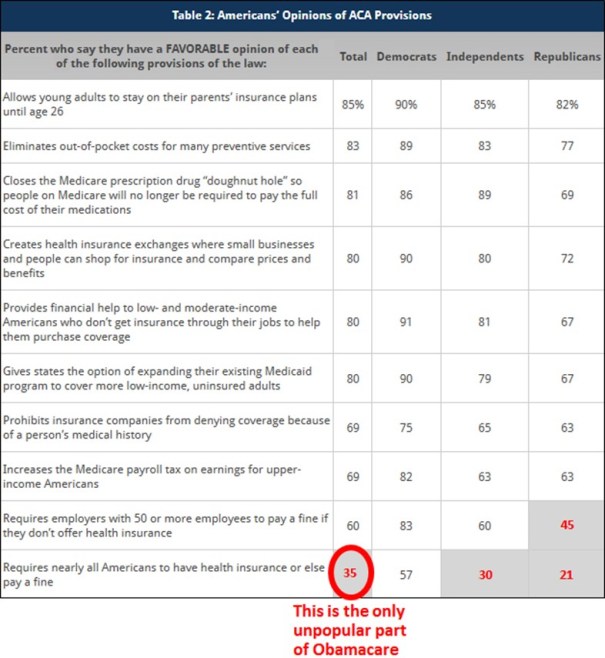
Similarly, if you ask Americans about whether they approve of the main things Obamacare does, they like nearly everything in the bill. Here is a Kaiser tracking poll from the end of 2016 with the graphic modified by Kevin Drum. Every part of Obamacare was very popular except the individual mandate:

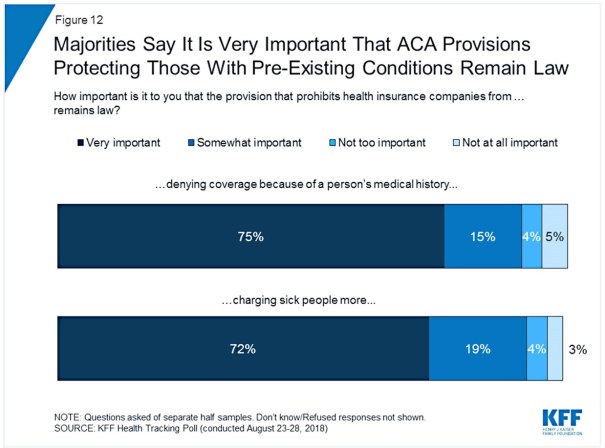
An August 2018 Kaiser tracking poll confirms that Americans overwhelmingly want to protect health coverage for people with pre-existing conditions:

Kevin Drum comments about it:

A full 90 percent want to keep the Obamacare provision that protects those with pre-existing conditions. 90 percent! You can barely get a number that high for approval of a congressional Mother’s Day resolution. And yet, the approval rate of Obamacare itself remains….meh… Among Republicans, 58 percent think it’s important to retain Obamacare protections for pre-existing conditions. However, only 15 percent have a favorable view of the law that provides those protections in the first place. [That] means that at least 43 percent of Republicans want to get rid of Obamacare but keep Obamacare’s protections for pre-existing conditions.

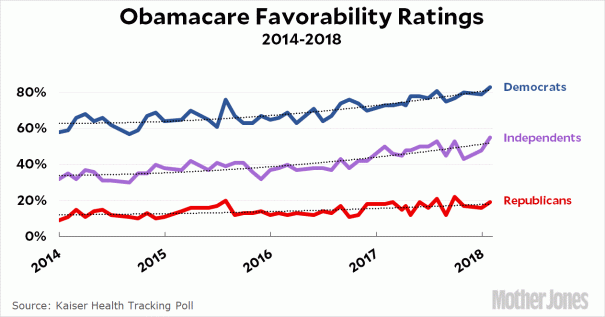
Meanwhile, as Obamacare ages, public opinion has been slowly warming to it:


The main goals of Obamacare was to help Americans get better healthcare and increase insurance coverage. These were and are extremely popular goals among Republicans and Democrats alike. Obamacare is mostly criticized in both parties for not achieving this goal well enough and it is a small program that didn’t change much compared to the implementation of Medicaid and Medicaid in 1966. Both of those programs are overwhelmingly popular among Democrats and Republicans alike.  Below are the 2018 Kaiser statistics for Medicaid and they didn’t show the popularity of Medicare, but it has consistently been even more popular than Medicaid shown here.

So there is some common ground about these healthcare goals and Obamacare did increase coverage and the people who have it generally like it. That is why it is getting more popular.

I expect that total repeal of Obamacare is politically impossible when 90% of Americans support some of its core parts, but if Washington actually did totally repeal Obamacare and try to take America back again to the way the health insurance system was structured before 2010, Obamacare would suddenly become even more popular.

Posted in Health

Why is extreme selfishness funny?

Here is a screenshot of a to-do list that the author undoubtedly meant as a joke, but I wonder why some people would post this kind of thing or find it funny.

The first point is being spiteful to his wife. The second point is selfish in relation to his own children. Third point is to deceive (to lie without words) to his own family for selfish gain. I find it kinda sad that Americans post this kind of thing and/or think others will find it funny. I’d be fine if he were making fun of it, but there is no hint that the author is making fun of this sort of ethical egoism. Ethical egoism is the sort of extreme individualistic philosophy which claims that the only good thing to do is whatever each individual’s selfish desires lead to. It explicitly rejects altruistic impulses as evil! Here is the author:

Ironically, the author identifies as a “Collaboration Engineer” which indicates that he engineers working together with others. This kind of ethical egoist attitude doesn’t help engineer collaboration. I’d love to see a cross-cultural study to see what societies think this kind of thing might be humorous. I don’t think you’d see this sort of thing in American culture a few generations ago when America was less prone to ethical egoism.

Of course, I used to love the Seinfeld sitcom which was all about shallow, selfish characters, so I sometimes find ethical egoism funny too. I don’t think most cultures would find Seinfeld funny. When one of the main characters dies (Susan, George’s fiancée), nobody displays any genuine emotions of empathy for her nor her family.  The characters are about as close to ethical egoism as it is possible to get.

Western civilization wasn’t always so individualistic.  Since at least the 1960s, Western culture has promoted the pursuit of self-interest as a road to happiness, but that is an unusual conception of happiness.  Sean Illing gives a brief history:

Aristotle was one of the first to offer what you might call a philosophy of happiness. For him, happiness consisted of being a good person, of living virtuously and not being a slave to one’s lowest impulses. Happiness was a goal, something at which humans constantly aim but never quite reach. Epicurus, another Greek philosopher who followed Aristotle, believed that happiness was found in the pursuit of simple pleasures.

The rise of Christianity in the West upended Greek notions of happiness. Hedonism and virtue-based morality fell somewhat out of favor, and suddenly the good life was all about sacrifice and the postponement of gratification. True happiness was now something to be attained in the afterlife, not on Earth.

The Enlightenment and the rise of market capitalism transformed Western culture yet again. Individualism became the dominant ethos, with self-fulfillment and personal authenticity the highest goods. Happiness became a fundamental right, something to which we’re entitled as human beings.

A new book entitled The Happiness Fantasy by Carl Cederström, a business professor at Stockholm University, traces our current conception of happiness to its roots in modern psychiatry and the so-called Beat generation of the ‘50s and ‘60s. He argues that the values of the countercultural movement — liberation, freedom, and authenticity — were co-opted by corporations and advertisers, who used them to perpetuate a culture of consumption and production. And that hyper-individualistic culture actually makes us much less happy than we could be.

One of the economic paradoxes of the last half century is that America has been getting richer and we are living longer, but measures of happiness have not increased with the increased production of almost everything else.  There are various explanations why this might be, but one explanation might be the cultural shift toward seeking happiness in selfish consumerism rather than in searching for meaning in life which often comes from self-sacrifice.

Posted in Culture, Philosophy and ethics

An epidemic of fake Trump tweets ironically claiming “Fake News”

Michael Cowen’s friends and official spokesmen have been playing the press for months. Rather than Cowen just telling the Mueller investigation what he knows, he and his allies have been constantly tantalizing the press with all sorts of specifics that they might tell Mueller. For example, Cowen went from saying he knows all about whether Trump knew about his campaign’s Trump Tower meeting with the Russians, but wouldn’t comment on the record and then Cowen allies said that Trump did know and approve of the meeting and now the same people are saying that they don’t know.

Naturally the changing stories led Trump to accuse the “Fake News” media of not knowing what they are talking about and lying when the news media is accurately reporting the changing stories that the Cowen camp is telling.

CNN is being torn apart from within based on their being caught in a major lie and refusing to admit the mistake. Sloppy @carlbernstein, a man who lives in the past and thinks like a degenerate fool, making up story after story, is being laughed at all over the country! Fake News  6:43 PM – Aug 29, 2018

To me the most interesting thing about this tweet is how unlikely it is that Trump actually wrote the above post. It is a Fake Tweet! Where are the trademark spelling mistakes, weird capitalization, and grammatical errors? Trump doesn’t use four-syllable words like “degenerate”. Trump doesn’t construct sentences out of multiple predicate phrases that are correctly delineated by commas. Both of these sentences are complex with multiple predicate phrases and both sentences have a word with more than two syllables. That’s not at all like Trump. A typical Trump tweet is like this with weird capitalization, scare quotes, missing spaces between words and no words with more than two syllables.

Ivanka Trump & Jared Kushner had NOTHING to do with the so called “pushing out” of Don McGahn.The Fake News Media has it, purposely,so wrong! They love to portray chaos in the White House when they know that chaos doesn’t exist-just a “smooth running machine” with changing parts! 7:44 AM – 30 Aug 2018

Everyone knows that Trump doesn’t write all of his own tweets. At least once, Trump subordinate Dan Scavino wrote a tweet on his own account and then seconds later tweeted exactly the same text from Trump’s account and then deleted his original tweet from his own account to make it look like the tweet originated from Trump. At one time, Trump was the only person tweeting from an Android phone, so it was easy to distinguish which tweets came from him and which were written by subordinates by checking the sources. But by comparing tweets that we know Trump wrote with tweets that he did not write, some clear patterns emerge.  Trump’s staff tries to use bad grammar and simple vocabulary to sound like him, but some people just can’t bring their language down to Trump’s level and it is often easy to tell when Trump did not write a text.

In fact, some enterprising computer programmer should write a fake spotting algorithm to automatically assess the chances that each Trump tweet is fake or not like FakeSpot.com does to weed out fake Amazon reviews.

UPDATE:  It turns out an enterprising programmer already did create a machine-learning system to separate real Trump tweets from the fake ones.  According to DidTrumpTweetIt.com, both of the above tweets were probably authentic.  So I probably got it wrong here.

Posted in Pence2018

New bill would require better measures of median income (plus a lot more)

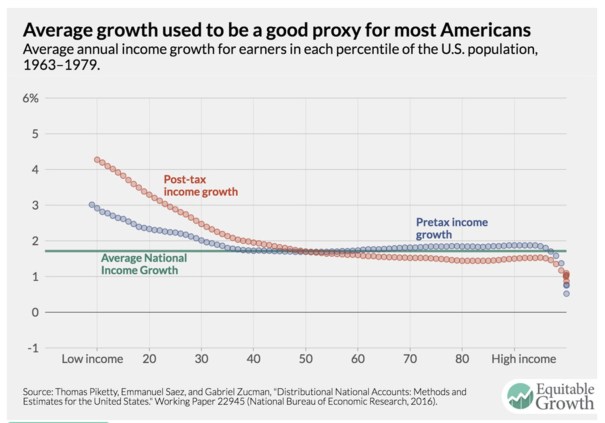
GDP is a measure of total income in a country. For at least the two decades before 1980, American median income grew about as fast as GDP and Americans below the median income saw faster growth than Americans who were richer than the median. Income growth was broadly shared and no class of Americans got poorer. The following graphs show the growth rate across the income distribution for all Americans. The median income had real growth of about 1.7% annually in the 1960s and 1970s which was also the growth rate of mean GDP (the green horizontal line).

Since 1980, only the richest 11% of Americans have seen their incomes grow faster than GDP (the average national income growth rate) and the bottom 89% of Americans have seen their incomes grow more slowly. Almost 90% of Americans are below average now! The incomes of the top 1% richest Americans have soared while the very poorest have actually gotten poorer.

The Washington Center for Equitable Growth is a tiny 5-year-old think tank that has compiled statistics about how economic growth is distributed and now there is a new bill in Congress (that will probably go nowhere due to gridlock) to develop official government statistics like the above graphs:

the Measuring Real Income Growth Act of 2018, would require the Bureau of Economic Analysis (BEA), which releases quarterly GDP numbers, to also report how growth is distributed along the income scale. The bureau would have to put together distributional measures of economic growth to be released with quarterly and annual GDP reports starting in 2020, laying out how growth shows up across each decile of earners and the top 1 percent. …[The] bill would require the BEA to produce a new metric, the “income growth indicator,” or IGI, to be reported quarterly and annually with GDP numbers starting in 2020.

Gridlock is only one obstacle to this bill. Additionally, there are well-funded think tanks like the Cato Institute that are ideologically opposed to measuring inequality and the distribution of income. For example, the above article reached out to

Jeffrey Miron, an economist at Harvard University and director of economist studies at the libertarian Cato Institute, …[He] expressed doubts that such a measure was really necessary or would make sense to calculate.

Plus, there is an infinite number of ways to measure economic growth that would be better than our current standard, GDP, and every academic economist who has studied it has an optimal way in mind. They tend to let the best be the enemy of the better and oppose other efforts that aren’t exactly what they personally feel would be optimal for example:

Dean Baker, an economist at the progressive-leaning Center for Economic and Policy Research, also expressed doubts. Current income data from the census and IRS is limited and retrospective, and fielding new surveys to produce the metric the Schumer-Heinrich legislation is proposing would be difficult and, initially, perhaps inaccurate. “I’m just not sure this is at all helpful,” he said. “It might be better to get an official release on something like the tax data when it becomes available with a year or so lag.”

However, the Center for Equitable Growth recognizes that this might not be the perfect legislation, but they argue that it is a good step in the right direction. Their chief economist Heather Boushy argues that the top 1% richest Americans will fight against this kind of effort:

“My guess is that anybody that’s opposed to this is thinking about whether or not they want Americans to know who gained [from GDP growth],” Boushey said. “When it’s 4.1 percent growth, they don’t want people to know that that growth most likely went to the top 1 percent.”

Posted in Inequality, Medianism

Enter your email address to follow this blog and receive notifications of new posts by email.

Join 75 other subscribers
Blog Archive
Pages