
Krugman’s Baby-Sitting Coop

playmoney

Once upon a time, there were three neighboring families with young children.  They all needed babysitting at different times and there was a shortage of reliable professional babysitters in the neighborhood.  The neighbors all wanted their children to be able to play with neighboring kids, so they often take turns babysitting for each other.  However, the Smith family started babysitting more for the Wilsons than the Wilsons could reciprocate, and the Wilsons would often say ‘we owe you one’ to the Smiths.  The Smiths know that they can count on getting the favor returned, but the Wilsons were worried that they would forget so the Wilsons started writing IOUs on scraps of paper to help keep track.

Then the Wilson family’s schedule changed and they could no longer babysit the Smiths anymore.  The Smith family had accumulated five IOUs, and the Wilson’s felt bad about not being able to pay them back.  Fortunately, the Jones family was available to babysit for the Smiths.  The Smiths give them an IOU each time to help keep track because they Smiths’ schedules meant that they weren’t able to pay them back very often.   The Joneses accumulated a pile of IOUs.

The Wilsons had been feeling guilty about not doing their part, so they figured out how to rearrange their schedule to babysit for the Wilsons even though they actually owed the Smiths.  Naturally, the Wilsons gave them IOUs and the Smiths were surprised to see that they were getting back the very same IOUs that they originally gave to the Smiths. The three families got together and decided to invite other neighboring families to join their babysitting circle and a babysitting coop was born.

This parable illustrates that even with only three families, there is often a coincidence of wants problem that is makes it difficult or impossible to barter between any two people even though there are other people who could fill the wants of both.  IOUs (also known as Money) can help solve this coordination problem.

This is also essentially how all money works.  In societies with less trust and more potential problems with counterfeiting than a community of friends exchanging the gift of babysitting, some sort of intrinsically-valuable commodity like gold or cigarettes is sometimes also used, but commodity money works exactly the same way as IOUs except for the greater difficulty in creating commodity money (and the greater incentive to intentionally destroy it to use it as a commodity).  People accept gold coins in payment merely because they know that lots of other people will feel indebted to whoever has a lot of gold coins.

Paul Krugman has often written about a similar case study that he says changed his life.  It was published in the Journal of Money, Credit, and Banking in 1978 and entitled, “Monetary Theory and the Great Capitol Hill Baby-Sitting Co-op Crisis” by Joan and Richard Sweeney.

The Sweeneys tell the story of …a baby-sitting co-op …to which they belonged… Such co-ops are quite common: A group of people (in this case about 150 young couples with congressional connections) agrees to baby-sit for one another… It’s a mutually beneficial arrangement: A couple that already has children around may find that watching another couple’s kids for an evening is not that much of an additional burden, certainly compared with the benefit of receiving the same service some other evening. But there must be a system for making sure each couple does its fair share.

The Capitol Hill co-op adopted one fairly natural solution. It issued scrip—pieces of paper equivalent to one hour of baby-sitting time. Baby sitters would receive the appropriate number of coupons directly from the baby sittees. This made the system self-enforcing: Over [the long run], each couple would automatically do as much baby-sitting as it received in return [because when the parents left the coop, they had to return as many coupons to the coop as they originally received.  The coupons were effectively loaned to the parents]. As long as the people were reliable—and these young professionals certainly were—what could go wrong?

Well, it turned out that there was a small technical problem. Think about the coupon holdings of a typical couple. During periods when it had few occasions to go out, a couple would probably try to build up a reserve—then run that reserve down when the occasions arose. [Normally] there would be an averaging out of these demands. One couple would be going out when another was staying at home. But …what happened in the Sweeneys’ co-op was that …the number of coupons in circulation became quite low [because members paid dues in coupons and some coupons got lost.]

As a result, most couples were anxious to add to their reserves by baby-sitting, reluctant to run them down by going out. But one couple’s decision to go out was another’s chance to baby-sit; so it became difficult to earn coupons. Knowing this, couples became even more reluctant to use their reserves except on special occasions, reducing baby-sitting opportunities still further.

In short, the co-op had fallen into a recession.

Since most of the co-op’s members were lawyers, …They tried to legislate recovery—passing a rule requiring each couple to go out at least twice a month. But eventually … More coupons were issued, couples became more willing to go out, opportunities to baby-sit multiplied, and everyone was happy. Eventually, of course, the co-op issued too much scrip, leading to different problems …

If you think this is a silly story, a waste of your time, shame on you. What the Capitol Hill Baby-Sitting Co-op experienced was a real recession. …if you are willing to really wrap your mind around the co-op’s story, to play with it and draw out its implications, it will change the way you think about the world.

…Above all, the story of the co-op tells you that economic slumps are not punishments for our sins, pains that we are fated to suffer. The Capitol Hill co-op did not get into trouble because its members were bad, inefficient baby sitters; its troubles did not reveal the fundamental flaws of “Capitol Hill values” …It had a technical problem—too many people chasing too little scrip—which could be, and was, solved with a little clear thinking. …

…imagine a co-op …when a couple found itself needing to go out several times in a row, which would cause it to run out of coupons—and therefore be unable to get its babies sat—even though it was entirely willing to do lots of compensatory baby-sitting at a later date. To resolve this problem, the co-op [could allow] members to borrow extra coupons from the management in times of need—repaying with the coupons received from subsequent baby-sitting. To prevent members from abusing this privilege, however, the management would probably need to impose some penalty—requiring borrowers to repay more coupons than they borrowed.

Under this new system, couples would hold smaller reserves of coupons than before, knowing they could borrow more if necessary. The co-op’s officers would, however, have acquired a new tool of management. If members of the co-op reported it was easy to find baby sitters and hard to find opportunities to baby-sit, the terms under which members could borrow coupons could be made more favorable, encouraging more people to go out. If baby sitters were scarce, those terms could be worsened, encouraging people to go out less.

In other words, this more sophisticated co-op would have a central bank that could stimulate a depressed economy by reducing the interest rate and cool off an overheated one by raising it.

…imagine there is a seasonality in the demand and supply for baby-sitting. During the winter, when it’s cold and dark, couples don’t want to go out much but are quite willing to stay home and look after other people’s children—thereby accumulating points they can use on balmy summer evenings. …the co-op could still keep the supply and demand for baby-sitting in balance by charging low interest rates in the winter months, higher rates in the summer.

Krugman also wrote about this story in his 2012 book, End This Depression Now! and I found some of the text online with a quick Google search.  He begins by giving an example of one of the many anti-Keynesians who do not believe that there could be a problem like the babysitting coop example:

…Here’s Brian Riedl of the Heritage Foundation …in an early-2009 interview with National Review:

The grand Keynesian myth is that you can spend money and thereby increase demand. And it’s a myth because Congress does not have a vault of money to distribute in the economy. Every dollar Congress injects into the economy must first be taxed or borrowed out of the economy. You’re not creating new demand, you’re just transferring it from one group of people to another.

Give Riedl some credit: …he admits that his argument applies to any source of new spending. That is, he admits that his argument that a government spending program can’t raise employment is also an argument that, say, a boom in business investment can’t raise employment either. And it should apply to falling as well as rising spending. If, say, debt-burdened consumers choose to spend $500 billion less, that money, according to people like Riedl, must be going into banks, which will lend it out, so that businesses or other consumers will spend $500 billion more. If businesses …scale back their investment spending, the money they thereby release must be spent by less nervous businesses or consumers. According to Riedl’s logic, overall lack of demand can’t hurt the economy, because it just can’t happen.

…What do we learn from [the babysitting coop] story? If you say “nothing,” because it seems too cute and trivial, shame on you. The Capitol Hill babysitting co-op was a real, …miniature, monetary economy. It lacked many of the features of the enormous system we call the world economy, but it had one feature that is crucial to understanding what has gone wrong with that world economy—a feature that seems, time and again, to be beyond the ability of politicians and policy makers to grasp.

What is that feature? It is the fact that your spending is my income, and my spending is your income. Isn’t that obvious? Not to many influential people. For example, it clearly wasn’t obvious to John Boehner, the Speaker of the U.S. House, who opposed President Obama’s [fiscal stimulus], arguing that since Americans were suffering, it was time for the U.S. government to tighten its belt too. (To the great dismay of …economists, Obama ended up echoing that line in his own speeches.)

The question Boehner didn’t ask himself was, if ordinary citizens are tightening their belts—spending less—and the government also spends less, who is going to buy American products? Similarly, the point that every individual’s income …is someone else’s spending is clearly not obvious to many German officials…

And because the babysitting co-op, for all its simplicity and tiny scale, had this crucial, not at all obvious feature that’s also true of the world economy, the co-op’s experiences can serve as “proof of concept” for …at least three important lessons.

First, we learn that an overall inadequate level of demand is indeed a real possibility. When coupon-short members of the babysitting co-op decided to stop spending coupons on nights out, that decision didn’t lead to any automatic offsetting rise in spending by other co-op members; on the contrary, the reduced availability of babysitting opportunities made everyone spend less.

People like Brian Riedl are right that spending must always equal income: the number of babysitting coupons earned in a given week was always equal to the number of coupons spent. But this doesn’t mean that people will always spend enough to make full use of the economy’s productive capacity; it can instead mean that enough capacity stands idle to depress income down to the level of spending.

This is what happens in a recession when many factories and workers are unemployed.

Second, an economy really can be depressed thanks …failures of [demand] rather than lack of productive capacity. The co-op didn’t get into trouble because its members were bad babysitters, or because high tax rates or too-generous government handouts made them unwilling to take babysitting jobs, or because they were paying the inevitable price for past excesses. It got into trouble for a seemingly trivial reason: the supply of coupons was too low, and this created a “colossal muddle,” …in which the members of the co-op were, as individuals, trying to do something—add to their hoards of coupons— that [everyone simultaneously] could not, as a group, actually do.

This is a crucial insight. The [2008] crisis in the global economy …is, for all the differences in scale, very similar in character to the problems of the co-op. Collectively, the world’s residents are trying to buy less stuff than they are capable of producing, to spend less than they earn. That’s possible for an individual, but not for the world as a whole. And the result is the devastation all around us.

…If we look at the state of the world on the eve of the crisis—say, in 2005–07—we see a picture in which some people were cheerfully lending a lot of money to other people, who were cheerfully spending that money. U.S. corporations were lending their excess cash to investment banks, which in turn were using the funds to finance home loans; German banks were lending excess cash to Spanish banks, which were also using the funds to finance home loans; and so on. …And because your spending is my income, there were plenty of sales, and jobs were relatively easy to find.

Then the music stopped. Lenders became much more cautious about making new loans; the people who had been borrowing were forced to cut back sharply on their spending. And here’s the problem: nobody else was ready to step up and spend in their place [The world was trying to increase savings without being willing to increase lendings.] Suddenly, total spending in the world economy plunged, and because my spending is your income and your spending is my income, incomes and employment plunged too.

So can anything be done? That’s where we come to the third lesson from the babysitting co-op: big economic problems can sometimes have simple, easy solutions. The co-op got out of its mess simply by printing up more coupons. …Could we cure the global slump the same way? Would printing more babysitting coupons, aka increasing the money supply, be all that it takes to get Americans back to work? Well, the truth is that printing more babysitting coupons is the way we normally get out of recessions.

For the last fifty years the business of ending recessions has basically been the job of the Federal Reserve, which (loosely speaking) controls the quantity of money circulating in the economy; when the economy turns down, the Fed cranks up the printing presses. And until now this has always worked. It worked spectacularly after the severe recession of 1981–82, which the Fed was able to turn within a few months into a rapid economic recovery… It worked, albeit more slowly and more hesitantly, after the 1990–91 and 2001 recessions.

But it didn’t work this time around. I just said that the Fed “loosely speaking” controls the money supply; what it actually controls is the “monetary base,” the sum of currency in circulation and reserves held by banks. Well, the Fed has tripled the size of the monetary base since 2008; yet the economy remains depressed. So is my argument that we’re suffering from inadequate demand wrong? No, it isn’t.

…So what [happened] to us? We found ourselves in the unhappy condition known as a “liquidity trap.”

The Liquidity Trap

…[When the 2008 recession hit] the Federal Reserve …responded by rapidly increasing the monetary base. Now, the Fed—unlike the board of the babysitting co-op—doesn’t hand out coupons to families; when it wants to increase the money supply, it basically lends the funds to banks, hoping that the banks will lend those funds out in turn. (It usually buys bonds from banks rather than making direct loans, but it’s more or less the same thing.) This sounds very different from what the co-op did, but the difference isn’t actually very big. Remember, the rule of the co-op said that you had to return as many coupons when you left as you received on entering, so those coupons were in a way a loan from [the coop] management.

Increasing the supply of coupons therefore didn’t make [babysitting economy] richer—they still had to do as much babysitting as they received. What it did, instead, was make them more liquid, increasing their ability to spend when they wanted without worrying about running out of funds.

Now, out in the [US economy] people and businesses can always add to their liquidity, but at a price: they can borrow cash, but [they] have to pay interest on borrowed funds. What the Fed can do …is drive down interest rates, which are the price of liquidity—and also, of course, the price of borrowing to finance investment or other spending. So in the [US] economy, the Fed’s ability to drive the economy comes via its ability to move interest rates.

But here’s the thing: it …can’t push them below zero, because when rates get close to zero, just sitting on cash is a better option than lending money to other people. And in the current slump it didn’t take long for the Fed to hit this “zero lower bound”: it started cutting rates in late 2007 and had hit zero by late 2008. Unfortunately, a zero rate turned out not to be low enough… Consumer spending remained weak; [and] business investment was low… And unemployment remained disastrously high.

And that’s the liquidity trap: it’s what happens when zero isn’t low enough, when the Fed has saturated the economy with liquidity to such an extent that there’s no cost to holding more cash, yet overall demand remains too low.

A “liquidity trap” is a weird name for a situation where the Fed is “trapped” because it has driven short-term interest rates to zero and so further monetary stimulus won’t have any effect because interest rates can’t go below zero.  Back to Krugman:

Let me go back to the babysitting co-op one last time… Suppose for some reason …most of the co-op’s members decided that they wanted to [hoard coupons and] run a surplus this year, putting in more time minding other people’s children than the amount of babysitting they received in return, so that they could do the reverse next year.

…That’s more or less what …happened to America and the world economy as a whole. When everyone suddenly decided that debt levels were too high, debtors were forced to spend less, but creditors weren’t willing to spend more, and the result [was] a depression—not a Great Depression, but a depression all the same. Yet surely there must be ways to fix this. It can’t make sense for so much of the world’s productive capacity to sit idle, for so many willing workers to be unable to find work. And yes, there are ways out. Before I get there, however, let’s talk briefly about the views of those who don’t believe any of what I’ve just said.

Is It Structural?

I believe this present labor supply of ours is peculiarly unadaptable and untrained. It cannot respond to the opportunities which industry may offer. This implies a situation of great inequality—full employment, much over-time, high wages, and great prosperity for certain favored groups, accompanied by low wages, short time, unemployment, and possibly destitution for others.

—Ewan Clague

The quotation above comes from an article in the Journal of the American Statistical Association. It makes an argument one hears from many quarters these days: that the fundamental problems we have run deeper than a mere lack of demand, that too many of our workers lack the skills the twenty-first-century economy requires, or too many of them are still stuck in the wrong locations or the wrong industry.

But I’ve just played a little trick on you: the article in question was published in 1935. The author was claiming that even if [there was] a great surge in the demand for American workers, unemployment would remain high, because those workers weren’t up to the job. But he was completely wrong: when that surge in demand finally came, thanks to …World War II, all those millions of unemployed workers proved perfectly capable of resuming a productive role. Yet now, as then, there seems to be a strong urge—an urge not restricted to one
side of the political divide—to see our problems as “structural,” not easily resolved through an increase in demand….

Sometimes this argument is presented in terms of a general lack of skills. For example, former president Bill Clinton …told the TV show 60 Minutes that unemployment remained high “because people don’t have the job skills for the jobs that are open.” Sometimes it’s framed in terms of a story about how technology is simply making workers unnecessary—which is what President Obama seemed to be saying when he told the Today Show,

There are some structural issues with our economy where a lot of businesses have learned to be much more efficient with fewer workers. You see it when you go to a bank and you use an ATM, you don’t go to a bank teller. Or you see it when you go to the airport and you use a kiosk instead of checking at the gate.

…And most common of all is the assertion that we can’t expect a return to full employment anytime soon, because we need to transfer workers out of an overblown housing sector and retrain them for other jobs. Here’s Charles Plosser, the president of the Federal Reserve Bank of Richmond, and an important voice arguing against policies to expand demand:

You can’t change the carpenter into a nurse easily, and you can’t change the mortgage broker into a computer expert in a manufacturing plant very easily. Eventually that stuff will sort itself out. People will be retrained and they’ll find jobs in other industries. But monetary policy can’t retrain people. Monetary policy can’t fix those problems…

OK, how do we know that all of this is wrong? Part of the answer is that Plosser’s implicit picture of the unemployed—that the typical unemployed worker is someone who was in the construction sector, and hasn’t adapted to the world after the housing bubble—is just wrong. Of the 13 million U.S. workers who were unemployed in October 2011, only 1.1 million (a mere 8 percent) had previously been employed in construction…

Construction workers were only about 5% of the labor force in 2006, so their share of total unemployment was surprisingly small given that the housing bubble precipitated the entire economic crisis.  Ninety-two percent of unemployment was in other sectors of the economy where there was no obvious reason why there should be a slowdown.

More broadly, if the problem is that many workers have the wrong skills, or are in the wrong place, those workers with the right skills in the right place should be doing well. They should be experiencing full employment and rising wages. So where are these people?

There were very few sectors of the economy where unemployment was as low during the Great Recession as it was in normal times.  The fracking boom in the great plains was about the only place with normal, low unemployment, but the fracking companies were only looking for a few thousand skilled workers whereas the excess unemployed American workers numbered in the tens of millions.

…The bottom line is that if we had mass unemployment because too many workers lacked the Right Stuff, we should be able to find a significant number of workers who do have that stuff prospering—and we can’t. What we see instead is impoverishment all around, which is what happens when the economy suffers from inadequate demand…

the private sector, collectively, is trying to spend less than it earns, and the result is that income has fallen. Yet we’re in a liquidity trap: the Fed can’t persuade the private sector to spend more just by increasing the quantity of money in circulation. What is the solution?

Krugman goes on to argue that when monetary stimulus loses its effectiveness due to a liquidity trap, fiscal stimulus should be used because it is more effective in a liquidity trap when the government can borrow money for negative real interest rates.  The massive military of World War II finally ended the Great Depression, so more productive spending on education, infrastructure, military training, and other domestic priorities (rather than just blowing up stuff like in WWII) would work again.

Alternatively, the Fed could get more aggressive in its monetary policy.  It could do like the Babysitting coop and print money to loan $1,000 to every American adult at a low interest rate.  Or it could do a “helicopter drop” and just give the money to every American.  This was one of Milton Friedman’s ideas for how to avoid using a fiscal stimulus when there is a deflationary liquidity trap.

Of course, if the Fed is giving everyone money on behalf of the US government, then is there really much difference between monetary stimulus (the Fed pumping out money) and a fiscal stimulus (the Treasury pumping out money)?  They both work the same way.  The government could accomplish the same thing via a “fiscal stimulus” by borrowing money at zero percent interest (the going rate in a liquidity trap) and giving $1,000 to every American.  Both would have essentially the same effect.  Indeed, that is more-or-less part of what Obama’s 2009 fiscal stimulus did when the government borrowed money to give all working Americans a tax cut (or increase tax rebates).  About a third of the 2009 fiscal stimulus was for tax cuts.

Posted in Macro

Why are we so afraid of other nations that can’t even take care of their own shit?

TomDispatch has a great article about the insanity of our military’s spending priorities and the money-grubbing paranoia of the associated defense-industrial complex. It is scary. You gotta read it. At the same time, all rich nations are military allies of the US. The only countries that we are even afraid of are so incompetent that they literally cannot even provide minimally sanitary toilets for all of their people. I’m just talking about a decent pit latrine for goodness sake.

A sanitary toilet is something that everyone gets 100% once mean GDP hits about $35,000. Look at our top military rivals, Russia and China. Pathetic.

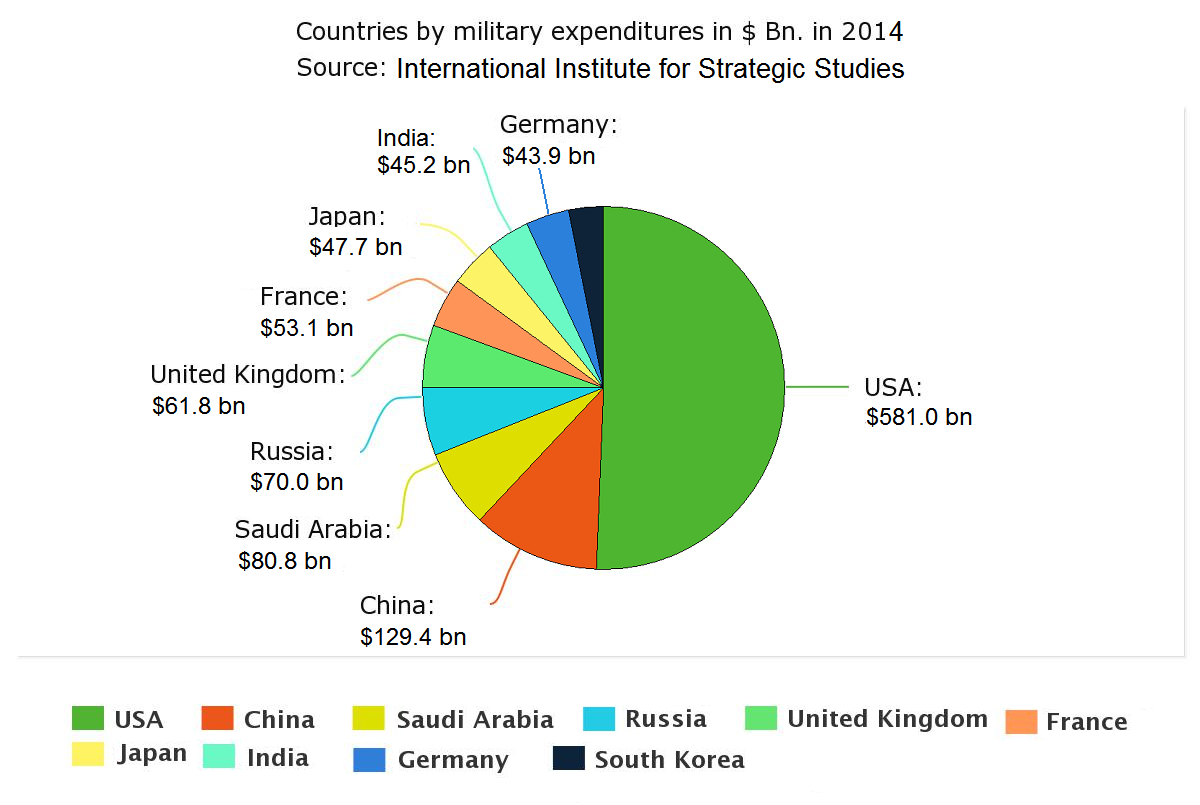
Meanwhile, here is what military spending looks like for the big spenders:

The USA simply outspends everyone else by a huge amount, and we really outdid ourselves during WWII.

The following chart shows one estimate for the US share of total worldwide military expenditure. This estimate is a bit on the high end for the US share of the total, but all estimates put the US at far, far above every other nation.

Posted in Development, Public Finance

#Pence2018 vs Trump tariffs

On Friday I was called in for a TV interview with WLIO about Trump’s tariffs so I put together a few notes for myself that I might as well post.

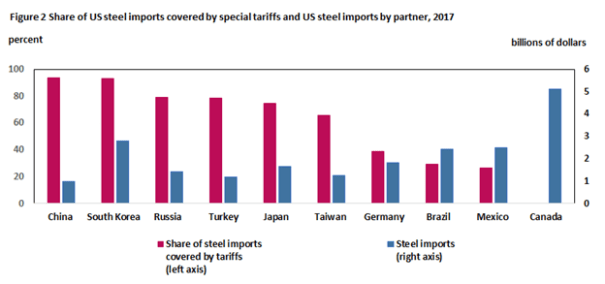
Trump says he will impose a 25 percent tariff on steel and a 10 percent tariff on aluminum. Trump says it is to punish China, but we don’t actually get much steel from China and China is already subject to special tariffs:


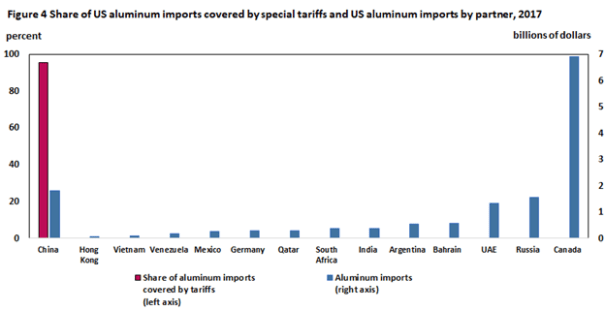
The National Review notes that, “China was the 10th largest supplier of steel to the U.S. market in 2017 and 94 percent of China’s steel exports were actually subjected to special tariffs.” China is the second largest supplier of aluminum, but they only supply about a fourth as much as Canada, the largest supplier and China’s aluminum is already subject to tarrifs too:

So Trump’s idea that his universal tariff will somehow hurt Chinese steel and aluminum is completely misplaced. If he wants to punish the Chinese, he should just increase their targeted tariffs rather than raising tariffs on all imports which mainly come from US allies.

Trump said that the steel industry is in financial trouble, but last year was good. Production peaked in 1973, at 137 million metric tons. In 2017, production was less than 91 million tons which was 5% better than the previous year. Earnings were up too. The industry earned more than $2.8 billion, up from $714 million in 2016 and added more than 8,000 jobs in 2017.

Trump said his tariffs would create jobs, but employment in the steel industry peaked in 1953 at 650,000 and was at 142,000 in 2015. The main reason there are a lot fewer jobs is technology which has made US steel producers much more efficient. Plus jobs will be destroyed in industries like car manufacturing that buy steel which will now be more expensive. Every other business association in America is opposed to the steel tariff.

Trump said the tariffs are also needed for national security, but Reason Magazine says:

 70 percent of the steel bought for use in the United States is produced here in the USA. Also, American steel production hasn’t changed much over the past decades. In fact, since 2010 it’s actually increased.

Vox magazine points out that we have never been in danger of having a national security problem with steel

the Pentagon says its total needs only come to about 3 percent of total domestic production. … America’s biggest foreign supplier of steel is Canada. That’s followed by Brazil, South Korea, Mexico, Turkey, the European Union, and Japan (then comes Russia). Defense Secretary James Mattis sensibly suggested that we might consider exempting our close allies from the tariffs to avoid creating a ridiculous diplomatic incident, but Trump blocked that idea because exempting allies would make the policy economically meaningless.

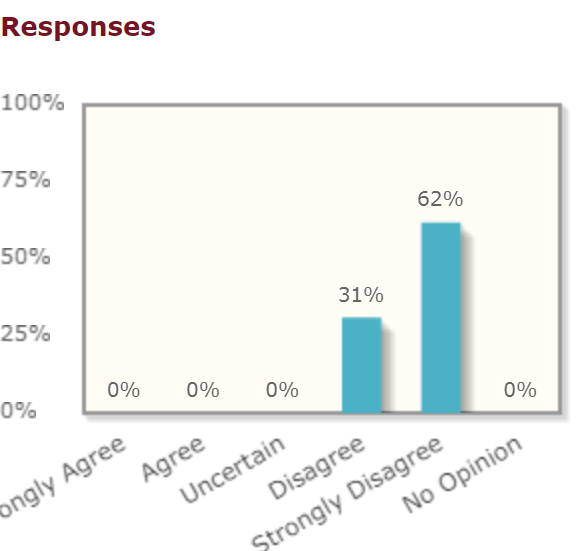
Economists are often accused of having trouble agreeing about anything, but PhD economists are pretty united in opposition to this kind of tariff. The University of Chicago polled elite economists about Trump’s tariff ideas back during the campaign and got universal disagreement with his plan to levy import duties:

Pence wouldn’t impose such an illogical policy. Pence for president in 2018.

Posted in Globalization & International, Pence2018

How to indebt future generations. Borrowing alone does not do it!

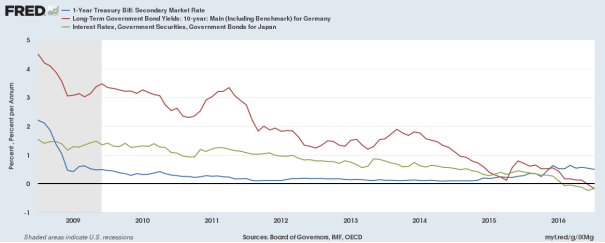
Private investors were begging governments to borrow more money in 2015. Interest rates were extremely low:

Government debt cannot significantly be a significant burden when interest rates are that low. For example, when interest rates are zero, there is no penalty for borrowing at all and all expenditures might as well be debt financed although there must be cash-flow planning for repayment.

Simon Wren-Lewis wrote a confused article worrying about government debt burdening future generations when debt isn’t the problem at all because one person’s debt is another person’s asset. Always. Finance is purely symbolic, not real because all finance is literally created out of nothing and returns to nothing when financial accounts are destroyed. Finances only have an effect on the economy by changing the use of real resources. In Wren-Lewis’s story, he assumes that government debt will decrease the production of capital goods make the future less productive. That is the key issue, not debt. Wren-Lewis doesn’t give any reason to think that government borrowing must cause less production of capital goods. In fact, if government borrowing is used for infrastructure, education, and healthcare, it should increase future productivity and if it also creates a Keynesian multiplier (which was likely during the recession when he was writing), that should increase productivity too.

Any parable that doesn’t show how real resources change is not useful. Financial symbols can have a powerful impact on incentives that do change the use of real resources, but we should keep our focus on the real resources not the financial symbols.

In Wren-Lewis’s story, all government debt that is owed to Americans, which means that the government is committing to tax future generations to pay back future generations. The government cannot indebt future generations of Americans by borrowing from them. The government can only commit to redistribute money in the future. It can commit to impose a net tax on some future Americans to give a net payment to other future Americans. There is always zero net debt because for every debtor there is always a creditor. The future generation cannot be more indebted than the present because total credits must always equal total debts.

This could still be a future burden, but it isn’t a debt burden. It would be a redistribution burden. The future redistribution might cause a problem due to inequality, higher taxes, or lower government services. Borrowing also redistributes resources in the present if it raises interest rates crowding out private business borrowing and by funding present priorities. But none of these problems are an inherent problem of debt per se.  Noah Smith explains how Nick Rowe got this confused too. Some argue that borrowing could cause the government to spend funds unproductively, but if government isn’t spending its funds wisely, then there is going to be lower productivity regardless of whether the money is borrowed or not.

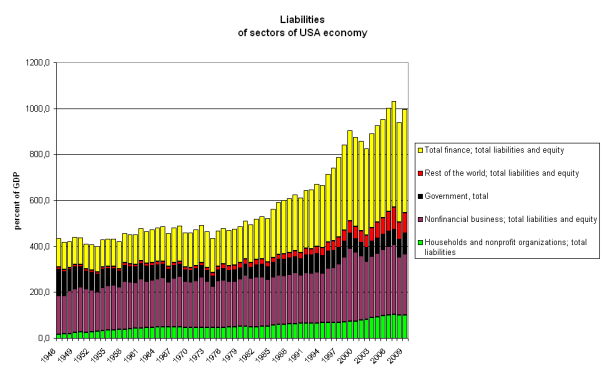
Anyhow, there is no reason to fetishize government borrowing when private borrowing is MUCH bigger according to the Fed’s flow of funds accounts:

Austerians like Peter Fisher believe that a Keynesian stimulus (borrowing) creates present demand by borrowing from future demand.  That is possible because Fisher correctly realizes that a nation can become indebted to foreigners.  But that is the only way and it is very simple.  The rest of Fisher’s rhetoric is gibberish.  It isn’t really a problem of “borrowing from the future” as he claims.  The issue is purely one of borrowing from foreigners.  He says that, “The inter-temporal trade-off of borrowing from the future might make us” worse off in the future because “we might borrow too much if, by increasing indebtedness, we bring too much demand from the future into the present…”

Panos Mourdoukoutas argues that “ultra-low interest rates help “steal” sales from the future” for example by getting people to buy cars earlier that “they would normally buy years later.”  However, when people pay back their borrowed money, someone else will have more money they can spend, so that doesn’t automatically reduce future sales.  It just redistributes the future sales away from today’s borrowers to their lenders who will have more to spend in the future as they get paid back.

The biggest way the present generation is leaving a debt for the future generation is by destroying natural resources.  We are depleting fossil fuels which directly makes the future poorer and using them to create global warming which will also make future generations poorer so that we can boost consumption today.  In the big scheme of things, a graph of history showing the consumption of depletable mineral resources like fossil fuels and helium will peak and get more scarce in the future. Furthermore, global temperature is rising.

Which will cause sea level to eat up land.

That is the kind of thing that will directly impoverish future generations. Other ways we are making future generations poorer are by increasing persistent toxins in the environment like mercury in the ocean which have made tuna and other fish less safe to eat. (Queue the iconic crying Indian commercial.) Future generations will be much more environmentalist than our generation because they will look back at history very differently than the present generation. We look back at history and see resource extraction as increasing our prosperity.  Future generations will look back at the history of resource extraction as indebting their generation to boost past consumption.

Posted in Macro, Public Finance

Keep marriage within the family?

Robin Fox believes that 80% of all marriages in all of history were between second cousins or closer relatives, but that has been changing rapidly since the advent of industrialization. Today, only about 10% of marriages are consanguineous. Little of the change is due to legal prohibitions. Marrying a first cousin is only banned “in China and Taiwan, North Korea, South Korea, the Philippines and 24 of the 50 United States” according to Wikipedia. More likely, cultural changes have caused the legal changes in the few places where it is now banned. A new study gives some additional clues:

Before the Industrial Revolution …you might have ended up married to a fourth cousin. People didn’t travel far to find a spouse, and the closer you were to home, the more likely it was you’d marry within your family. Then, in the late 19th century, something changed, and people stopped marrying their cousins. It has been conventional wisdom that Europeans and North Americans married more outside their families as geographic dispersal ramped up between 1825 and 1875, with the advent of mass railroad travel. But over the same period, the genetic relatedness of many couples actually increased. It wasn’t until after 1875 that partners started to become less and less related.

This 50-year lag might indicate that shifts in social norms played a bigger role than geographic mobility in getting people to wed outside their bloodline. It’s also just one example of the insights that can be gleaned from the world’s largest, scientifically-vetted family tree, presented in a study published on Thursday in Science.

The Economist magazine argues that cousin marriage will have to drop when fertility rates drop due to the mathematical probabilities:

cousin marriage is doomed, if only for demographic reasons. In many countries where it is common, birth rates are plunging. In the early 1980s Pakistan’s fertility rate was 6.4 (meaning that a woman could expect to have that many children during her childbearing years). That number is now thought to have come down to 3.4, and UN demographers expect it to fall to 2.4 by the early 2040s. In Iran, the fertility rate has crashed from 6.5 in the early 1980s to just 1.6.

Two academics, Bilal Barakat and Stuart Gietel-Basten, point out that when women usually have five surviving children, a woman can expect to have 25 male cousins. When the average number of children falls to two, that same woman will have just three male cousins, some or all of whom might be younger than she is, and thus ineligible as marriage partners.

In addition to greater access to more diverse marriage partners due to urbanization and better transportation, and smaller families limiting the possibility of marrying within the family, a third factor is the increasing cosmopolitanism of modern life. People used to be much more tribalistic and that extended towards their attitudes towards marriage. We don’t have many measures of how much people disliked marrying outsiders who are not just like their family except for in the case of inter-racial marriage. Gallop has been tracking that for over a half century and says that it shows “one of the largest shifts of public opinion in Gallup history” Inter-racial marriage was taboo for all but 4% of Americans in 1958 when Gallop began polling about it. It was so taboo it was illegal in 19 states until 1967, when the U.S. Supreme Court ruled that marriage across racial lines was legal. Despite legalization and the civil rights movement, by 1995, 55% of nonblacks still did not approve of inter-racial marriage. That number has shrunken markedly since then, and by 2013, only 16% of non-black Americans did not approve of inter-racial marriage, but that still represented about 50 million Americans who were uncomfortable with marriage between people who were racially different from family.

This map from Matt Zang shows estimates of co-sanguineous marriage (inbreeding) around the globe: Yellow = <1%; Pink = 1%-10%; Green = 10%-50%

Posted in Labor

Naming aspirations

If “A rose by any other name would smell as sweet,” does it matter what names we have? Rafael Cruz thinks so. He is better known by his nickname, Ted Cruz, the 2016 presidential candidate from Texas who prefers a stereotypically Anglo name, Ted, over his given Latino name, Rafael. However, ‘Ted’ Cruz is attacking his challenger, ‘Beto’ O’Rourke, for using the Latino nickname ‘Beto’ which is a common Latino nickname for Robert, the name O’Rourke’s Irish-American parents gave him. ‘Ted’ ran an add making fun of ‘Beto’ for using a nickname that implies a connection with a different ethnicity rather than his legal name.

Names are correlated with race and ethnicity.  Consider this story:

My name is Jamaal; I’m white.

…In a high school soccer game I was called “a white man with a [horrific racial expletive deleted] name”.

In January of 2002 I flew to London.  I was randomly selected for additional passenger screening.  It was me, Muhammad, Abdul, Tariq, and an old white haired lady named Jenny Smith.  Seriously.  I’m not sure what was faster, Jenny Smith’s pat down or the dropping of the TSA agent’s face when I responded to the name Jamaal.

…The most frequently asked question is, “how did you get the name Jamaal?”  I usually say something about a Ouija board or a heated game of Boggle that put my mother into labor.  The letters just sort of fell randomly in that order.  “How did you get the name Jamaal?”

I got my name the same way you did.  Somewhere between birth and leaving the hospital, my parents wrote it on my birth certificate.

…When people have seen my name before they’ve seen my face,  I get “OH – you’re Jamaal.”  It is not uncommon for people to follow up with, “I expected you to be –”and then there’s a pause; a sudden realization they are on the verge of sounding racist.  There’s a look—not quite ‘deer in the headlights’, but it is a definite freeze.  What to say next?  I’ve heard several:  taller, older, different (usually accompanied with an uncomfortable chuckle).

Very few people have the courage to say darker.

Several people have told me that Jamaal is a black name.  It’s not.  It’s an Arabic name.  Arabic is a language, not a color.

…So, no, as a white man… from a small rural town in Southern Oregon with a high school of around 400 and two black and two Hispanic families, I don’t know a lot about race.  I do, however, know a little about stereotyping.

Steven Levitt says:

 People don’t really remember this, but if you go back to the 1960s, blacks and whites basically were giving their kids pretty much the same sets of names, not really very different, a lot of overlap. But within about a seven-year period in the 1970s, names just completely diverged. And among most African Americans now are giving names that virtually no whites have. So what we saw was in a period that really coincides with the Black Power movement and a very strong move away from the initial Civil Rights movement was that names changed completely, and many black parents decided I think that the identity they wanted for their children was one that was distinct from white culture. 

Could it be that somehow black culture was interfering with black economic success? And the difficulty whenever you start talking about things like culture is how do you quantify it? How do you capture what culture means in a way that an economist and data would find it? And so what we settled on was the idea that you could use names as an indicator of culture because you know, the set of names that parents choose are very different for blacks and whites and they also reflect the way that people think about the world.

So the ultimate question we wanted to answer is does your name matter for the economic life that you end up leading? Are people who are quote “saddled” with distinctively black names facing a burden when they enter the labor market?…So wanting to study names and having the right data set are two different things. But we managed to stumble onto an amazing data set that was kept by the state of California. It encompassed the birth certificate of every person born in the state of California between 1960 and the year 2000, and it included the name of the baby, the first and last name, the first and last name of the mother, and the maiden name of the mother, along with a lot of other information about the hospital and the kind of health care the mother had that gave you a hint at some of the economic circumstances. And this turned out to be the absolutely perfect dataset to do what we wanted to do. What we could do is we could match up two young African American girls at birth, say born in 1965, who are born at the same hospital about the same time to a set of parents who on all the data we have look very similar except that one of those sets of parents give their daughter a distinctively black name, like Shaniqua, say, and the other set of parents given their baby a more traditional white name, like Anne or Elizabeth. So what do we do? We follow those girls. We fast-forward say 25 years into the future when those girls grow up in California and have babies, themselves. So from when they give birth we can see what kind of lives they’re leading, whether they have fancy health care, whether they’re married, how old they are when they have babies, things like that. And we get a glimpse into their economic life — not perfect, we certainly don’t know everything about them, but we know certain things about them. And we were able to see something quite remarkable, which is that the name that you were given at birth seemed not to matter at all to your economic life.

In other words, they found that names don’t matter for determining economic outcomes in their dataset.  This is contrary to what most people think.  Even the Freakonomics movie told the opposite story about that chapter of the book!

But other researchers have found that names can make a difference in economic outcomes.  For example, consider the study called “Are Emily and Greg More Employable Than Lakisha and Jamal?” The researchers sent out identical resumes to numerous employers except with one difference.  Half had a white-sounding name, and half had a black-sounding name.  The resumes with white names were about 50 percent more likely to get a callback than the identical resumes where the only difference was a black-sounding name. Levitt goes on to explain it this way:

[When] researchers …take identical resumes and just change the first name so that one name is distinctively black and another name isn’t. And they send those out to employers and see whether there’s a callback. And what they find every time is that if you have a distinctively black name you’re less likely to get a callback. So how can that be reconciled with the fact that in our data, in real life data, how people actually lived, the names didn’t seem to matter? I think the answer comes in a couple different ways. The first is that just because you get a callback doesn’t mean that you’re likely to get a job. So to the extent that there are discriminatory employers out there and those discriminatory employers are using your name to figure out whether or not you’re black, then indeed the worst thing you could possibly do would be to show up for an interview if you are black with a white name and have wasted all day trundling downtown to do the interview for a discriminatory employer who’s not going to hire you anyway. That’s one possibility. The other possibility is that there are two different kinds of labor markets. There’s a sort of formal labor market that involves resumes and applying, and really hardly anybody gets jobs that way, that’s not the typical way people get jobs. And your black name might hurt you in that segment, but it might actually help you in other areas. So you could certainly imagine that within the black community having a distinctively black name would help you get along better with people, signal that you’re part of the community, and might work in your favor in all sorts of informal networks that aren’t captured in these [resume-research] data.

Poor black parents with low education are more likely to give their children distinctively black names, and because poor families with low education have disadvantages that handicap their kids, those kids tend to have disadvantaged outcomes, but Levitt’s research shows that it isn’t due to the effect of their names.

The typical baby girl born in a black neighborhood in 1970 was given a name that was twice as common among blacks than whites. By 1980, she received a name that was 20 times more common among blacks. (Boys’ names moved in the same direction but less aggressively—likely because parents of all races are less adventurous with boys’ names than girls’.) Today, more than 40 percent of the black girls born in California in a given year receive a name that not one of the roughly 100,000 baby white girls received that year. Even more remarkably, nearly 30 percent of the black girls are given a name that is unique among every baby, white and black, born that year in California. (There were also 228 babies named Unique during the 1990s alone, and one each of Uneek, Uneque, and Uneqqee; virtually all of them were black.)

 What kind of parent is most likely to give a child such a distinctively black name? The data offer a clear answer: an unmarried, low-income, undereducated, teenage mother from a black neighborhood who has a distinctively black name herself. Giving a child a super-black name would seem to be a black parent’s signal of solidarity with her community—the flip side of the “acting white” phenomenon. White parents, meanwhile, often send as strong a signal in the opposite direction. More than 40 percent of the white babies are given names that are at least four times more common among whites.

…The data show that, on average, a person with a distinctively black name—whether it is a woman named Imani or a man named DeShawn—does have a worse life outcome than a woman named Molly or a man named Jake. But it isn’t the fault of his or her name. If two black boys, Jake Williams and DeShawn Williams, are born in the same neighborhood and into the same familial and economic circumstances, they would likely have similar life outcomes. But the kind of parents who name their son Jake don’t tend to live in the same neighborhoods or share economic circumstances with the kind of parents who name their son DeShawn. And that’s why, on average, a boy named Jake will tend to earn more money and get more education than a boy named DeShawn. DeShawn’s name is an indicator—but not a cause—of his life path.

Steven Levitt’s research concludes that names have no measurable effect upon destiny as he illustrates with this anecdote:

in 1958, a New York City father named Robert Lane decided to call his baby son Winner. ….this boy—well, Robert Lane apparently had a special feeling about him. Winner Lane: How could he fail with a name like that?

Three years later, the Lanes had another baby boy, their seventh and last child. For reasons that no one can quite pin down today, Robert decided to name this boy Loser. Robert wasn’t unhappy about the new baby; he just seemed to get a kick out of the name’s bookend effect. First a Winner, now a Loser. But if Winner Lane could hardly be expected to fail, could Loser Lane possibly succeed?

Loser Lane did in fact succeed. He went to prep school on a scholarship, graduated from Lafayette College in Pennsylvania, and joined the New York Police Department, where he made detective and, eventually, sergeant. Although he never hid his name, many people were uncomfortable using it. To his police colleagues today, he is known as Lou.

And what of his brother? The most noteworthy achievement of Winner Lane, now in his late 40s, is the sheer length of his criminal record: more than 30 arrests for burglary, domestic violence, trespassing, resisting arrest, and other mayhem.

Levitt’s book, Freakonomics, also tell about how parents pick names:

California names data tell a lot of stories… Broadly speaking, the data tell us how parents see themselves—and, more significantly, what kind of expectations they have for their children. Here’s a question to begin with: where does a name come from, anyway? Not, that is, the actual source of the name—that much is usually obvious: there’s the Bible, there’s the huge cluster of traditional English and Germanic and Italian and French names, there are princess names and hippie names, nostalgic names and place names.

Increasingly, there are brand names (Lexus, Armani, Bacardi, Timberland) and what might be called aspirational names. The California data show eight Harvards born during the 1990s (all of them black), fifteen Yales (all white), and eighteen Princetons (all black). There were no Doctors but three Lawyers (all black), nine Judges (eight of them white), three Senators (all white), and two Presidents (both black). Then there are the invented names.

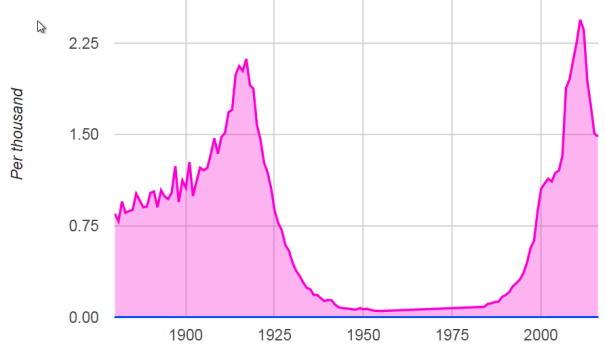
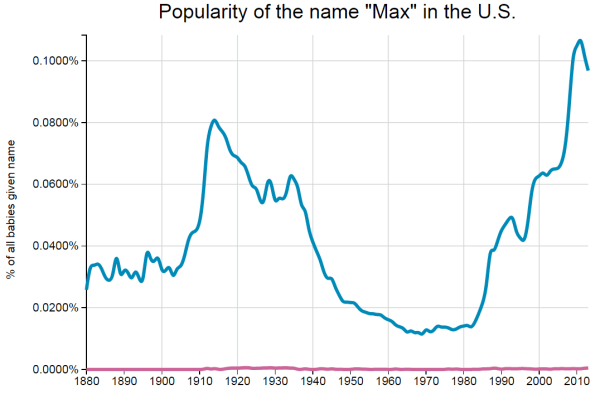
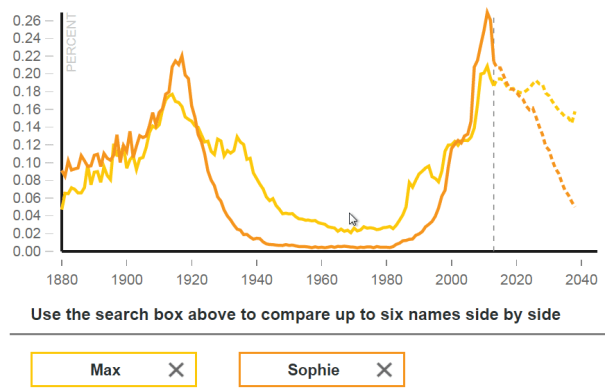
Roland G. Fryer Jr., while discussing his names research on a radio show, took a call from a …woman who was upset with the name just given to her baby niece. It was pronounced shuh-TEED but was in fact spelled “Shithead.” Or consider the twin boys OrangeJello and LemonJello,… whose parents further dignified their choice by instituting the pronunciations a-RON-zhello and le-MON-zhello. OrangeJello, LemonJello, and Shithead have yet to catch on among the masses, but other names do. How does a name migrate through the population, and why? Is it purely a matter of zeitgeist, or is there some sensible explanation? We all know that names rise and fall and rise—witness the return of Sophie and Max from near extinction—but is there a discernible pattern to these movements? The answer lies in the California data, and the answer is yes. Among the most interesting revelations in the data is the correlation between a baby’s name and the parent’s socioeconomic status.

The rest of the chapter basically explains that most parents want to distinguish their kids by giving them a name that sounds prosperous and successful. Poorer families do this by copying the names of rich kids, and when rich families see poor families using names, they start looking for new names that sound more sophisticated than the names that are getting copied by the middle class and poor people.  It is a bit like the way elite clothing fashion changes.  As Levitt says:

one of the most predictable patterns when it comes to names is that almost every name that becomes popular starts out as a high class name, or a high-education name. So in these California data we had we could see the education level of the parents. And even the names that eventually become the quote “trashiest” kinds of names, so the Tiffanys and the Brittanys, and I’ll probably get myself in trouble, and the Caitlyns and things like that start at the top of the income distribution, and over the course of 20, or 30, or 40 years they migrate their way down becoming more and more popular among the less-educated set. And as names become popular among the less-educated, the higher-educated parents absolutely abandon these names and don’t want anything to do with them.

Below is data from NameTrends.net showing the rise and fall and rise again in popularity of the name Sophie, as mentioned in the text above.

You can make your own graphs at Baby Name Voyager, and elsewhere. Below shows the trends for the name Max on a site by Randy Olson.

Time Magazine even has a Baby Name Predictor that uses statistical data to predict how popular names will be in the future, but it hasn’t been updated since 2013. It predicts a steady decline for both Max and Sophie:

In case you are curious, ABC gave the list of the whitest and blackest names from Levitt’s paper.  They determined the list by correlating names and race and these names had the highest correlation:

20 “Whitest” Girl Names

  1. Molly
  2. Amy
  3. Claire
  4. Emily
  5. Katie
  6. Madeline
  7. Katelyn
  8. Emma
  9. Abigail
  10. Carly
  11. Jenna
  12. Heather
  13. Katherine
  14. Caitlin
  15. Kaitlin
  16. Holly
  17. Allison
  18. Kaitlyn
  19. Hannah
  20. Kathryn

“Blackest” Girl Names

  1. Imani
  2. Ebony
  3. Shanice
  4. Aaliyah
  5. Precious
  6. Nia
  7. Deja
  8. Diamond
  9. Asia
  10. Aliyah
  11. Jada
  12. Tierra
  13. Tiara
  14. Kiara
  15. Jazmine
  16. Jasmin
  17. Jazmin
  18. Jasmine
  19. Alexus
  20. Raven

“Whitest” Boy Names

  1. Jake
  2. Connor
  3. Tanner
  4. Wyatt
  5. Cody
  6. Dustin
  7. Luke
  8. Jack
  9. Scott
  10. Logan
  11. Cole
  12. Lucas
  13. Bradley
  14. Jacob
  15. Garrett
  16. Dylan
  17. Maxwell
  18. Hunter
  19. Brett
  20. Colin

“Blackest” Boy Names

  1. DeShawn
  2. DeAndre
  3. Marquis
  4. Darnell
  5. Terrell
  6. Malik
  7. Trevon
  8. Tyrone
  9. Willie
  10. Dominique
  11. Demetrius
  12. Reginald
  13. Jamal
  14. Maurice
  15. Jalen
  16. Darius
  17. Xavier
  18. Terrance
  19. Andre
  20. Darryl
Posted in Discrimination, Labor

The mistaken libertarian/anarchist theology underpinning bitcoin and other blockchain currencies

Ian Bogost writes that Cryptocurrency Might be a Path to Authoritarianism. You should read the full article for full effect, but he says that “Extreme libertarians built blockchain to decentralize government and corporate power,” but he warns that blockchain could do the reverse and consolidate government control over our lives instead.

Bitcoin is hard to grasp because it’s almost like a technology from an alien civilization. …Making sense of it first requires deciphering the [alien] political assumptions that inspire it.

Bitcoin is an expression of extreme technological libertarianism. This school of thought goes by many names: anarcho-capitalism [or ancap], libertarian anarchy, market anarchism. Central to the philosophy is a distrust of states… Its adherents believe society [is] best …in a free-market economy driven by individual property owners—not governments or corporations—engaging in free trade of that private property.

Anarcho-capitalism is far more extreme than Silicon Valley’s usual brand of technological individualism… The ancap worldview only supports sovereign individuals engaging in free-market exchange. Neither states nor corporations are acceptable intermediaries. …currency troubles market anarchists. The central banks that control the money supply are entities of the state. Financial payment networks like Visa are corporations, which aren’t much better. That’s where Bitcoin and other cryptocurrencies enter the picture. They attempt to provide a technological alternative to currency and banking that would avoid tainting the pure individualism of the ancap ideal.

This makes Bitcoin’s design different from other technology-facilitated payment systems, like PayPal or Apple Pay. Those services just provide a more convenient computer interface to bank accounts and payment cards. For anarcho-capitalism to work in earnest, it would need to divorce transactions entirely from the traditional monetary system and the organizations that run it. Central banks and corporations could interfere with transactions. And yet, if individuals alone maintained currency records, money could be used fraudulently, or fabricated from thin air.

To solve these problems, Bitcoin is backed by mathematics instead of state governments. The Bitcoin “blockchain” is a shared, digital record of all the transactions (or “blocks”) that have ever been exchanged. …the key to Bitcoin is that the network distributes copies of one common record of all Bitcoin transactions, against which individuals verify new exchanges. This record is the blockchain, which is sometimes also called the “distributed ledger”….

But Bitcoin’s success has accidentally undermined its viability. Each Bitcoin transaction adds more encrypted data to the blockchain, requiring increasingly more computer power to verify (and to earn the associated commission). More computing power means more energy cost to run and cool the machines, which requires more capital and physical infrastructure to support. Those rising [fixed] costs inspire centralization. Adam Greenfield tells me that two Chinese giants can control over half of the global Bitcoin mining operations. If they collaborate, a majority-control of the blockchain could allow them to manipulate it. That’s precisely the risk a decentralized currency was meant to avoid.

…The same hype driving cryptocurrency speculation has also attracted banks, governments, and corporations—exactly the authorities it was designed to circumvent. Financial services firms have taken an interest in cryptocurrency. Federal Reserve chair Janet Yellen has called for the Fed to leverage blockchain. Canada has been experimenting with a blockchain-backed version of its national currency, called CAD-Coin. Future cryptocurrencies operated by banks or governments might enjoy more productive use than Bitcoin.

But those futures also undermine cryptocurrency’s ancap aspirations. Corporations and governments re-centralize control, for one. But also, they undermine the discretion and anonymity that accompanies free trade in the ancap fantasy. When the local or central bank manages the cryptocurrency platform, it also gets a record of every transaction that takes place in that economy. One doesn’t need to be an anarchist to surmise potential downsides of that situation. Picture China mandating state cryptocurrency, tying the country’s proposed social credit system to that ledger. Or imagine if the North Carolina State legislature decided to issue all food stamp vouchers in crypto form to better manage their future use.

…[The blockchain revolution of society] only works if the entire system of contemporary life becomes sufficiently interconnected to make it possible. All the departments of public health and the DMVs and the voter registration venues—not to mention the parking spaces and the automobiles and the power grids and all the rest—would have to cohere around a common understanding, so that the machines could execute smart contracts on their behalf. This would require a complete reinvention of public and private life.

A different reinvention is more likely. Instead of defanging governments and big corporations, the distributed ledger offers those domains enormous incentive to consolidate their power and influence. For people like Eddie Lee Holloway, Jr, who’s African American, that might mean even greater exclusion, as the very institutions that locked him out of the voting booth might suppress his transformation into a digital-ledger citizen in the first place.

Or if not, other traumas might yet face citizens like Holloway in a society run by blockchain. A mandated DNA-test could accompany citizens’ blockchainification, allowing their ethnic origins and medical predispositions to become attached to an identity record. Financial assets would also be connected, thanks to an underlying cryptocurrency account through which they make debits and credits. Not to mention all the personal insights already consolidated by services like Facebook.

Businesses might subscribe to this data. Thanks to distributed ledger, it could be used to prevent their automated doors from opening for people whom a smart-contract risk-assessment service rates below a threshold of desirability. Left outside, privately-contracted security robots might deploy ledger-backed ID scanners to sweep loiterers from private property. Once delivered and booked into jails, smart courts could automate sentences based on an automated assessment of future crime potential.

And that’s just America. Imagine how a mature authoritarian state would fare under the rule of blockchain. …For Adam Greenfield, the anti-authoritarian left has profoundly misunderstood the corner into which such an ambitious aspiration paints society. “I believe distributed ledger enables the kind of central control they’ve never in their worst nightmares contemplated,” he tells me. The irony would be tragic if it weren’t also so frightening. The invitation to transform distributed-ledger systems into the ultimate tool of corporate and authoritarian control might be too great a temptation for human nature to forgo.

There are several problems with the anarchist dreams for blockchain. First is that the technology doesn’t actually work very well yet. It is highly inefficient and that inefficiency means that hardly anybody doing legitimate transactions has an incentive to use it. Secondly, the main anarchist goal is to replace central banks like the Fed, because they are the main central planners of capitalism and ideologically anathema to libertarians because these government institutions actually control the value of money (inflation) and the rental price of money (interest rates) as well as being the only government agency that is directly responsible for keeping unemployment low. Unfortunately for libertarians, blockchain currencies like bitcoin are EXTREMELY bad at monetary policy. Nobody has figured how a blockchain currency could follow some sort of Taylor rule even in theory, and they fail worse than any monetary system in history to maintain stable prices in neither the short run (like most modern fiat currencies) or in the long run (like currencies under the gold standard) in which inflation should be close to zero.

A huge problem for libertarians is the fact that the distributed ledger of Bitcoin keeps track of every single purchase that you make. For the first time in history, blockchain technology makes it possible to accurately track every single transaction for every single person in the economy. That would be extremely useful for an authoritarian government.  At the very least, it will be a very powerful tool for the taxman just like getting people to rely on banking is crucial for income taxation.  There are workarounds, but governments will be extremely tempted to use this power of blockchain. At this point the identity of each bitcoin user can begin anonymously, but as soon as the government finds someone’s bitcoin identity, they immediately know the precise details of every transaction made using that identity.

Finally, and most importantly, there is a need for a monopoly on the legitimate use of violence in society. No anarchist has even come close to solving that problem.  Everyone in every society is better off when violence is managed well, and capitalist society is no exception.  Capitalism is dependent upon coercion because capital requires property rights. A property right is the right to exclude someone else from doing something which requires force.  Capital is wealth and in every society that has wealth beyond a basic minimum of subsistence, government naturally assumes a monopoly on violence.  We will always have government in every prosperous society. Prosperity requires coercion and blockchain doesn’t change need to manage coercion at all. If anything, new blockchain technologies will give governments even more power over the everyday economic affairs of ordinary people than governments have ever had before in all of history.  This technological marvel can grant new superpowers to governmental and/or corporate central planners.  Let’s hope that they manage these new capabilities for the benefit of most people rather than just the few at the top.

Posted in Macro, Public Finance

Enter your email address to follow this blog and receive notifications of new posts by email.

Join 75 other subscribers
Blog Archive
Pages