The danger of the linear-thinking fallacy and the diminishing marginal utility of alcohol consumption

Unlike most elites, Charles Wheelan freely admits that he was “born on third base.” Although he probably inherited less than celebrities like Donald Trump or Bill Gates, Wheelan was born into a stable family that could afford to send him to an elite high school and then an ivy league college. When you are born in privilege like these people, there aren’t many things that can knock your life out of privilege, but illness is the most common reason. The illness that should be the easiest to prevent is the one that killed Donald Trump’s older brother: substance abuse. As Wheelan said,

…alcohol abuse is one of the things that can seriously derail the lives of otherwise privileged people… at Dartmouth and most other college campuses, binge drinking is the most serious social issue. 

The Harvard Study of Adult Development has followed Harvard sophomores for 70 years starting in 1937. It found that alcohol abuse was the most common way for this privileged group to lose socioeconomic status.

This is because most youths (especially wealthier youths) are not very rational in their use of alcohol.  People in their late teens and early 20s have the highest hazard rate for alcoholism, so it is a problem, but there are ways to moderate the risk.  First, people should only use the minimum effective dose for any drug.  Many college students still haven’t figured out that more is not always better.  Binge drinking shortens life expectancy for all ages and increases risk of alcoholism.   Alcohol companies love drinking games that result in binge drinking because they rely on alcoholics for most of their revenues.  Everything eventually hits diminishing marginal utility including alcohol, but many youths get too drunk to notice when drinking more is producing more harm than benefit.  Lifehacker recommends making a plan while sober to limit consumption to two drinks because that reduces risks of harm and it is easier to avoid accidental overconsumption if you make a plan while sober than if you wait to decide until after your judgement has already been compromised by a couple drinks.  This is part of the “mindful drinking” movement.

Youths are the most prone to mindless drinking of any age group. They have more problems with binge drinking and its problems than people over age 25 partly because of the linear thinking fallacy.  This is the overwhelming tendency for people to extrapolate from an experience and think that because one drink feels good and two drinks feels better then ten drinks must feel way better than two drinks.  That fallacy leads to vomiting, blackouts, injuries, violence, and six Americans dying of alcohol-poisoning every day

This is the mental model many youths unthinkingly have in their heads:

More alcohol always means more fun?

This is because the easiest way to think is linear when in reality, all consumption, including technology, eventually exhibits diminishing marginal utility as consumption increases. The real relationship between drinking and fun looks something like this:

Reality: diminishing marginal utility of alcohol.


This is the standard medical model for describing the effect of any drug, known as the dose–response or exposure–response relationship. Contrary to the bunk of homopathy, as any drug dose approaches zero, it’s clinical effect also approaches zero. For example, when someone drinks a quarter of a beer, his brain won’t feel much effect of the alcohol (although there can be a significant placebo effect). Then, there is increasing marginal effect as the dosage increases and the next half beer can have, perhaps, ten times more psychoactive effect.

But as with any drug, diminishing marginal benefit kicks in as dosage continues growing and the positive clinical effect eventually plateaus. Unfortunately, the negative side effects generally continue to rise after positive effect stops growing which causes the net benefit (labeled “fun” in this case) to decline with excessive dosage.

The scaling will differ for different people, but for most people a third drink gives little immediate benefit over two drinks and should be avoided because it causes long-term health problems that probably exceed whatever short-term marginal benefit there may be. And by the fifth or sixth drink, many youths can expect to regret a hangover, vomiting, elevated accident risk, and social regrets. A few more drinks beyond that can lead to immediate death from alcohol poisoning, so the marginal utility of alcohol clearly becomes negative at some point when people drink too much. An average of six Americans dies from alcohol poisoning every day.

Most youths are too inexperienced with alcohol (and other drugs) to realize that the benefits stop rising with increased consumption whereas the costs of drinking continue to rise exponentially. And once people get inebriated, they are no longer good at making rational decisions and analyzing concepts like the diminishing marginal utility of alcohol.

Addiction theory advises against routinely using any addictive drug and against bingeing on large does because these behaviors increase the body’s desire to consume more partly because they shift the curve to the right and make small doses less effective while increasing the desire for larger doses.  That is addiction. Days of fasting between doses (and smaller doses) help reset the body’s defenses and reduce tolerance so that small doses recover their effectiveness.  

My main worry with marijuana legalization is that it will make marijuana use routine enough to cause a large increase in addiction.  Right now marijuana rarely causes addiction, but that might be due to the fact that very few people ever use Marijuana enough times to pass the threshold where it alters their brain structures enough to produce addiction. In the past, very few Americans have ever used it 100 times in their lifetimes and that was partly because it was illegal, and so most people never found enough space in their lives where it was socially acceptable to use it routinely enough to become addicted.  Of the people who have used marijuana more than 100 times, it has higher self-reported rates of problems than for people who have used alcohol more than 100 times, so as casual usage patterns change, we might discover that marijuana is much more addictive than alcohol. The research just isn’t clear yet.

Plus, the hazard rate for addiction is much higher for youths than for older adults.

“The younger you are, the more vulnerable your brain is to developing these problems,” Dr. Levy said. Youths are also more likely to become addicted when they start using marijuana before the age of 18, according to the Substance Abuse and Mental Health Services Administration. Furthermore, there is growing evidence that cannabis can alter the brain during adolescence, a period when it is already undergoing structural changes.

It is clear that higher doses of marijuana are more likely to produce unpleasant side effects.

Furthermore, the potency of marijuana has been skyrocketing. In 1972, the average THC content of marijuana was less than 1%. Now it is MUCH higher:

A study by ElSohly et al., published in Biological Psychiatry in April 2016, looked at changes in cannabis potency from 1995 to 2014… The team found that marijuana had an average potency of 4% THC in 1995…. [They] found a noticeable increase in the amount of sinsemilla found in the cannabis they tested in the early 2000s. By 2014, the average THC content had risen to 12%… Today, it is normal to find marijuana with a THC content of over 20%. There are samples with a recorded THC level of over 30%, which is insanely high… Apparently, the average THC in Colorado weed is 18.7%! Expert Jonathan Page from the University of British Columbia says he doesn’t pay much attention to strains with an apparent THC of over 28%. In his opinion, these results are either faulty or based on the fact that breeders add extra cannabinoids to the strain to make it stronger.

In case you didn’t understand what it means to add extra cannabinoids, that means that chemists are cheaply synthesizing novel compounds that are cousins of THC and breeders are adding them to marijuana in order to get more bang for the buck. There are thousands of types of artificial cannabinoids and nobody knows what effect they will have. Plus, illegal drug dealers are doping their dope with (hopefully) trace amounts of fentanyl to cheaply increase it’s kick. Some marijuana products advertise THC levels exceeding 95%.

Furthermore, CBD levels are dropping at the same time. According to one marijuana aficionado, the best ratio of THC:CBD is 1:1, but that is rare today:

the THC:CBD ratio went from 14:1 to 80:1 within 20 years. This has major repercussions when it comes to analyzing the potency of marijuana.

The higher the THC:CBD ratio, the higher their addictiveness. Today’s ‘marijuana’ products, “are as close to the cannabis plant as strawberries are to frosted strawberry pop tarts.”

Nobody in the public health establishment feels that alcohol consumption has any possible net health benefit for college-age people, but for people over age 65, the costs and benefits are different and there is some disagreement.  Alcoholism is going to have a much smaller harm after retirement. One the predictions of the theory of rational addiction is that old people should get addicted at high rates because their life expectancy is so short that it doesn’t matter as much if alcoholism eventually messes up the rest of their lives.

Small amounts of alcohol can even protect against cardiovascular disease which is the main killer of old Americans.   This is the kind of research that alcohol companies love to fund, so you might take it with a grain of salt.  But the heart-protective benefits of alcohol only work for people with a significant risk of heart disease.  People younger than 30 don’t have significant heart disease risk, and even moderate alcohol consumption raises the incidence of lots of other illnesses including cancer, so there is zero net health benefit for young people.  Accidents are the main cause of death among college students and alcohol is the biggest contributor.   Although alcohol use is down considerably among American youths, older people are abusing more.  German Lopez reports that alcohol deaths are a large and growing problem:

alcohol deaths

According to new data from the Centers for Disease Control and Prevention, after controlling for age, the alcohol-induced death rate reached 8.5 per 100,000 people in 2014, up from 7.1 in 1999 and 7 in 2006.
As a result, nearly 31,000 people died by alcohol in 2014, up from 22,000 in 2006. That means more people died to alcohol in 2014 than the nearly 29,000 who died from opioid — including heroin — overdoses, but fewer than the nearly 34,000 who died to gun violence or car crashes that same year.
Still, the 2014 data likely under-counts alcohol-related deaths, since it only includes deaths induced directly by alcohol, like liver cirrhosis. It doesn’t include deaths from drunk driving, other accidents, and homicides committed under the influence (alcohol is linked to 40 percent of violent crimes). Counting those deaths, alcohol’s death toll in the US reached 88,000, according to the CDC — and that’s before accounting for the recent rise in alcohol-induced deaths shown in the chart above. All together, this puts alcohol behind only tobacco, which is by far the deadliest drug in the US, in terms of total drug deaths.
...Why are alcohol-induced deaths on the rise?
…For one, Americans are drinking more. According to the latest National Survey on Drug Use and Health, the number of Americans who reportedly drank in the previous month slightly increased as alcohol-induced deaths did: from 51 percent of all persons 12 and older in 2006, when deaths began to climb, to 52.7 percent in 2014.
…But why are people drinking more? …alcohol is more affordable than ever: According to a 2013 study…as a result of rising incomes and falling prices, alcohol is more affordable than it has been in 60 years. And …most US alcohol taxes aren’t indexed for inflation.
…[Secondly, the] opioid painkiller and heroin epidemic could have made alcohol deadlier. When taken together, alcohol and opioids interact to intensify each other and make each other more dangerous. So it’s possible that alcohol deaths rose as more people used — and died from — opioids throughout the 2000s, and many of those deaths [may have been] counted as alcohol-induced deaths in the CDC data.
Another factor could be greater use of the anti-anxiety medication, benzodiazepine. …these drugs were prescribed more and more throughout the 2000s. Since benzos can intensify alcohol’s effects, it’s possible they [caused] more alcohol-induced deaths in the same way opioids might have.
…Many, many studies, for example, have found benefits from a much higher alcohol tax. A recent review of the research from David Roodman, senior adviser for the Open Philanthropy Project, made a case for a higher alcohol tax:
“[H]igher prices… cause less drinking. A rough rule of thumb is that each 1 percent increase in alcohol price reduces drinking by 0.5 percent. …I estimate …a 10 percent price increase would cut the [cirrhosis] death rate 9-25 percent. For the US in 2010, this represents 2,000-6,000 averted deaths/year.”
…So for the US, boosting alcohol prices 10 percent could save as many as 6,000 lives each year. To put that in context, paying about 50 cents more for a six-pack of Bud Light could save thousands of lives. And this is a conservative estimate, since it only counts alcohol-related liver cirrhosis deaths — the number of lives saved would be [almost three times] higher if it accounted for deaths due to alcohol-related violence and car crashes.

This estimate of the social cost of alcohol is still too conservative because it doesn’t count alcoholism-related crime, accidents, lost productivity, and family breakdown.  Alcohol also causes a lot of domestic abuse that is left out of the numbers above because it falls short of murder.

A 10% increase in alcohol prices causes about a 5% decrease in alcohol consumption.  That is because alcohol is addictive and so its demand is inelastic.  Even so, a mere 5% reduction in alcohol use reduces the number of alcohol deaths by a large amount (up to 20%) because of the diminishing marginal utility of alcohol.  The marginal social utility of excessive drinking is negative, so a small reduction has a big benefit.  If everyone only drank one drink of alcohol per day, alcohol wouldn’t be a significant problem and it might even increase average life expectancy because of the reduction in heart-attack risk for people over 30.  Unfortunately, alcohol is addictive and it is hard for people to have one drink everyday without wanting more and more over time.  Excessive drinking causes most of the deaths and it only takes a little decrease in consumption to save most of the lives.

An increase in alcohol price can help people avoid excessive drinking because it has a bigger impact on the problem drinkers than on more responsible drinkers.  Someone who only drinks one beer per day is going to be impacted 1/10th as much as an alcoholic who drinks ten beers per day.  Because the budgetary impact on problem drinkers is ten times bigger than on responsible drinkers, the problem drinkers cut back the most in response to a price rise and and that is where a bit less drinking is most likely to save lives (primarily their own).

A big objection to alcohol taxes is fairness. They are very regressive because low-income people (and people at the median) pay a much higher percentage of their income as alcohol taxes than rich people. But alcohol taxes arguably benefit non-rich people more because they give us a greater incentive to avoid excessive drinking.   Rich drunks don’t care as much about a 50-cent increase in the price of a six pack and will keep drinking and dying despite the price increase.


Posted in Labor, Public Finance

Noblesse Oblige

Spider-man has often spoken the moral principle that power brings responsibility.

6281439715_76c015b13b_o

Clint Hamada CC BY NC

 This moral principle is rarely taught in moral philosophy, but it is an important idea that was the basis for the principle of noblesse oblige.  That was the principle that the powerful people of society (the nobility) had an obligation to serve their people.  Luke Froeb’s Managerial Economics textbook seems to mock this idea, but it is in the Bible and it is one of the most important concepts for making a just society.  Luke 12:48 says: “To whomever much is given, of him will much be required; and to whom much was entrusted, of him more will be asked.”

There are two main ways to define power: power to make other people do things and the power to do things on one’s own.  In the rare case in which actions have no externalities on other people, the latter kind of power does not necessarily bring responsibility, but any power that affects others brings a noblesse oblige.

One of my favorite professors in college, Kesho Scott, said that racism is a form of power and when minorities don’t have power, they cannot be racist.  I agree in theory, but every person has some amount of power over every other person they relate to.  The IAT test shows that almost everyone has racist tendencies and everyone has a responsibility to counter it.  But she was correct in her moral sentiment because people with more power have more responsibility.  For example, both slaves and slave owners probably harbored some racist animosity, and the slaves would have much greater cause for it than the owners since the owners got a lot more benefit from the slaves than vice versa.  But the slaves’ racist attitudes weren’t the problem that caused racial injustice.  Only the owners’ racism was a problem.

Similarly, being part of a majority group creates power which also creates a responsibility to be more careful than people in a minority group.  For example, a minority group is likely to experience more racism than people in a majority even if everyone has the same likelihood of being racist, so the majority should put more effort into reducing their racism because a minority inherently has less power.

As Sebastian Junger wrote:

“For most of human history, freedom had to be at least suffered for if not died for. That raised its value to something almost sacred. In modern democracies, however, an ethos of public sacrifice is rarely needed because freedom and survival are more or less guaranteed… The idea that we can enjoy the benefits of society while owing nothing in return is literally infantile. Only children owe nothing.”

In 1946 Viktor Frankl wrote that responsibility should be celebrated just as much as freedom:

“Freedom, however, is not the last word. Freedom is only part of the story and half of the truth. Freedom is but the negative aspect of the whole phenomenon whose positive aspect is responsibleness. In fact, freedom is in danger of degenerating into mere arbitrariness unless it is lived in terms of responsibleness. That is why I recommend that the Statue of Liberty on the East Coast be supplemented by a Statue of Responsibility on the West Coast.”

Posted in Discrimination

To Trade Is Human

What makes humans different from animals?  Anthropologists used to say that humans are unique in using tools (but it turns out that many animals use tools).  Linguists used to think that language is unique to humans (but other animals have demonstrated pretty sophisticated language abilities too).  Adam Smith thought that trade is uniquely human:

Nobody ever saw a dog make a fair and deliberate exchange of one bone for another with another dog. Nobody ever saw one animal by its gestures and natural cries signify to another, this is mine, that yours; I am willing to give this for that.

It turns out that animals do trade, but humans learned to do it much more extensively than other animals starting about 45,000 years ago.  The Wall Street Journal summarized the work of some economic historians who argue that the invention of trade was the reason that puny humans were suddenly able to take over the world:

Nothing seems to explain the sudden takeoff of the last 45,000 years—the conversion of just another rare predatory ape into a planet dominator with rapidly progressing technologies. Once “progress” started to produce new tools, different ways of life and burgeoning populations, it accelerated all over the world, culminating in agriculture, cities, literacy and all the rest. Yet all the ingredients of human success—tool making, big brains, culture, fire, even language—seem to have been in place half a million years before and nothing happened. Tools were made to the same monotonous design for hundreds of thousands of years and the ecological impact of people was minimal. Then suddenly—bang!—culture exploded, starting in Africa. Why then, why there? The answer lies in a new idea, borrowed from economics, known as collective intelligence: the notion that what determines the inventiveness and rate of cultural change of a population is the amount of interaction between individuals….
Scientists have so far been looking for the answer to this riddle in the wrong place: inside human heads. Most have been expecting to find a sort of neural or genetic breakthrough that sparked a “big bang of human consciousness,” an auspicious mutation so that people could speak, think or plan better, setting the human race on the path to continuous and exponential innovation.  But the sophistication of the modern world lies not in individual intelligence or imagination. It is a collective enterprise. Nobody—literally nobody—knows how to make the pencil on my desk …let alone the computer on which I am writing…
We tend to forget that trade and urbanization are the grand stimuli to invention, far more important than …individual genius. It is no coincidence that trade-obsessed cities—Tyre, Athens, Alexandria, Baghdad, Pisa, Amsterdam, London, Hong Kong, New York, Tokyo, San Francisco—are the places where invention and discovery happened. Think of them as well-endowed collective brains. Trade also gave way to centralized institutions…
Agriculture was invented where people were already living in dense trading societies….
Go even further back and you find the same thing. The explosion of new technologies for hunting and gathering in western Asia around 45,000 years ago, often called the Upper Paleolithic Revolution, occurred in an area with an especially dense population of hunter-gatherers—with a bigger collective brain. Long before the ancestors of modern people first set foot outside Africa, there was cultural progress within Africa itself, but it had a strangely intermittent, ephemeral quality: There would be flowerings of new tool kits and new ways of life, which then faded again….
Trade is to culture as sex is to biology. Exchange makes cultural change collective and cumulative. It becomes possible to draw upon inventions made throughout society, not just in your neighborhood. The rate of cultural and economic progress depends on the rate at which ideas are having sex.
Dense populations don’t produce innovation in other species. They only do so in human beings, because only human beings indulge in regular exchange of different items among unrelated, unmated individuals and even among strangers. So here is the answer to the puzzle of human takeoff. It was caused by the invention of a collective brain itself made possible by the invention of exchange.
Once human beings started swapping things and thoughts, they stumbled upon divisions of labor, in which specialization led to mutually beneficial collective knowledge. Specialization is the means by which exchange encourages innovation: In getting better at making your product or delivering your service, you come up with new tools. The story of the human race has been a gradual spread of specialization and exchange ever since: Prosperity consists of getting more and more narrow in what you make and more and more diverse in what you buy. Self-sufficiency—subsistence—is poverty….
This theory neatly explains why some parts of the world lagged behind in their rate of cultural evolution after the Upper Paleolithic takeoff. Australia, though it was colonized by modern people 20,000 years earlier than most of Europe, saw comparatively slow change in technology and never experienced the transition to farming. This might have been because its dry and erratic climate never allowed hunter-gatherers to reach high enough densities of interaction to indulge in more than a little specialization.
Where population falls or is fragmented, cultural evolution may actually regress. A telling example comes from Tasmania, where people who had been making bone tools, clothing and fishing equipment for 25,000 years gradually gave these up after being isolated by rising sea levels 10,000 years ago. Joe Henrich of the University of British Columbia argues that the population of 4,000 Tasmanians on the island constituted too small a collective brain to sustain, let alone improve, the existing technology.
The oldest evidence for human trade comes from roughly 80,000 to 120,000 years ago, when shell beads in Algeria and obsidian tools in Ethiopia began to move more than 100 miles from the sea and from a particular volcano respectively… This first stirring of trade was the most momentous innovation of the human species, because it led to the invention of invention. Why it happened in Africa remains a puzzle, but Steve Kuhn and Mary Stiner of the University of Arizona have argued that for some reason only Africans had invented a sexual division of labor between male hunters and female gatherers—the most basic of all trades….

The process of cumulative innovation… has doubled life span, cut child mortality by three-quarters and multiplied per capita income ninefold—world-wide—in little more than a century.  [This] is driven by ideas having sex. And things like the search engine, the mobile phone and container shipping just made ideas a whole lot more promiscuous still.

The article also argues that Neanderthals disappeared because they didn’t trade.

Neanderthals are now known to have had brains that were bigger than ours and to have inherited the same genetic mutations that facilitate speech as us. Yet, despite surviving until 30,000 years ago, they hardly invented any new tools, let alone farms, cities and toothpaste. The Neanderthals prove that it is quite possible to be intelligent and imaginative human beings (they buried their dead) yet not experience cultural and economic progress.
Further proof that exchange and collective intelligence are the key to human progress comes from Neanderthal remains. Almost all Neanderthal tools are found close to their likely site of origin: they did not trade. In the southern Caucasus, argues Daniel Adler of the University of Connecticut, it is the “development and maintenance of larger social networks, rather than technological innovations or increased hunting prowess, that distinguish modern humans from Neanderthals.

Our ancestors (Homo sapiens) displaced Neanderthal man (Homo neanderthalensis) despite our competitors having tools, speech, larger brains and much stronger bodies.  Jason Shogren agrees that the only advantage our ancestors had over Neanderthal man is that Homo sapiens was much more inclined to trade:

SINCE the days of Adam Smith and David Ricardo, advocates of free trade and the division of labour, …have lauded the advantages of those economic principles. Until now, though, no one has suggested that they might be responsible for the very existence of humanity. But that is the thesis propounded by Jason Shogren, … For Dr Shogren is suggesting that trade and specialisation are the reasons Homo sapiens displaced previous members of the genus, such as Homo neanderthalensis (Neanderthal man), and emerged triumphant as the only species of humanity.
Neanderthal man has had a bad cultural rap over the years since the discovery of the first specimen in the Neander valley in Germany, in the mid-19th century. The “caveman” image of a stupid, grunting, hairy, thick-skulled parody of graceful modern humanity has stuck in the public consciousness. But current scholarship suggests Neanderthals were probably about as smart as modern humans, and also capable of speech. If they were hairy, strong and tough—which they were—that was an appropriate adaptation to the ice-age conditions in which they lived. So why did they become extinct?
Neanderthals existed perfectly successfully for 200,000 years before Homo sapiens arrived in their European homeland about 40,000 years ago, …. But 10,000 years later they were gone, so it seems likely that the arrival of modern man was the cause. The two species certainly occupied more or less the same ecological niche (hunting a wide range of animals, and gathering a similarly eclectic range of plant food), and would thus have been competitors….  according to Dr Shogren’s paper in a forthcoming edition of the Journal of Economic Behaviour and Organisation, it was neither cave paintings nor better spear points that led to Homo sapiens‘s dominance. It was a better economic system.
One thing Homo sapiens does that Homo neanderthalensis shows no sign of having done is trade. The evidence suggests that such trade was going on even 40,000 years ago. Stone tools made of non-local materials, and sea-shell jewellery found far from the coast, are witnesses to long-distance exchanges. That Homo sapiens also practised division of labour and specialisation is suggested not only by the skilled nature of his craft work, but also by the fact that his dwellings had spaces apparently set aside for different uses….  Only in the case of the trading and specialisation variables did they allow Homo sapiens an advantage: specifically, they assumed that the most efficient human hunters specialised in hunting, while bad hunters hung up their spears and made things such as clothes and tools instead. Hunters and craftsmen then traded with one another.
According to the model, this arrangement resulted in everyone getting more meat, which drove up fertility and thus increased the population. Since the supply of meat was finite, that left less for Neanderthals, and their population declined…. the presence of a trading economy in the modern human population can result in the extermination of Neanderthals even if the latter are at an advantage in traditional biological attributes, such as hunting ability.

Recent archaeological evidence from the Olorgesailie Basin site in southern Kenya suggests that some hominoids started trading about 300,000 years ago.  Both trade and technology expanded dramatically during the “upper paleolithic explosion” about 40,000 years ago. The theory mentioned above argues that greater population density caused the flourishing.  Haim Ofek argues that the flourishing of technology was due to the invention of money.  This was also the time when there was a blossoming of symbolic expression like sculpture and cave paintings.  Money is nothing more than a symbolic representation of value and so a culture that widely engages in symbolic artistic representation may also ‘get’ the idea that rare shells are a symbol of value (money) which makes them useful for trading for food or stone tools.

Although Adam Smith was wrong to think that only humans engage in trade, perhaps the use of money really is unique to humans.
Posted in Development, Globalization & International

The Box

thebox

The Economist magazine explains containerization:

[C]ontainers—uniform boxes that can be easily moved between lorry, train and ship—have reshaped global trade over the past few decades. Why…?

Uniform metal containers were invented by Malcom McLean …in 1956. Before then goods were shipped as they had been for centuries. Crammed in to the hold of a ship, loose cargo in wooden crates would be loaded and unloaded by vast crews of dockworkers. The process was unwieldy, unreliable and so slow that ships often spent longer docked than they did at sea. Theft of transported goods was rampant: as an old joke put it, dock workers used to earn “$20 a day and all the Scotch you could carry home.”

Containers changed this in several ways. The price of everything fell…

  • The cost of loading and unloading fell …to $0.16 per tonne to load compared with $5.83 per tonne for loose cargo. …
  • Because containers were packed and sealed at the factory, losses to theft plummeted, which in turn drastically reduced insurance costs.
  • More could also be loaded: in 1965 dock labour could move only 1.7 tonnes per hour onto a cargo ship; five years later they could load 30 tonnes in an hour.
  • As a consequence, ships could get bigger and more efficient while still spending less time in port.
  • As containers made inland distribution by train and lorry easier, ports became bigger and fewer in number. (In 1965 there were 11 loading ports in Europe; by 1970 there were three.) This, along with increased productivity, meant fewer dockworkers were needed, undermining their bargaining power and reducing the number of strikes.

The bolded phrase is wrong.  The longshoremen unions have achieved incredible wages due to containerization. Harold Meyerson says that they are “this country’s best-paid blue-collar workers; many make more than $100,000 a year.” Although there are only a tenth as many people working the docks as in 1950, they are much more productive and their wages are incredible.  Before containerization longshoremen got paid “$20 a day and all the Scotch you could carry home.” One of the benefits of the job had been the ease with which goods like Scotch could be routinely stolen from the open piles on the docks.

New research claims that containerization is the most important reason that trade has increased over the past half century.

[The authors] find that containerisation is associated with a 320% increase in bilateral trade over the first five years and 790% over 20 years. A bilateral free-trade agreement, by contrast, boosts trade by 45% over 20 years, and membership of GATT raises it by 285%. In other words, containers have boosted globalisation more than all trade agreements in the past 50 years put together. Not bad for a simple box.

But the effect of containerization was not mainly by reducing the cost of shipping.  The improved speed and reliability was more important in boosting trade by allowing companies to reinvent their supply chains.

Though containers brought some early [cost] savings, shipping rates did not drop very much after their introduction. In a 2007 paper David Hummels… found that ocean-shipping charges varied little from 1952 to 1970… Speed and reliability of shipping enabled just-in-time production, which in turn allowed firms to grow leaner and more responsive to markets as even distant suppliers could now provide wares quickly and on schedule. International supply chains also grew more intricate and inclusive. This helped accelerate industrialization in emerging economies such as China, according to Richard Baldwin, an economist at the Graduate Institute of Geneva. Trade links enabled developing economies simply to join existing supply chains rather than build an entire industry from the ground up. But for those connections, the Chinese miracle might have been much less miraculous.

Posted in Globalization & International

Why is Trump’s America upset?

Charles Murray recently wrote a Wall Street Journal essay arguing that, “Trumpism is an expression of the legitimate anger that many Americans feel about the course that the country has taken.”  In particular, he says that increasing inequality since the 1970s has caused white working class culture to embrace Trump.  This is a theme he has previously studied in his 2012 book, “Coming Apart: The State of White America, 1960-2010.”  He makes the dramatic claim that inequality has led Americans to lose their faith in freedom and individualism.  Murray also laments that working-class labor force participation, and marriage have declined since the 1960s.

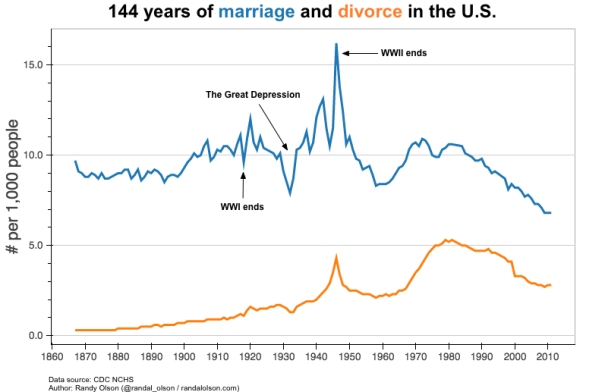
Even though Murray is cherry-picking data to make the state of America look as bleak as possible, he doesn’t come up with much other than the rise in inequality.  For example, although marriage rates are down since the 1960s, the decline in marriage is partly due to the aging of America.  In particular, when the baby boomers were children was a time of few marriages in the late 1950s.  Their coming of age in the 1960s created a mini marriage bubble that Murray sees as the golden age of marriage.  Then in the 1970s, the baby boomers created a divorce bubble which was even more dramatic than the earlier rise in marriage. Since then, as the baby boomers aged, it was only natural for a smaller percentage of the aging population to get married.  That is a lot less worrisome than Murray makes it seem.  Plus the statistics for divorce rates tell the opposite story. They demonstrate a dramatic strengthening of marriage.  Divorce rates have fallen by almost half from their 1970s peak, so American marriages are lasting a lot longer than during the time Murray adulates.

marriages_divorces_per_capita (1)

Randy Olson

Americans still value marriage. According to Gallup, only 5% of Americans said that they did not want to get married, and upper-class Americans are still just as likely as ever to marry, but Brookings Institution research shows that marriage rates have dropped among the middle and lower classes (the bottom 65% of the income distribution).  They suggest that rising inequality is contributing to the decline in marriage.

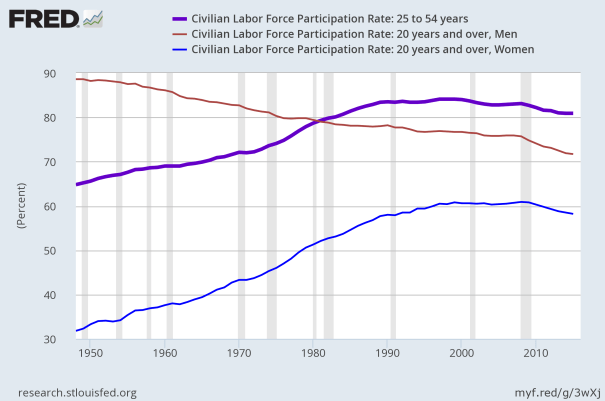
Murray also laments the decline in labor-force participation for men, but the data in the graph below shows that the prime-age labor-force participation (purple line) is much higher now than in the 1960s which is the time Murray thinks was the golden age of work.  This is because women’s labor force participation (blue line) has risen dramatically since the 1960s and it more than made up for the decline in working men (red line) until 1999.

labor force participation

Total labor-force participation peaked in 1999 and it has only declined three percentage points since then.  That doesn’t look like the kind of end-of-work crisis that Murray thinks is fomenting a political revolution.

Other than stagnant median income and growing inequality, most statistics are much better now then 20 years ago. For example, a recent Vox article looked at CDC data which shows that America is doing better than ever on most measures.  For example, American teenagers are making much better choices than their parents’ generation did 20 years ago.  For example, if you were born in 1974, you would have been nineteen in 1993 and the following chart applies to you.  Your peers were behaving much worse in 1993 than today’s teens by almost every measure.

Teen behavior

20 years ago

(1993)

Today

(2013)

Regularly wear a seat belt

80.9

92.4

Ever tried alcohol

80.9

66.2

Ever tried a cigarette

69.5

44.1

Used a condom during last sexual intercourse

52.8

59.1

Ever had sex

53

46.8

Had sex within the last 3 months

37.5

34

Ever been in a physical fight

41.8

24.7

Drank 5 or more drinks in a row in past month

30

20.8

Smoke cigarettes

30.5

15.7

Seriously considered a suicide attempt in past year

24.1

17

Carried a weapon to school in the last month

11.8

5.2

Carried a gun in past 30 days

7.9

5.5

Had sex before 13 years old

9.2

5.6

Childbearing (% of teen girls)

2.4

5.6

Tried cocaine

4.9

5.5 (worse)

Tried marijuana

32.8

40.7 (worse)

Very few measures (like cocaine and marijuana use) have gotten worse.  Most measures, other than inequality have gotten markedly better, and those few that have gotten worse usually haven’t declined much. Here are more statistics:

Other Indicators

 20 years ago

(1993)

Today

(2013)

 Our schools are better.  NAEP Reading & Math
scores are higher.
Better
 Abortion rate per 1,000 women age 15-44  24 (in 2011)  13.9 (in 2011)
 Murder rate per 100,000 people 9.5 4.5
 Life expectancy 76 79
 Divorce rate per 1,000 population 4.7 (in 1990) 2.8 (in 2010)
 Heritage index of economic freedom
Murray asserts that Americans have less liberty,
but even Heritage data shows insignificant change.
76.7 (1995) 76.2 (2015)

The US isn’t alone in making progress.  Most important statistics show that the rest of the world has been improving over the past 20 years too.  But Americans are angry about the state of the world and whatever explains Trumpism, there are probably similar factors driving Democrats to support another anti-establishment outsider in Bernie Sanders. Americans weren’t looking for a political revolution 20 years ago when most things were objectively worse, so what has deteriorated since then besides rising inequality?

Perhaps the changing media landscape has been encouraging revolution too. The proliferation of media competition has also increased the sensationalization of news and its partisan fragmentation into separate echo chambers.  In the 1960s that Murray idolizes, almost all Americans got their news from common news outlets because there were very few national news services.  The national news outlets had to be moderate because they had to appeal to all political stripes to attract a wide audience.  Today, the Pew Research Center shows almost zero overlap between the audience of Rush Limbaugh and Democracy Now or Fox News and The Daily Show.  There was nothing like that in the 1960s.

Even more importantly, social media is amplifying the voices of passionate people much more than the calm voices that don’t generate as much attention.  Social media has encouraged activists to band together into like-minded social networks that can circulate stories and ideas independently from professional journalists.  Social media gave rise to political revolutions across the Arab League during the Arab Spring in 2011, so perhaps a parallel kind of force is shaping the presidential race into a revolutionary American Spring.   If so, then lets hope that the coming winter will turn out better than the Arab Winter was for Egypt, Libya, Yemen, Syria, or Bahrain.

Update:

The home ownership rate is plummeting which may be another cause for concern, but it is mainly due to rising inequality.  Inequality suppresses the median income and drives up the price of housing in the cities where most Americans live because markets chase dollars and focus more on where the incomes are growing: the upper classes.  Their expanding purchasing power can cause gentrification that drives up average prices.  It was also artificially inflated in the 2000s by the securitization that caused the mortgage bubble.  Here is the FRED data.


Posted in Inequality, Public Finance

Trump & Sanders are both reactions to mmutilitarian policies

John B. Judis recently wrote a good analysis of populism on the right (Trump) and on the left (Sanders).  This updates some of the themes in his book, The Paradox of American Democracy, in which he:

presents a familiar diagnosis of American democracy with an interesting twist. He deplores the absence of even a basic conception of the common good in contemporary pluralism.

I could not disagree more.  The problem isn’t that American democratic institutions (and elite leadership) don’t have a basic conception of the common good.  The problem is that our main conception of the common good is mmutilitarianism which is so warped that most people, including Judis, don’t even realize that it is an ethical conception of the common good.  But mmutilitarianism is the moral philosophy that motivates much of American thinking about the common good and government policy.  The whole point of medianism is to point out how warped mmutilitarianism is by presenting medianism as an equally simple alternative which is much better even though it is still far from perfect. (Don’t let the perfect be the enemy of the good).

Judis probably doesn’t realize that mmutilitarianism is our basic conception of the common good because mmutilitarianism so easily enmeshes with selfishness and ethical egoism and that is the antithesis of the common good.  Mmutilitarianism abets selfishness because every dollar of income is an equal contribution to the mmutilitarian conception of the common good.  Under mmutilitarianism, you might as well try to get as many dollars as you can for yourself because it doesn’t matter who gets the dollars.

Ethical egoism is a selfish individualist conception of the common good.  Most mmutilitarians aren’t ethical egoists, but both philosophies often lead to the same conclusions because many mmutilitarians erroneously believe that higher inequality is always better for mmutilitarian growth (GDP).  They also erroneously think that one’s income is a good measure of how much one contributes to the common good. That is why mmutilitarians tend to adulate wealthy elites.

Perhaps Judis doesn’t understand that mmutilitarianism is the dominant moral philosophy that underpins the trends he describes because the founders of mmutilitarianism were economists who rejected moral philosophy and claimed to be positive scientists.  But don’t believe them. It is impossible to avoid moral philosophy and if you try, you will end up with an accidental ethical system like mmutilitarianism.

But this is a minor quibble with Judis’ excellent analysis.  He describes a public that is angry with mmutilitarian economic policies and is seeking an alternative.  Whether that alternative will be Trumpism or Sanders’ socialism or something else remains to be seen. Trump doesn’t have a clear definition of the common good and is running a negative campaign which blames our problems on foreigners,  Muslims, and to a lesser extent towards American elites.  Sanders is focused on blaming economic elites.  I haven’t heard either one clearly define how they would measure an improvement in the common good.  Median Expected Lifetime Income could help both insurgents move beyond mmutilitarianism.

Posted in Medianism, Public Finance

Why do deer stand in roads and curiously watch the oncoming headlights?

Jared Diamond wrote one of my favorite books, Guns Germs and Steel, which explains why Eurasians conquered and colonized the rest of the world rather than vice versa.  It also explains why Europeans didn’t displace the local populations anywhere except in the southern tip of Africa, Australia, and the Americas.  Here is an excerpt from chapter that explains why Australia and the Americas didn’t have many big animals that people could domesticate.

Domesticated animals in Eurasia led to higher agricultural productivity, more interchange of ideas through travel and trade, and, most importantly, immunity to more infectious diseases which wiped out most of the people of Australia, and the Americas.

During the Ice Ages, so much of the oceans’ water was locked up in glaciers that worldwide sea levels dropped hundreds of feet below their present stand. As a result, what are now the shallow seas between Asia and the Indonesian islands of Sumatra, Borneo, Java, and Bali became dry land. (So did other shallow straits, such as the Bering Strait and the English Channel.)

…To reach Australia/New Guinea from the Asian mainland at that time still required crossing a minimum of eight channels, the broadest of which was at least 50 miles wide. …Australia itself was always invisible from even the nearest Indonesian islands, Timor and Tanimbar. Thus, the occupation of Australia/New Guinea is momentous in that it demanded watercraft and provides by far the earliest evidence of their use in history. Not until about 30,000 years later (13,000 years ago) is there strong evidence of watercraft anywhere else in the world…

The settlement of Australia/New Guinea was perhaps associated with still another big first, besides humans’ first use of watercraft and first range extension since reaching Eurasia: the first mass extermination of large animal species by humans. Today, we regard Africa as the continent of big mammals. Modern Eurasia also has many species of big mammals (though not in the manifest abundance of Africa’s Serengeti Plains), such as Asia’s rhinos and elephants and tigers, and Europe’s moose and bears and (until classical times) lions.

Australia/New Guinea today has no equally large mammals, in fact no mammal larger than 100-pound kangaroos. But Australia/New Guinea formerly had its own suite of diverse big mammals, including giant kangaroos, rhinolike marsupials called diprotodonts and reaching the size of a cow, and a marsupial “leopard.” It also formerly had a 400-pound ostrich-like flightless bird, plus some impressively big reptiles, including a one-ton lizard, a giant python, and land-dwelling crocodiles.

All of those Australian/New Guinean giants (the so-called megafauna) disappeared after the arrival of humans. While there has been controversy about the exact timing of their demise, several Australian archaeological sites, with dates extending over tens of thousands of years, and with prodigiously abundant deposits of animal bones, have been carefully excavated and found to contain not a trace of the now extinct giants over the last 35,000 years. Hence the megafauna probably became extinct soon after humans reached Australia.

The near-simultaneous disappearance of so many large species raises an obvious question: what caused it? An obvious possible answer is that they were killed off or else eliminated indirectly by the first arriving humans. Recall that Australian/New Guinean animals had evolved for millions of years in the absence of human hunters. We know that Galapagos and Antarctic birds and mammals, which similarly evolved in the absence of humans and did not see humans until modern times, are still incurably tame today. They would have been exterminated if conservationists had not imposed protective measures quickly. On other recently discovered islands where protective measures did not go into effect quickly, exterminations did indeed result: one such victim, the dodo of Mauritius, has become virtually a symbol for extinction. We also know now that, on every one of the well-studied oceanic islands colonized in the prehistoric era, human colonization led to an extinction spasm whose victims included the moas of New Zealand, the giant lemurs of Madagascar, and the big flightless geese of Hawaii. Just as modern humans walked up to unafraid dodos and island seals and killed them, prehistoric humans presumably walked up to unafraid moas and giant lemurs and killed them too.

Hence one hypothesis for the demise of Australia’s and New Guinea’s giants is that they met the same fate around 40,000 years ago. In contrast, most big mammals of Africa and Eurasia survived into modern times, because they had coevolved with protohumans for hundreds of thousands or millions of years. They thereby enjoyed ample time to evolve a fear of humans, as our ancestors’ initially poor hunting skills slowly improved. The dodo, moas, and perhaps the giants of Australia/New Guinea had the misfortune suddenly to be confronted, without any evolutionary preparation, by invading modern humans possessing fully developed hunting skills.

However, the overkill hypothesis, as it is termed, has not gone unchallenged… Critics emphasize that, as yet, no one has documented the bones of an extinct Australian/New Guinean giant with compelling evidence of its having been killed by humans, or even of its having lived in association with humans. Defenders of the overkill hypothesis reply: you would hardly expect to find kill sites if the extermination was completed very quickly and long ago, such as within a few millennia some 40,000 years ago. The critics respond with a countertheory: perhaps the giants succumbed instead to a change in climate, such as a severe drought on the already chronically dry Australian continent. The debate goes on.

Personally, I can’t fathom why Australia’s giants should have survived innumerable droughts in their tens of millions of years of Australian history, and then have chosen to drop dead almost simultaneously (at least on a time scale of millions of years) precisely and just coincidentally when the first humans arrived. The giants became extinct not only in dry central Australia but also in drenching wet New Guinea and southeastern Australia. They became extinct in every habitat without exception, from deserts to cold rain forest and tropical rain forest. Hence it seems to me most likely that the giants were indeed exterminated by humans, both directly (by being killed for food) and indirectly (as the result of fires and habitat modification caused by humans). But regardless of whether the overkill hypothesis or the climate hypothesis proves correct, the disappearance of all of the big animals of Australia/New Guinea had, as we shall see, heavy consequences for subsequent human history. Those extinctions eliminated all the large wild animals that might otherwise have been candidates for domestication, and left native Australians and New Guineans with not a single native domestic animal.

…The oldest unquestioned human remains in the Americas are at sites in Alaska dated around 12,000 B.C., followed by a profusion of sites in the United States south of the Canadian border and in Mexico in the centuries just before 11,000 B.C. The latter sites are called Clovis sites, named after the type site near the town of Clovis, New Mexico, where their characteristic large stone spearpoints were first recognized. Hundreds of Clovis sites are now known, blanketing all 48 of the lower U.S. states south into Mexico. Unquestioned evidence of human presence appears soon thereafter in Amazonia and in Patagonia. These facts suggest the interpretation that Clovis sites document the Americas’ first colonization by people, who quickly multiplied, expanded, and filled the two continents.

One might at first be surprised that Clovis descendants could reach Patagonia, lying 8,000 miles south of the U.S.-Canada border, in less than a thousand years. However, that translates into an average expansion of only 8 miles per year, a trivial feat for a hunter-gatherer likely to cover that distance even within a single day’s normal foraging. One might also at first be surprised that the Americas evidently filled up with humans so quickly that people were motivated to keep spreading south toward Patagonia. That population growth also proves unsurprising when one stops to consider the actual numbers. If the Americas eventually came to hold hunter-gatherers at an average population density of somewhat under one person per square mile (a high value for modern hunter-gatherers), then the whole area of the Americas would eventually have held about 10 million hunter-gatherers. But even if the initial colonists had consisted of only 100 people and their numbers had increased at a rate of only 1.1 percent per year, the colonists’ descendants would have reached that population ceiling of 10 million people within a thousand years. A population growth rate of 1.1 percent per year is again trivial: rates as high as 3.4 percent per year have been observed in modern times when people colonized virgin lands, such as when the HMS Bounty mutineers and their Tahitian wives colonized Pitcairn Island.

…The Edmonton pioneers would have found the Great Plains teeming with game. They would have thrived, increased in numbers, and gradually spread south to occupy the whole hemisphere. [It took less than 1,000 years for people to fill up all of the Americas.]

…Like Australia/New Guinea, the Americas had originally been full of big mammals. About 15,000 years ago, the American West looked much as Africa’s Serengeti Plains do today, with herds of elephants and horses pursued by lions and cheetahs, and joined by members of such exotic species as camels and giant ground sloths. Just as in Australia/New Guinea, in the Americas most of those large mammals became extinct. Whereas the extinctions took place probably before 30,000 years ago in Australia, they occurred around 17,000 to 12,000 years ago in the Americas. For those extinct American mammals whose bones are available in greatest abundance and have been dated especially accurately, one can pinpoint the extinctions as having occurred around 11,000 B.C. Perhaps the two most accurately dated extinctions are those of the Shasta ground sloth and Harrington’s mountain goat in the Grand Canyon area; both of those populations disappeared within a century or two of 11,100 B.C. Whether coincidentally or not, that date is identical, within experimental error, to the date of Clovis hunters’ arrival in the Grand Canyon area.

The discovery of numerous skeletons of mammoths with Clovis spearpoints between their ribs suggests that this agreement of dates is not a coincidence. Hunters expanding southward through the Americas, encountering big animals that had never seen humans before, may have found those American animals easy to kill and may have exterminated them. A counter theory is that America’s big mammals instead became extinct because of climate changes at the end of the last Ice Age, which (to confuse the interpretation for modern paleontologists) also happened around 11,000 B.C.

Personally, I have the same problem with a climatic theory of megafauna extinction in the Americas as with such a theory in Australia/New Guinea. The Americas’ big animals had already survived the ends of 22 previous Ice Ages. Why did most of them pick the 23rd to expire in concert, in the presence of all those supposedly harmless humans? Why did they disappear in all habitats, not only in habitats that contracted but also in ones that greatly expanded at the end of the last Ice Age? Hence I suspect that Clovis hunters did it, but the debate remains unresolved. Whichever theory proves correct, most large wild mammal species that might otherwise have later been domesticated by Native Americans were thereby removed.

Similarly, deer are vulnerable to getting hit by cars on highways because they haven’t yet evolved an instinctual fear of the oncoming headlights and attendant sounds, but I predict that they will have the inbred instinct to fear oncoming cars within my kids’ lifetimes because the selection pressures seem very high.


Posted in Development

Enter your email address to follow this blog and receive notifications of new posts by email.

Join 75 other subscribers
Blog Archive
Pages