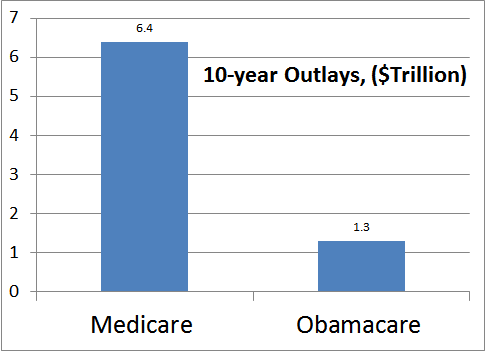
A lot of Americans dislike the Affordable Care Act (ACA or Obamacare) because they say it expands government too much and will increase taxes. As Milton Friedman accurately said, for the government, to spend is to tax. So how big is the actual increase in government spending? Forbes magazine editorials have been wanting to roll back the ACA and a recent Forbes headline by Chris Conover reads, “Takeover: Government On Track To Make Up 66% of Healthcare Spending“. But if Forbes really wants to roll back the government takeover of healthcare, they need to roll back our biggest government healthcare program: Medicare. By Forbes’ numbers, Obamacare will only increase the government share of health spending by six percentage points from 60% to 66%. Medicare has always been where the big money is. Medicare gives free universal health insurance to all Americans over age 65 and it is very expensive to give free healthcare to old people. Strangely, I couldn’t find any cost comparisons of Obamacare and Medicare, so I made a graph of projected 10-year spending based on the most comparable CBO statistics I could find.*
My above comparison greatly inflates Obamacare’s portion of government healthcare expenditures. The true number is probably closer to Forbes’ numbers: about 10%. On top of the Medicare spending, Medicaid is also much bigger than Obamacare, and some of the ACA’s expenditures are entangled with Medicaid, Medicare, and other Federal programs. In particular, it is hard to disentangle Medicaid from the ACA because a large fraction of ACA spending will go through the Medicaid system. The ACA is so small relative to Medicare, it will raise government health spending less than Medicare is expected to increase over the next 25 years.
If you really want to get the government out of healthcare, you need to go where the money is and attack Medicare and Medicaid. Obamacare is small potatoes compared with them. It is more comparable in size to the Veterans Administration spending than it is to the big government healthcare programs.
Spending is the easiest way to compare the size of government programs, but regulations are also important. The ACA expands government by adding a lot of new regulations, but it is hard to measure the size of regulatory burdens and I would guess that Medicare regulations are much bigger than ACA regulations simply because Medicare has been around longer and spends a lot more money. The original ACA was under 1,000 pages. That is nothing compared to the total body of Medicare regulations. The entire ACA is shorter than just one new set of Medicare regulations that were added this year. The new regulations will add details like how to code killer whale attacks and squirrel bites. Medicare imposes much more price controls than the ACA and regulations about quality of care. More regulations keep getting added to both ACA and Medicare every year due to legal, bureaucratic, and legislative changes, but Medicare has had a big head start in creating regulations, so it is would be impossible to argue that the ACA has already caught up.
So if you really want to get government to stop meddling in healthcare, you gotta go after the big old elephant in the room, not the little new pipsqueak. Ironically, if the Republican party is successful at repealing Obamacare, many liberals think that the result would be to increase the likelihood of expanding Medicare for all and more Medicare would be a much bigger government intervention in healthcare.
*The numbers in the graph aren’t perfectly comparable, but better statistics would probably make Medicare look even more expensive compared with Obamacare over the next ten years. For example, the 10-year estimate for Medicare begins counting in 2013 and the ACA estimate begins in 2014, so Medicare would cost even more over 10 years if both estimates began in the same base year because of adding 10 years of inflation and population growth to the costs of one year. The Medicare estimate also excludes administrative costs. The only factor that I can see working to shrink the estimated costs of the ACA is the fact that it is not covering as many people in 2014 as it will cover in subsequent years, so beginning its 10-year total cost in its first year is going to be a little smaller than the estimate would be if beginning a year later in 2015.
Everyone likes more freedom, but all the freedoms that people debate about are contentious because increasing one person’s freedoms reduces the freedoms of others. In theory there are freedoms that don’t affect other people, but nobody talks about those freedoms. Whenever anyone talks about wanting more freedom, they are really wanting to take some freedom away from somebody else. Whether that is good or bad depends on how we weigh the rights of the winners versus those of the losers.
Beware of pundits like The Heritage Foundation and Fox News who portrays their opponents as “enemies of freedom.” This is merely an attempt to dehumanize opponents with jingoism. What kind of evil monster could oppose freedom? Everyone loves freedom. Freedom brings happiness, so you might as well demonize people as enemies of happiness.
When Heritage and Fox talks about “freedom haters” they are actually wanting to restrict those people’s freedoms. That is a natural human impulse. We ALL want to reduce other people’s freedom and for good reason. Nobody wants anyone else to have unlimited freedom because that would mean that they have enormous power over us. That includes Fox News which hates some of the freedoms of their opponents and sometimes they are right to do so! (However, the link above is a comedian making fun of Fox News at times when their hosts got a little hyperbolic and opposed fundamental US constitutional freedoms. Oops!)
Tribalistic animosity is one reason why people sometimes want to restrict the freedoms of others (and perhaps explains why Fox has sometimes preferred freedom-crushing Muslim dictators over America’s democratically-elected Democratic leaders), and tribalism often leads to injustices. But a good reason why everyone should sometimes be an enemy of freedom comes from public good analysis. A public good is defined as a good that is both nonrival and nonexcludable. The consumption of rivalrous goods imposes some kind of negative externality on other people. There are two kinds of rivalrous goods: private goods and common goods. Private goods impose a pecuniary externality on others.* That is a rise in the cost for someone else who would like to consume the same good. For example, if I drink a can of soda, that means that there is one less soda for everyone else, and I have raised the cost of getting soda for someone else. We cannot all drink the same can of soda, so we are rivals in its consumption. But if I enjoy looking at a sunset, it doesn’t take away the enjoyment of others who can also enjoy looking at the same sunset, so as long as there are equally good places to watch the sunset available, it is a nonrival good. There are no pecuniary externalities of watching a sunrise.
Freedoms can also be rivalrous or nonrival. Nobody cares if you exercise nonrival freedoms. Everyone can have the freedom to watch a sunset when it is nonrival. Similarly, you are free to think about your dreams because nobody is going to object to your quiet thoughts.** But people rarely talk about nonrival freedoms like that because there is no motivation for anyone to try to restrict nonrival actions.*** The freedoms that people usually talk about are rivalrous freedoms because one person’s freedoms conflicts with another person’s rival freedoms.
For example, the Freedom From Religion Foundation attempted to force freedom of religion at a small southern diner, but that restricted the diner’s freedom of religion. Similarly, the freedom of speech of the people singing karaoke across the street from my hotel in Beirut at 2AM last night interfered with my freedom to sleep. But is my right to peace and quiet (and freedom to sleep) more important than their freedom of speech? All the important freedoms are sometimes restricted because these freedoms are rivalrous and when freedoms are rivalrous, we must judge which freedom takes precedence.
In modern democracies, people who say that they want more freedom are usually claiming that they want more rights over other people. An example I like is whether people should have the freedom to shoot bullets up into the air. It does feel very free to shoot bullets randomly into the air (as you can see in the videos) and it has been a common freedom around the world. But I think my right to be free of the risk of dying from falling lead should take precedence over other peoples’ freedom to shoot lead into the air. In Chicago, my neighbors used to shoot guns into the air to celebrate special occasions and my landlord had a collection of lead bullets that he had found on the flat roof of my building. New Year’s Eve is a traditional time for shooting in the air and one morning on New Year’s Day as I stepped out on the sidewalk in front of my apartment I found a bullet with an armor-piercing jacket that had fallen out of the air and smashed down on my sidewalk the night before.
I happen to be in Lebanon at the moment, so I’ll post a couple entertaining videos about the Arab tradition of celebratory gunfire from an interesting Lebanese blog, Blogbaladi.
When I heard celebratory gunfire in Chicago, it sounded like warfare as you can hear in this video from Detroit. Celebratory gunfire kills people every year. Yemenese men were shooting their AK-47s in the air while dancing to Gangnam Style at a party and accidentally killed two people in this very unfunny (and graphic) video. The US government doesn’t seem to care enough about celebratory gunfire to collect national data, but a single hospital in Los Angeles kept track from 1985 – 1992 and they treated 118 people for random falling-bullet injuries over 8 years including thirty-eight people who died. Celebratory gunfire is a freedom to bear arms that infringes on other people’s freedoms. That is why it is technically illegal in most of the US even though it is virtually never prosecuted.
Like all other rivalrous freedoms, the freedom to shoot guns in the air needs to be legally balanced against other freedoms like the freedom from getting killed by errant bullets.
The Heritage Institute, like many libertarian-leaning organizations, tends to focus on “economic freedom” over other freedoms. Heritage defines economic freedom as, “the right to acquire, use, and possess private property, as well as the right to enter into private contracts of one’s choosing.” Both private property and private contracts ARE the power to limit other people’s freedom. It is misleading to equate property and contractual obligations with freedom. Property is better described as a right and a contract is better described as an obligation.
When people think of freedom, they usually imagine nonrivalrous freedoms like flying like a bird or watching a sunset without any cares in the world. The destruction of private property rights (and contracts) always involves an increase in (negative) freedom for other people. The abolition of slavery or the conversion of a tollway into a freeway are examples where the destruction of private wealth makes the former owners feel less free, but makes less powerful people more free. Thomas Jefferson probably realized that property rights directly conflict with freedom when he chose not to begin the Declaration of Independence with John Locke’s famous quote about ‘life, liberty, and property’ but instead wrote ‘life, liberty, and the pursuit of happiness.’
Locke’s quote is a little self-contradictory unless you don’t care about the liberty of people who have little property because property is the right to restrict the liberty of others. Heritage’s “economic freedom” means the freedom of wealth owners. The more wealth you have, the more positive freedom you have. And the more wealth you have, the greater your power to restrict other people’s freedoms by excluding them from stuff. It is exceedingly odd to define freedom as the right of economically powerful people to restrict poorer people’s freedom by excluding them from things.
Intellectual property rights are an excellent illustration of how property is the right to reduce freedom. Anyone could freely use the word “droid” until October 9, 2009, when George Lucas trademarked the word and made it legally excludable. He thereby turned a free word into five letters of intellectual property so that his lawyers could exclude people from saying or printing the word unless they pay Lucas money. Some speculate that he timed his trademark to extract cash from Motorolla who had been heavily investing in a campaign to sell their new line of Droid phones which were released a week after Lucas’ lawyers trademarked the word and immediately sued Motorolla for illegally printing the word on phones. As a result, if you have bought a Droid phone, part of your money went to George Lucas. Lucas’ new property is an expansion of his ‘economic freedom’ at the expense of everyone else’s freedom to use the word droid. In this example, Lucas’ new ‘economic freedom’ is a violation of freedom of speech for all Motorolla phone users and many others who have been directly affected without even realizing that they are paying a property tax to Lucas.
Property rights weren’t created by God in Genesis. They are created by an ongoing threat of force and that usually means government coercion. For example, intellectual property rights were clearly created to encourage greater production of new goods and services to make everyone richer. Unfortunately, that doesn’t always work out. Lucas’ acquisition of the word ‘droid’ is just like a regressive tax that just benefits Lucas and his lawyers. Motorola Droid owners get nothing in return for their payment to Lucas because he isn’t using his ownership of the word to make the world a better place and justify the fees that he is charging. The creation of Lucas’ property made the world poorer and less free.
All private property is a restriction of others’ freedoms. If you can’t exclude anyone from your property, then there is no point in even calling it your property. Property rights are very important, but they don’t inherently increase freedom. Every property right is a decrease in the freedom of everyone in the world except for the owner. For example, slave owners must have felt enormous freedoms. The were even free to rape and torture their slaves, but that was not an increase in total freedom. The owners’ gains in freedom were offset by the slaves’ loss. The same is true for all other property rights too. Before the Civil War, Slaves were nearly a third of all American wealth. They were worth more than all the railroads, factories, and industrial capital in America combined.
The abolition of slavery was the greatest destruction of property in American history and an incredible increase in freedom for most of the people involved in slavery, but the destruction of property rights was also a destruction of freedom for the slave owners.
Thus we must decide whose freedoms are the most important and like nearly everyone today, I believe that the freedom from slavery is more important than the freedom to own slaves, but for most of history until the 1800s, most civilizations prioritized the freedom to own slaves.
Whereas libertarians frequently imply that property = freedom, anarchists like to say that property = theft. Both are a bit misleading, and yet both have a grain of truth. When property rights are created and distributed justly, they can make us all better off, but I’m not clear about any simple rules for how to decide how much private property rights are optimal.
Confusing freedoms and rights
The Madison Collaborative created a list of eight moral dimensions and it is a very useful paradigm for helping ordinary people make moral decisions, but two of their questions are redundant:
5. Liberty: How does respect for freedom, personal autonomy, or consent apply? … 8. Rights: What rights, if any, (e.g., innate, legal, social) apply?
Liberty and rights are the same thing. Every right is the freedom to do something and every liberty is the right to do something. There is no need to list both questions because they both get at exactly the same dimension of moral reasoning. This is one reason I updated the list of moral dimensions.
Footnotes
*A pecuniary externality happens when the consumption of something raises others’ costs of getting the same good or the same kind of good. There are two ways to think about pecuniary externalities:
If I eat a piece of pizza, the cost for someone else to eat that same piece of pizza rises to infinity because it becomes impossible for them to also eat it. This is the usual way to define rivalrousness when discussing “private goods”, but economists usually define the term as a negative externality when discussing “common goods” (AKA “the tragedy of the commons”).
Another way to look at it is the additional cost of consumption when there is an upward-sloping supply curve. When I eat a piece of pizza, I raise the overall cost of pizza a tiny bit for everyone else by shifting total demand a tiny bit up the supply curve. This is the usual way to define a pecuniary externality.
**If nobody even knows what you are thinking about, then they cannot exclude you from your thoughts and so your freedom of thought is both nonrival and non-excludable from yourself. That sounds like the definition of a public good, but your private thoughts aren’t public goods for the public at large because you can easily exclude the public from your thoughts. Even though your own private thoughts are nonrival and non-excludable from yourself, they aren’t public goods because you aren’t the public.
***There can be an indirect reason to restrict a nonrival freedom if some other rivalrous good can be extorted away from someone. Kidnapping is an example where someone’s freedom is taken in order to extort money from friends and/or family.
UPDATE: See the MELI FAQ for more up-to-date information about how and why we should reform the use of GDP.
Photo by Alex E. Proimos (CC BY-NC 2.0)
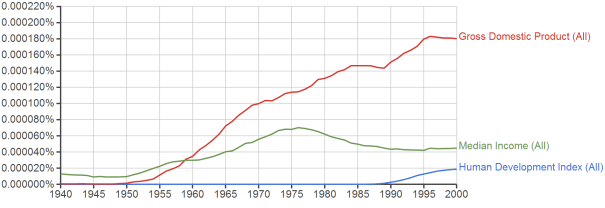
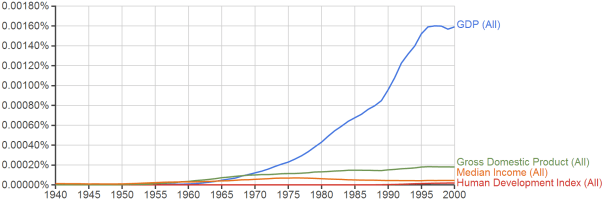
The reigning measure of economic progress and development is GDP per capita. Sure the United Nation’s Human Development Index (HDI) gets some use, but it only gets a tiny fraction of the love that GDP gets as you can see below. One reason why people prefer GDP is that nobody can relate to the HDI. We all know what income is and GDP is just a kind of measure of income, so people understand what it means if GDP per capita falls 17% from $35,000 to $30,000. Ouch! But if Argentina’s HDI of .811 falls 17%, nobody has the direct experience to know what that really means. It turns out that that would be like going from Argentina’s HDI down to China’s level (.699).
Median income is a more useful statistic than either HDI or GDP, but it has been increasingly neglected in favor of the other two. This is even more apparent if we add the term “GDP” to the above graph, because that familiar nickname is much more common than all the other terms combined.
One problem for median income is that it is hard to get a meaningful statistic for annualincome unless one uses household income, but we care more about individuals than households, and it is hard to make the adjustment between the two (see below). However, median hourlyincome in a given month would work well for macro purposes. Europeans should love this statistic because it makes them look a lot better than the GDP statistic that Americans invented. The US probably has lower median hourly earnings than much of Europe because Americans work a lot more hours per month and have higher inequality than Europeans.
Along with median hourly earnings, we should pay more attention to the total hours of work per month. We measure annual hours worked, but it is a neglected statistic and it is not tracked monthly. In some ways, total hours of work per month would be a better measure of recessions than GDP because even the crude-quality annual data that we have predicts recessions much better than GDP as you can see in my graph of hours worked per person.
Annual Hours Worked Per Capita
This is a pretty crude and inexact measure because of the poor-quality data I threw together to make it, but even so, it still predicts recessions better than many private companies that specialize in predicting recessions.
Hours worked per person helps demonstrate that people don’t “tighten their belts” during recessions and work harder when times get tough. People work a lot less during recessions. Recessions are defined as a decline in GDP, but the big problem during recessions is not the decline in GDP, but the decline in work. A recession wastes the valuable labor of people who want to work. Many are desperate for work. It would also be interesting to see more information about seasonal variations in the hours of work too. Research has shown that seasonal variations in GDP are typically bigger than the biggest recessions. Fortunately, normal people don’t seem to notice this issue because seasonal variations are shorter than recessions, and well anticipated, so they are hardly problematic. And anything that is impossible to avoid has no opportunity cost, so there is no problem to solve. But it is interesting from a macro perspective.
Finally, in place of the HDI, we should use median lifetime income. It would be calculated by estimating the median consumption for every age up to the median life expectancy and adding them all up. I think we should call it median lifetime income rather than median lifetime consumption because people are more used to talking about income measures. Median lifetime income has several advantages. Unlike the HDI, median lifetime income is something that everyone would instantly understand. It captures 2/3 of the variables in the HDI, lifespan and income. And these two components are much more powerful than the third variable (education) which does not add much information because it is highly correlated with the other two anyhow.
Like the HDI, median lifetime income would show that economic development has been successful in Sub-Saharan Africa between 1960 and 1985. Although per-capita GDP was stagnant, average lifespan increased almost 25% from about 40 years to about 50 years. If the average person’s lifespan increases 25%, and annual incomes stay about the same, then median lifetime income rises about 25% despite the failure of GDP per capita to rise. That is an economic development success. At a conference presentation, someone in the audience responded to this point by suggesting that poor people in Africa are worse off if their suffering is prolonged 25%, but Africans aren’t committing suicide at higher rates than the rest of the world, so the poor people don’t seem to agree. Of course, unhappy people could respond to their poverty by violently lashing out at others and Jared Diamond suggested that this was one reason for the genocide in Rwanda, but the genocide would have had a big effect on median lifetime income measures whereas suicide has been a relatively minor concern for all of the statistics mentioned here.
It might seem that median lifetime income could be calculated more easily by simply multiplying median individual income times median life expectancy. That is true in theory, but median individual income is easy for statisticians to fudge because most people live in households and share their income. That makes it hard to determine how much of a fathers’ income should be apportioned to the wife and kids in his household. That is a difficult decision for statisticians, but if we are adding up the median income for every age, then the decision becomes less important because a statisticians who splits the household income evenly between all members will raise the incomes of young people, but reduce the incomes of working age people by exactly the same amount. So the total effect of the statistician’s decision on median lifetime income would be modest.
It might also seem that it would be a huge expense to calculate the median income for every age, but it is a lot cheaper than adding up the market values of all the final goods and services produced within a country. That is a lot more difficult because everyone must be measured. A median is much cheaper and easier to measure because nobody has to measure any of the people who are clearly above the median nor those who are clearly below it. It is a much simpler statistical sample.
Speaking of statistical samples, why don’t economic statistics always have error estimates? What is the error on a GDP measure? ±2% or ±5% or what? If economics is going to be an empirical science, we should always include margins of error with our measures. Why don’t we? Are the margins of error so terribly embarrassing that nobody wants to try to estimate them?
Paul Krugman writes that wages are stagnant because unemployment is high and the owners of capital/corporations like that just fine. Their profits are up 60% above where they were before the recession began whereas compensation of employees is only up about 11% and much of that is likely compensation for the high-income employees.
Because [workers] have so little bargaining power. Leave or lose your job, and the chances of getting another comparable job, or any job at all, are definitely not good. And workers know it: quit rates, the percentage of workers voluntarily leaving jobs, remain far below pre-crisis levels, and very very far below what they were in the true boom economy of the late 90s:
employment is, in many though not all cases, a power relationship. In good economic times, or where workers’ position is protected by legal restraints and/or strong unions, that relationship may be relatively symmetric. In times like these, it’s hugely asymmetric: employers and employees alike know that workers are easy to replace, lost jobs very hard to replace.
And may I suggest that employers, although they’ll never say so in public, like this situation? That is, there’s a significant upside to them from the still-weak economy. I don’t think I’d go so far as to say that there’s a deliberate effort to keep the economy weak; but corporate America certainly isn’t feeling much pain, and the plight of workers is actually a plus from their point of view.
The economy has been working great for corporate America, but lousy for the median worker and so the Fed recently announced that it is tapering because the Fed feels like it is already nearing its final objective. As I wrote earlier, the Fed has never really cared about unemployment. It mostly cares about the banks. The Economist magazine recently celebrated the Fed’s 100th birthday and pointed out that the Fed was not even given its official “dual mandate” to fight unemployment until 1977. Before that, the Fed’s mandate had always been to help the banks although there has always been a tension between the Fed’s public servant role and its role to serve the banks. The Economist explains the history:
Congress set up a commission led by Nelson Aldrich, a Republican senator, which consulted bankers and studied the central banks of Britain, Germany and France. It recommended setting up a largely private association of banks that would issue its own currency to members facing runs. But many Democrats feared that a central bank run by bankers would keep too tight a grip on the supply of money, starving businesses and farmers of credit. They thought the government would be more liberal if it were in charge.
Campaigning for president in 1912, Wilson, a Democrat, had attacked the Aldrich plan as a sop to “money power”. In office, he directed Congress to rewrite the plan to reduce the influence of bankers at the 12 regional banks that make up the Fed network, and to add a board appointed by the president to oversee it… Bankers hated this “socialistic” scheme. Wilson stood firm, and signed the Fed into existence on December 23rd 1913
…[A hundred years later] Many Republicans pine for the days when Washington held less sway at the Fed and gold held more. One Republican-sponsored bill would strip the Fed of any responsibility for full employment, limit its ability to buy bonds and give more say to the heads of its 12 regional banks.
They are swimming against the tide of history. A century ago Wilson sought a central bank that would support the entire economy, not just Wall Street. With each new crisis his successors have concluded that that requires a bigger, burlier Fed.
Bobby Constantino wrote an amazing story about how hard it was to get arrested as an educated white guy wearing the uniform of the upper-class, a suit and tie. It is well worth reading. He is a hero for the sacrifices he makes to expose the arbitrary cruelties and injustices that the heavy hand of government imposes on our fellow Americans. Constantino implies that the system’s injustices are racially motivated and no doubt that is true. Justin Peters dismisses Constantino’s story as just an anecdote without any experimental controls, but it is a powerful story and well worth reading.
One problem with the way Constantino tells the story is that it isn’t clear how much of the injustice is due to racial motivations and how much is due to class motivations. Another problem is that there isn’t any clear solution to the problem of the injustice in the story. For example, it isn’t clear if affirmative action would make the problem worse by increasing racial resentment or if affirmative action would help solve the problem by desegregating society.
I generally tend to think that economic affirmative action would be better than racial affirmative action for reducing this kind of problem because it creates very similar outcomes due to the fact that racial minorities are disproportionately poor. And it reduces racial resentment among the kind of whites who end up working as police. Plus, much of the injustice might be due to class bias anyhow. If Constantino had showed up in ragged clothing rather than a suit, he would probably have been treated differently.
But perhaps I am wrong and racial affirmative action is the best. It is certainly important to desegregate police and other parts of our criminal justice system, but that is not sufficient to eliminate the kinds of injustice that Constantino writes about because some of the officials who seem to discriminate against Blacks are Black.
Some of the most successful examples of desegregation did not use affirmative action. American professional sports desegregated by including Black athletes who were better than the average and the military desegregated without affirmative action preferences. What are the greatest successes of race-based affirmative action? Surely there are some success stories to rival the desegregation of American military and sport.
Mutilitarianism is money-metric utilitarianism in which ‘the social good’ is measured in money according to each individual’s willingness and ability to pay (WAP). One of the immoral tenets of standard economics is the mutilitarian idea that the demand curve (WAP) represents a measure of the marginal benefit to society. This is illustrated by the water-diamond paradox. The marginal benefit (WAP) of having one more liter of water in any particular year is very small because we already have so much water whereas the marginal benefit (WAP) of having one more liter of diamonds is enormous because diamonds are so scarce and they are both very pretty and very useful for industry. If diamonds were as common as water and water were as scarce as diamonds, then the marginal benefit of water (and its price) would be much higher than the marginal benefit (and price) of diamonds.
When something like water is nearly free, people who are rich or poor consume about the same, but for something like diamonds, wealthy elites have a lot more WAP than the rest of us. Most of us are comfortable with the mutilitarian justification for determining who should get diamonds and who should not because diamonds are fairly frivolous, but health care can be as expensive as diamonds and mutilitarianism produces unethical judgements about who should live. For example, libertarian economist, Steven Landsburg wrote an article asking “Do the Poor Deserve Life Support?” Landsburg argued that it is acceptable that, “A woman who couldn’t pay her bills is unplugged from her ventilator and dies”. His logic is that if poor people are not willing to pay for their own health insurance, then they don’t value it enough to be worth the expense for them to have it.
The same kind of mutilitarian analysis has produced the American preoccupation with moral hazard in health insurance. Moral hazard was originally defined as a situation where a party takes more risks because an insurance company will pay for the potential costs. From the insurance industry’s point of view, this is unprofitable and immoral. It is true that people with health insurance get more medical care than people without insurance and this would seem to fit the definition of moral hazard, but is it really immoral? People get a lot more care when they have insurance than they would get without it because insurance increases their ability to pay for healthcare. This is particularly true for poor people. If the poor woman on the ventilator had had insurance, she would not have died, so is it moral hazard to get lifesaving healthcare if you are poor? Standard economic analysis says yes–it is immoral for poor people to get lifesaving healthcare because the benefit is measured in WAP and poor people don’t have enough WAP to be worth saving.
Now you may think that this is merely an obscure academic idea that only oddball mutilitarians like Steven Landsburg would believe in, but mutilitarian ethics has infected the national dialog about health insurance. Most of my economics students come to class with the preconceived notion that the moral hazard of patients is the main reason US healthcare expenditures are so high, but that notion is completely wrong. Countries that give 100% free healthcare to all citizens have much lower healthcare expenditures than the US. About the only kind of medical care that patients can independently overconsume without a prescription is the office visit, but there is no evidence of moral hazard here. The US has fewer physician visits than any other rich nation (of the twelve I found data for) except Sweden. Healthcare is never a free market where patients can simply choose to buy anything they want, so patients’ ability to overconsume is much more limited than in most markets. Almost everything that insurance covers except physician visits requires a physician’s explicit written permission. The 10% costliest patients account for almost 90% of health spending, and all of the expensive healthcare requires a doctor’s orders. So if you are worried about reducing healthcare expenditures, you need to follow the money and doctors are the ones controlling the the big money decisions. It is immoral for a doctor to prescribe unnecessary treatment (although Atul Gawunde points out that it commonly happens anyway), and it turns out that doctors decide to give more expensive lifesaving treatments, like a ventilator, to patients with insurance than patients without it. Patients must acquiesce to the doctors’ orders and bear some responsibility for these choices, but it is illegal for patients to buy almost all medical care without a doctor’s explicit orders.
The decision to withhold healthcare based on the ability to pay strikes many people as being immoral, but it is exactly the opposite of ‘moral hazard’. According to the original mutilitarian concept of moral hazard, doctors should withhold lifesaving treatments from people who are too poor to have the WAP to pay on their own. The idea of moral hazard is that health insurance reduces the price of healthcare which makes people overconsume it wastefully. As Malcolm Gladwell wrote, “If your office gives you and your co-workers all the free Pepsi you want—if your employer, in effect, offers universal Pepsi insurance—you’ll drink more Pepsi than you would have otherwise.” But whereas most people wish they had the self-control to drink less soda, few of us wish we had the self-control to go to fewer doctor visits. I wish I had the self-control to go to the doctor moreoften for preventative care. If my health insurance encouraged me to get more preventative care, that is technically called ‘moral hazard’, but what a stupid name for a useful increase in life-giving healthcare.
The main point of buying health insurance is to increase our ability to pay for treatment if we need it. If my kids get into a terrible health crisis, I want to be able to spend like Bill Gates to save their lives and make them comfortable. Economists take the insurance industry perspective that it is morally hazardous for me to spend more money on my kids than I would have been able to spend without insurance. The insurance industry likes the judgmental term ‘moral hazard’ because it would be more profitable to them if I just let my kids die in pain rather than spending insurance money.
Many of my health economics students are healthcare professionals who are convinced that Medicaid produces much more moral hazard than other parts of the insurance industry. I have even had a student that was currently on Medicaid who joined in on Medicaid bashing because “those people” don’t deserve such generous health insurance. I have spent hours trying to figure out where they get this idea from and I can’t find any empirical evidence to confirm their impression that Medicaid patients spend more than patients with private insurance. I think this is another example of mutilitarian ethics infecting the American psyche. Medicaid covers poor Americans and according to moral hazard analysis, poor people are by far the most guilty (“¡¿immoral”) of getting too much healthcare for two reasons. First of all, people are only worth their WAP and poor people have the lowest WAP, so almost any amount of spending on their healthcare is wasted because their lives are cheap. Secondly, poor people cannot normally spend much on healthcare, so they spend a lot more when they have insurance than without, and moral hazard analysis says that insurance should not cause people to spend more money on healthcare. Rich elites like Bill Gates cannot ever have problems with moral hazard because they will always get the same amount of healthcare regardless of whether they pay out of pocket or not. So insurance doesn’t change the behavior of rich elites, but it can completely change a homeless person’s behavior who might be dead without it. Death is a big behavioral change.
I suspect that part of the real problem healthcare providers have with Medicaid is not that Medicaid patients spend too much on healthcare, but that they spend too little. Medicaid pays lower prices than any other insurance, and healthcare providers like more profitable patients better. Healthcare professionals often complain that they lose money on every Medicaid patient. Perhaps if Medicaid paid as generously as every other insurance, healthcare professionals would be less vocal in expressing concern about the “moral hazard” of these patients.
In my health economics class, students often think that America has faster waiting times for medical procedures than other nations because they have heard about healthcare systems like Canada that have waiting lists for procedures that the government considers to be ‘elective’. In contrast, the US allocates medical care according to supply and demand and lets the price rise in order to eliminate queues. Economists often criticize the Canadian system for forcing people to wait for care (queuing). The idea is that because the Canadian government provides free healthcare to all Canadians, they ‘ration’ care. Of course, giving something away for free would be an odd way to ration it, so the ‘rationing’ accusation is a bit odd.
The standard mutilitarian argument against queuing is that raising the dollar price would cause people spend less time waiting in the queue and more time working to get the money to pay for the desired healthcare (or whatever the queue had been for). This is more efficient in dollars of production, but it doesn’t actually change the waiting time unless it causes a larger supply of healthcare. And that is part of the problem in the US. The supply of healthcare is limited by the licensure regulations that restrict the supply of healthcare providers. A higher price for healthcare just means higher incomes for providers as long as the number of places in medical school is fixed by the medical cartel (in collaboration with the legal heft of the US government). Instead of everyone waiting equally like in Canada, in America’s market system, wealthy elites can skip to the front of the line whereas the rest of us have to work overtime before we can afford to get treatment.
It isn’t at all clear that Canadians wait longer for medical care than Americans because the statistics don’t include the underinsured Americans who are waiting to sign up for healthcare procedures until they have enough money to pay. In 2010, a third of American adults said did not get recommended healthcare because of the high cost. That is higher than in any other rich nation in the study.
That isn’t to say that Canada has a perfect system. One problem with the Canadian system is that they arguably spend too little on healthcare. In fact, they spend so little that even though the Canadian government gives free health insurance to all Canadians, their government spends less per person than the US government.
The US healthcare system is so inefficient that even though the US government spends more per person than almost any other nation (see chart) our government only covers 31% of Americans (the old, the poor, disabled, federal employees (notably active-duty military), Native Americans and veterans). The population that the government insures includes some the most expensive demographics because old people, the disabled, and newborns have very expensive healthcare. Almost half of babies born in America are paid for by Medicaid and premature babies can cost millions of dollars.
This graph comes from Avik Roy who wants to eliminate Medicare and Medicaid, because he dislikes socialized insurance (and seems opposed to insurance generally), but those government programs provide much cheaper treatments than the private health insurance system in the US. The private part of the US healthcare system is what is really expensive compared with other nations.

 My above comparison greatly inflates Obamacare’s portion of government healthcare expenditures. The true number is probably closer to Forbes’ numbers: about 10%. On top of the Medicare spending, Medicaid is also much bigger than Obamacare, and some of the ACA’s expenditures are entangled with Medicaid, Medicare, and other Federal programs. In particular, it is hard to disentangle Medicaid from the ACA because a large fraction of ACA spending will go through the Medicaid system. The ACA is so small relative to Medicare, it will raise government health spending less than Medicare is expected to increase over the next 25 years.
 If you really want to get the government out of healthcare, you need to go where the money is and attack Medicare and Medicaid. Obamacare is small potatoes compared with them. It is more comparable in size to the Veterans Administration spending than it is to the big government healthcare programs.






 Medianism