How many lives did social distancing save?

Although we’ll never know exactly how many lives our masking and other social distancing saved from Covid, it is pretty sure that it saved over 30,000 lives from dying of the flu because the fatality rate from the flu dropped to practically nothing.  That is an amazing result.

According to the CDC, so far we have had a total of about 500 deaths from the flu this season compared with a usual average of over 35,000. This graph compares overall mortality from respiratory illness over time (red line) with just influenza mortality (orange shading and right-axis scale):

We’ll always think about respiratory illnesses differently in future years. For example, I expect to see a lot more routine mask wearing during influenza season like common practice in several Asian nations.

The first time I wore a mask in public, I was at a supermarket at the beginning of the pandemic back when the CDC was still saying that masks weren’t necessary because of the mistaken belief that the virus was not airborne and I got strange looks from almost everyone in the nearly empty store.  They probably wondered if I was infected because the CDC was telling people to reserve masks for sick people and healthcare professionals at the time.  One guy walked up beside me at the milk shelf and when he suddenly noticed my mask, he jumped back with an expression of horror as if I were wearing a super-scary Halloween costume.  He immediately wheeled around and scurried away.

That won’t happen again in my lifetime because most of us are used to masks now.  Although masks make some people furious for political reasons, my guess is that it will cease to have political valence as time goes by.  It is shocking how much passion mask mandates have caused for a small percent of Americans, but it is probably mostly because of political thought leaders who have been stoking anti-mask sentiment and they will turn to other causes as people have gotten accustomed to masks.  It isn’t an issue with partisan valence in Asian countries where public mask wearing has been normal for decades already. 

My wife sat next to a man on a flight who was not wearing his mask and when she asked him to please use the mask, he retorted, “Shut up you stupid bitch.”  It could have been worse.  There has been a surge of assaults when flight attendants ask passengers to follow the mask-wearing rules that they agreed to when they purchased their tickets. 

Here are the counties with the highest willingness to wear masks (darker shading) according to surveys.


An external file that holds a picture, illustration, etc.
Object name is 41302_2020_186_Fig1_HTML.jpg

Posted in Health

VAERS has reported a huge spike in vaccine-related deaths. Is VAERS overstating the risks?

My sister informed me that she and the people she trusts are worried about new data coming from the Vaccine Adverse Event Reporting System, or VAERS, an official CDC database. There have been over 4,000 deaths within 30 days of a Covid vaccine dose reported on VAERS so far which would seem like a dramatic spike in deaths from the Covid vaccine if you don’t understand what the statistics mean.

The VAERS mortality numbers are completely misleading and I’m confident that the preponderance of evidence will show that none of the covid vaccines given so far has caused a mortality rate that is larger than say the risk of deaths due to the birth control pill per year which is about 5 per million.  I have a friend whose young sister tragically died from blood clots caused by birth control pills just before getting married.* The risk of clots from the birth control pill seems like an apt comparison with the risks of Covid vaccines since society has been freaking out about a possible association of less than 1/million deaths from blood clots due to the J&J vaccine which is much less than the risk of similar clots from birth control even though the birth control pill is mainly taken for recreational lifestyle purposes whereas the Covid vaccine has already saved tens of thousands of lives.  Nothing is completely without risk, and we don’t freak out about all the deaths that are directly caused by aspirin or vitamins or birth control given the other benefits of these drugs.

About 8000 Americans die every day and mostly due to illness.  That is the baseline daily mortality rate without Covid and well over 2,000 Americans have died per day from Covid diagnosis on average since the first vaccine was approved.  We have given 260milliion doses of the vaccine which is over 75% as big as the population of the US.  Given that the doses are disproportionately given to the elderly and none to children, the baseline mortality rate of the Americans who have gotten the vaccine is probably on the order of twice the rate for the Americans who haven’t gotten the vaccine.  Anyhow, let’s just round down and say that the age-adjusted mortality rate of people is only 33% higher than the American average.  Thus, there should have been about 8,000 Americans who died in the 24 hours after they got the vaccine.  If the VAERS reporting period for time between deaths and the vaccine is 10 days on average, then there should have been at least 80,000 deaths within ten days of getting a Covid vaccine and probably a lot more because I’m being fairly conservative in my estimates. Heck, there have probably been more Americans who died of Covid after getting vaccinated (and before the vaccine takes effect) than the total number of reported VAERS fatalities.

8,000 reported deaths sounds like a crisis, but this is an example of the base-rate fallacy because it is out of a total of 260 million people. Bayesian statistics teaches that whenever you have such a tiny fraction of the base rate, small amounts of noise in the data will completely swamp any signal. Every diagnostic system has a certain number of false positives and if our VAERS system only had a false positive rate of 5% in misattributing deaths to the vaccine, that would explain every single report.

VAERS reports have historically had a high false positive rate since anyone can submit reports and the false positive rate is undoubtedly higher than usual for Covid because there is much more hysteria about vaccines now than ever before due to hype on social media and Fox News.  Given the self-selection bias that ANYONE can report to VAERS including the wingnuts, and  I’d guess that there are more than 4,000 wingnuts in America, so a significant fraction of the VAERS number is going to be submitted by the crazies.  I mean, if mainstream media stars like Tucker Carlson started talking night after night about how aliens are killing people through mind control and named a website for reporting, I bet we’d get more than 8,000 reports of alien-mind-control deaths.  So until there is some analysis of the VAERS data to look for some plausible theory of how the vaccine could be killing people, I am not going to be worried about it.  I prefer to trust the numerous scientific studies over crowdsourced numbers.  VAERS is not a random sample. It has always been highly biased by reporting errors and now it has become more like an extension of social media so it is nearly impossible to make inferences from the raw VAERS numbers without a lot more analysis.

It is understandable that liberals wouldn’t trust a vaccine effort that Donald Trump deserves a  lot of credit for overseeing, but I haven’t seen evidence that he messed this up.  To the contrary, this is the one part of the Covid response that the US has succeeded at better than anywhere else in the world except Israel. So go get your #MAGAvaccine.

*Although the birth control pill elevates the risk of lethal blood clots, it reduces other health risks (like the risk of dying in pregnancy) and it reduces all-risk mortality, so it saves lives overall. I was ignoring the benefits side of the ledger above and just focusing on the mortality caused by the pill’s blood clot risks kinda like many of the anti-vaxers. So go ahead and get the pill too! It is so safe it really should be an over-the-counter medication. In countries where it is available without a prescription, they have health outcomes that are at least as good if not better than in countries where the pill is hard to get like in the USA.

Posted in Health

Bitcoin is not money. Therefore it cannot replace the dollar which IS money.

UPDATED on 4/24/21

Bitcoin is not money.  There are three main functions of money: 1) a unit of account (a measurement of value); 2) a medium of exchange; and 3) a store of value.  The most important and unique function of money is to serve as a unit of account.  Because bitcoin is not a unit of account, it is not money.

If bitcoin is not money, what is it?  Bitcoin is mainly a store of value like stocks, bonds, rare baseball cards, and lottery tickets.  None of these are money because they do not serve the first two functions of money.  Bitcoin is closer to a form of money than stocks because bitcoin is also occasionally used as a medium of exchange, and this is where bitcoin is unique.  All other mediums of exchange are also used as units of account, but bitcoin, uniquely, is occasionally used as a medium of exchange that is never used as a unit of account.  Every bitcoin transaction uses prices not in bitcoin, but in dollars (or another money).  Bitcoin’s failure at the primary function of money is why bitcoin is not money and no economy could operate on bitcoin alone. Capitalism needs money to function and the most fundamental function of money is to serve as a unit of account.

Only the first two functions are really unique to money. Whereas everything we buy can serve as a store of value, money is generally one of the worst long-run stores of value.  So although value storage is an inherent function of money, it is a distant third-place function behind the other two. There is is also an inherent tension between the store-of-value function and the medium-of-exchange function because you can’t store your money and exchange it too just like you cannot have your cake and eat it too. Whenever people have a choice between different mediums of exchange, they always whichever medium is the worst store of value. That is the point of Gresham’s Law which says that whenever there is a choice between different currencies, everyone will hoard the one that is a better store of value and the worst store of value will circulate as money. If everyone thought that the value of bitcoin was going to steadily and slowly drop whereas the value of the dollar was going to start a long-run appreciation, then, ceteris paribus, people would stop hoarding bitcoin and start using it as money and they would start hoarding dollars instead.  But that isn’t going to happen because we have a competent central bank that will never let dollars appreciate in value.

The last time the dollar appreciated dramatically was the Great Depression and it was the rise in the value of the dollar that was a major that made the Depression so “Great”.  If the central bank had kept the value of the dollar from appreciating, it could have mostly avoided the Great Depression because when the dollar started rising in value, people started hoarding dollars rather then spending.  Spending plummeted as everyone tried to buy as little as possible which caused incomes to plummet in a vicious cycle. The reason central banks let the dollar rise was their attempt to maintain the gold standard.  Gold has a much less stable (short-run) value than modern fiat dollars and every time gold/money appreciated, it caused recessionary pressures.  That led to more regular recessions than we have had since abandoning the gold standard. 

Bitcoin is more like gold than money and neither are used for money anymore for the same reason. Both gold and bitcoin have very volatile values because they are both mainly used as speculative stores of value. If bitcoin continues to grow in popularity, it won’t replace money, but it could become an increasing substitute for investing in gold and cause the value of gold to drop!  Bitcoin is a fantastic substitute for gold because both are used to hedge system failure.

Goods that are primarily used as a speculative store of value have volatile prices because speculators capriciously speculate about future values rising which drives up prices, or they sell when they think future values will fall which drives prices down out of pure speculation.  In fact, the more that something comes to be seen as primarily a store of value rather than as something that is valued for its intrinsic usefulness, the more volatile its price becomes. For example, housing bubbles are not caused by people who just want use a house as a place to live, but by speculators who see housing as a growing store of value and are hoping to resell at a profit in the future.  Housing bubbles pop when speculators suddenly think that housing prices will fall and they all try to sell before the price falls farther. 

Although bitcoin proponents like to tout bitcoin’s rising “market capitalization” as a sign of success, that is a concept that is used for valuing property, not money.  Note that they measure the “success” of bitcoin’s market capitalization in dollars!   But currency appreciation is deflation which has caused a major problem for bitcoin as a medium of exchange because nobody wants to exchange anything that it rapidly rising in value.  When something is rapidly appreciating in value, people want to hoard it.  If they need to exchange something, they should rationally use something else instead that is not expected to appreciate as rapidly.

In contrast, a modern fiat money almost never goes up in value, so there is almost no incentive to hoard it as a store of value.  The main reason people hold ordinary money is to use as a medium of exchange. Central banks actively engineer a little inflation which steadily reduces the long-run value of money. That inflation gives speculators an incentive to buy other things (like stocks, bonds, money-market shares, gold or bitcoin) as stores of value rather than money. It is the “animal spirits” of speculators that cause most price volatility in financial markets and by making money unattractive for speculation, central banks reduce its volatility.  A primary responsibility of all central banks is to minimize the volatility of inflation and maintaining a little inflation helps reduce the volatility of inflation.  Because money is held for use as a medium of exchange, there is little speculation about how much it should be worth and speculators focus their volatility-inducing attention on other assets like bitcoin and gold instead.  The lower the volatility of the value of money, the more useful it is both as a unit of account and a medium of exchange.

Bitcoin is not money because nobody uses bitcoin (nor gold) as a unit of account (for measuring value) and that is the most important function of money.  Bitcoin sucks as a unit of account because the value of bitcoin jumps around much more capriciously than almost anything that is actively traded.  Even fresh pork bellies would be a better unit of account than bitcoin because pork bellies have a more stable value! 

The US dollar has been the best money in the world for many decades because it is the best medium of exchange in the world. For example, oil producers in the Middle East use the dollar as their unit of account for selling to everyone because it is the most convenient unit of account for everyone around the world.  It is also frequently used as a medium of exchange between companies that do not use dollars at home.  For example, Airbus has often sold airplanes in places like Argentina using dollars.  Even though Airbus is a European consortium and neither Airbus nor their customer use dollars at home, it can be more convenient to exchange pesos for dollars and then dollars for airplanes and then exchange the dollars for euros, than to exchange pesos for euros directly and buy with euros.

According to Mark Williams, as of 2014, bitcoin had volatility seven times greater than gold, eight times greater than the S&P 500, and 18 times greater than the U.S. dollar.  Even the Bitcoin Foundation sets its employee’s salaries in dollars rather than in bitcoins.  Because bitcoin (and gold) are bad units of account, they are rarely used as a medium of exchange except by criminals. Cryptocurrency has a major advantage for criminal exchanges because it is much harder for police to trace, but for everyone else, the transactions costs due to high price volatility outweighs any other advantage of bitcoin for use as money.

A unit of account is the most fundamental use of money because it is hard to have any exchange without agreeing upon a unit of account.  This is why barter doesn’t work for complex economies.  Barter uses every product as a unit of account.  If you have four products, then a barter economy will have 4^2=16 prices instead of just the four prices that you have with money.  The number of prices for a market with n goods is n^2 in a barter economy which causes exchange to break down.  If there are 100 goods, there will be 100^2=1,000 prices and because every product before mass production was unique, everything was a unique product which caused pricing to explode in complexity without a money as a unit of account.  Imagine trying to invent accounting in a barter economy!

Whatever currency is used as the unit of account also has a big advantage for use as the medium of exchange unless there is a fixed exchange rate because otherwise prices in the unit of account have to be converted into the medium of exchange which adds extra complexity and cost.  That added transactions cost means that bitcoin will always be at a disadvantage for transactions compared with a stable fiat currency like dollars because dollars are an infinitely better unit of account and every transaction requires a unit of account. 

Bitcoin uses block chain technology and that technology could offer a more efficient way of making payments at some point, but prices will always be quoted in money (a unit of account) such as dollars because dollars have a stable value. And as long as dollars are used as the unit of account, they will also be used as primary medium of exchange too because having a single currency that serves both purposes reduces transactions costs. For this reason bitcoin will never replace money as a medium of exchange, but perhaps someday someone will invent a blockchain stablecoin that will be able to replace dollars as a unit of account.  If so, it will undoubtedly then replace bitcoin too. 

Blockchain technology may come to have some advantages for reducing some kinds of transactions costs but then blockchain technologies will then be adopted by the dollar-based banking system to reduce transactions costs.   It would be great to modernize our antiquated money transfer system, but even that lousy system is better than bitcoin and as new technologies for exchange come along, they will still use dollars for payments rather than bitcoins.

The big long-run problem with bitcoin specifically is that it will go obsolete as soon as a newer block-chain technology is produced that works better than bitcoin.  Bitcoin cannot change (or only with extreme difficulty) and all technology platforms that cannot change get replaced by newer technologies sooner rather than later. The probability that bitcoin will be replaced by a better blockchain technology in the near future is the biggest long-run threat to bitcoin.  There are already more than 13,015 digital currencies according to CoinMarketCap, and the oldest technology is rarely the best. Newer technologies will inevitably make bitcoin obsolete eventually, and then the value of bitcoin will collapse like the value of telegraph companies. Or bitcoin could collapse in value overnight when its security is successfully attacked by newer technologies because bitcoin cannot evolve to meet new threats. 

Bitcoin is just an information technology that is competing with other rapidly evolving technologies.  Bitcoin itself is almost impossible to update and so as other technologies continue to progress, at some point bitcoin’s technology will seem like a 1970s mainframe computer in comparison to a vastly superior Iphone 13.  Bitcoin will look so inferior to newer alternatives that its value will collapse a bit like the Confederate dollar or other defunct currencies that went obsolete overnight.  Bitcoin is mainly popular because it was the first blockchain currency, but it is such an old, inefficient technology that it is unlikely that it will always be the best blockchain technology.  It has already been surpassed in transactions by Ethereum e-currency and more competition will continue to come.  Bitcoin was invented in 2009 and so it is going to seem increasingly elderly and decrepit compared to new technologies when it is 20 or 30 years old. 

All stores of value must have some underlying value. Fiat money (like the dollar) is truly useful because it  minimizes transactions costs as a medium of exchange and that usefulness produces its underlying value.  If there were some other technology that was better at facilitating exchange transactions, we would use it instead of dollars and the dollar would become worthless because it has no other fundamental source of value. The fact that bitcoin is mostly used as a store of value and not as a medium of exchange demonstrates that it isn’t money and it isn’t threatening the dollar. 

Fiat monies get their value from being useful as a medium of exchange and become worthless when something else replaces them.  In contrast, the value of commodity monies like gold and silver cannot fall to zero and when fiat money replaced them for transactions, they remained valuable because they are inherently useful for other things besides facilitating transactions.

But even a poorly-managed fiat money cannot fall completely to zero value if a government requires that everyone pay taxes using it.  Almost a quarter of US income is paid in taxes each year and that would prevent the value of dollars from falling to zero even if the Fed were so incompetent that everyone tried to avoid dollars for all other transactions. But the Fed manages the dollar well and that makes it the best kind of money for all legal transactions in America.  It is so useful, it dominates a huge share of international transactions too.

Bitcoin gets much of its fundamental value because cryptocurrency is the best form of money for a peculiar kind of transactions.  It is the cheapest and best form of payment for evading taxes, criminal transactions, and funding terrorism.  In 2017, researchers estimated that 46% of bitcoin transactions were for facilitating criminal activities.  Although the main comparative advantage of bitcoin for transactions has been facilitating criminal transactions, it isn’t even ideal for that because every transaction made from every account is public information.  Bitcoin does provide a degree of confidentiality because account holders are not named, but it is anything but anonymous.  Other technologies provide both confidentiality and anonymity, including good old-fashioned cash.

Although there are also some ideologues who are willing to use bitcoin for legal transactions despite its higher cost, most legal users treat bitcoin as a speculative asset and do not use it for making transactions other than for adjusting their investment portfolio.  Similarly, there are a lot of transactions of Tesla stock which are exclusively for the purpose of adjusting investment portfolios.  We don’t call Tesla stock money even though the main difference between Tesla stock and bitcoin is that stocks are rarely used to facilitate illegal transactions. A notable difference between those who use bitcoin for legal purposes versus illegal purposes is that illegal users tend to hold less bitcoin as an asset (a stock) relative to the amount that they use for transactions (flows).

So a big part of the bitcoin economy depends upon how much governments are willing to tolerate the black-markets it sustains.  Because bitcoin’s main advantage as a medium of exchange is for use by terrorists and criminals, governments have an incentive to shut down the companies that exchange bitcoin for real money and that would make bitcoin worthless for criminals who rely upon real money for most of their legal transactions.

Trendon Shavers founded Bitcoin Savings and Trust and defrauded investors out of more than 4.5 million dollars worth of bitcoins.  In court he argued in defense that bitcoin is not money because it is not legal tender anywhere in the world and therefore cannot be regulated under financial fraud laws.  Similarly,  Ross William Ulbricht who owned the Silk Road website argued that he did not facilitate money laundering on the site because it used bitcoin which is not money.  These arguments did not succeed even though they were correct because fraud doesn’t require money.  One can commit fraud with any sort of property.  Legally, bitcoin is a form of property according to America’s IRS.  They got it right. 

Most people are excited about bitcoin based on the theory that it could eventually become a new global money, but as long as governments are functional, bitcoin is never going to beat government money as a medium of exchange (for legal transactions), nor as a unit of account.  But what about if  governments collapse?  How reasonable is the argument that bitcoin should get intrinsic value from being a hedge against civilizational collapse. After all, this function gives gold some of its fundamental value.

…one reason gold is valuable is that some people see it as a hedge against the collapse of governments. In medieval and early modern Europe, as well as in many other premodern states, gold was used as money for cross-border payments because governments weren’t stable enough to be able to maintain stable fiat currencies. Even if we never return to that sort of anarchic world, people might want some kind of insurance against the possibility.

Gold’s current total market cap is estimated at a bit over $10.6 trillion. Bitcoin’s market cap, as of this writing, is about a tenth of that. So if Bitcoin were to become as big of a hedge against global disaster as gold is, it would probably be worth a lot more than it is now.

Another fundamental reason for Bitcoin to have long-term value is its usefulness in [illegal activities] or use as a currency in places where the government has broken down, [such as] where hyperinflation makes local fiat currency effectively useless…

In general, all of these uses can be grouped under a single umbrella concept: System failure. The system of governments, banks, financial regulations, etc. etc. that currently runs the world is not infinitely robust. In the places and times and future conditions in which that system fails, peer-to-peer financial solutions like Bitcoin are inherently very valuable. That gives Bitcoin fundamental value.

So bitcoin could be useful if the ordinary banking system collapses, but again, this is a motive for using bitcoin as a store of value because it could become useful as a form of money at some point if our ordinary monetary system collapses.

Ordinarily a fiat money like the US dollar is cheaper to use than bitcoin as a medium of exchange because

1) its value is more stable because it is actively managed by the central bank.  A stable value makes it a much better unit of account.

2) it is required for paying taxes so Americans have to use lots of dollars every year. 

3) the fact that everyone uses dollars creates a kind of economy of scale called a network effect which makes dollars more convenient to use simply because all other Americans are already using them. 

4) bitcoin is structurally prone to deflation which would contribute to recessions if it were adopted for an entire economy.  That fact alone will prevent any sovereign economy from adopting it.

5) Bitcoin is expensive to store and gets more expensive and environmentally destructive to manage as the bitcoin economy expands (see below).

6) Bitcoin transactions are extremely expensive and slow relative to dollar transactions in the conventional banking system.  This is one of the biggest failures of bitcoin as a money.  As Marketwatch points out, “Credit cards can settle 5,000 transactions per second. One bitcoin transaction takes 10 minutes.”  Visa and Mastercard charge about 3% transaction fee which is a ridiculously large, inefficient monopolistic fee. Hopefully a blockchain technology will someday be able compete with the banks to force down their fees at some point, but so far the credit card duopoly is safe because bitcoin transactions are much more expensive than Mastercard:

to use bitcoin to buy a $4 latte at Starbucks, you might have to either wait several hours for the purchase to go through or pay $5 to speed it up. “One of the biggest challenges for bitcoin has been that the fees are too high for it to be used as a simple transaction account, and it takes too long,” O’Hara said. “The number of bitcoin transactions that can be added in any given time is orders of magnitude smaller than, say, Visa cards.”

Even the “free” work that is done to process bitcoin transactions have high real costs.  Those costs are actually paid by bitcoin “miners” who do the calculations that process transactions for which the system “prints” them new bitcoins.  In the process they consume an incredible amount of electricity.  It is tremendously expensive and wasteful.

digiconomist

Bitcoin mining alone uses more electricity than 159 different countries and in order to make it worthwhile for miners to continue processing transactions, bitcoin will have to deflate in value because there is a finite amount of bitcoin that can be “mined” and as we approach that hard limit, the costs of mining (processing transactions) continues to rise, plus there are limits to how many blockchain transactions can be processed per minute.  Perhaps that is why we reached peak Bitcoin transactions way back in 2016 or 2017 depending on how the data is collected:

Bitcoinity.org shows an even bigger decline in bitcoin as it is replaced by better technologies:

Screenshot 2022-01-03 at 13-19-32 Bitcoin trading volume - Bitcoinity org

Meanwhile, the rising expense of processing transactions won’t be worthwhile unless the value of bitcoin continually rises.  That may sound good, but a rising value of a currency is called deflation and deflation is extremely harmful for an economy when it is caused by a money supply that does not expand as fast as the number of transactions that people want to make.  Because the costs of processing Bitcoin transactions must rise over time, it will continue to get even worse as a medium of exchange.  Inflation is much healthier for macroeconomic stability than the same amount of deflation because deflation turns money into a store of value which causes hoarding rather than the transactions that make the economy go round.

Bitcoin’s technology definitely has some advantages over conventional transactions, but the dollar is better so far for almost all legal transactions. Plus, as the technological advances of blockchain become truly important, the dollar banking system will copy them perhaps using a stable-coin denominated in dollars. 

So far bitcoin speculators have been hoping that bitcoin’s technological advantages will eventually prove to be so much better than the dollar as a medium of exchange that everyone will someday want bitcoins for conducting all their daily business. But it is more likely is that the dollar system will eventually adopt some of bitcoin’s technologies and wipe out what little advantages bitcoin currently has for exchanges.  Plus, because bitcoin’s main advantage for exchange has been its ability to fund illegal activities, it will probably eventually be used to fund a major terrorist act and that will motivate large governments to clamp down on the exchanges that connect the bitcoin network to the global financial network.  That would be the sudden end of bitcoin except as a historical curiosity like the great tulip bubble of 1637.

I hope that doesn’t happen because bitcoin is that it provides a backstop alternative for the fiat monies of the world.  A fiat money is always in peril of being managed badly and that has dire consequences for the people who depend upon it such as in the Zimbabwe hyperinflation.  But if a fiat money ever becomes a worse option than bitcoin, then people could switch and bitcoin might be used as a backstop in that case.  Bitcoin may be inefficient, but it would be better to have a really inefficient form of money than no money.

But I’d rather have gold, because if the US government collapses, then our communications and electric grid will also probably collapse and that would make bitcoin useless.  So bitcoin provides some insurance against economic collapse, but it isn’t a very secure insurance.  For example, Zimbabwe had an economic collapse and most locals have been using the cash of other nations, most commonly, the US dollar, rather than bitcoin. There is simply no major economy where bitcoin has replaced fiat currencies as the main medium of exchange.  Cryptocurrencies have only been dominant in some online marketplaces in the criminal underworld and even there they still rely upon real money to serve as the unit of account.

Bitcoin is a fascinating new kind of store-of-value, a lot like baseball cards and other collectables and it is also occasionally used as a medium of exchange, but it isn’t money.

Posted in Macro

The decline of news and news quality

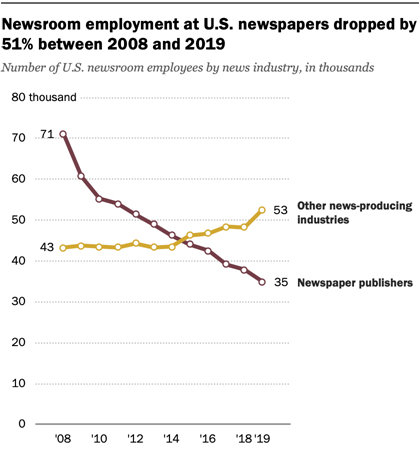
Pew Research reported that “U.S. newspapers have shed half of their newsroom employees since 2008

While print news has lost 36,000 employees, other parts of “journalism” have only added 10,000 for a net loss of 26,000. The BLS predicts that employment will continue to drop.

And the reality is much worse than the numbers because TV news has grown the most in raw numbers and TV news is much lower quality information than print news. TV emphasizes drama and emotion over analysis and research. There is much less depth and less editing. The priority in video is to get dramatic video footage, not to explain and inform.

Plus, the industry is shifting from expensive investigative reporting to more opinion. CNN and Fox news are the two most important sources of news for Americans and Fox has been gradually reducing its journalism and replacing them with opinion shows because opinion shows develop loyal followers whereas news consumers are fickle and go to wherever the current reporting is best about any particular story. Talk shows are cheaper and more consistently entertaining. There is never a “slow news day” on a talk show because outrage can always be generated. As a critic of CNN put it:

While CNN star anchor Anderson Cooper was a good reporter, he was boring. “Would you watch an old guy talk rationally about a topic? Bet you’d rather watch two hot chicks who are smart and who disagree, yell at each other”

So CNN replaced its CEO with Jeff Zucker who wanted to make it more entertaining. He let Trump dominate the “news” during the 2016 presidential campaign because Trump was so darn entertaining.  All that free “news” coverage boosted Trump to win the election without having to buy much advertising for his campaign.

Other “news” sources also seem to be moving towards more cheap opinion and fluffy human interest stories and away from investigative news too. The New York Times has elevated it’s expanded opinion section so that it fits on the online front page of the website.

As NassimTaleb wrote in Antifragile: Things That Gain from Disorder, the enormous explosion of information we have had is mostly an explosion of noise more than an increase in signal (truth).  The best way for anyone to get attention in the flood of information is to become more dramatic rather than more accurate, particularly when drama is much cheaper to produce than accuracy.

Who will do the kind of investigative journalism that really make the world a better place and the research that keeps democracy healthy and will it be enough to survive the flood of noise and drama that is more profitable?

Posted in Public Finance

Violence has been declining globally. Consider lynching in America.

Tuskegee University researchers looked for records of lynchings in newspapers published between 1882 – 1968 and generated this chart. The orange color are victims whose race is unknown. This isn’t a complete account of lynching victims. It is only a count of the ones that were recorded by newspapers and which were reviewed by the Tuskegee researchers. There were many more. For example, the Lynching in Texas project of Sam Houston University found public records of over 100 additional lynching victims in that state alone that Tuskegee had missed.

Tuskegee’s “white” category should be labeled “non-Black” because it also included Mexicans, Native Americans, Chinese, Jews, and Catholic immigrants. The KKK was rabid against Catholic immigrants and did not consider them white.  According to the Tuskeegee dataset, Texas lynched by far the most non-Black people, but most of them were Mexican-Americans according to the Lynching in Texas project. Many whites were lynched in Western states, and in the South there were also 148 black-on-black lynchings, 200 cases of white-on-white lynchings, and four incidences of black mobs killing whites recorded between 1882 and 1930.

The graph paints a picture of lynchings being common practice for meting out vigilante ‘justice’ against many races in 1882, but lynching soon morphed into a technique that was primarily used to terrorize Blacks in the South by 1900.

Lynching was such a celebrated part of life that participants paid professional photographers and made commemorative postcards to send to friends and family as you can see below. Photography was extremely expensive in at the time and was only afforded for commemorating particularly special occasions. Time magazine noted:

Even the Nazis did not stoop to selling souvenirs of Auschwitz, but lynching scenes became a burgeoning subdepartment of the postcard industry. By 1908, the trade had grown so large, and the practice of sending postcards featuring the victims of mob murderers had become so repugnant, that the U.S. Postmaster General banned the cards from the mails.

Naturally, given that lynchings were accepted as normal, nobody was punished for participating in a lynch mob. Arthur Raper investigated nearly one hundred lynchings and estimated that, “at least one-half of the lynchings are carried out with police officers participating, and that in nine-tenths of the others the officers either condone or wink at the mob action.” Despite being sanctioned by law enforcement, Arthur Raper’s study estimated that approximately one-third of the victims were falsely accused. Some mobs didn’t even correctly identify the person they lynched.

Lynchings were sometimes announced in newspapers to draw crowds and to give photographers time to prepare their equipment. Some attracted up to 15,000 people. Schools were sometimes cancelled and railroads sometimes ran special excursion trains to accommodate spectators. The photo below shows Jesse Washington, “a 17-year-old retarded black child“, who was killed by a crowd that was estimated at over 10,000 in Waco Texas in May 15, 1916.

They mayor initially resisted the mob which threatened to hang him for doing his job and trying to protect the unconvicted man. The lynch mob put a rope around the mayor’s neck and set the courthouse on fire in retaliation. Here is a later photo of Jesse Washington’s corpse showing a smiling youth among the people posing for a professional photographer behind Jesse’s charred remains.

Below is a postcard reading, “George and Ed SILSBEE HANGED by a MOB of CITIZENS IN FRONT OF JAIL. Jan. 20, 1900. Fort Scott Kan.” The back of the postcard advertised the photography studio that took the photo: J.V. DABBS PHOTOGRAPHER GROUND FLOOR STUDIO, Frames and Mouldings, 407 Market Street. FORT SCOTT, KANSAS.

This shows a mother and her fifteen-year-old son who were tortured by being dragged for miles before being hung for this commemorative postcard in Okemah, Oklahoma, in 1919.

Close to my home, Sheriff Sherman Eley was assaulted by a mob for not giving up the location of a Black man who was in custody.  Sheriff Eley’s home was ransacked, his sick infant daughter was taken as a hostage, and he was beaten to unconsciousness and suffered cuts and broken ribs.   The mob put a noose around his neck in downtown Lima and started to hang him, but a colleague stepped in and convinced Eley to tell where the ban was being held and he relented and told them that the Black man was being held at the Putnam County Jail.  The mob then drove to the Putnam County Jail, which would have likely been about an hour drive on the bumpy roads of the day.

They kidnapped Eley and took him with them, tied spread-eagle across the hood of a creamery truck they had commandeered.” Eley, “vomiting and slipping in and out of consciousness,” remembered little of it

Meanwhile the prisoner had been moved to Toledo and Eley escaped the mob.  Eley’s daughter Doris died soon thereafter. That was the last attempted lynching in Ohio, shown below.

limalynching 

My colleague, historian Perry Bush, researched this event and when the Lima News published a story about it in 2017, he learned that descendants of the people in the story had never heard anything about it. He also received a call warning him that some local people were offended and were threatening his safety, so the event was still raw a century later. 

The photo below shows well-dressed members of an Omaha, Nebraska lynch mob posing around the body of black man named Will Brown in 1919. The mob also attempted to hang the mayor and nearly killed him because the mob had been egged on by a rival political party that was stoking racial animosity in order to gain political power and defeat the mayor. Somewhere between 5,000 and 15,000 people participated in the lynch mob which also poured gasoline in the courthouse and lit it on fire and shot seven police officers in the frenzy of the lynching. Nobody served any term of imprisonment.

This kind of violence had probably been going on for centuries so the big question is why has it become so much rarer in the past century. Although there is less documentary evidence going farther back into the mists of history, there is still plenty of evidence for public executions and mob violence. The Salem witchcraft trials, the Boston tea party, and on and on. Steven Pinker has done the most thorough analysis of the decline in violence over the centuries. The world is much less violent today along most dimensions. For example, America is MUCH less likely to execute people.

in the United States in the 17th and 18th centuries, the death penalty was prescribed and used for theft, sodomy, bestiality, adultery, witchcraft, concealing birth, slave revolt, counterfeiting, and horse theft. We have statistics for capital punishment in the United States since colonial times. As you can see, in the 17th century a majority of executions were for crimes other than homicide. In current times, the only crime that is punished by capital punishment other than homicide is conspiracy to commit homicide.

The death penalty itself, of course, has been abolished in most of Europe… Currently, only Russia and Belarus have it had on the books.

But interestingly, even before capital punishment was abolished by the stroke of a pen, it had fallen into disuse. You can see that the percentage of European countries that actually carry out executions has always been far lower, and the decline began much earlier.

…Now the United States, of course, notoriously is the only Western democracy that has capital punishment (though only in two-thirds of the states), a number that has been dwindling. And to say that the United States has the death penalty is a bit of a fiction. If you look at the number of executions as a proportion of the population, it has been plunging since colonial times. Today, out of about 16,500 homicides per year, there are about 50 executions, and that rate has been in decline as well.

Here is a rough estimate of the homicide rate in New England from the National Academies:

And here is a graph from Claude Fischer (or see Lane Kenworthy)

We have longer-term data for homicide in Europe. Here is data from Michael Eisner. It is on a log scale so it diminishes the true decline in the homicide rate which is over 50 fold.

Bill Gates notes that Americans don’t just hurt each other a lot less, we also talk a lot more about rights:

Use of the terms civil rights, women’s rights, children’s rights, gay rights, and animal rights in English-language books, 1948-2000. These staggered rises tell a story. Each of the movements took note of the success of its predecessors and adopted some of the tactics, rhetoric, and most significantly, moral rationale. The Rights Revolutions have brought us measurable and substantial declines in many categories of violence.

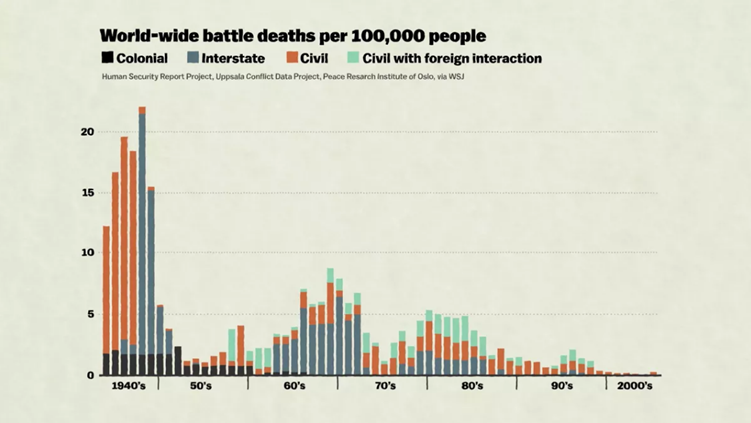
Plus, worldwide deaths in warfare have been declining too:

Posted in Violence & Peace

Do we have a responsibility to develop more millionaire superheroes?

Peter Singer’s book called The Life You Can Save is about one of his most famous thought experiments:

Suppose on a walk you notice a young girl drowning in a lake. If you can swim, and you can save her life if you immediately jump in, you will feel some obligation to do so even if that will ruin a new suit worth $500. Singer points out that we wouldn’t think twice about ruining a pair of shoes that costs us hundreds of dollars. Peter Singer points out that it is irrational that people don’t feel any responsibility to spend the same amount on charities that can save the life of a child in a developing nation when we wouldn’t hesitate to ‘spend’ that amount by jumping into a lake to save a child.  Most of us in the rich world have the power to spend a few hundred dollars on those kinds of charities and instead we buy expensive clothes and other luxuries. 

If you do not have hundreds of dollars to give to these charities, you have no responsibility just like you would have no responsibility to save the drowning girl if you could not swim. You obviously have no responsibility to do something if you don’t have the power to do it. Thus power creates moral responsibility and the absence of power absolves it.

I’ve been documenting the lives of some remarkable people who have probably saved millions of lives through a breakthrough like vaccines and oral rehydration therapy and sanitation. Today those breakthroughs have given us both the power and the moral responsibility to use them rather than stand by and let millions of people die.

If someone had come up with these breakthroughs thousands of years ago, hundreds of millions of more lives could have been saved over the millennia.* For similar reasons, we now have an obligation to speed up lifesaving breakthroughs by spending a lot more on research to save more lives in the future. If we could produce another millionaire superhero a year sooner, it could save thousands more lives.

We aren’t doing nearly as much as we could be doing. Federal R&D spending was over three times higher in the 1960s as a percentage of national income. Plus, the majority of federal R&D spending has always been spent on a combination of military and space research which probably has a lower payoff for health and wellbeing than research on health and wellbeing.

For thousands of years there was no sustained progress in median living standards nor life expectancy until a couple centuries ago beginning in Europe.  Then know-how began growing faster than ever before and that changed everything.  Now productivity is stagnating again and part of that is due to stagnating investment and stagnating research

Just as people don’t feel the responsibility to save a child on the other side of the planet, we don’t feel the responsibility to save lives in the future by investing in our capacity to save lives and technologies to make the future better.  We even feel little responsibility to stop our environmental destruction that is making the future worse!


*Ok, some of you are probably thinking about the Malthusian equilibrium and worried that reducing mortality earlier might have caused overpopulation earlier, but I doubt it would have been much problem because there was always tremendous overpopulation. The world was close to the Malthusian equilibrium for almost all of history until a couple centuries ago. Plus, a reduction in mortality rate naturally brings down the human fertility rate because families adjust when more kids survive and when mortality declines, people naturally invest more in education and are more attracted to urban living which also reduces fertility and increases productivity.  It is a virtuous cycle with little demographic risk given that overpopulation was always a serious issue.

Posted in Millionaire Superheroes, Philosophy and ethics

How social media technologies took advantage of our psychological weaknesses and created an accidental revolutionary movement.

Netflix has a great documentary called The Social Dilemma about how social media companies are using algorithms and artificial intelligence to manipulate and addict us in order to make money. They might not have developed artificial intelligence to the point where it is better than human strengths, but they have already achieved increasing mastery over manipulating human weaknesses. This fundamental change in how people communicate and what we spend time thinking about is remaking society and has led to a rise in extremism everywhere.  In some places it has even caused genocide.

Ben Smith has been an eyewitness to this transformation of our media ecosystem as one of the founders of BuzzFeed because BuzzFeed was a pioneer at using social media to get attention. He tells the story of two of the most successful social media stars at BuzzFeed who moved on to become influencer entrepreneurs of the sort of right-wing voices that caused the assault on the capital last week. This story tells a lot about how the profit-seeking social media algorithms that thrive on pushing emotional “engagement” have produced this new political phenomenon that led to the riot in the capital building.

He fit in as well as anyone did at our Los Angeles studio, a place full of ambitious misfits with an unusual gift. They knew how to make web videos people wanted to watch.

His real name was Anthime Joseph Gionet, though he preferred others. His value to BuzzFeed was clear: He’d do anything for the Vine, the short video platform that had a brief cultural moment before being crushed by Instagram and Snapchat…

Once, he poured a gallon of milk on his face and a clip of it drew millions of views, back when mostly harmless stunts amused millions of American viewers on the platform.

He was, in that way, a natural for BuzzFeed when he arrived… and his job mostly consisted of editing down to six seconds the silly, fun videos… Within months, he took over a BuzzFeed Twitter account, too, drawing on his same intuition for what kind of video people would share.

We were better than anyone in those days at making things for social media… occasionally spectacular live streams, most famously the one where two of my colleagues exploded a watermelon, one rubber band at a time.

And so the language I heard from Mr. Gionet, now 33, on his livestream last Wednesday was familiar. “We’ve got over 10,000 people live, watching, let’s go!” he said excitedly. “Hit that follow button — I appreciate you guys.”

Mr. Gionet was standing inside the trashed office of Senator Jeff Merkley of Oregon, streaming from one of the few platforms yet to ban him, alongside other Trump loyalists who played with the telephone receiver and draped themselves over the furniture. It seemed an apt conclusion to a recent career arc that some might see as trolling or internet pranks, but is probably best described as performative violence.

After I saw Mr. Gionet, I called up some of my old colleagues, who recalled him with a mixture of perplexity and repulsion. He was sensitive and almost desperate to be liked, they said, once getting extremely upset when someone made fun of his thick mustache and blond mullet. Two of his closest friends at the office at the time had different ethnic backgrounds and gender identities than he did, and they sometimes bonded over a sense of being outsiders. One… remembered him as a sad character who didn’t really express political views beyond the broadly bro-ey and insensitive culture of Vine, and… confided that he was haunted by a lonely childhood in Alaska. He seemed, three of them said, to be missing something — to be hollow inside.

As the 2016 election took hold, he started to flirt with a political persona. He first put a Bernie Sanders portrait on his desk…. Then, he moved on to wearing MAGA hats around the office, which raised eyebrows among his… fairly apolitical, co-workers, though that was when some people still imagined the far right could be “ironic.”

When he left BuzzFeed… to work as the “tour manager” for Milo Yiannopoulos, a darling of the racist and anti-Semitic “alt-right,” colleagues were momentarily shocked…

Still, it’s not clear what Mr. Gionet actually believes, if anything. And really, I’m not sure I care.

…I can’t muster much pity for a guy who, before he was attacking his Capitol, spent his time shooting some kind of bottled irritant (he called it “content spray”) into the eyes of innocent people for YouTube views and shouting at store clerks who asked him to wear a mask.

To me, this story is about something different, a sort of social media power… that can exert an almost irresistible gravitational pull.

If you haven’t had the experience of posting something on social media that goes truly viral, you may not understand its profound emotional attraction. You’re suddenly the center of a digital universe, getting more attention from more people than you ever have. The rush of affirmation can be giddy, and addictive. And if you have little else to hold on to, you can lose yourself to it…

[For] Mr. Gionet… The only through line was his desire to build an audience. He was boosting Bernie Sanders before he was chanting anti-Semitic slogans in Charlottesville, Va., then temporarily recanting those extreme views and later committing violent crimes to get views on YouTube. He built an audience among coronavirus deniers and then, when he apparently contracted the disease, posted the screenshot of his own positive test to Instagram with a tearful emoji. A few weeks later, he joined the pro-Trump uprising in the Capitol.

“His politics have been guided by [viewing] metrics,” reflected Andrew Gauthier…
“You always think that evil is going to come from movie villain evil, and then you’re like — oh no, evil can just start with bad jokes and nihilistic behavior that is fueled by positive reinforcement on various platforms.”

And so Mr. Gionet’s story isn’t quite the familiar one of a lonely young man in his bedroom falling down a rabbit hole of videos that poison his worldview. It’s the story of a man being rewarded for being a violent white nationalist, and getting the attention and affirmation that he’s apparently desperate for…

When he was arrested in Scottsdale, Ariz., last month for spraying mace into the eyes of a bouncer, an officer reported that Mr. Gionet “informed me that he was a ‘influencer’ and had a large following on social media,” according to a police report. He was released on his own recognizance, a Scottsdale police spokesman said, and is awaiting trial…

I didn’t work directly with Mr. Gionet. But in 2012, I did hire a writer named Benny Johnson who was cultivating a voice that blended social media savvy and right-wing politics. I thought, wrongly, of his politics at the time as just conservative…

I was slow to realize that his interests weren’t journalistic, or even ideological, as much as they were aesthetic, thrilled by the imagery of raw power. In the tradition of authoritarian propagandists, he was awed by neoclassical buildings, guns and, later, Donald Trump’s crowds. And, after we fired him for plagiarism in 2014, he went on to lead the content arm of Mr. Trump’s youth wing, Turning Point USA, and host a show on Newsmax. Last week, he was cheerleading attempts to overturn the election (though he pulled back… and later blamed leftists for it). He’s also selling his skills in the “viral political storytelling” … to a generation of new right-wing figures like Representative Lauren Boebert, who has won attention for vowing to bring her handgun to work in Congress…

While we were refining the new practice of social media at BuzzFeed, we were slow to realize that the far right was watching closely and… imitating us… Steve Bannon, who ran Breitbart, recalled to a writer… that he was surprised we hadn’t turned BuzzFeed to pure Bernie Sanders boosterism, as Breitbart did for Donald Trump. He noted, probably correctly, that the traffic for a pro-Sanders propaganda outlet would have greatly exceeded what we got for fair coverage of the Democratic primary…

I’m already hearing what seem to be two competing explanations of what happened in Washington last week: that the overwhelmingly white, sometimes overtly racist, mob embodied old, deep unexpurgated American evil; or that social media reshaped some Americans’ blank slate identities into something radical.

But Mr. Gionet’s story shows how those explanations don’t really conflict. A man his colleagues saw as empty and driftless turned his identity into a kind of a mirror of that old American evil, and has become what many Americans told him they wanted him to be.

At one point in Mr. Gionet’s livestream during the siege of the Capitol, an unseen voice off camera warns that President Trump “would be very upset” with the antics of the rioters.

“No, he’ll be happy,” Mr. Gionet responded. “We’re fighting for Trump.”

This story helps explains why the mob attack on the capital was so performative and so many participants were wearing GoPro cameras and carrying selfie sticks. Many were obsessed with selfies and live streaming for their followers on social media who were egging them on. But the result was not just theatrical.  It was deadly. Their attack in the capital building left five people dead and at least 50 police officers injured. By comparison, the last mob assault on a federal building that killed people was in Benghazi.  The Benghazi attack actually resulted in fewer Americans getting killed and much fewer injuries.  The failure to protect Benghazi led to over two years of congressional inquiries and was still a major issue during the 2016 presidential election, four years later. 

It is fortunate that the mob of misguided Trump fans who broke the law to seek attention at the Capital weren’t enabling more hard-core terrorists. If it happens again, the hard-core terrorists will be better prepared to take advantage of the situation and we might not be so fortunate.

Posted in Pence2018

Enter your email address to follow this blog and receive notifications of new posts by email.

Join 75 other subscribers
Blog Archive
Pages