
Keynesians don’t understand their own theory when they leave out hoarding

Updated 10/31/2016

Mathematical economists are attracted to equilibrium solutions like moths to a flame.  One reason is because mathematicians like the aesthetic beauty of finding a unique solution to a mathematical puzzle.  An equilibrium is a solution where everything is in perfect balance.  Recessions are unpleasantly messy to model mathematically because a recession is a disequilibrium which requires uglier math.  Perhaps that is why mathematical macro models have a long history* of emphasizing equilibrium rather than disequilibrium (recession).

For example, one would think that basic Keynesian equations would demonstrate disequilibrium, but the standard, textbook Keynesian equation that begins every macro course is an equilibrium equation:

Y=C+I+G+NX

Y = GDP = expenditures on newly-produced final goods and services  = income
C = Consumption spending by households
I = Investment spending by firms.  Confusingly, this is completely different from the usual way English speakers define ‘investment’.  Most people consider their savings to be investment, but here investment (I) is expenditures by firms on durable goods in hopes of generating future profits.  It is mostly capital goods that will increase future productivity like factories and tools and inventory that can be sold later.
G = Government expenditure.
NX = Net eXports = eXports (X) – iMports (M).

The Keynesian equation for savings is also an equilibrium equation:

S = Y – T – C

S = “Savings” but economists really mean “lendings.”
Y = Income (as in the first equation above).
T = Taxes (net of transfer payments like Social Security that are paid back to households).
C = Consumption by households (as above).

There is no hoarding possible in this standard Keynesian model and yet hoarding is what explains recessions, so these archetypal Keynesian equations don’t make any sense for modeling the basic Keynesian story.  When you begin by writing equations that assume equilibrium, you will end up in equilibrium and that is why economists, including Keynesians like Paul Krugman, and quasi-monetarists like Nick Rowe say that it is an economic ‘law’ that savings always equals investment: S≡I**.  But S=I is another equilibrium condition.  It is ridiculous to assume that S≡I because if that were true then there could not be recessions.

It would be possible for savings to equal investment because that is true in a barter economy without any credit nor money (because money is a form of credit).  Without credit, one cannot save=lend money and then the only way to save (S) is to produce durable goods that are not immediately consumed.  In this case, savings always exactly equals investment (I) because investment is defined as an increase in the stock of durable goods including inventory (such as a stockpile of canned food) or the production of tools and infrastructure. Most people think investment means putting money into stocks and bonds and mutual funds, but that is not how it is defined in Macroeconomics.  In macroeconomics, putting money into banks or bonds is a form of savings (S) which is really defined as lending money to someone else.  Investment is defined completely differently from saving=lending; it is the creation of durable goods inventories and capital equipment with the intention of increasing future consumption.

Some macroeconomics textbooks assert that S=I because they are implicitly assuming a barter economy or else they are assuming that there is no hoarding.  But in an economy with credit (and money is just one form of credit), there can also be hoarding (H), so now the equation should be S=I+H.  Since the advent of capitalism, credit (a.k.a. debt) values have been rising faster than the value of real assets like land and capital goods.   Credit Suisse estimates that total global financial wealth has been larger than non-financial (real) wealth from 2000-2015 except in 2008 when the financial crisis caused much of the financial wealth to collapse.  In modern economies, one person’s financial wealth is another person’s debt.  Some debt is used to finance investment in creating new inventories and capital, but unlike in a barter economy without credit, the presence of money and debt/credit means that savings can exceed investment because money can be hoarded.

The only way to explain recessions is to modify the standard equation by adding hoarding:

S = I + H

H = Hoarding.  Recessions are caused by an increase in hoarding.

In a monetary economy, in order for savings to equal investment (S≡I), all savings (S) must be lent out to people who spend it on creating investment goods.  But that is a weird assumption!  There are lots of places for savings to go without creating investment goods.  For example, it is possible to save money without lending it to anyone and that is what hoarding is.  I can hoard my money by burying it in a jar in the back yard or stuffing it into my mattress.  That is saving money without lending it out to anyone. Hoarding creates a kind of leakage of money out of the circular flow of the economy.

In contrast, lending does not leak money out of the economy because the money (and market demand) is merely transferred from the savers to the borrowers who will spend the money on something productive.  Lending does not reduce GDP because lending requires an interest payment and that gives a strong incentive for the borrowers to spend the money (not hoard it) because they are paying for the privilege of borrowing it.  The only rational reason to pay interest for borrowed money is if the borrowers have an idea for spending the money that will yield profits that are bigger than the interest payments.

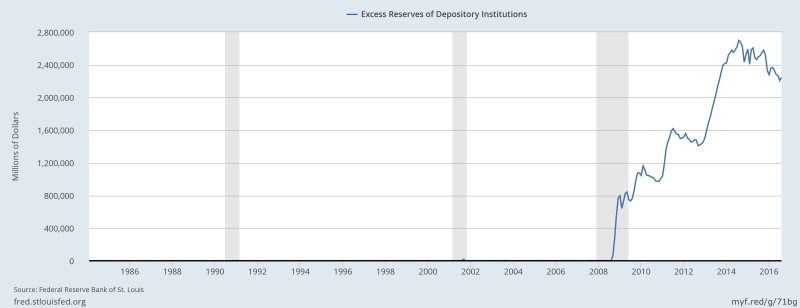
When you save money by putting it into your bank account, you are really lending the money to the bank, but if the bank doesn’t lend it out, then the bank is hoarding the money.  That has been a huge problem since the financial crisis of 2007.  Banks have been hoarding money in excess reserves.  The FRED graph below shows that banks hoarded a peak of 2.8million million dollars (or 2.8 trillion dollars).
excessreserves

The equations below are the standard textbook model of the economy in black type, but the standard equations are always in equilibrium and cannot explain recessions.  With my simple additions in red type it is easy to illustrate how recessions happen.

1.   Y = C + I + G + NX

Equation 1 shows the real market values of the production of real goods and services.  The production is broken down on the left side of the equation according to who buys each part: households (C), firms (I), government (G), and foreigners (NX).  To simplify things, I will assume that the trade balance equals out exports and imports so that NX = 0.  That way we can ignore NX so we get a slightly simpler equation:

1.1.    Y = C + I + G

Whereas equation 1 measures the monetary value of real goods and services, the next classic textbook equation looks at pure financial flows:

2.  S = Y – T – C

This classic equation for private savings assumes that firms do not save which is unrealistic because the US corporate cash hoard was $1.68 trillion in 2016, but firms as a whole have tended to be net borrowers, so it is usually a reasonable simplification.  The equation says that Savings are equal to Income from the sale of newly-produced goods minus Taxes and Consumption.

But this equation leaves out the possibility that some income is hoarded.  The equation implicitly assumes that savings equals lendings, but that is wrong.  It is possible to hoard money without lending it out.  The equation should be:

3.   S = Y – T – C – H

H = Hoarding: financial assets that are neither spent nor lent out.
S = Lendings: financial assets that are lent to someone else.

If you rearrange equation 3 to solve for Y you get:

4.   Y = C + S + T + H

This is almost the same as equation 1 because in long-run equilibrium H≈0.  In the very long-run this should be approximately true because the financial flows (S & T) must pay for the flows of real goods and services (I & G).  Savings will eventually equal Investment (S ≈ I) and Taxes will eventually equal Government spending (T ≈ G).  So in equilibrium, equation 4 is the same as equation 1.1:

Y = C + S + T = C + I + G

But equation 4 differs from equation 1.1 because in the short run, such as in any given year, savings does not have to equal investment because of hoarding.  Equation 4 adds a term for short-term leakage: H.   In equation 4, S, H, and T are purely financial movements and Y and C represent both financial flows and the market value of real goods and services that are produced as in equation 1, so we can combine the two equations.  Substitute equation 4 into 1.1 to eliminate Y and you get:

5.   C + S + T + H = C + I + G

Cancel out the two Cs in 5, and rearrange:

6.   I – S – H = T – G

You can eliminate government spending (G) and taxes (T) if you define S to include both government and private savings because government savings is T-G.  Or, if the government has a balanced budget (G=T), these terms would also cancel out to get:

7.   S = I + H

This equation makes more sense with both the English meaning of savings (which can be either hoarded or lent) and with the Keynesian-monetarist story where hoarding of money causes recessions.  For example, if people increase hoardings, ceteris paribus, the amount of investment must decrease according to equation 7 and that will cause GDP to decline:

8.  ↑H→ ↓I → ↓Y

Of course, equation 7 assumes that everything else in the economy is held constant, so it would also be possible for the increase in hoarding to reduce consumption instead of investment, but economics mostly just cares about the effect upon GDP (Y) and the recession would be the same regardless of whether hoarding reduced investment or consumption.  Although hoarding undoubtedly does directly impact consumption too, it is a reasonable simplification to assume that hoarding only directly affects investment because investment is by far the most volatile component of GDP and it is the main driver of US recessions, so equation 8 is fairly realistic in omitting consumption.  Additionally, all economists agree that a reduction in GDP during a recession tends to reduce consumption, so it is reasonable to add consumption to the end of the chain of causation: ↑H→ ↓I → ↓Y → ↓C.

Keynesians typically say that a rise in savings causes a recession, but that makes no sense in their model which assumes S=I. They implicitly define savings to mean lendings and assume that lending all goes to finance business investment.  But it is a rise in hoardings that causes recessions, not savings.  An increase in savings must decrease consumption by definition, but if hoardings don’t increase, then there is no problem because investment must increase exactly as much as consumption decreases.

To make this static model more realistic, it should show some passage of time.  An extremely simple way to do that is to use subscript numbers for two periods: 1 & 2.  Now we can demonstrate that income from period 1 (Y1) must go in period 2 into consumption, investment, government, and hoardings:

9.   Y1 = C2 + I2 + G2 + H2

The left side of equation 9 is income from the past period of time (subscript ‘1’) and the right side of the equation shows the categories where past income will go in the current period of time (subscript ‘2’).  A recession happens if the sum of (C2 + I2 + G2) have lower real value than Y1.  That can happen if there is a demand shock: hoarding (H2) rises in period 2.

Supply-Shock Recessions

Most recessions over the past two centuries have been caused by increases in hoarding which has decreased demand, but recessions could also be caused by a supply shock which reduces real productivity in period 2. In this case, the economy would produces less goods and services despite spending just as much money. That should cause prices to rise because there is are fewer things for the money spent on C2 + I2 + G2.

These kinds of supply shocks were the usual cause of recessions in subsistence agricultural economies where most people worked in agriculture.  In primitive societies, when a drought caused a drop in productivity, hoarding would actually drop because people would want food more than money and people would spend their hoarded money on fewer products which would increase inflation (prices).  Real GDP (Y) would decrease anyhow because there would simply be fewer goods being produced (↓Y).  When the same amount of money chases fewer goods, prices must rise:

10.  (↓Y1)/M1  →  ↑(M1/Y1) = ↑P

A price (P) is just an amount of money (M) divided by the goods that the money bought.   The aggregate amount of goods bought in period 1 is Y1 and the aggregate amount of money spent in period 1 is M1.  so the price level (P) in period 1 is higher than in the previous period if the quantity of output (Y) is lower than before.

The ironic thing about the archetypal Keynesian model of the economy (equation 1) is that it is not a Keynesian model at all.  It is really more like a holdover classical general-equilibrium model* where demand-shock (hoarding) recessions are impossible and all recessions were caused by supply shocks like crop failures.  That was understandable for the early classical economists who lived in agricultural economies where the weather really did cause a lot of recessions, but since the industrial (capitalist) revolution, most recessions have been due to demand shocks (hoarding).  Keynesians have still been trying to tell stories based on the old classical model to yield Keynesian results, but they should really just change the model itself.  Fortunately, it isn’t hard to turn it into a Keynesian equation by adding hoarding.  Why isn’t this the standard textbook model?

Wicksellian Loanable Funds Model

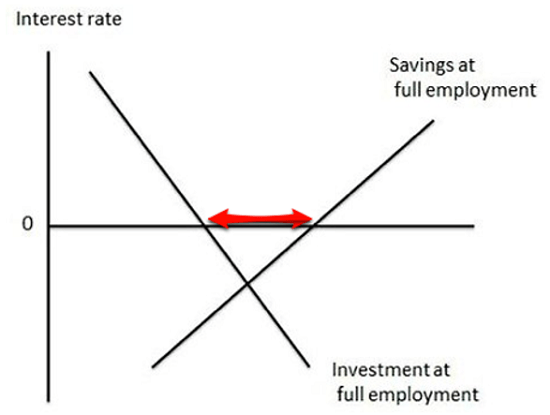
Knut Wicksell helped develop the monetary theory of recessions way back in the late 1800s because he understood the problem of hoarding.  In his model, a recession happens when the interest rate is too high.  He defined the natural interest rate as the rate that eliminates hoarding.  If the interest rate was above the natural rate, then people would hoard money which would cause unemployment and recession.  In the graph below, the red arrow represents the amount of hoarding, and the interest rate where the diagonal lines cross would have no hoarding because savings equals investment at that point.
wicksellian interest rate

In Wicksell’s model, if the interest rate is too high, S>I and the gap between the two is the amount of hoarding.  Unfortunately, this crucial  idea is only partially incorporated into Keynesian analysis.  Zoltan Jakab & Michael Kumhof argue that the standard loanable funds model doesn’t make sense because it ridiculously implicitly assumes that banks transfer goods from savers to borrowers in a kind of barter system.  In a barter system like that, hoarding would be impossible.  In reality, banks create money and whenever you have money, it can easily be hoarded which causes recessions.

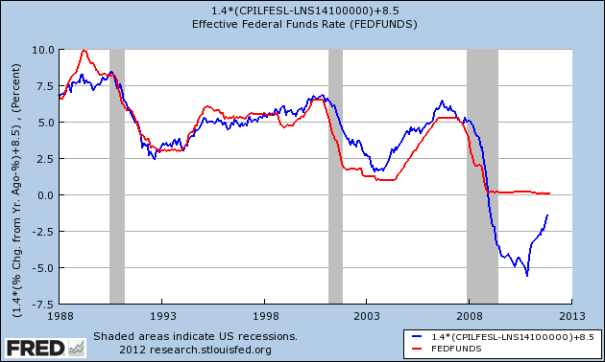
Fortunately, the hoarding version of the loanable funds model is implicitly incorporated into the liquidity trap models of monetary policy.  President Bush’s chief economist, Greg Mankiw understood this when he calculated that the appropriate Federal Funds interest rate that could have largely avoided much of the 2008 recession was below zero. In Mankiw’s graph below, the blue line shows the interest rate that Mankiw thinks would have minimized hoarding and the red line shows the actual interest rate that the Fed maintained.
liquidity trap interest rate

The problem during the recession of 2008 was that the Fed cannot make the interest rate go below zero.  This situation is called a liquidity trap: when the Fed is trapped because it already cut the interest rate to zero and it cannot reduce interest rates more because nominal interest rates don’t go below zero and that causes excessive hoarding.  ‘Liquidity’ means the quantity of money in circulation and when the interest rate is zero, the Fed cannot increase liquidity because when it pumps more money into the banking system, the banks just hoard it rather than lending it out.  Hoarded money isn’t really part of the money supply.

Disinflation and hoarding.

Most recessions in modern (industrialized) economies have been caused by hoarding which tends to cause inflation (prices) to drop.  When people take money out of the economy and hoard it, there is more output per each dollar being spent which implies disinflation or deflation.

11.  Y2/(↓M2)   →   ↑(Y2/M2)   →   ↓(M2/Y2) = ↓P

Equations 10 and 11 illustrate how hoarding relates to the “quantity theory of money”:

12.  MV=PY

V = Velocity of money:  a measure of how often each dollar of money is spent on average. I simplified equations 10 and 11 by setting V=1 which means that each dollar was spent once (on average).

Velocity usually doesn’t change much, so we can mostly ignore it.***  Thus when there is an increase in hoarding, that effectively decreases the amount of money (↓M) which must decrease the amount of nominal GDP = ↓(PY).  Because prices (P) tend to be sticky, hoarding usually causes real GDP to drop (↓Y) rather than causing a drop in prices (deflation), but sometimes there is some of both.

Footnotes:

*Historical examples of macro models that tried to show general equilibrium include Léon Walras’ Elements of Pure Economics, Arrow-Debreu‘s general equilibrium, and real business cycle theory.  John Cassidy explored the tendency of mathematical economists to look for equilibrium in his excellent book including chapters entitled “the mathematics of bliss” and the “perfect markets of Lausanne.”  Microeconomic models also tend to assume equilibrium by incorporating ideas like “nonsatiation” which means that people always want to consume more.  Nonsatiation is the antithesis of Keynes’ idea of hoarding.  Mr Keynes actually wrote a lot more about ‘hoarding’ than ‘saving’ in his 1937 essay The General Theory of Employment, but he never formalized his ideas into equations.  In 1937 Keynes wrote that he expected others would collaborate on how to express them into equations:

I am more attached to the comparatively simple fundamental ideas which underlie my theory than to the particular forms in which I have embodied them, and I have no desire that the latter should be crystallized at the present stage of the debate. If the simple basic ideas can become familiar and acceptable, time and experience and the collaboration of a number of minds will discover the best way of expressing them.

Classical macroeconomics had been based on equilibrium models at the time and other economists took Keynes’ stories and tried to translate them into math.  The “Keynesian” equations were most notably authored by John Hicks in an essay titled “Mr. Keynes and the Classics” in which Mr. Hicks tried to make sense of Keynes’ ideas using classical frameworks.  Classical economics had assumed that S=I so perhaps that is how this pernicious idea entered the standard Keynesian model.  Let me know if you find evidence that this is how it happened.

**All economists realize that S=I is actually a simplification that assumes a closed economy with zero net exports (NX). So S=I isn’t really a law even by the standard model which really says:

S-I=NX    (Savings-Investment = NetExports)

I left out international trade as a simplification and it isn’t a particularly bad simplification for a large economy like the US because NX usually doesn’t change much as a percent of GDP in large economies.

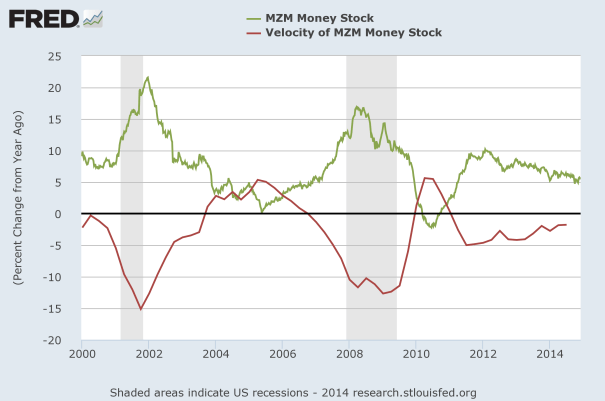
***Although economists tend to ignore velocity as though it were a constant, official measures of velocity occasionally appear to fluctuate greatly.  But velocity is never directly measured so nobody knows how much it really fluctuates.  Velocity is calculated using a rearranged equation 12: V=PY/M.  We directly measure  the other three variables (P,Y,&M), and use them to calculate V.  But because we do not directly measure V, it’s calculation is influenced by measurement errors in all the other three variables.  One way to explain drops in our calculations of velocity is that they are probably caused by jumps in hoarding which is also unmeasured and when hoarding rises, the effective money supply falls.  Our measurements of M cannot account for how much of the money is being hoarded, so we cannot measure when hoarding rises and economists tend to forget that it exists!  Rather than infer hoarding, economists infer that a decrease in nominal GDP is due to a drop in velocity which they calculate based on equation 12.  It would be more reasonable to assume that it is due to an increase in hoarding because there is no direct evidence that people suddenly become slower to spend money (↓V) during recessions.
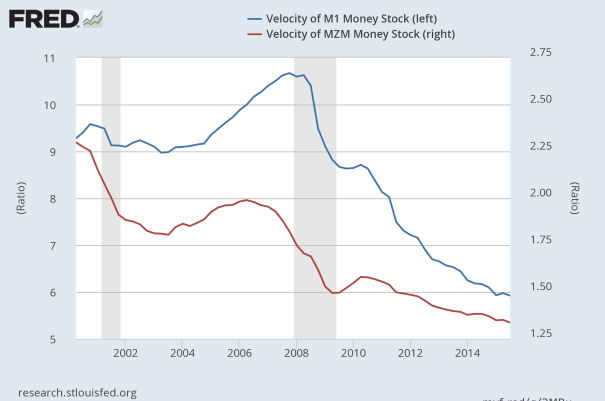
velocityA more intuitive explanation is that hoarding rises during the recessions (shaded columns) which shrinks the remaining effective money supply.  An alternative interpretation is that a decrease in velocity (holding on to money longer and spending it more slowly) is just another way of hoarding money.
Posted in Macro

Do Monetarists Understand Their Own Models?

I have learned a lot from Nick Rowe.  For example, he wrote a great post where he pointed out a place where many Keynesians don’t understand their own models.  But the following section suggests that Nick doesn’t completely understand his own monetarist model either.

Keynesian unemployment only makes sense as a monetary phenomenon. What’s fiscal policy got to do with it? Fiscal policy is supposed to be about micro stuff, like providing the goods that the government is better at providing. Fiscal policy can’t do that micro stuff properly if it’s being asked to also do the job that monetary policy is supposed to be doing. …The trouble with Keynesians is that they aren’t radical enough. They need to look at their own models and see the root of the problem, and recommend policies to get at the root of the problem. The root of all Keynesian recessions is monetary.

The trouble with monetarists who don’t understand their own models is that both the Keynesian and the monetarist mechanism for solving recessions is one of redistribution of financial resources from hoarders to spenders.  As I wrote in an earlier post on this topic, monetary policy and fiscal policy both work the same way and if policymakers don’t understand how they work, they often attempt fiscal and monetary expansions that don’t work at all.  For example, if the Fed tries to expand the money supply by giving more money to the banks when they don’t want to use more money, then they will simply add it to their hoards and nothing will happen in the real economy.  Monetary policy only works if it redistributes some financial resources from hoarders to spenders.  This is generally what happens when the Fed successfully lowers interest rates, raises inflation, or how a “helicopter drop” would work if it directly distributed newly printed money to the spenders.  But a helicopter drop of money that goes to wealthy people like Bill Gates wouldn’t work because they are already spending about as fast as they can.  Similarly if the government performs Keynesian tax cuts by cutting taxes on people who are already hoarding money, they will probably just hoard the additional tax rebate too.  When the government increases the deficit, it tends to borrow some of the money that had been hoarded.  As long as the government redistributes that money from the hoarders to spenders, the economy will grow.  Government spending is always spent, so deficit-financed spending will always help even if some kinds of government spending have a higher multiplier than others.

One way that expansionary policy serves to redistribute resources is by changing the hoarders’ expectations about the future which induces them to spend.  A change in expectations is a change what they expect the future distribution to be and that causes them to voluntarily redistribute their own resources from hoardings to spending in the present.  For example, if the hoarders expect higher future inflation (an expected future redistribution away from the value of their hoard), they will want to spend more of their hoard or they will lend it to people who are willing to spend it and pay interest.

The only way fiscal and/or monetary policy can work to reduce a recession is if money is redistributed from the hoarders to the spenders.  The real difficulty with  ending recessions is political.  The hoarders are afraid of redistribution and they have the funds to buy influence.  That makes it difficult to find the political will to redistribute resources to the spenders.


Posted in Macro, Medianism

The Streetlight Fallacy

The Streetlight Fallacy is a kind of informal fallacy in which people over-emphasize readily-available information even though it is clearly wrong instead of looking for the right information.  It is a version of the availability heuristic, except that in the streetlight fallacy, one realizes that the available information is wrong and simply gives up on looking for the correct information.  The name of the fallacy comes from a joke that is often told by economists.  Here is a version from David H. Freedman.

Late at night, a police officer finds a drunk man crawling around on his hands and knees under a streetlight. The drunk man tells the officer he’s looking for his wallet. When the officer asks if he’s sure this is where he dropped the wallet, the man replies that he thinks he more likely dropped it across the street. Then why are you looking over here? the befuddled officer asks. Because the light’s better here, explains the drunk man.

One of the places that economics falls into the streetlight fallacy is in welfare economics.  Economists going all the way back to Adam Smith have often promoted maximizing the production of goods and services, as measured in money, as being efficient.  Luke Froeb says that efficiency is “the Holy Grail of economics.”  But this is just the cult of GDP and I call it mmutilitarianism: money-metric utilitarianism.  Instead of maximizing the sum of utility, it is simply maximizing the sum of money-measure production.  As I mentioned in an earlier post, the efficient way to run Social Security is to exterminate people when they get too old to work and eat them.  That would be more efficient than having a bunch of old people around who are planning to never produce any marketable goods and services.  And if slavery induced people to work harder and produce more than paying them wages, as Robert Fogel famously argued, then slavery is more efficient than markets!  (I don’t believe slavery really is efficient, but I could be wrong.)

Of course, any ethical system that could recommend slavery and cannibalizing our elders is a bad ethical system.  So why has mmutilitarianism captured the economics discipline?

Mmutilitarianism is partly a product of the lamppost fallacy.  Utilitarianism was probably the most common ethical system in economics until the ordinal revolution of 1934-1960.  Then the “new welfare economics” tried to base economics on Pareto efficiency, but that was such a vacuous standard that in practice, economists have gone back to a form of utilitarianism which measures utility in money at market valuations.  And we know it is a bad ethical system if we just think about it for a second, but economists use it anyway because it is easy to measure the accumulation of goods and services and it is harder to measure other things that we care about like justice or freedom or utility (happiness).

Medianism is a small improvement over mmutilitarianism.  It is still just another streetlight that illuminates easy-to-measure information, but at least the streetlight is a little closer to the neighborhood where we really want to look for our ethical ideal.

Posted in Medianism, Philosophy and ethics

The Fed is of the banks, by the banks and for the banks.

Brad Delong recently remarked that it is “good to know” that the Fed doesn’t have a double mandate (1. fight inflation, 2. fight unemployment), but rather a triple mandate (3. keep the financial system strong and stable).  The idea the the Fed has only a dual mandate is a common misconception that is perpetuated in the standard economics textbooks.  As I posted earlier, if you bother to look at the Fed’s charter and mission statement, it is clear that the ‘new’ mandate that Delong just noticed has always really been the Fed’s primary job.  The Fed was created during the gold standard when there was little it could do with monetary policy to stabilize inflation and unemployment, so its original charter was almost purely to help the banks.  The so-called “dual mandate” is really just an afterthought that was added later when monetary policy responsibilities were added to the Fed’s main responsibilities helping the banks.   The banks help choose the people who run the Fed, and some of these people come through the rotating door from bank employment to the Fed and go back to the banks after working at the Fed.  So the Fed’s ecological niche in the political landscape is firmly ensconced on a high peak of finance that is remote from ordinary Americans.  The political economy of the Fed is sadly neglected in comparison with the scrutiny pundits and intellectuals give to the politics that drive fiscal policy because the Fed has the most control over the economy of any institution.  If median income is declining (as it has been), then the Fed should bear some of the responsibility as the main driver of economic policy.  The fact that the Fed doesn’t care about the median American is shocking and should be bringing out street protests, but instead the Fed mostly gets a pass for printing money and giving it to the banks rather than directly trying to help the average American.  The banks have been earning record profits for several years under this policy and most of banking profit ultimately goes to elite households.  This Fed policy helps explain why the top 1% richest Americans have gotten virtually all the increased income since the recession officially ended.

Tagged with: ,
Posted in Macro

How The Fed Has Exacerbated Inequality

One of the confusing concepts in public economics is how the government prints money and where it goes.  The Treasury is responsible for literally running the presses that print the cash, but the Fed is in charge of deciding how much money should be created and determining where it goes.  This is a bit odd because the Fed is officially a private bank that is independent from the government.  Why would we want an independent private bank to get the profits from printing money?  The Fed’s independent control over the money supply is supposed to be one way the government is prevented from printing money to pay for government spending.  But the Fed deliberately increases the money supply every year, so why shouldn’t the government get the profits of printing money to help pay for spending rather than an independent private bank?

Well, the government ultimately does get the money in a roundabout way.  Printing money is very profitable and the Fed uses these profits to pay for its own operating expenses.  Any money left over after the Fed pays itself is turned over to the US Treasury and this is still a lot of money.  So printing money does subsidize government spending even though the government does not get to budget how much new money it wants to get in any given year.   That depends on the whims of the Fed.  Unfortunately, the Fed is dominated by banking interests.  There is considerable amount of regulatory capture built into the Fed system because the Fed’s true primary mandate is not to keep unemployment and inflation low which is what the economics textbooks say.  The Fed’s main mission is to keep banking system profits high enough to prevent the banking system from going bankrupt.

When the banking system’s profits turned negative in 2007-8, the Fed did everything in its power to help the banks return to profits.  One way the Fed accomplished this was by lending huge amounts of money to the banks at a negative interest rate.  In other words, the Fed has been paying the banks to borrow money from the Fed for the first time in history! So instead of printing money and paying the profits to the government, the Fed has been printing money and directly paying the banks for the past five years.  This welfare payment to the banks has made them quite profitable during this time.  Meanwhile the government has been slashing its spending and raising taxes and Piketty and Saez have found that during the recovery from the great recession, almost all the income growth has gone to the top 1% richest Americans, many of whom are indirectly getting welfare from the Fed via their work with the banks.

The Fed paid the banks over $4billion in 2012 in its ongoing bailout payments.  This is only one way that the Fed helps the banks and it is very small potatoes relative to the record-setting total profits that the big banks are earning, but they have had a particularly pernicious effect on the money supply, causing it to contract at a time when the economy needs a monetary expansion to help fight unemployment by increasing economic growth.  Eliminating the interest payments on bank reserves is a social justice issue.  It would help redistribute Fed largesse from the banksters to the unemployed by decreasing hoarding.  The vast majority of the Fed’s money used in quantitative easing is being hoarded in the banks as excess reserves due to this Fed policy to pay the banks free money to keep it hoarded in the Fed vaults.  No wonder quantitative easing has failed.  It is just being hoarded.  It is almost as if the Fed economists don’t really understand how monetary policy affects recessions.  Or else they do, but they don’t care because the Fed has other priorities.

Tagged with: , ,
Posted in Macro

Phantom Money Measures and Predictions of Phantom Inflation

UPDATE: Today I came across this old post that I started a year ago and never quite finished.  I’ll finally post it now, but I’ll try to put it in at the date when I originally wrote it.

Suppose everyone in the world burns up 10% of the cash that they possess in a temporary fit of insanity.  That destruction of money would decrease the money supply, but we would have no way of measuring that a decrease had happened.  The monetary authorities (like the Fed) would go on assuming that the supply of money is holding steady with historical trends as they always do.  But the decrease in money would have an effect on the economy.  GDP would likely decrease because it would be harder to make transactions and interest rates would tend to rise as people tried to take more cash out of banks.  The Fed would observe a decrease in output and assume that it was due to a decrease in the velocity of money instead of a decrease in the money supply.

One of the fundamental problems in macroeconomics is the difficulty in measuring basic variables.  It is impossible to directly measure V at all.  The Fed calculates velocity based on the Fed’s imprecise measurements of nominal GDP (PY) and the quantity of money (M).  Nominal GDP is PY, where P=price level, and Y= real GDP.  M = the quantity of money.  The Fed then calculates velocity (V) using the formula V=PY/M.

In reality, when 10% of the cash disappears, the real velocity of money tends to increase as people are forced to make a smaller pool of money work harder to generate the flow of goods that they want.  But when the Fed measures a decrease in PY, the Fed cannot measure the decrease in M and erroneously assumes that V must have decreased, when in fact it increased.

Burning cash might seem like an unrealistic scenario, but a similar thing actually happened during the Great Depression when ordinary people lost faith in banks and withdrew their cash.  But instead of burning it, they literally buried it.  They stuffed cash in jars and buried them in the yard or stuffed cash in mattresses and sewed them up.  This semi-permanent sequestration of cash is just as much a decrease in the money supply as if people had burned the cash except that the buried cash could eventually be unburied again (if it were not lost or otherwise destroyed).

When the pool of actively used money shrank out of the economy, the economy shrank for the reasons mentioned above.  Anna Swartz and Milton Freidman’s book, A Monetary History of the United States blamed the Great Depression on the Fed’s failure to keep the money supply from shrinking.  Swartz and Friedman based their book on new measurements of the money supply that economists had been ignoring.  Monetarism could never have been born without better measures of the money supply. Today we are in a similar situation to the Great Depression because the money supply is being missmeasured and that is leading to misunderstanding about the macroeconomy.

Recessions Happen Because of Hoarding

The Keynesian-Monetarist explanation for recessions is when there is too much savings.  Economists typically say that savings (S) equal investment (I) in an economy.  The only way this could be true is if economists define investment as borrowed money because financial savings is always money that is lent out.  But that is wrong.  Savings (S) does not always equal investment (I) because sometimes money is hoarded.  Hoarding is when people don’t spend money AND they don’t lend it to borrowers who would spend it on investment (I).  In the Great Depression, people hoarded their money in jars in the yard.

Hoarding is the equivalent to a decrease in the true money supply.  The Keynesian explanation for a recession is that people increase savings (S) and/or decrease borrowing (I) at the very same time, but that is impossible if S=I.  What really happens in a recession is that there is an increase in hoarding.  This hoarding is the amount of increased savings that are not lent to anyone.  It is simply money that is taken out of circulation by sewing it inside mattress stuffing or secretly burying it in a jar in the yard.  Usually when someone saves money, they lend it to a bank who lends it to businesses who invest it in building something useful.  But this virtuous cycle breaks down during a recession.  Some saved money ceases to be lent out.  It is hoarded instead and hoarded money might as well be burned into ashes for all the good it does anyone during the years it is being hoarded.  The hoarded money only becomes useful again if it is resurrected from whatever dark pit it had been sequestered in.

Unfortunately, it is impossible to measure the amount of money that individuals sequester in pits in their yard, but that is rarely a big problem.  Ordinary individuals only hoard cash in pits under conditions like the Great Depression when there was deflation and fear of bank failure.  Deflation makes the real value of cash rise and encourages people to hoard it and bank failures make people withdraw their cash from banks which they see as being less safe than a pit in the back yard.

So if the US isn’t having problems with people hoarding money in pits in their yards, where is the money been hoarded during this recession?  This is one of the great empirical flaws of Keynesian-monetarist theory.  We don’t have a way to measure hoarded money so we still say that savings equal borrowings (S=I).

During a liquidity trap when private individuals and for-profit corporations lend their money for zero interest, it is obvious where the hoardings are going.  Any savings that are lent for zero interest rate are being hoarded because the money earns the same ROI as cash and it is an attempt by savers to lock up the money for a period of time.  For example, a 5-year bond that is bought with a zero interest rate is the same thing as cash that is buried in a time capsule that cannot be opened for five years. This is where some of the hoarded money goes.  Instead of going to people who will spend it on investments (I) or consumption (C), money flows away from risk-taking businesses towards ultra-safe government bonds even though the government does not spend more money when its borrowing costs decrease.  Almost anyone else would spend more money when their borrowing costs declined to a negative real interest rate, but government spending is hardly influenced by low interest rates.  Private businesses tend to spend more when interest rates decline, but politicians defy market incentives and common sense.  They have actually been spending less than usual over the past four years during which private savers have been willing to pay the government (a negative real interest rate) to take the money.

Another place where money is being hoarded is in the excess reserves of the banking system.  This has been ignored by most economists because it is a new phenomenon and they don’t seem to know what to make of it yet.  Excess reserves are moneys that banks are hoarding instead of lending out.  Bank reserves have the same effect on the economy as money that is secretly sequestered in backyard pits.  It is just as sequestered in the vaults of the banks as it would be if it were buried in private pits.

Banks are special because they create money when they lend it out, but we don’t really know how much money is being created by bank lending (or ‘leverage’) because part of the banking system is “shadow banking” done by financial institutions that lend out money (and thereby create money) while avoiding bank regulations by not entering the formal banking system.  Note that this is one of the big potential problems for Admati and Hellwig’s recommendations to raise reserves requirements or proposals for full-reserve banking.  Bigger reserve requirements increase the gains of shadow banking.

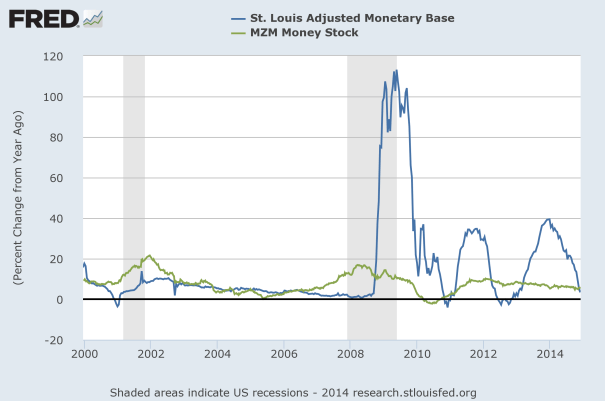
Bank reserves should not be counted as part of the money supply and have no effect on inflation because bank reserves have absolutely no more effect on MV=PY than cash that is burnt.  Normally bank reserves don’t matter much for economic analysis because they are usually fairly constant.  When reserves don’t change, they don’t change their effect upon monetary policy.  But reserves changed dramatically during the 2008 financial crisis.  They exploded.  This caused many people to predict runaway inflation because they looked at the monetary base (MB) which mostly measures bank reserves and the MB showed what looked like a dramatic expansion of the money supply.  For example, the NY Fed said that “Meltzer (2009), …worries that “the enormous increase in bank reserves — caused by the Fed’s purchases of bonds and mortgages — will surely bring on severe inflation if allowed to remain.”  That is ridiculous.  Bank reserves are irrelevant because they are not money and inflation is a monetary phenomenon.  Reserves could only become inflationary if they were first converted into money that enters the real economy.  That didn’t happen as the following graph demonstrates.

MB vs MZMMany naïve economists like Meltzer think that the doubling of an official money measure (the Monetary Base in blue above) should cause a big increase in prices (P), because of the equation MV=PY.  GDP (denoted as Y in the equation) and velocity (V) normally don’t change that much in one year, so the only other alternative is an increase in prices, but inflation didn’t happen.  If people had been looking at better measures of the money supply like MZM (the green line) instead of an irrelevant measure of phantom dollars hoarded in banking vaults (like MB), they might have worried about the deflation and recession like what actually happened in 2008.

MZM (Money of Zero Maturity) attempts to measure all financial assets that have “zero maturity” which means that they are about as liquid as cash because they can be used as a medium of exchange at any time with zero advance notice.  A Treasury bond that matures in 3-months cannot be used as a medium of exchange unless it is first sold in exchange for money.  It has a 3-month maturity, not a zero maturity.  Any financial asset that cannot be immediately exchanged for goods and services is not money and any financial asset that imposes a penalty for early withdrawal (before maturity) is not money.  MZM attempts to measure everything that can be immediately used for transactions buying goods and services.

The conventional rationalization for the failure of MV=PY to predict that the MB expansion would increase inflation (P) or output (Y) was that there was a collapse of the velocity of money (V).  But this is contrary to the conventional wisdom about V which says it should not change rapidly and unpredictably. The conventional wisdom makes sense.  Given official measures, velocity of MZM plummeted by almost half (in total) since the recession began, but nobody has come up with an explanation for why the true velocity of transactions could have slowed to half its ante-recession speed.  Why would people become permanently so much slower to pay than they had been before the recession?

MZM velocityA better explanation is that MZM did not really explode and its velocity did not plummet.  MZM is just poorly measured.  I suspect that the apparent rise in the money supply is miss-measurement.  MZM abruptly rose when bank reserves skyrocketed in fall of 2008, but it is hard to believe that the real money supply rose right at a time when velocity was plummeting.  Most money is created by lending and why would lending increase when people aren’t using money as fast?  What really happened was an increase in hoarding reduced the real money supply.  I suspect that bank hoardings (reserves), also artificially inflated the official money measures somehow.

Bank reserves are far from money.  Reserves are never directly exchanged for goods and services and nobody who wants to buy goods and services has any direct claim on reserves.  Nevertheless, many economists think the MB, which mainly measures reserves, is important for macroeconomic policy.  Perhaps this misconception is partly due to the Streetlight Fallacy.  This is the fallacy of focusing too much on things that are easy to measure (well illuminated by the streetlight) even though the true answer is obviously elsewhere (in darker places).  Bank reserves have always been the most easily measured kind of “money” since they are directly held by the very authorities that are responsible for measuring money.  But bank reserves are no more a form of money that can be used for transactions than a government bond is.  Both must be converted into money before they can be used for spending on goods and services.

Tagged with:
Posted in Macro

News Flash: Americans Are Mostly Below AVERAGE Income…

…And Tyler Cowen Predicts That Even Fewer Will Be Above AVERAGE In The Future

Garrison Keillor jokes that in the mythological town of Lake Woebegone, all the students are above average.  This is humorous because it is mathematically impossible for everyone to be above average.  If there is a normal distribution (as intelligence testers often assume) it is impossible for a majority to be above average because half are always above average and half are below.  But the income distribution is always completely different.  Income is always distributed with a strong skew where a few people have a lot of income and most people have very little.  That means that only a small minority can ever earn above the mean earnings.

Mean income statistics are always going to make most people feel behind because they are.  That is why median income is a better statistic for measuring the wellbeing of a population.  It actually reflects the wellbeing of the average person because half of the population earns more and half earns less.

Tyler Cowen is one of the few economists who gets the importance of median income and yet, he doesn’t seem to care that it has been stagnating.  His latest book predicts that median income will continue to be stagnant in the future, but instead of sounding a call to arms, Cowen’s tone suggests that we’d just better just get used to it!  Instead of mobilizing the tools of democracy to improve the lot of the median, the book description claims that Cowen “identifies the best path forward for workers and entrepreneurs, and provides readers with actionable advice to make the most of the new economic landscape.”  Instead of thinking about how to help everyone and benefit the median, Cowen describes strategies to beat the rat race to the top and become one of the elite overlords whose economic power can ride on top of the workers earning the median income and below.

Of course, Cowen probably earns not only above the median income, but well above the mean income.  And his livelihood has long depended upon the favors of the billionaire Koch brothers who have been funding his work and they are fervently opposed to any government action to reduce inequality.  Given the elite self-interests of his patrons, Cowen is probably pushing up against the limits of their comfort zone to even talk about the difficulties that stagnating median income at all.

Posted in Medianism

Enter your email address to follow this blog and receive notifications of new posts by email.

Join 75 other subscribers
Blog Archive
Pages