Economics of Slavery

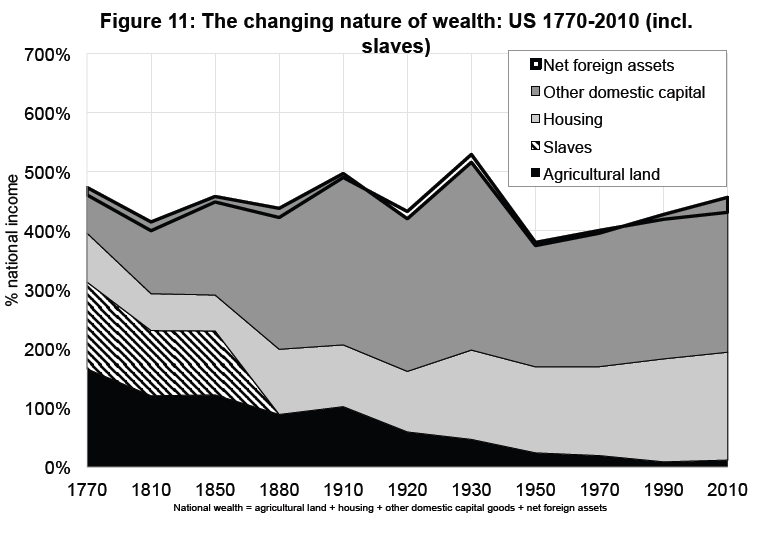
There is a little bit of research on slavery that is buried in the back of some inequality research by Thomas Piketty and Gabriel Zucman (pdf) that just floors me. Check out this graph of the total wealth of different regions:

slave wealthIn the US South, slaves accounted for almost half of the total wealth!  Stephen Taylor explains why the US had a civil war to end slavery whereas most countries ended legal slavery through peaceful means.

[Piketty and Zucman] noted that a great deal of wealth in the United States in the pre-Civil War period was possess in the form of slaves:

By putting together the best available estimates of slave prices and the number of slaves, we have come to the conclusion that the market value of slaves was between 1 and 2 years of national income for the entire U.S., and up to 3 years of income in Southern states.

[…]

Needless to say, this peculiar form of wealth has little to do with “national” wealth and is better analyzed in terms of appropriation and power relationship than in terms of saving and accumulation. We view these “augmented” national balance sheets as a way to illustrate the ambiguous relationship of the New world with wealth and inequality. To some extent, America is the land of equal opportunity, i.e. the place where wealth accumulated in the past does not matter too much. But at the same time, America is also the place where a new form of wealth and class structure – arguably more extreme and violent than the class structure prevailing in Europe – flourished, whereby part of the population owned another part (35).

Here is the graphical representation of the findings:

image

As Yglesias notes:

The “human capital” consisting of black men and women held as chattel in the states of the south was more valuable than all the industrial and transportation capital (“other domestic capital”) of the country in the first half of the nineteenth century. When you consider that the institution of slavery was limited to specific subset of the country, you can see that in the region where it held sway slave wealth was wealth.

For those who understand that the core reason for southern secession and therefore for the Civil War itself was slavery, then this information is less illuminating as it confirming.  However, I am constantly running into people who want to claim that the Civil War was caused by other factors, with the most popular being tariffs as well as the ever-popular “states’ rights” argument.

The above figure blows the tariff argument out of the water insofar as if the Southern states were willing to secede and risk war over the economic impact of a tariff (so the argument goes) then how much more so would they have been willing to secede and risk war over the wealth represented by their collective slave holdings.  [The economic impact of tariffs was negligible compared with the impact of slavery.]

As I keep trying to tell any number of persons…:  the Civil War was very much driven by economic forces and slavery was the main variable in the discussion.

As …Alex Knapp noted on Facebook:

In 1860, slaves were worth more than than all all the industrial and transportation capital in the United States. This is why a war in the U.S. to end slavery was inevitable – in other countries where slavery ended peacefully, it was only a tiny fraction of their wealth. But for the South, slavery was their wealth.

So yes, it can properly be said that the Civil War was about states’ rights, but only if one acknowledges that the “right” in question was the right to maintain the institution of chattel slavery.

Slavery is so bad for slaves that it should be banned even if it did have a beneficial impact upon the median income.  Medianism is not a fundamentalist ideology that sees the median income as the sole overriding criteria for determining ‘the good.’  Median income is simply a better indicator than GDP and medianism seeks to break the hegemony of GDP.  But the example of slavery reinforces usefulness of median income as a measure of prosperity because slavery creates so much inequality that it seems to hurt the median too.   As I alluded to in an earlier post, the slave states still have higher inequality and worse off median than regions of the US that were never corrupted by slavery.

Posted in Development, Discrimination, Labor, Medianism

Voting and Utopianism

Daniel Little reviewed Jon Elster’s new book and summarized it thusly:

The fundamental point that Elster takes from Bentham is that institutions should not be considered in terms of their ideal functioning, but in terms of how they will function when populated by ordinary people subject to a range of bad motivations (self-interest, prejudice, bias in favor of certain groups, …). This is the point of “security against misrule” — to find mechanisms that obviate the workings of venality, bias, and self-interest on the part of the participants.

This is a good idea in theory, and focusing on “ordinary people” was enshrined into the law in the mid 1800s in what became known as the “average man” or “reasonable man” standard.  The problem is that it is hard to model “ordinary people”.  For example most police officers get off scott-free after shooting unarmed civilians because juries are persuaded that a “reasonable policeman” would feel scared and shoot, but this legal standard adds up to mean that we have  unreasonably many civilians getting shot by police.

One of the problems with the Public Choice Economics programme is that it tends to model people as excessively greedy and selfish.  Too much emphasis on selfishness tends to create a society that normalizes and reinforces that kind of ethos.  One outcome of this kind of attitude is a reduction in efficiency.  For example, public officials are so constrained in negotiating infrastructure bids to avoid any possibility of corruption that they cannot use good judgement to select the best quality contractors and that is a reason why US infrastructure costs are much higher than in other countries.   For-profit companies must rely upon a lot of altruism from workers toward the company because they cannot specify every possible contingency in an employment contract, nor can managers monitor everything and even if they try, it soon becomes excessively costly.  Public institutions and non-profits should create institutional structures to try to encourage even more altruism than for-profits already do because it is easier for humans to feel altruistic about a public mission of service than about maximizing profits for private owners.

Most of the literature on voting theory in Economics centers around utopian ideas like Arrow’s Impossibility Theorem that are completely useless for improving how real democratic institutions function for ordinary people, so Elster’s goals are a movement in the right direction.  There are many simple ways to improve our democratic institutions to make them more democratic.  And democratic is exactly what medianism is in the political realm.  A democracy that does not give power to a minority to rule over that majority is always making medianist political decisions.  In coming days I will post some simple ways to make our democracy more medianist, that is, to make it more democratic.  Kenneth Arrow was a genius, but his clever work on voting theory was too utopian and it actually moved political thinkers away from working on making voting work better because it distracted them into utopian rabbit holes.  His Nobel-Prize-winning work is often interpreted as concluding that the only rational political system is a dictatorship!  I kid you not.  Too bad he did not use more of his genius as a force for good.  Instead of saying that rational democracy is “impossible,”  he could have worked at improving the flawed democratic institutions that rule most of the countries of the world.  Even ordinary people of mere median intellect can think up many pragmatic ways to make voting more democratic, so Arrow really wasted his talents.


Posted in Medianism

AP Fires Up Racial Divide

TV news reporter Ty Batemon interviewed me today for a WLIO segment in response to a recent AP article by Hope Yen that has the ridiculous, meaningless headline, “4 in 5 in USA face near-poverty, no work“. This is meaningless because it does not measure true hardship nor do we know if this measure is getting better or worse.  Like most people with doctorates, I was in poverty during graduate school, but that is nothing like the hardship of involuntary poverty due to illness, layoffs, or family breakdown.

Even more objectionable, the article misleadingly emphasizes white poverty over poverty among other races.  The article claims that,

“Hardship is particularly on the rise among whites, based on several measures. Pessimism among that racial group about their families’ economic futures has climbed to the highest point since at least 1987… ‘There is the real possibility that white alienation will increase if steps are not taken to highlight and address inequality on a broad front’… ‘[Working class whites] feel that politicians are giving attention to other people and not them'”.

But this is misleading.  There is no “particular” rise in hardship among whites.  Some data shows that the recession was much harder on minorities than on whites. White pessimism has risen relative to other races, but that is not an objective economic hardship.  Economic hardship, as measured as a decline in income, is broadly similar among racial groups.  Median income moves fairly much in parallel for all races.

File:US real median household income 1967 - 2011.PNG

In the long run, other races have been catching up relative to whites, but most of that catch up happened in the first decades after the civil rights era, not since the great recession of 2008 as the AP article implies.  This was already clear way back in 1978 when William Julius Wilson published The Declining Significance of Race to show that “economic class has become more important than race in determining job placement and occupational mobility.” (pdf)  Although William Julius Wilson is a firm supporter of race-based affirmative action, his research suggests that class-based affirmative action might be more appropriate today.

The AP article demonstrates that, “‘[Working class whites] feel that politicians are giving attention to other people and not them'”.  Both the article and some of the responses to it on the web shows demonstrate white resentment against anti-poverty programs that they see as taking their money and giving it to other races.

The AP article also says that, “wealth is a greater predictor of standardized test scores than race; the test-score gap between rich and low-income students is now nearly double the gap between blacks and whites.”  This reinforces what I argued earlier. We should replace race-based affirmative action with a class-based system because it will create more political unity to help more people in need.  It creates outcomes that are almost as beneficial for African-Americans as our current race-based system and some of the few minorites who would lose from the switch to class-based affirmative action are rich enough that they really don’t deserve help anyhow compared with someone in poverty.  Finally, class-based programs are potentially more beneficial to minorities if they help reduce the racial stereotype vulnerability that is perpetuated by the race-based system.

Posted in Discrimination, Labor

The REAL Reason Elites Abandoned The Unemployed In 2010

Paul Krugman’s (2013) book, End This Depression Now documents how governments in Europe and the US adopted conventional textbook fiscal and monetary stimulus only in the beginning of the economic crisis of 2008.  Then Krugman says, “A funny thing happened in 2010: much of the world’s policy elite—the bankers and financial officials who define conventional wisdom—decided to throw out the textbooks and lessons of history, and declare that down is up.”  Instead of preaching for increased monetary and fiscal stimulus to fight high unemployment, Krugman says, “it suddenly became the fashion to call for [government] spending cuts, tax hikes, and even higher interest rates even in the face of mass unemployment.”  The world’s policy elite became ‘Austerians’ who want job-killing austerity despite high unemployment.

Krugman theorizes that the reason policy elites don’t care about unemployment is class warfare.  The Austerians are led by the rich who like high interest rates because they lend to the young, poor, and middle classes.  They are fighting for the rich against the rest of us.  Bruce Bartlet recently theorized that this was also why the financial elite opposed monetary stimulus during the Great Depression: “bondholders enjoyed getting back 25 percent more than they had lent in real terms.”  Plus, the elites like elevated unemployment because it suppresses the wages of their employees and it makes it easier for them to keep workers in line when workers are scared of economic ruin.  When unemployment is low like in 2000 when it averaged 4%, Krugman says that employers were forced to hire any workers who passed the “mirror test”.  That is, if someone had enough breath to fog a mirror, they were good enough to hire.  But that meant that employers were feeling pretty desperate and they prefer times when they have the power to be more selective in screening potential employees.

The class-warfare theory is an interesting possibility for why the policy elites ignored high unemployment after 2010, but Krugman overlooks another important reason.  The policy elite did not really abandon textbook economics.  Textbooks are mutilitarian and worship GDP growth.  GDP growth had officially returned by the end of 2009.  The recession was officially over by the middle of 2009 and there is nothing in the textbooks that says we should fight a recession after it is over.  During times of GDP growth, the textbooks say we should focus on keeping inflation low and balancing government budget deficits, and this is what the policy elite have done.  This is an unethical value judgement, but the textbooks say nothing about unemployment being more important than government deficits or the remote possibility of inflation.  The policy elites did not abandon textbook economics.  The policy elites abandoned the unemployed because the textbooks are mutilitarianist and the policy elites followed textbook priorities.

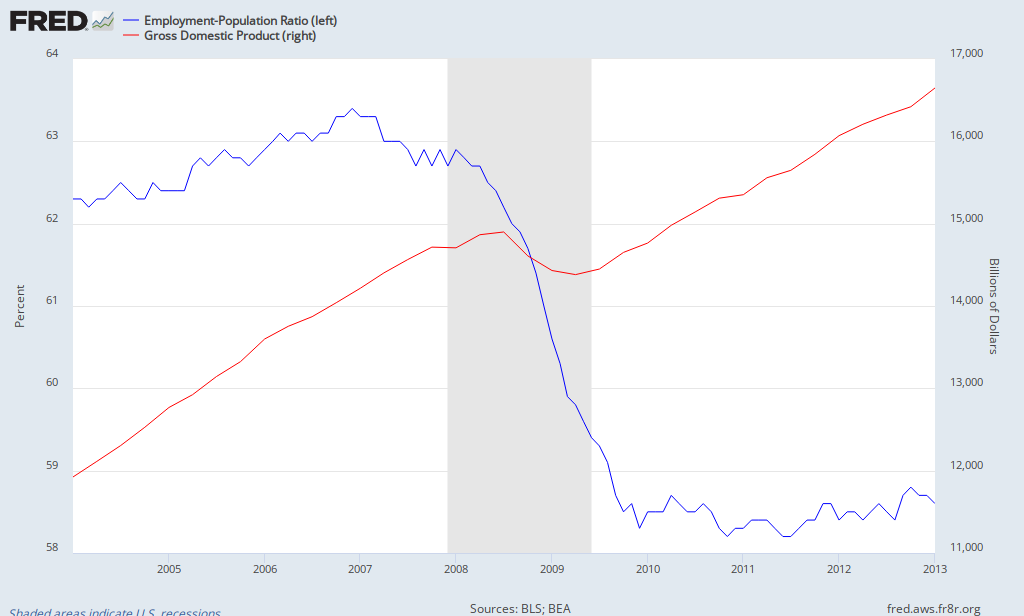
Plus, the fact that GDP growth had returned despite a stagnant employment ratio as seen in the following graph bolsters Krugman’s theory that the elites preferred the high-unemployment policies in place in 2010.  That is because the elites’ income was growing robustly and they saw no reason to change anything.

FRED Graph

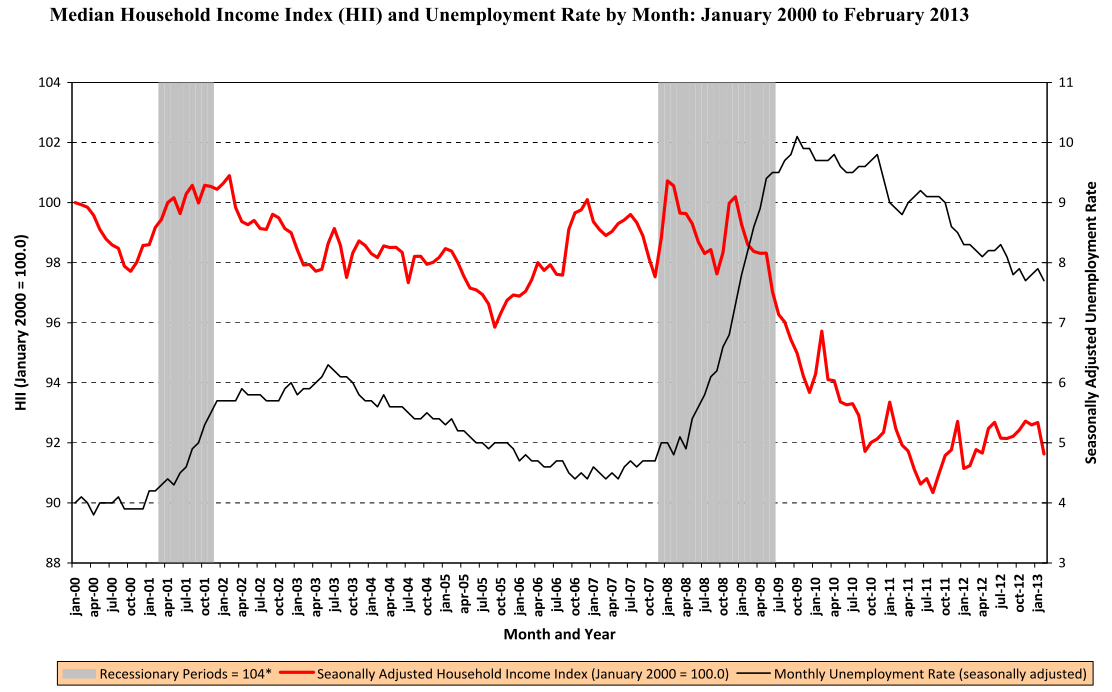
The above graph shows the official recession dates shaded gray.  The recession officially ended in 2009 when GDP began growing again.  But It was a period of growing inequality where the elites were happy with their growing income and meanwhile the majority of Americans were still in a deepening recession.  The median household income was still dropping as most American’s real incomes continued falling.  Unfortunately, the data in this graph comes from the Fed and they do not even track median income.  This reveals their preference for the 83,000 different data series that they do track over median income. So I’ll have to post median household income in a separate graph from a private think tank below.  As you can see, when the recession officially ended (at the right side of the gray bar), the majority of households (represented by the median in red) had not even seen half of the fall in their incomes that was to come.  And there is still no significant recovery in sight for most households.

median HH income

Krugman should adopt a medianist view of recessions.  Economic stimulus should continue not just until the mean income (GDP) increases again, but until the median income increases again.  That way the majority of Americans can see the income growth that signifies the end to a recession rather than just the elites whose income growth caused the end of the official recession in 2009.  The textbooks should prioritize median income rather than aggregate income (GDP).

Unemployment is also an important indicator that is neglected by our mmutilitarian overemphasis on GDP.  Economists should research the link between unemployment and median income.  From eyeballing the data, it appears that high unemployment leads to stagnant wages and stagnant median income which makes sense, but I have never seen a statistical analysis of the relationship.  Governments should prioritize fighting unemployment over budget deficits when interest rates are historically low and inflation is historically low as is the case today.  A medianist definition of recessions would help reinforce this priority.

Posted in Macro

Wikipedia Benefits the Median But Hurts A Few Elites

The internet has destroyed or reduced the profits in numerous industries by lowering prices and making people better off by increasing the services that we enjoy.  For example, recorded music is much less profitable today than in the heyday of the compact disc because of the ease of copying music over the internet and the bonanza of free streaming music, but the median person has much more music than ever before and I see no slowdown in the production of new music.  Wikipedia is a huge destroyer of mutilitarian value because it has completely destroyed the encyclopedia industry, but Wikipedia is a tremendous creator of social value.  The last of the great encyclopedias, Encyclopaedia Britannica, shut down last year.  This is a decline in GDP because Britannica had sold 120,000 sets back in 1990 in the United States at about $1,000 each.  That means that Wikipedia has destroyed an industry whose leading company alone earned about $120,000,000 and all that it earns is about $40m as of 2012.  According to mutilitarianism, this is a terrible destruction.

This is clearly good for the median individual who gets something better for less money (free).  Unfortunately, it does not show up in our usual income accounts, but if we adjusted for inflation correctly (which should be more feasible for the median individual… more on that later) then we could show that the deflation (declining prices) in encyclopedias is boosting the real incomes of the median American (and almost everyone else). When good stuff becomes free (freeconomics) that is good for people even though it shows up as a decline in GDP.

An unappreciated benefit of Wikipedia is its perceived unreliability.   Already in 2005 when it was only four years old, a study published in the most prestigious academic journal, Nature, found that Wikipedia had a similar amount of factual errors as the top for-profit competitor, Encyclopaedia Britannica.  Although it has improved greatly since 2005, it is still perceived to be quite unreliable and that is a very good thing.  Encyclopaedia Britannica did not deserve its reputation for Truth and the world is better when people are a little skeptical of the experts.  Today Wikipedia is both more accurate than the encyclopedia industry that it destroyed, but users are still skeptical of its information and that is a healthy thing for intellectual life.  A key part of learning is learning when to question authority and how to check up for yourself.  Wikipedia engenders that skill.  Wikipedia is also more humble and allows anyone to correct it which helps get people more engaged with information and arguments.  Even its logo humbly shows that it is incomplete and has holes in it!

13 May 2010 – present

Here is a graph of the number of articles in Wikipedia.  Back in 2005 when the Nature study said it achieved similar accuracy with Britannica, it was already much bigger than Britannica.  Today (in 2013) its English pages alone are 9,000 times larger than Britannica was and its entries in other languages would double that size.

Posted in Medianism

Slavery → Racism → Inequality of Opportunity

Last week I visited the National Archives and viewed the original copy of the US Constitution with my family.  I was struck by how the original constitution only contained three explicit rights for individuals: they are freedoms from habeas corpus, bill of attainder, and ex post facto law.  Along with this is the implicit right to hold slaves that is assumed by the rights of slave-holders that are mentioned in three places: the 3/5ths compromise in Article One, the Fugitive Slave Clause requiring that escaped slaves be returned to their owners even if they cross state lines, and the guaranteed freedom to import slaves for at least 20 years.  So slave-holding was an assumed right along with only three other individual rights (or ‘freedoms’) in the original constitution.  The framers of the constitution could not agree on any more individual rights, but the Bill of Rights soon added ten amendments to the constitution to add many more.  But the enshrinement of slavery in the original constitution makes it unmedianist because by not counting slaves and Native Americans for democratic representation, the constitution was not using the proper median voter for making political decisions.  Furthermore, slavery creates huge inequalities that even hurt the median non-slave.

You can still see this legacy of slavery today.  Leonhardt at the NYT posted the following map showing red where there is the least opportunity for poor people to get richer.  The reddish, low-opportunity regions are concentrated in areas where African-Americans live due to the institution of slavery.  But the researchers also looked at what happens to the low-income people of different races and found that there is little difference in upward mobility for low-income people of all races.

race and mobility

The correlation between low-upward mobility and race indicates the persistent problems of racism in America, but it also shows that anti-racism may actually be counterproductive.  According to Pew data Kevin Drum found that “Obama won about 46 percent of the white vote outside the South and 27 percent of the white vote in the South.”  Meanwhile about 95% of African-American voters voted for Obama.  Unfortunately, I could not find county-specific map of racial partisanship like the map above, but I suspect that it would look similar.  Regions with a greater racial divide also have more problems with inequality of opportunity for all races.  A lot of the white vote in the South lives in its biggest states (Florida and Texas) which are not very southern anymore and probably the red counties in the above map have more racial partisanship.

I suspect that one reason there is worse inequality of opportunity in areas that had slavery is that these regions developed racism to justify slavery and racism divided the working class and allowed the elites to dominate them more easily.  Rich Cohen’s National Geographic cover story about the history of sugar says:

According to Trinidadian politician and historian Eric Williams, “Slavery was not born of racism; rather, racism was the consequence of slavery.” Africans, in other words, were not enslaved because they were seen as inferior; they were seen as inferior to justify the enslavement required for the prosperity of the early sugar trade.

Whereas slavery in the US began slowly and with much ambivalence, the desire to morally justify it grew stronger as economic forces made slavery more valuable with the rise of the cotton industry.  Chris Hayes summarizes the history of how slavery warped the culture and economy of the South.

…In Battle Cry of Freedom, James McPherson notes that while in 1850 slave states had 42 percent of the population, they “possessed only 18 percent of the country’s manufacturing capacity, a decline from the 20 percent of 1840.” The same holds true for the South’s percentage of railroad miles, which was declining as the war approached. In 1852, James D.B. DeBow, a vociferous advocate of diversifying the Southern economy, lamented that “the North grows rich, and powerful, and great, whilst we, at best, are stationary.” (This underdevelopment would haunt the South well into the twentieth century: in 1930, only 38 percent of residents of the former Confederate states had electricity, compared with about 85 percent in states that had been free.)…

as slavery became more profitable to the planter class and ever more central to the economic health of the South, the ideas about slavery grew increasingly aggressive, expansionist and reactionary. “Very few people at the time of the Revolution and the Constitution publicly affirmed the desirability of slavery,” Foner observes. “They generally said, ‘We’re stuck with it; there’s nothing we can do.’”

Even in much of the South, slavery was at first seen as a necessary evil, a shameful feature of the American experience that would necessarily be phased out over time. Many slave-owning founders shared in this consensus. Slave owner and Virginian Patrick Henry referred to slavery in a private letter as an “abominable practice…a species of violence and tyranny” that was “repugnant to humanity.” His fellow Virginian Richard Henry Lee called the slave trade an “iniquitous and disgraceful traffic” in 1759 while introducing a bill to try to end it. Thomas Jefferson, at times an ardent defender of slavery and the white supremacy that undergirded it, confessed in 1779 that “the whole commerce between master and slave is a perpetual exercise of the most boisterous passions, the most unremitting despotism on the one part, and degrading submissions on the other.”

When Jefferson wrote those words, slavery had nowhere near the economic grip on the South that it would have during the cotton boom in the first half of the nineteenth century. Between 1805 and 1860, the price per slave grew from about $300 to $750, and the total number of slaves increased from 1 million to 4 million—which meant that the total value of slaves grew a whopping 900 percent in the half-century before the war…

It’s hard to overestimate the impact that cotton had on the South during the decades leading up to the war. No place on earth produced more cotton, and the world’s demand was insatiable. Economic historian Roger L. Ransom writes that “by the mid-1830s, cotton shipments accounted for more than half the value of all exports from the United States.” So lucrative was the crop that the planter class rushed into it, leaving behind everything else. As McPherson notes, per capita production of the South’s principal food crops actually declined during this period…

It is perhaps not surprising that under conditions of stupendous profit and accumulation, the rhetoric of the South’s politicians and planter class changed to a florid celebration of the peculiar institution. “By the 1830s, [John C.] Calhoun and all these guys, some of them go so far as to say, ‘It would be better for white workers if they were slaves,’” Foner tells me. “They have a whole literature on why slavery should be expanded.”…

“Our negroes,” according to Southern social theorist George Fitzhugh, “are not only better off as to physical comfort than free laborers, but their moral condition is better…. [They are] the happiest, and, in some sense, the freest people in the world.”

So the basic story looks like this: in the decades before the Civil War, the economic value of slavery explodes. It becomes the central economic institution and source of wealth for a region experiencing a boom that succeeded in raising per capita income and concentrating wealth ever more tightly in the hands of the Southern planter class. During this same period, the rhetoric of the planter class evolves from an ambivalence about slavery to a full-throated, aggressive celebration of it. As slavery becomes more valuable, the slave states find ever more fulsome ways of praising, justifying and celebrating it. Slavery increasingly moves from an economic institution to a cultural one; it becomes a matter of identity, of symbolism—indeed, in the hands of the most monstrously adept apologists, a thing of beauty.

Race-based affirmative action serves to maintain the racial divide which has been used to maintain the advantages for elites.  If the recent equality of opportunity research is correct and all races have similar opportunities, then class-based affirmative action would be fairer and it would help heal some of the divisions between races.  It would still give the biggest advantage to disadvantaged races because they are poorer on average, and the effect on African-American graduation rates would be small.

Posted in Discrimination, Labor

Medianism Is Un-Radical and Anti-Utopian

My family took a trip to Washington D.C. this summer because it seems to be an American tradition for 8th-grade kids visit DC and my oldest son has come of age.  One day he came home from school with a Middle School brochure for the $1,000 class trip to DC and he asked if we could do a trip together as a family instead. What parent could say no to a request like that–to spend time with us rather an 8th-grade school trip with his friends?  And it cost considerably less than $1,000 for the entire family to go.

We stayed with a Mennonite-Your-Way family near DC and one of our hosts said that Christians should be radical because Jesus was a radical.  I support her sentiment, but this reminded me of just how un-radical medianism is.  Many ideologies have a utopian bent.  For example, both pacifists and libertarians often have the utopian ideal that society would be much better if we could just eliminate coercion, but their ideal is something that has never existed anywhere on the planet for any large group of people.  Neither pacifists nor libertarians usually have much of a plan to get to their ideal world even hypothetically.  They are usually a bit utopian.

That isn’t to say that utopian ideologies are bad.   They can provide a vision to guide actions, but some utopians are fundamentalists for whom, the perfect is the enemy of good.  They cannot see the possibility of feasible small improvements because small changes won’t put them on the road to the best possible utopian ends and that is what they really seek.  In contrast, I am a pacifist* who seeks to minimize violence, but I see a positive role for the state in monopolizing violence because I agree with Stephen Pinker that this has been one of the main reasons for the dramatic decline in violence over the last ten millennia.  I am not a pure, utopian pacifist because for now I am content to permit the police a monopoly on violence in the society.  When I look at history, I see a strong state monopoly on intra-state violence as being strongly correlated with long-run peace.  (Wars, on the other hand, have very low probability of increasing long-run peace.)  Of course the goal of policing and criminal justice should be to minimize violence and the US could easily improve on this score. That is where pacifist ideology can improve society IF we are willing to dirty our hands in thinking about how criminal justice actually works.  It isn’t something that utopian pacifists are willing to do.

Medianism is not anything like utopian fundamentalist ideologies.  Even if all of Medianism’s goals were completely met, the world would still be a tragically flawed place.  But it would be a somewhat better place and that is why medianism is a useful ideology.  Some pacifists and libertarians do work for incremental improvements, and for them, their ideologies are useful.  But many are fundamentalists who ignore the possibilities of marginal changes and instead hope for a radical vision of a utopian place despite lacking any kind of roadmap to get there.

So Medianism is the opposite of most kinds of ideologies.  It won’t revolutionize society like communism, libertarianism, anarchism, Rawlsianism, utilitarianism, and fascism promise to do.  But all those ideologies have utterly failed to accomplish anything approaching their own goals.  Medianism is a lot more humbly feasible than those more-famous political philosophies.  And the road map to achieving its goals is simpler.

Surprisingly, the economic philosophy that has come to dominate the world has not even been properly named.  I call it mmutilitarianism and it is much more influential than all the ideologies listed above.  Its only advantage over the more famous ideologies is that it is so much more feasible and simple than the utopian ideologies.  It is so non-controversial that it is not considered to be an ideology.  It is just there, like the air we breathe.  Mmutilitarianism had not been named before because it formed spontaneously in the intellectual vacuum when the utopian ideologies all failed and it is only tacitly accepted out of expediency.  Mmutilitarianism is morally flawed and needs to be replaced, but the utopian ideologies are too unwieldy for service.  Only something feasible and un-utopian will work and that is why medianism is useful and important.  Medianism is a mediocre ideology, but it is better than the mmutilitarianism that we currently use, so give mediocrity a chance.

*I am not only a (non-fundamentalist) pacifist, I am also much more libertarian than the median American, but I would never call myself a libertarian because I find the priorities of most self-described libertarians to be very un-medianist. Many libertarians worship wealth and/or are devoted to elitist mmutilitarianism.  Like libertarians, I appreciate the power of markets and the limits of government more keenly than most people, but unlike libertarians, I want both markets and governments to prioritize the bottom half of the income distribution more than the top half.  That is the opposite of the society we have created.

Posted in Medianism

Enter your email address to follow this blog and receive notifications of new posts by email.

Join 75 other subscribers
Blog Archive
Pages