
Monuments For The Median?

P1080084

My family toured the Washington DC monuments on Saturday and almost all of them are tributes to elite leaders or soldiers.  There are very few monuments for the poor, but the Martin Luther King monument has quotes about the poor and the nearby Franklin Delano Roosevelt monument even has the above statues representing the poor.  In the center of it is the following inscription.  P1080085 (2)This is a version of John Rawls’ conclusion about what a just society looks like.  Although many people give lip service to the idea that the poor should be the focus of progress and justice, there are always many other people who disagree.  For example many prominent Americans think that the poor in America have excessive food stamps and healthcare.  Because there are always some people who dislike the poor or dislike efforts to help them, no society has really prioritized the poor anything like the way the FDR monument (and Rawls) said that we should.

Maybe working for policies that benefit the median would be more politically feasible?  So far there is a blindness in the political corridors of power about the median.  The beltway insiders are out of touch partly because they don’t have much data about the median American.  There are no monuments to the median American in Washington.  If medianism is successful, we will have a monument for the median in Washington to balance out the numerous monuments for the elites. Even the poor are represented in more monuments than the median because some Americans idealize helping the poor.

Many of the policies that benefit the median will also benefit the poor.  There would be more trickle down to the poor of medianist policies than with current policies and the median American needs a safety net   For example, the recent farm bill proposed cutting food stamps for the poor in order to maintain billions of dollars of subsidies that mostly go to rich farmers who earn above the median income.  The median American has a much larger chance of losing her job and getting food stamps than she has of being given farmland and thereby benefiting from the subsidies that go to farm owners.  A medianist farm bill would eliminate most of the farm subsidies (which go to elites) in favor of maintaining food stamps as a safety net for the median.

Posted in Medianism

Racism and The Achievement Gap

This summer, the entire Bluffton University faculty is reading a Ken Bain book as a focus for meetings about improving our teaching, and it has some sections that are relevant to the Bluffton civic engagement theme I mentioned in my previous post.  There is an achievement gap between African American, Hispanic, and Native American students and the rest.  Even at elite colleges where all the students have similar credentials as measured by their SAT scores, high school grades and other accomplishments, these minority groups do significantly worse than the other students in particular courses.  Ken Bain cites research that suggests that the reason is that these minorities have internalized racism.  In his terminology, they suffer from stereotype vulnerability.  If they are judged by others as being members of a poorly performing group, and they are worried about that stereotype, then they will actually perform worse partly due to a kind of performance anxiety.

It turns out that it is easy to make white students’ work suffer from stereotype vulnerability.  All it takes are some offhand comments about how whites generally perform worse than Asian students on an exam and they internalize the idea and perform worse (p. 71).  To the extent that stereotypes are holding back minority groups, then race-based affirmative action only reinforce stereotypes that should be fading away.  For example, according to Ken Bain, giving these students a remedial program only makes matters worse (p. 81).

Now, this is perhaps only valid at the elite schools that Ken Bain was discussing, and remedial work really is valuable for students who really do need remedial work, but race-based affirmative action doesn’t help them much anyway compared with class-based affirmative action which raises graduation rates more than race-based (as I posted earlier).  Perhaps class-based affirmative action raises graduation rates partly because it reduces racial stereotypes and therefore reduces stereotype vulnerability.  Class is easier to hide than race and so there is likely to be less stereotype vulnerability.  I am speculating here and I would love to see more evidence on why graduation rates improve with class-based affirmative action.  Any ideas?

Tagged with:
Posted in Discrimination, Labor

Affirmative Action and Trayvon Martin

I find ‘ writings about racism to be thoughtful and a useful perspective.  I was surprised to read how sanguine he is about the Trayvon Martin verdict.  I don’t know what we can do about racism and racial profiling in society, but stand-your-ground laws only encourage shootings like this and because there are more whites than blacks in America, they result in more white males being killed than black males according to economists from the NBER and Georgia State University.  Stand-your-ground laws make it legal to shoot anybody if there are no witnesses.  The shooter must be sure he actually kills his victim so the shooter can tell a story about feeling threatened without contradictory testimony.

Almost everyone agrees that the Trayvon case demonstrates that racism is still a significant problem.  Some people in my family have emailed me about how it shows that whites are discriminated against and others feel that it shows that blacks are discriminated against, but I haven’t seen anyone claim that the case shows that racism is a thing of the past in America.

Racism is part of the civic engagement theme at Bluffton University for the upcoming year and that helped inspire my earlier post about affirmative action. The Trayvon case confirms that racism is still a serious problem in America, but I don’t see how race-based affirmative action could possibly redress the sorts of problems that have been exposed by the Trayvon case.  Race-based affirmative action is intended to redress economic discrimination by giving disadvantaged groups some help to counter it.   But affirmative action has no bearing upon how the Trayvon story played out.  If anything, affirmative action might make racists even more bitter.  So, as I posted earlier, class-based affirmative action might be a better way to go and perhaps it will even help us work on racism more than race-based affirmative action.

Tagged with:
Posted in Discrimination, Labor

Weekend Dimmeu: BornRich.com

This is the inaugural post for a series of occasional posts demonstrating the diminishing marginal utility (dimmeu) of wealth using common sense examples.  BornRich.com is a voyeuristic website in the tradition of Lifestyles of The Rich and Famous that the excesses of wealth in a fantasizing way.  BornRich asks you to fantasize that, “If you have heaps of money lying idle, then better put them in an investment that will leave you feeling like the ‘king or queen of the ocean’.” The “investment” is a luxury submarine with swimming pool.  Or it suggests that you fantasize that you can spend millions “Pampering your Pooch”:

Make your dog feel special by purchasing it the Amour collar worth $3.2 million and make him feel like a million bucks by buying him the most costly dog collar in the world.  This 52-carat diamond encrusted dog collar has a centerpiece that measures to 7-carats and is set in an 18-karat white-gold and platinum setting.  The area in which this luxurious collar does not comprise of priceless stones is made up by exotic and expensive crocodile leather which adds to its durability and comfort quotient. …However, if you cannot stretch your budget to buy the most expensive dog collar, ‘I Love Dogs Diamonds’ has a range of other priceless collars between $280,000- $900,000. …Nevertheless, if you still have your heart set on the ultra-expensive ‘Amour’ and you believe in Easy Monthly Instalments, then you could still go in for the most expensive dog collar and by paying three instalments!

Meanwhile, some people are so poor that they go hungry or eat dog food and other societies eat dog meat.  De gustibus non est disputandum.

Posted in Medianism

Walmart, Job Destroyer?

My former PhD advisor, Joseph Persky, published research a few months ago showing that a new Walmart in Chicago destroyed, “approximately 300 full-time equivalent jobs in nearby neighborhoods. This loss about equals Walmart’s own employment in the area.”  Persky’s work suggests that Walmart has zero net effect on retail employment because it creates just as many jobs as it displaces.  However, Persky also found that Walmart has no effect on total retail sales.  This is puzzling. Walmart claims to be more efficient than competitors at retailing, but if Walmart sells the same amount of stuff as the businesses that it displaces, with the same number of workers, where are the efficiencies coming from?  I would expect that Walmart is more labor efficient than competitors, but if it were, then it would not need as much labor as the competition.  Productivity gains usually reduce employment (holding output constant as is the case for Walmart).  Farming and manufacturing have dramatically reduced jobs because of increased efficiencies.  They simply don’t need as many people to produce the same output.  But Walmart has not increased output, so where is the efficiency coming from?  Walmart must be more efficient than the other retail businesses or it would not be able to eliminate them.  There are several possibilities:

  1. Persky et al. under measured the true job loss.  It is really hard to estimate that sort of thing. I suspect that Walmart is actually a job destroyer because of its greater productivity, but that needs more research.  The same reasoning suggests that more productive teaching methods would destroy teaching jobs (holding the quantity of students constant).  Walmart should be more efficient due to economies of scale which allow it to use labor more efficiently, but perhaps Walmart’s labor productivity is no better than its competition and Walmart achieves its efficiencies in some other way…
  2. Walmart uses less capital per dollar of output.  Walmart certainly requires less bricks and mortar than a bunch of small town ‘main street’ stores.  But Persky’s study looks at an urban Walmart and I doubt that Walmart uses less capital in an urban area where it is cheaper to build in a small space than to buy up numerous adjacent lots due to the holdout problem.  I doubt this is how Walmart has gotten productivity gains, but another way Walmart gets high productivity out of its capital is by producing more sales per square foot of space.  Increasing sales per square foot still takes a lot of labor too.
  3. Walmart uses its monopsony power to press down wages and supplier profits.  This is often measured as increased productivity, but it is really just a transfer of resources from workers and suppliers to Walmart and its customers.  Once Walmart has suppressed wages, it might even want to hire more workers to do low-productivity jobs like standing at the doors as greeters.
  4. Economic analysis often simplifies inputs into labor and capital, but there are different kinds of labor and Walmart may be able to use its economies of scale to reduce skilled-labor workers, but increase its low-skilled workers.  At small stores, the high-skilled workers spend a lot of time sweeping or working the cash register.  Walmart may have leveraged its information technology capabilities to reduce the quantity of skilled managers it hires and utilize more low-skilled workers instead.  As a result, its average labor productivity could be higher than the average labor productivity of the competition even though it has the same number of workers as the competition that it displaced.  Walmart’s workers are cheaper because they have a lower average skill level.  If this is so, then Walmart should increase unemployment among skilled workers and decrease it among low-skilled workers.

If Persky et al. are correct and Walmart is not reducing retail employment, then I suspect that #4 is one reason for that.  It fits with the stylized facts that seem true about Walmart.  Walmart seems to have low labor productivity because Walmart does hire a lot of low-skilled workers who do most of the everyday mission-critical tasks as well as low-productivity jobs like working as greeters.  But Walmart must have high average labor productivity to be able to sell so much so cheaply, so it must be saving money by hiring fewer high-skilled workers that I don’t notice when I go there.  Those are unseen wizards who are running the show from behind the curtain as the watch over everything via their surveillance systems.

In theory, this kind of innovation could increase or decrease inequality because it benefits people at the top of the hierarchy and at the bottom while hollowing out the middle.  But in practice, the retail labor market seems to have stagnating wages at the bottom, so inequality is increasing.  Meanwhile information technology may be doing something similar to society as a whole because the rest of society is seeing increasing inequality too.  Walmarts lower prices are cushioning the blow of stagnant wages for the median worker, but real living standards are still down for the median household from where they were in the 1990s.  It doesn’t have to be this way.  Higher productivity could increase everyone’s living standards.  Yglesias thinks that more Walmart-type supermarkets in India would help the median Indian:

India’s government announces plans to eliminate rules prohibiting or curtailing foreign investment in the retail sector. That means most of all a possible influx of western supermart brands — WalMart from the US, Carrefour from France, Tesco from the UK — into an Indian economy that’s been grappling with skyrocketing food prices. James Fontella-Kahn explains in his FT coverage that “only about 8 percent of urban India retail spending takes place in the ‘organized’ sector” with the rest of the supply-chain in the hands of a confusing array of “tens of millions of middlemen” who constitute a powerful lobby that’s backed these protectionist rules.

The hope is that western firms will not only offer customers a more attractive retail experience, but that they have more knowledge and capacity to do large-scale supply chain management. That would mean a higher share of rural produce making it to market with the introduction of modern shipping practices, and also more cooperate efforts to improve the volume of rural output.

All-in-all if it comes to pass it’s almost certainly good news for the average Indian. But note here a lesson in how globalization can drive inequality. India contains well over one billion people. So if we liquidate the interests of tens of millions of rent seeking middlemen and replace them with three or four or five executives in charge of Tesco India, Tesco Carrefour, and so forth then this should benefit the typical Indian household. But that handful executives is going to be much richer than any of the individual middlemen they put out of business. The top one percent will pull away from the 99 percent. But it would be a mistake, in this context, to obsess too much about that 99:1 divergence. The important issues are whether the typical Indian family near the median are making progress, and whether the poorest and most vulnerable Indian households are making progress. If they are, then there’s no particular need to begrude the fact that growth + economies of scale will create wild fortunes for a few people. And in India that’s more or less what’s been happening for the past twenty years and reforms like this should drive the progress further forward. The problem that specifically arises in the United States is that we’re not just getting inequality, we’re getting inequality without any big improvement in living standards throughout the bulk of the income distribution.

This trend hasn’t been beneficial for the median American, but that doesn’t meant that India won’t be able to spread the benefits to more than the top 1% richest Indians.  Sweden has massive retailers like Ikea and H&M and Sweden’s retail workers are prosperous, so it is possible.  And Sweden’s retailers are opening shop in India, so India can see the Swedish model of retail as well as the Walmart model.

Posted in Labor, Macro

The Monopoly Dilemma

The internet (and information technology) is often portrayed as a great leveler that democratizes power.  This is one of the themes of Thomas Friedman’s bestselling book, The World Is Flat.  It is true that the internet has leveled power in some areas. Wikipedia has a list of disruptive innovations that includes Wikipedia itself which wiped out the profitable encyclopedia industry.  That leveled power because everyone with a computer can access a better product than the best encyclopedia for free and everyone can even make a contribution to it.  Previously, the best encyclopedia had been Encyclopædia Britannica, which cost over $1,000.  But overall the internet has concentrated power, albeit in new hands, because it has increased economies of scale.  Barry Lynn’s recent book, Cornered: The New Monopoly Capitalism and the Economics of Destruction makes this case (p. 53).  There are two reasons.

First, the internet has increased economies of scale.  Amazon.com has wiped out numerous physical bookstores because it has greater economies of scale.  The result has been a greater concentration of economic power in book retail.  Fortunately for consumers, Amazon has been operating as a charitable organization and has never cared at all about making any profits, so this has resulted in lower costs for most Americans (and an improvement in the median standard of living), but Amazon’s shareholders are implicitly betting that in the long run, Amazon will be able to use its monopoly power to make some serious profits.  That is the only rational explanation for Amazon’s high share price.  And the information technology revolution that created the internet has produced greater economies of scale in many areas.  Technological innovation has been increasing economies of scale for all of history and it has been one of the drivers of increased inequality for millennia.

Secondly, the internet is helping expand property rights into new realms of society in a way that increases monopoly power and inequality.  All property rights are a kind of monopoly power.  A property right is the ability to exclude everyone else from something.  It is fine for you to have a monopoly over stuff that other people can easily get substitutes for like your underwear, because a monopoly is only profitable if other people really want the thing you have and they have few alternative substitutes that can satisfy their desire for it.  (Evidently, there are few substitutes for Queen Victoria’s underwear which sold for about $15,000).  So all property rights are a kind of monopoly, but only certain kinds of property rights are really lucrative.  And information technology has created really lucrative property rights because of (at least) two different kinds of economies of scale that are particularly common in information technology.

1. Constant or decreasing marginal costs plus fixed costs mean that there is decreasing average total cost for most information technology products.  That is the traditional textbook definition of a natural monopoly: a monopoly that is caused by economies of scale.

2. Network externalities make many information technologies more valuable as more people have them.  For example, one phone is useless if nobody else has a phone.  But if ten people have a phone, it becomes useful to have a phone to be able to call them.  And the more people get phones, the more valuable each phone becomes.

The perverse thing about economies of scale is that they create barriers to entry that give monopoly power to some lucky people who happened to be at the right time and place to get the property rights.  Barriers to entry unfairly prevent later generations from being able to profit (except the lucky few who inherit the property rights). But economies of scale also increase productivity and that is good for society.  Small businesses are ugly because they lack economies of scale and so they have low productivity and impoverish workers.  The problem with large businesses is that they concentrate power and than can corrupt society.  This is the monopoly dilemma.  We want large monopolies to exploit their efficiencies and productivity, but we don’t want them to use their power to exploit us.

Posted in Managerial Micro, Public Finance

Small Is Ugly – Old Version

UPDATE: I posted a better version with more details. Click on the link.

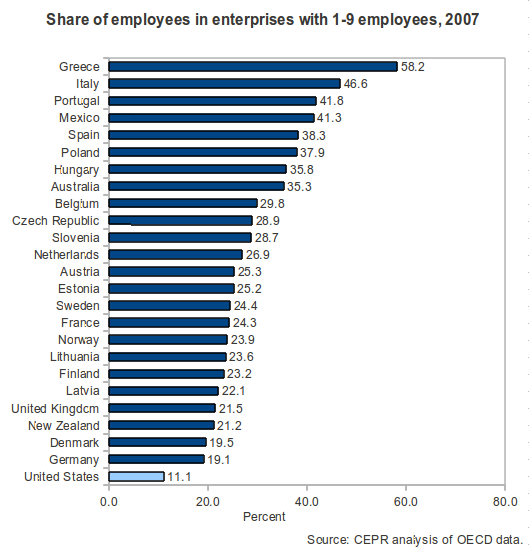
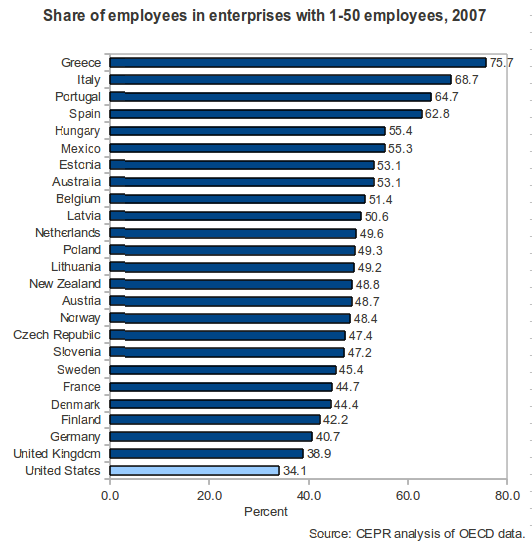
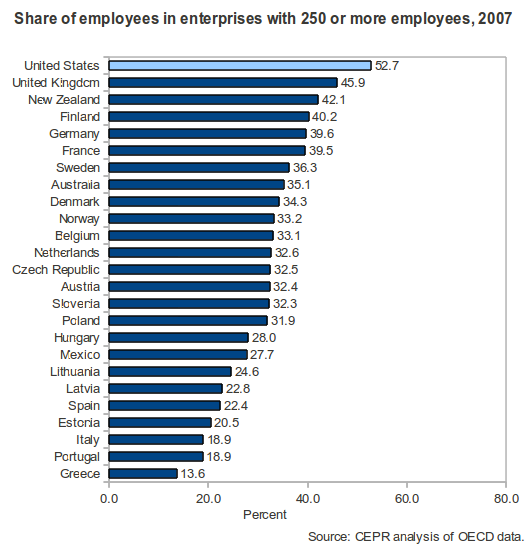
Most Americans work for someone else.  Entrepreneurialism is rare.  Would it be better for America if average firm size shrank and there were more, smaller firms?  Economists like Leopold Kohr and E.F. Schumacher belived that “Small Is Beautiful” and all politicians seem to lionize small businesses.   But countries with only small businesses (and more entrepreneurs) are poorer than countries that are more dominated by big businesses. Of the OECD countries (the club of rich nations), the US is by far the most dominated by large businesses and the OECD nations that are most dominated by small businesses are all relatively poor.  It appears that US small businesses have been growing at the expense of large ones, so is that a good thing?  Matt Yglesias argues that the existence of large businesses is a sign of trust in an economy and therefore their shrinkage may be a bad sign. Trust is certainly good for the economy and the fact that Americans are more trusting of each other than most counties has been a boon for the US economy, but there are many other reasons that could cause the relationship between firm size and economic wealth.

Yglesais at Moneybox explains why Greece, Italy, and Spain have too many small businesses.  It is due to corruption and poor regulation and it keeps them poor:

Politicians often tout the virtues of small firms as a way of signaling support for dynamism and entrepreneurial spirit… But it turns out that some of the most troubled economies of Europe are precisely the ones that are most dominated by small businesses. And this is no coincidence. An economy where a huge share of the population works at small businesses is not one that is friendly to entrepreneurs, but rather one that has widespread corruption and poor regulation. The key to prosperity is not to coddle small firms, but to give people the tools they need to start one and the firms that exist the ability to thrive and compete.

John Schmitt, an economist at the Center for Economic Policy Research in Washington, D.C., pulled together some striking data last fall from an Organization on Economic Cooperation and Development report on entrepreneurship showing that the United States has a strikingly low percentage of its workforce employed by small businesses. The countries at the other end of the spectrum, however, aren’t dynamos—they’re basket cases. If you look at share of the workforce employed by firms with fewer than 10 workers, the leaders among OECD members are Greece, Italy, Portugal, Mexico, and Spain. Only 11 percent of employed Americans work at firms with fewer than 10 employees while 58 percent of Greeks do. Expand it to look at the share of the workforce employed by firms with 50 or fewer workers, and you get Greece, Italy, Portugal, Spain, and Hungary. About one-third of employed Americans work at firms with fewer than 50 employees while 75 percent of employed Greeks do.

 What went wrong?

 One issue is trust and corruption. One of the most difficult aspects of modern social life is that the world is a big place and cooperating with strangers is difficult. After all, they might rip you off. You could appeal to the authorities, but the authorities are likely to be strangers, too. In societies with poorly functioning institutions, high levels of corruption, and low levels of social trust, it makes sense to try to stick with smaller-scale entities. Business relationships are driven by family and personal ties rather than contracts, and a small scale is used to solve the difficulties of impersonal administration.

 It’s not a coincidence that if you look at Transparency International’s Corruption Perceptions Index, the four worst-performing eurozone members are our old friends Greece, Italy, Portugal, and Spain. The converse is that large-firm employment is most common in English-speaking and Nordic countries that have the least corruption.

 Keeping economic units small is a perfectly reasonable response to a less-than-ideal situation, but it’s very economically limiting. Economies of scale can make larger firms more productive and let medium-skilled workers specialize more and earn higher wages. A bigger issue is that great ideas deserve to start small, prove themselves, and then grow. Not every business owner wants to build a Fortune 500 company, but sticking forever with a staff of fewer than 10 people is very limiting.

…It ought to be the case that the worst-managed shops close and the best-managed shops branch out and prosper. That way more people would end up working for managers who know what they’re doing, rather than managers who happen to have inherited a license. Such competition-stifling rules are not unheard of in the United States. An idiosyncratic regulatory framework explains why you’ve traditionally had to buy a car from a locally owned car dealership rather than from a national retail chain or directly from a manufacturer. But the fact that most Americans work at companies with more than 250 employees while almost 70 percent of Italians work at firms with fewer than 50 highlights the scale of the difference. The strength of the Nordic and Anglophone models, from an entrepreneurial perspective, is that these are the places where it’s easiest to start a business and also the places where it’s easiest for one to grow.

So big business is good for the median person IF we can keep that concentrated power from exploiting the rest of us and corrupting society.  Every rich country has figured out how to do it, but this is one of the ongoing challenges in Latin America, Russia, and countries that suffer from the resource curse.  Concentrated business power can corrupt society and entrench a de facto caste system of class privilege.

[Reposted from Bluffton Global.]

Posted in Development, Macro

Enter your email address to follow this blog and receive notifications of new posts by email.

Join 75 other subscribers
Blog Archive
Pages