Charles Duhigg wrote a fantastic article about habits and marketing for The New York Times Magazine based his book entitled Habit. You should read the whole thing, but below are some excerpts that are most relevant for marketing:
Andrew Pole had just started working as a statistician for Target in 2002, when two colleagues from the marketing department stopped by his desk to ask an odd question: “If we wanted to figure out if a customer is pregnant, even if she didn’t want us to know, can you do that? ”
…As the marketers explained to Pole …new parents are a retailer’s holy grail. Most shoppers don’t buy everything they need at one store. Instead, they buy groceries at the grocery store and toys at the toy store, and they visit Target only when they need certain items they associate with Target — cleaning supplies, say, or new socks or a six-month supply of toilet paper. But Target sells everything from milk to stuffed animals to lawn furniture to electronics, so one of the company’s primary goals is convincing customers that the only store they need is Target. But it’s a tough message to get across, …because once consumers’ shopping habits are ingrained, it’s incredibly difficult to change them.
There are, however, some brief periods in a person’s life when old routines fall apart and buying habits are suddenly in flux.
One of those moments is when people move to a new home. Then they are completely open minded about where they are going to be shopping while they live at their new home. This timing is even more important for young people whose habits are more malleable than for the elderly who are more set in their ways. Moving to a new house is also correlated with other major life transitions that also upend people’s habits and motivate the move such as college graduation, marriage, divorce, or a new job.
People naturally change habits when they are thrown into completely different circumstances like on a foreign vacation and even addicts have an easier time breaking their addictions when they are completely removed from the environment where they had build their habit. But when they return to their old environment, the old habits tend to return and it can be hard to bring their newer habits back into the old habitual context.
Target’s marketers argue that the most important life transition for building new habits is the birth of a child and especially the first child. There is no returning to the old life after the birth of a child:
…right around the birth of a child, …parents are exhausted and overwhelmed and their shopping patterns and brand loyalties are up for grabs. But as Target’s marketers explained to Pole, timing is everything. Because birth records are usually public, the moment a couple have a new baby, they are almost instantaneously barraged with offers and incentives and advertisements from all sorts of companies. Which means that the key is to reach them earlier, before any other retailers know a baby is on the way. Specifically, the marketers said they wanted to send specially designed ads to women in their second trimester, which is when most expectant mothers begin buying all sorts of new things, like prenatal vitamins and maternity clothing. …
“We knew that if we could identify them in their second trimester, there’s a good chance we could capture them for years,” Pole told me. “As soon as we get them buying diapers from us, they’re going to start buying everything else too. If you’re rushing through the store, looking for bottles, and you pass orange juice, you’ll grab a carton. …Soon, you’ll be buying cereal and paper towels from us, and keep coming back.”
The desire to collect information on customers is not new for Target or any other large retailer, of course. For decades, Target has collected vast amounts of data on every person who regularly walks into one of its stores. Whenever possible, Target assigns each shopper a unique code — …the Guest ID number — that keeps tabs on everything they buy. “If you use a credit card or a coupon, or fill out a survey, or mail in a refund, or call the customer help line, or open an e-mail we’ve sent you or visit our Web site, we’ll record it and link it to your Guest ID,” Pole said. “We want to know everything we can.”
Also linked to your Guest ID is demographic information like your age, whether you are married and have kids, which part of town you live in, how long it takes you to drive to the store, your estimated salary, whether you’ve moved recently, what credit cards you carry in your wallet and what Web sites you visit. Target can buy data about your ethnicity, job history, the magazines you read, if you’ve ever declared bankruptcy or got divorced, the year you bought (or lost) your house, where you went to college, what kinds of topics you talk about online, whether you prefer certain brands of coffee, paper towels, cereal or applesauce, your political leanings, reading habits, charitable giving and the number of cars you own. …All that information is meaningless, however, without someone to analyze and make sense of it. That’s where Andrew Pole and the dozens of other members of Target’s Guest Marketing Analytics department come in.
Almost every major retailer, from grocery chains to investment banks to the U.S. Postal Service, has a “predictive analytics” department devoted to understanding not just consumers’ shopping habits but also their personal habits, so as to more efficiently market to them…
The reason Target can snoop on our shopping habits is that, over the past two decades, the science of habit formation has become a major field of research… “It’s like an arms race to hire statisticians nowadays,” said Andreas Weigend, the former chief scientist at Amazon.com. “Mathematicians are suddenly sexy.” As the ability to analyze data has grown more and more fine-grained, the push to understand how daily habits influence our decisions has become one of the most exciting topics in clinical research, even though most of us are hardly aware those patterns exist. One study from Duke University estimated that habits, rather than conscious decision-making, shape 45 percent of the choices we make every day, and recent discoveries have begun to change everything from the way we think about dieting to how doctors conceive treatments for anxiety, depression and addictions.
…Luckily, simply understanding how habits work makes them easier to control. …Some of the most ambitious habit experiments have been conducted by corporate America. …Andrew …Pole’s most important assignment was to identify those unique moments in consumers’ lives when their shopping habits become particularly flexible and the right advertisement or coupon would cause them to begin spending in new ways.
In the 1980s, a team of researchers …undertook a study of peoples’ most mundane purchases, like soap, toothpaste, trash bags and toilet paper. They learned that most shoppers paid almost no attention to how they bought these products, that the purchases occurred habitually, without any complex decision-making. Which meant it was hard for marketers, despite their displays and coupons and product promotions, to persuade shoppers to change.
But when some customers were going through a major life event, like graduating from college or getting a new job or moving to a new town, their shopping habits became flexible in ways that were both predictable and potential gold mines for retailers. The study found that when someone marries, he or she is more likely to start buying a new type of coffee. When a couple move into a new house, they’re more apt to purchase a different kind of cereal. When they divorce, there’s an increased chance they’ll start buying different brands of beer.
Consumers going through major life events often don’t notice, or care, that their shopping habits have shifted, but retailers notice, and they care quite a bit. At those unique moments, …customers are “vulnerable to intervention by marketers.” In other words, a precisely timed advertisement, sent to a recent divorcee or new homebuyer, can change someone’s shopping patterns for years.
And among life events, none are more important than the arrival of a baby. At that moment, new parents’ habits are more flexible than at almost any other time in their adult lives. If companies can identify pregnant shoppers, they can earn millions.
The only problem is that identifying pregnant customers is harder than it sounds. Target has a baby-shower registry, and Pole [used that database of known pregnancies to observe] how shopping habits changed as a woman approached her due date, which women on the registry had willingly disclosed. …and before long some useful patterns emerged. Lotions, for example. Lots of people buy lotion, but one of Pole’s colleagues noticed that women on the baby registry were buying larger quantities of unscented lotion around the beginning of their second trimester. Another analyst noted that sometime in the first 20 weeks, pregnant women loaded up on supplements like calcium, magnesium and zinc. Many shoppers purchase soap and cotton balls, but when someone suddenly starts buying lots of scent-free soap and extra-big bags of cotton balls, in addition to hand sanitizers and washcloths, it signals they could be getting close to their delivery date.
As Pole’s computers crawled through the data, he was able to identify about 25 products that, when analyzed together, allowed him to assign each shopper a “pregnancy prediction” score [and] he could also estimate her due date to within a small window, so Target could send coupons timed to very specific stages of her pregnancy.
…Take a fictional Target shopper named Jenny Ward, who …bought cocoa-butter lotion, a purse large enough to double as a diaper bag, zinc and magnesium supplements and a bright blue rug. …[Based on her recent purchase history, the computer model can predict an] 87 percent chance that she’s pregnant and that her delivery date is sometime in late August. What’s more, because of the data attached to her Guest ID number, Target knows how to trigger Jenny’s habits. They know that if she receives a coupon via e-mail, it will most likely cue her to buy online. They know that if she receives an ad in the mail on Friday, she frequently uses it on a weekend trip to the store. And they know that if they reward her with a printed receipt that entitles her to a free cup of Starbucks coffee, she’ll use it when she comes back again.
In the past, that knowledge had limited value. …But now that she is pregnant, everything is up for grabs. In addition to triggering Jenny’s habits to buy more cleaning products, they can also start including offers for an array of products, some more obvious than others, that a woman at her stage of pregnancy might need.
Pole applied his program to every …female shopper in Target’s national database and soon had a list of tens of thousands of women who were most likely pregnant. If they could entice those women or their husbands to visit Target and buy baby-related products, the company’s [marketers could get] them to buy groceries, bathing suits, toys and clothing, as well. When Pole shared his list with the marketers, he said, they were ecstatic. Soon, Pole was getting invited to meetings above his paygrade. Eventually his paygrade went up.
At which point someone asked an important question: How are women going to react when they figure out how much Target knows?
“If we send someone a catalog and say, ‘Congratulations on your first child!’ and they’ve never told us they’re pregnant, that’s going to make some people uncomfortable… We are very conservative about compliance with all privacy laws. But even if you’re following the law, you can do things where people get queasy.”
About a year after Pole created his pregnancy-prediction model, a man walked into a Target outside Minneapolis and demanded to see the manager. He was clutching coupons that had been sent to his daughter, and he was angry, according to an employee who participated in the conversation.
“My daughter got this in the mail!” he said. “She’s still in high school, and you’re sending her coupons for baby clothes and cribs? Are you trying to encourage her to get pregnant?”
The manager didn’t have any idea what the man was talking about. He looked at the mailer. Sure enough, it was addressed to the man’s daughter and contained advertisements for maternity clothing, nursery furniture and pictures of smiling infants. The manager apologized and then called a few days later to apologize again.
On the phone, though, the father was somewhat abashed. “I had a talk with my daughter,” he said. “It turns out there’s been some activities in my house I haven’t been completely aware of. She’s due in August. I owe you an apology.”
…Using data to predict a woman’s pregnancy, Target realized soon after Pole perfected his model, could be a public-relations disaster. So the question became: how could they get their advertisements into expectant mothers’ hands without making it appear they were spying on them? How do you take advantage of someone’s habits without letting them know you’re studying their lives?
…After Andrew Pole built his pregnancy-prediction model …someone pointed out that some of those women might be a little upset if they received an advertisement making it obvious Target was studying their reproductive status, everyone decided to slow things down.
The marketing department conducted a few tests by choosing a small, random sample of women from Pole’s list and mailing them combinations of advertisements to see how they reacted.
“We have the capacity to send every customer an ad booklet, specifically designed for them… We do that for grocery products all the time.” But for pregnant women, Target’s goal was selling them baby items they didn’t even know they needed yet.
“With the pregnancy products, though, we learned that some women react badly… Then we started mixing in all these ads for things we knew pregnant women would never buy, so the baby ads looked random. We’d put an ad for a lawn mower next to diapers. We’d put a coupon for wineglasses next to infant clothes. That way, it looked like all the products were chosen by chance.
“And we found out that as long as a pregnant woman thinks she hasn’t been spied on, she’ll use the coupons. She just assumes that everyone else on her block got the same mailer for diapers and cribs. As long as we don’t spook her, it works.”
…Soon after the new ad campaign began, Target’s Mom and Baby sales exploded. …Pole was promoted. He has been invited to speak at conferences. “I never expected this would become such a big deal.”
Getting habitual customers is the art of lowering prices when people have more elastic demand because that is when people change their habits. Then raise prices later after they have become habitual customers and less elastic. Target does this by giving discounts to new parents and expecting that they will keep coming back and pay full price later.
Amazon Prime is another effort to make customers more habitual & inelastic and we just started to see evidence in 2018 that Amazon has started to raise prices a little to make it’s retail business profitable. Its shareholders have long been betting that they will rise prices at some point because that is the only thing that could justify the high price/earnings ratio of Amazon shares. Amazon had been intentionally keeping profits near zero and using all their resources to destroy their competition for most of the company’s history and much of their strategy has been aimed to make Amazon a weekly or even daily habit for shoppers.
Individualized insurance pricing and habit
The Boston Globe reported research into car insurance pricing by Consumer Reports that found that they charge more for habitual customers (who have less elastic demand).
You’ll …be charged more if big data says you won’t notice. In yet another bid to maximize profits, some insurance companies have begun in the past few years to use a new technique to determine your sensitivity to prices. That way, they can base your premiums not just on your risk profile or credit score, but also on how high a price you’re willing to tolerate. Called price optimization, the practice — [banned in some states like Ohio for automobile insurance] — uses data about you and statistical models to gauge how likely you are to shop around for a better price. Two factors are whether you have complained about your policy, and how much of an increase you accepted when you renewed your policy in the past. So don’t be shy about complaining a little more.
Longtime loyalty to a company might work against you. Many companies, including car insurers, reward their most loyal customers with discounts or other incentives. But Consumer Reports’ study found that while some insurers give a sizable discount, others give a small one, and still others offer nothing at all. Some insurers even salute your allegiance with a price hike.
Additionally, Consumer Reports found that insurance companies tended to charge more for adding a teen driver to an existing policy than for new customers and the highly advertised “discounts” for bundling home and auto insurance saved very little. That makes sense because people who bundle more services probably become less elastic for either one. They are less likely to switch their car insurance when the price rises if they like their home insurance and vice versa.
Age and political marketing
During election season when political ads dominate the airwaves, it can be jarring to see how political ads tend to be much more conservative than the consumer-goods ads. Although most consumer-goods ads are politically neutral, there is a tendency for some liberal bias there. This would seem odd given that the CEOs who are in charge of consumer-goods corporations tend to be on the conservative side of the political spectrum. The reason is demography and habits.
Consumer goods prioritize their marketing to target young people for two important reasons: 1) The habits of young people are more elastic (especially with respect to addictive substances). 2) Young people have much larger customer lifetime value (CLV) because they have a longer life expectancy.
In contrast, political campaign ads prioritize targeting older Americans because they are much more likely to vote than the young and political campaigns tend to be funded by candidates who are extremely short sighted and prioritize winning just the current election. For example, Trump and Biden don’t care about changing future lifetime voting habits–they just want to win this election!
Sometimes consumer goods corporations use advertisements to deliberately create political controversy and multiply their publicity. For example, during the first Superbowl after Trump was inaugurated, there were several corporate advertisements celebrating immigration and diversity which triggered some people who interpreted these ads as being anti-Trump. For example, some Trump supporters called for a boycott of Budweiser in retaliation for the company’s ad celebrating immigration. I disagree with that interpretation, because normally companies like Budweiser just try to influence their target youth demographic in order to make money but you can watch the Budweiser ad and judge for yourself.
The most politically controversial corporate TV ad in recent memory was Nike’s Colin Kaepernick ad. The advertisement was rarely shown on TV and most of the content would have been inspiring for everyone but for the fact that Colin Kaepernick appeared at the end and Kaepernick had been at the center of divisive culture war issues.
It is hard to believe in retrospect, but Nike’s Kaepernick ad immediately drew rebukes from President Trump and calls for boycotts:
Just like the NFL, whose ratings have gone WAY DOWN, Nike is getting absolutely killed with anger and boycotts. I wonder if they had any idea that it would be this way? As far as the NFL is concerned, I just find it hard to watch, and always will, until they stand for the FLAG!… What was Nike thinking?
As a result, numerous Trump supporters posted videos of burning Nike products and their declaration of boycottscaused Nike stock to fall the next day. But within a few days the stock rebounded to new heights buoyed by higher sales and the stock went up by $5 billion shortly after the ad came out. At first glance Nike seemed to have the the philosophy that all publicity is good publicity even if it makes some people upset (which is arguably Donald Trump’s media philosophy). By that philosophy, Nike’s ad was a dramatic success generating over six million news articles around the world in less than two weeks according to hits compiled by Google News. That is an extraordinary amount of free publicity for an ad that Nike rarely ever paid anyone to show.
It was a gamble for a company like Nike to deliberately lose sales from partisans on one side of the political spectrum rather than stick with neutral ads that appeal across the entire political spectrum, but it makes sense given Nikes demographic priorities. Because American youth tend to be more liberal than older Americans, corporate ads tend to have a liberal bias simply because the net-present-value of younger consumers is higher than for older consumers. This is especially for youth-oriented products like athletic wear.
On the other hand, political ads for both parties have a more conservative bias compared to the true median of the American political spectrum today because older Americans are much more likely to vote and they also tend to be more conservative than younger people. Matthew Yglesias:
The target demographic of consumer-focused advertising skews younger than the national average, while the electorate skews older… Advertisers need to target young people
But beyond those extreme cases, the main groups that advertisers worry about are millennials and the younger “Generation Z.” That’s in part because young people spend a larger share of their budget on branded products (as opposed to boring things like mortgages and child care) but it’s primarily because once people find a brand they like they are unlikely to switch.
Older people have found brands that they like, and less inclined to try new things. What’s more, if you’re already a fan of a given brand’s products, it doesn’t really matter whether or not you like their new marketing campaigns.
Meanwhile, the oldest consumers not only tend to have a whole set of brands they are already committed to, they are also unlikely to be interested in exploring new product categories. Even new categories that eventually become ubiquitous such as televisions or smartphones initially face reluctance from older consumers. Companies with new products normally focus on winning young adults first and expand to older customers later.
On the other hand, seniors are disproportionately likely to vote. Older people move around less, have more knowledge of the community they live in, and have deeper ties to local institutions. They have more time on their hands to engage with the political system. And they reliably turn out to vote at a higher rate than younger people.
This means that while senior citizens are largely irrelevant to mass-market consumer brand advertising, they are crucial to politics. Teenagers, conversely, are overwhelmingly ineligible to vote and yet are absolutely central to consumer advertising.
These things have both been true for a long time. What’s made them salient recently is that it’s only over the past few election cycles that age has been a major driver of partisan politics.
Corporations aren’t anti-Trump; they are pro-profits. If anything, corporate leadership has a long history of favoring the political right. For example, although Nike burnishes a progressive image in its ads, the company leadership is not liberal. Nike donates to both parties and its founder is a huge Republican donor. Although Nike likes to associate with Kaepernick’s image (which is cool among youth) Nike as has pointedly NOT supported Kaepernick’s progressive political positions at all. All Nike supports is people who are willing to fight for what they believe in “even if it costs you everything” and that message is popular with youth of all political persuasions.
Nike doesn’t want to touch the actual substance of the policy positions Kaepernick has been advocating. They just want to associate with him as a media persona because that seems cool to most youth.
Because Trump’s average supporter happens to be a lot older than the most valuable target demographic for marketers, that means that stoking some backlash from Trump is free publicity that helps get attention and an appearance of authenticity from their key demographic. Some research indicates that people generally get more conservative as they get older, so some liberal bias among corporate advertisements is probably always there, but right now there is a much bigger generational divide than usual between the preferences of voters under age 28 and those over 59.
But younger voters are politically unimportant because that they are only about half as likely to vote.
The dominance of seniors in political marketing has been rising because their numbers have been growing faster than other demographics as longevity rises, fertility rates fall, and the baby boom reaches their peak voting age. Plus, it is the only demographic that has had an increasing rate of voting participation:
As long as old Americans are more conservative than young Americans, political ads will be more conservative than consumer ads because both Democrats and Republicans always have to pander to the preferences of older Americans who vote at twice the rate of younger Americans. But consumer-goods corporations don’t care about old people. They want to win life-long consumers rather than just winning an election year, so they pander to the tastes of youth who have the biggest potential life-long expenditures and who are easier to influence than old people anyhow. Old people are much more set in their habits.
*Note that there is some slight discrepancy between the above data produced by the Census Bureau versus Pew. Neither one perfectly shows what really happened in the election because this data is based on exit polls of self-reported voting and some people lie or make mistakes about how they actually voted. Despite the discrepancies, the polling is pretty close to what actually happened. In reality, Trump got 46% of the vote and Clinton got 48% of the vote, so the above exit poll data is probably pretty reliable.
**Another reason why political campaigns target older demographics may be that politicians tend to be old themselves (with an average age of 64) and the corporate world is dominated by younger leaders (average age of 52). Bradley Schurman points out that whereas everyone has experience being young, only old people know what it is like to be old and so perhaps it is hard for middle-aged executives to market to older demographics than to market to youth whereas old politicians really know how to communicate to old people.
Writing changed the world by allowing one author to communicate with thousands of people. Even though only a few readers could read at the same time, a writing is a memory that can be preserved without corruption for decades and transported over vast distances.
The Population Resource Bureau estimates that nearly 7% of the total population of humans who have ever been born are currently alive today. That is a overestimate because they are assuming that the first two humans emerged only 50,000 years ago. Most scientists think that modern humans appeared at least 200,000 years ago. In any case, the Population Resource Bureau estimates that only 20% of all humans have been born after 1650.
Within that 20%, a small fraction of humans suddenly started becoming much more inventive because Gutenberg invented the printing press in 1436.
In particular, it was the Europeans and their cultural descendants who suddenly became more inventive because Gutenberg was European and his invention was particularly suited to European language and culture. But before Gutenberg came along, Europe had been a backwater for centuries after the collapse of the Roman Empire. If aliens looked at the peoples of the world and tried to predict what civilizations had the most potential at that time at the end of Europe’s dark ages, they would probably pick an Islamic or Chinese nation. The Ottoman Empire had inherited the fruits of the Islamic Golden age and just conquered the last remains of the Eastern Roman Empire. They were about to take over much of the Middle East, Southeastern Europe and North Africa.
The Chinese empire was already massive and they had produced the Grand Canal and the Great Wall and had the best technology in the world. They had just sent a majestic fleet to explore the seas. They sent hundreds of ships with about 27,000 personnel on several exploratory voyages including the largest ships in history dwarfing Columbus’ three ships that sailed at the end of the century. They brought back African elephants, giraffes, and raw materials from all across the South China Sea and Indian Ocean. Below you can compare the relative size of major European and Chinese ships and their voyages.
If the printing press had not come along, the Renaissance probably could not have rapidly spread out of northern Italy to the rest of Europe and it might have fizzled out. Later historians would trace the origins of the Renaissance to the decades preceding Gutenberg, but without the printing press, historians probably would not see the importance of the artistic and political achievements in the tiny Italian city states that were soon copied across Europe. When the printing press was invented, Europe was so backward, nobody would have thought that it would soon come to dominate the world. But Europe suddenly changed after Gutenberg.
Some argue that Gutenberg didn’t really invent the printing press because most of the technologies that he used had been invented by others. His main contribution was merely to combine several existing technologies into a revolutionary new business model that dramatically reduced the price of books. He was the first to figure out how to take advantage of several improvements in metallurgy, moveable type, paper, presses, ink, book binding, scripts, and literacy to produce an entirely new kind of publishing industry. Other than his cleverness (and luck) in combining those technologies into a new package, his main technological innovations were small: he invented an improved formula for ink that stuck to metal type better, and he probably reinvented an improved matrix for casting better moveable type. Gutenberg had been a goldsmith, so he had a perfect skill set for casting better moveable type.
Moveable type is the practice of casting each letter of the alphabet in a separate piece of metal. Each metal letter is arranged in a frame to produce words and sentences. That way the same bunch of letters can be quickly and cheaply rearranged to print any combination of words for every possible page. Previously printers had laboriously carved each unique page in its entirety on a block of wood or other material. It could take days to just get a single page of text ready for printing. With moveable type, the pre-cast letters could be quickly rearranged to produce a new page of text in under an hour.
Gutenberg’s innovation dramatically increased the output of books and decreased their cost.
By TentotwoData from: Buringh, Eltjo; van Zanden, Jan Luiten: “Charting the “Rise of the West”: Manuscripts and Printed Books in Europe, A Long-Term Perspective from the Sixth through Eighteenth Centuries”, The Journal of Economic History, Vol. 69, No. 2 (2009), (417, table 2), CC BY-SA 3.0
For example, by 1424, (after being open for 215 years) Cambridge University library still only owned 122 books total and each book had a average value equal to an average farm or vineyard. In market value, their library owned as much as 122 farms worth of books. All those riches could all easily fit on a single bookshelf in my office with the kind of printing that we have today.
Today’s books hold much more information because the paper was so coarse and primitive everyone preferred to books printed on leather instead of paper! Plus, before the printing press, handwritten books needed much more space to create legible words, so only about half as many words could fit on a page.
The Bible was originally divided into 72 separate books because it would have been too heavy and expensive to try to combine them into a single volume. That is why we still call them the books of the Bible rather than the chapters of the Bible. A single Bible was originally a library. A Bible was a collection of 72 separate books because books were so rare and expensive before Gutenberg that many early churches could not afford all of the holy books and different churches had different books. It took three and a half centuries after Jesus died for the Catholic church to first establish what books should be in the official cannon during the Council of Rome and that was the beginning of the official Bible. It took a long time to bring every congregation in line so that they had all 72 books of the Bible and stopped using the extras and most eastern churches maintained a separate tradition with somewhat different books.
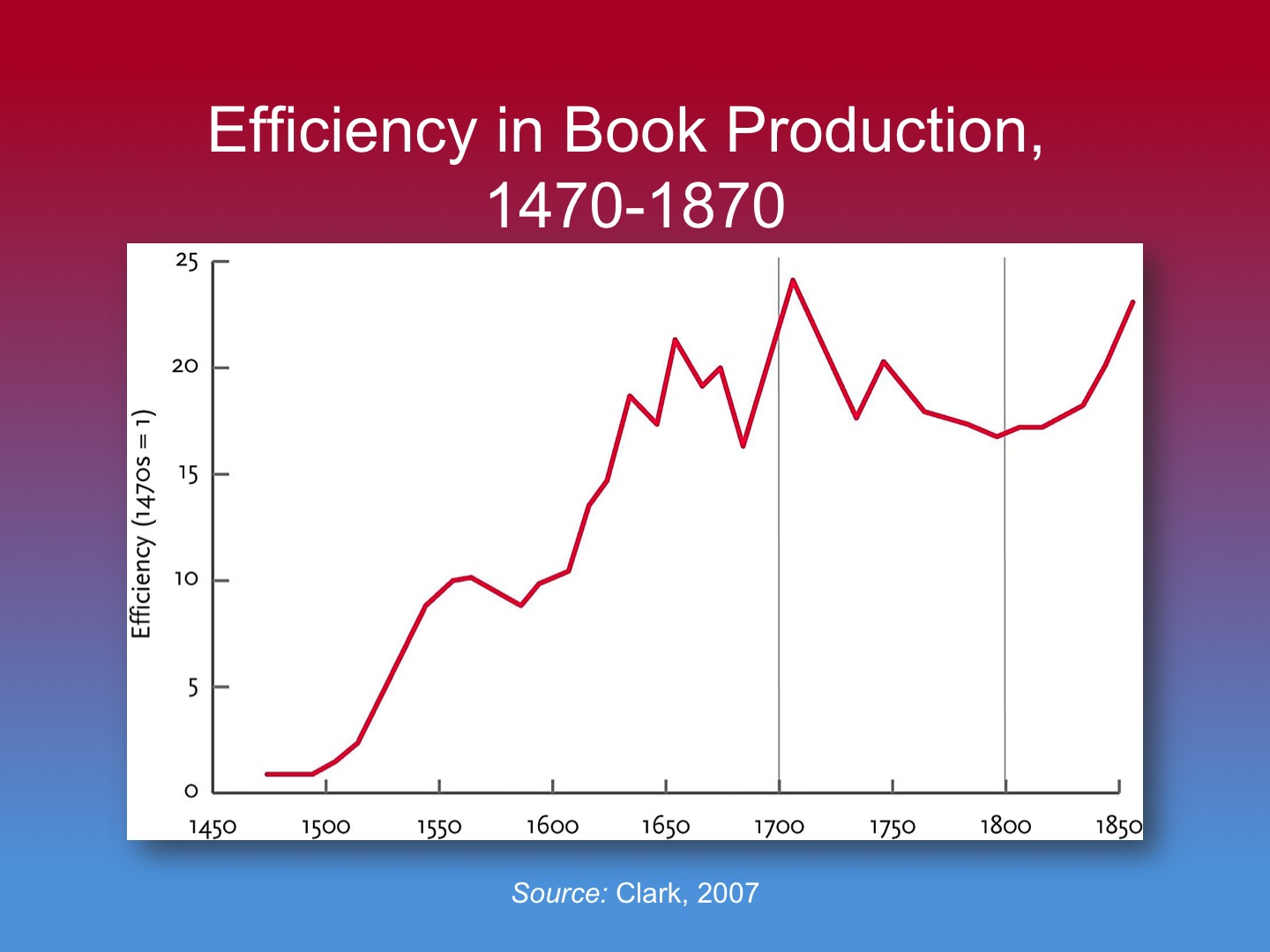
Although there were dramatic improvements in paper and printing during Gutenberg’s lifetime, a complete Gutenberg Bible still weighted about 30 pounds if printed on paper and nearly 50 pounds printed on parchment (sheepskin) or vellum (calf skin), so it was still nearly impossible to handle all that information in a single book. The printing press soon enabled each worker to print 30 times more books.
The increased productivity in printing spurred inventions in paper production and book binding which caused further drops in the price of books and by 1500, there were 15,000 books in print that a wealthy library like Cambridge could buy.
Note that this graph estimates productivity growth beginning well AFTER Gutenberg’s invention and does not show how Gutenberg’s initial invention created an immediate revolution in efficiency in the first half century. These graphs just show how much gradual improvement in printing happened well after he died.
The printing industry was the first modern manufacturing industry because it was the first capital-intensive form of mass production using interchangeable parts (movable type) and the first example of manufacturing’s ability to dramatically increase production and reduce costs. Nevertheless, it is not associate with the industrial revolution because it didn’t have any measurable effect on the median standard of living. Most people were still too poor to own any books even at the dramatically reduced cost. And at least 90% were illiterate even some people who had money didn’t have any use for books. Books have always been an insignificant fraction of one percent of GDP both before Gutenburg and after.
Economists typically say that economic growth didn’t benefit ordinary people until it reduced the prices of things that most people spent most of their budget on like clothing, food, and fuel. They usually look at the “hockey stick” graph of world history and note that it looks like the exponential growth kink begins around 1800 (or even not until 1870 according to Brad Delong!). But the industrial revolution really began in England and if we focus on when growth took off in England, it looks like it began not long after the printing press was invented. It is just that a constant exponential growth rate of 1.8% doesn’t look like anything on a linear-scale graph until somewhere around 1800, but economic growth really started far earlier, in the mid 1600s according to the Bank of England’s data, which is shortly after literacy took off.
Jared Diamond’s book, Guns, Germs, & Steel, persuasively explains why somewhere in Eurasia conquered the world, but he didn’t do much to explain why Europe conquered Asian civilizations. One explanation is the printing press. That could explain why Europe subjugated China and not vice versa.
The printing press required an alphabet to work efficiently. Printing didn’t take off in China until the early 1900s, almost 500 years after it began revolutionizing European society! The complex Chinese scripts were just too cumbersome for moveable type, but when offset lithography and other techniques finally began replacing moveable type in the mid 1800s those new technologies made printing Chinese much easier and that helps account for why printing did not take off in China until the 20th century. A history of printing in Japan said the revolutionary invention of lithography was as dramatic as Gutenberg’s invention. The first modern moveable-type printing began in Japan in 1849 when a Stanhope press was given to the Shogun and lithographic printing began shortly after that in 1868.
The complex Chinese script is much easier to manage with lithographic printing than moveable type, but even with lithography, typesetting is slower and more difficult in Chinese than for languages that use alphabets. It is probably no coincidence that China did not take off economically until computers became powerful enough in the 1980s to allow printing in Chinese to finally become as cheap AND as easy to produce as in languages that use an alphabet.
The difficulties of Chinese writing also delayed their adoption of telegrams, typewriters, Braille, linotype printing presses, punch-card computer memory, and computer programming itself. Despite a century of development, Chinese typewriters never achieved the kind of importance they achieved in Western society:
The Chinese typewriter was a metaphor for absurdity, complexity and backwardness in Western popular culture. One such example is MC Hammer‘s dance move named after the Chinese typewriter in the music video for “U Can’t Touch This“. The move, with its fast paced and large gestures, supposedly resembles a person working on a huge, complex typewriter.
Whereas the typewriter for the half of the planet that uses an alphabet look approximately identical, here is a photo of a state-of-the art 1970’s Chinese typewriter. It works completely differently and it is MUCH harder. No mechanical Chinese typewriter ever had a keyboard and although they could never print the vast majority of Chinese characters! They only worked for the most common characters.
It wasn’t until the mid 1980s when the Chinese finally agreed upon a standard way to type with a keyboard (wubi). They could finally use computers with Chinese writing. Until that time, computers in China had to be run using foreign languages that used alphabets. The Chinese government saw this as such a crisis that they considered altogether abandoning their traditional Chinese logogram writing system. Today the most common method of typing in Chinese is to sound out the words using a Roman alphabet with the pinyin system.
Most people think that Gutenberg invented moveable type, but he was far from the first. Jared Diamond points out that moveable type was reinvented several times in history such as in 1700 B.C. in Crete (the Phaistos disk), and again in China and Korea a half millennium before Gutenberg. In fact, Asian societies still use stamps called “name chops” to sign documents that look just like moveable type as shown here at a modern store that sells them:
So one would think that they would have thought to use something just like these chops for printing too, but it never took off except in Korea where printing was strictly limited by the government. That combined with the fact that the population of Korean speakers was small so the total number of printed books in Korean didn’t have much influence. In contrast, most books in Europe were printed in Latin in the first half century after Gutenberg, so there was a much larger market that could buy the books and a larger population of authors who could write in Latin for the European audience.
Earlier inventors lacked the other technologies that made printing finally a commercial success when Gutenberg reinvented it yet once again. Although moveable type had been invented numerous times in history, it didn’t revolutionize those societies because they didn’t have other supporting technologies.
Gutenberg’s development of typecasting from metal dies, to overcome the potentially fatal problem of nonuniform type size, depended on many metallurgical developments: steel for letter punches, brass or bronze alloys (later replaced by steel) for dies, lead for molds, and a tin-zinc-lead alloy for type. Gutenberg’s press was derived from screw presses in use for making wine and olive oil, while his ink was an oil-based improvement on existing inks. The alphabetic scripts that medieval Europe inherited from three millennia of alphabet development lent themselves to printing with movable type, because only a few dozen letter forms had to be cast, as opposed to the thousands of signs required for Chinese writing. (Diamond, 1999, p259)
Not only did printing notrevolutionize China when the Chinese invented it in the 1100s, it still didn’t revolutionize Chinese society even centuries after Gutenberg’s innovations revolutionized the Western societies simply because they use an alphabetic script which works much better with moveable type than the Chinese writing system.
The basic Latin alphabet only requires 26 characters to write everything (plus approximately 70 rarely-used characters for capital letters, punctuation marks, and common symbols like the dollar sign) and early moveable typefaces could be organized in a box divided into only ten columns and ten rows.
In the Chinese writing system, they would have needed more than 30 times more little boxes to store the minimal set of 3,000 characters and potentially up to 50,000 boxes to have a more comprehensive set. That would make moveable type maybe 100 times more expensive to use in Chinese than in languages like English.
So it is remarkable that the Chinese accomplished it at all as shown in this photo of wooden moveable type:
But given the cheap labor in China and greater difficulty of using moveable type with numerous Chinese characters, they preferred to use wooden block printing in which each page was custom carved by hand on a slab of wood and then laboriously pressed by hand (rather than pressed by a machine as with Gutenberg’s technology). Woodblock printing is an inferior technology because wooden blocks are much more expensive to carve and produce less sharp images and the blocks wear out much faster than Gutenberg’s metal movable type.
Japan may be an exception that proves the rule. Advanced printing presses took off in Japan much earlier than in China and that may be partly due to their adoption of alphabetic systems for writing. For example, Japanese printing first started with a Romanized script that the Jesuits developed in 1590. The Jesuit system never became popular, but the Japanese also developed their own kind of phonetic ‘alphabets’ representing syllables called kana made up of hiragana and katakana which each have just 46 basic characters and are easily adapted to moveable type. That may have helped Japan develop an earlier printing industry than China developed. Japan also developed early systems of copyright and circulating libraries. And whereas one system of Japanese writing does use Chinese characters (kanji), they use a much smaller set of characters than Chinese. Secondary school students are only expected to know 2136 kanji.
The printing press caused phonetic writing systems to spread and they took over the entire planet except places that had already developed a strong tradition of using Chinese logograms. Phonetic alphabets and syllabaries had a huge advantage over Chinese logograms for printing using moveable type since languages have much fewer sounds than words. Some of China’s cultural offshoots also adopted Chinese writing, notably Japan and Korea, but both of them also later developed phonetic writing systems and that may have helped them develop economically earlier than China.
Although Korea was another early innovator of movable type, it has an interesting history that explains why Korean society was not immediately revolutionized by printing like European cultures were. The primary theory is that printing was monopolized by the central government in Korea which may have recognized the potential threat of the printing press and wanted to control it. The fears of the Korean rulers were prescient because in Europe the printing press led to to religious revolutions and political uprisings. In Europe, neither the church authorities nor governments realized the extent to which the printing press would soon cause revolutions that would overthrow their power. Jeremiah Dittmar wrote that, “regulatory barriers did not limit diffusion [in Europe] because printing fell outside existing guild regulations and was not resisted by scribes, princes, or the Church (Neddermeyer 1997, Barbier 2006, Brady 2009).”
The Islamic world was a center of learning partly because Muslims call it a religion of the book to emphasize the sacredness of the written text. The word “quran” simply means ‘reading’ and the quran:
“transformed Arab society into a pre-eminently literary culture …[where] textuality became the predominante characteristic …and came to permeate Muslim society… The writing and copying of texts was an essential and integral part of this endeavour; during the 8th-15th centuries in Muslim lands it reached a level unprecidented in the history of book production anywhere.”
But moveable type was very slow to revolutionize Muslim society. Italy was the home of Arabic printing beginning with the first book printed on behalf of Pope Julius II for Arab Christians and continuing through the 16th century. Even in through the 19th century, printed Arabic books continued to flow from Europe to the Arab world and the first Arabic book printed in the 18th century. There were several reasons why the Arab world took many centuries to embrace the printing press.
A full Arabic fount can contain over 600 sorts due to the abundance of letter forms, ligatures, and diacritics. That is much more expensive than the 52 letters in both upper and lower case.
Arabic script is cursive which is harder to carve and more delicate to reproduce in printing. That is one reason it required many times more typesets than Latin alphabets.
Book printing was challenged by the entrenched monopoly of the scholarly class called the ulama who had intellectual authority. Islamic governments also wanted to control information and even after modernizing rulers finally sponsored a few of their own printing presses, they did not give freedom of the press to private individuals.
The foreign technology of mechanical reproduction was seen as sacrilege by many Muslims, particularly printing for religious texts which was the most common use of early printing in both Europe and the Islamic world. There were rumors that the ink used pig hair which is seen as a profane animal. Presses could not match the highly-refined style of proper Arabic calligraphy whereas printed text in the Latin alphabet usually looks more precise than handwriting.
Joseph Henrich argues that Islamic culture was less interested in the kind of individualism and liberal ideas that flourished with printing. He points out that there was a second technology that revolutionized European society at the same time as the printing press: the mechanical clock. Every European town spent a large amount of resources to buy and maintain large clocks and even among the poor, a large percentage of workers (about 40% in England) bought pocket watches. Islamic culture simply had much less interest in non-religious texts and time keeping for parallel cultural reasons.
Most of the early printing in Arabic was done by Christian minorities or European missionaries that did not have these religious and aesthetic constraints, but they did not reach a large audience. Indigenous Muslim printing did not take off in Arabic until the advent of lithography in the mid 1800s which could finally reproduce the stylistic calligraphy that they considered (and still consider) sacred. Lithography had only been used in Europe for reproducing pictures and maps because it was much more expensive than moveable type, but it finally brought widespread mass-produced books to Muslim cultures. By the turn of the 20th century, printed books finally displaced expensive handwritten and block-printed books although it took a bit longer for printed Qurans to become the norm.
…the major Ottoman printing houses published a combined total of only 142 books in more than a century of printing between 1727 and 1838. When taken in conjunction with the fact that only a miniscule number of copies of each book were printed, this statistic demonstrates that the introduction of the printing press did not transform Ottoman cultural life until the emergence of vibrant print media in the middle of the nineteenth century”
In contrast, about 12.6 million books were printed in Europe (and 27,704 different titles) between Gutenberg’s invention of the printing in 1454 and 1500, only 46 years later. Literacy and printing in Turkish were further boosted in 1929 when Atatürk replaced Arabic letters with the Latin alphabet for writing Turkish. He was partly motivated to simplify Turkish writing and boost literacy as well as by the needs of the telegraph and to facilitate more use of the printing press (Zurcher, 2005, p.188).
Nick Szabo wrote an excellent essay about how printing changed European culture entitled Book Consciousness, but he has unfortunately taken it down, so I’ll repost sections here:
Marshall McLuhan, Elizabeth Eisenstein and others have described the importance of the “printing revolution” to European developments such the Reformation, Renaissance, and science. According to Eisenstein, printing finally foiled the entropy that had destroyed the vast majority of written works since ancient times. Printing also enlarged the bookshelves of scholars all over Europe: by a factor of fifty or more by the middle of the 16th century.
I’d go even farther than Eisenstein. Printing soon brought literacy to vast numbers of people (eventually to the vast majority of us). Printing, especially printing in newly standardized vernaculars, changed the very consciousness of people, and turned a small corner of the world, Western Europe, into a culture that in conquered the world. Widespread decentralized printing and the accompanying book markets, new schools, and rise of literacy gave rise to a new form of consciousness — book consciousness.
Columbus was among the first generation of navigators who had been reading avidly and widely since a child. On his bookshelf was Marco Polo’s Travels. On his voyages he carried maps made by geographers who had been literate since they were children, and he carried astronomical tables that had been printed widely across Europe. These tables had been made by a Hungarian-Italian mathematician whose bookshelf was full of ancient Greek science and mathematics. Such information had been rather inferior and far less available just a few decades before.
With the easy conquest by tiny Portugal of Asia’s vast and ancient sea trade routes, rapidly literizing Western Europeans were by the early 16th century demonstrating a vast superiority in naval affairs. In navigation as in battle officers using accurate charts and astronomical tables were at a premium. (Europeans did not have quite such good luck on land against the Turks). Western Europeans would retain completely uncontested (except among each other) naval superiority on the world’s oceans until the Japanese victory over Russia in the early 20th century. The Japanese by then had long since taken up printing and had a very well read population . Even on the ground by the 18th century English merchants, officers, and civil servants, practically all of them literate and widely read since young children, were finding it quite easy to conquer and take over the administration in far larger and otherwise highly advanced civilizations like India.
Soon after the spread of the printing press, the very fundamentals of organization in Western Europe began to change. In the late Middle Ages organizations, even royal and papal bureaucracies and banking “super-companies”, rarely engaged more than a few dozen employees. Organizational size came up against the severe limit of the Dunbar number. By the end of the 16th century, the colonial companies and bureaucracies of Spain and Portugal were vast, highly literate, and well coordinated. Officer corps had often been raised on military books and thus able to draw lessons from a wide variety of ancient and recent battles. Even a minor salt extractor in Wear, England, was employing 300 men by the mid 16th century. (Large organizations in manufacturing would largely have to wait until the 18th century and the industrial revolution, however).
Before book consciousness there had been no national languages, but only a range of often mutually incomprehensible dialects and in Western Europe the language of the tiny literate elite, Latin. With newly unified national vernaculars, organizations were able to coordinate and grow in an unprecedented manner. A much larger group of people, raised on the same written language, increasingly also came to look and speak similarly and become far more mutually trusted. It was the birth of national loyalty and nationwide webs of trust. The “tribe” to which we are instinctively loyal vastly increased in size. The pool of already somewhat trusted “same tribe” people from which a bureaucracy could recruit new members vastly increased. National polities and militaries were able to coordinate political, economic, and battlefield strategies in an unprecedented manner. The 16th century saw the first major growth of the joint-stock corporation, enabling far more capital to be invested in the enlarging organizations that engaged in mining and manufacture as well as government and conquest. This development is probably a response to the new ability to form larger organizations, since the basic ideas (corporate law, shares of stock, etc.) had already been in use in Europe for quite some time. Some of the early English 16th century joint-stock companies included military expeditions (Drake’s privateering voyages and naval actions were financed through joint stock companies: a different company for each expedition), trading and slaving companies (the Muscovy and Guinea companies) and mining and manufacturing companies (the Royal Mining Company and the Royal Batteries & Mines Company). The most famous became the English East India Company, but many of the American colonies were also joint-stock corporations. The first widely traded and initially most successful joint-stock company was the Dutch East India company, which quickly grew far beyond the Dunbar number to have thousands of employees.
Book consciousness changed almost every profession. Good books on a trade could greatly increase the knowledge imparted during apprenticeships, and indeed eventually led to the end of the apprenticeship system. Meanwhile, widely printed books on mathematics and science, such as Euclid’s Geometry, gave knowledge that could be used in a wide variety of occupations, and training was often restructured to assume and build upon such new general knowledge. This led to a profound change in labor productivity, moving mankind away from the Malthusian curve and (along with the expansion of organizational size beyond the Dunbar limit) eventually to the industrial revolution.
A typical example of the rise of book consciousness was the radical improvement in how cases were reported in the English legal system by the late 16th century. For the first time, cases and statutes were widely and accurately cited. This reflected the fact that judges, barristers, attorneys, and even some of the parties had for the first time printed books of statutes and cases at their fingertips — instead of having to find the single copy of a scroll hidden away in some monk’s or bureaucrat’s library. The first great English opinion writer, Sir Edward Coke, dates from this period. In turn, the wide availability of printed statute and case law led to basic changes in the way we interpret and view the law.
Almost invariably, during the colonial period, when largely illiterate cultures (i.e. cultures where most of the second-tier nobility, military officers, and merchants, and almost all craftsmen and farmers, had not been raised on books) were encountered by literate Europeans, the latter described the former with severe epithets, such as “savages.” This makes our forbears seem odious to us, who understand that all human races are capable of literacy, and indeed by now book consciousness has spread to most of the globe and most of us encounter a wide variety of highly literate people every day. However, at least in the 16th century for book-raised Western Europeans this was not so much a racial prejudice as a largely accurate observation. “Savage” was applied not only to Neolithic Africans and Americans, but also to Irish backlanders and Scottish highlanders. There was a similar Western European attitude to otherwise very advanced civilizations in India and China. From the 16th century onward, any culture that did not have book consciousness was a culture of savages.
It’s possible that today the availability of thousands of times still more material to read, readily accessible by search engine, and the expansion of a small number language groups (but especially English) to a worldwide real-time network is creating a new “Internet consciousness.” People within this network may soon come to see people outside of it as savages.
…If I had to pin down three key differences between East Asia and European reception of printing they’d be (1) a small phonetic alphabet is more suited to printing and was already standard and widely used in Europe, (2) the decentralized nature of European printing business (Europe within a couple decades of Gutenberg had many competing printers not directly controlled by a government or religious organization), and (3) the widespread nature of European learning — especially the universities and the already literate merchants. The need for universities in turn was driven by the almost uniquely European need for those much-maligned lawyers. There’s a strong relationship here to the European adversarial legal system (as opposed to bureaucratic legal systems dominant in Asia).
The Chinese language has about 50,000 characters rather than the 26 used in the European alphabets, so even though the Chinese invented printing, it never became widely used because it was so expensive to do, and it was more of an art form than a means of mass media. Lots of civilizations had been printing with custom-carved wooden blocks, but Gutenberg’s great innovation was metal moveable type which finally made printing cheap and easy to do. The Chinese got European-style moveable type in the 1700s but it required about 250,000 types to be cut by hand from bronze to print books and the expense of using moveable type constrained printing relative. Relatively expensive xylography (wood-block printing) dominated Chinese printing until the late 1800s when techniques like lithography finally replaced it.
The lack of an alphabet also constrained the next great leap in communications technology, the telegraph, which reshaped business in the West beginning in the mid 19th century. Although the telephone replaced the telegram for local communication, the telegram continued to be preferred for long-distance communication for decades and the peak in telegraph messages happened in either the 1920s or perhaps as late as the 1940s. The telegraph revolutionized corporate America by permitting the rise of huge centrally-controlled conglomerates. It was particularly revolutionary in coordinating military operations, railroads, financial markets, and news organizations:
the railroads needed the telegraph to coordinate the arrival and departure of trains… The greatest savings of the telegraph were from the continued use of single-tracked railroad lines… The potential for accidents required that railroad managers be very careful in dispatching trains… By using the telegraph, station managers knew exactly what trains were on the tracks under their supervision…
Telegraph and Financial Markets
…in 1846, wheat and corn prices in Buffalo on the west end of the Erie Canal lagged four days behind those in New York City at the other end. In 1848, the two markets were linked telegraphically and prices synchronized immediately. The telegraph allowed centralization of stock prices and helped make New York the financial capital of the United States. Over the course of the nineteenth century, hundreds of stock exchanges appeared across the country as the economy grew and then as telecommunication created economies of scale, they disappeared again. Few of them remained, with only financial markets in New York, Philadelphia, Boston, Chicago and San Francisco achieving any permanence. By 1910, 90% of all bond sales and two-thirds of all stock trades occurred on the New York Stock Exchange.
The telegraph was adopted more rapidly in China than book printing even though it was also harder to use in Chinese because each character was assigned a number which had to be transmitted using Morse Code and then looked up in a large code book. Each code book only needed about 3,000 of the most common characters which would fit into a very slim book and every telegraph office in China only needed one book per telegraph, so the writing system wasn’t much problem at all. even though it was nearly impossible for anyone to memorize all the codes, Morse code was very efficient at communicating Chinese with very few keystrokes when using a code book.
Nick argues that the rise of large private companies was impossible without mass literacy and easy written communication. In particular, the corporation was impossible because it was a form of mass democracy which relied upon cheap printed communication to coordinate shareholders, but large private companies of any form had been impractical before Gutenberg. Although there had been a few relatively short-lived large ‘supercompanies’ in the city states of northern Italy such as the Compagnia dei Bardi, they were unusual as Nick says:
The Bardi supercompany was quite exceptional and didn’t last very long. You’d have a very hard time finding any other examples in the entire stretch of civilization from the Sumerians in 3,000 BC until the European 16th century where Dunbar number (really a range between about 100 and 200 people where organization becomes quite difficult) was exceeded for any long period of time by a commercial organization. The Dutch East India Company, with its managers and most of its employees raised on the same common language due to printing, was the first company to do so, and quite exceptionally so (it had by the 17th century over 10,000 employees if I recall correctly) and many other companies (mostly English) soon followed within a century.
This radical change in the ability of businesses to organize employees the leads directly to European empires, and later to the industrial revolution. It cries out to be explained. It corresponds to the rise of literacy in a common language. The most likely cause is the expansion of the perceived “ethnic boundary” created by language …or the “tribal illusion” and resulting network of easily trusted people… This phenomenon explains the exceptional (but comparatively very humble) pre-printing-press example of the Florentine supercompanies as well. But had it not been for the printing press that Renaissance, like many earlier ones, would have died and been largely forgotten.
The Dunbar number is important in all this because it’s a psychological limit on how many people we can get to know well enough to develop the long-term relationships needed for solid trust. …Christopher Allen… has observed that corporate culture changes radically as the size of organizations grow larger and in particular as they exceed the Dunbar range…
Before the European printing press commercial organizations almost never exceed the Dunbar number. …[T]he early 14th century “supercompanies”…[like the the Compagnia dei Bardi], only barely and temporarily exceed the Dunbar range. This was probably made possible by the unusually high level of literacy in a common language …among the Florentines.
Large organizations were only possible when people’s activities were coordinated by religious belief (church organizations) or threat of force (government & military organizations). Economic motivation (wages & earnings) were insufficient for coordinating workers across a very large organization before the printing press.
No large empire is possible without writing. It used to be thought that the Inca Empire was the exception to this rule, but that is only because their writing system was so different from any other we know of. They used khipu, a system of knotted cords, as writing and outsiders just didn’t understand it until recently. So now we know that no large empire has ever been managed without writing.
One reason why southern US states banned teaching slaves to read was that literacy is power. Throughout modern history, it is usually educated individuals who have led political revolutions because they have more access to knowledge that helps organize groups and they have better communication ability for mobilizing people.
Mass democracy is a very new thing in the history of the world. There were zero nations where a majority of the adult population could vote in 1900. Today the majority of the nations of the world at least aspires to have universal suffrage and this is the legacy of the printing press. Without printing, there could be no mass democracy because mass democracy requires mass communication. Before the printing press, decisions could only be made by a group of people that was small enough that they could be in the same physical space and hear each other when they yell. In theory, the Roman Colosseum could have enabled a democracy of about 50,000 that could hear an orator screaming in the middle, but ironically, there is no evidence that the Colosseum was ever used for political speeches. Instead, the machinery of democracy took place just outside the Colosseum in the Forum which was a remarkably small, flat, rectangular plaza which would have limited communication to relatively small groups and in the spartan Ovile which was named after the wooden sheep pens that it resembled. At the end of the Roman Republic a larger structure had been in construction for voting, the saepta Iulia, but the importance of voting was greatly diminished after the fall of the Republic and although in theory the space is estimated to have had the capacity to hold more than 30,000 people, it would have been impossible for them all to communicate in the din of a dark, crowded ballroom with voices echoing off of the stone ceiling and well over 60 large stone pillars. Compared with the Colloseum or the Parthenon, it would have been a miserable space for organizing large groups to try to undertake cooperative decision making because it had terrible acoustics and lines of sight.
Similarly, in Athens, the Theatre of Dionysus was the largest theater and could seat up to up to 17,000 people for mass communication, but again there is no evidence that it was used for democratic purposes. Instead, the Athenian assembly met in a park on Pnyx Hill, a 6-minute walk away, with a capacity of only about 6,000 to 13,000 people and much worse acoustics.
Before the printing press, there is no hard evidence that any vote ever extended to even 25,000 people and most democracies only relied on a fraction of that number actually casting a ballot. The major problem was mass communication. There was no point trying to attempt political communication in a Colosseum or large theater because it only took a few noisy people to block mass oral communication so it was just as well to campaign in relatively small groups in a forum or a park and that is why voting took place in such places rather than in the structures that were built to allow everyone in a crowd to see and hear the people on the stage.
The printing press didn’t immediately create mass democracy because it first had to create mass literacy:
And before the printing press created mass democracy, it created a revolution in constitutional government. As Jill Lapore wrote in a review of Linda Colley’s book about constitutions:
Laws govern people; constitutions govern governments. Written (or carved) constitutions, like Hammurabi’s Code, date to antiquity, but hardly anyone read them (hardly anyone could read), and, generally, they were locked away and eventually lost. Even the Magna Carta all but disappeared after King John affixed his seal to it, in 1215. For a written constitution to restrain a government, people living under that government must be able to get a copy of the constitution, easily and cheaply, and they must be able to read it. That wasn’t possible before the invention of the printing press and rising rates of literacy. The U.S. Constitution was printed in Philadelphia two days after it was signed, in …a newspaper that cost four pence…
One overlooked factor that distinguished the [US constitution from earlier constitutions like Russia’s] Nakaz… is how quickly, easily, and successfully the American document was circulated. There were no newspapers in Russia, and no provincial presses. By contrast, anyone who wanted a copy of the U.S. Constitution could have one, within a matter of days after the convention had adjourned.
…[The importance of the press for a successful constitution is why] constitutions guarantee freedom of the press. In the nearly six hundred constitutions written between 1776 and about 1850, the right most frequently asserted—more often than freedom of religion, freedom of speech, or freedom of assembly—was freedom of the press. Colley argues, “Print was deemed indispensable if this new technology was to function effectively and do its work…”
Printing was invented in the middle of the 15th century. Books were cheap by the end of that century. Thereafter they just got cheaper. At first books printed en masse what scribes had long considered to be the classics. Eventually, however, books came to contain a wide variety of useful information important to various trades. For example, legal cases became much more thoroughly recorded and far more easily accessible, facilitating development of the common law. Similar revolutions occurred in medicine and a wide variety of trades, and undoubtedly eventually occurred in the building trades that were the source of Clark’s data.
Printing played a crucial role in the Reformation which saw the schisms from the Roman Church and the birth in particular of Calvinism. The crucial thing to observe is that, while per Clark the gains from investment in skills did not increase relative to unskilled labor, with the availability of cheap books and with the proper content the costs of investing in the learning did radically decrease for many skills. Apprenticeships that used to take seven years could be compressed into a few years reading from books (much cheaper than bothering the master for those years) combined with a short period learning on the job. This wouldn’t have been a straightforward process as it required not just cheap books with specialized content about the trades, but some redesigning of the work itself and up-front investment by parents in their children’s literacy. Thus, it would have required major cultural changes. That is why, while under my theory cheap books were the catalyst that drove mankind out of the Malthusian trap, many institutional innovations, which took over a century to evolve, had to be made to take advantage of those books to fundamentally change the economy.
Probably the biggest change required is that literacy entails a very large up-front investment. In the 17th century that investment would have been undertaken primarily by the family. Such an investment requires delayed gratification — the trait Weber considered crucial to the rise of capitalism and derived from Calvinsim. However, Calvinist delayed gratification under my revised theory didn’t cause capitalism via an increased savings rate, as Weber et. al. postulated, but rather caused parents to undertake a costly practice of investing in their children’s literacy. Once that investment was made, the children could take advantage of books to learn skills with unprecedented ease and to skill levels not previously possible. So the overall investment in skills did not increase, but instead the focus of that investment shifted from long apprenticeships of young adults to the literacy of children. At the same time, the productivity of that investment greatly increased, and the result was overall higher productivity.
Protestants, and in particular sects like the Quakers derived from Calvinism, plaid a leading role in the early industrial revolution in England. For example the Quaker Darby family pioneered iron processing techniques and the use of iron for railroads and in architecture.
Investment in literacy would have both enabled and been motivated by the famous Protestant belief that people should read the Bible for themselves rather than depending on a priest to read it for them. This process would have started in the late 15th century among an elite of merchants and nobles, giving rise to the Reformation, but might not have propagated amongst the tradesmen Clark tracks until the 17th century. It is with the spread of Huguenot, Puritan, Presbyterian, etc. literacy culture to tradesmen that we see the 17th century revolution in real wages and the first major move away from the Malthusian curve.
Literacy took off in Europe after the printing press, but it still took a couple centuries:
No nation in Western Europe had a literacy rate above 10 percent in 1500, but by 1800 it was above 50 percent in Great Britain and the Netherlands, and between 20 percent to 40 percent in most other parts of Western Europe.
Max Weber famously theorized that the Protestants pioneered the industrial revolution and got rich sooner than the Catholic regions of Europe because he said the Catholics were lazy and the Protestants were more industrious. A less chauvinistic and scientifically measurable theory would be that the Protestants believed that they must learn to read the Bible and developed literacy to satisfy their religious duty whereas many Catholics believed that the church should interpret the Bible.
The amount of literacy and printing seems to be a better predictor of industrialization than religious sect because literacy helps explain why northern Italy, a Catholic area, industrialized earlier than surrounding regions and why Scandinavia didn’t industrialize early despite being Protestant. Northern Italy actually had the largest demand for books in the world in the 1400s despite being Catholic. Industrialization tended to favor areas that developed printing industries:
Jeremiah Dittmar created these maps in his study of the effect of the printing press on economic growth. He found that cities that adopted the printing press had a 60 percentage point growth advantage between 1500-1600.
The movable type printing press was developed by Johannes Gutenberg and his business partners in Mainz, Germany around 1450. Printing was from the outset a for-profit enterprise… The key innovation in printing – the precise combination of metal alloys and the process used to cast the metal type – were trade secrets. The underlying knowledge remained quasi-proprietary for almost a century. The first known “blueprint” manual on the production of movable type was only printed in 1540. Over the period 1450-1500, the master printers who established presses in cities across Europe were overwhelmingly German. Most had either been apprentices of Gutenberg and his partners in Mainz or had learned from former apprentices. Thus a limited number of printers brought the technology from Mainz to other cities… The restrictions on diffusion meant that cities relatively close to Mainz were more likely to receive the technology other things equal… Historians observe that printing diffused from Mainz in “concentric circles” (Barbier 2006). Distance from Mainz was significantly associated with early adoption of the printing press,
The big anomaly on this map would seem to be England because that was the birthplace of the biggest revolution in economic growth, the industrial revolution, despite having almost zero printing industry in 1500. But printing was slow to spread in the early decades because the new technologies were guarded by insiders as trade secrets and it only spread when former employees or family members left one business to start another. The above map only shows the spread of printing in its first fifty years through 1500 before printing spread to England and soon took off there. England could not have led the industrial revolution if a thriving printing industry had not first revolutionized English society.
England soon caught up and along with the Netherlands, it became one of the literacy pioneers by 1650 according to Joseph Henrich who writes about how religion shapes culture:
The historical connection between Protestantism and literacy is well documented… Even as late as 1900, the higher the percentage of Protestants in a country, the higher the rate of literacy. In Britain, Sweden, and the Netherlands, adult literacy rates were nearly 100 percent. Meanwhile, in Catholic countries like Spain and Italy, the rates had only risen to about 50 percent. Overall, if we know the percentage of Protestants in a country, we can account for about half of the cross-national variation in literacy at the dawn of the 20th century…
The Protestant commitment to broad literacy and education can still be observed today in the differential impacts Of Protestant vs. Catholic missions around the globe. In Africa, regions that contained more Christian missions in 1900 had higher literacy rates a century later. …regions with early Protestant missions are associated with literacy rates that are about 16 percentile points higher on average than those associated with Catholic missions. Similarly, individuals in communities associated with historical Protestant missions have about 1.6 years more formal schooling than those around Catholic missions. These differences are big, since Africans in the late 20th century had only about three years of schooling on average, and only about half of adults were literate. These effects are independent of a wide range of geographic, economic, and political factors, as well as the countries’ current spending on education, which itself explains little of the variation in schooling or literacy… [Protestant missions had a particularly big impact on women’s literacy and the] impact of Protestantism on women’s literacy is particularly important, because the babies of literate mothers tend to be fewer, healthier, smarter, and richer as adults than those of illiterate mothers.
As you can see in Henrich’s graph below, Protestant nations achieved mass literacy earlier than predominantly Catholic or Orthodox Christian nations.
After the Protestant Reformation began in 1517, Protestant areas developed universities that were more secular than Catholic universities and focused more on secular topics like science, engineering, finance, law, and math compared with Catholic areas which maintained a more traditional religious focus.
The change in educational focus towards secular employment would have been a big advantage for bringing the economic growth of the industrial revolution.
Whereas it is true that Protestant areas achieved higher literacy than Catholic areas on average, there is also enormous variance within both groups. For example, the Brethren of the Common Life and the Cistercians promoted work ethic and the Jesuits promoted schooling and literacy about as ardently as many Protestent sects whereas some Protestants like the Amish rejected science and technology and discouraged education beyond grade school.
The United States was founded by religious sects that placed a high value on literacy to read the Bible. Early settlers not only started printing presses, but also numerous libraries. More than 2100 libraries were created between 1796 and 1840. In New England they already had tax-financed public schooling in the 1700s and the national postal system was set up to amplify the power of writing at the beginning of the revolutionary war.
Similarly, printing presses have had an influence in Africa. Cagé & Rueda found that,
African regions where Protestant missionaries were active had indigenous newspapers a century before other regions… this difference has had lasting effects. Proximity to a mission that had a printing press in 1903 predicts newspaper readership today. Population density and light density (a proxy for economic development) is also higher today in regions nearer to missions that had printing presses. The results suggest that a well-functioning media – not Protestantism per se – was important for development.
Unfortunately, Africa prints less than 2% of global books and most of that is in the relatively developed country of South Africa. African literacy is also hampered by the fact that there are over 1,500 different languages spoken in the home and it is not profitable to publish in most of the native languages with such a limited market. Most publishing is in the European languages of former colonists which are not spoken fluently by everyone. That linguistic divide is an extra barrier to literacy and the culture of the book.
Like some Protestant sects, many Jewish sects thrived economically in European cities after the rise of printing and they too had a longstanding religious tradition that achieved near universal literacy among males. This helps explain why the Jewish diaspora is overly represented in science, literature, the arts and why Jewish communities have tended to earn incomes that are well above average. In modern times, some Asian diasporas have duplicated this cultural focus on education and achieved a similar level of economic success.
Literacy causes physiological changes in brain structure and neurology
Specialized left ventral occipito-temporal region for literate people.
Thickened corpus callosum, the information highway that connects the left and right hemispheres of your brain.
Altered Broca’s area and other parts of the prefrontal cortex.
Improved verbal memory.
Shifted facial recognition processing to the right hemisphere. Pre-literate humans process faces almost equally on both the left and right sides of their brains.
Diminished ability to identify faces, probably because the left ventral occipito-temporal region that usually specializes in facial recognition is dedicated to reading.
Reduced tendency from holistic visual processing in favor of analytical processing.
Physiological changes in neurology must also change culture and economies.
Marshal McLuhan argued that all communication media changes how we think. When the telegraph was in its heyday, it caused people to think, write and speak more telegraphically in short, succinct phrases with newly invented words and acronyms that were invented to save money in telegraphic messages which paid by the letter. The greater accuracy of printing led to a renaissance in mathematics because ideas could be shared widely and more importantly they were shared much more accurately. The first major printed mathematics text popularized Arabic numbers and other new mathematical symbols which finally replaced Roman numbers in Europe and converted mathematics from a literary endeavor into a system of abstract symbolic logic. Arabic numerals (math) also replaced Latin as a lingua franca in international science.
In the days when manuscripts were hand-written, authors of mathematics texts avoided any use of the abstract symbols they used to do calculations—other than the basic numerals—because they could not rely on accurate copying of formulas and equations by the scribes who made copies. But with print, there was nothing that prevented them having entire pages consist of little else than formulas and equations. (The reason people today associate mathematics with symbols is a result of the printing press. Before then, mathematics was a subject presented in prose.)
Writing technology has also caused a divergence between how Chinese speakers and English speakers speak and think. Chinese people do not use an auditory part of the brain for reading and that shortcut means that they can read faster than people reading alphabetic languages. Ironically, modern Chinese text input also relies upon sound, so there is a return to the connection the phonetic. (Tom Mullaney argues that Chinese text input is also now faster on computers than English because Chinese computers have much better predictive autocompletion than is available for English.)
Because the English language uses phonetic writing it is easy to coin new words and disseminate them whereas Chinese words are much more difficult to coin because Chinese writing is logographic. The difficulty of memorizing thousands of different characters means that Chinese reading takes more time to learn. Chinese reading is so much more cognitively demanding that Chinese readers are going to be less receptive to needing to learn new words. Plus the pronunciation of a word is completely separate from the writing of a word, so people who would coin new words would have to teach two different kinds of information separately whereas alphabetical writing incorporates the phonetics directly in the writing. The difficulty is compounded by the fact that there are people who speak completely different languages and have completely different pronunciation for exactly the same written words who use the same Chinese writing system so it is impossible to define a single pronunciation for any given Chinese word that works for all readers.
As a result of these complexities, there are only about 7,000 characters that are used in modern Chinese as unique monosyllabic words. It is estimated that those characters are combined into a total of about 106,230 compound words, but the typical college graduate only recognizes about 4,000 to 5,000 characters, and 40,000 to 60,000 compound words. In contrast, there are many more words in alphabetic languages despite all other languages having fewer native speakers and a much younger writing system.
…the changes brought about by the printing press, and other information media, may have re-shaped our minds. Books laid the foundations for “deep reading” and, through that, deeper and wider thinking. Technology was, quite literally, mind-bending… this re-wiring stimulated the slow-thinking, reflective, patient part of the brain identified by psychologists such as Daniel Kahneman.
The most reliable way to improve brain function is much like how we improve the functioning of muscles: long-term deliberate practice. It is hard to imagine a better tool for changing brain function than books which require years of practice before they can be used fluently and then readers spend hours at a time in an altered mental state using them. Actually, the TV and the cellphone may have had a bigger effect upon brain function, but it is likely to be a negative effect because they are more passive and require so little concentration that many people use them while attempting to ‘multitask’. Books require too much concentration to multitask and train people to think more deeply rather than shallowly like browsing social media.
The internet is more addictive than books because it engages more of our senses with colorful videos and sounds and because the corporations that run most of the internet have turned us all into lab rats pressing levers to get immediate gratification. The corporations are constantly testing how to get us to be more engaged with content so they can sell data about our personal habits and influence us on behalf of advertisers. Activities like sustained, uninterrupted reading are bad for selling products. Selling and harvesting information about our triggers requires frequent interruption to encourage interaction with the various levers (links) they are testing.
The supernova of [published, mass-media] knowledge continuously redefines what it means to be human… Though unlettered hunters, herders, and peasants are fully human, anthropologists often comment on their orientation to the present, the local, the physical. To be aware of one’s country and its history, of the diversity of customs and beliefs across the globe and through the ages, of the blunders and triumphs of past civilizations, of the microcosms of cells and atoms and the macrocosms of planets and galaxies, of the ethereal reality of number and logic and pattern—such awareness [which originally came about through printing] truly lifts us to a higher plane of consciousness.
Printing changed how we organize information
Although alphabetical order was invented before printing, the idea of using it to index information did not take off until the printed codex (book) was invented and page numbers were added. Suddenly it became possible to nearly instantly look up all sorts of information by creating indexes and Dennis Duncan wrote an entire book about how indexing changed life. Suddenly we could have dictionaries and encyclopedias and tables of contents and library catalogs and the biggest index of all, Google’s search engine, which is merely a digital extension of the humble book index.
Information used to spread VERY slowly
It is hard to imagine how slowly information used to spread before the modern era. Goods used to spread much faster than information. For example, for thousands of years, silk was traded across thousands of miles along the silk road, but the tacit knowledge about how to produce silk didn’t travel. The surprising complexities of rice cultivation also took thousands of years to make it from Asia to Europe and Africa where it revolutionized diet after the late 1400s beginning in Italy. Although corn spread around the world rapidly, the nixtamalization process that made it much more nutritious never made it out of North America.
One reason why revolutionary know-how about silk, rice, and nixtamalization didn’t spread across oceans is that tacit knowledge is hard to write down, but it isn’t impossible and when the transactions costs of sending information are high and the extent of the market is small, it just isn’t worth the effort for anyone to try to communicate the information. Before the printing press, books were extremely heavy (due to the aforementioned primitive paper technologies) and easily damaged by dampness. Because they were extraordinarily valuable and easily damaged, they were rarely transported away from the places where they were created. Even in the early decades after the printing press brought down costs, According to Flood (1987, p.25), they were still not circulated widely outside of the towns where they were printed.
Similarly, although the printing press spread rapidly across the European cultures, it took hundreds of years for Book Culture to spread to many parts of Asia and Africa. Without Book Culture, they couldn’t develop corporations, science, democracy, nor the industrial revolution. But in the past half century, reading and literacy has finally transformed almost the entire globe and almost all poor nations have been catching up with rich countries in economic development for at least three decades now.
Still today in most developing nations public libraries are extremely rare or completely absent and bookstores are few and carry few titles. The printing-press revolution has only finally reached most of the world in the past century and because it is coming at about the same time as the cellular internet revolution, it is going to be an information revolution on steroids.
Conclusion
Francis Bacon said that the world’s most important inventions in 1620 were printing, gunpowder and the compass. All were invented in East Asia so it is surprising that Europeans used them to conquer the world. Although printing was invented in Asia with the oldest surviving printed work probably dating back before 751, Gutenberg’s printing press was a major advancement and that advance alone may explain why Europeans conquered the world rather than Asians.
Although computers and the internet have not yet increased measured GDP growth, they are revolutionizing society. Similarly, the printing press revolutionized society and eventually directly contributed to the industrial revolution even though printing itself was never more than a minuscule part of GDP. Printing caused numerous revolutions in society.
Religious revolution ← protestant reformation
Scientific revolution ← the rest of the industrial revolution depended on this. The enlightenment was based upon printed communication.
Cognitive revolution. Literacy changes how people think. The extra challenge of written syntax pushes writers to be more logical and memorization was extremely important before literacy. The printing press nearly eliminated professional storytellers who specialized in reciting great works of oral tradition like Homer’s Illiad or Beowulf. Literacy completely changes how people think and alters brain anatomy. The written word is the most efficient way to communicate many kinds of information between humans.
Political revolution
Constitutional law: Before the printing press, most democracies didn’t have a constitution. Today, even many non-democracies have constitutions that constrain government.
Mass democracy. Although most people think about democratic federal and local governments when they think about democracy, the corporation is also an example of a revolutionary form of mass democracy for the plutocratic governance of business which couldn’t have arisen until after the spread of mass communication.
Capitalism. The printing press made capitalism possible because capitalism requires standardized forms of information in order to be able to create meaningful rule of law, financial markets (stock markets, etc.), corporations, contracts (insurance, etc.), and property rights. There was no point creating intellectual property rights before mass media was invented and so the first intellectual property wasn’t invented until 1710 when copyright was first created in England.
Accounting standards couldn’t be developed and standardized without printed books to communicate exactly how to standardize bookkeeping and the literacy to adopt the standards.
Printing increased the speed, durability, and accuracy of communication and dramatically reduced the cost of storing and transmitting information.
Colonial revolution. Columbus might not have sailed across the ocean if the elites of Europe hadn’t been reading about the science of sailing west to get to China. Then the conquistadors would not have been able to learn from previous conquests and discoveries without cheap written communication. There would not have been sufficient communication power to organize the corporations that colonized India, Indonesia, New England, and elsewhere. And Europe’s armies would not have been backed by the industrial weaponry and infrastructure needed to take over the world.
Ageist revolution. Elders were revered in every preliterate civilization partly because they had the most knowledge and wisdom. Mass literacy meant shifting social prestige away from the most experienced people because younger generations could seek wisdom from books instead. Today there is more shift from asking knowledgeable people towards asking Google or Alexa! (Elders were also more revered for most of history because there were so few elders due to high mortality and high fertility.)
Industrial revolution. It would not have been possible without mass literacy and mass communication.
Ironically Gutenberg effectively went bankrupt by 1456, only about six years after he had starting printing. When he died in 1468, he was not seen as particularly important relative to local church leaders or nobility and his grave is now lost. It was only much later that historians developed enough perspective to realize how important his invention had been.
The truly unique trait of Sapiens is our ability to create and believe fiction. All other animals use their communication system to describe reality. We use our communication system to create new realities. Of course not all fictions are shared by all humans, but at least one has become universal in our world, and this is money. Dollar bills have absolutely no value except in our collective imagination, but everybody believes in the dollar bill…
Humanity’s greatest invention is religion, which does not mean necessarily mean belief in gods. Rather, religion is any system of norms and values that is founded on a belief in superhuman laws. Some religions, such as Islam, Christianity and Hinduism, believe that these superhuman laws were created by the gods. Other religions, such as Buddhism, Communism and Nazism believed that these superhuman laws are natural laws. Thus Buddhists believe in the natural laws of karma, Nazis argued that their ideology reflected the laws of natural selection, and Communists believe that they follow the natural laws of economics.
No matter whether they believe in divine laws or in natural laws, all religions have exactly the same function: to give stability to human institutions. Without some kind of religion, it is simply impossible to maintain social order. During the modern era religions that believe in divine laws went into eclipse. But religions that believe in natural laws became ever more powerful. In the future, they are likely to become more powerful yet. Silicon Valley, for example, is today a hot-house of new techno-religions, which promise us paradise on earth with the help of new technologies. From a religious perspective, Silicon Valley is the most interesting place in the world.
…History is a very unexpected process. Time and again the most unlikely events take place. For example, in the third and fourth centuries AD an esoteric Jewish sect took over the mighty Roman Empire. In the seventh century a religion born in a remote corner of the Arabian Desert managed to establish the largest empire in the world. In 1917 the Communist Party, boasting a mere 23,000 members, gained control of the mighty Russian Empire, which had 180 million subjects. There were no deterministic reasons mandating the Christian, Muslim or Communist victories.
The two ideals of liberal democracy are liberty and equality. If your belief system is shot through with lies, you’re not free. Nobody thinks of the citizens of North Korea as free, because their actions are controlled by lies.
Truth is required to act freely. Freedom requires knowledge, and in order to act freely in the world, you need to know what the world is and know what you’re doing. You only know what you’re doing if you have access to the truth. So freedom requires truth, and so to smash freedom you must smash truth….
Part of what fascist politics does is get people to disassociate from reality. You get them to sign on to this fantasy version of reality, usually a nationalist narrative about the decline of the country and the need for a strong leader to return it to greatness, and from then on their anchor isn’t the world around them — it’s the leader…
The thing is, people willingly adopt the mythical past. Fascists are always telling a story about a glorious past that’s been lost, and they tap into this nostalgia. So when you fight back against fascism, you’ve got one hand tied behind your back, because the truth is messy and complex and the mythical story is always clear and compelling and entertaining. It’s hard to undercut that with facts.
I think both men have valid points. Harari thinks that all social activities (government, business, sport, etc.) are built upon narrative religion/myths that orient everyone to a common goal because of beliefs in certain laws. Stanley thinks that fascism is uniquely founded upon these sorts of myths. But some laws really are natural laws of science! And some myths make most people better off, like the almost universally shared delusion that money is intrinsically valuable. That is a really useful myth. Most of the world would starve without it. What is different about fascist myths is their divisiveness, tribalism, and authoritarianism, not necessarily their unreality.
I mean, Hitler’s Germany recovered from the Great Depression almost immediately due to having better macroeconomic “myths” than the other western nations. They probably just got lucky that their economic policies were better, but certainly not all of their ideas were based on lies and delusion.
Rather than define fascism as a kind of rhetorical style of propaganda, I’d define it as a kind of authoritarian economic system which I would call plutocratic socialism. It is the unity of big corporate power with big government. I’d argue that China and Russia now have fascist economic systems even though their rhetorical style is quite different from that of traditional fascist movements. Business people who amass power (wealth) that is independent of the dictatorship are punished and so big business and government work together for the same political ends. For example, large companies in Russia “typically have a member of the intelligence services, either active or retired, working at a senior level. If a company’s services are required in some way [by the secret police], the officer—called a kurator—coördinates them.”
During wartime, capitalism naturally turns towards fascist economics and both Japan and the US were pretty fascist during WWII. Fortunately the US didn’t go as far down that road as Germany and we didn’t adopt the fascists’ racial ideas. But war does have a way of making people more tribalistic. On the one hand, it helped unofficially integrate African Americans and whites in the military. (There wasn’t an official order to integrate the troops until four years after the war in 1948, but it came about largely due to the experience of the races working together during the war). On the other hand, the war led to demonization of German speakers and Japanese Americans were actually rounded up and put into internment camps in the desert. That is pretty fascist in style.
Now that communism is dead, fascism is once again the greatest geopolitical and ideological threat to capitalist democracies. Indeed, the two countries that were the biggest powers of communism, China & Russia, have both converted to fascism since 1990. If these two huge neighbors hadn’t hated each other so much over the past century, their power to export communism would have been truly formidable. If they unite in the future, they could still have even more influence to export fascism.
Most Americans think that our healthcare system is worth spending a lot of money, but there is some research that indicates that it doesn’t make people healthier! For example, Ross Douthat criticized Republicans for not repealing Obamacare because he doesn’t think it is saving enough lives to be worth the expense:
It’s worth raising once again the most counterintuitive and frequently scoffed-at point that conservatives have made about Obamacare:
It probably isn’t saving many lives.
One of the most powerful arguments in the litany that turned moderate Republican lawmakers to jelly was that they were voting to “make America sick again,” to effectively kill people who relied on the Affordable Care Act for drugs and surgery and treatment….So far the evidence is conspicuously missing.
Kevin Drum explains why he strongly supports Obamacare although he agrees with Douthat that Obamacare isn’t saving many lives.
The words probably and many are doing a heavy lift here, but let’s set that aside. Douthat is almost certainly right. Here’s why:
People in the US don’t die much before age 65, so health insurance for working-age folks has never been likely to have much effect on death rates. Below age 55, it’s even less likely: the death rate is so minuscule that it would take a miracle to invent any kind of health-related practice that had a measurable effect on life expectancy. If the crude death rate is already below 0.5 percent, there’s just no way to reduce it much more.
And yet, people like health care anyway. They like it so much that we’re collectively willing to spend vast amounts of money on it. As you’ve probably heard many dozens of times, health care is one-sixth of the economy. On average, that means we all pay about one-sixth of our income to provide health care for ourselves.
Why? At the risk of repeating the obvious, most medical care isn’t about lifespan. Before age 65, almost none of it is about lifespan. It’s about feeling better. I’m taking a very expensive chemotherapy drug that probably won’t delay my eventual death by much, but it will improve my life considerably in the meantime. Ditto for the antidepressant I take. And for the arthroscopic knee surgery I had a couple of decades ago.
The same is true for putting a leg in a cast; prescribing an asthma inhaler; replacing a hip; treating an infection; inserting an IUD; treating a hernia; removing a cataract; prescribing a statin; or a hundred other medical procedures. Only a small percentage of what doctors do is lifesaving.
Julia Belluz reviews some of the research that doesn’t find health insurance improving health and gives five theories. Three of them are about errors in how we measure health improvements and the other two are condemnation of the entire health insurance (and medical) industries. Her first theory is a measurement error theory mostly like the above idea.
Studies often find that giving people health care doesn’t always improve health in measurable ways. A new NBER working paper has reignited that debate, looking at the people who gained coverage from the Affordable Care Act… They found that the ACA increased insurance coverage — by 5.3 percentage points in non-expansion states and 8.3 points in expansion states. The law also boosted the number of people who had a primary care doctor and checkups. But that increased coverage didn’t translate to better health outcomes after two years. …
So why doesn’t giving people health insurance lead to better health? The evidence on this question is quite mixed — this study isn’t the first to find less-than-stellar health gains after people get insurance. I think there are at least five compelling explanations:
1) [Health insurance has the biggest immediate benefits for people who are the sickest, but most people aren’t very sick.]. Consider just one of the seminal studies on the impact of health insurance, which focused on Oregon’s Medicaid expansion. The researchers found insurance improved people’s access to care, made them less depressed, reduced their financial strain, and improved their perceptions of their health and well-being — but it didn’t improve blood sugar control or their prevalence or diagnosis of high blood pressure or high cholesterol. It also didn’t influence their use of medications for these conditions.
In the new NBER paper, one group — older adults — seemed to be healthier after the ACA. Courtemanche thought this was probably because they were sicker to begin with and needed the most care. When they got coverage, their health improved, unlike younger people who may not have had as many health conditions.
2) [This is a condemnation of our health system] The health system isn’t great at addressing the chronic health issues that sicken people these days. So much of why we’re unhealthy has to do with our behaviors and environments. We don’t eat healthy diets, we smoke too much, we don’t exercise, we live in communities that are polluted or unwalkable. These factors drive up the risk of cancers, diabetes, heart disease, and obesity — all among the top killers in America today.
Our health system came of age when the most pressing health problems people faced were infectious diseases, not these lifestyle-associated conditions. It wasn’t designed to tackle them, and it often doesn’t do a very good job on them. As the lead author on the Oregon study cited above, Katherine Baicker, told me: “There’s lots of evidence throughout the health care system that we don’t do a great job at managing chronic health conditions in general. And Medicaid doesn’t seem like the magic bullet on that.”
3) The studies we have may be too short-term to capture longer-term health benefits. Like many of the papers on the effects of health insurance, the new NBER study had a pretty short follow-up time — two years — and that may not be enough time to detect changes in health status, particularly for chronic conditions like diabetes and cancer. As Benjamin Sommers, a health economist and physician based at Harvard University, put it, “Coverage effects likely grow over time, and while this is a ‘new’ study, it’s not using newer data. It’s still only through the end of 2015, which is similar to what’s already out there.”
4) [This is a condemnation of our health system] Health insurance isn’t the same as access to care, Kosali Simon, who has also studied the impact of insurance on health, told me. “[This is] because of the hurdles in navigating the health care system, or finding the best providers, or adhering to medical advice, and all the other factors that go into meaningful health improvements.” Those are conditions that one’s insurance status won’t necessarily ameliorate — which also means health professionals need to find ways to make insurance a more powerful tool to improve health.
5) There may be limitations to the methods used to study health improvements with insurance. Many of the studies on the impact of health insurance rely on self-reported data (how people think about their health status) or administrative data (like medical claims to track costs and what services the newly insured might be using). But these methods may not be the best ways to measure health.
Her even-numbered theories support Ross Douthat’s theory that most Americans are irrational to buy health insurance because it doesn’t do any good, but that is such a severe condemnation of the health industry representing about 1/6th of the US economy, that it is hard to imagine Americans are that irrational.
There are many studies that claim to show that health insurance does not save lives, but they are typically observational studies without any control group or else they have small samples. The Romneycare insurance expansion in Massachusetts was a big expansion and produced one of the best quasi-experimental studies. It found impressive reductions in mortality that the authors attributed to insurance expansion.
On the other hand, Jacob Stegenga, a philosopher from Cambridge University, argues that, “our confidence in the effectiveness of medical interventions should be low” according to former BMJ editor, Richard Smith. Stegenga bases this on an application of Bayes Theorem:
we should start with a prior belief in the low effectiveness of medical interventions—to the point that “even when presented with evidence for a hypothesis regarding the effectiveness of a medical intervention, we ought to have low confidence in that hypothesis”… empirical evidence to support his particular arguments… Firstly, many medical interventions have been rejected because they don’t work… Secondly, the best evidence shows that many medical interventions are barely effective, if effective at all. Thirdly, there is conflicting evidence on the benefits of many medical interventions.
There is certainly diminishing marginal utility of healthcare and too much healthcare is harmful because it all produces side effects. I just got the new Shingles vaccine and I was one of the 1/6 of patients (higher in younger people) to get “side effects that prevented them from doing regular activities. [for] about 2 to 3 days.” I got them all–I “got a sore arm, …felt tired, had muscle pain, a headache, shivering, fever, stomach pain, [and] nausea.”
I’m a big supporter of vaccinations, but if this didn’t reduce my risk of shingles by 90%, I wouldn’t be so willing to undergo those side effects.
David Leonhardt has a great new article about measuring economic progress. This graph shows the main problem with GDP. It has become completely divorced from the reality for 90% of Americans:
By The New York Times | Source: Thomas Piketty, Emmanuel Saez and Gabriel Zucman; Bureau of Economic Analysis
Homicide is the third leading cause of workplace death after vehicular accidents and falls according to the most recent report from the Bureau of Labor Statistics. Homicide is shown in the green bar below which also includes a small number of other violent deaths such as animal attacks.
Rene Chun at The Atlantic argues that the official statistics under-count the true workplace homicide rate and suggests that the motivation for most of those 800 workplace murders in 2016 was narcissistic psychopathy:
Frank S. Perri, [is] a CFE and defense attorney who teaches forensic accounting at DePaul University… In “Red Collar Crime,” published in the International Journal of Psychological Studies in 2015, Perri describes a few dozen fraud-related homicides and attempted homicides that he researched in detail. Consider Aaron Hand, the former president of American Financial Group who plotted a $100 million mortgage fraud. After he was jailed, Hand tried to hire hit men to silence an informer. His quotes read like dialogue from a Scorsese movie (“I wish I was there to watch him suffer”). Perri finds two traits to be most correlated with white-collar violence: narcissism and psychopathy. The latter is even more common than you might expect in the business world. In a 2010 study, researchers administered a test frequently used to gauge psychopathy to 203 managers and executives at seven companies. On a 40-point scale, the average person scores 3 or below. Shockingly, eight subjects pulled a score of 30 or higher, which is serial-killer territory. “Their excellent communication and convincing lying skills, which together would have made them attractive hiring candidates in the first place, apparently continued to serve them well,” the researchers concluded. How many office psychopaths turn violent is less clear: The FBI doesn’t track red-collar crime, nor does OSHA. Richard G. Brody, another CFE and an accounting professor at the University of New Mexico, sometimes trawls the web for murder trials involving white-collar defendants, and has become convinced that red-collar crime is more prevalent than most people suspect. Detectives don’t always spot such homicides, he told me, so crime scenes may be contaminated and murders may pass for suicide. “Whenever I read about high-profile executives who are found dead, I immediately think red-collar crime,” he said. “Lots of people are getting away with murder.”
One way to avoid getting murdered by coworkers is to avoid psychopathic narcissists in your organization. Unfortunately there is evidence that they can succeed in business in part because they are extremely good at lying convincingly and manipulating people. Very few of them will end up as murderers, but even if they don’t kill anyone, they will still try to suck as much out of you, your organization, and your clients as they can. There are several ways organizations can avoid these kinds of people.
Screen job applicants by focusing on dishonesty. Psychopaths are notorious for lying and being very good at it. They are bad at cultivating warm relationships. Always call references for all job applicants to see what kind of relationships they have developed. References cannot legally say any negative opinion that goes beyond a neutral factual description of observed history, but nobody can be sued for giving positive opinions and the lack of any positive opinions should be a danger sign. Plus, it is important to talk to references in person because hearing their tone of voice is worth a thousand words. Beware of references that might be beholden to the applicant such as family or employees because psychopaths are very good at using their power to manipulate people. Always ask how long and how closely a reference has known the applicant because psychopaths are great at making first impressions and making new friends when they think it could benefit them. Ignore references that have known the applicant for less than one year or have only had occasional interactions for longer than one year. Be aware that psychopaths can be good at sucking up to powerful people, but have a harder time getting along with coworkers, so try to talk to someone on their team at their same level of power. Investigate unusual claims on resumes for deception.
Fire employees for selfish dishonesty. Do not even tolerate them cheating a client to profit your organization. Anyone who will cheat clients could cheat you (or worse). Be vigilant. You probably tend to think that everyone else has a personality that is similar to yours, but many people are not like you at all and perhaps one in twenty people are borderline psychopaths or worse.
Create a sense of community. Small organizations (smaller than Dunbar’s number) are good at this and larger organization should divide up into smaller working groups that are small enough to give people a sense of community and team spirit with their coworkers. Narcissist psychopaths are not attracted to community unless they can figure out how to be in charge of it.
Make your organization about mission to serve a higher calling than selfish profit. This should come natural to nonprofits, but some nonprofits and government agencies end up feeling like soulless places where people just want to get their money and get out. In contrast, many small for-profits succeed at instilling a sense of mission that can attract good people. Create an aspirational mission statement and talk about it when you are making important decisions for the organization so that everyone thinks about how decisions are (or are not) fitting in with your mission. Talk openly about ethics. This will attract non-psychopaths and help motivate them to work hard.
Don’t pay top dollar to your top managers. You should be able to pay less than the soulless competition if you can create a sense of mission and/or community that will help make up for lower pay. If you pay more than everyone else, you’ll attract selfish narcissists who just want the money. Narcissist psychopaths are also attracted to power, (and power makes ordinary people a bit more narcissistic and psychopathic) so lower pay won’t eliminate narcissists from wanting the power and status of top jobs, but a flatter pay scale helps.
Most of us don’t have much power to steer an organization like the above advice recommends. But we all have some power to decide what organizations we want to work in and we can all try to screen them to see how much mission, community, and honesty is valued there. Nonprofits tend to be less soul crushing than for-profits in my experience and smaller organization tend to be more satisfying than large ones, but there are many exceptions to both these rules of thumb. Perhaps the most important part of the organizational culture for each employee’s work life wellbeing is whether their direct supervisor is a psychopathic narcissist, so do your best to look for the signs. Unfortunately, well balanced supervisors keep employees longer than narcissistic psychopaths, so you are disproportionately likely to get hired by a psychopath whose staff turnover is higher, but if you do find yourself in that kind of position, keep looking for something else.
Democracy faced its most serious crisis in decades in 2017 as its basic tenets—including guarantees of free and fair elections, the rights of minorities, freedom of the press, and the rule of law—came under attack around the world.
Seventy-one countries suffered net declines in political rights and civil liberties, with only 35 registering gains. This marked the 12th consecutive year of decline in global freedom.
The United States retreated from its traditional role as both a champion and an exemplar of democracy amid an accelerating decline in American political rights and civil liberties.
Autocracies are often overthrown in a sudden, dramatic revolution. Democracies don’t die that way because, as Aziz Huq wrote,
Democracy is not a simple concept … it relies on drams of transparency, legality, impartiality, and constraint,… These are promoted by a range of different laws, norms, institutions, and individual loyalties. All of these rarely vanish all at once. Their evaporation is ineffable and easily missed.
Even the most dramatic examples of democracy collapsing in the past half century have seemed like slow, uneven transitions to the people living in them. The death of democracy feels like the proverbial frog that is slowly boiled alive to participants. That is why most people haven’t heard about the dramatic death of democracy in Hungary over the past eight years. There was never any one event that was so dramatic as to be particularly newsworthy in the US. In fact, Freedom House still hasn’t changed Hungary’s status from its highest category of most democratic to the sham it has become.
For 20 years after the fall of communism, Hungary was a shining example of a reformed system where democracy and freedom flourished. However, that has ended since the 2010 election of the once-popular Fidesz party led by their demagogic “Prime Minister” Viktor Orbán who has increasingly been grabbing power. After only eight years in power, Orbán now has so much political control he can be dictator for life if he wishes. Orbán continues to hold elections, but they are completely rigged and he does not allow any political rivals to publish criticism nor develop political parties that could challenge his Fidesz party. Zack Beauchamp reported from Hungary:
In 2010, [Orbán] got a chance to turn this vision into reality. That year, Fidesz won a “constitutional majority” — winning 263 seats, just over the two-thirds margin necessary to rewrite the constitution by parliamentary vote. Fidesz’s victory was widely seen as more a product of general anti-establishment sentiment — the Socialist party had been in power during the 2008 financial crash and was plagued by corruption scandals — than a vote for Orbán’s agenda. Regardless, the Fidesz constitutional majority swiftly went to work, rewriting parts of the constitution within months of taking power. Parliamentary districts were redrawn and gerrymandered to give Fidesz a leg up. Liberal bastions, principally large cities like Budapest and Szeged in the south, were divided so that large numbers of people were packed into a handful of parliamentary districts, while each district in Hungary’s conservative countryside had fewer people in it. The new constitution also expanded the size of the country’s constitutional court, which decides whether laws passed by parliament are constitutional. Orbán filled the new seats with Fidesz loyalists. All judges over the age of 62 were also forced to retire, so their seats could be filled with even more Fidesz-friendly jurists. The constitutional changes were supplemented by legislation expanding the scope of Fidesz’s authority. Civil servants were fired en masse, and Fidesz allies were installed in vital roles, like election supervision. Hungary’s state broadcaster was brought under the control of a new media board — and its editorial slant began to mirror Fidesz’s positions. …
Private media was a principal target of the Fidesz power grab. After the 2010 victory, the Fidesz government used the power of the state to pressure private media corporations to sell to the state or to oligarchs aligned with Fidesz. Tactics included withholding government advertising dollars, selectively blocking mergers that would allow outlets to expand, and imposing punitive taxes on ad revenue. By 2017, 90 percent of all media in Hungary was owned by either the state or a Fidesz ally, according to a count by Budapest-based scholar Marius Dragomir. This media empire includes every single regional newspaper in the country. Fidesz also worked to reshape the electorate itself. A 2010 law granted citizenship rights to ethnic Hungarians in nearby countries like Romania, including the ability to vote and to access Hungarian social benefit payments. Though many of these ethnic Hungarians have never set foot in Hungary, more than a million non-domestic Hungarians have signed up for the citizenship program. They currently make up about 10 percent of the electorate and are largely on board with Orbán’s right-nationalist agenda, voting for Fidesz at an astonishing 95 percent rate. Some of these actions have been even shadier. In the past two elections, for example, Fidesz helped create several fake parties — including one party that was being run by someone who turned out to be homeless — that got on the ballot using signatures of Fidesz supporters and dead people. These parties split the anti-Fidesz vote in competitive districts, making it much easier for the Fidesz candidate to win a plurality.
In the 2018 election, Fidesz only won a minority of the vote even according to the government’s own statistics (which could be rigged) and the undemocratic nature of the vote and dominance of the government controlled media. Despite being rejected by a majority of voters according to government statistics, Fidesz won a supermajority of the political power again with Fidesz maintaining control over 2/3 of the elected officials due to gerrymandering and other undemocratic maneuvers. Fidesz is following the fascist playbook of scapegoating ethnic minorities, controlling the press, and allying with major corporations. Big business leaders who ally themselves with Fidesz are helped to profit while companies that rebel are forced to sell out control to corporate elites who are part of the Fidesz party. Fascism is an authoritarian political system which preserves private for-profit corporations, but forces them to be politically allied with the ruling party and this mix of state control and corporate control is why fascism is often called a form of socialism. It is also a form of socialism that is generally associated with political conservatives like Orbán unlike most people who call themselves socialist who identify with the political left.
The state’s economic policies are cleverly designed both to enrich Orbán’s allies and to neutralize potential threats to their hold on power. Fidesz watches Hungary’s business community closely because they’re the people who could finance an anti-government uprising, and punishes those it sees as potentially serious threats.
Naturally, this is encouraging massive government corruption which is going to slow down economic development in Hungary, but Hungarians might now know about that because of censorship and government control over the Hungarian-language media.
Orbán (and Steve Bannon) see Trump as a fellow traveler on the same road, but fortunately Trump has not been able to gain as much control over the Republican party nor the courts and federal bureaucracy (including the military and FBI) as Orbán was able to achieve in his first two years. But will Trump accomplish something similar to Orbán if he gets as much time over the course of eight years?
This is how the 2018 Freedom House report rates the state of democracy in the US:
This is why Republicans should exercise their constitutional duty to provide oversight over the President and choose Pence for President in 2018 while they are still in control of congress! Pence isn’t an unusually corrupt, dishonest, undemocratic demagogue like Trump. Democrats don’t really like Pence any better than Trump, but they should for the same reasons.


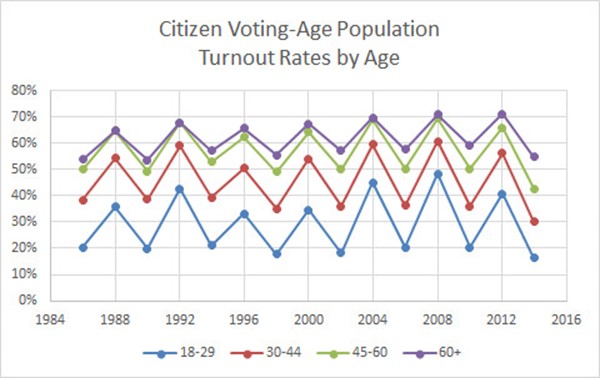

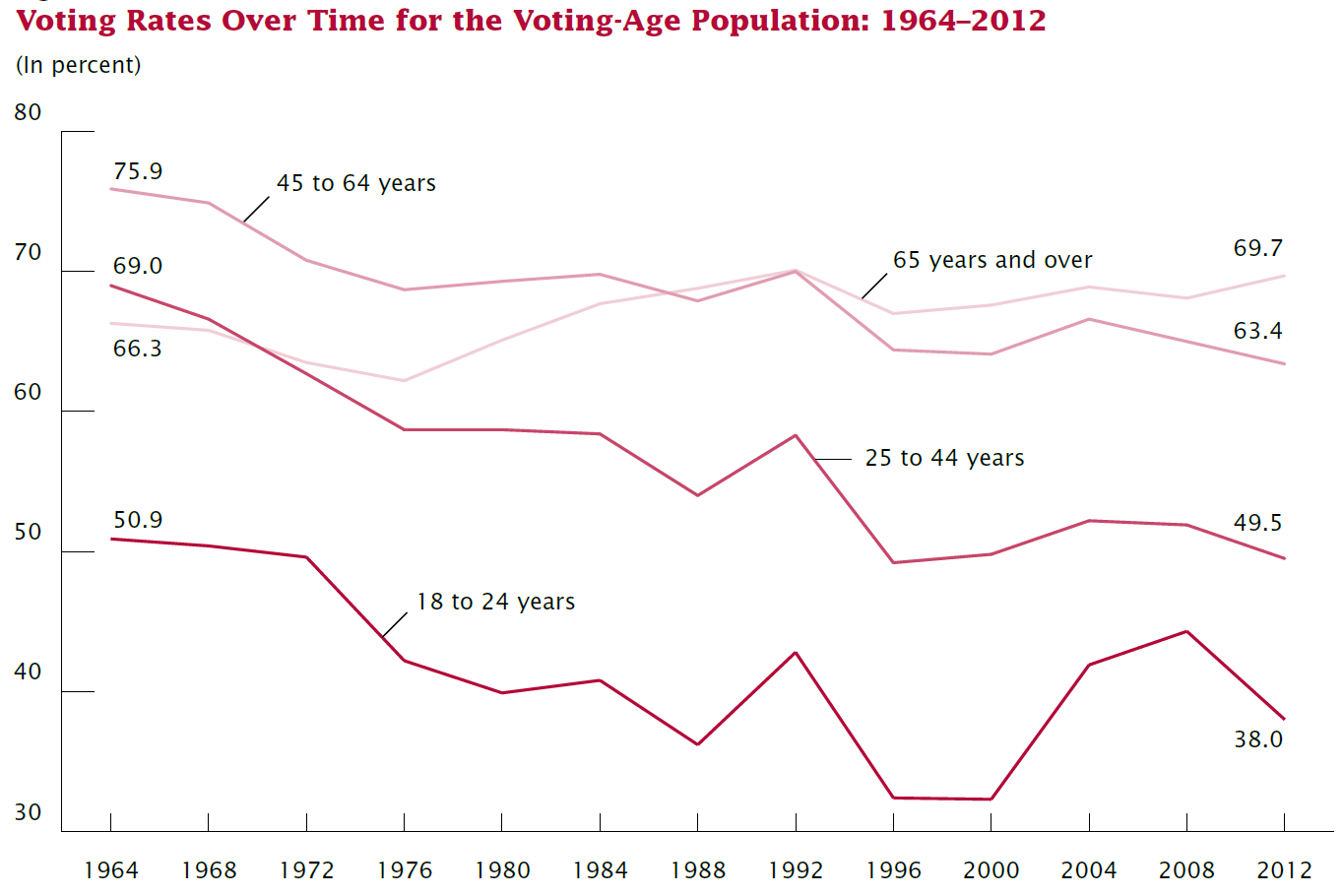
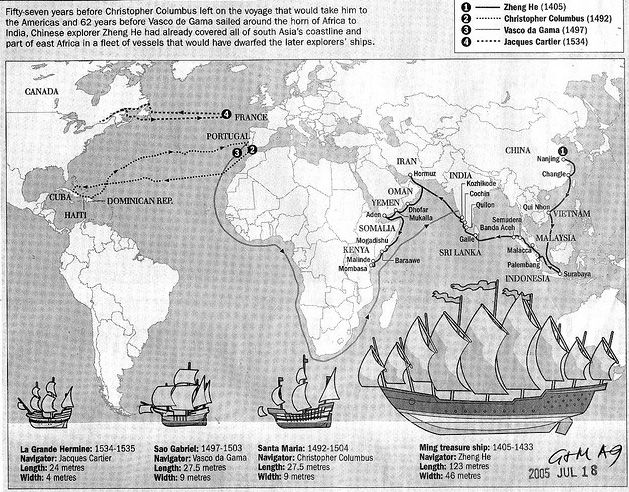

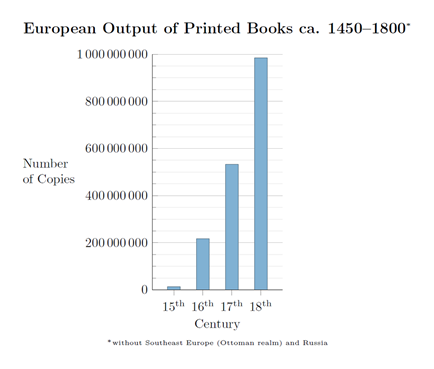
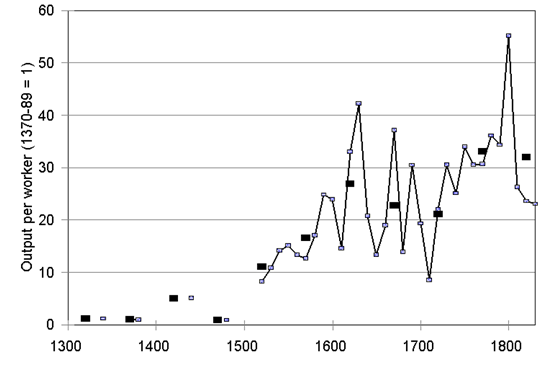

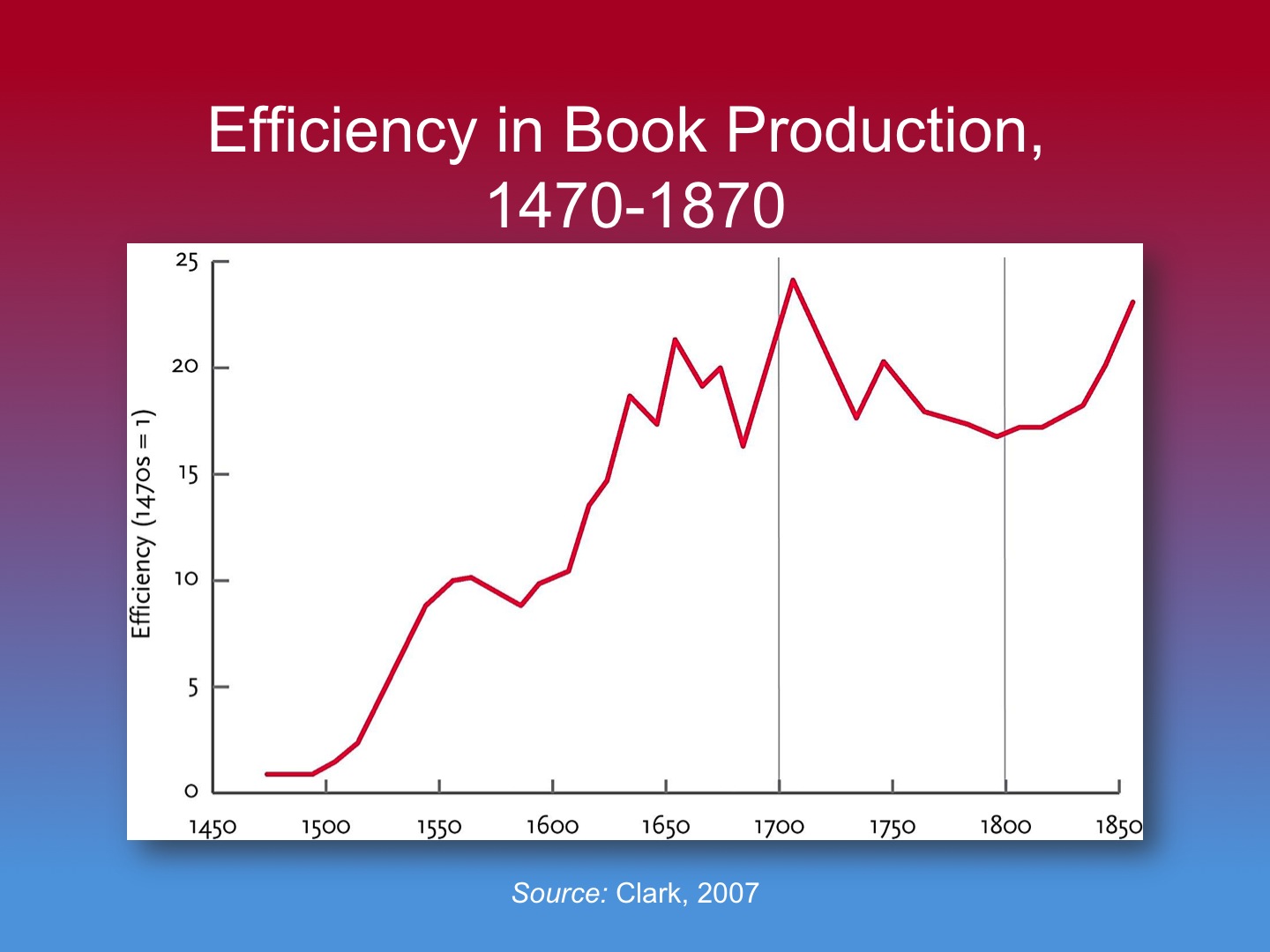
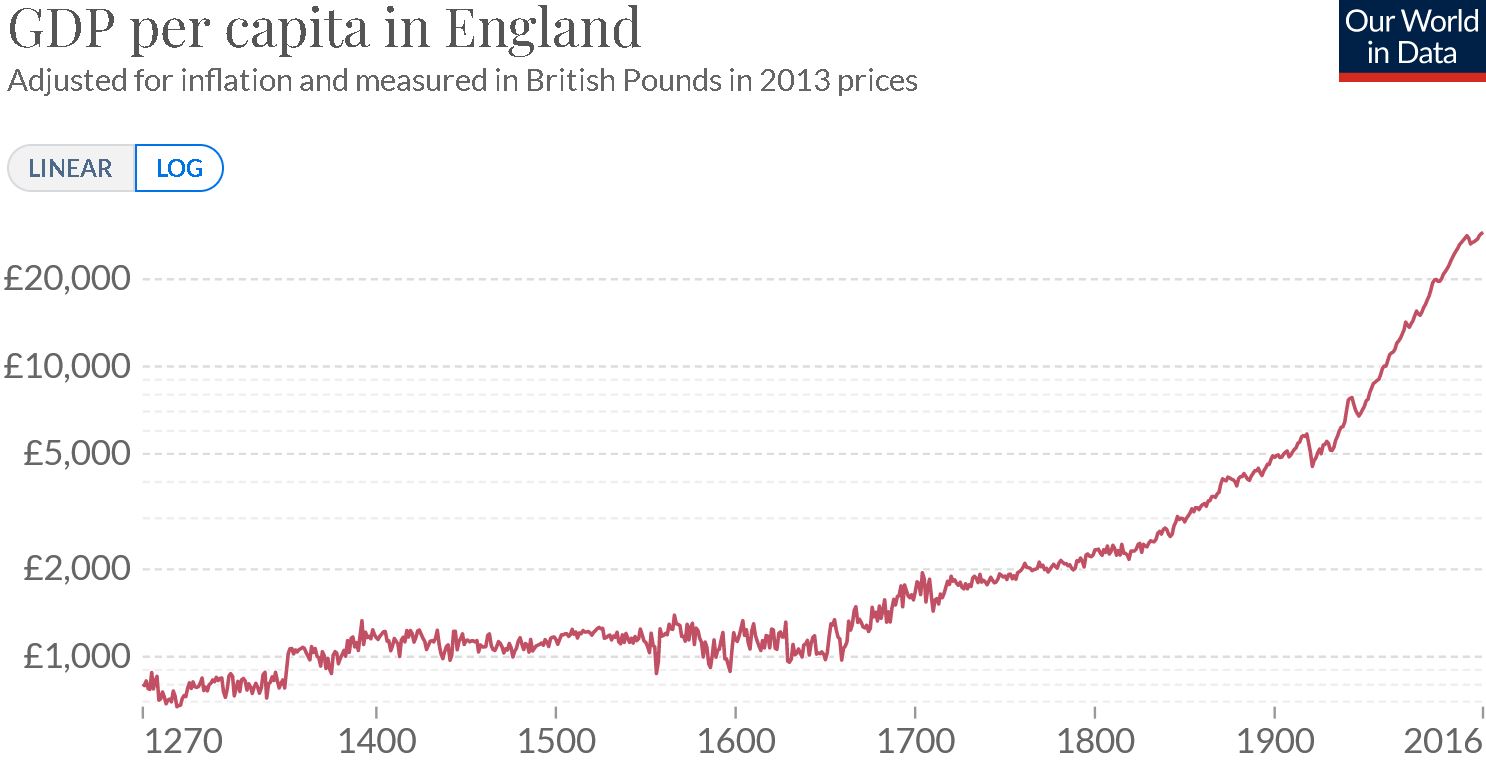




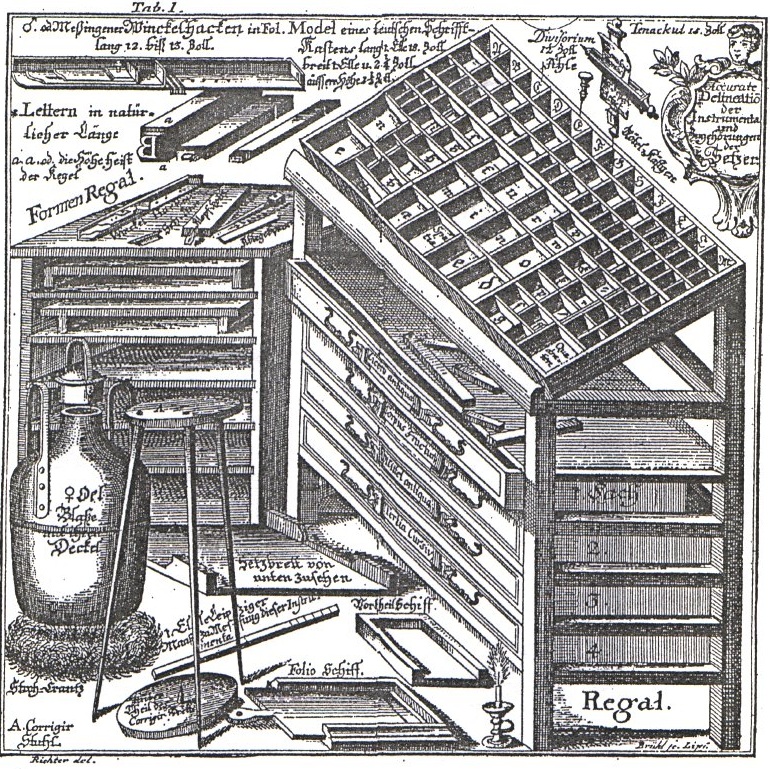

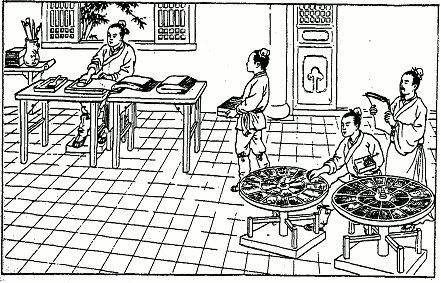
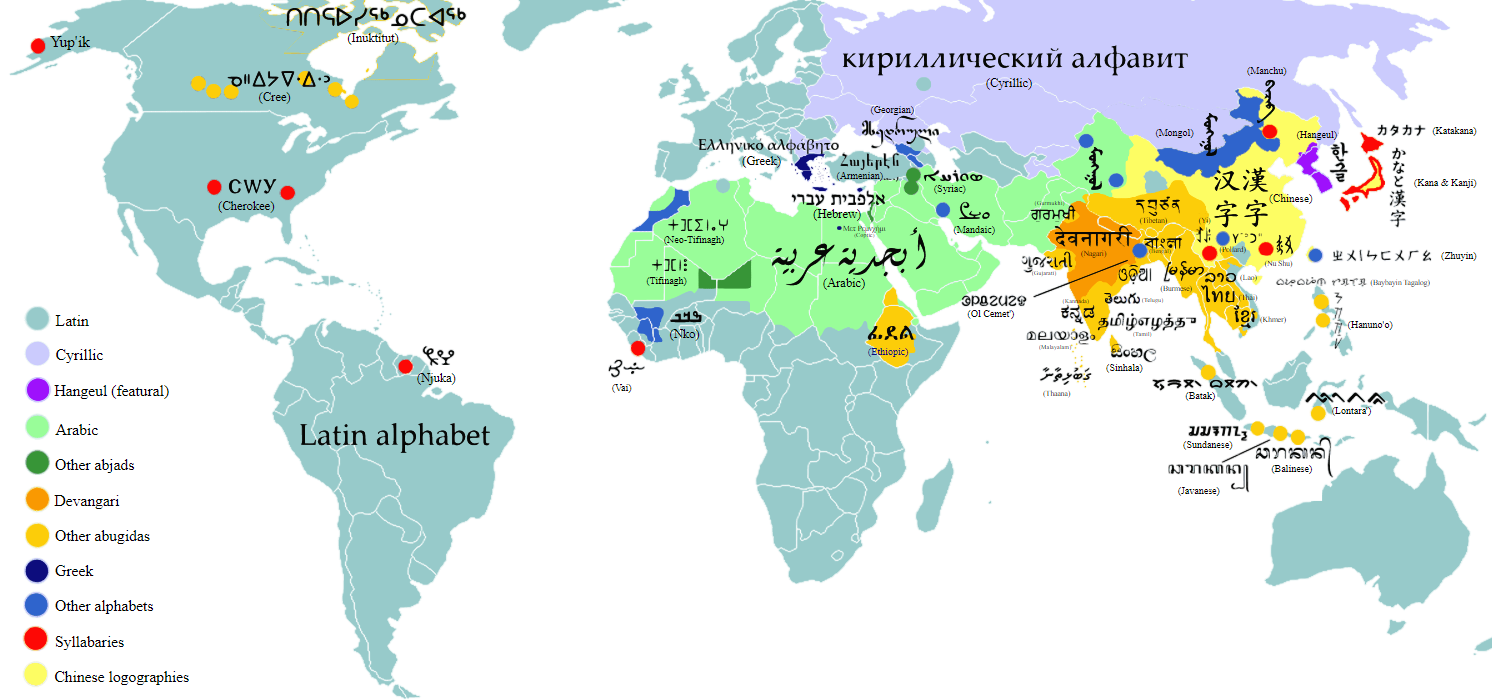
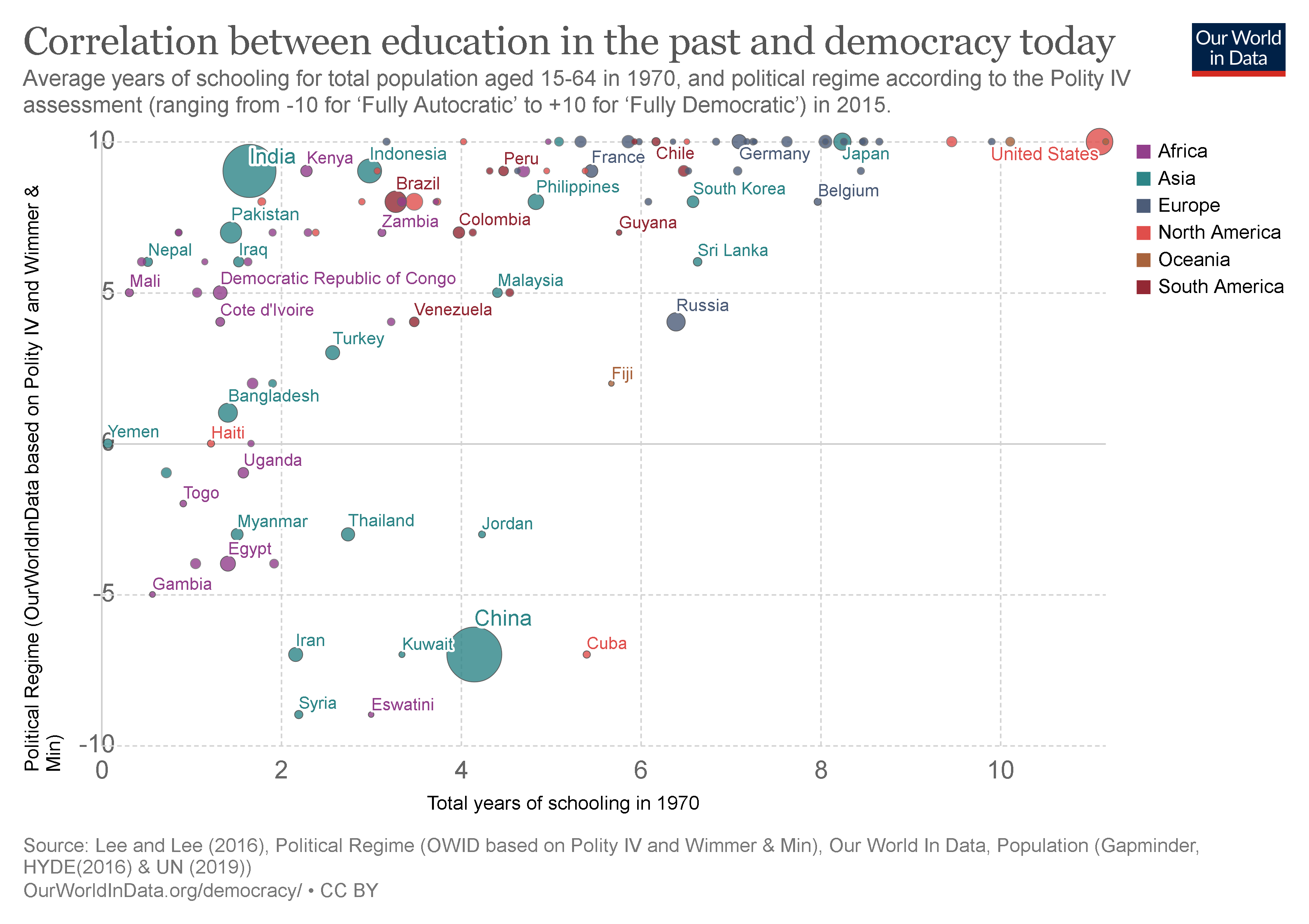

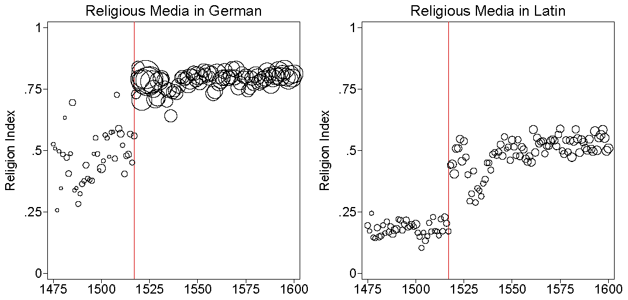
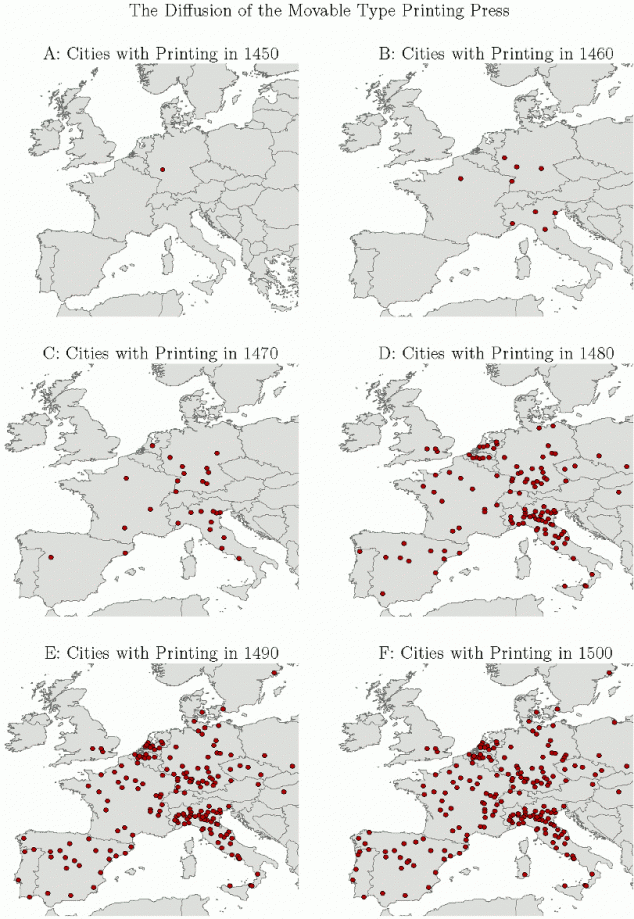
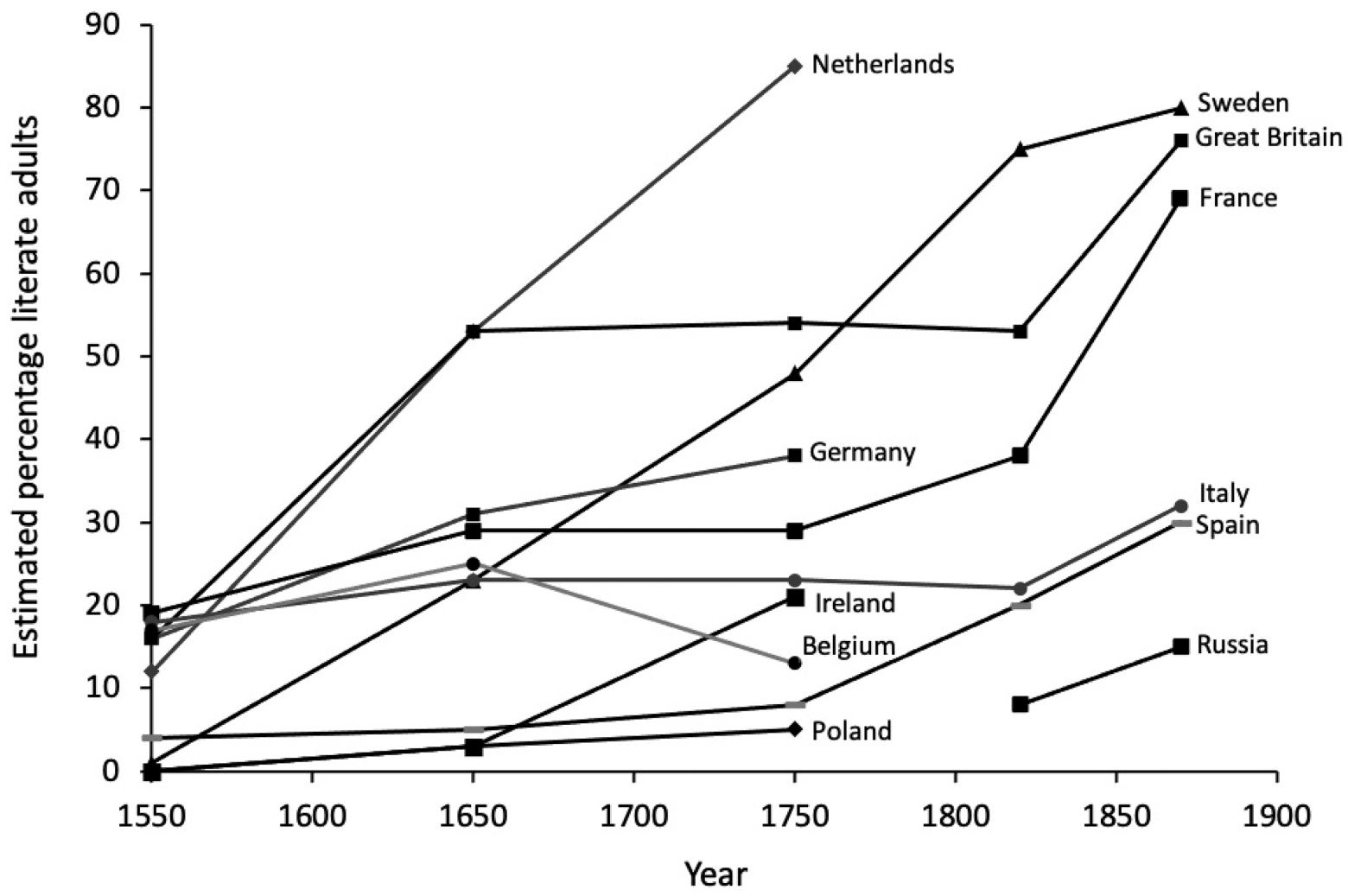


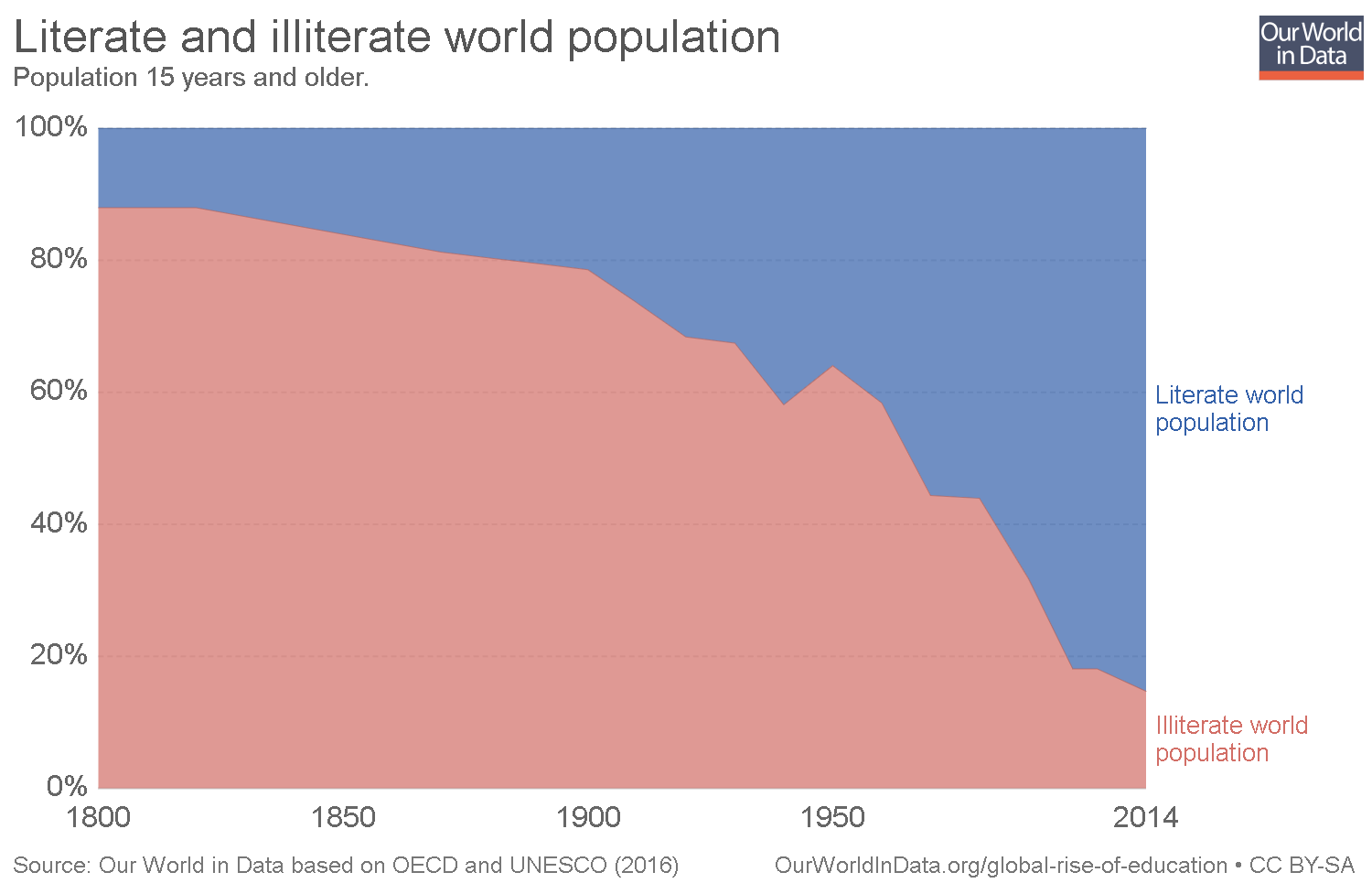

 People in the US don’t die much before age 65, so health insurance for working-age folks has never been likely to have much effect on death rates. Below age 55, it’s even less likely: the death rate is so minuscule that it would take a miracle to invent any kind of health-related practice that had a measurable effect on life expectancy. If the crude death rate is already below 0.5 percent, there’s just no way to reduce it much more.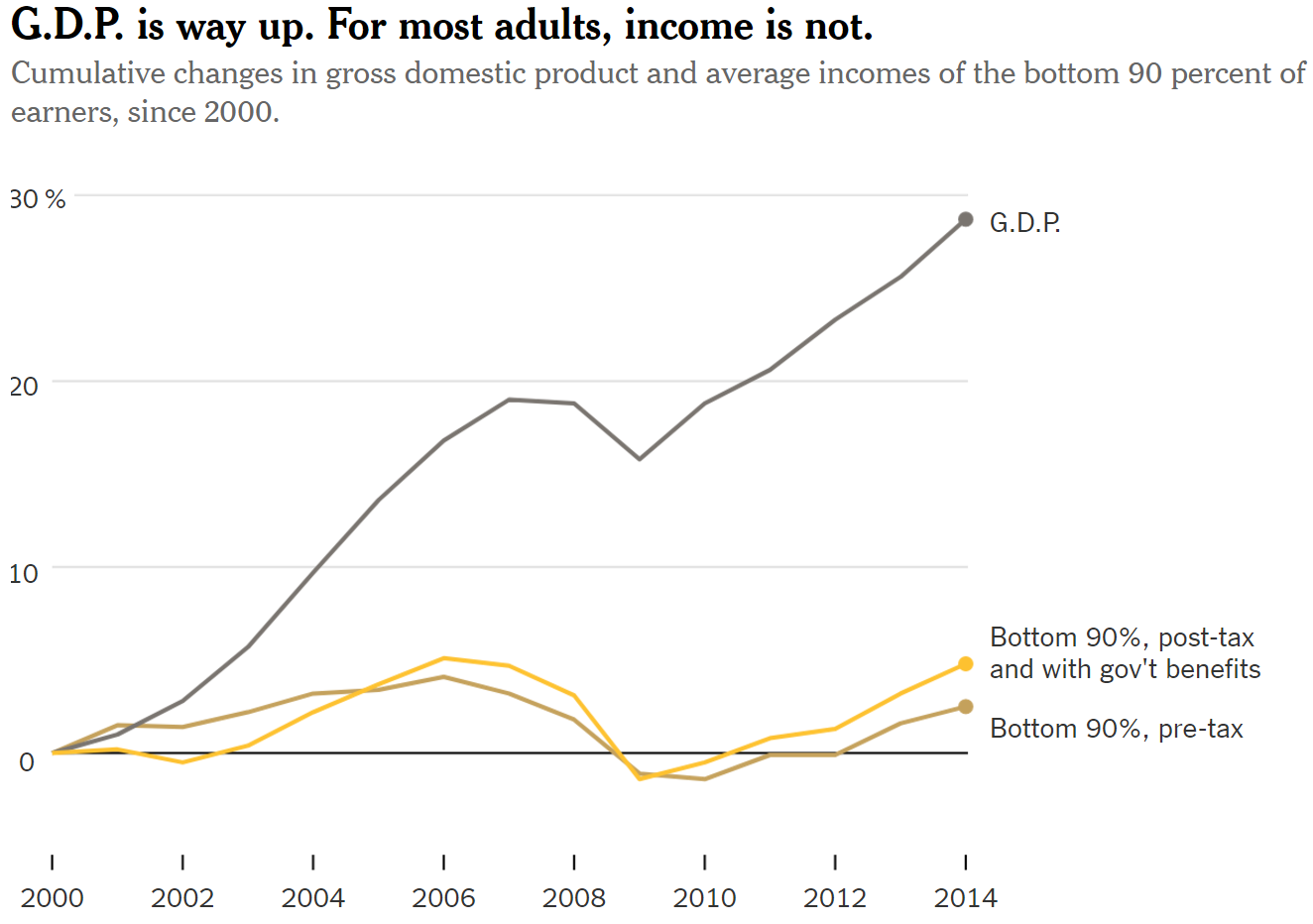


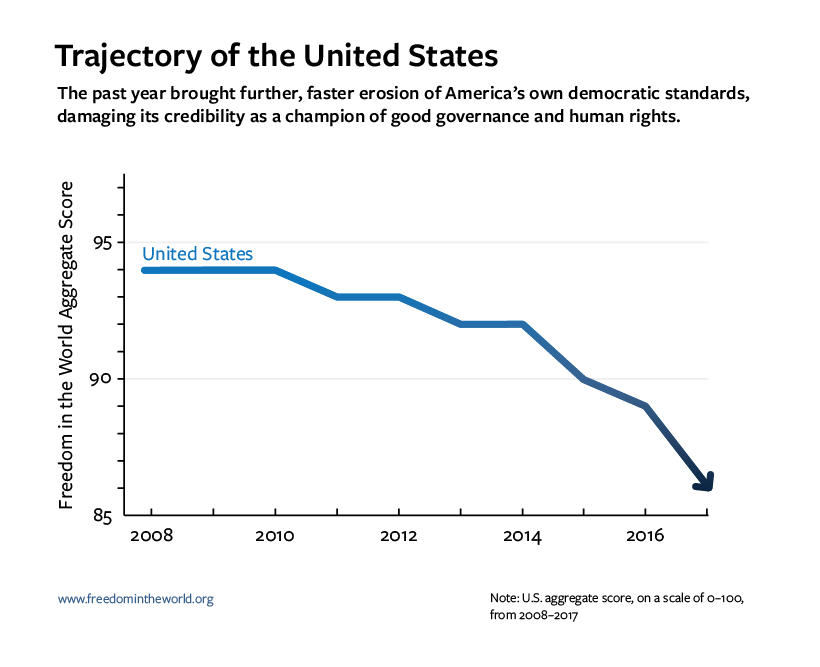





 Medianism