We need a better concept of collective morality to be able to deal with climate change

Suppose God told you that you would go to hell if the median human faith of humanity is insufficient when you die. If the median faith of humanity is good enough, then everyone goes to heaven, but if not, than everyone goes to hell. That would be a radically different kind of religion than any the world has seen; it would be a religion with a universal collective morality rather than focused on individual morality. Collective issues like climate change are like this because mother nature will judge every individual based on humanity’s collective actions and ignore how people behaved as individuals.

Westerners are particularly individualistic and most try to focus upon the morality of each person’s individual actions. We are taught that we should mind our own business about other people’s morality because other people’s choices are their individual personal responsibility. Western moral philosophers have neglected collective moral responsibility and when they do identify it, it is often disparaged because some forms of collective morality are problematic including:

  1. Intergenerational moral guilt is an idea that is in the Old Testament. It condemns descendants for the sins of their fathers “unto the third and fourth generation.” Even more dramatically, it says that all humans are collectively punished for the original sin of Adam and Eve. Some of the calls for reparations for slavery are based upon ancestral sin to atone for ancestral trauma. A better justification for reparations would be to forget about intergenerational moral guilt and just look at intergenerational wealth inheritance. People don’t inherit wealth due to any moral merit and if someone inherited something that is stolen, then that should be returned even though there is no moral guilt upon the possessor unless they knowingly try to keep stolen goods.
  2. A more common instinct for collective morality is moral tribalism. For example, Russian-speaking kids who live outside of Russia are being bullied around the world because of being blamed for Putin’s brutal invasion of Ukraine. This kind of collective morality comes all too easily to human instinct, and it is one of the motivations for nationalistic wars and racism. This kind of collective morality leads to the guilt by association fallacy such as when Putin bombs Ukrainian civilians because they support the Ukrainian resistance and so they are partly guilty by association.
  3. Corporate anthropomorphism wherein people act like a corporation (or other group) is a moral person that is separate from the individuals that run it. This is frequently used to shield decision makers from moral responsibility as illustrated by the concept of limited liability.

Now we need a new kind of collective morality to help address global problems like climate change. Individual morality isn’t enough and inter-generational morality won’t suffice and tribalistic morality just creates strife and pulls peoples apart when we really need for everyone to pull together. We need a universal collective morality because global warming is a moral issue unlike any the world has faced before. With previous moral issues, each individual’s harms created identifiable victims because the harms were much more concentrated. For example, untreated sewage had the biggest impact on the nearest neighbors downstream and reducing it immediately increases their chances of staying healthy. But no individual* creates enough greenhouse gas to have any effect on anyone whatsoever. Humans will be judged collectively for the total greenhouse gasses and the amount any individual contributes is too small to have a measurable impact.

It doesn’t matter whether I stop producing greenhouse gasses entirely or whether I produce 100 times more. My carbon footprint affects nobody. Nonetheless, most people cannot stop thinking selfishly about their own individual responsibility for global warming. When someone entirely stops producing carbon emissions, that just means that they are doing nothing to solve the real problem. We need a collective response to solve climate change, not just individual responses. You might quibble that the collective response is just the sum of individual responses, but even a lot of individual responses are not going to be enough. For example, a large nation like the US cannot solve the problem by eliminating our greenhouse gas emissions because that will just delay the inevitable by about 11%. Even if all the rich countries in the world completely eliminated their greenhouse gas emissions, it would only delay climate change because the majority of greenhouse gas emissions are now being produced by developing nations and their emissions are growing rapidly. What the planet truly needs is a way for developing countries to grow economically without the massive carbon emissions that rich countries relied upon to get rich. It isn’t fair that rich nations got rich by burning massive amounts of fossil fuels and the globe cannot afford to let everyone else follow the same path too. What we really need is an alternative path to solve climate change. Rich nations simply cannot solve the problem by cutting emissions without finding a way for developing nations to develop without burning lots of carbon.

Another way to illustrate the moral issues is to think of it as a trolley problem. Suppose you are on a trolley together with eight billion people, and it is careening toward a precipice. Nearly every single person on the trolley is pushing it towards the cliff. Some are pushing it harder than others, and you are have been pushing harder than most, but If you stop pushing the trolley, it isn’t going to make any difference at all. If you stop pushing, there is no reason at all to feel smug about it because you have done literally nothing to solve the problem. To solve the problem will require everyone else to stop pushing the trolley too, so your primary moral responsibility is to convince as many people as possible to stop pushing. That matters much more than how much you yourself are pushing the trolley.

When Greta Thurnberg came to America to campaign for greenhouse gas reductions, she sailed across the Atlantic rather than flying in an airplane because she felt a personal responsibility to avoid the carbon produced by buying an airplane ticket. But the carbon produced by an airplane trip literally makes zero difference and humans will ultimately be judged for our collective greenhouse emissions, not for anyone’s individual emissions. If her voyage helped convince the world to collectively reduce greenhouse gas emissions, then it doesn’t matter if she rode on an airplane. Even worse, her sailing trip caused some of the sailors to fly across the ocean, so even though Greta could feel virtuous that she hadn’t flown herself, she actually caused more flights than if she had just bought an airplane ticket for herself. A focus on individual moral purity solves nothing. The important question is whether the sailing trip helped her influence the world to find a collective solution or whether it made her less influential because it allegedly made her seem elitist and out of touch.

Each person needs to transfer more resources away from thinking about our own carbon footprint and put more resources into solving the collective carbon footprint. Reducing your own carbon footprint is only worth doing if it also helps influence others to do the same. For example, buying solar panels can help develop economies of scale which will help lower costs and hasten the day when solar is cheaper than fossil fuels. But when people focus on their own individual carbon footprint there is a danger of falling into moral license in which they feel like they have done their part and don’t have to worry about what other people are doing about global warming. Another danger is self-righteousness which could alienate other people who we need to join the effort. The priority for Americans who are worried about climate change should be to influence their fellow Americans to care. So far we cannot even get a majority of Americans to agree to make any sacrifice to reduce global warming and if we can’t even get most people in rich nations to care, then individual sacrifices are doomed to failure.

To return to the original thought experiment, if you want to go to heaven and eligibility is entirely dependent upon the collective faith of humanity rather than your own individual faith, then you would put most of your efforts into building up other people’s faith. The only effort you would put into maintaining your own faith would be the bare minimum necessary to keep up your efforts for helping others build the collective faith. Global warming is the same kind of moral issue. Don’t worry about your individual carbon footprint except so much as it helps you influence the carbon footprint of the rest of the world.

As Jesus might say based upon Matthew 7:5:

If having a log of wood in your own eye helps you remove specks from other people’s eyes, then don’t worry about the log in your own eye. Only worry about the log in your own eye if it impacts how much you can reduce the total wood in all eyes.

This is the kind of universal collective morality we need to deal with global issues like climate change.

*If you believe the corporate anthropomorphist idea that corporations are people, then the 25 largest fossil-fuel corporations produce 50% of carbon emissions! But they couldn’t do it without the cooperation of billions of customers, and millions of workers so the individual responsibility is still very diffuse.

Posted in Environment, Philosophy and ethics

The campaign to change our pronouns is partly caused by the Sapir-Whorf theory of linguistics

Updated 3/31/23

If people used the pronoun ‘ki’ when referring to the earth, would that make people treat the earth more environmentally? That is the hypothesis of Robin Wall Kimmerer the author of Braiding Sweetgrass. She doesn’t like calling the earth an ‘it’ nor a ‘she’ because she doesn’t think those pronouns are special enough and she thinks that we’ll respect the earth more if we invent a special new pronoun for the earth.

This idea is a product of the theory of strong linguistic determinism, also known as the Sapir-Whorf hypothesis.  This theory claims that “language determines thought” and “linguistic categories …determine cognitive categories.” Sapir-Whorf is wrong and it is easy to see evidence.  For example, this theory created the bizarre myth that “Humans Didn’t Actually See Blue Until Modern Times” based on the idea that people couldn’t see blue because most languages didn’t have a word for it.  Language has zero impact on the ability to distinguish colors.  The average person can distinguish between about a million colors even though most languages have less than a dozen words for colors.  The myth that language determines thought is so pervasive, John McWhorter wrote a book to refute it, called The Language Hoax.

Part of the effort to change how we use gendered pronouns is motivated by the Sapir-Whorf idea that that will change how people think about transgender people, but pronouns have approximately zero effect on how well people treat others. Consider spoken*  Chinese.  Chinese has no gendered pronouns for the Earth nor anyone else.  That hasn’t stopped China from causing more pollution than any other nation on earth today. Similarly, Chinese culture is not less sexist nor it is friendlier to transgender people than cultures with extremely gendered languages.  In a survey of 1,640 Chinese transgender people, nearly 100% reported experiencing violence from their own parents (or guardian)!  A UN report found that transgender people in China experience more discrimination than any other minority group.

In contrast, Spanish is extremely bi-gendered because every noun and adjective is either male or female.  Nothing is gender-neutral in Spanish.  Every book is male and every table is female and even adjectives like ‘red’ and articles like ‘the’ have to be either male or female in Spanish grammar.  To add gender neutrality into Spanish will require changing all adjectives, articles, and pronouns!  Although Spanish is an extremely gendered language, transgender people in most Spanish-speaking nations have had a much easier life than in China where the language has no grammatical genders.

Inventing a new gender-neutral pronoun for the earth isn’t going to make people treat the earth differently any more than gender-neutral pronouns will end transgender discrimination. But language does affect how individuals think about our own identities, so a gender-neutral pronoun for people can help them feel differently about themselves.  Identity isn’t important for the earth, but identity is important for people and pronouns are important for one’s identity which is one reason why many nonbinary people have recently been using ‘they’ as a gender-neutral singular pronoun.

Words reflect what we think and the pronouns “you” and “we” evoke very different perspectives.  The fact that women use the words “I,” “me,” “we,” and “mine” a lot more than men is because the genders tend to think differently.  Men use more articles like “a” and “the” partly because men talk more about things and women talk more about people.  Some cultures are more communal and use the word “we” more than individualistic cultures that focus more on “I”.

I wish English speakers would invent a new gender-neutral singular pronoun because using ‘they’ is not particularly cognitively kind.  ‘They’ is traditionally a plural pronoun and it becomes less specific to also use it as a singular definite pronoun that overlaps with the meaning of ‘it’.  People who claim ‘they’ has always been used for singular references are mistaking a definite pronoun for an indefinite pronoun.  ‘They’ was only used for indefinite references which could be referring to multiple different people because the reference is indefinite.  Thus the indefinite ‘they’ is cognitively plural even when it is referring to an unknown singular because that individual could be many different possibilities.  Changing ‘they’ to mean a definite singular individual makes English a wee bit less specific and more confusing.

Sometimes people want to make their language more indefinite such as: “I have a friend and they are eating.”  Traditionally, this meant that, ‘I don’t want you to know who my friend is” and the “they” was to avoid revealing the friend’s gender to help conceal their identity.  An indefinite they never means that a person is nonbinary.  It erases gender entirely.

We could clarify things if, when ‘they’ is used as a singular pronoun, we would conjugate the verb as a singular to demonstrate that ‘they’ is singular.  For example, if ‘they’ is a singular nonbinary person, then it is clearest to say, “I have a friend and they IS eating.”  Unfortunately, that isn’t current practice.  People say “They ARE eating,” even if there IS only one specific nonbinary person that IS eating.

The whole point of having multiple pronouns is to make references more specific which makes them more useful.  Nearly all languages have both singular and plural pronouns and even when a language doesn’t have separate words for both, speakers often create modifiers to distinguish between the two kinds of pronouns. For example, the plural form of you in English was ‘ye’ and when some English dialects lost that word, people created new plural versions of the pronoun like y’all, you guys, yinz, yous, or you people. So if ‘they’ becomes a gender-neutral singular pronoun, we are going to need to create a new plural pronoun such as ‘they-all’ or ‘those guys’ to distinguish from they-singular. Lots of languages, like Chinese, have no gendered pronouns, but plurality is ubiquitous because it is particularly useful for communication.  Reducing the specificity of ‘they’ reduces its usefulness, so we will need additional modifiers to make English accommodate a ‘they’ that means singular-nonbinary.

I’d prefer to create a new 3rd-person singular gender-neutral pronoun to reduce confusion, and there are at least a dozen different proposed gender-neutral pronouns, but they have all failed, so it is hard to change such fundamental units of language as a pronoun.  Plus, I suspect one reason why nonbinary people prefer the pronoun ‘they’ over alternative gender-neutral pronouns is that it is hard to turn ‘they’ into a term of abuse. English already has a gender-neutral singular 3rd-person pronoun–‘it’– which has insulting connotations when used to refer to a person.  It is easy to see how a new attempt at a gender-neutral 3rd-person pronoun could end up becoming a term of abuse too. As long as ‘they’ is an ambiguous pronoun, it cannot be turned into a term of abuse because it is too much of a linchpin of the language to be converted into an insult.  But if ‘they’ becomes specific to nonbinary people, then we will  invent another word that will be specific to plural 3rd-person and ‘they’ may come to have the same connotations as ‘it’.

More importantly, as long as ‘they’ is predominantly used with a plural meaning, that very plurality tends to confers additional status.  Many cultures have independently invented the tradition of using plural pronouns as honorifics towards respected individuals of status, so perhaps human brains tend to associate plural pronouns with status. Calling a singular person by a plural pronoun is known as the majestic plural. The one difference between the singular ‘they’ and honorific pronouns in other languages is that honorific pronouns are usually limited to 2nd-person or 1st-person pronouns like the royal we. In many languages honorific pronouns derive from 3rd-person plural pronouns, so the new singular-definite ‘they’ might be seen in this light.

Furthermore, linguistic difficulty is also a sign of status which is why elites often have longer, more complex names and titles than commoners.  For example, honorific speech in Japanese is much longer and more complex than speech between equals.  The additional complexity of new grammatical genders also helps confer status upon those new categories which may feel somewhat equalizing for traditionally marginalized groups.

Again, contra the Sapir-Whorf hypothesis, there is no evidence that honorific pronouns like the royal we cause other people to feel more respect toward the object of the pronoun, but the pronouns you use certainly affect your own identity.  You can try it for yourself.  Use the majestic plural pronouns (like ‘we’ and ‘us’) when referring to yourself for an hour and the change in pronouns will make you feel differently about yourself (uh, sorry, I mean, about yourselves).  The importance of pronouns for expressing identity and status is why Japanese has 18 different pronouns for the word “I” plus at least 10 additional pronouns for “I” that are no longer common, but are part of the literary tradition.  Pronouns are part of our identity and identity has a big impact on how we feel.  Other people may also feel differently about you, but not necessarily in a good way.  

Another evolving tradition in gender identity is how people announce their gender identity beside their name.  English speakers used to use gender specific honorifics like Mr., Ms., and the married-female gender, Mrs.  This has been going out of fashion and English speakers have increasingly been writing multiple different grammatical cases of the same pronoun such as “he/him/his”.  It is odd that multiple cases are used when gender is communicated perfectly well with a single pronoun case such as just “he”. Writing multiple pronouns would seem to imply that some people have a different gender identity depending on the grammatical case! It would only make logical sense to list “he/him/his” rather than just “he” if it were possible that some people’s preferred gender changes with grammatical case such as, “they/his/her”!

Furthermore, why use “they/them/their” rather than “we/y’all/they”?  If we are going to use the plural “they”, then why not also  use plural first/second/third-person pronouns too.  Making all the pronouns exclusively plural could augment a feeling of respect because, as mentioned before, numerous linguistic traditions use majestic plural pronouns to signify high social status for someone so big that singular just seems too small.

gender

Adjectives are words that are designed for describing more details about nouns whereas pronouns are words that are designed for hiding some details about nouns, so it makes more sense to write an adjective to identify gender rather than a trio of pronouns as is current practice. Instead of a woman writing ‘she/her/hers,’ someday she will probably just use an adjective like ‘female’ or perhaps a gendered honorific like Ms.  Healthline.com lists adjectives for 68 different kinds of genders whereas we only have three common pronoun genders (so far), so our adjectives are already much more descriptive because they encompass dozens of different kinds of gender identities.  And an adjective is a more natural grammatical structure than a trio of pronouns for specifying classifications like gender.

Right now people prefer to identify gender using “they/them/their” rather than an adjective because the point is to change the English language more than to identify gender.  Once everyone gets the pronouns they want for their genders, we will probably use adjectives to describe our genders instead of pronouns, or perhaps we will go back to using gendered honorifics next to our names. That was the traditional way to announce the gender of an ambiguous name like Mr. Robin Hood or Ms. Robin Wright.  The most common gender-neutral honorific is Mx. which is pronounced various ways.

It will be interesting to see how gender norms evolve regarding infants.  Traditionally the first question people have commonly asked about new babies is, “Is it a girl or a boy?”  Oddly, the pronoun ‘it’ has never been insulting in this context.  But this question assumes a binary conception of gender and we cannot ask about all 68 possible genders, so perhaps the polite way to ask the question will become, “What gender is they?”  Or as norms change, parents might prefer to not identify their baby’s gender at all, or some will say they don’t know yet because the baby is too little to choose.

*Note that although SPOKEN Chinese has no gendered pronouns, WRITTEN Chinese pronouns became gendered about a century ago.  Thus, there have been recent efforts to create a non-gendered written Chinese pronoun for nonbinary folk.  Still, all the pronouns for he, she, it, and the new pronoun for non-gendered people would still be pronounced the same way: “ta”.  But it is difficult to add written words to the Chinese vocabulary and one of the most popular proposed pronouns for the nongendered human version of he/she/it contains a fundamental symbol (called “radicals”) that doesn’t exist in Chinese:  the Latin letter X.  This seems likely to be inspired by same group of Western cosmopolitans who invented the word “latinx” which also uses “x” the way it is used in English rather than how it is used by native Spanish speakers!  Proposing to add a non-Chinese element to the language adds to the challenge of getting the new pronoun accepted into Chinese.  It would be the only word in all of Chinese that has ever adopted any part of a foreign alphabet.  Similarly, native Spanish speakers instantly recognize that “latinx” is an obviously foreign word which helps explain why it is rejected by most Spanish speakers and primarily only used in English.

nonbinary

Ironically, for all of Chinese history until a century ago, there were no gendered pronouns.  Gendered pronouns in Chinese writing only began about a century ago with the New Culture Movement which was partly brought about by feminist activists who wanted to celebrate female distinctiveness by adding new gendered pronouns, so in some ways, it was a similar social movement to what is happening today.  Plus, translators also wanted to have a better way to translate foreign languages with ‘he’ and ‘she’ into written Chinese.

Posted in Philosophy and ethics

The BA.2 Covid variant is spiking. But it is still a good bet that the Pandemic will be over this spring.

Two months ago, I wrote that the pandemic would be over this spring. We are now officially in the second day of spring and my prediction does not look good at first glance because Covid BA.2 infections are spiking in Europe and Asia. But I still feel good about the celebratory essay I wrote and I’m sticking with my optimistic stance that Covid will move into the endemic phase this spring because almost 95% of Americans have either had a Covid vaccine or been infected by the virus according to the CDC and we still have three months to go until the end of spring. I think we are witnessing the end of the Pandemic!

Unfortunately, most vaccinated Americans have not had their booster, but even just two doses of vaccine reduce the chance of hospitalization and death. So the virus is running out of the easiest targets to kill. But get your booster now if you haven’t done it yet!

The new variant is likely to be a serious problem in Asian nations that haven’t already had lots of infections, but Americans have already been sharing infections with each other like there is no tomorrow. The official count of Covid infections in America (shown above) is a severe undercount because it only includes people who tested positive with PCR tests in states like Ohio where I live and most of the people I know who got infected just diagnosed the infection with an at-home test which goes unrecorded with the public health statistics.

So get prepared for another spike of Covid this spring, but it will be less deadly than the last one and infections will come crashing down again before summer. Plus warmer weather will soon bring reduced virus transmission because of more airflow in buildings and more outdoor socializing. I am still optimistic that the end is in sight and we will see record low infection rates this summer in America.

Posted in Health

The rise of the Passport Bureaucracy

For most of history, passports and visas were two words for the same thing and in Europe and the US they were only occasionally required during wartime in order to exclude dangerous foreigners. In 1941, the US was again at war and congress again created the authority to deny entry into the US of foreigners who were deemed dangerous to the Republic and this time the authority was never revoked. In 1979, the US government made it illegal for Americans to travel abroad without a passport (except to Mexico and Canada). Until around this time there was essentially no de-facto controls over people crossing America’s land border with Mexico and Canada. That gradually began to change and as a result, Mexican migration became a lot more permanent. Mexicans had been accustomed to just doing seasonal work in the US and then returning home to Mexico because they could cross the border freely and after border crossings started to be regulated, they started to put down roots in America in much larger numbers.

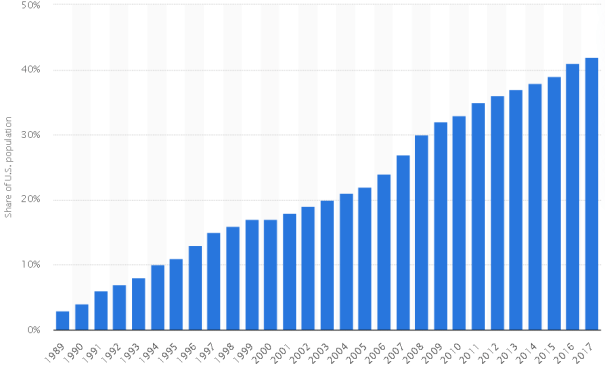
In the early 2000s, the government started talking about requiring passports for travel to Canada and Mexico for the first time. In 2006, about 75 million travelers crossed the US-Canadian border by land and about 87 million by air. By contrast, there were 234 million crossings of the US border with Mexico. In June 2009, the Western Hemisphere Travel Initiative (WHTI) started requiring passports (or related international travel documents) for movement across these borders and the percent of U.S. citizens owning a valid passport has nearly doubled since the government started talking about requiring passports for travel to our nearest neighbors:

One reason passports are becoming more popular is that international tourism has been growing, and the other reason is that government bureaucrats have been increasing their control over international travel over the past century. The Statue of Liberty is undoubtedly happy about the first reason and sad about the latter.

Posted in Globalization & International

What caused hyperglobalization?

Paul Krugman says that transportation technology and free-trade policies caused globalization:

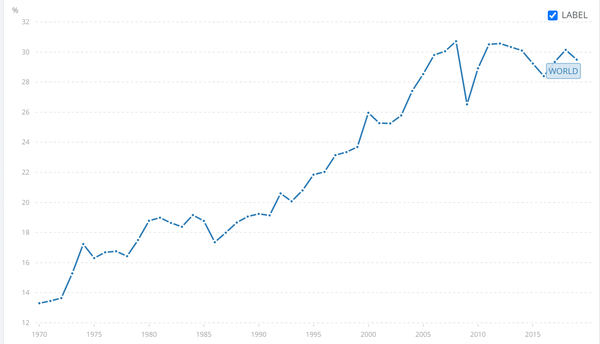
…In the mid-1980s, world trade had recovered from the disruptions and protectionism of the interwar period, but exports as a share of world G.D.P. were still back only to around their level in 1913. Starting around 1988, however, there was a huge surge in trade — sometimes referred to as hyperglobalization — that leveled off around 2008 but left the world’s economies much more integrated than ever before:

Exports as percentage of world G.D.P.Credit…World Bank

This tight [global] integration has played an important …role in pandemic economics. Vaccine production is very much an international enterprise, with production of each major vaccine relying on inputs from multiple nations. On the downside, our reliance on global supply chains has introduced forms of economic risk: One factor in recent inflation has been a worldwide shortage of shipping containers.

But how did we get so globalized? There are, it seems to me, two main narratives out there.

One narrative stresses the role of technology, especially the rise of containerized shipping (which is why the box shortage is a big deal). As the work of David Hummels, maybe the leading expert on this subject, points out, there has also been a large decline in the cost of air transport, which is a surprisingly big factor: Only a tiny fraction of the tonnage that crosses borders goes by air, but air-shipped goods are, of course, much higher value per pound than those sent by water, so airplanes carry around 30 percent of the value of world trade.

By the way, pharmaceuticals, presumably including Covid-19 vaccine ingredients, are mainly shipped by air:

…An alternative narrative, however, places less weight on technology than on policy. …Globalists pushed to open our borders to imports, and that’s why foreign goods have flooded into our economy.

And the truth is that from the [late] 1930s up to Donald Trump, the U.S. government did, in fact, pursue a strategy of negotiating reductions in tariffs and other barriers to trade, in the belief that more trade would both foster economic growth and, by creating productive interdependence among nations, promote world peace.

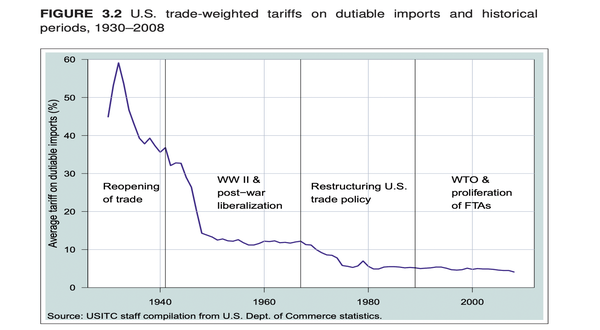
But the long-run push toward more open trade on the part of the United States and other advanced economies mostly took place before hyperglobalization; tariffs were already very low by the 1980s:

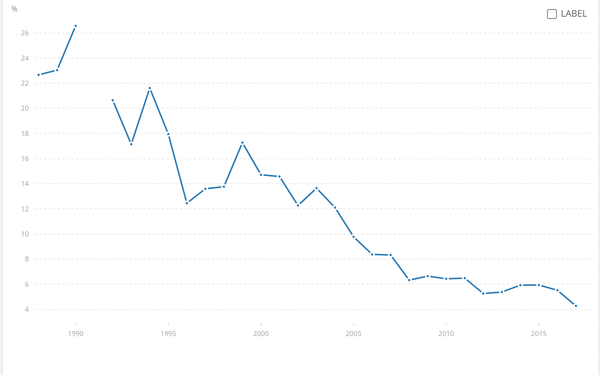
…While there weren’t big changes in the policies of advanced economies, however, there was a trade policy revolution in emerging markets, which had high rates of protection in the early 1980s, then drastically liberalized. Here’s the World Bank estimate of average tariffs in low and middle-income countries:

Average tariffs in low- and middle-income nations…

You might ask why a reduction in emerging-market tariffs — taxes on imports — should lead to a surge in emerging-market exports. So let’s talk about the Lerner symmetry theorem …tariffs eventually reduce exports as well as imports, typically by leading to an overvalued currency that makes exporters less competitive. And conversely, slashing tariffs leads to more exports. Basically, nations can choose to be inward-looking [by using tariffs and trade restrictions], trying to develop by producing for the domestic market, or outward-looking, trying to develop by selling to the rest of the world.

What happened in much of the developing world during the era of hyperglobalization was a drastic turn toward outward-looking policies. What caused that trade policy revolution and hence helped cause hyperglobalization itself?

The immediate answer, which may surprise you, is that it was basically driven by ideas.

For more than a generation after World War II, it was widely accepted, even among mainstream economists and at organizations like the World Bank, that nations in the early stages of development should [be inward-looking and] pursue import-substituting industrialization: building up manufacturing behind tariff barriers until it was mature enough to compete on world markets.

By the 1970s, however, there was broad disillusionment with this strategy, as observers noted the disappointing results of I.S.I. (yes, it was so common that economists routinely used the abbreviation) and as people began to notice export-oriented success stories like South Korea and Taiwan.

So orthodoxy shifted to a much more free-trade set of ideas, [sometimes called the] Washington Consensus. …The new orthodoxy also delivered its share of disappointments, but… The important point, for now, is that the change in economic ideology led to a radical change in policy, which played an important role in surging world trade: We wouldn’t be importing all those goods from low-wage countries if those countries were still, like India [China, Vietnam, the entire Soviet Block] and Mexico in the 1970s, inward-looking economies living behind high tariff walls.

There are, I think, two morals from this story.

First, ideas matter. Maybe not as much as John Maynard Keynes suggested when he asserted that “it is ideas, not vested interests, which are dangerous for good or evil,” but they can have huge effects.

Second, it’s a corrective against American hubris. We still tend, far too often, to imagine that we can shape the world as we like. But those days are long gone, if they ever existed. Hyperglobalization was made in Beijing, New Delhi and Mexico City, not in D.C.

In addition to greater efficiencies in airplane transport and the box (containerized shipping), the drop in communications costs is by far the most dramatic. In the 1980s, it cost well over $2/minute (inflation adjusted) to make a transatlantic phone call and today we can make video calls across the globe for free. That probably has had the biggest impact on globalization of any technological change by helping multinational corporations thrive because without multinational corporations, there would be relatively little multinational trade. If nothing else, cheaper communication helped ideas about free trade spread around the world.

Posted in Globalization & International

Introduction to Factfulness by Hans Rosling

Below is an excerpt of the Introduction of Factfulness by Hans Rosling that is posted for free use by the publisher, McMillan. Before reading the introduction, please take the test it is based.  The test website interface is a bit confusing so read the hints below before heading over to the test.

Press the “start” button under the heading, “Test your global knowledge” to begin. You might have to get rid of a pop-up window covering part of the page first. (You can press the <esc> key or click on the X in the corner of the pop-up to get rid of it.) When you succeed in getting the right “test”, the first question should show a group of African school kids dressed in green.  Ok, you are ready to take the test at Factfulnessquiz.com.  Consider yourself a genius if you score better than chimpanzees!

After you take the test, then come back here and read what the author has to say about it below.

Read more ›

Posted in Development, Globalization & International

Steve Jobs got a small part of the Giant Turnip at Apple and a large part at Pixar

Updated January 20, 2024

When Apple’s founder Steve Jobs died in 2011, Matt Yglesias said that he was a net-worth failure compared to other computer executives of his era like Michael Dell and Bill Gates:

The rivalry between Steve Jobs and Bill Gates… dominated the computer industry for decades… And it’s clear that [Microsoft founder Bill] Gates won. With his net worth of $66 billion, Gates still sits atop the Forbes 400 list of richest Americans, as he has since 1995… In fact, Microsoft’s victory over Apple was so decisive that current CEO Steve Ballmer and third co-founder Paul Allen, sitting on $16 billion and $15 billion, respectively, are substantially wealthier than Jobs… who must subsist on a mere $11 billion… Except of course, Microsoft isn’t a more successful company than Apple. Not even close. …Microsoft’s … $260 billion stock market capitalization is impressive. But Apple dwarfs those numbers with …a $400 billion market capitalization…

If productivity were related to pay, then Jobs should have been richer than Bill Gates because Jobs created a far more valuable company, but Bill Gates had six times more money than Jobs at his death. Jobs was more successful in business by every measure but his income was much lower — even several of Bill Gates’ underlings at Microsoft got more money than Jobs!  Jobs not only started Apple, the world’s most valuable company, but he kind of started it twice because Apple faltered after he left it in 1985, and nearly went bankrupt. Then Jobs returned to Apple in 1997, and he deserves considerable credit for helping resurrect it again to become the world’s largest and most profitable company. Whereas Microsoft was a copycat company that used its monopoly power over Windows to invade markets that competing entrepreneurs had invented, Apple was an innovator that created entirely new markets and changed the way we live and do business today. Jobs sometimes said that his goal was to, “put a ding in the universe” and he made a bigger ding that most CEOs. His company pioneered the microcomputer revolution, the smartphone revolution, the modern computer interface with icons and a mouse that we all use, tablet computers, digital music players, music streaming, the modern smartphone and many more innovations. Along the way, Apple’s digital audio systems revolutionized the entire music industry, bringing the world away from CDs into digital music with the Itunes store and created the podcasting industry.

Despite all of that success, Jobs got very little of his money from Apple. Most of Jobs’ wealth came from a lucky break on a relatively small investment he made in a business that he bought as a side hobby. After leaving Apple Jobs cashed out his Apple stock and in 1986, he bought the computer graphics division of George Lucas’ company for $10 million which he renamed Pixar. Pixar was a money loser for the first decade and Steve Jobs was only involved in a very part-time manner while he focused on his main business startup, NeXT, a struggling computer hardware company that never became successful. Tim Ott says that Pixar, “was only being kept afloat through [Jobs’] personal checks, amounting to some $50 million through 1991… Pixar remained something of a side project; day-to-day operations were left to Lasseter and CTO Ed Catmull, [Jobs] only showing up about once per week.” But then Pixar came out with Toy Story in 1996 which was hugely profitable and it produced five more movies after Jobs returned to Apple as CEO.  Then Jobs sold Pixar to Disney for $7.4 billion in January 2006, and that money grew to account for most of his $11 billion fortune when he died five years later.  Jobs did not earn billions from  Apple where he put a ding in the universe while sometimes only drawing $1 in salary per year nor from the NeXT company that he worked so hard to little avail.  Most of his fortune came from investing in an animation company that produced a mere six cartoons over the two decades he owned it.

If pay were related to productivity, then Steve Jobs would have been the richest man in the business world, but he was far from the richest businessman because pay is determined by bargaining power not productivity.  Jobs didn’t bargain for a large share of Apple’s wealth while he was frenetically putting a ding in the universe at Apple. Jobs got most of his wealth from Pixar which was only about 2% as big as Apple.  For some reason, Jobs used his bargaining power to extract a huge share of the value from the cartoons the Pixar company created and very little of the value of Apple.

Posted in Labor, Managerial Micro

Enter your email address to follow this blog and receive notifications of new posts by email.

Join 75 other subscribers
Blog Archive
Pages