Trickle-down vs. flood-down

Thomas Sowell wrote a 20-page book called “Trickle Down Theory” and “Tax Cuts for the Rich” that he is selling on Amazon for $5, but you can download it for free on his website. In it, he argues in favor of tax cuts, particularly for the wealthy, using two basic arguments, 1) that lowering tax rates will bring in more government revenues (the so-called Laffer-curve argument) and 2) that tax cuts will increase GDP (mmutilitarianism).  Mmutilitarianism is the philosophy that inequality doesn’t matter because only the production of goods and services (as GDP attempts to measure) matters. Sowell hates the idea that a tax cut for the wealthy could be justified on the basis that some benefit might trickle down to non-wealthy people because he is a mmutilitarian who thinks it is immoral to consider issues of class (inequality). For example, he says:

Repeatedly, over the years, the arguments of the proponents and opponents of tax rate reductions have been arguments about two fundamentally different things. Proponents of tax rate cuts base their arguments on anticipated changes in behavior by investors in response to reduced income tax rates. Opponents of tax cuts attribute to the proponents a desire to see higher income taxpayers have more after-tax income, so that their prosperity will somehow “trickle down” to others… [Proponents of tax-cuts for the wealthy argue that they] can change the total output of the economy, while the other side is talking about changing the direction of existing after-tax income flows among people of differing income levels at existing levels of output.

In his National Review column, Sowell has repeatedly claimed that nobody is advocating for “trickle-down” economics and he issued a challenge several times, “to name any economist, outside of an insane asylum, who had ever said any such thing. Not one example has yet been received, whether from economists or anyone else.” I’ll give him one: me. I’m in favor of trickle-down economics if the trickle is big enough and in the case of modern-day Venezuela, there are probably policies to help the wealthy that would indeed trickle down enough to be well worth doing. Another famous example is philosopher John Rawls who wanted all policies to be judged on how well they benefitted the person who was the worst off. He recognized the need for policies that benefit the richest people in society because some inequality is necessary for providing trickle-down benefits that help the poorest people. He didn’t use the term “trickle down,” but the flow of resources to the poorest was the only reason he would support policies to boost the incomes of the richest members of society.

Everyone should support a trickle-down argument if the trickle is big enough. For example, suppose we give a dollar in tax breaks to Bill Gates and he somehow could invest that dollar that would indirectly cause the income of the poor to increase by $1,000. That would be an incredible investment and even a mmulitarian like Sowell would support it even though it decreases inequality because it is an increase in GDP in this case.  However, mmutilitarians like Sowell would probably think that this is a ridiculously impossible example because they tend to think that rising inequality is good for GDP because of their mistaken belief in a strong equity-efficiency tradeoff, but trickle-up is also possible.

Another recent example of a proponent of trickle-down economics is one of Trump’s top economic advisers, Gary Cohn who said ” When you take a corporate tax rate at 35 percent and move it to 20 percent … We create wage inflation, which means the workers get paid more; the workers have more disposable income, the workers spend more.  We see the whole trickle-down through the economy, and that’s good for the economy.”

The immediate beneficiaries of a corporate tax cut are the wealthy owners of corporations:

Trump’s chief economist, Kevin Hassett also used a trickle-down argument when he said that their proposed cut in corporate taxes would “increase average household income in the United States by, very conservatively, $4,000 annually.” Hassett says that this tax break for wealthy Americans can be justified because it would also benefit the middle class.

Although National Review writers like Thomas Sowell don’t like the term, “trickle down,” it is revealing how important trickle-down economics is at the National Review because they have used the phrase in hundreds of different articles. A Google search of the site reveals 1,110 pages using the terms “‘trickle-down’ and “tax”. For example, National Review author Ryan Bourne argues in favor of lower corporate-tax rates because they will hopefully “boost worker wages”. Similarly, Steven Horwitz wrote an article that is similar to Sowel’s which Horwitz titled, “There is No Such Thing as Trickle-Down Economics” in which he argued that “There’s no economic argument that claims that policies that themselves only benefit the wealthy directly will somehow “trickle down” to the poor.” Ironically, in the same article where he said that trickle-down isn’t a valid argument, he actually made a trickle-down argument himself because it is a good argument to justify policies whose immediate beneficiaries are the wealthy. Horwitz ended his argument by saying, “improving standard of living for everyone that results from more economic freedom [such as tax cuts] will be more of a flood than a trickle.”

And if he is right that the trickle is a flood, then everyone should support trickle-down economics. The real debate is whether there really is enough trickle-down to justify the tax cuts for the wealthy.

Even better, we should focus on trickle-up economics. Let’s help the rich get richer by strengthening the middle class (and poorer) who will then be able to pay higher rents to the rich.

Posted in Public Finance

Rural politics

Farming communities have always been less cosmopolitan than urban areas, and that makes them more culturally conservative, but my sense is that they used to be more economically liberal in the past than today. Today, the most solidly conservative parts of the nation are the rural areas and this is obviously due in part to their cultural conservatism, but perhaps they have become more economically conservative too as mean farm incomes have risen. For all of history until recently, average farm income was lower than average non-farm income. However, today the average farmer earns more than the average non-farmer. Of course there is very high inequality in farm income and it is probably increasing as the average farm size (and wealth) rises, so that doesn’t mean that the median rural farm worker earns more than the median non-farm worker, but perhaps rising average farm incomes have increased rural economic conservatism to match rural cultural conservatism.

Posted in Pence2018

Escaping the tyranny of climate

Note: This is an abbreviated repost that I did for a climate change class of an article I wrote that focused more on economic development.

Humans co-evolved with our technological inventions for warming up in the cold: fire, shelter, and clothing.  Our large brains would not work without the precise temperature regulation provided by our nearly furless skin.  Even the remnant fur on our heads is there to insulate the most temperature-critical body part by shading it from intense sun and warming it from the cold while the naked skin on the rest of our body can radiate out the enormous heat created by our brains.  Although our brains are only about 2% of body weight, they generate 20% of the heat of our bodies and they don’t work well if they overheat.  Brains must be kept within a very narrow temperature range to work correctly. Because human skin is better at eliminating heat than retaining it, humans have needed heating technologies to survive even moderate cold snaps: fire, shelter, and/or clothing.

Whereas humans have always had technologies for warming up, it was not until the 1950s that humans had an equally reliable technology for cooling down when trying to work in a place that is too hot.  And cooling down is crucial for our brains to function well.  Witness our naked bodies for evidence.  Before the air conditioner, people could not work when the weather gets too hot.  They were forced to siesta during the heat of the day or migrate into the cool of the mountains during hot seasons.  Here is an estimate from NOAA of how much less time humans can do physical labor outside in the tropics compared with temperate zones:

labor_capacity-1

By their estimate, people in the tropics can’t spend as much time doing physical labor as in the temperate zone where people can spend roughly 50% to 300% more time working. The bottom graphs shows that this would get much worse with 3 degrees of global warming.

Throughout history, observers have noticed that cooler geographic regions have been richer than hot regions.  For example, the richest part of the globe is the temperate zone in the northern hemisphere, but even in the southern hemisphere, the richest part of Brazil is its temperate south, the richest part of Africa is its temperate south and the same goes for Australia.  Even in tropical countries like Mexico, Bolivia, and Ethiopia, the majority of economic activity is at high altitudes where the temperatures are cool.  Whereas the majority of the Mexican population lives above 5,000ft, most people in temperate nations prefer to live in lowlands near bodies of water.  The island states of Indonesia and the Philippines have a lot of economic activity, but much of this territory is surprisingly temperate due to temperate ocean breezes or high altitudes as you can see in the following map which comes from 2001 research by Sachs, Mellinger, and Gallup.

They discovered that 8.4 percent of the world’s inhabited land area, produces 52.9 percent of the world’s income. The blessed geography of wealth is the temperate zone within 100km of an ocean-navigable waterway.  Per-capita income is 2.3 times greater than the global average in this region.  Being in a temperate zone has been an economic blessing that accounts for a lot of why some places are richer than other places.  Global warming will expand the zone of tropical weather and shrink the cool temperate zone.  Fortunately, we have some reason for optimism: the air conditioner.

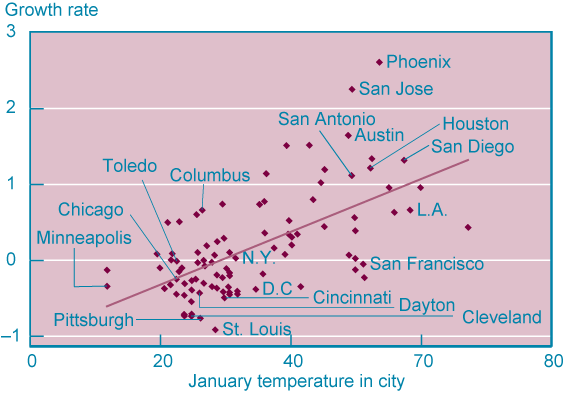
The southern US is the poorest region of America has been for all of history, but since the spread of the air conditioner in the 1950s, it has been growing faster and it is finally catching up.  Ed Glaeser found that the two main factors that are correlated with regional population growth in the US after 1960 are warmth in winter and the prevalence of college educated workers.  The air conditioner is the main reason why the south has been the fastest growing region of the US since 1960.

For example, the Cleveland Fed made a graph showing how the air conditioner contributed to shrinking cold-weather cities and growing hot-weather cities:

hot population

Cooler working temperatures simply make people more productive.  In Caribbean nations, short-term drops in temperatures are correlated with large increases in GDP.   Cooler temperatures seem to reduce crime and make people less impatient and violent. Installing air conditioning in public schools is a cost-effective way to raise academic achievement in America.  Air conditioners can bring higher productivity and more patience anywhere that indoor temperatures climb above 78 degrees, but even in the US where most buildings have modern air-conditioning, extreme heat still reduces economic output:

Tatyana Deryugina and Solomon Hsiang find that hot days are bad for the economy — not just in poor countries with an overwhelmingly agricultural workforce, but in the United States of America. Here in the US, “productivity of individual days declines roughly 1.7% for each 1.8°F increase in temperature above 59°F.” That means that “a weekday above 30°C (86°F) costs an average county $20 per person.”

…Hot days kill growth both because of negative impacts on agriculture and because it seems that, despite air conditioning, people simply work less efficiently when it’s hot. …Extreme cold is unpleasant, but as a society we can live through it and even thrive. Extreme heat saps our will to live in a more fundamental way, crushing the economy and driving long-term immiseration.

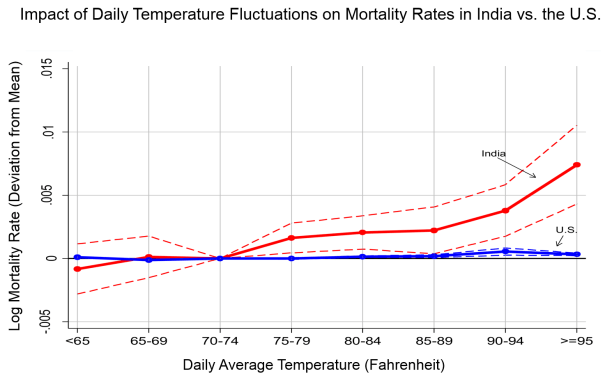
Before the air conditioner, heat waves were deadly in the US.  Now they are more of a mere annoyance that keeps people inside.

The above graph shows that before the air conditioner (red line), heat waves caused mortality spikes.  Since 1960, relatively few Americans have been unable to escape the heat and have had problems.  Because most Indians are too poor to afford air conditioning, they still have large mortality spikes during heat waves.

Burgess, Deschenes, Donaldson, Greenstone, 2017

Tragically, the idea for mechanically cooling living space was invented in the 1840s by John Gorrie, but didn’t take off.  Unfortunately, he was unable to get financial backing and died bankrupt.  He marketed it as a remedy for malaria and yellow fever because he believed in the common theory of the day that malaria was caused by bad air (which is literally what the word ‘malaria’ means) and he believed that cooling the air could keep the poisonous gasses away.

Perhaps his idea was ahead of its time, but he might have just been targeting the wrong market.  He might have been more successful if he would have marketed it for industrial and luxury markets because that is how  Willis Carrier succeeded when he reinvented the air conditioner a second time in 1902.  He initially found success selling them to printing and textile factories to stabilize the humidity that wreaked havoc with production and that focus on humidity is why they got the name air conditioners rather than air coolers. Nobody tried using them to cool the air merely for human comfort until the first residential unit was installed in 1914 in Minnesota (of all places) and they became popular in the 1930s in movie theaters and finally revolutionized life in the sunbelt in the 1950s as the technology improved and costs dropped.

Posted in Development

The worst drug epidemics in American history

The New York Times said “The current opioid epidemic is the deadliest drug crisis in American history.” Last August, Donald Trump declared, “The opioid crisis is an emergency, and I’m saying officially right now it is an emergency… It’s a national emergency. We’re going to spend a lot of time, a lot of effort, and a lot of money on the opioid crisis.” But that was just a declaration to reporters at his golf resort without any official action. Two and a half months later, he finally got around to changing actual policy, but he stopped short of declaring an official state of emergency. Instead he declared a Public Health Emergency which doesn’t raise any additional funding, but allows the government to use a special fund that currently has just $57,000 in it. That is less than one dollar per death!  Vox said, “America’s opioid epidemic is so bad it’s causing average life expectancy to drop” because the problem has been skyrocketing:

In one year, drug overdoses killed more Americans than the entire Vietnam War did… a new report by Josh Katz for the New York Times, …calculated that 59,000 to 65,000 people died of overdoses last year… In comparison, more than 58,000 US soldiers died in the entire Vietnam War [over the course of 14 years], nearly 55,000 Americans died of car crashes at the peak of such deaths in 1972, more than 43,000 died due to HIV/AIDS during that epidemic’s peak in 1995, and nearly 40,000 died of guns during the peak of those deaths in 1993.

In contrast, in the fifteen years after 9/11, jihadi terrorists have only killed 94 people inside the United States according to the New America Foundation, but most Americans are much more worried about the war on Islamic terror than the war on opioids.  Of course most terrorist deaths in the US aren’t due to Jihadis, so all terrorism is a larger risk than just Islamic terror, but regular homicides, like the mass shooting in Las Vegas, are a much bigger problem yet.

As the above graphic illustrates, people are bad at rationally assessing risks. For example, we are more scared of terrorism than homicide and more scared of homicide than opioids.  But what we really should be scared of is another drug altogether because opioids are not even the deadliest drug in the US.  As German Lopez explains, The New York Times was wrong to call it “the deadliest drug crisis in American history.”

[another drug besides opioids] was associated with more deaths…  alcohol.

According to the Centers for Disease Control and Prevention (CDC), alcohol is linked to 88,000 deaths each year… it’s a very high death rate — making alcohol the third leading cause of preventable death in the US. What’s worse, the 88,000 number may, at this point, be an underestimate. The figure comes from an analysis of deaths between 2006 and 2010. But since then, we’ve seen some signs that alcohol deaths may have gone up: Between 2010 and 2015, the number of alcohol-induced deaths (those that involve direct health complications from alcohol, like liver cirrhosis) rose from nearly 26,000 to more than 33,000.

Alcohol isn’t even the deadliest drug in the US; that would be tobacco. Smoking is linked to, depending on the estimate, 480,000 to 540,000 deaths each year — the leading preventable cause of death in America. (This figure is potentially too high, since it’s based on mortality data from 2005 to 2009, and smoking rates have dropped since then. Still, it’s an extremely high death toll.)

Yet all of these deaths didn’t inspire President Donald Trump or the presidents before him to formally declare a public health emergency over tobacco or alcohol, as Trump finally did for opioids on Thursday. We don’t often call alcohol or tobacco “epidemics,” even as we regularly use that same language for opioids that are linked to a fraction of the deaths from alcohol or tobacco.

Maybe we should. We have a lot of evidence that we could do much more to combat alcohol and tobacco deaths. But we haven’t….

There are plenty of things we could do about alcohol and tobacco.

In drug policy discussions, we typically talk about drugs in a binary framework: You either legalize them or prohibit them… The reality, though, is there are plenty of policy interventions we could take on before reaching for prohibition.

For alcohol, the research backs raising the alcohol tax. It supports limiting the number of alcohol outlets. There are innovative evidence-based policies that temporarily yank a person’s right to drink if they get in trouble with the law due to alcohol. We could also put states, instead of private businesses, in charge of alcohol sales, which the research shows can keep prices higher, reduce access to youth, and reduce overall levels of use. And we could increase access to evidence-based addiction treatment.

With tobacco, we have other evidence-backed policies: raising taxes to reduce access; improving access to safer alternatives to smoking like nicotine gum, nicotine patches, and e-cigarettes; using stronger warning labels; and raising the smoking age… These policy interventions, though, aren’t pushed with the same kind of vigor and all-hands-on-deck effort we see with opioids, at least rhetorically, today. That’s especially the case with alcohol, which is many Americans’ drug of choice and has a powerful, big lobby behind it — making lawmakers cautious about raising alcohol taxes even to keep up with inflation or instituting policies as simple as labeling alcohol with nutrition facts.

Posted in Labor, Public Finance

What is imputed rent?

Suppose you own a house worth $240,000, but your job forces you to move to Chicago for two years where you will have to pay $12,000 ($1,000/month) to rent another house with nearly identical characteristics. Fortunately, you can rent out your house for $12,000, but this won’t completely cover your cost of housing because you will have to pay 25% income tax on the rent you earn ($3,000), so your gross housing bill goes up just because you are paying rent for the same kind of housing. As it turns out, your new landlord is Jane who happens to also be relocating to your town and she will be renting your house and paying you $12,000 too. Legally, she will also have to pay $3,000 income tax on the rent you are paying her, but if you can both just quietly agree to trade houses without any money being exchanged, you can both avoid paying these taxes. 

That is imputed rent and everyone who owns their home is getting the same kind of economic benefit stream (a.k.a. income) from owning their home whether they rent out the home or whether they live in it. If they rent it out, they get rent payments, and if they live in it themselves, then they are earning “imputed rent”. Imputed rent is the rental value that an owner would get from renting the home they occupy at market rates. A few countries including Iceland, Luxembourg, the Netherlands, Slovenia, and Switzerland do tax imputed rent, and where it is not taxed (like in the US) it is the biggest subsidy for home ownership. For example, suppose you were renting for $12,000 ($1,000/month), and earning $1,000/month on $240,000 in savings. If you used your savings to buy the house where you live for $240,000, you would still be getting the same amount of earnings from your savings ($1,000/month), but your taxes would drop under the American system which ignores imputed rent. It isn’t fair to levy a higher tax on people who have invested their savings in stocks or bonds rather than in housing.

In addition, there are a lot more tax breaks for homeowners like the mortgage-interest tax break that increase the government tax subsidies for home ownership. The mortgage-interest tax break would make sense in the above nations where imputed rent is taxed because in that case the interest would be just like any other business expense, but in the US, it is just an extra subsidy on top of the savings from avoiding taxes on imputed rent income.

Below is a graph from the Urban Institute via VOX that shows how much the OTHER kinds of subsidies benefit owner-occupied households in different income classes, but with interest rates so low right now, the tax savings of untaxed imputed rent is probably much bigger than the more explicit subsidies shown in the graph below, at least for families in high income tax brackets.

The rent that home owners pay themselves is a kind of tax-free income and combined with the other subsidies for homeowners, renting becomes a worse deal financially than buying for most Americans who are going to live in one place long enough to cover the higher transactions costs of buying a home.  

These subsidies are wasteful because they decrease labor mobility (because homeowners have higher transactions costs that impede them from moving closer to new jobs) and they encourage Americans to spend excessive amounts on McMansions.  These policies are also regressive because most people below the median income don’t get the subsidies because they rent whereas most Americans above the median do get them because home ownership rates rise with income and the subsides are higher for more expensive homes and even the plutocrats with numerous homes get the imputed rent subsidy for owning them.

It is unfair and inefficient to NOT tax income from imputed rent and although the simplest way to rectify this would be to just tax it, but an even more efficient way to rectify the subsidy for home ownership would be to implement a land-value tax (explained here).

Annual real parking cost

The Mortgage Bankers’ Association’s think tank, The Research Institute for Housing America investigated the value of parking spaces in five US cities which was neatly summarized by Richard Florida:

The costs they calculated for each household are the replacement costs of the parking spaces. It looks expensive for just a bunch of asphalt and concrete, but the land costs a lot, especially in New York City.

It is easy to convert this information into the imputed rent of parking per household. The simplest–and probably most accurate–way is to simply multiply the total cost by the discount rate. The discount rate in this case is the opportunity cost of funds that residents face which varies widely and the proper way to calculate that would be to find the weighted average cost of capital (WACC).

That is basically the average borrowing cost for households as weighted by the amount that they have borrowed. I don’t know what that is, but the Stern Business School compiled a database of the WACC for America’s corporations and the average WACC in January 2019 for non-financial firms was 8.22%.

So if America’s households were lucky enough to borrow money as cheaply as America’s big corporations, then their per-household imputed annual rent for parking comes out to:

New York Philadelphia Seattle Des MoinesJackson, WY
$540$2,464$9,673$6,343$15,794
Imputed rent per household per year

If they hadn’t built all of that parking and decided to rely upon public transit, Uber, and other kinds of transportation that doesn’t require so much parking, then households would have approximately that much more money every year. New York City basically made that choice and only has a minimal amount of parking which is why New York’s average imputed parking rent is so low.

But because parking is a fixed cost, it is a hidden cost that we don’t have to think about every year and so most people ignore how much of a burden it really is every year.

Below is one of the satellite images the researchers used to measure the amount of pavement that is used for parking. This shows a neighborhood in Seattle.

The area of green space appears about as big as the area for parking but a lot of the green is tree tops that are just hiding some of the parking space below the canopy.

Posted in Public Finance

Vox’s misleading gun death graph

In the wake of the mass shooting tragedy in Los Vegas, Vox posted an analysis showing that more guns lead to more gun deaths:

I was immediately suspicious because I’m living in Guatemala and I am constantly being reminded that Latin America has very high homicide rates, and although I see guards with massive guns all over the place, Guatemala has quite low gun ownership rates. Whereas I agree that a lot of data supports the thesis that too many guns contributes to more gun deaths, gun availability isn’t the only thing that leads to gun deaths. Other factors are often more important. Otherwise the US would have the highest homicide rate in the world because the US has by far the most guns per capita.

I can’t figure out any simple rule that explains how they picked the nations they included in the above graph. It isn’t the list of OECD nations. It is pretty close to a graph that excludes all poor nations, but if so, then it should really include Panama and Uruguay which are richer than Argentina (which is included). But that wouldn’t fit the thesis that guns cause more deaths as nicely. The graph originally came from Tewksbury Lab, but they have taken down all reference to it, so I can’t see where they got their data, but it looks like they used data from the 2011 “Estimating Civilian Owned Firearms” by the Small Arms Survey. Nationmaster seems to have taken the Small Arms Survey data and added some estimates for other countries to come up with a more comprehensive data set of gun ownership which I combined with World Bank homicide data to produce this graph:

In fact, it appears that gun availability is actually somewhat correlated with fewer gun deaths. I tried excluding all nations poorer than Spain, but it still doesn’t give much support to the thesis that more guns cause more homicides because there is little correlation again:

Basically, there are two outliers, the US and Qatar, and they are so different from all other rich nations, that they should both probably be excluded. When you do that, again there is almost zero correlation between guns and homicides. That doesn’t mean that guns don’t contribute to the high homicide rate in the US, but it just isn’t a simple matter. Lots of other factors are also important such as environmental lead, criminal justice, inequality, etc.

Below is another graph using data from Wikipedia’s entry about firearm-related deaths which looks more reliable than NationMaster because Wikipedia cites where all their data comes from, and it is more up to date. Still, it tells a similar story.

Guns don’t make that much difference because there are wide differences in the number of homicides per gun:

That is using the Nationmaster & World Bank data again. Each gun kills over 2,000 times more people in Tunisia than in Switzerland. Here is a close up of the left tail of the above graph to show the nations that have low levels of homicides per 1,000 guns like in the USA.  On average, only about 1 in 20,000 guns is used to kill people in America.  That is just a few bad apples.

UPDATE: I found the original graph on the Wayback Machine and the author’s methodology looks sound, but he says he got a lot of criticism about it so maybe he took it down to avoid controversy (UPDATE AGAIN: as he explains in comments below, he unfortunately just happened to take down his old website, so it was hard to find his original work.)

Also, the following chart from Mother Jones is a pretty convincing simple demonstration that more guns are linked to more deaths since US states are all relatively similar in income, culture, demography, criminal justice, and all the other important factors that influence homicides, so the effects of differences in gun ownership can pop out more clearly:

Gun ownership tightly correlates with gun violence.

So, reducing gun access undoubtedly saves a few lives (particularly gun suicides and gun accidents), but lots of other factors are more important for saving lives than guns.  

It may be harder to commit mass murder without guns, but extremists have managed to do it with airplanes, trucks, and explosives too, so gun restrictions help, but they don’t eliminate the problem and fear of mass murderers is completely irrational anyhow.  

Posted in Health, Violence & Peace

US median income finally rises above record set in 1999. Yea!

Kevin Drum reports that the official census bureau measure of:

household income is now at an all-time high:

And now for the buzzkill portion of this post: this means household income has increased a whopping 0.6 percent since 1999. That’s $22 per year.

Posted in MELI & Econ Stats

Enter your email address to follow this blog and receive notifications of new posts by email.

Join 75 other subscribers
Blog Archive
Pages