Racial and gender politics influence Fed governance

The Center for Popular Democracy’s “Fed Up” campaign inspired a letter from Elizabeth Warren and 11 senators and 111 members of the House of Representatives to increase diversity at the Fed.  They complain that:

Currently, 92 percent of regional Bank presidents are white, and not a single president is either African-American or Latino. Moreover, at present 100 percent of voting FOMC participants are white…

Matt Yglesias notes that:

Diversity among decision-makers is not, of course, directly a monetary policy issue. But as the letter points out, monetary policy does have significant consequences for racial disparities in employment. They cite research from the Economic Policy Institute“demonstrating that for every .91 percent reduction in unemployment for whites, black unemployment drops 1.7 percent” meaning that African Americans have more to gain from monetary policy that is more pro-growth and less inflation-averse.

Michigan Representative John Conyers who was one of the main driving forces behind the letter issued a statement observing that “Detroit and cities across the country with high minority populations have some of the highest unemployment rates and will be harmed if the Federal Reserve does not consider our needs when they make key policy decisions.”

The big problem with monetary policy is that its management was intentionally set up to be biased in favor of the big banks rather than ordinary people.  When you combine that fact with the tendency for all institutions to be dominated by people well above the median income, you can immediately see how the Fed could neglect the interests of most Americans.  The main way that the Fed neglects African Americans is because they are disproportionately earn less than the median income and the Fed doesn’t care about people below the median.

Americans don’t have much of a tradition of class identity and so we don’t pay much attention to class.  We do have a long, storied history of obsessing about issues of racial identity.  For many years people have pointed out how unfairly the Fed is biased in favor of wealthy Americans without gaining traction.  It is remarkable that when the Center for Popular Democracy framed this issue in terms of racial and gender bias, the issue finally took off.  It is now part of Hillary Clinton’s economic policy:

The Federal Reserve is a vital institution for our economy and the wellbeing of our middle class, and the American people should have no doubt that the Fed is serving the public interest.  That’s why Secretary Clinton believes that the Fed needs to be more representative of America as a whole as well as that commonsense reforms — like getting bankers off the boards of regional Federal Reserve banks — are long overdue.

This is the most obvious way that Fed policy is dominated by the banks. They directly appoint many of the Fed’s top management!  The first step towards reducing Wall Street’s power over the US economy should be to take away their control over the Fed.  The Fed is the only institution in America that is has responsibility for managing inflation, unemployment, interest rates, and financial stability.  No other institution has nearly as much power over the economy, so it is crucial that the Fed’s goals are aligned with ordinary Americans more than with elite banksters.

(For further reading, see past thoughts on Fed policy.)

Posted in Discrimination, Macro

YUGE revelation! The one word Trump hasn’t tweeted in the past 7 months is HUGE! Has public ridicule about it been getting to him?

Zachary Crockett analyzed 7 months of Trump’s tweets at Vox and his top three adjectives have been:

  1. Great (used 415 times)
  2. New (used 227 times)
  3. Big (used 148 times)

The Trumpiest adjective of all is the word “HUGE!” which Trump would probably be inclined to write in all-caps followed by an explanation point. Surprisingly, it didn’t even make the list.  Why is this?  Is it because Trump pronounces it “YUGE” and doesn’t like to express it in writing with the H? Did months of comedians ridiculing his pronunciation cause him to strike it from his vocabulary?  The full analysis is worth reading although oddly there is no mention of the huge absence.

Posted in Pence2018

The most important medical advance of the past century

Antibiotics revolutionized medicine, but it is likely that no single antibiotic caused as big of a drop in deaths as a simple over-the-counter medicine that you have probably taken it at some point without appreciating how revolutionary it is.  It treats the ailment that was the biggest killer in the world for thousands of years until sometime in the mid 20th century.  Guess what ailment it is:

  • Everyone in the world gets it occasionally, including you.
  • It is an infectious disease that is caused by numerous different pathogens.  But the most important treatment is the same for all pathogens, so doctors rarely even bother to diagnose which pathogen is causing the disease. 
  • It used to be particularly tragic because it mostly killed infants and children.
  • Largely due to a new treatment its death toll dropped from 5 million children annually in the early 1980s, to only 1.5 million in 2004 (WHO).
  • The treatment only costs pennies per day and can be produced at home by anyone with a rudimentary ability to follow a recipe.
  • Although the new treatment has caused death rates to plummet, there is still a lot of work to be done and in 2008, it was still the world’s second leading cause of death in children under 5.
  • Although it rarely kills anyone in rich countries today, it was still the fourth biggest killer of all ages in developing countries in 2001.

The world’s biggest killer for all of history until perhaps the 1980s is…. drum roll… diarrhea!*  Most Americans would never guess it because almost nobody dies from diarrhea in temperate nations like the US nowadays mostly due to improved sewage and water treatment, but it was still the third biggest killer in the USA in 1900 after influenza and pneumonia (#1) and tuberculosis (#2).  

Diarrhea was still the biggest killer in low-middle income nations in 1990 and it is disproportionately deadly among children.

Diarrhea is much harder to manage in poor, tropical nations because of bad sanitation.  Rich countries developed intravenous treatment a century ago which was effective, but it is expensive and requires medical professionals to administer.  So diarrhea remained the biggest killer in poor countries until the a new treatment was developed in the 1970s which almost magically eliminates over 90% of diarrheal deaths for pennies per treatment.  The British medical journal, the Lancet called it, “potentially the most important medical advance this century,” but most people don’t even know what it is.

As an economist, I rarely teach something practical that could save a life, but I have used this treatment many times for myself when afflicted with severe diarrhea while traveling in the tropics and for my children when they were little.  It may have already saved your life when you were a child because it is now the primary treatment for diarrhea in the US.  It is called Oral Rehydration Therapy (ORT – but there are several other acronyms like ORS).  It is basically water with a fairly precise amount of salt and sugar.  That’s right, salty water with sugar is the most important medical advance of the 20th century!  The WHO estimates that ORT has saved well over 60 million people and it continues to save millions every year.

The basic formula:  Just mix up these ingredients and drink as much as you can to replace the fluids lost due to diarrhea.

  • 6 level tsp sugar (30 ml)
  • 1/2 tsp salt (2.5 ml)
  • 4.25 Cups of clean water (1 liter)

This is not the perfect formula, but if you cannot purchase a professional version, it is pretty good and certainly better than nothing.  It is very important to not mix in too much salt and sugar.  Too much salt and sugar is worse than not enough because it will increase dehydration and draw liquid out of the body instead of increasing absorption.  For example, sports drinks like Gatorade have too much sugar (more than double the optimal amount) and not enough salts (less than half the optimal amount), so they are far from optimal.  ORT should taste only VERY slightly salty and slightly sweet like 1/3-strength juice. A proper ORT mix tastes a bit unpleasant, but the flavor should be very mild if it is mixed correctly.

I prefer using apple juice.  It tastes better and provides some potassium too.  Other juices like orange juice or grape juice are probably ok to substitute, but don’t look good if you are vomiting.  The basic apple juice recipe is:

  • 1C apple juice
  • 3C water
  • ½t salt

This treatment is largely responsible for the dramatic reduction in the number of children dying from diarrhea.  Diarrhea still causes nearly 1 in five childhood deaths  according to the World Health Organization and these deaths are mostly preventable if people had used ORT.  This treatment is so simple, the big problem with getting people to use it has been to convince them that something so trivial is really a miracle cure.  Historically, nobody was convinced that ORT could work until scientists figured out the mechanism of how diarrhea kills people.

People don’t literally get so ‘pooped’ that they die.  Diarrhea actually kills the same way that sweating too much could kill.  There are two main lethal mechanisms:

  1. Dehydration
  2. Salt (electrolyte) depletion

People can die when they lose about 10% of their fluid, but when diarrhea is severe, such as it is when caused by cholera, kids can lose up to 30% of their fluid in 24 hours which is absolutely fatal without treatment.  Imagine that you had a single massive sweat gland that is going to produce 10 to 20 liters (up to 5.2 gallons) of sweat over the next 24 hours.  It is easy to see how that could be life threatening.  (Or, for an alternative analogy, someone with a giant pimple that is pumping out gallons of fluid per day would probably forget about the social embarrassment of having a giant pimple and worry instead about mortality.) 

To put 10 to 20 liters of fluid loss into perspective, most people drink less than 2 liters/day (about 8 cups) and pee less than 1.5 liters/ day, so it is easy to see how a loss of 20 liters of fluid could cause lethal dehydration.  In addition, diarrhea pumps out salt and other electrolytes that are necessary for life.  An electrolyte shortage can directly cause death causing the heart, brain, or other vital organs to malfunction. Or an electrolyte shortage could indirectly cause death by weakening the immune system’s ability to fight infection.

Normally the intestines absorb more liquid than they excrete, but diarrhea turns the intestines into something like a giant sweat gland.  Both diarrhea and sweat glands are salty because they both work through osmotic transport.  The body’s cells move water across membranes using an osmotic salt pump.  For example, when the body wants to expel sweat, the cells in the sweat gland push salt out of the body. Then the salt attracts water from inside the body because osmotic pressure tries to equalize the salt concentrations.  The water then flows through the membranes and out of the body as a result.  I guess nobody tasted diarrhea to discover that it is a bit salty like sweat, but diarrhea pulls water out of the body using the same mechanism as a sweat gland and diarrhea is even saltier than ORT.  One significant difference between the sweat glands and the intestines is that the intestines use symporters that use both sugar and salt to pump water into the body.  That is why ORT contains both sugar and salt.  The sugar is pulled across your intestinal membrane into your bloodstream and each sugar molecule pulls one sodium ion which pulls some water.  This is why ORT formula should have an equal concentration of salt and sugar molecules for optimal functioning.  It only works when each molecule of salt is paired with a sugar.

Research is currently being carried on to utilize these additive effects to develop a multi-component "Super ORS".

Because the intestines are huge and have a lot bigger capacity for moving fluid than the body’s sweat glands, the intestines can squeeze ten liters of fluid out of an adult body per day.  Without replacement, that amount of water and salt would be lethal. ORT works by creating just the right amount of osmotic pressure in the intestines to push fluids back into the body to replenish both fluids and electrolytes.

HISTORY OF ORT:

There are many ancient traditions in India and elsewhere that developed home remedies using somewhat similar solutions, but nobody tested the optimal ratio of salt and sugar, so nobody knew what worked best and so success was haphazard and wasn’t replicated consistently. India has had a longstanding tradition of treating diarrhea by giving rice or coconut water with is fairly effective, but this traditional formula does not contain enough salt.  Sweden had a tradition of using a diluted carrot soup, but it didn’t always have the right ratio and often had too much salt. 

Without scientific understanding, the traditional remedies were often a little off and sometimes a lot off.  In this matter, more is not better:  If the solution has too much salt or sugar, it can be worse than plain water and is likely to be lethal.  There were several failed attempts that used overly-concentrated solutions.   For example, in the US in the 1950s powdered banana was mixed with water with varying degrees of success.  A 1968 article in The New England Journal of Medicine wrote about one of these solutions, but began by admitting that they didn’t understand how it worked.  They authors said, “the mechanisms for stool production are not, as yet, understood” because they can be so “massive”.  They didn’t even understand if diarrhea was due to “overproduction or underabsorbtion of fluid by the intestine”.   

Top researchers still weren’t even sure if diarrhea was squeezing out that reserve of fluid or simply the “underabsorbtion” of ingested fluids!  The mistaken idea that diarrhea is caused by the body rejecting drinking water has undoubtedly killed millions of people because it leads to people to drink less when they have diarrhea!

Atul Gawande explains:

Cholera is a violent and deadly diarrheal illness, caused by the bacterium Vibrio cholera, which the victim usually ingests from contaminated water. The bacteria secrete a toxin that triggers a rapid outpouring of fluid into the intestine. The body, which is sixty per cent water, becomes like a sponge being wrung out. The fluid pouring out is a cloudy white, likened to the runoff of washed rice. It produces projectile vomiting and explosive diarrhea. Children can lose a third of their body’s water in less than twenty-four hours, a fatal volume. Drinking water to replace the fluid loss is ineffective, because the intestine won’t absorb it. As a result, mortality commonly reached seventy per cent or higher. During the nineteenth century, cholera pandemics killed millions across Asia, Europe, Africa, and North America. The disease was dubbed the Blue Death because of the cyanotic blue-gray color of the skin from extreme dehydration.

In 1906, a partially effective treatment was found: intravenous fluid solutions reduced mortality to thirty per cent. Prevention was the most effective approach. Modern sewage and water treatment eliminated the disease in affluent countries. Globally, though, millions of children continued to die from diarrheal illness each year. Even if victims made it to a medical facility, the needles, plastic tubing, and litres of intravenous fluid required for treatment were expensive, in short supply, and dependent on medical workers who were themselves in short supply, especially in outbreaks that often produced thousands of victims.

Then, in the nineteen-sixties, scientists discovered that sugar helps the gut absorb fluid. Two American researchers, David Nalin and Richard Cash, were in Dhaka during a cholera outbreak. They decided to test the scientific findings, giving victims an oral rehydration solution containing sugar as well as salt. Many people doubted that victims could drink enough of it to restore their fluid losses, typically ten to twenty litres a day. So the researchers confined the Dhaka trial to twenty-nine patients. The subjects proved to have no trouble drinking enough to reduce or even eliminate the need for intravenous fluids, and none of them died.

Three years later, in 1971, an Indian physician named Dilip Mahalanabis was directing medical assistance at a West Bengal camp of three hundred and fifty thousand refugees from Bangladesh’s war of independence when cholera struck. Intravenous-fluid supplies ran out. Mahalanabis instructed his team to try the Dhaka solution. Just 3.6 per cent died, an unprecedented reduction from the usual thirty per cent. The solution was actually better than intravenous fluids. If cholera victims were alert, able to drink, and supplied with enough of it, they could almost always save their own lives.

One might have expected people to clamor for the recipe after these results were publicized. Oral rehydration solution seems like ether: a miraculous fix for a vivid, immediate, and terrifying problem. But [the miraculous results were mostly ignored for many years and have been slow to be adopted].

To understand why, you have to imagine having a child throwing up and pouring out diarrhea like you’ve never seen before. Making her drink seems only to provoke more vomiting. Chasing the emesis and the diarrhea seems both torturous and futile. Many people’s natural inclination is to not feed the child anything.

Furthermore, why believe that this particular mixture of sugar and salt would be any different from water or anything else you might have tried? And it is particular. Throw the salt concentration off by a couple of teaspoons and the electrolyte imbalance could be dangerous. The child must also keep drinking the stuff even after she feels better, for as long as the diarrhea lasts, which is up to five days. Nurses routinely got these steps wrong.   

Western medicine ignored the ancient wisdom even after numerous clinical experiments showed that it worked to save lives.  It wasn’t until researchers developed an understanding of the biological mechanism for why it works that doctors finally accepted the clinical evidence.  Medical doctors were unconvinced by the multiple studies that showed how well ORT worked until they also understood the osmotic mechanism of how diarrhea works.  Unfortunately, for many years the scientists who discovered the osmotic mechanism didn’t think about how their discovery might have clinical applications for diarrhea treatment and the clinical scientists who were testing various ORT formulas didn’t read the biology research to learn the mechanism explaining how it worked.  Nobody combined the understanding of the simple biological mechanism with the experimental evidence until the 1970s and once the two were combined, doctors were finally convinced and ORT finally caught on and began to spread across the world.  

In hindsight, you can see a mountain of evidence had been accumulating before mainstream medicine finally caught on, but the quality of medical “science” was horrifically bad before the 1970s, so it was hard for practitioners to know what was good science and what was bad.  The gold-standard in medical research is the randomized-controlled trial (RCT), but before the late 1960s, there were almost zero RCTs per year and most medical research was junk.  Even among RCTs, most medical research is still contradictory or misleading, so in an era before RCTs it was exceptionally hard to know what research to believe.  RCTs were almost unheard of until the 1970s.

Med_stud

Once medical professionals understood how ORT worked, they finally believed the research showing that it did indeed work. With both an understanding of the mechanism they finally believed the clinical evidence and ORT rapidly gained widespread acceptance in the 1980s.  Salty sugar water just didn’t seem like a technological breakthrough that could be a magic bullet.  The basic ORT formula sounds like something out of an ‘old wives tale’ that might be followed with the extract from the boiled toes of a newt.

Before ORT, the conventional scientific theory had been that diarrheal deaths were merely caused by the inability of the gut to absorb fluid.  That wouldn’t be nearly as big of a problem as the reality.  Diarrhea kills people by turning the intestine into something like a giant sweat gland that rapidly extracts fluid and electrolyte from the body.  Based on the old theory, IV treatment had been developed in 1920s and doctors thought that oral nutrients should actually be withheld from patients to help stop the flow of diarrhea and give the intestines a rest.  Even though the theory was faulty, the IV treatment worked well enough that it was not much problem that patents weren’t given enough to drink.  The success with expensive hospital IV treatment made it hard for medical science to change their thinking.  IV treatment seemed more scientific and technical than the traditional remedies like carrot soup or coconut water that work like ORT and the IV formula was easier to standardize than the traditional remedies. It was also a lot more profitable, but poor people cannot afford it and ORT works as well or better for almost all diarrhea cases.  A big advantage of ORT over IV therapy is that IVs can cause lethal infections, particularly in hospital settings.  ORT really is safer for most patients which is why it is the preferred treatment in rich countries today.

Unfortunately, even though ORT is an incredibly cheap and effective way to save lives, it still isn’t being used nearly enough.  The biggest problem is educating doctors and patients about how well it works.  One problem with cheap interventions like ORT is that it isn’t very profitable because it isn’t patented and there is little incentive for markets to disseminate it around the world to where it is needed most.  The Global Healthcare Information Network estimates that:

Only 1 in 10 children with diarrhoea in India receive increased fluids to prevent death from dehydration. Almost 4 in 10 receive less to drink than normal, thereby tragically increasing their risk of death. By contrast, more than 1 in 3 are inappropriately given antibiotics, which are not generally recommended for childhood diarrhoea. Almost half of children with diarrhoea in India are given little or no food, contrary to WHO recommendations. A thousand children die needlessly from diarrhoea every day in India alone, due to basic errors in care from parents and health workers.

And ORT use is much better in India than in many other nations in darker shades on the map below.  

clip_image001

Age-standardised disability-adjusted life year (DALY) losses from Diarrheal diseases per 100,000 inhabitants.

Ironically, if you have money and you get severe diarrhea in America, you are likely to get worse medical care than if you get it in a developing nation. American doctors are particularly lackadaisical about diagnosing the specific pathogen whereas in developing nations, pharmacies are commonly equipped to analyze a stool sample without even needing a prescription.  When my wedding reception caused a diarrhea outbreak (striking about half our guests), many people had trouble for weeks without doctors ever diagnosing the pathogen so that a cure could be prescribed.  Only one of the dozens of people who could have shortened the problem with antibiotics got tested to find out that it was campylobacter.  Plus, American doctors are more likely to go straight to an expensive, invasive IV treatment rather than using ORT.  Doctors in developing nations are much better at treating diarrhea because they are more experienced, so if you get diarrhea while traveling abroad, you are better off getting treated before coming home to America. 

Although ORT is an incredible success story that very few people have heard about, there is much work yet to be done.

*Note that some diseases like smallpox and bubonic plague are defined by one specific pathogen whereas diarrhea is caused by numerous different pathogens. So if you are defining the world’s biggest killer according to a specific pathogen, then smallpox has a much better claim than any of the numerous bacterias and viruses that cause diarrhea. But most diseases are not like smallpox and have multiple causes. For example, the biggest killers in the developed world are heart disease and cancer which have uncountable causes and much less consistent symptoms than diarrhea. Indeed, one of the causes of heart disease and cancer is our success at curing diarrheal disease! That has allowed people to get old enough to get heart disease and cancer.


Posted in Development, Health, Millionaire Superheroes

Are the profits at the bottom of the pyramid enough motivation for research and development of appropriate technologies?

The back cover of C.K. Pralahad’s book, The Fortune at the Bottom of the Pyramid: Eradicating Poverty Through Profits says,

One market that’s been overlooked is also the fastest growing market in the world, and it’s where you least expect it: at the bottom of the pyramid. Collectively, the world’s 5 billion poor have vast untapped buying power. They represent enormous potential for companies who learn how to serve this market by providing the poor with what they need. This creates a win-win situation: not only do corporations tap into a vibrant market, but by treating the poor as consumers they are no longer treated with indignity; they become empowered customers… You can learn how to serve them and help millions of the world’s poorest people escape poverty. It is being done—profitably.

Pralahad is right that markets have been ignoring developing nations, but that is because poor people aren’t nearly as profitable as he makes them sound.  In 2001, the income of everyone in Sub-Saharan Africa totaled $336b.  For comparison, that was considerably less than the total income in Michigan that year ($351b) and only a bit more than the state of Massachusetts ($296b).  That means that markets care about all the people in Sub-Saharan Africa less than about the people of Michigan and markets mainly care about the few rich people in Africa more than the masses of poor people who hardly buy anything that isn’t produced in their villages.  Most of the GDP in Sub-Saharan Africa is subsistence production that is produced and consumed locally which international businesses could care less about because there is little money left over to import anything.

A tiny, rich city-state like Singapore exported $409b of goods and services in 2014 which was more than double the $153b exports of all of Sub-Saharan African nations combind.  This is a remarkable inequality because the population of Sub-Saharan Africa was 962m versus 5m people in Singapore.  For comparison, Sub-Saharan Africa’s population is more than double the size of the US whereas Singapore has a smaller population than Wisconsin or Maryland.  The rich residents of Singapore exported an average of $81,800 per person whereas residents of Sub-Saharan Africa only exported $0.16 per person.  Within Africa, the rich controlled most of African exports, and the billions of poor people were mostly bypassed.  That is why markets don’t care much about poor people.  The “fortune” at the bottom of the pyramid in Sub-Saharan Africa has been only a few pennies per person that they have been using to buy our goods.  Markets care more about a small rich country like Singapore or a small U.S. state than about the bulk of Africa, and the poor people in Africa are particularly ignored.  Foreign corporations care more about the hundreds of African millionaires than about the almost 1 billion poor Africans.

Because markets serve concentrations of wealth, not people, manufacturers around the world have invested in more in developing cooking stoves for rich backpackers than for the billions of people cooking with wood in poor nations.  Markets have produced many inexpensive woodburning stoves that serve a tiny niche market for occasional use by backpackers in rich nations rather than developing cheap wood-burning stoves that could dramatically reduce the firewood used everyday by the billions of people who cook with it.  Markets follow the money.  Hopefully some of the new backpacking stove technologies will eventually trickle down to be sold in developing nations where they could revolutionize everyday life and reduce deforestation, but they aren’t practical for everyday use because they are too small and unsteady for cooking for families, and require too much constant attention for busy cooks who aren’t just heating up a ready-made freeze-dried backpacking meal while enjoying a sunset on a leisurely vacation.  One of my students bought this wood-burning backpacking stove on Amazon for $16 for doing the $2/day challenge, but it was a lot of work to use.

cookstove

Some companies are using the backpacking market to help fund work on appropriate technologies for developing nations.  BioLite makes innovative backpacking wood stoves that generate electrical power while you cook and has a parallel mission to adapt these backpacking technologies for poor people.

Fortunately, poor nations have been booming in recent decades and they are rapidly developing their own technologies.  Some of those new technologies will eventually trickle up to benefit rich countries too.  Eric Bellman wrote about this in the WSJ which also has some wonderful photos of the products, but unfortunately, it is all behind a paywall.

Indian companies, long dependent on hand-me-down technology from developed nations, are becoming cutting-edge innovators as they target one of the world’s last untapped markets: the poor. India’s many engineers, whose best-known role is to help Western companies expand or cut costs, are now turning their attention to the …nation’s own 1.1-billion population.

The trend that surfaced when Tata Motors’ tiny $2,200 car, the Nano, hit Indian roads in July, has resulted in a slew of new products for people with little money… Many products aren’t just cheaper versions of well-established models available in the West but have taken design and manufacturing assumptions honed in the developed world and turned them on their heads.

For the farmer who wants to save for the future, one Indian entrepreneur has developed what is, in effect, a $200 portable bank branch. For the village housewife, a wood-burning stove has been reinvented to make more heat and less smoke for $23. For the slum family struggling to get clean water, there is a $43 water-purification system. For the villager who wants to give his child a cold glass of milk, there is a tiny $70 refrigerator…. And for rural health clinics, whose patients can’t spend more than $5 on a visit, there are heart monitors and baby warmers redesigned to cost 10% of what they do elsewhere.

Such inventions represent a fundamental shift in the global order of innovation. Until recently, the West served rich consumers and then let its products and technology filter down to poorer countries. Now, with the developed world mired in a slump and the developing world still growing quickly, companies are focusing on how to innovate, and profit, by going straight to the bottom rung of the economic ladder. They are taking advantage of cheap research and development and low-cost manufacturing to innovate for a market that’s grown large enough and sophisticated enough to make it worthwhile.

…Unexpectedly strong demand for cheap cellphones in recent years revealed …untapped markets… Thanks to $20 cellphones and two-cent-a-minute call rates, Indian cellphone companies are signing up more than five million new subscribers a month, most of them consumers no one would have considered serving …five years ago.

At the same time, many of the nation’s poor have become aware of material goods available …thanks to a proliferation of television networks, radio stations, newspapers and magazines.

I am more opposed to consumerism than most people, but it probably has had considerable benefit in causing reduced family sizes.  Marketing works and when people are influenced to want to buy more stuff, they have fewer kids because they cannot afford both a lot of stuff and a lot of kids.  In rural developing areas where there is practically nothing to buy, there is less temptation for parents to conserve their resources to buy more stuff and little material sacrifice from having more kids. Commercial marketers change that calculation even though they aren’t trying to reduce fertility because there is a tradeoff between buying lots of consumer goods and services and having more children.  When marketers show lots of beautiful pictures of small, rich families happily enjoying the products they have bought, fertility drops.  For example, one study found that Brazillians who watched more soap operas on TV wanted fewer children.

…the trend could … lead to a new kind of multinational corporation that thrives outside of the developed world. Unilever NV and General Electric Co. are taking notice. GE’s chairman, Jeffrey Immelt… outlined how the global giant is restructuring to take advantage of what he calls “reverse innovation.” While in India this month, he said the innovations in medical equipment here could eventually help bring down the cost of health care in the U.S.

“The biggest threat for U.S. multinationals is not existing competitors,” says Vijay Govindarajan, professor at Dartmouth’s Tuck School of Business and chief innovation consultant to GE. “It is going to be emerging-market competitors.”

What is happening today is much different than the so-called “sachet revolution” of the 1980s when Unilever and other consumer-goods companies realized they could sell hundreds of millions of dollars more of their shampoo, detergent, toothpaste and snacks just by selling them in tiny packets.

This time, Indian engineers are reinventing products to cut costs and reach the billions of people world-wide who live on less than $2 a day… “These are not cheap knockoffs of Western products, they are in many cases very different products,” says Arindam Bhattacharya …of the Boston Consulting Group. “Western companies have not often explored these segments so they are untapped markets.”

…[They] ignored poor markets because any potential profits seemed too slim. It was too expensive to create a distribution system that could serve the consumer who shops from closet-size kiosks or weekly country markets.

But instead of using traditional supply chains, many companies are distributing through rural self-help groups and microlenders that are already plugged into villages. And while profit margins are slim, companies are counting on volume to compensate. …

Hindustan Unilever spent four years developing its battery-powered portable water-purification system called Pureit. The $43 water-cooler-size system is now in more than three million Indian homes, many in hard-to-reach rural areas, thanks to its network of 45,000 women, who demonstrate the Pureit and other Unilever products in their own homes. They then sell door to door around their villages, …from the back of bicycles.

Some of the products may end up in developed markets. One of the Nano’s first export markets, for example, will be Europe. The European version of the car will have better interiors and safety features and cost more than the Indian version but will still be cheaper than almost anything in Europe.

Note that this is how disruptive innovation works.  New competition begins by selling a lower-quality, but much cheaper substitute in an existing market. Over time technology tends to improve and quality tends to improve which causes the high-end incumbent companies to shrink.  Meanwhile the high-end companies don’t adopt the cheaper substitute because that would cannibalize sales of their high-profit products.

Godrej, one of India’s oldest [companies] wanted in on the action. Fewer than one in five Indian homes has a refrigerator, so Godrej figured it could attract a huge new group of consumers if it could get the price right.

It sent surveyors into village huts for months at a time to discover the needs of farm families. The result: The “ChotuKool,” or “Little Cool” in Hindi, looks more like a cooler. It opens from the top and is about 1.5 feet tall by 2 feet wide. It is tiny because the poor live in small homes and don’t buy food in bulk. It has handles to make it portable for the migrant workers who move a lot. It has no compressor to break or make noise. Instead, it runs on a cooling chip and fan similar to those used to cool computers. It can survive power surges and outages common in the country kitchen and even has the option of running on batteries. While designed with cost in mind, it uses high-end insulation to stay cool for hours without power.

By keeping it small and reducing the number of parts to around 20 instead of the 200 that go into regular refrigerators, Godrej has been able to sell it for only $70, which is less than one third of the price of a regular bottom-of-the-line fridge. It also consumes only half the power… “No one in our family has ever had a refrigerator,” said Sangeeta Harshvardhan, a housewife in Udgir, a remote rural village… “But at this price even we can afford one now.”

While they have only had the fridge a month, her family is already used to the convenience. It allows her to stock up on the cucumbers her husband munches three times a day, put cool water in her son’s thermos before he goes to grade school, and avoid having to boil milk to purify it every time she makes tea.

If you go to the ChotuKool website, they aren’t marketing their products to poor Indian families.  All the pictures show Indian families who would be above the median income in the US!  Even though most of their buyers are probably poor Indians, their marketing shows rich Indians buying it for “partyKool” storage of party drinks, “carKool” use as an expensive picnic basket, “personalKool” use in a dorm room and next to a luxurious swimming pool.  Markets chase money not people.

PoolFridge

But ChotoKool is probably bought by more poor Indians than rich Indians and when they look at the ChotoKool marketing, they see wealthy adults having fun without any children.  These subtle messages are intended to change their priorities towards buying more ChotoKool products which by necessity must mean having smaller families because poor Indians cannot afford both.

A start-up company, First Energy, which was launched with the help of BP… [hoped] to help village women who spend hours a day looking for wood and keeping a fire going to cook for their families, the Pune-based company adopted the gasifier technology used in power plants to make a stove that would burn more efficiently and with less smoke. Engineers… designed a stove with a perforated chamber that uses a small fan to get just the right amount of air to keep a fire burning at a high temperature, meaning less smoke and quicker cooking. It has sold around 400,000 of the $23 stoves across India.

“A lot of innovation has gone into the stove as well as the fuel,” which is dry pellets made of agricultural waste like corn husks and peanut shells, says Mahesh Yagnaraman, head of First Energy. “This is not a gizmo like a cellphone. But it is definitely a life-changing product because the houses will not be smoky.”

To bring banking services to villages, Anurag Gupta …distilled a bank branch down to a smartphone and a fingerprint scanner. A bank representative goes directly to a village and can set up shop anywhere there is shade. Savers line up and give an identification number, scan their fingers and then deposit or withdraw small amounts of rupees. The transactions are recorded through the phone and the representative later visits a standard branch to pick up or drop off rupees as needed.

Mr. Gupta named his innovation Zero, after what he says is India’s most important innovation — the number zero — which many believe was invented by Indian mathematician Aryabhata in the sixth century. Indian banks already are using his system to open millions of new accounts. The running cost of his “branches” is about $50 a month to serve hundreds of people daily. A standard branch or ATM costs thousands to run.

“We made this phone into a branch of a bank,” said Mr. Gupta, holding up the smart cellphone his system uses to keep data on accounts, depositors’ fingerprints, photos and voices.

The Zero system is already helping Indian construction workers in Bahrain open bank accounts and send money home.

Much of this is possible because engineers are so plentiful and inexpensive in India. It took close to 300 engineers around four years to develop the Tata Nano, which required rethinking everything from the engine to the seats to the supply chain…

The Tata Nano is an amazing accomplishment that gets 55mpg, and costs about $3,000 for the base model.

tata

The Japanese auto companies started with similarly small, cheap vehicles and ended up disrupting the US automobile industry which had been focused on big, profitable gas guzzlers.  The Japanese were ready for the gas-price crises of the 1970s.  Perhaps Tata motors will repeat that story if gas prices skyrocket again.

Posted in Development

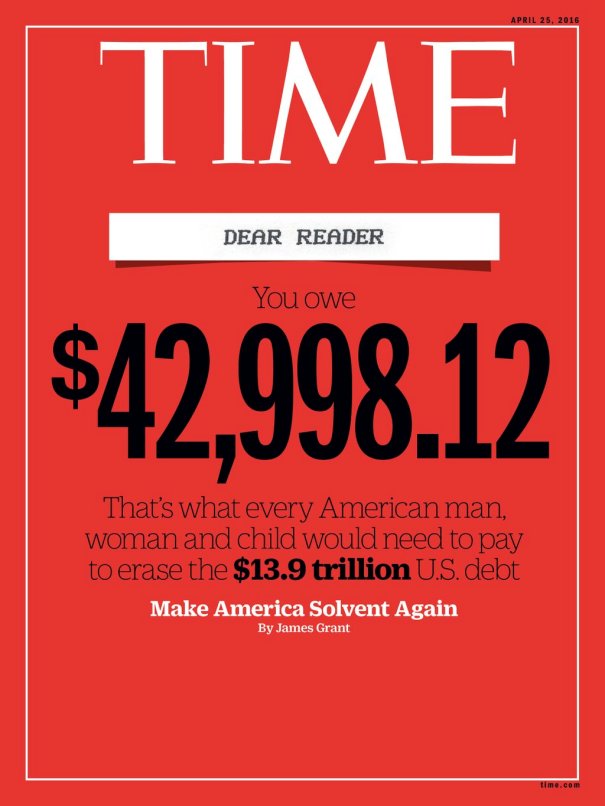
The US federal government owes you $23,871. Really, it does!

time cover

Time magazine’s cover is trying to scare economically illiterate people.   Time’s reasoning is exactly the same as the absurd reasoning I used to calculate the numbers in the title above. The U.S. federal government owes 56% of its debt to Americans, so the US government would literally have to pay, “every American man, woman and child [$23,871] to erase” the government debt to Americans.  Does that number make you feel any better?   Unfortunately, the government probably won’t be paying much of that money to you. You probably don’t own that much government debt because the richest 3% of Americans hold 52% of total U.S. wealth (according to Fed data).  Thus the US government will be paying the majority of that money to the richest 3%.  Some of those wealthy investors love to pay for reminders (like Time just published for free) about that big debt we owe them so that the rest of us don’t forget.  Time magazine’s reasoning appeals to a lot of those wealthy bond holders that want the average American to pay higher taxes (or maybe cut Social Security or other programs) to pay off the debt, and maybe they think they can scare us into accepting a bleaker future to pay them off, but the reality is that the median American isn’t currently obligated pay much of the money back because America still has somewhat progressive taxation.  Unless they succeed in making taxation a lot less progressive, the wealthiest bond holders will pay the taxes to pay a lot of that money back to themselves.

It would be more accurate for me to state the amount that the government owes to the median American (closer to $0) rather than stating the mean amount of debt that the government owes us ($23,871).  Time’s cover story would also be more accurate if it attempted to asses the median amount that taxpayers can expect to pay to cover the federal debt, but Time is trying to scare people with mean numbers.  The median amount that Americans will pay would be a much more accurate and less alarming statistic because wealthier people pay more taxes, but even that number isn’t particularly relevant to the median American’s well-being for several reasons that Matt Yglesias explains. The Time cover story is by James Grant who has a long reputation as a flaky gold bug who has a tradition of making bad predictions about inflation. Paul Krugman notes that he is a…

 signatory of the infamous 2010 letter warning Ben Bernanke that his policies would cause inflation and debase the dollar, [and a] crusader for a return to the gold standard.

Grant continues to pine for a return to the gold standard in the Time cover story.  If Grant thinks that gold is better than government bonds, then he can just buy gold.  He doesn’t have to force the entire U.S. economy to use gold for him to be able to have whatever security he thinks there is in having gold.

Grant’s story also says America is insolvent. He complains that the government can print money and that private investors are lending money to the U.S. government at, “an average of just 1.8%.” How can the government be “insolvent” when it has the power to print money.  I wouldn’t be worried about my debts if I could legally print money.  And why would private investors lend vast amounts of money to an “insolvent” government for just 1.8%?  Grant is wrong. private lenders charge the U.S. government the lowest interest rates of anyone who borrows in dollars because investors put great faith in the solvency of the U.S. government.

Note: The $23,871 mean debt that the government owes each American was calculated using Treasury data for total debt and debt held by foreigners.

Posted in Macro, Public Finance

The rules of globalization were written to help elites hide money.

Hernando de Soto believes that economic development and capitalism depends upon formal property rights. He has been advocating for making a clear public record of who owns all real estate and to help entrepreneurs register their ownership of their businesses because millions of poor people in developing nations have not had legal ownership of their homes, farms, and businesses and that fact contributes to trapping them in poverty.

At the same time, there has been a growing movement since the 1980s that has been moving the opposite direction.  Rich people and big corporations have increasingly been using the new rules that were set up to boost globalization to hide their ownership of businesses, real estate, and financial accounts.  This movement was publicized in April 2016 by the leak of the Panama Papers, a massive electronic data dump of the secret account activities of Mossack Fonseca, an international finance company headquartered in Panama that specializes in setting up shell companies in order to help rich people and corporations hide wealth offshore.  German Lopez explains:

[T]he heart of the story — a bunch of individuals and organizations storing their money in secret offshore locations like Panama — isn’t that complicated. Over at Reddit, user DanGliesack gave one of the best explanations I’ve read yet:

When you get a quarter you put it in the piggy bank. The piggy bank is on a shelf in your closet. Your mom knows this and she checks on it every once in a while, so she knows when you put more money in or spend it.

Now one day, you might decide “I don’t want mom to look at my money.” So you go over to Johnny’s house with an extra piggy bank that you’re going to keep in his room. You write your name on it and put it in his closet. Johnny’s mom is always very busy, so she never has time to check on his piggy bank. So you can keep yours there and it will stay a secret.

Now all the kids in the neighborhood think this is a good idea, and everyone goes to Johnny’s house with extra piggy banks. Now Johnny’s closet is full of piggy banks from everyone in the neighborhood.

One day, Johnny’s mom comes home and sees all the piggy banks. She gets very mad and calls everyone’s parents to let them know.

Now not everyone did this for a bad reason. Eric’s older brother always steals from his piggy bank, so he just wanted a better hiding spot. Timmy wanted to save up to buy his mom a birthday present without her knowing. Sammy just did it because he thought it was fun. But many kids did do it for a bad reason. Jacob was stealing people’s lunch money and didn’t want his parents to figure it out. Michael was stealing money from his mom’s purse. Fat Bobby’s parents put him on a diet, and didn’t want them to figure out when he was buying candy.

Now in real life, many very important people were just caught hiding their piggy banks at Johnny’s house in Panama. Today their moms all found out. Pretty soon, we’ll know more about which of these important people were doing it for bad reasons and which were doing it for good reasons. But almost everyone is in trouble regardless, because it’s against the rules to keep secrets no matter what.

Although most of money seems to have been hidden for shady reasons, it is mostly completely legal because the politicians who set up the new rules of globalization want it to be legal for their friends to be able to hide assets and dodge taxes.  It could easily be stopped by our global trade (and finance) treaties if our trade negotiators wanted to stop it.  After all, US law doesn’t allow our financial elites to hide money in Cuba or in Bluffton Ohio.  It is easy to identify the tiny jurisdictions like Panama and Bermuda that specialize in hiding money and it would be simple to clamp down on them by applying a little economic pressure.  We could eliminate it by threatening to cut them off from our banks the same way we cut off Cuba.  We could also incorporate financial transparency rules into our international trade agreements.  Although most people think of trade agreements as being about tariffs on goods and services, finance is undoubtedly the biggest form of international services trade.  International trade agreements include volumes of rules that govern financial flows to make this possible.  For example, the Trans-Pacific Partnership was mostly about harmonizing these kinds of rules and had little to do with tariffs on goods which were already minuscule.  Matt Yglesias explains:

[G]lobal economic integration is about much more than the flow of goods across borders — it’s about the nature of the rules that govern (or don’t) economic activity on a worldwide basis.

…The United States, for example, is a major global exporter of both pharmaceuticals and entertainment products. Many foreign countries where these are not major industries have intellectual property rules that are friendlier to consumers of medicines and TV shows and less friendly to their producers. In …trade agreements, American negotiators typically put a high priority on inducing foreign countries to changing their domestic laws to more closely conform to US practices and the interests of big US-based firms.

America’s bilateral trade promotion agreement with Panama is no exception to this, with the US Trade Representative’s Office touting “important disciplines … related to intellectual property” that are included in the agreement.

…The nature and extent of global economic integration is deeply driven by elite priorities, and [they prioritize intellectual property. Cracking] down on tax evasion isn’t that high of a priority [for them].

In the specific case of Panama, it’s worth recalling that back in 1989 the United States sent a small military force to invade Panama, depose its president, extradite him to the United States, and put him on trial for drug trafficking charges. If there were a strong bipartisan consensus in favor of coercing Panama into changing its laws regarding taxation or shell companies, we could get the job done.

…And illegal evasion is only a small part of the larger picture of perfectly legal tax avoidance. Companies and individuals are perfectly within their legal rights to structure economic activity so as to make as large a share of it as possible take place in low-tax jurisdictions. Hedge funds whose staff is located in New York are often formally incorporated in the Cayman Islands. Apple registers a very large share of its global profits as accruing to its Irish subsidiary rather than its US-based parent company. In both cases, this is to take advantage of a low corporate tax rate.

If these kinds of relatively small countries were acting to undermine the integrity of the global pharmaceutical patent system, they would be stopped. But political elites in powerful countries allow them to undermine the integrity of the global corporate tax system — even when Ireland was desperately in need of bailout funds from the European Union, it was not forced to change its corporate tax system [as a condition of the bailout] — largely because the wealthy and powerful want the global corporate tax system undermined.

Globalization [treaties are] a process of writing common global rules for economic activity.

And it’s sometimes a process of not writing common rules, and implicitly allowing integration to erode standards. Different choices are made on different subjects, and it’s not a coincidence that the choices made have tended to be systematically biased in favor of the priorities of Western economic elites. The Panama Papers, by revealing the quasi-secret activity… offer an unprecedentedly detailed look at how that works in practice.

International elites don’t want to allow international financial flows that hide money for terrorism, drug lords, other criminals, but they are torn because they do like the lax standards that help them hide money from taxation and legal liabilities like divorce settlements.  Yglesias explains:

I was once in Switzerland and talking to a private banker there who complained to me that Americans have a lot of Hollywood-driven misconceptions about Swiss banking. Americans, he said, tend to think of banking secrecy as all about money laundering for terrorists or drug traffickers when the real truth is that it’s mostly for rich people trying to avoid taxes or husbands trying to shield assets from their wives during divorce proceedings.

The basic issue is that even with “offshore” banks you can’t just show up with an oil drum full of cash and no explanation. The bank is going to ask you for some kind of documentation of how you earned the money.

One important reason for that historically has precisely been able to preserve their function as havens for tax evasion and asset-shielding. Neither Switzerland nor the Cayman Islands nor any other offshore banking center is exactly a mighty superpower. Their ability to preserve banking secrecy is based largely on the acquiescence of the world’s major powers. And elites in the United States, United Kingdom, Germany, France, etc. are a lot more likely to wink and nod at tax avoiders than at major drug drealers and mass murderers. Letting too many violent criminals in the door would risk spoiling the whole party.

An international system that is deliberately designed to make it easy to hide money from taxation is going to make it a lot easier for criminals and international terrorists to slip through the cracks, but this is unintentional.  The Panama Papers might shed some light on how much the rules that aid tax-evasion have been helping criminals and terrorists too.  Even if the system were designed for criminals, they are a much smaller part of the global economy than rich tax evaders, corporations, and corrupt officials, so we should expect that only a small percent of the money has come from terrorists and organized crime.  Yglesias explains:

Gabriel Zucman, an economics professor at UC Berkley, has made the most detailed study of [how much wealth is being hidden in shell companies like those revealed by the Panama Papers] for his book The Hidden Wealth of Nations, and estimates that it totals at least $7.6 trillion. That’s upward of 8 percent of all the world’s financial wealth, and it’s growing fast. Zucman estimates that offshore wealth has surged about 25 percent over the past five years…

if you have made a bunch of money illegally (taking bribes, trafficking drugs, etc.) you need to do something with the money that won’t attract the attention of the authorities or the media. A secret offshore shell company is perfect. Not only does it help you avoid scrutiny in real time, but if you are found out its assets can’t be taken from you if you have to flee the jurisdiction or even serve jail time.

But even though various criminal money-laundering schemes are the sexiest possible use of shell companies, the day-to-day tax dodging is what really pays the bills. As a manager of offshore bank accounts told me years ago, “People think of banking secrecy as all about terrorists and drug smugglers, but the truth is there are a lot of rich people who don’t want to pay taxes.” And the system persists because there are a lot of politicians in the West who don’t particularly want to make them.

…a leaked memorandum from a Mossack Fonseca partner revealing the more boring truth that “[n]inety-five per cent of our work coincidentally consists in selling vehicles to avoid taxes.”

…Incorporating your hedge fund in a country with no corporate income tax even though all your fund’s employees and investors live in the United States is perfectly legal. So is, in most cases, setting up a Panamanian shell company to own and manage most of your family’s fortune.

Libby Nelson interviewed Gabriel Zucman, the economist who had estimated that 8 percent of the world’s financial wealth is hidden in these kinds of offshore tax havens.

Zucman… argues that this tax avoidance worsens the vast global gap in wealth and income between the rich and the poor. Hiding vast sums of wealth from taxation makes it easier for the rich to stay rich and avoid tax policies meant to help the poor. Offshore accounts also make it harder for everyone else to get rich, because they’re paying higher taxes to make up for the tax dollars the wealthy don’t pay when they shelter their assets overseas.

“If we want to deal with rising inequality seriously, then we need to make these forms of tax dodging much, much more limited,” Zucman told me in an interview…

LN: How much does this vary across countries?

GZ: Eight percent is a global average that conceals significant heterogeneity. According to my estimates, the US has a bit less than 8 percent of its financial wealth offshore, maybe something like 4 percent. Europe has a bit more, something like 10 percent.

But then if you look at Latin America, more than 20 percent of Latin America’s financial wealth is in offshore tax havens. In Africa, more than 30 percent; in Russia, 50 percent. For many countries in the world, in particularly developing countries, these are extremely important sums. So it means it’s really meaningless to study inequality in Latin American and developing countries without considering this issue. It’s really a very important phenomenon.…

LN: How did you come up with the $8 trillion estimate?

GZ: When you look at the global investment data, you see that there is a big problem, which is that the world’s financial assets fall short of the recorded liabilities. So there’s a discrepancy.

LN: In other words, there’s a lot of money missing from the balance sheets.

GZ: It’s been known for quite a long time, but until recently it was a bit hard to understand the reason for that. I was able to show that the bulk of this statistical anomaly is because the wealth that people own in tax havens is not recorded as assets. It’s recorded as liabilities, but not as assets, and that’s a reason why you have this big imbalance in the global accounts. By using these statistical anomalies I was able to estimate that there is 8 percent of the world’s financial wealth in tax havens.

This fact is why I am always skeptical of claims about rising total debt.  Every person’s debt is another person’s asset.  All of finance is just various forms of debts.  Total debts minus credits for everyone must always equal zero, so there can never be any rise in net debt.  Zucman took advantage of this accounting identity to estimate hidden assets because debtors have no reason to hide their debts from the tax man, but creditors (wealth holders) do.  The fact that financial debts are about 8% larger than financial assets means that the assets must be hidden somewhere.  And there are even more real assets that are being hidden.

The interview continues:

LN: Are there other things this hidden money obscures about the world economy?

GZ: When you look at the official statistics and the net financial positions of nations — who’s a creditor, who’s a debtor — one of the world’s biggest debtor is the eurozone.   And I think that’s just wrong. There’s growing recognition that it’s wrong. This data fails to capture quite a lot of assets, and when you try to reattribute them to the countries that actually own them — to Germany, France, Italy, Greece, Spain, Portugal — this improves the net financial position of these economies. In particular, that makes Europe a net creditor rather than the world’s biggest debtor. For the US, the effect is the same but it’s less strong — the US [would actually be] the world’s biggest net debtor in the statistics, but this [too] exaggerates the reality [because of hidden US assets].

This wasn’t always the case.  Before the 1980s, less than 1% of US equities were in tax havens.  And because offshore shell companies were one of the reasons that US banks avoided regulations that contributed to the 2007 financial crisis, financial reforms since then have clamped down on some of these activities.  Libby Nelson’s interview of Zucman continues:

LN: How long have tax havens been a problem?

GZ: …But from the 1920s to the 1980s, Switzerland was the only well-functioning tax haven. It was mostly used by Europeans. You can look at the fraction of all US equities that belong to offshore financial institutions and to individuals who live in tax havens — that’s data collected since the 1940s by the US Treasury. From 1940s to the mid-1980s, it was very small; about 1 percent of US equities belonged to tax havens.

Then in the 1980s, lots of other tax havens appear — the Cayman Islands, Singapore, Hong Kong, Panama, Bermuda, and so on. And so at the global level, the use of tax havens increases dramatically starting in the 1980s.

LN: What’s causing this increase?

GZ: Changes in financial regulation have made it possible for tax havens to develop and grow. Technological change has made it much easier to move money all over the world. And there have been cultural changes in the ways people see taxes — starting in the 1980s, a growing fraction of the population started thinking it’s okay to really, minimize your taxability and even evade taxes.

You have all these things combined that explain this spectacular increase that continues to this day. Today about 10 percent of all US equities in the data belong to tax havens.

LN: So how should we see the revelations from the Panama Papers in light of everything you already know about the harms tax havens cause?

GZ: …What’s shocking is that we thought we had made quite a bit of progress, in particular in terms of convincing offshore financial institutions to apply the international anti-money laundering regulations. What we discover is they don’t — they just don’t care about these regulations. There’s an important lesson, which is that we should rethink the way we regulate these institutions. It’s good and it’s necessary to have regulations and to ask the countries in the world to apply them and have inspections from time to time, but it’s not enough.

Many banks and financial institutions in tax havens, and many bankers, have become very rich by servicing tax evaders or criminals. If they have nothing to lose in continuing to do this, some of them will continue. That’s what we see in the leaks. In principle, the basic requirement of anti-money laundering regulations is to identify the owners of the wealth that you manage. But the vast majority of the shell companies created by these Panama firms did not even try to identify the initial owners. It was okay to service potential criminals or tax evaders.

And the reason is very simple: It is profitable to do this, and right now tax havens and the firms that operate there don’t have much to lose by doing this.

LN: What can be done to change that?

GZ: I think it’s important to acknowledge that there’s been progress through the financial crisis. So in particular before 2008, there was strictly no exchange of bank information between tax havens and foreign countries’ tax authorities. So it was really easy to evade taxes, because there was total bank secrecy.

And this has changed mostly thanks to the US law starting to be implemented right now that forces foreign institutions to automatically tell the IRS about their US clients and their holdings. Now other countries are trying to do the same thing. There’s going to be an automatic exchange of bank information that involves many countries around 2017, 2018. So there’s been significant progress. The problem is it’s not enough to just create laws.

I think we need to clearly say there’s clear evidence that out of the 100,000 shell companies in Panama and the British Virgin Islands, many of them are used for illegal activity. Why do we even tolerate these activities taking place? Why do we tolerate that these countries host such an enormous amount of financial activity?

We should have immediate sanctions against places like that and say that the sanctions will remain in place until you’re able to prove that you’ve correctly identified all the initial owners of all the companies that are incorporated on your territory. We need to have this approach that’s centered on sanctions to change the incentives and the behavior of the countries and the firms and the people involved in this business.

LN: Would sanctions be enough? What about the activity that isn’t necessarily illegal but still leads to losses of [tax] revenue?

GZ: We need to invent new modern transparency tools. I think the main challenge is to create financial registries.

All the wealth in the shell Panama companies and the Swiss bank accounts is not invested in Panama and Switzerland. It’s invested in New York and London real estate and so on. And what the US and European countries could do is say, Okay, let’s start from the wealth that’s on our territory and try to find out who owns it. Who are the actual owners of the real estate, and the equities, and mutual funds and bonds and shares on our territory?

This means creating financial registries of wealth and recording the owners of the wealth, and at the end of the day that’s the main way to make a lot of progress on these money laundering and tax evasion issues.

It will also be a global public good, in particular for developing countries, which right now are totally unable to have any idea of the wealth of their elite, a big fraction of which is in the US and in Europe. Having this register would be a great service to these countries. They are not involved in the talks for automatic exchange of bank information, so at this stage there’s no hope that things are going to improve for them.

LN: That would be an amazing global financial audit. Has anyone tried to create one?

GZ: Well, we have land and real estate registries. They’ve been in place for decades or even centuries.

All countries are very familiar with their logic: If there’s real estate in New York City, we are recording who owns it. Everybody can go online and type any name in the website to find out who owns a building in Brooklyn. This is public, it has been for a very long time, and there’s a long track record. I think we need to start from what exists and works well, and expand the scope of these registries by trying harder to find out who are the initial owners.

Hernando de Soto has been working on expanding these kinds of registries in developing nations for decades.  Many developing nations never bothered to include the real estate that poor people traditionally owned in their official property registries so much of their territory isn’t formally owned by anyone.  The elites who run the government have simply never bothered to record who owns the land in vast areas where poor people live and that makes them vulnerable to being displaced without compensation.  The difference in property registration has created a divide between rich elites and the poor in places like Peru because rich people get secure property rights, and the poor people don’t and that contributes to entrenched poverty.

Shell corporations have been increasingly doing the opposite of what de Soto advocates.  They are increasingly hiding the ownership of property for elites and creating a new economic divide between rich and poor around the world.  Shell corporations are more important for the economies of corrupt nations like Russia where 50% of financial assets are hidden than for rich nations like the US.  Many poor nations are trapped in poverty in part because they suffer from an epidemic of corrupt government officials who rely on shell corporations to embezzle money and hide it in the US and other rich nations.  Although America has tried to create international financial rules that don’t benefit criminals that could directly hurt US interests like terrorists and drug mafia, American interests have turned a blind eye towards corrupt government officials in other nations who are dragging down their people.  This double standard might be due to the fact that it benefits Wall Street when their money ends up in the US.

America could help poor nations develop by reforming international finance and preventing corrupt foreign officials from using shell corporations to hide their stolen money in the US.  International and US laws are set up to make it too easy for them. Although the ordinary citizens in highly corrupt nations currently have more to gain than Americans from reforming global finance to crack down on shell corporations, we have been rapidly moving towards the kind of banana republic system that they have.  There is a giant sucking sound that has been pulling more and more money out of the legitimate US economy into offshore shell corporations and we shouldn’t be complacent about our own self-interest in avoiding Russia’s fate.  Russian elites don’t need to care as much about ordinary Russians because most of elite financial wealth is hidden in offshore shell companies.  US elites have been moving that direction too.

Posted in Development, Globalization & International, Public Finance

Hernando de Soto & Property Rights

glassball

Hernando de Soto thinks that formal property rights are the key to prosperity and that the government must clearly define and enforce specific private ownership rights.  De Soto’s thesis is that government must be efficient at clarifying the legal ownership rights for all real estate and businesses to make it easier to buy and sell them because that will encourage more investment.

In poor nations, it is typically extremely expensive to set up a legal business that can then obtain credit and that limits the ability of entrepreneurs to expand which prevents them from being able to accomplish economies of scale.  It is also impossible to sell a business if it isn’t a formal legal entity.  Small businesses usually dominate poor nations and that makes poor nations less efficient because in business, small is ugly.

Furthermore, governments cannot tax property if there isn’t clear ownership and they cannot tax informal business income.  De Soto argues that a lack of clear property rights prevents governments from collecting taxes and generating revenue to spend on the public welfare.  Poor people get stuck in an underground economy which often gets managed by extralegal mafias or tribal governance that are undemocratic and inefficient.

“The existence of such massive exclusion generates two parallel economies, legal and extra-legal. An elite minority enjoys the economic benefits of the law and globalization, while the majority of entrepreneurs are stuck in poverty, where their assets–adding up to more than US$ 10 trillion worldwide–languish as dead capital in the shadows of the law.”

De Soto claims that poorly defined property rights make a natural disaster worse:

Two recent natural disasters …grabbed our hearts – the tsunami that ravaged 11 countries on the shores of the Indian Ocean, history’s worst, and the hurricane …Katrina that inundated the city of New Orleans. Images from both regions were tragically similar: demolished buildings, floating corpses, stunned survivors, and water, water everywhere. There was one profound difference. In New Orleans, the first thing authorities did to secure the peace and assure rebuilding was to salvage the city’s legal property records that would quickly determine who owned what and where, who owed what and how much, who could be relocated quickly, who was creditworthy to finance reconstruction…

In Southeast Asia, there were no such legal records to be found, because most of the tsunami’s victims had lived and worked outside the law.

[With] the floodwaters still high, New Orleans’ custodian of notarial records, Stephen Bruno, rushed to the courthouse basement where the city’s property records were stored, hauled them out of the water and packed them into refrigerator trucks that ferried them to Chicago, where they were expertly dried. The restored documents were quickly sent back to New Orleans – 60,000 volumes now archived under armed guard…. “Abstractors” …are painstakingly going through the documents that will produce the legal tools for designing and financing the city’s recovery, allowing bankers, insurers and realtors to identify owners, activate collateral, raise financing, access secondary markets, make deals, close contracts, as well as make it profitable for utilities to pump energy and water into neighborhoods – the entire legal infrastructure that is needed to keep a modern economy in gear.

Such a scene was impossible after the tsunami of December 2004 sent …waves the size of buildings onto beachfront property from Indonesia and Thailand all the way to Sri Lanka …killing more than 270,000 …In Banda Aceh, Indonesia, 200,000 homes were washed away, most of them built without property titles. When the water receded from Nam Khem, Thailand, a well-connected tycoon rushed in to grab the valuable beachfront. The survivors of the 50 families that had occupied the shore for a decade protested, but they didn’t have legally documented property rights…

That is the case with the majority of people in the developing and ex-Soviet world, where legal systems are inaccessible to most of the poor.

Life in the extralegal world is at constant risk.

An earthquake rocked Pakistan …leaving …73,000 people dead. When a similar sized quake hit the Los Angeles area in 1994, 60 people died. The difference? …inadequately constructed housing …built outside the law ignoring construction codes.

But what poor homeowner …has any incentive to invest in safer housing and reinforced concrete without evidence of secure, legal ownership and the possibility of getting credit?

Governments are powerless to enforce legal codes when most people operate outside the law.

Typically, [rich] governments promote …private property to increase property taxes. In the extralegal economy, people may pay bribes, but no one pays taxes. Where will the [government] money for reconstruction come from? Private property in the United States is likely to be covered by insurance – an estimated $30 billion worth for Katrina. In Sri Lanka, only 1 percent of the 93,000 tsunami victims were covered.

In the developing world, few people have an official address, never mind the kind of legal title to their assets required by insurers.  In the developing world, neither capital nor credit will venture where there are no clear property rights.  …for developing countries without an adequate legal property system, peace itself is on the line – as was the case in the United States before more widely accessible legal property law gradually turned violent squatters into noble pioneers.

Before that, squatters had threatened to burn George Washington’s farms unless he gave them title. …That’s where developing countries are today.

The bloodshed can be stopped. Livelihoods and businesses could be reconstructed in the developing world. But first the poor must be legally empowered.

We take the law for granted; but without legal documents, people do not exist in a market. If property, business organizations and transactions are not legally documented, they are fated to remain forever uninterpreted and society cannot work …Legally created titles and stock certificates generate investment; clear property records guarantee credit; documents allow people to be identified and helped; company statutes can pool resources for recovery; mortgages raise money; contracts solidify commitments.

Four billion of world’s six billion people do not have this ability to create wealth and recuperate from disaster. Their constant tragedy is to live without the benefit of a single rule of law. …Only if the poor themselves are legally empowered will they be in a position to turn the next tsunami into just another storm.

There are excessive regulations on entrepreneurs in poor countries that prevent them from establishing legal businesses and only legal businesses can write legal business contracts, apply for bank loans, buy business insurance, copyright a brand, or be sold.  In Lima, Peru, in 1983, Hernando de Soto registered a business legally without using any of his political connections and he tried to avoid paying bribes except that it was absolutely unavoidable twice.

Peruvian elites normally use their political connections to obtain business licenses and other advantages.  Most Peruvian businesses are part of the informal sector where there is constant danger of being shut down by police for operating a business without the necessary permits.  Small, informal businesses pay no taxes, but they also have to pay extra bribes to police and/or “protection money” to local mafia to keep from being shut down for operating without the legal permits.

Hernando de Soto’s research team followed all necessary bureaucratic procedures in setting up a one-employee garment factory in the outskirts of Lima. The factory was in a legal position to start operations 289 days and $1,231 later. The cost amounted to three years of wages—not the kind of money the average Peruvian entrepreneur has at his or her disposal. “When legality is a privilege available only to those with political and economic power, those excluded—the poor—have no alternative but illegality,” writes Mario Vargas Llosa in the Foreword to de Soto’s (1989) book.

De Soto did the same process in Tampa, Florida, where it only took two hours to obtain a permit to open a small business.  The process took over 1,000 times longer in Peru.  Why would someone in Peruvian society want onerous restrictions on entrepreneurs to prevent them from being able to start new businesses?  Peruvian elites own legal  businesses and they do not want new competition.  A World Bank study found that incumbent businesses in Mexico saw their incomes drop 3% after the government simplified business registration because increased competition lowered prices.  Workers also gained a 3% increase in employment and the number of businesses increased 5%.

Ideology may help explain why onerous business regulations developed.  Liberals may have been overly willing to think that business regulations were benign due to an ideological bias whereas incumbent business owners tend to be conservatives, and they are happy to have these regulations that benefit them by limiting potential competitors.  Incumbent business elites have a pro-entrepreneur ideology because they see themselves as being successful entrepreneurs even though in reality they dislike new entrepreneurs who could become their competition.     Because of de Soto’s work, publicizing the insanity of regulations that only benefit a small group of elites, the World Bank established the Doing Business Project in 2002 to measure the cost of pro-elite regulations around the globe that protect incumbent business.  They have succeeded in getting reforms merely by merely doing a bit of social marketing and publicizing the absurdity of the regulations.  Within the first five years, there were 193 reforms in 116 countries.

De Soto pioneered an interesting ideological niche.  He is a conservative who uses free-market language to promote greater government involvement in distributing property rights to the poor.  He has promoted land reform and greater equality without using those terms.  ‘Land reform’ is usually a hot-button concept that is generally associated with the far left, but de Soto has gotten conservatives to enthusiastically embrace his version of land reform.  Leftist land reformers typically want to redistribute land from rich elites to their poor tenants.  De Soto noticed that there are vast amounts of land (he claims US$ 10 trillion worth) in poor nations without any clear legal title.  Rather than stepping on the toes of rich landowners, de Soto only wants to redistribute the ownership of the unowned (or government-owned) land to the poor tenants who live and work on it.  This is why de Soto has been much more politically successful than liberal land reformers.

De Soto points out that a financial crisis, like the one we had in 2008, creates problems due to the same sort of dynamics that keeps poor countries poor:  ill-defined property rights.

Why does ownership matter so much? 

Ownership means that I have something to lose. If you’re a banker, it means that you’ve got collateral. It also means that I’m credible, so you can give me credit. When you think about it, whether it’s ownership, whether it’s credit, whether it’s capital, whether it’s identification, none of the things that make a modern economy are possible without property.

How does this relate to the financial crisis? 

The enormous amount of derivatives that had poured into the market—there are close to $600 trillion of these papers around—are also not recorded in a global or centralized manner, or in a manner that allows you to begin to quantify them. [Former SEC Chairman Christopher] Cox thought that maybe the toxic part of all of these assets was $1 trillion to $2 trillion. [Treasury Secretary Timothy] Geithner told us there’s maybe $3 trillion or $4 trillion. Nobody really knows, so in a way [they’ve created an] informal or shadow economy. This unidentified paper is the source of uncertainty and the credit contraction.

So they’re unidentified in the same way that ownership of, say, a slum in Peru or Africa is unidentified. 

That’s right. We have worked in places like Tanzania and Egypt and Ethiopia. When you go visit a home there you don’t find justification for it through the books. In other words, it’s not centrally available information. When you talk about shadow economies in many places, it’s not only the economy of gangsters. It’s also economies that are legal in every respect except for the fact that the paper, which backs up the ownership or the evidence that something exists, is not easily and publicly available. That creates the shadow.

Has the subprime mortgage market become a shadow economy? 

Subprime mortgages are not a shadow economy. But what happened is that a lot of these mortgages got repackaged into securities. Then they became collateralized debt obligations and some of these mortgages were sliced and diced and put into tranches. When some of these mortgages went sour and people started defaulting on their payments, then of course a lot of the securities tied to them also started defaulting. But when you try and trace who’s ultimately responsible for the value of that paper, you couldn’t find it. That’s the part of the market that has become the shadow.

ill-defined property rights in the subprime mortgage sector caused a meltdown. Does the same happen in the developing world? 

Yes. That shadow hopefully is a temporary condition in the United States and in Western Europe. And it might pass in a year or 10 years, but it will pass. That passing condition that’s occurring now in developed countries, that’s a chronic condition in developing countries. We’re always chronically in credit crunches—because you don’t know who owns what, nobody dares lend to somebody else. Bringing the law to emerging markets is possibly the most important measure that can be taken to help these countries become rich. Look at the Iranians, look at the North Koreans—they’re building nuclear plants. Look at the computer—they’re being built in northern India. The issue isn’t the expansion of technology. We can all get it, borrow it, buy it or steal it. The issue is how do you get a legal system that allows people to cooperate so as to create more complex systems and objects.

So at this point, a Wall Street banker in a $10,000 suit is encountering basically the same problem that Nairobi slum dwellers have had to deal with for decades or more. 

Absolutely. The difference, however, is that in Nairobi they are still struggling to understand that a property system is the best way that they can do things. In the United States, every piece of land, every house, every automobile, every airplane, every manuscript for a film, every patent is written up and recorded and described. There’s only one thing in the United States which is not recorded in such a way and that’s derivatives. We’re only talking about 7 percent of the subprime market being in default, yet it is causing a major contraction in your economy. You’re not getting your credit flowing because you don’t know what is where and who it belongs to.

I am a big fan of de Soto’s work, but more private property rights aren’t always better.  Slavery is a form of property right that is particularly pernicious.  We are better off both morally and economically because of banning that kind of private property partly because slavery creates excessive inequality.  One of the key reasons de Soto’s work has been beneficial for development is that he has focused on issues that will create greater equality of property rights.  Rich elites have always gotten government help protecting their property rights.  Even though de Soto doesn’t talk much about equality, he really cares about the disadvantaged and he promotes more equality of property rights.  He wants poor people to get the same kind of government assistance in defining and protecting property that rich people have always gotten in every nation.

For more about Hernando de Soto’s work, see this VOX EU article and Alan Krueger’s NYT article.

Posted in Development, Real Estate

Enter your email address to follow this blog and receive notifications of new posts by email.

Join 75 other subscribers
Blog Archive
Pages