
Why are liberal-arts degrees valuable in the marketplace?

The governor of Florida, Rick Scott, declared that he wants to eliminate the liberal arts majors at state universities and community colleges because he does not think that they produce job skills.  However, liberal arts majors (humanities, social sciences, science, and math) do better on tests of learning than job-oriented majors like business, education, and engineering.

Liberal arts majors earn less immediately after college, but their incomes grow more quickly than job-oriented majors and ten years after graduation, they earn about the same amount as job-oriented majors despite the fact that they are more likely to work at nonprofits which pay less.  Liberal arts majors earn a lot because the most important part of education is learning how to learn and exercising thinking and communication skills.  This is why economics majors do so well at getting into law schools and have such high earnings: it is a challenging major.  But how much you get out of your education depends upon how much work you put into it.  An economics major who wants to scrape by won’t do as well later as one who is challenged by wanting to master difficult material.

Leonhardt, NYTimes.com:

A century ago, the United States decided to make high school nearly universal. Around the same time, much of Europe decided that universal high school was a waste. Not everybody, European intellectuals argued, should go to high school.
It’s clear who made the right decision. The educated American masses helped create the American century, as the economists Claudia Goldin and Lawrence Katz have written. The new ranks of high school graduates made factories more efficient and new industries possible.
Today, we are having an updated version of the same debate. Television, newspapers and blogs are filled with the case against college for the masses… The evidence is overwhelming that college is a better investment for most graduates than in the past. A new study even shows that a bachelor’s degree pays off for jobs that don’t require one: secretaries, plumbers and cashiers. And, beyond money, education seems to make people happier and healthier.
…the returns from a degree have soared. Three decades ago, full-time workers with a bachelor’s degree made 40 percent more than those with only a high-school diploma. Last year, the gap reached 83 percent. College graduates, though hardly immune from the downturn, are also far less likely to be unemployed than non-graduates. Skeptics like to point out that the income gap isn’t rising as fast as it once was, especially for college graduates who don’t get an advanced degree.
The Hamilton Project, a research group in Washington, has just finished a comparison of college with other investments. It found that college tuition in recent decades has delivered an inflation-adjusted annual return of more than 15 percent. For stocks, the historical return is 7 percent. For real estate, it’s less than 1 percent.
Another study being released this weekend — by Anthony Carnevale and Stephen J. Rose of Georgetown — breaks down the college premium by occupations and shows that college has big benefits even in many fields where a degree is not crucial.
Construction workers, police officers, plumbers, retail salespeople and secretaries, among others, make significantly more with a degree than without one. Why? Education helps people do higher-skilled work, get jobs with better-paying companies or open their own businesses.

None of this means colleges are perfect. Many have abysmal graduation rates. Yet the answer is to improve colleges, not abandon them. …
think about it this way: People tend to be clear-eyed about this debate in their own lives. For instance, when researchers asked low-income teenagers how much more college graduates made than non-graduates, the teenagers made excellent estimates. And in a national survey, 94 percent of parents said they expected their child to go to college.
Then there are the skeptics themselves, the professors, journalists and others who say college is overrated. They, of course, have degrees and often spend tens of thousands of dollars sending their children to expensive colleges.
I don’t doubt that the skeptics are well meaning. But, in the end, their case against college is an elitist one — for me and not for thee. And that’s rarely good advice.

Similarly, Abhijit Banerjee and Esther Duflo’s book Poor Economics shows evidence that subsistence farmers in developing countries earn higher incomes with more education even though they are basically just full-time gardeners who are so poor they scarcely have any tools.  Many subsistence farmers only use an eye hoe, a machete, and a bucket.  For some reason, education makes them more productive even though their work doesn’t require education and doesn’t involve reading, history, nor arithmetic in any obvious way.
Posted in Labor

Alcohol deaths are rising. Happy New Year.

See updated version that I reposted for spring break.

Posted in Labor, Public Finance

Anthropomorphizing Bill Gates as the God of Microsoft

It is human to anthropomorphize. We like to personify holidays into heroic figures like Santa Claus or the Easter Bunny and personify companies as Ronald McDonald or the Michelin Man. The flourishing of art and culture of entire eras is personified as Elizabethan or Victorian even though these people had little to do with creating the art and culture that is named after them. Polytheistic religions anthropomorphized forces of nature and even human activities like war (Mars & Thor) or love (Venus & Freyja). Today, the cult of the entrepreneur is guilty of anthropomorphizing the success of large teams onto a single leader.

As societies get increasingly complex, businesses and other organizations get larger which makes their leaders more powerful, but at the same time this trend should decrease the importance of any single individual in a successful organization according to research about group intelligence:

groups, as entities, have characteristics that are more than just a summing up or averaging of those of its members.

“Intuitively, we still attribute too much to individuals and not enough to groups. Part of that may just be that it’s simpler; it’s simpler to say the success of a company depended on the CEO for good or bad, but in reality the success of a company depends on a whole lot more,” said Thomas W. Malone, director of the MIT Center for Collective Intelligence and senior author of the recent study, published in the journal Science. “Essentially what’s happening as our society becomes more advanced and more developed is that more things are done by groups of people than by individuals.

According to the researchers, one of the most important leadership skills is listening and getting out of the way of teammates so that they can all achieve their maximum contribution:

…groups with overbearing leaders who were reluctant to cede the floor and let the others talk did worse than those in which participation was better distributed and people took turns speaking.

Bill Gates owes more to the hundreds of thousands of current and former Microsoft employees for his wealth than the median Microsoft employees owes to him for theirs.  Without Bill Gates, most Microsoft employees would have a similar amount of economic wealth to what they have now whereas without the huge Microsoft team, Bill Gates would have only a minuscule fraction of his wealth.

Bill Gates was certainly a successful leader who was able to listen to numerous voices on the Microsoft team and get out of their way so that they could work successfully, but he was also spectacularly successful at skimming off a larger than usual share of the profits compared to entrepreneurs like Steve Jobs who was a more successful entrepreneur by just about every other measure.  On the other hand, Bill Gates is a much more successful philanthropist than Steve Jobs was, so perhaps the ends will justify the means.

Posted in Managerial Micro

Inequality decimates the heroes of the cult of the entrepreneur

Webster has two definitions of ‘entrepreneur’.  The first definition is “a person who starts a business and is willing to risk loss in order to make money.” By this definition, high inequality creates a lot of entrepreneurs. Extremely poor people mostly work as subsistence-level entrepreneurs out of desperation: they can’t find a better job. Nations with high inequality are much more entrepreneurial (as a percent of the labor force) than highly equal nations. Similarly, in the US, the cities that are the biggest centers of inequality are also centers of entrepreneurship because of vast ranks of poor people working in the underground economy at least part of the year as day laborers, drug dealers, street vendors, or scrap metal collectors. Most of our statistics neglect this kind of entrepreneur because they aren’t part of the formal economy, but desperation does breed entrepreneurialism. At the extreme, it encourages panhandling which is an extremely entrepreneurial industry.

But the kind of entrepreneurship that flourishes under high inequality is not the kind that the cult of the entrepreneur admires. The cult of the entrepreneur uses a version of Webster’s second definition of entrepreneur: “one who organizes, manages, and assumes the risks of a business or enterprise.” In particular, they admire managers of big businesses who have become rich by hiring many employees. But big business is the antithesis of entrepreneurship because the bigger the business, the fewer the entrepreneurs.  Employees are not entrepreneurs and when a business grows, it destroys entrepreneurship by hiring people  and by displacing smaller competitors.

This is a very good thing. Nations develop and get richer in part because they develop bigger businesses that gain from economies of scale and they displace smaller, less efficient entrepreneurs. As a result, richer nations have a smaller percentage of entrepreneurs. Competition from bigger businesses makes it harder and risker to become an entrepreneur in rich nations and so their main barrier to entrepreneurship is the lack of money among potential entrepreneurs.  Aimee Groth reports:

the most common shared trait among entrepreneurs is access to financial capital—family money, an inheritance, or a pedigree and connections that allow for access to financial stability. While it seems that entrepreneurs tend to have an admirable penchant for risk, it’s usually that access to money which allows them to take risks.

And this is a key advantage: When basic needs are met, it’s easier to be creative; when you know you have a safety net, you are more willing to take risks. “Many other researchers have replicated the finding that entrepreneurship is more about cash than dash,” University of Warwick professor Andrew Oswald tells Quartz. “Genes probably matter, as in most things in life, but not much.”

University of California, Berkeley economists Ross Levine and Rona Rubenstein analyzed the shared traits of entrepreneurs in a 2013 paper, and found that most were white, male, and highly educated. “If one does not have money in the form of a family with money, the chances of becoming an entrepreneur drop quite a bit,” Levine tells Quartz.

New research out this week from the National Bureau of Economic Research (paywall) looked at risk-taking in the stock market and found that environmental factors (not genetic) most influenced behavior, pointing to the fact that risk tolerance is conditioned over time…

For creative professions, starting a new venture is the ultimate privilege. Many startup founders do not take a salary for some time. The average cost to launch a startup is around $30,000, according to the Kauffman Foundation. Data from the Global Entrepreneurship Monitor show that more than 80% of funding for new businesses comes from personal savings and friends and family.

Societies with higher inequality have fewer people in the middle class who can afford to risk the average startup costs of $30,000 AND forgo a salary for months while a business gets going. Add this to the list of reasons why high inequality is bad for economic growth.

Posted in Development, Inequality, Managerial Micro

The freaky economics of socialist healthcare in Britain

Below is an excerpt from Think Like A Freak, by Steven Levitt and Stephen Dubner.

Shortly after the publication of Superfreakonomics [2009], while on a book tour in England, we were invited to meet David Cameron, [the Leader of the Conservative Party] who would soon become prime minister of the UK. Mr Cameron burst through the door. “All right,” he boomed, “where are the clever people?” He wore crisp white shirtsleeves, his trademark purple tie, and an air of irrepressible optimism. As we chatted, it became instantly clear why he was projected to become the next prime minister. Everything about him radiated competence and confidence…

Cameron said the biggest problem he would inherit as prime minister was a gravely ill economy. The UK, along with the rest of the world, was still in the grip of a crushing recession. The mood, from pensioners to students to industry titans, was morose; the national debt was enormous and climbing. Upon taking office, Cameron told us, he would need to make broad and deep cuts. But, he added, there were a few precious rights that he would protect at any cost.

Like what? we asked. “Well, the National Health Service,” he said, eyes alight with pride. This made sense. The NHS provides cradle-to-grave health care for every Briton, most of it free at point of use. One former chancellor of the exchequer called the NHS “the closest thing the English have to a religion”, which is doubly interesting since England does have an actual religion. There was just one problem: UK healthcare costs had more than doubled over the previous 10 years and were expected to keep rising.

Levitt & Dubner incorrectly implied that Britain’s rising healthcare costs caused of the enormous growth of its government debt in 2008-9, but they were wrong.  All rich nations had seen similar increases in healthcare costs during the previous decade and government debt in Britain had been fairly steady (as a fraction of GDP) until the Great Recession of 2008 when all rich nations saw their government debts grow enormously regardless of their healthcare financing system.  Furthermore, Britain’s government spent less on healthcare per capita than America’s government, so their healthcare system couldn’t have caused a bigger government debt problem.

Although we didn’t know it at the time, Cameron’s devotion to the NHS was based in part on an intense personal experience. His eldest child, Ivan, was born with a rare neurological disorder called Ohtahara syndrome. It is marked by frequent, violent seizures. As a result, the Cameron family had become all too familiar with NHS nurses, doctors, ambulances and hospitals. “When your family relies on the NHS all the time, day after day, night after night, you really know just how precious it is,” he once told the Conservative party’s annual conference. Ivan died in early 2009, a few months short of his 7th birthday.

So perhaps it was no surprise that Cameron, even as head of a party that embraced fiscal austerity, should view the NHS as sacrosanct…

But that didn’t mean it made practical sense. While the goal of free, unlimited, lifetime health care is laudable, the economics are tricky. We now pointed this out, as respectfully as possible, to the presumptive prime minister.

Because there is so much emotion attached to healthcare, it can be hard to see that it is, by and large, like any other part of the economy. But under a set-up like the UK’s, healthcare is virtually the only part of the economy where individuals can go out and get nearly any service they need and pay close to zero, whether the actual cost of the procedure is £100 or £100,000.

What’s wrong with that? When people don’t pay the true cost of something, they tend to consume it inefficiently.

Think of the last time you sat down at an all-you-can-eat restaurant. How likely were you to eat a bit more than normal? The same thing happens if healthcare is distributed in a similar fashion: people consume more of it than if they were charged the sticker price. This means the “worried well” crowd out the truly sick, waiting times increase for everyone and a massive share of the costs goes to the final months of elderly patients’ lives, often without much real advantage.

This sort of overconsumption can be more easily tolerated when healthcare is only a small part of the economy. But with healthcare costs approaching 10% of GDP in the UK – and nearly double that in the United States – you have to seriously rethink how it is provided and paid for.

We tried to make our point with a thought experiment. We suggested to Mr Cameron that he consider a similar policy in a different arena. What if, for instance, every Briton were also entitled to a free, unlimited, lifetime supply of transportation? That is, what if everyone were allowed to go down to the car dealership whenever they wanted and pick out any new model, free of charge, and drive it home?

We expected him to light up and say: “Well, yes, that’d be patently absurd – there’d be no reason to maintain your old car, and everyone’s incentives would be skewed. I see your point about all this free healthcare we’re doling out!” But he said no such thing. In fact, he didn’t say anything at all. The smile did not leave David Cameron’s face, but it did leave his eyes. Maybe our story hadn’t come out as we’d intended. Or maybe it did and that was the problem. In any case, he offered a quick handshake and hurried off.

Britain has one of the most socialist healthcare systems in the world. Assignment:

  1. Why do the authors say that socialist healthcare in Britain is a problem for the British economy?
  2. Would healthcare be less of a burden on the British economy (& easier to afford) if they adopted America’s healthcare system, the least socialist of any rich nation?  Note that although the above excerpt presents some statistics in a misleading way, it does gives a statistic that pretty definitively answers this question, and many other data series could also help answer it.
  3. Are the authors correct that “healthcare [is] like any other part of the economy” such as “an all-you-can-eat restaurant”?  Is Britain’s NHS health system just like an “unlimited, lifetime supply of transportation [in which] everyone were allowed to go down to the car dealership whenever they wanted and pick out any new model, free of charge”?
Posted in Health, Medianism

Why do stocks rise faster than incomes? Is that a good thing?

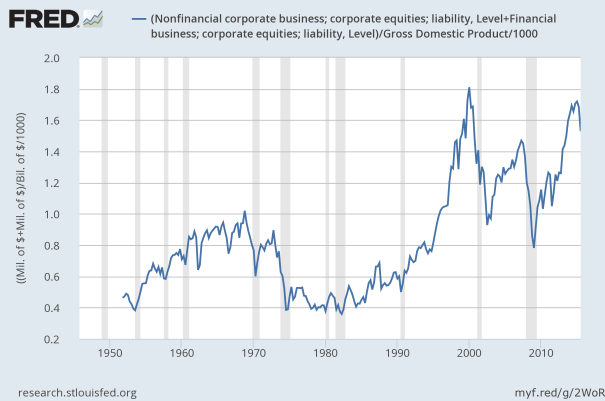
The US stock market has had faster long-run growth than US incomes (GDP).  The FRED graph below shows data for a little more than a half century, but stock values have historically grown considerably faster then incomes since the beginning of the US stock market in the late 1700s.

Stock market - GDP ratio

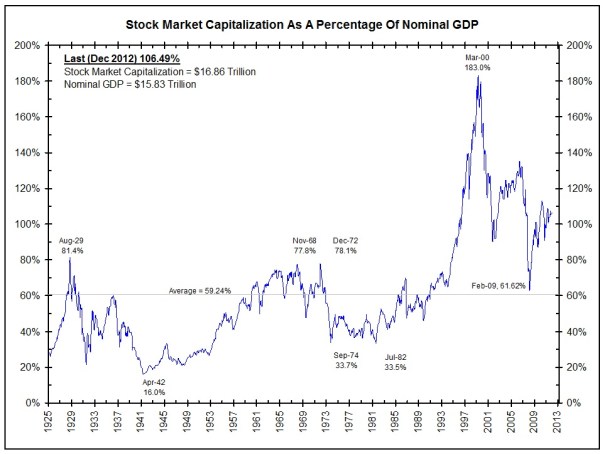
Stock values went from about 40% of total national income in the mid 1970s to an average of about 130% over the past two decades. Going even further back, the stock market was an even smaller fraction of total income.  It was only 16% in 1942. The famously irrational stock-market bubble highs of 1929 only briefly brought it up above 60%.  That would be a disastrously low stock market value by today’s standards–lower than the famous crash of 2008.

stocks per gdp

The fundamental value of a share of stock is the net present value (NPV) of all future income that the stock will earn.  That means that stocks should rise in value when the interest rate (a.k.a, the discount rate) falls.  Interest rate variations should account for much of the short-run variation in stock values, but it cannot account for the long-run increase in value over centuries. The US stock market can also grow faster than US income as long as corporate America takes over more and more of the American economy.  When expected profits rise, the stock values rise.  Nick Hanauer points out that this has been happening:

After-tax corporate profits have doubled from about 5 percent of GDP in 1970 to about 10 percent, even as wages as a share of GDP have fallen by roughly 8 percent.

If corporations were able to take over the entire US economy, then the stock market would only be able to rise at about the same rate as GDP long run because all capital income would then be captured by corporations.

Once corporations run the entire US economy and all capital income is earned by corporations, at that point the only way for the stock market to rise faster than GDP would be for corporations to boost their profits at the expense of wages.  If corporations could continue growing by reducing wages, that would lead to the second scenario where corporations eventually enslave labor and cease to pay wages whereupon all income is corporate income.

(Of course, the return on owning stocks both comes from capital gains which this essay focuses on and dividends, so if the growth in capital eventually matches GDP growth as Warren Buffet expects, then overall return would be about 1.5% more than because of dividend earnings.)

At least until the early 1970s, the corporatization of America was a good thing overall because corporations have brought greater efficiencies by destroying millions of small businesses and taking over their markets.  For example, there used to be hundreds of small family-run American car manufacturers in the late 1800s that ultimately were taken over by three big US automobile corporations that still exist today.  Retail used to be the exclusive domain of small ma & pop stores, but has been consolidating into ever larger retail corporations like Walmart and Home Depot.  This process was beneficial for most Americans until the early 1970s, because growing US corporations shared their increased efficiency with their workers whose real wages rose dramatically.

In particular, 1941-1968 was a time when there was a rising ratio of stocks/GDP without increasing inequality, so a rapidly rising stock market can be good for ordinary Americans. However, since the 1970s, real wages have stagnated and the labor share of total income has declined.  For some reason, the profits of increased corporatization in the 1980s and 90s failed to trickle down.  Corporations continued to boost American output, but the increased productivity disproportionately benefited a wealthier minority of Americans.

I predict that information technology will continue to create economies of scale that will continue the corporate takeover of the American economy.  This could be a good thing if the increased income is shared with the people doing the work and ordinary Americans get higher wages rather than the money just going to shareholders, because most stocks are owned by elites and when the stock market rises faster than incomes, it increases inequality without benefiting the median American.  But recent history doesn’t give much reason for optimism.

Posted in Macro, Medianism

Bankster politics in a Christmas classic

Julia Szabo organized a poll of favorite Christmas movies at a Bluffton faculty/staff celebration and my favorite, Elf, won the poll (yea!).  She also passed along some trivia about some of the top movies including this:

“It’s a Wonderful Life” – this movie was mentioned in an FBI file in 1947 when an analyst passed along the concern that the film was an obvious attempt to discredit bankers…a “common trick used by Communists.”

The big banksters are an emotionally fragile lot who have shown remarkable sensitivity to even slight criticism.  I’ll be curious to see how they react to The Big Short movie.  They might like it because the heroes are some scrappy finance guys, but it also reportedly portrays most of mainstream Wall Street as bunch of immoral buffoons.   That is similar to It’s a Wonderful Life which also pits a scrappy banker against the corrupt big money, so the big money guys probably won’t like it.

At the same time, the Wall Street banksters don’t always know when they are being criticized because their morals are so different from mainstreet American values.  For example, they didn’t get that they were the sordid but of the joke in Martin Scorsese’s black comedy,  “Wolf Of Wall Street.”  They cheered at the depictions of moral failures that repulsed ordinary Americans.

So whether or not they like “The Big Short” will probably depend on whether they identify with the scrappy outsiders who predicted the financial crisis and won big on free-market bets or the big investment bankers that lost during the period featured in the movie.  In hindsight, the investment bankers had a Cinderella story later when they returned to big profits with help from government bail outs, so they shouldn’t have much financial regret, but the movie doesn’t depict their financial recovery, and the government is their hero in that story anyhow, so I’m guessing that Wall Street will hate the movie because they probably want to forget about the history of the financial crisis.

Note: I’m not talking about retail bankers here.  Most of the small banks had nothing to do with the financial crisis nor any of the kind of shenanigans in “The Big Short” or “The Wolf of Wall Street.”  The Wall Street investment banks were in a completely different business from the retail “main street” banks. Ninety-nine percent of Americans never do any business with the big investment banks that I am talking about here.  It is too bad that both kinds of institutions are called ‘banks’ because they are very different and the main street bankers quite rightly take umbrage when they feel criticized for the shenanigans of Wall Street.

Posted in Macro

Enter your email address to follow this blog and receive notifications of new posts by email.

Join 75 other subscribers
Blog Archive
Pages