Secular Hoarding

Secular stagnation usually refers to some sort of structural problem with aggregate demand that will maintain high unemployment along with low inflation and interest rates as you can see in this free ebook about secular stagnation written by famous economists.  As Yglesias at VOX points out:

The most prominent alternative to secular stagnation is probably the technological slowdown hypothesis. This view, best represented in academia by Northwestern University economist Robert Gordon, in the business world by investor Peter Thiel, and in the popular press by Tyler Cowen, posits that slow growth is a structural phenomenon due primarily to a slowdown in the rate of technological progress. Cowen’s book the Great Stagnation is a good treatment of these ideas…

These ideas distinguish themselves from secular stagnation in that they are primarily ideas about the supply side of the economy. In other words, they say the economy is growing slowly because we are running out of new inventions or natural resources. The secular stagnation hypothesis, by contrast, is the view that the economy can no longer be trusted to maintain an adequate level of demand. One way to dramatize the difference is to specifically focus on unemployment. The technological slowdown hypothesis is primarily the belief that we won’t get much richer over the next few years, even if people do manage to get jobs. The secular stagnation hypothesis is the opposite view — the view that we may get a bunch of shiny new gadgets, but unemployment will stay high.

So far it is hard to know if there has been a big sudden slowdown in productivity because productivity is badly measured, but there has clearly been a big spike in unemployment and a drop in interest rates and inflation despite dramatic expansions of the monetary base.  There is simply much more evidence of a secular drop in aggregate demand than a drop in aggregate supply.  It is hard to explain high unemployment, rising inequality, low inflation, and dropping gasoline & energy prices in a world with constrained supply.  Tyler Cowen argues that secular stagnation requires high storage costs of capital, and that may be a feature of the new Egertsson and Mehrotra model of secular stagnation, but all you need for a shortfall of demand is an equilibrium where there is excessive hoarding of financial capital.

There is far too little effort to measure hoarding, but Paul Krugman recently showed a graph of hoarding in the corporate sector:

investment vs profitsProfits are very high, so why are companies concluding that they should return cash to stockholders rather than use it to expand their businesses?  After all, we normally think of high profits as a signal: a profitable business is one people should be trying to get into. But right now we see a combination of high profits and sluggish investment.

The profits are being paid to wealthy shareholders who don’t know what else to do with the money and it is being hoarded.  If our corporations invested the money in capital and research (and increased the red line on the graph), that would help raise median salaries and productivity.  Again, this graph does not look like a world with a supply (productivity) constraint.  If there was a supply problem, profits would not be so high or there would be more incentive to invest.  Plus, there would be less hoarding as wealthy people spend down their hoardings by buying whatever became limited in supply.  Although a lot of people like Cowen suddenly perceived supply shortages during the financial crisis of 2007, it is hard to find any concrete examples.  And why would a supply shortfall hurt the median American more than the elites?
Posted in Macro

Secular Stagnation of The Median

Secular stagnation is a concept that Alvin Hansen developed after nearly a decade of Great Depression in the US because he feared that the stagnation could continue forever.  Then WWII brought the biggest government spending stimulus in history and the depression abruptly ended.  No industrialized nation faced that kind of prolonged stagnation until Japan in 1990, but outside of Japan, most economists continued to ignore the economics of secular stagnation until the Great Recession of 2007 which has been worse in most of Europe (as officially measured by GDP, so take that with a grain of salt) than the Great Depression.  The term, ‘secular stagnation’ has nothing to do with the religious definition of secular, but with a somewhat archaic definition of secular as used in statistics which means “going on from age to age; continuing through long ages.

Secular stagnation is the idea is that stagnation could continue from age to age under certain conditions.  Yglesias at VOX argues that secular stagnation theories are already going out of style because:

as the secular stagnation conversation has intensified its empirical motivation appears to have waned. In the 10 months since Summers’ initial secular stagnation talk, the unemployment rate has fallen from 7 percent to 5.9 percent. The number of job openings has steadily risen as well. In other words, while nobody is exactly thrilled with the state of the American labor market, the situation does seem to be improving. It may be, in other words, that we have suffered through a prolonged and painful period of excessively low demand that is slowly but surely ending, rather than an endless depression.

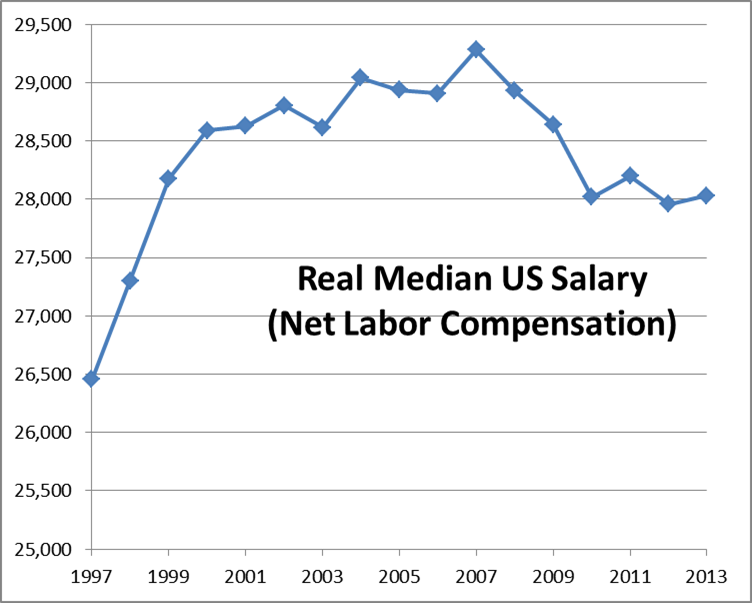
This is somewhat true for the US, but the US economy is still far more stagnant than most people would have predicted back before the financial crisis in 2007, and the rest of the industrialized countries (Europe and Japan), still look like textbook secular stagnation.  More importantly, the textbook definition of stagnation is wrong because it looks at mean GDP rather than the median.  The majority of Americans are still mired in stagnation because the real median income plummeted during the recession and then flat-lined.  For example, the Social Security Administration just released its estimate of median individual wages for 2013 which shows it is still down 0.6% from 2011 (adjusted for inflation) and 4% below its peak in 2007.  If you earn more than $28 thousand dollars per year ($14/hr full time), you are doing better than the majority of American workers.

Median US SalaryThat is what I call secular stagnation.  Most Americans’ incomes are still stagnant despite the drop in unemployment.  And because the labor force has been shrinking (thus reducing unemployment statistics), median household income is doing even worse.  The real problem of secular stagnation in the US is that monetary policy is increasing inequality and thereby keeping the real incomes of most Americans stagnant.  Here is a VoxEU paper about it and there is no end in sight.  The secular stagnation problem should have been evident starting back in 2000 if people paid any attention to median income.  The secular stagnation problem didn’t just start in 2007.  It only intensified then.

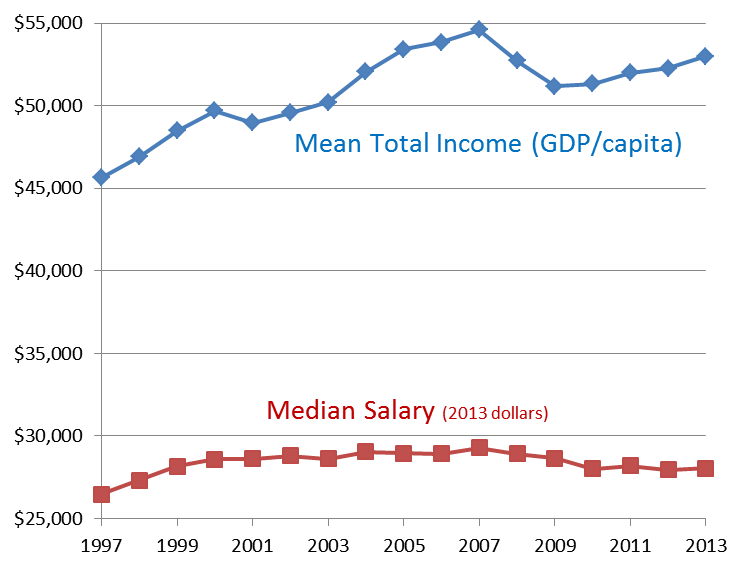
The mean salary has risen more than the median salary, but the big rise in inequality is due to rising wealth of the top 1% richest Americans that does not show up in statistics about wage income.  As Paul Krugman recently pointed out, most Americans get very little income from investments.  You can get some idea of the disparity by comparing GDP per capita with median salary info:

Mean vs Median Income

The stagnation is concentrated among the wages of the bottom half of working people.  The stagnation of median income has been secular and secular and secular.

Posted in Macro, Medianism

Progressive Taxes Could INCREASE Inequality

UPDATED 2015/01/28

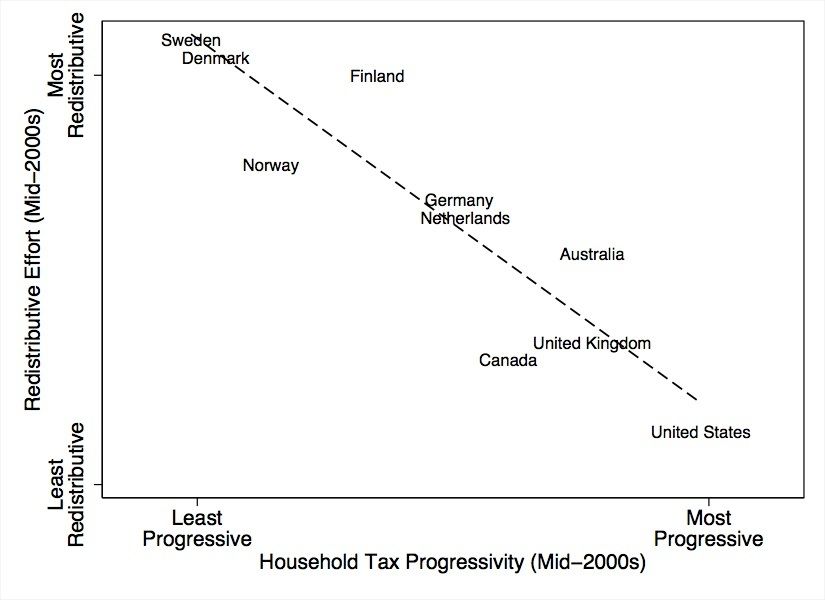
Cathie Jo Martin and Alexander Hertel-Fernandez wrote an interesting article on Vox arguing that progressive taxation increases inequality.  It is a counter-intuitive argument, but their graph gives evidence for it:

OECD_Tax-RedistributionTheir theory is that progressive taxation leads to political and governance problems.  On the political side, elites resent progressive taxation and strive to subvert governance instead of unifying around increasing the efficiency of government.  Elites are natural leaders because of their tremendous economic and political resources and when a large fraction of the power of a nation feels that they are unfairly taxed, they can do a lot of damage.  In countries with less progressive taxes like Sweden and Denmark, you would never hear national political leaders like Mitt Romney complaining to wealthy donors that 47% of citizens “pay no income tax” and don’t take “personal responsibility…for their lives.”

The poorer half of Swedish society has greater capability to take personal responsibility for their lives because Sweden’s business class wants to invest more in the human capital of their labor force than America’s business class.  Because of greater support for the Swedish government to provide quality minimum standards in education, healthcare, and childcare to increase labor productivity, Swedes have more equal opportunities to get good jobs and that gives them more incentive to contribute to society.

Another political science theory says that voters make better, more informed decisions when they have to pay more taxes because voters hold governments more accountable for efficiently spending tax dollars when they all feel the burden of taxation.  One of the political problems for governments that get all their revenues from mineral wealth like Alaska or Saudi Arabia is that the masses don’t care as much about how badly the government works if they feel like they are getting something from the government for no sacrifice.  The government benefits in these nations are like manna from heaven that tend to stave off populist political reforms and revolutionary pressures.  Government without taxation is a recipe for citizens to put up with corrupt, inefficient governments that choke long-run economic growth.  Nations that tax all workers tend to be more democratic and less corrupt.  And because citizens trust efficient governments more than corrupt governments, they are happier for the government to expand its provision of  education, healthcare, and other services that increase human capital and increase productivity.  This is another illustration of how reducing inequality often increases efficiency.

So higher taxes on the poorer 47% of Americans could end up making them (and the median) better off by increasing the efficiency of our democracy and paying for greater investment in their human capital like Scandinavia does.  And it would make people like Mitt Romney happier to feel like they live in a nation with fairer taxes.

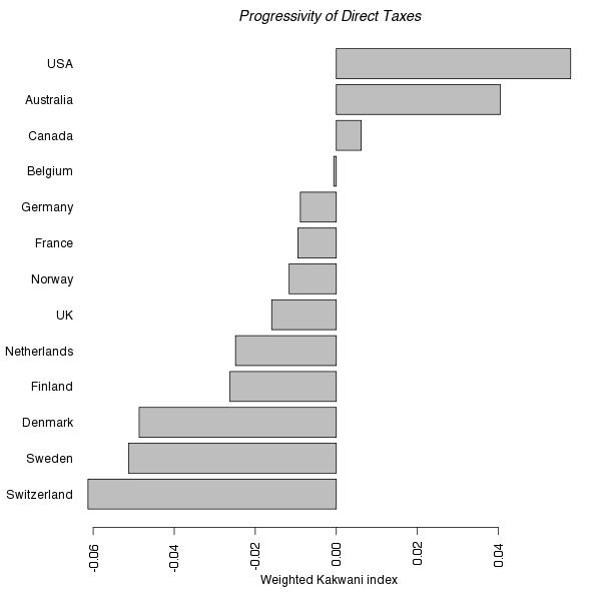
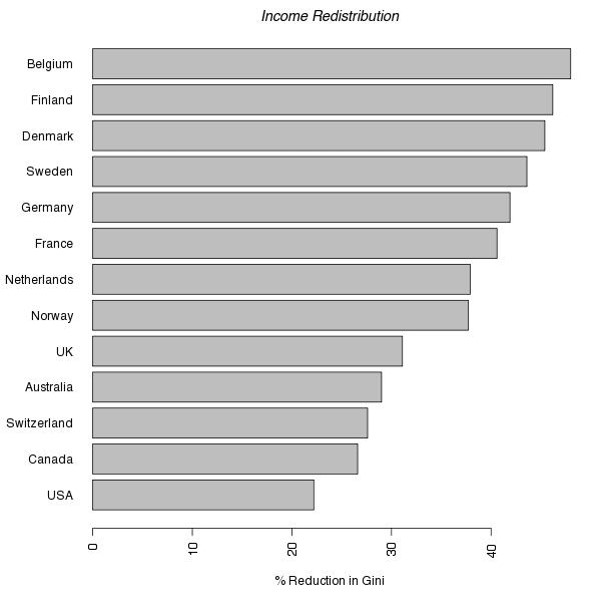
UPDATE: I did a TV interview on this topic for WLIO and I didn’t bother to get the video, but Branden Ferguson did a writeup about it that isn’t quite accurate.  I argued that greater government social spending is more correlated with equality than greater tax progressivity.  I showed one of the best works of research on progressivity of taxation from Monica Prasad and YingYing Deng, who calculated total tax burdens at different levels of the income distribution (gated):

progressive taxationPrasad and Deng also calculated the total progressivity of governement after spending is also included.  Unfortunately, they didn’t correlate the two measures into a scatterplot like in the graph at the top of this article (and I don’t have the time at the moment).  That would have been a more useful display of their data than two separate graphs.  If someone does this work, please leave me a note about it in the comments.

total progressivity

Posted in Development, Inequality, Medianism, Public Finance

The Median Is A Powerful And Neglected Statistic

The median is so neglected that Microsoft Excel’s pivot tables which are designed to display statistical summary data don’t even give the option of displaying medians.  The arithmetic mean was independently invented several times for reducing measurement error including by Isaac Newton and it has been the dominant measure of central tendency since the beginning of modern statistics in the late 1800s.  But the median is the best measure for ordinal data such as measures of economic wellbeing and the median is often better for data that has unreliable outliers such as political polls.  Sam Wang is a biologist at Princeton who created a very simple model for aggregating political polls as a hobby in his spare time which has been more accurate than almost all of the professional pollsters who stake their careers on predicting election outcomes.  His relatively simple technique uses the median of polls for aggregating them rather than the mean of poll results.

[Wang’s] Analysis relies entirely on the well-established principle that the median of multiple state polls is an excellent predictor of actual voter behavior. [One reason is because] median-based statistics correct for outliers.

Using the median poll result is a simple protocol for reducing the bias that individual polls have rather than engaging in motivated reasoning to weigh the relative biases of different polls.  Sam Wang has many rivals in predicting election outcomes like HuffPollsterThe Upshot, and FiveThirtyEight (Nate Silver).  They use much more complex models based on mean poll results, but so far Wang’s model has worked just as well or better with much less complexity.  I do have some qualms about some of Wang’s assumptions and conclusions, but his use of median poll results has proven itself in the last few elections.  I’ll look forward to seeing how it does in the next election.  Currently, he is predicting that the Republican party will take over the Senate.

Posted in Medianism

Our Monetary Overlords Want Low, Low Wages

Josh Bivens has the scoop:

Dallas Federal Reserve Bank President Richard Fisher has a secret paper telling us how to fight inflation: stop progress in reducing unemployment so that nominal wages never grow fast enough to actually boost living standards (or, never grow fast enough to boost real wages).

Last week, Fisher argued that a so-far unpublished (i.e. secret) paper by his staff showed that “declines in the unemployment rate below 6.1 percent exert significantly higher wage pressures than if the rate is above 6.1 percent.”

In other words, Dallas Fed President Fisher is worried that wages will rise if the Fed allows unemployment to fall further.  This shows the elitist priorities of some of the central planners who steer the US economy.  The goal of monetary policy should be to increase real wages, not to decrease them.  The Fed clearly wants the total national income (GDP) to rise, and if the Fed does not want wages to rise, then the only possible way to increase GDP is for the incomes of capital owners to rise.

That would be an increase in inequality that would hurt most Americans because only a tiny percent of Americans at the wealthiest end of the income distribution gets more income from owning stuff (capital) than from working (wages).  Monetary policy and monetary ideology matters for the lives of ordinary Americans, but almost nobody cares about it outside of a few elites.  That is a huge problem for ordinary Americans.  If you care about unemployment and stagnant real wages, you should pay attention to Fed policy.

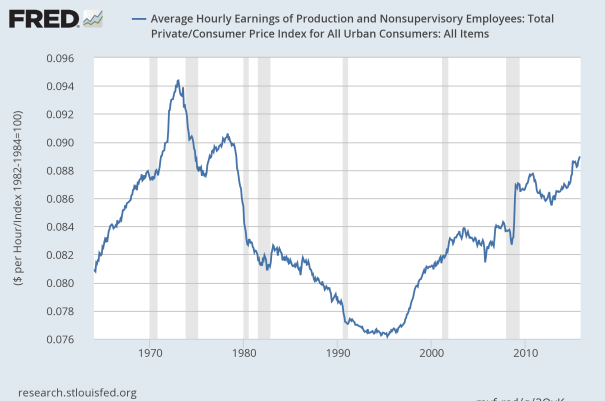
One of the great legacies of Alan Greenspan’s tenure at the Fed was that he kept doing expansionary monetary policy in the 1990s even when unemployment was already low because he didn’t believe that inflation was a problem.  As a result, the 1990s saw the real wages of ordinary Americans begin a sustained rise and began to reverse the decline that started in the 1970s.

real wagesFRED

Anti-inflation mania is bad for real wages because wages don’t rise much unless unemployment is low and there is a short-run trade-off between lower inflation and lower unemployment.  One way this works is that wages don’t rise if unemployment is high and that keeps prices (inflation) low because wages are 2/3 of the economy.  If we never let unemployment get low, we reduce inflation in large part by keeping wages low.  But this will increase inequality because higher GDP (income) has to go to someone and if it doesn’t go to workers, it must go to owners which includes all of the extremely wealthy people.

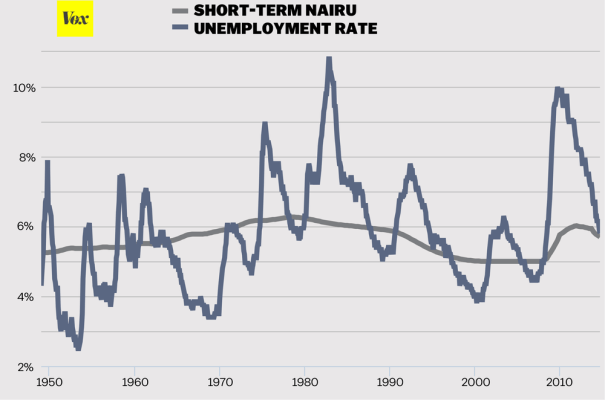
In the 1970s, the Fed changed its priorities from emphasizing low unemployment to emphasizing low inflation and ever since, wages have been relatively stagnant compared with the time from WWII until the 1970s when wages grew briskly.  You can see the change in Fed policy by looking at the government’s own estimate of NAIRU, which is the amount of unemployment that the government thinks would be ideal because it could be achieved without causing inflation.

nairu

Before the mid 1970s, the Fed mostly kept the actual unemployment rate below the rate that the government thought was ideal and risked a bit more inflation which finally happened in the 1970s.  Since then, the Fed has let unemployment get much higher than NAIRU, and has rarely let unemployment drop below it.  That latter time period corresponds with declining or stagnant real wages relative to the earlier period when they grew robustly.

I’m not sure why the Fed changed course, but two things happened in the 1970s that may have contributed to their wage crushing policies.  First was the monetarist intellectual revolution which emphasized low inflation more than low unemployment.  The monetarists succeeded in shifting macroeconomic thought towards that priority.

Secondly, another intellectual revolution caused all the major economies to let their foreign exchange rates float in 1973 and let international markets determine currency values from then on.  It seems normal now, but it was the first time this had happened.  Gold had still been used for fixing foreign exchange values, so this was the end of the final vestiges of the gold standard.  Letting exchange rates float created much more monetary flexibility than before when monetary policy was constrained by the desire to keep exchange rates stable and the Fed has used that additional flexibility to to keep wages and inflation low.

Posted in Inequality, Labor, Macro

Were “The Good Old Days” in the 1990s Really Better Than Today?

For most Americans, according to official economic statistics, the 1990s were the best of times. Anne Lowry explains:

This week, the Census Bureau came out with its big annual report on income and poverty in the United States, and it reconfirmed that as a country, we peaked in the late 1990s.

To be more specific, median household income peaked. Back in 1999, the average household made $56,895 in today’s dollars. That number took a hit when the dot-com bubble burst and never reached the same high note again. It plummeted once more during the Great Recession and has slinked lower through the recovery. That middle-of-the-road household is now making $51,939. In other words, for the past 15 years, a growing economy has failed to translate into rising incomes.

It is a big problem. And it goes a long, long way to explaining the squeeze lower and middle-income families feel. If the economy had kept on performing the way it did in the late 1990s, that median household would be making $20,000 more than it currently is.

Where did that $20,000 go?  Most is GDP that has gone to wealthy households instead of to middle America.  Some income was permanently was lost in the great recession of 2008 partly because of inadequate policy responses.   And finally, productivity growth has slowed as inequality has risen.  In theory, we could be growing slower because we have too much inequality.  Excessive inequality means that most Americans have too few resources to invest in themselves (less education) and most people have less incentive to contribute to society when the gains tend to go to someone else anyhow.

One flaw in Lowry’s article is that she is overly pessimistic about monetary policy.  She cites Lawrence Summers saying that expansionary monetary policy will just inflate more bubbles, but there is little evidence for that assertion.  There have been bubbles under every kind of monetary policy regime and low interest rates don’t contribute much to the risks at all.  For example, there have been dramatically fewer bubbles in Japan since 1995 during the last two decades of low-low interest rates than there were in the two decades before 1995 when Japanese interest rates averaged over 20 times higher.  The biggest and most problematic Japanese bubbles inflated when Japanese interest rates were high, not during their historic low rates.  It is possible that more expansionary monetary policy might not work to raise median incomes, but nobody has tried to achieve this objective and there is very little risk from trying.  Higher inflation is the worse case scenario and the Fed is absolutely confident in its ability to reduce inflation, so that is a very manageable risk.  A bit higher inflation would help the median American anyhow.

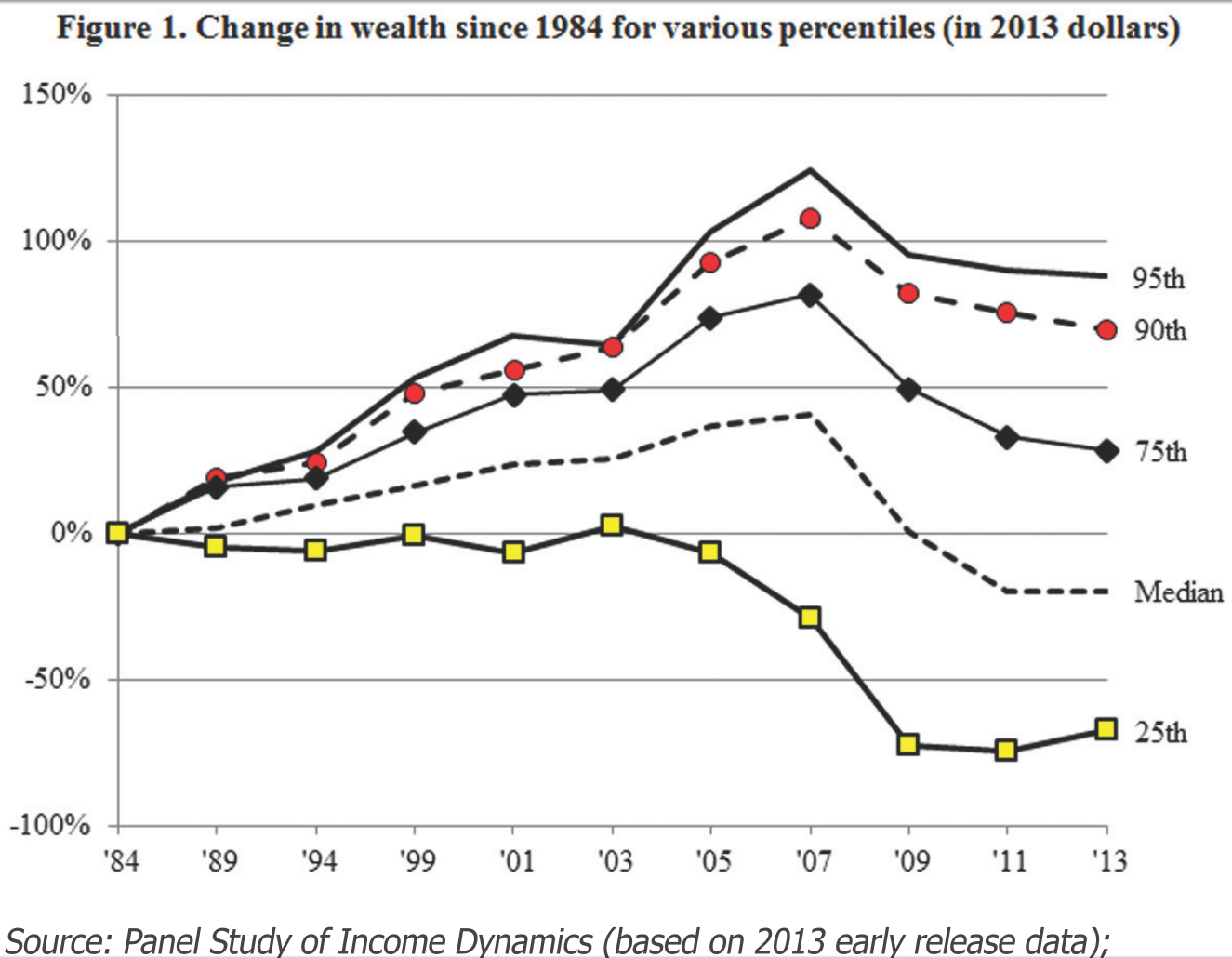
The above article only looks a statistics about median annual income.  Median wealth statistics tell an even more depressing story.  A new Russel Sage Foundation study revealed that the median household is 20% poorer in 2013 than it was in 1984 in real purchasing power.

median wealth


Posted in Inequality, Macro, Medianism

Economic “Recoveries” Are Not benefitting the Median American

Pavlina Tcherneva tweeted a graph last month showing how the macroeconomic policy has increasingly left behind 90% of Americans.  @ptcherneva:

inequality recoveryI’d like to see the data that generated this graph because it has gotten a lot of attention and I’d like to understand it better.  It looks pretty ominous. Obviously, it doesn’t show who suffers more during recessions, so it is incomplete, but if it is true, it does show how the monetary policy response to recessions is increasingly failing most Americans.  We should try new methods to do better monetary policy.

Tagged with:
Posted in Inequality, Macro, Medianism

Enter your email address to follow this blog and receive notifications of new posts by email.

Join 75 other subscribers
Blog Archive
Pages