
Stop Pretending Anybody Wants Exactly Equal Wealth

Millions of people have seen a great 6-minute video that explains research about inequality by Michael Norton of Harvard Business School and Dan Ariely of Duke [pdf].   Unfortunately, the video propagates a common misleading trope by claiming that a perfectly equal distribution of wealth is the “dreaded socialism”.  In reality, no socialist nation ever tried to create a perfectly equal distribution of income nor wealth.

Socialism has always produced unequal income for two reasons.  First, perfectly equal income would not be fair to people who do unpleasant, difficult work like cleaning sewers.  People who do unpleasant work must be compensated with more income than people who do more pleasant work like playing music.  Unequal pay creates more equitable well-being that way.  Secondly, the video claims that a society that is as equal as socialism “won’t work”, and it is probably true that perfect income equality won’t work, but there are numerous socialist countries and they generally worked better than colonialism for their residents.  Some socialist countries have been socialist for decades without any sign of collapse.

It is hard to pin down exactly what different people really mean when they say ‘socialism,’ but Sweden is often cited as a real-world example.  Sweden’s economy is flawed, but it works much better than most countries in the world.  It turns out that the actual distribution of wealth in Sweden is less equal than what Americans said is ideal. Communist countries were even more egalitarian than Sweden, but the Soviet Union’s central planners still had considerable wage inequality.  Some people probably earned over ten times more than others.  Without paying some people a lot more than others, the USSR would not have been a superpower that rivaled the combined might of the allied capitalist nations of the world for seventy years.

True: a perfectly equal distribution of money would NOT work.  That is why nobody who has thought about it for more than a few minutes thinks it is a good idea.  For example, Rawlsians are some of the most egalitarian people that have ever existed.  Their “difference principle” roughly seeks to maximize the wellbeing of the poorest person. In other words, they don’t even care about anyone except whoever is the worst off at any given moment. You might think that this would produce perfect equality, but even Rawlsians recognize that inequality is necessary to maximize the production of the goods and services to benefit the poorest person.

For example, the poorest person, like everyone, needs doctors.  Doctors need to be compensated for the sacrifices they made to go to medical school or else we won’t get enough doctors.  If fast-food workers and doctors were paid the same wage, the doctors would have lower lifetime earnings because they had to give up a lot of time and money to go to medical school.  Doctors would actually be poorer than fast-food workers.

Similarly, the poorest person, like everyone, needs sewage systems.  People who risk their health cleaning out and repairing sewage mains also need a higher hourly wage than fast-food workers to compensate them for the difficulty and danger in the work that they do too.

Wage inequality is necessary to create more equality in true well-being (or ‘utility’ as economists like to call it) and utility is what really matters, not money.  When we pay doctors and sewage workers a higher wage than a fast-food worker, we are compensating them for the greater disutility they suffered to be able to produce the services we need. The extra money helps them raise their utility up to be more equal with the utility of the fast-food worker and it gives more incentive to do more difficult jobs.

These compensating wage differentials create unequal wages but they reduce true inequality because true inequality is measured in utility, not dollars.  Unfortunately, this reason is not the only source of inequality.  Some is due to power differentials caused by sociological factors like race, gender, or politics.  And the video doesn’t mention Thomas Piketty’s thesis that the biggest cause of rising inequality over recent decades has nothing to do with wages.  It is due to the rise in capital incomes for the richest 1%.  It is much harder to justify the increasing dominance of capital earnings and inherited wealth among the top 1% than it is to justify the small rise in wage inequality among the bottom 99%.

I have edited the conclusion of the video so that it  represents real-world socialism rather than fairy-tale socialism:

“We certainly don’t have to go all the way to socialism [perfect equality] to find something that is fair for hardworking Americans.  We don’t even have to achieve what most of us consider might be ideal [–greater equality than Scandinavian socialism].”

Here is a graph of the data that the video was based upon

The bottom 2/5 poorest Americans have essentially zero wealth and the top fifth has 84%.  Americans estimated that wealth was much more equally distributed and the average American thought that nearly equal wealth would be ideal.  There was remarkable agreement among Republicans, Democrats, men, women, the rich, and the poor:

In Sweden, the wealth distribution is actually about as unequal as in the United States despite their socialism, but the income distribution is much more equal:

income_sweden.PNG

This is still much LESS equal than most Americans thought was ideal according to the poll.


Update: Also see more comprehensive information about the equity-efficiency curve and a follow up parable about equality, plus an inequality infographic at the link.
Posted in Inequality, Public Finance

New York City is rather poor!

Note: This is updated post from my pathetically small Medianist website as an experiment (mentioned earlier) to see if I get more traffic on this hosting service or on my previous hosting service. 

Yglesias notes that New York City is rather poor!

the median household income in New York City is about $50,000, which is slightly below the national median of $55,000. People are perhaps thinking of the fact that in Manhattan, average incomes are higher than the national average. But even in Manhattan the median household income is only $65,000, and if you’re earning almost quadruple the local median income you’re obviously doing pretty well. The flipside of this is that in the Bronx the median household income is below $35,000, so if you want to work in New York and make sure you’re way wealthier than your neighbors, you can always move there (speaking of which, I recommend Adam Davidson’s piece on Bronxonomics).

The more serious concern people have is that housing costs in New York (and several other major cities) are wildly higher than the national average. This is true and represents a real blow to the living standards of New Yorkers, Bostonians, San Franciscans, and so forth.

I certainly think of New York as being rather rich and it is by mean income, but what a change in my thinking medianism produces!

Posted in Medianism

Pareto efficiency and the wingnut theorem

Many academics like the concept of Pareto optimality because it is the easiest moral criteria to agree that it is a good thing and that we should avoid any situation that isn’t Pareto optimal.  Pareto optimality is similar to the doctors’ creed, ‘first do no harm’ because a Pareto optimal situation is one in which any possible change that anyone could want would make someone else worse off.  Another way to say it is that a situation is Pareto optimal when there is no change that would make someone better off and would harm nobody.

If we are thinking about how to divide a pie up among three people and if all three people would enjoy eating all of it, then any division of the pie that doesn’t waste any pie is Pareto optimal.  If one person gets none and the other two get 1/2 pie each, that is Pareto optimal or if each person gets and equal share of the pie, that is also Pareto optimal.  The only division of the pie that is not Pareto optimal is if some of the pie is wasted such as if each person only gets 1/4 of the pie which leaves 1/4 of the pie uneaten.

There are infinite ways to divide the pie between people without wasting any, and since everyone will agree that it is dumb to waste pie, it is unlikely that you would ever see any possible division of the pie that would not be Pareto “optimal”.  But if almost every situation we see is “optimal” it seems silly to always call everything “optimal”.  “Optimal” implies that there is a best solution, but the Pareto criterion is a very weak standard for judging any outcome because nearly every possible social situation that we see in the real world is Pareto “optimal”!  People naturally select Pareto “optimal” outcomes because if there had been a potential improvement that everyone could agree upon, they would have already done it. If a group of people is only minimally rational, then every status quo is already Pareto “optimal”. 

The Wingnut Theorem

One problem with Pareto “optimality” as a moral criteria is what I call the wingnut theorem.  The wingnut theorem is the idea that as the number of people increases, the probability of finding a wingnut approaches certainty.  A wingnut is a nutty contrarian with extreme political views, and when there is a wingnut in a group, he will object to just about anything.  Even if all the rest of the group is unanimous, a wingnut will disagree by definition.  The increasing likelihood of wingnuts with bigger population means that the probability of finding a Pareto improvement (a change everyone agrees with) approaches zero as group size increases.  Wingnuts explain why Pareto efficiency is a useless criteria for evaluating situations for large groups.

This is because if we merely adopt the Pareto criterion for judging whether a situation is efficient, that means that anyone can veto any possible change.  If a situation is not Pareto optimal, then there will be unanimous agreement that a change should happen.  That makes the Pareto criterion the most universally acceptable moral rule (which academics like) but that is also why it is useless in large groups.

Because the Pareto criterion is useless for large groups, we need to use some other principle for making decisions. The three simplest ways to describe how societies make social decisions include:

  • dictatorship (One person has ultimate power and can make any change at any time.)
  • democracy (Dictatorship of the majority.  Changes only happen if more than 50% agree.)
  • consensus (Universal agreement is required to make a change, so it is hard to make changes.)

These three different kinds of decision making represent three points on a spectrum of infinite different possibilities from different everyone having equal political power (consensus) to extreme inequality of power at the top (dictatorship) and democracy right in the middle between the two extremes.  Of these three methods, democracy is the least objectionable for large groups because consensus sufferers from problems due to the wingnut theorem. Under consensus, every single person can be a dictator that has the power to block the will of the rest of the group from making changes.

Suppose a meteor is hurtling towards earth.  Everyone (except one wingnut) agrees that the meteor will destroy life on earth and that we should use our rockets to try to knock it off course and save the planet.  But under consensus, it only takes one wingnut who believes that the world is flat and meteors don’t exist to veto the will of the other 9 billion people on earth.  Consensus is bad because it gives every single person the power to be a dictator that can veto the will of the majority.  Consensus makes it very hard to make a change and increases the chance that group will decide to do nothing.

Consensus can work great in a small group where everyone cares for each other, but in larger groups it becomes more likely you will get a wingnut who is a misanthrope that hates people and wants to see everyone die.  That would make consensus terrible.  Large groups like nation-states cannot operate under consensus due to the wingnut problem, but some democratic governments require super-majorities which puts them on the spectrum closer to consensus and creates political gridlock.  Super-majority democracies are vulnerable to collapse if they cannot make decisions in the face of crisis.  The US government is the notable exception.  The US government has more veto points and super-majority requirements than any other democracy that has survived long term and the reasons for this is a matter of ongoing research in political science.

Government must be created using some arrangement creates rights and limits violence.  In fact, one universal definition for government is the institution that has a monopoly on the legitimate regulation and use of force in society.  Once a government has created rights, then there are other ways to make group decisions such as:

  • markets (Decision-making power is allocated by wealth.  This requires governments protect property rights in order to work.)
  • hierarchy
    • legal system (where officials interpret and enforce the rules.)
    • bureaucracy

Types of wingnuts

People’s characteristics often have a somewhat bell-shaped distribution (with potentially many dimensions) that have thin tails on the extremes.  Wingnuts are the people on the far tails of each distribution of characteristics.  There are different types of characteristics that cause wingnuttery.

1. Sociopathic wingnuts.  These are selfish people who do not care about the wellbeing of others or who take pleasure in the suffering of others.  This is the most dangerous type of wingnut and political systems must have mechanisms to prevent them from gaining power. 

2. Heterodox wingnuts.  The heterodox have an alternate model of reality from the vast majority which leads them to conclusions that the majority thinks is bizarre.  If there is any wisdom of the crowds, then the heterodox will usually tend to be wrong, but there is no guarantee that the crowd isn’t wrong and one of the heterodox ideas will eventually become the new conventional wisdom.  But because there is a broad distribution of ideas about reality, and they cannot all be right, so most heterodox ideas probably tend to be wrong even in cases where the conventional wisdom is also wrong.  Flat earth conspiracy theorists are heterodox wingnuts who oppose spending money on NASA because they think it is a scam. 

3. Preference wingnuts.  These are people who care about others (not sociopathic, #1) and agree with others about the nature of reality (not heterodox, #2), but just have odd preferences compared with the majority.  For example, ornithophobics fear birds and some of them would probably like to see policies that would help push more bird species into extinction.

Pareto maximal gridlock

A Pareto “optimal” situation is never a unique optimal for a large group of people, but the Pareto criterion does maximize something, and that is gridlock.  There is no other form of democracy (defined as giving every person equal decision-making power) that produces more gridlock than the Pareto criterion because it is a universal veto power.  A Pareto improvement would require a universal super-majority because any individual can veto any change.  It is impossible to create more gridlock than that.  If you really like the status quo, then the Pareto criterion is the best democratic rule for preventing decisions that might bring change. 

Posted in Medianism

WordPress vs. Blogger

Since blog traffic depends on whether an audience can find them, bloggers put a lot of work into search-engine optimization (SEO).  SEO is a set of strategies to get noticed in search-engine results.  There are numerous businesses where you can buy SEO services to get traffic.  Google has an incentive to prioritize their own blog service, Blogger, over WordPress as a hidden cross-subsidy from the corporate search engine division to the blogging division that hurts Google’s competitors like WordPress (and Google’s users).

I unintentionally did an experiment on whether Google prioritizes its own Blogger service over WordPress.  I have several blogs and I had been using Google’s Blogger service to host them.  In 2012 I started a blog called the Medianist, but I never had time to do much with it.  I only wrote two short posts total over the course of six months.  When I resurrected the Medianist project a year later, I decided to start over using WordPress and I renamed it Medianism.org.  Even though I was much more serious about posting and promoting Medianism.org, it took months before it showed up in the Google search index.  I had written fifty posts by the time Google noticed my blog in mid August.  I had produced the equivalent of a 142 page book using the standard publishing measure of 250 words/page.

Once Google finally bothered to index my blog, my comment spam traffic suddenly spiked. It still took a few more months before reader traffic increased, perhaps because my blog was buried in search results for a while, because I didn’t start getting many referrals from Google searches until December, seven months after I started the blog.

The bottom line is that my Medianist blog on Google’s Blogger got a lot more page views per month, particularly in the beginning, than my Medianism blog got on WordPress despite having less than 2% of the content of the new blog:

Medianist.blogspot.com

(on Google Host)

Medianism.org

(on WordPress Host)

first 3.5 months of blog

1 Page

142 pages

1 Post

50 posts

45 views/month

40 views/month

first 9 months of blog

2 Pages

234 pages

2 Posts

81 posts

30 views/month

71 views/month

This experience indicates to me that Google did not play fair.  Google gave its own Blogger service (a.k.a. Blogspot) an advantage in its page-rank algorithm.  Having experience with both Blogger and WordPress, I agree with the general consensus that WordPress offers a superior product in most respects, but my one* caveat from my experience is that it was MUCH easier to generate traffic in the beginning using Blogger.

As a continuation of my experiment, I will re-post the two old posts from my Blogger site here on Medianism.org and see if they continue to generate more traffic on Blogger than here using WordPress hosting.

*Actually I have two caveats, but the other is well known.  Spider-man’s uncle said that “With great power comes great responsibility”.  Greater power also usually brings greater complexity.  WordPress is a bit more complex and beginners might get distracted by all the options.  Even for an experienced blogger like myself, it took a lot more hours to work my way through the more powerful feature set of WordPress.

Tagged with: ,
Posted in Blogging

Revealed Preference: The Fed Favors Money Hoarders Over The Unemployed

Ryan Avent at The Economist produced some original research about what the Fed thinks:

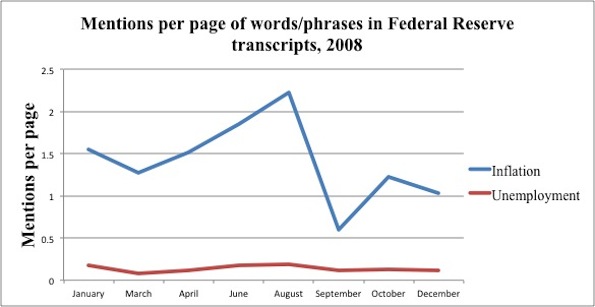
HAVING combed through the Fed transcripts the old-fashioned way, we decided to apply some fancier techniques. We plugged all 1,865 pages of central-bankery into a computer programme and came up with a few extremely informative nuggets. First, there is only one winner in the dual mandate. The word “inflation” (or variants thereof, such as “inflationary”) was mentioned a cool 2,664 times in 2008; “unemployment” pops up just 275 times.

It turns out that the Fed cared about inflation ten times more than it cared about unemployment.  And that was at a time when unemployment was at one of its worst levels in the past century and inflation was lower than it had been since the end of the Great Depression.   Imagine how little the Fed must care about unemployment in more normal times (like now) when it is merely 7.3%.  Nevermind that it is still higher now than when Clinton made his unofficial campaign slogan, “It’s the economy, stupid.”

Unemployment << Inflation

When the Fed prioritizes inflation over unemployment it is prioritizing the interests of money hoarders, who fear inflation above all, over the interests of unemployed people who want to work but can’t find jobs because there isn’t enough money circulating in the economy to hire them.

Ryan Avent’s article helps dispel the myth that the Fed has a dual mandate to fight unemployment and inflation.  As I wrote before, the Fed does not really have a dual mandate.  It has a triple hierarchy of desires:

  1. First, the Fed loves the banksters.  Its priority is to “maintain the stability [and profitability] of the financial system.”
  2. IF the financial system is securely profitable, then the Fed works to maintain low inflation because that is another way of serving the interests of the financial system.
  3. IF all is well with the above missions, then the Fed might do something about unemployment IF it is costless to the financial system.  But in practice, the Fed does nothing about unemployment that are not a simple byproduct of supporting the financial system.  Lower unemployment can be a way to support banking profits sometimes.
Tagged with:
Posted in Macro, Medianism

It Is OK That Raising The Minimum Wage Hurts Someone

Economists like to talk a lot about Pareto improvements.  This is the idea that you can make a change that improves life for somebody and hurts nobody. A Pareto improvement is obviously always an good idea.  Nobody could object by definition!  Economists like to create mathematical models of the world Pareto optimality is an easy ethical concept to model.  Deontological ethical systems and virtue ethics is harder to put into mathematical equations and all other ethical systems are more controversial.  Thoughtful, well-intentioned people have criticisms of all the major ethical systems, but a Pareto improvement is literally impossible to criticize.  Except that in real-world societies (as opposed to mathematical models) Pareto improvements are so ephemeral, it is hard to find any example of one.

The concept is completely useless in the real world because it is tantamount to unanimous assent and if everyone agrees to a change it will happen automatically without any need for economists to give expert opinion.  That makes them ephemeral at best.  Any real-world issue that does not immediately resolve itself must deal with tradeoffs where some people will win and others lose.  Economists have had to devise a method for dealing with with tradeoffs in order to maintain their relevance for all real-world issues.  That method is an ethical system I call mutilitarianism.  The mutilitarian rule is simple.  Maximize the sum of total monetary costs and benefits.  The problem is that if one rich person gains and everyone else loses, economists still say that this is a great improvement if the gains of one rich person is greater than the losses of everyone else.  Most people disagree (perhaps because they have not had sufficient training in economics).

Mutilitarianism is like a system where people can have as many votes as they have dollars. Whoever has the most dollars gets the most votes and that makes it an extremely elitist ethical system.  Mutilitarianism is biased towards recommending policies that increase inequality.  For example, the standard textbook explanation of minimum wages is that they reduce ‘efficiency.’  Efficiency  is the mutilitarian ideal in which aggregate net monetary income is maximized.  When economists say the word ‘efficiency’ they are almost always talking about their mutilitarian nirvana.  In theory, minimum wage laws should indeed reduce efficiency, but the effect has been so small that empirical studies on minimum wage regulations can’t even reliably show any reduction in efficiency.  Some studies show a small reduction, but others actually show a small increase in efficiency.  Whatever efficiency loss there is seems to be less than the margin of measurement error.

But minimum wage laws do redistribute income.  That is the real motivation behind the controversy that makes it so political.  So how should we decide if a minimum wage is a good idea?  It is wildly popular.  A majority of both parties support it.  In total, 71% of Americans want it.  In a democracy we would get an increased minimum wage.  But politicians don’t always do what is popular.  They favor elite interests over the will of the median American and a majority of politicians oppose raising the minimum wage.  Also, politicians are influenced by the opinion of their economic advisers who say that a minimum wage is inefficient in theory (although probably only slightly inefficient in practice).

Economics should change its standard for ethical judgements and adopt a more democratic ideology.  We should explicitly study how many people benefit from a change rather than examine how many dollars are the benefit. In a rare example of this kind of analysis, the economists at the Congressional Budget Office (CBO) studied the distribution of the benefit of the minimum wage this week. Kevin Drum noticed that their results indicate that raising the minimum wage would have a net benefit for probably well over 80% of Americans.*  It tends to hurt only the richest 20% of households.  But politicians pay more attention to the desires of the top 20% than to the bottom 80%, so they oppose it.  Economists also tend to be in the richest 20% of households, so their advice may be somewhat self-serving too.

There are certainly other ways to help the low wage earners besides the minimum wage.  Germany achieved low inequality without any minimum wage.  But real median income is lower now in the US than it was nearly two decades ago, so if a minimum wage can help 80% of American households at a modest cost to the top 20%, then it should be done because the top 20% have been getting a lot richer whereas the median household has not.

The worst case for a minimum wage is that it increases unemployment among low-income people.  David Neumark and William Wascher make this case in their book Minimum Wages. But their main thesis is that the minimum wage raises unemployment among teenagers and I would argue that that is a good thing for America. American teens work much more than teens in other rich nations (xls) and we would be better off as a society if they would put more effort into education than into making money to spend on fast food, fast cars, and other consumption goods.  Many of the college students I teach would be better off in the long run working less at their minimum wage jobs (even if that means borrowing more), and putting more emphasis on their studies.

Household income is more important than unemployment (particularly teen unemployment) and if household incomes rise despite working less time, that is a very good thing. That is exactly what the CBO study suggests for about 80% of Americans.  We would all like to get more money in less time and that seems to be the scenario that the CBO is predicting.  Higher incomes despite slightly higher unemployment for the bottom 80% of Americans.  It may not be the best way to help the bottom 80%, but I see no reason to let the best be the enemy of the good.

Posted in Inequality, Labor, Medianism

What College Degree Is Most Valuable, BS, MS, or MRS?

In high school I knew some girls who wanted to find a husband at college. We made fun of them by joking that they didn’t want a BA degree, but a MRS degree instead.  But in hindsight it isn’t the worst idea for anyone to go to college to look for marital bliss.  That is because education is highly correlated with successful marriage and a college degree is even more important for men who want to get married than for women.

Recent Census Bureau data show that college-educated parents are more likely to get married and stay married than less educated Americans.  Divorce is much lower among college graduates than among those with less education.  Almost 9 in 10 college-educated parents of kids under age 18 are married and living with their kids.  In contrast, only 64% of high-school parents who dropped out are married.  cb13-199_families

The overall marriage rate has been going down, but this is largely because low-education, low-income Americans have much lower marriage rate than in earlier decades.  As a result, over 40 percent of births in America are to unmarried women today.

Part of the problem that is causing the marriage rate to decline is the fact that American men don’t find women who earn more (and are more educated) attractive and American women are less attracted to men who earn less (and are less educated).  Thus, high status women and low status men find themselves unmarriageable.

women overwhelmingly choose men who earn more than they do. Research suggests that when women earn more than their husbands, they often feel embarrassment and resentment towards their spouse, and become significantly more likely to initiate divorce (in the contemporary U.S., divorces are overwhelmingly initiated by women).

This “assortative mating” has strongly contributed to a situation where wealth and opportunity have been “hoarded” in the top quintile of society — leading to stagnating social mobility and rising inequality.

However, the situation may ultimately prove unsustainable because even as women have become increasingly educated, are increasingly employed, and are earning more than they have in the past, the opposite trends are taking root for men. They are growing less likely to graduate college, to be employed, to live independently, etc. This has led to a situation where women are forced to compete ever more intensely with one-another for an ever-diminishing pool of acceptable men.

Faced with a shortage of men who earn as much or more than themselves, women are increasingly opting out of marriage altogether rather than “marrying down.” More women are also exploring non-heterosexual relationship arrangements — especially in communities where the shortage of acceptable men is particularly acute. Collectively, these dynamics have created a growing class of unmarriageable (and often resentful) young men, colloquially referred to as incels.

The erosion of taboos on out-of-wedlock births, adultery, and divorce also seem to be far more destabilizing… “Broken homes” are tied to all sorts of negative mentalphysicalemotional, and socio-economic outcomes; their prevalence is correlated with regional rates of crime and poverty.

Studies have also shown that married people say they are happier than single people.  This is partly due to selection bias because nobody wants to marry a grump, but it may also be partly causal.  And married men earn more money than single men.  One study attributed it to married men working harder, but employers might also discriminate somewhat against single men.

Marriage also pays off economically because 2-parent families have more economies of scale in home production because they can share more resources with more people living in one house.  Divorce directly causes a lot of poverty because of the need to pay rent for two houses instead of one and smaller households are simply less efficient because it is harder to share things like vehicles, TVs, and internet services between separate households whereas the whole point of a household is to share with other household members.

Education is correlated with all sorts of benefits that are not directly related to the subjects taught in school.  Educated people are more likely to get married, less likely to get divorced, and educated people are healthier and live longer.

Posted in Labor

Enter your email address to follow this blog and receive notifications of new posts by email.

Join 75 other subscribers
Blog Archive
Pages