
Updated February 2023.
In the 1970s, one of the most popular books about economics and business was Small Is Beautiful by E. F. Schumacher. The book makes many valid points, but the title is misleading to suggest that small businesses are best. In fact, most of the economic progress of the past two centuries has come from large organizations, not small businesses. Big organizations were necessary to produce most of our dramatic economic developments and although some of the changes have been bad, the benefits have been bigger.
That used to be obvious to Americans. Robert D. Atkinson and Michael Lind wrote that
One 1950 poll found that 60 percent of Americans had a favorable opinion of large businesses; more than 70 percent had a favorable view of GM. “We believe today, both inside and outside the business world, that the business enterprise, especially the large business enterprise, exists for the sake of the contribution which it makes to the welfare of society as a whole,” the management scholar Peter Drucker wrote in 1952. “There is, in fact, no disagreement, except on the lunatic fringes of the Right and on the Left.” Today, you need not travel to the lunatic fringes to find suspicion of Big Business. A majority of Americans now view large businesses as self-serving and self-dealing. Only 21 percent of respondents to a 2017 Gallup poll said they have a “great deal” or even “quite a lot” of confidence in Big Business.
I suspect that the median American soured on big business for two main reasons. First, US businesses adopted the Friedman doctrine in which Milton Friedman argued that the ONLY responsibility of business was to maximize profits for shareholders which helped produce higher inequality and bad corporate behavior. Secondly, globalization has made big corporations into rootless multinationals that do not care about any locality because when the going gets rough, they can just move business elsewhere rather than having an incentive to use their considerable power to make local improvements. Corporate directors used to feel more connected to their ‘home’ communities, but corporations are now increasingly managed by global elites who are only connected to the other multinational elites in the same cosmopolitan social class rather than being connected to any particular city or nation.
Would it be better for America if average firm size shrank and there were more firms of a smaller size? Politicians love to lionize small businesses, but countries with more small businesses (and therefore more entrepreneurs) are poorer than countries that are dominated by big businesses. For example, in the OECD (the club of rich nations), bigger business is more beautiful because OECD nations that are more dominated by big businesses tend to be richer. The US is fortunate to be one of the richest OECD nations perhaps because the US economy is by far the most dominated by large businesses. All nations that are dominated by small businesses are desperately poor.
And the trend towards big business is continuing. Eric Nilsson documented how large US corporations have been growing at the expense of small entrepreneurs.
A relatively few giant firms dominate the US economy. These firms are surrounded by a large number of smaller firms. This had led some to argue that the US economy has two quite different sectors: the core and the periphery. The core includes the large giant firms. These core firms are typically able to avoid extreme competitive environments and, as a result, earn higher profit rates than average. The periphery includes the other firms: small and medium sized firms which face high levels of competition and which typically earn fairly modest profits. …For instance, the US beer industry has about 500 firms. But a few firms in the industry are giants, and dominate the industry… The largest four firms in the industry sell about 90% of all beer in the US. The other 10 is sold by the 490 smaller beer firms.
Vaclav Smil wrote that there were over 6,000 beer breweries in the USA in 1900 and by 1980 there were only 142 despite the fact that the US population was three times larger and per-capita beer consumption had risen. In the 1990s, the microbrewery fad caused a dramatic increase in breweries again, but they mostly sell a bar experience because their beer is much more expensive than what the big companies produce so they haven’t captured much market volume. Most beer will always be produced by a few giant companies.
Nilsson goes on:
[G]iant firms are the most important economic actors in the U.S. economy. These relatively few firms gain control of 75% of the profit (that is, surplus) generated within the US economy and the decisions they make about how to use this surplus has major consequences for the evolution of the U.S. economy. And …major power in the political and cultural arenas. Politicians must pay attention to the concerns of these giant firms because the economic health of the US economy depends largely on the decisions made by these few (but giant) firms. Further, part of the surplus going to these firms is used to shape the cultural landscape of the US economy. The decisions made by these giant firms about what advertising campaigns to carry out, what media to support (magazines, websites, TV shows, newspapers, and so on), and what cultural institutions (museums, symphonies, and so on) has a major impact on the evolution of culture within the United States.
Nilsson shows that the largest 0.2% of manufacturing firms in the United States made 61% of sales and 74% of manufacturing profits. Big firms also dominate global trade. According to the Richmond Fed, large firms are less than one percent of all American businesses and account for only about 85 percent of exports and 90 percent of imports. Most of those large firms have multinational operations and the BIS reports that about half of America’s foreign trade is done within multinationals. In other words, half of American imports are things like Ford Motor in the US importing from their Ford Motor China division rather than between independent companies. Half of international trade is within giant firms rather than between firms because that minimizes legal costs and exchange rate risks.
Vaclav Smil wrote that in 1900 there were over 600 car manufacturers in France and today only Renault is still headquartered in France. There used to be about 2,000 car manufacturers in the USA and there were 50 just in Iowa alone. Iowa had the most cars per capita in the nation in 1916 (and probably in the world) and in those days it was possible for a tiny, rural state to have 50 car manufacturers because no car companies had achieved economies of scale yet. But most car companies went out of business by the Great Depression and were consumed by bigger car companies. Since Chrysler was founded in 1925, only one new car entrepreneur has succeeded at having four consecutive profitable quarters producing mass-market cars in the United States: Elon Musk’s Tesla. And Tesla only succeeded by avoiding direct competition with the big car companies who were neglecting electric vehicles. Disruptive innovation like Tesla’s electric cars is the only way an entrepreneur can ever hope to directly compete with giant, mature companies. Avoiding direct competition was the only way Tesla could scale up and avoid getting crushed by the big car companies. Today there are 22 American car manufacturers, but only 3 that produce mass-market cars and the rest mostly just produce a few boutique race cars. The Big 3 today are Ford, GM, and Tesla. (Chrysler no longer counts as an American company because it was bought by a German company over two decades ago and has bounced around under different foreign owners since then. Chrysler is currently run by Stellantis N.V., a Dutch conglomerate.)
Entrepreneurship is rare because most small businesses fail and as a result, 64% of Americans work for the biggest 2% of America’s firms. Most of the rest of us work for businesses that have over 20 employees. In 1820, only about 20% of the United States labor force depended on a wage income. By 1950, that percentage increased to 90% with only 10% in the entrepreneur category. Today one government dataset says 10% of Americans are still categorized as entrepreneurs and another dataset says 6.3%. Neither dataset is clear about how many of these self-employed people are full-time, and how many self-identify as self-employed because they sell for a pyramid scheme part time.
The rise of the multi-level marketing (MLM) industry (popularly called ‘pyramid schemes’) is a big exception to the long-term trend of shrinking entrepreneurial work. But very few MLM workers make a profit (generally less than 10%), so even though the numbers of MLM sellers has been growing, they are mostly unpaid workers because the only way to make a livelihood in MLM is to profit from sellers below you in the hierarchy that you have to manage. In other words, most people who make a full-time living in MLM, are managers who do the kind of work that bureaucrats do in large organizations.
Farming is one of the most highly entrepreneurial industries, but entrepreneurs are a shrinking share of farm workers too because economies of scale have been steadily increasing the average farm size. By 2022, the BLS expects that America will have twice as many hired hands on farms as entrepreneurs who run their own farm. The 1% biggest landowners already control 70% of global farmland and the majority of cropland in the US is owned by investors who rent it out rather than farming themselves. Pork and other meat producers are even more dominated by a few large corporations. Farming is steadily going corporate.
Small farms, defined as those bringing in less than $350,000 a year before expenses, accounted for just a quarter of food production in 2017, down from nearly half in 1991. In the dairy industry, small farms accounted for just 10 percent of production… “Get big or get out,” Earl Butz, Nixon’s secretary of agriculture, infamously told farmers in the 1970s. It’s a sentiment that Sonny Perdue, the agriculture secretary under President Trump, echoed recently. “In America, the big get bigger and the small go out,” Perdue said…
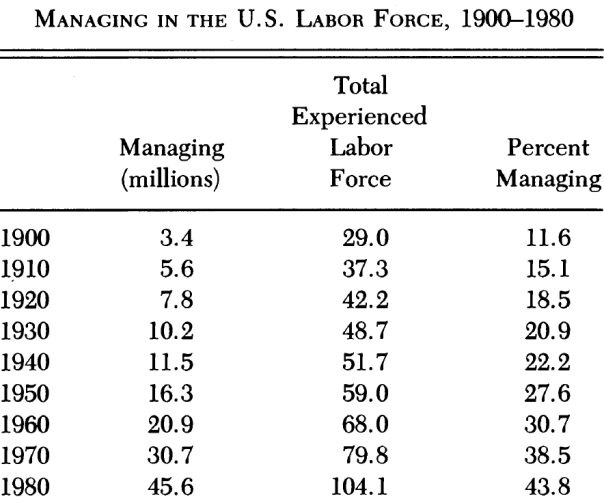
As entrepreneurs have been shrinking, bureaucrats have been replacing them. As Roy Radner showed in this table (1992) the percent of the labor force that are managers has been steadily rising:
We need trust in bureaucrats to achieve economies of scale
Matt Yglesias argues that the predominance of large businesses is a sign of trust within an economy and trust makes business more efficient. The fact that Americans have been more trusting of each other than people in most counties has certainly been a boon for the US economy and perhaps trust is also important for big business. Yglesias argues that Greece, Italy, Portugal, and Spain have so many small businesses because of corruption and poor regulation. That prevents them from achieving economies of scale and it keeps them poor:
Politicians often tout the virtues of small firms as a way of signaling support for dynamism and entrepreneurial spirit… But it turns out that some of the most troubled economies of Europe are precisely the ones that are most dominated by small businesses. And this is no coincidence. An economy where a huge share of the population works at small businesses is not one that is friendly to entrepreneurs, but rather one that has widespread corruption and poor regulation. The key to prosperity is not to coddle small firms, but to give people the tools they need to start one and the firms that exist the ability to thrive and compete.
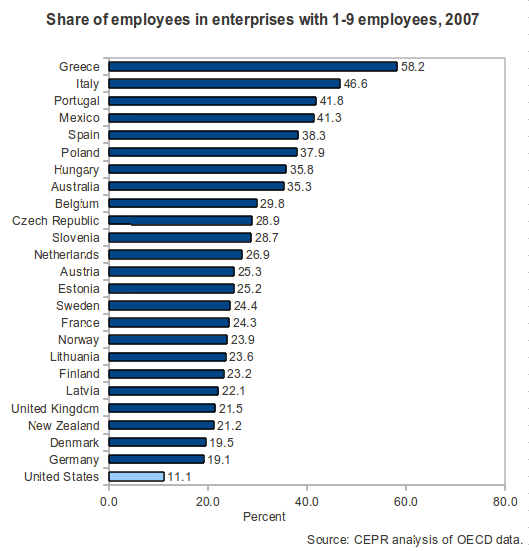
John Schmitt, an economist at the Center for Economic Policy Research in Washington, D.C., pulled together some striking data last fall from an Organization on Economic Cooperation and Development report on entrepreneurship showing that the United States has a strikingly low percentage of its workforce employed by small businesses. The countries at the other end of the spectrum, however, aren’t dynamos—they’re basket cases. If you look at share of the workforce employed by firms with fewer than 10 workers, the leaders among OECD members are Greece, Italy, Portugal, Mexico, and Spain. Only 11 percent of employed Americans work at firms with fewer than 10 employees while 58 percent of Greeks do. Expand it to look at the share of the workforce employed by firms with 50 or fewer workers, and you get Greece, Italy, Portugal, Spain, and Hungary. About one-third of employed Americans work at firms with fewer than 50 employees while 75 percent of employed Greeks do.
What went wrong? One issue is trust and corruption. One of the most difficult aspects of modern social life is that the world is a big place and cooperating with strangers is difficult. After all, they might rip you off. You could appeal to the authorities, but the authorities are likely to be strangers, too. In societies with poorly functioning institutions, high levels of corruption, and low levels of social trust, it makes sense to try to stick with smaller-scale entities. Business relationships are driven by family and personal ties rather than contracts, and a small scale is used to solve the difficulties of impersonal administration.
It’s not a coincidence that if you look at Transparency International’s Corruption Perceptions Index, the four worst-performing eurozone members are our old friends Greece, Italy, Portugal, and Spain. The converse is that large-firm employment is most common in English-speaking and Nordic countries that have the least corruption.
Keeping economic units small is a perfectly reasonable response to a less-than-ideal situation, but it’s very economically limiting. Economies of scale can make larger firms more productive and let medium-skilled workers specialize more and earn higher wages. A bigger issue is that great ideas deserve to start small, prove themselves, and then grow. Not every business owner wants to build a Fortune 500 company, but sticking forever with a staff of fewer than 10 people is very limiting.
…It ought to be the case that the worst-managed shops close and the best-managed shops branch out and prosper. That way more people would end up working for managers who know what they’re doing, rather than managers who happen to have inherited a license. Such competition-stifling rules are not unheard of in the United States. An idiosyncratic regulatory framework explains why you’ve traditionally had to buy a car from a locally owned car dealership rather than from a national retail chain or directly from a manufacturer. But the fact that most Americans work at companies with more than 250 employees while almost 70 percent of Italians work at firms with fewer than 50 highlights the scale of the difference. The strength of the Nordic and Anglophone models, from an entrepreneurial perspective, is that these are the places where it’s easiest to start a business and also the places where it’s easiest for one to grow.
Workers in poorer countries are much more entrepreneurial and less hierarchical than in richer countries. Below is a graph of OECD data which just tracks relatively wealthy countries, but even within richer countries, the more entrepreneurial nations like Greece and Mexico tend to be poorer than more hierarchical countries like the US and Germany.
Entrepreneurs vs. bureaucrats
The cult of entrepreneurship has led some textbook authors to elevate the status of entrepreneurship to being one of the four fundamental economic resources (along with land, labor, & capital). This is misleading because although entrepreneurship is important, but it isn’t nearly as important as efficient bureaucracy (management) or technology. If entrepreneurship were a more important factor of production than bureaucracy, then poor countries should be rich because they have a very high ratio of entrepreneurs to bureaucrats, but in fact, richer countries have much lower entrepreneur/bureaucrat ratios.
One of the most influential business thinker of the 20th century, Peter Drucker, said, “It is only managers–not nature or laws of economics or governments–that make resources productive.” He said managers, not entrepreneurs because he was talking about how we need good managers to achieve the economies of scale that makes society productive and wealthy. Entrepreneurs mostly do very low productivity work except for the extremely rare entrepreneurs who successfully grow their businesses to the point where they become just like any other manager of a large company.
Entrepreneurs and managers are two very different concepts. Very few entrepreneurs develop into great managers and very few of our great managers have ever been entrepreneurs. Of course in addition to managers, we also need entrepreneurs, markets, governments, and capital too, but they are not under appreciated like all appreciated. bureaucrats are. Bureaucrats are the central planners of the organizations where most Americans work and without skilled managers in big organizations, our world would be a very poor place.
Another key reason why rich nations are dominated by large companies is that we have better institutions that are more effective at allowing small businesses become more bureaucratic and grow into large businesses. Poor countries have too many entrepreneurs because they have regulations and other institutions that make it almost impossible for an entrepreneur to grow a business that is big enough to hire employees from outside of the family. Poor countries tend to have laws that hinder small businesses from growing and education systems that do not train people to become managers and banking systems that exclude growing medium-sized enterprises. Microfinance has been great for entrepreneurs, but it is a big disappointment in economic development because it hasn’t helped small businesses achieve economies of scale and become highly productive. So microfinance has alleviated extreme poverty, but it has not helped poor people raise their productivity up to middle-class levels because they cannot grow businesses beyond the micro-level. They need more medium-level finance.
One reason nations often regulate mid-sized businesses out of existence is that big businesses are run by elites who don’t want competition from upstart new companies and they favor laws that limit competition. This is particularly true in poor countries that often have a few enormous companies. Carlos Slim of Mexico became the richest man in the world by running the biggest company in Mexico, but he only became so rich by having near monopoly control over Mexican telecommunications. If the Mexican government were less corrupt it would encourage more competition like America did when the US government broke up the ATT monopoly to increase competition. Big is only beautiful if the benefits don’t merely trickle down from the billionaires in the commanding heights, but flow among all citizens. In Mexico, more equality could increase efficiency.
Another reason why large businesses are less successful in poor countries is that they lack agglomeration economies because they lack a large number of medium-sized businesses that are common in rich countries. Agglomeration economies are the benefits of the business ecosystem that provide support services and inputs for other businesses. It is easier for giant banks to locate in New York City than in Des Moines Iowa because New York has specialized accounting firms, legal services, technology support, electronic markets, and amenities like entertainment that attract skilled workers. Those support services produce a kind of economy of scale that makes New York more productive for banking than most other places on earth. Similarly, silicon valley has produced an ecosystem of medium-sized businesses that support one another and make each other more innovative and productive through the agglomeration economies that come from their complementary services and products.
Nigeria has big businesses in its capital city of 21m people, but they lack the medium-sized companies that produce quality support services and other inputs to help small businesses grow. Nigeria has too many entrepreneurs working as sole-proprietors and too little competition for the giant companies. China is successful partly because it has fewer independent entrepreneurs than most developing nations. More of China’s workforce are working together in bigger teams that can grow as they develop synergies together rather than remaining in tiny, unproductive businesses.China is richer than Nigeria partly because China is good at producing medium-sized companies and at achieving agglomeration economies because it clusters industries with competing firms located near one another. Different Chinese towns develop different industry clusters that specialize in producing things like motorcycles (in Bishan), fireworks (in Changsha), or undwerwear (in Shantou). Over a fifth of the world’s violins are produced in Beijing and 60% of the world’s buttons and 80% of all zippers are produced in Qiaotou. Agglomeration economies are another way to achieve economies of scale.
Small towns are ‘ugly’ too
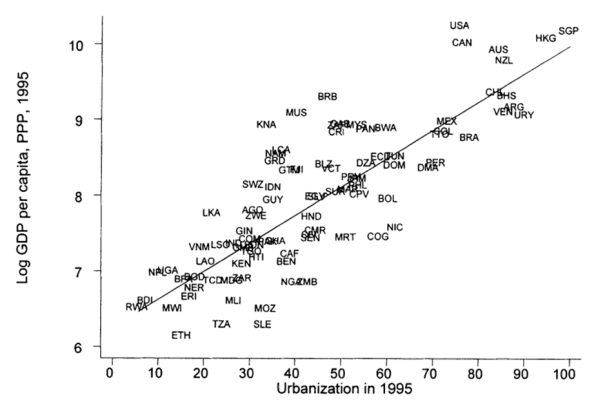
Although rural areas are quaint, their economics are ugly. Perhaps the most important kind of agglomeration economy happens when people agglomerate in cities which are more productive than rural areas. You can tell by looking at wages which are higher in cities. Big is beautiful for wages and the bigger the better because bigger cities are more efficient. Geoffrey West found that when cities double, wages, per capita innovation, and energy efficiency increase by about 15%. Similarly, countries that are more urbanized have higher incomes:
The two most important events in economic history were the agricultural revolution and the industrial revolution. The latter saw the first sustained increase in median income in all of human history. And it was dependent upon urbanization. Without cities, we couldn’t have much industrialization and vice versa. If you plot median income AND urbanization rates over all of the millennia of history the two graphs look almost identical although urbanization started growing earlier:

Big companies are better than small
Big companies have better statistics for almost everything. They:
- Do almost all of the research that increases productivity and living standards. The 700 largest multinationals firms account for close to 70% of the world’s business R&D spending (UN World Investment Report, 2005). Large firms also get more results per dollar of R&D spending. By comparison, big government accounts for roughly a third of total global R&D, so big business is the big kahuna in R&D.
- Account for 2/3 of innovation. Smaller challengers are important because challengers give the big incumbents more incentive to innovate. For example, Goettler and Gordon argued that copycat chip maker AMD forced Intel to innovate to keep ahead, but it is mid-sized companies that disrupt the big companies, not individual entreprenurs.
- Pay higher wages than small businesses and they offer more benefits like health insurance because they are more productive. A Kauffman Foundation study showed that large businesses paid 50% more than small businesses in 2011. Workers with some college education earned 36% more at big stores. Brianna Cardiff-Hicks, Francine Lafontaine, and Kathryn Shaw looked at retail businesses and found that the big-box stores paid more than small retailers. Part of the reasons may be that larger firms are more likely to be unionized.
- Create more equal opportunity for upward mobility. The Cardiff-Hicks et al. paper (mentioned above) found that small, family-owned firms typically privilege family members for promotion even if they are not quite as capable as other workers. Big, impersonal corporations give a better chance to people who were not born into privilege.
- BLS data shows that firms employing more than 500 people give 2.5 times more insurance benefits and paid leave and offer 3.9 times more retirement benefits than workers at firms with 99 employees or less.
- May be more friendly towards women and minorities. For example, Goldin and Katz (2012) found that as the pharmacy industry consolidated into large chains, more women entered the field in part because larger pharmacy chains have better human resource policies that made the field better for women.
- Are more reliable for employees because they are more financially stable and less likely to go bankrupt. Robert D. Atkinson and Michael Lind wrote that, “In 2015, small enterprises were four times more likely to lay off their workers than large ones.”
- Pay a higher tax rate. The aforementioned authors also wrote that “the tax code favors small firms to such a degree that, in 2013, federal income tax paid, as a share of total net income, was 18.2 percent for firms with more than $250 million in sales and just 4.6 percent for firms with less than $5 million in sales.”
- Are easier to regulate. As long as they don’t corrupt the government through regulatory capture, it is easier to regulate a dozen large businesses than a thousand small ones. That may be one reason big companies have better safety records.
The ugliness of big
Unfortunately there are also a few drawbacks to having an economy dominated by large companies and things can go too far. After all, communism was just an economy with a single business, so if bigger were always better, then communism would have been a dramatic success, but it wasn’t. There is a mound-shaped relationship between big business and prosperity. It is not a linear relationship because businesses can get too big. Concentrated business power is bad for:
- Political corruption. Half of the top 100 donors to political campaigns in 2004 were private corporations and much of the rest of the list were organizations or individuals that represent corporate interests. Big companies are the source most of the money that corrupts the political process. Of course, small businesses have tremendous clout as well. Five of the twelve biggest business PACs in 2016 were representing associations of small businesses like the National Association of Realtors, and the National Automobile Dealers Association. But rich nations are less corrupt than most poor nations despite the presence of enormous corporations, so this problem can be managed.
- Entrepreneurial freedom. Wannabe entrepreneurs have little chance of competing due to the barriers to entry that economies of scale create. America gives lots of subsidies to small entrepreneurs which helps entrepreneurs feel more free.
- Monopolistic rents. It is not clear how much of the higher stability and profit at large businesses is due to greater efficiency and how much is due to their unfair monopoly power at the expense of the rest of society. For example, big pharmaceutical companies clearly have both a lot more efficiency than little companies and a huge amount of monopoly power and it is not clear how much of their high profits comes from socially harmful monopoly power. Governments can reduce monopoly rents by breaking up companies, progressively taxing more dominant companies (as they should do to the too-big-to-fail banks), or by encouraging globalization which allows for greater competition from foreign behemoths. To take full advantage of economies of scale requires good management both by corporate management and by government regulators too to prevent too much abuse of monopoly power.
Much of the resource curse is due to the problems of concentrated economic power. Natural resource abundance leads to a concentration of power in a few large companies that corrupt politics and stifle opportunities for other kinds of businesses. The good news is that these problems can all be managed if there is good democratic governance. Economies like Norway, Australia, and Canada are dependent upon their abundant natural resource wealth, but they don’t suffer from the resource curse because they developed efficient democratic institutions before they developed the technologies to create the economies of scale that concentrate economic power. Their governments use policies like public education to give the median person a greater ability to contribute to the national wealth, and progressive taxation to give the median a greater stake in the national wealth.
Marijuana is an example of an industry that is ripe for an economy-of-scale revolution. In 2017 the cost of a 0.5g dose of marijuana was about $2.50-$10. If marijuana were completely legalized, producers would achieve the same kinds of economies of scale found in the cotton industry (as a comparison for field-grown marijuana) or the tomato industry (as a comparison for capital-intensive greenhouse production) and prices would plummet. Cargill would bred the plants and produce genetically-engineered seeds which would be grown by corporate farms using specialized equipment engineered by John Deere and they would sell the leaves to Phillip Morris (Altria) to manufacture joints who would hire Madison Avenue marketing firms to produce SuperBowl TV ads to generate sales. With legalization, Walmart would sell marijuana along with beer and tobacco. All of these corporations have economies of scale that would make them more efficient than the current system run by small businesses. Mark Kleiman’s analysis suggests that with completely legalization, the cost of marijuana would drop by about 99% to just pennies per dose. High quality pot would be cheaper than the ketchup packets and low-quality pot would be cheaper than salt. In other words, economies of scale could make pot so cheap it is given away for free at restaurants to encourage the purchase of more food by giving customers the munchies. If the marijuana industry is allowed to maximize its economies of scale and go corporate, it will be the cheapest intoxicant the world has ever known. It will be so cheap, companies will give it away with packages of Doritos to stimulate appetite and sell more snacks. Free intoxicants being pushed by big business? That could get ugly.
Fortunately, there are numerous regulations that keep our big corporations like Cargill, Altria, and Walmart completely out of the marijuana business so far.

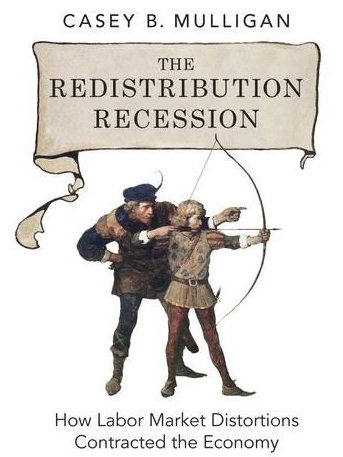 Mulligan argues that the government caused the recession by taking too much from the rich and giving it to the working classes and so if the government would reverse course, the working class would be more desperate for work and the rich would have more money to employ them. The standard textbook reasoning is pretty much the opposite. It argues that too much hoarding of money (by elites in particular) has reduced spending and demand for workers and so the solution is to give more incentives to stop unproductively hoarding money by lowering the real interest rate or by directly taxing the money and spending it on something more productive. Mulligan’s thesis has little empirical support and few economists have taken it seriously except other proponents of plutocracy like Koch-funded economist Tyler Cowen who calls the book, “excellent and highly original.” But even Cowen does not waste much ink defending the book’s content against its many critics. Instead, Cowen sticks to briefly praising vague qualities and shies away from discussing its main thesis at all. In contrast, Noah Smith reviewed Mulligan’s main thesis and gave three persuasive reasons to be skeptical of it:





 Medianism