1/3 of Bloomberg articles are written by artificial intelligence!

Artificial intelligence and automation is taking over more and more jobs. Daron Acemoglu and Pascual Restrepo recently produced research confirming that:

the recent stagnation of labor demand is explained by an acceleration of automation, particularly in manufacturing, and a deceleration in the creation of new tasks… if the origin of productivity growth in the future continues to be automation, the relative standing of labor… will decline.

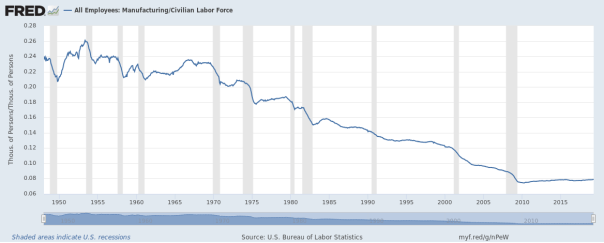
That isn’t particularly surprising, because everyone knows about what has been happening to manufacturing employment.

fredgraph

But the NYT reports that more and more journalism is actually being written by robots now including nearly 1/3 of Bloomberg articles.

“robot reporters have been prolific producers of articles on minor league baseball for The Associated Press, high school football for The Washington Post and earthquakes for The Los Angeles Times… Last week, The Guardian’s Australia edition published its first machine-assisted article, an account of annual political donations to the country’s political parties. And Forbes recently announced that it was testing a tool called Bertie to provide reporters with rough drafts and story templates… The Wall Street Journal and Dow Jones are experimenting with the technology to help with various tasks, including the transcription of interviews… Patch [is] a nationwide news organization devoted to local news, [with] 110 staff reporters and numerous freelancers who cover about 800 communities… In a given week, more than 3,000 posts on Patch — 5 to 10 percent of its output — are machine-generated… “One thing I’ve noticed,” Mr. St. John said, “is that our A.I.-written articles have zero typos.”

Bloomberg primarily writes for the financial industry and it is fitting that Bloomberg has robots write for financial traders because about 92% of forex trades are done by robots and about 2/3 of stock trades.  It is robots writing for people who mostly compete with robots in financial markets!

Kelsey Piper reported on a new kind of AI that learned how to write fake news articles and fake product reviews. The most impressive part is that it learned to do this all by itself by reading what humans have written in the past and although it can only write fake news, it is very good at it.

Google demonstrated last summer that Google Assistant can make phone calls and book appointments while sounding just like a human (though the company promised it won’t use deceptive tactics in practice).

More recently, a student at the University of California, Berkeley used an OpenAI program called GPT-3 to generate several blog posts.

[He] posted them on the internet, where they were read by 26,000 people. Sixty viewers were inspired to subscribe to the blog, and only a few suspected that the posts were written by a machine.

They were not necessarily gullible people. One of the blog posts — which argued that you can increase your productivity if you avoid thinking too much about everything you do — rose to the top of the leader board on Hacker News, a site where seasoned Silicon Valley programmers, engineers and entrepreneurs rate news articles and other online content.

Most bloggers do not get as much attention as the AI in this example, but then most bloggers do not write solely to generate attention.  Commercial companies focus their algorithms on maximizing attention which isn’t the same thing as seeking truth and advancing better analysis.

Artificial intelligence is already so common, we don’t recognize the numerous examples of our interactions with robotic brains. For example, Facebook uses artificial intelligence to serve up content to try to get you addicted to their services and Amazon uses artificial intelligence to get you to buy more of their products.  Even Netflix customizes the images on their homepage for every user to try to get people to spend more time watching Netflix.  They don’t just randomly serve up content to you.  It is all very calculated to try to suck in your attention.

Every Google search is taking advantage of advanced artificial intelligence too. The other day my father-in-law was talking about how one of his friends never wanted to schedule future meetings on Superbowl Sunday and that got us thinking. If you wanted to know when the Superbowl would be held next year, how would you find out? Nowadays the answer is as easy as a Google search. Google’s artificial intelligence finds answers to questions.

But how would you find the answer without the internet? In the old days, you had to rely upon human intelligence.  You could ask a librarian, but most librarians would probably need a lot of time to find the answer and some would have given up.  It would probably be faster to call a human operator to get the toll-free number for the NFL and then ask a human receptionist at the NFL. Those jobs are gone forever; replaced by computers.

We all benefit equally from the cheaper, better services that computers provide, but it has not boosted everyone’s incomes equally.  It has only boosted the incomes of a tiny proportion of people and particularly those who own a handful of tech companies. For example, Gizmodo reported that, “Amazon, Facebook, Google, Microsoft, and Apple move more money than many medium-sized nations.” Gizmodo reporter Kashmir Hill tried to live without their services and found that it is almost impossible to live without them because the kind of librarians and phone operators and map publishers we used to rely upon for information have lost their jobs and everyone has reoriented their daily life to use the computer servers and intellectual property owned by the big five.

Needless to say, the owners of those companies have become fabulously wealthy and by eliminating numerous other jobs, they have contributed to widening inequality in America in the process of amassing enormous power.

If these five companies collectively decided to overthrow the American government, I have no doubt that they could do it by using their collective influence to engender a populist electoral revolt that could elect a new political party with enough control to re-write the constitution.  China is already using that kind of information power.  In China, the government controls the equivalent of Amazon, Facebook, and Google which gives the Chinese government almost absolute power to prevent dissent by controlling the information that all Chinese people see each day and tracking every purchase and surveilling everyone’s GPS cellphone location and electronic communications every day.

Posted in Globalization & International, Inequality

Go to college to get an MRS degree.

As a kid I heard the joke that Mennonite women in my mother’s generation went to college to get an MRS degree and indeed, my own mother dropped out of college soon after she got married. Of course, my dad dropped out then too, so perhaps he was also sent to college to find a good Mennonite spouse.  Surprisingly the data shows that there is probably more reason for Americans to go to college in order to get married now than ever before. That is because, as Pew shows, marriage is in decline, but just for Americans without a college degree.

The graph shows a little tiny decline for adults with college degrees, but that is probably mainly due to the rising median age of first marriage.

How much later will the median age of marriage go in another fifty years?

Naturally, college graduates marry later because they usually wait until after graduation at least. Divorce rates have also diverged by education. College graduates are doing better now than in 1990 whereas everyone else keeps getting worse:

College education isn’t preserving marriage merely because young couples are meeting their spouses in college. People are increasingly meeting their spouses using dating applications rather than in person. Todd Schneider analyzed 63,000 New York Times wedding announcements and found that less than 30% of those couples met in school and the frequency of meeting via online dating apps is rapidly growing.

The success of college graduates at marriage is in large part due to college graduates having more income because, increasingly, marriage is just for rich people:

It isn’t that non-rich Americans just don’t want to get married. “80 percent of never-married Americans say they want to marry“. Perhaps rising income inequality is causing the decline in the family? The Institute for Family Studies summarized a few of the researcher who have made that link, but there seems to be more data on the related issue of how education impacts the family. For example, the majority of births of American high school dropouts are outside of marriage whereas only 6% of births to college-educated women are outside of marriage.

Better luck in love is just one of many reasons to go to college.  Another little-known reason is longer lifespan!

Some of the apparent effect of marriage upon life outcomes might also be related to childbirth which is correlated with marriage and also has dramatic effects. Here is a study showing the effects of childbirth upon fathers which begins when new fathers merely expect a future birth.

Posted in Labor

The six most likely ways the Trump era could come to an end.

There is very little chance that Trump will be reelected by American voters given his behavior so far and his long-run track record of consistently dismal polling numbers. The big question now is how the Trump presidency ends and who will he bring down with him. Here are the six most likely possibilities. Two remote possibilities that I left of the list are fair re-election or the end of American democracy which both seem unlikely.  Here is a list of more likely endings:

  1. An electoral defeat in 2020.  This is nearly inevitable if Trump isn’t impeached before he can run for re-election and bring down the Republican Party with him.  Trump already dragged Republicans down to defeat in the 2018 midterms and polls have consistently indicated that Trump himself would have suffered a defeat if he had been up for election on any day since the day he took office.  When Trump loses, he will probably cause a political crisis because he won’t accept defeat and will have to be removed from office somehow because he believes that all sorts of conspiracies are undermining what he believes is his huge, widespread popularity.  And his low odds of winning could become worse through the following…
  2. Proof of additional crimes that Republicans feel deserve impeachment. This is what sunk Nixon. Democrats and Independents already feel like Trump is impeachable due to obstruction of justice, campaign finance crimes, hiring indicted criminals who committed their crimes on behalf of Trump while working for him, etc. But nothing will actually happen to Trump until Republicans agree that the crimes are worthy of impeachment because the Senate is controlled by Republicans.  Until the next election, the Senate solely controls the impeachment process to decide whether Trump or Pence will serve as president. Republicans have overlooked Trump’s crimes and misdemeanors so far, but Republican opinion also supported Nixon until it suddenly fell apart over a mere span of months, so politics could change quickly.
  3. An economic recession. This also contributed to Nixon’s downfall.
  4. Bad crisis management. Trump could create a crisis that spirals out of control (like more government shutdowns or a war) or he could be forced to manage a crisis caused by external events.  Bush’s mismanagement of Hurricane Katrina and his self-inflicted mismanagement of the Iraq/Afghanistan wars contributed to the dramatic erosion of his popularity among everyone including Republicans. In 2016, Bush’s mismanagement was still so toxic that Trump was still slamming opponents (like Hillary Clinton) for initially supporting Bush’s disastrous foreign policies–a mistake Hillary made over a decade earlier!
  5. A deterioration of the president’s behavior. A majority of Americans have always considered Trump unfit to be president including a substantial fraction of Republicans as mentioned below.  Of course, a lot of Americans always thinks our political leaders are unfit for office nowadays, but it could get worse.
  6. A health crisis. An average male 72-year-old like Trump has about a 5% chance of dying in the next two years plus an even greater chance of having a major health crisis that would prevent him from carrying out his duties.  We know very few specifics about Trump’s true health status because his medical reports have been little more than political theater.

To prevent an electoral defeat in 2020, Republican senators would have to recognize that Trump’s crimes, misdemeanors, mismanagement, and conflicts of interest are worthy of impeachment and that everyone would be better off with a better Republican in the Oval Office: Mike Pence.

This doesn’t seem at all likely so far given that Republicans have become more approving of Trump’s behavior over time. Trump had had the highest negatives of any candidate among Republicans in February 2016 and nearly a third of Republicans still considered Trump to be unfit for President in June 2016. That number dropped to 23 percent of Republicans three months later, just before they elected him and one year later in 2017, only 16 percent of Republicans considered him unfit to be President. But self-identified Republicans are only about a quarter of the electorate (vs. about 1/3 Democrats and about 40% who identify as Independents), so Trump cannot win elections unless he figures out how to appeal to Independents and/or a few Democrats and he has been losing appeal with those groups.

Instead, by reshaping the Republican Party in his own image, Trump could take the party down with him when he is defeated. The end of a major political party hasn’t happened very often in American history, but Trump is exactly the kind of disaster that can cause a political party to die and be replaced by a new party that hasn’t had its brand reputation trashed. That is why rational Republicans should be looking for an exit strategy from the Trump era. The best chance for the party is for the Republican-controlled Senate to remove Trump from office in favor of the much less dangerous President Pence.  That would also be safer, more unifying, and all Americans would benefit from more competent leadership.

Jonathan Rauch and Peter Wehner wrote a prescient analysis of the situation:

Mr. Trump’s Gallup approval rating among Republicans is almost 90 percent and has never dipped significantly below 80 percent… Mr. Trump’s hard-core base is large enough to dominate the Republican Party, at least for now, but it is not large enough to dominate the country. In the long run, a third or so of the country cannot effectively govern the other two-thirds with an unpopular agenda…

by consolidating behind Mr. Trump, the Republican Party is isolating and alienating itself from the broader public. Indeed, the Trump paradox is that his support deepens among his most persistent admirers even as it erodes everywhere else…

What, then, might flip Mr. Trump’s removal from impossible to inevitable? The most likely possibility is also the most obvious: the collapse of his support among center-right Republicans who so far have wavered but not completely turned against him.

… Mr. Trump’s removal by his party would be… healthy, democratically speaking: It would reinvigorate the idea that political parties exist not just as vehicles for politicians but as protectors of vital democratic norms.

The most troubling — and from our point of view the most disappointing — development of the Trump era is not the president’s own… behavior; it is the institutional corruption, weakness and self-betrayal of the Republican Party. The party has abandoned its core commitments to constitutional norms, to conservative principles and even to basic decency. It has allowed itself to be hijacked by a reality television star… And it has embraced presidential conduct that, if engaged in by a Democrat, it would have been denounced as corrupt, incompetent and even treasonous.

We disagree with those who think that Mr. Trump’s removal by his own party would weaken democratic accountability; if anything, the opposite is true. The United States has only two major political parties, and it needs both to be healthy, rational and small-d democratic. They are our system’s most durable and accountable political institutions and they comprise its first and most important line of defense against political demagogues and conscience-free charlatans. By reasserting its institutional prerogatives — by setting limits to the depredations and recklessness it will accept — the Republican Party would be acting to deter hijackers in the future. In doing so, it would defend our democracy, not weaken it.

It is looking nearly impossible for Trump to win another election.  Trump got really lucky when he was elected in 2016. The odds were always against his win and they are stacking up even higher against him for 2020.  How was he lucky in 2016?

  • He ran against the least popular opposition candidate in American history (Hillary Clinton) and still managed to lose the popular vote by millions of ballots.
  • He barely eked out an electoral college win because of ‘spoiler candidates’ in Utah, Nebraska’s 2nd district, Wisconsin, Michigan, Pennsylvania, Arizona, Florida, and North Carolina. In all of those states, Trump lost the majority of the vote but won these states’ in the electoral college partly due to third party candidates.
  • FBI Director James Comey’s last-minute PR announcements regarding his new investigation into Clinton’s emails caused her support among independent voters to suddenly dip in the last week before the election.
  • Trump was the first major-party presidential candidate in history with zero service in public office who could truly run as a political outsider. Now he is the central insider of Washington as its supreme leader. He is in charge of the swamp. He won’t have the benefit of seeming like an outsider who could drain the swamp after being in charge of it.  Next time he won’t be able to run purely on aspirational promises.  He’ll have to defend his actual record like normal politicians and he has an unusually big problem with broken promises and unpopular policies.  His main advantage is his amazing talent at lying for shameless self-promotion, so he will just claim victory on everything he can get away with and blame scapegoats for all his problems.  Some of his fans will continue to blindly trust him, but many of his present fans are not cult followers and will eventually be reminded of all the reasons why they didn’t like him during the 2016 Republican primaries.
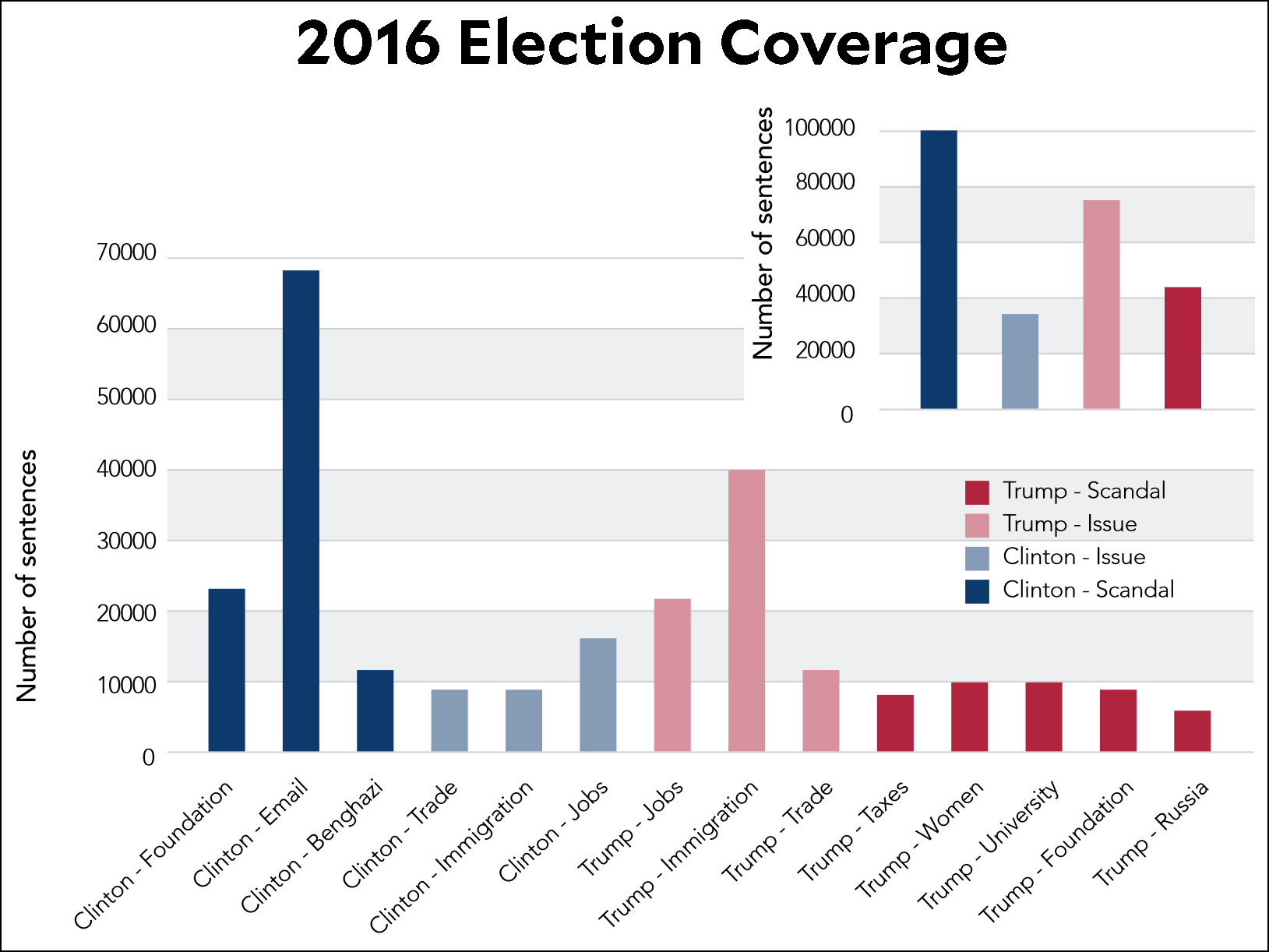
  • Trump scandals were amazingly hushed before the election compared to Clinton’s scandals over her email server, her foundation, and even her role in Benghazi, but after exhaustive investigations, there was never even any criminal activity and the investigations were dropped after there was no longer a political motive to stop her from getting elected.  Even though none of Clinton’s ‘scandals’ resulted in any criminal indictments, they dominated election media coverage. blog_berkman_hillary_clinton_coverageIn hindsight, we know that the FBI was investigating the Trump campaign’s suspicious ties to Russia.  Unlike the FBI’s very public investigations of Clinton’s emails and her foundation, news of the FBI investigations into the Trump-world’s criminal activities didn’t leak until after the election. We now know of Trumps illegal hush money that kept his affairs with porn stars quiet. We now know Trump’s foundation was such a fraud it has been shut down.  We know numerous Trump associates have been convicted for crimes they committed while working for Trump’s campaign. More scandals or indictments have been revealed regularly over the past two years even with Republicans in charge of all branches of Federal government (House, Senate, Executive, & Supreme Court).
  • Now that the Democrats have taken over the House, they will begin the kind of more aggressive investigations that opposition parties normally impose on presidents. For example, Trump has managed to keep his taxes and financial entanglements almost completely secret so far, but the House Democrats will have subpoena power to reveal the kind of financial information that all other presidents (and presidential candidates) have voluntarily revealed since Nixon (and even Nixon finally revealed his taxes shortly before he resigned). Other than the president, all other high-level government officials are required to reveal their financial conflicts of interest. Normally all presidential candidates voluntarily reveal their finances to prove that they have no hidden conflicts of interest, but Trump has doggedly resisted pressures to follow this tradition.  The House will now have the power to examine why he has been so much more reluctant than everyone else.
  • Polls randomly rise and fall and on election day, Trump was lucky that his popularity was briefly higher than it had been during most of the previous year.
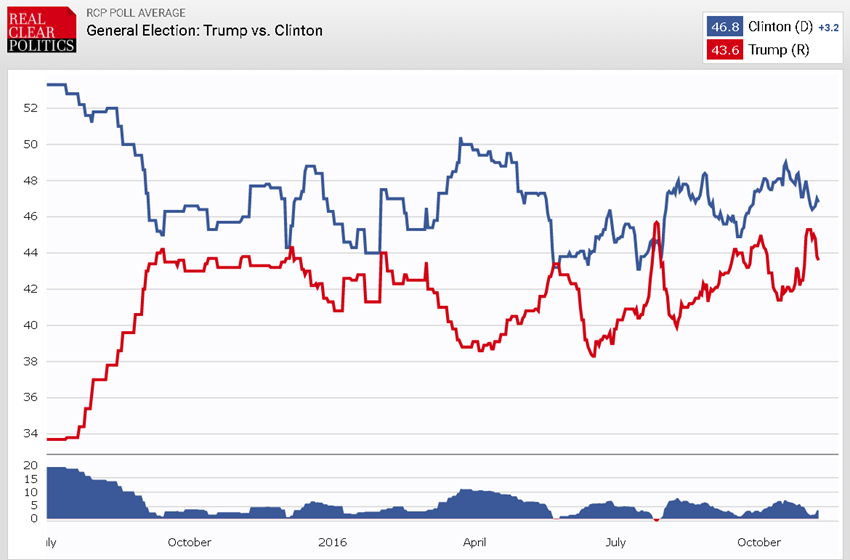
On this graph, Clinton was significantly more popular than Trump for 99% of the time.  There were only seven brief times when Trump’s polls came close to Clinton’s and the election happened to be held during the last blip.  You cannot count on getting lucky every election and Trump’s popularity has never risen back to as high as it was when he took office. Most incumbents politicians move to the political center and see their popularity rise, but Trump moved more extreme and has dug himself into a partisan hole.  His popularity was near one of his all-time peaks when he was elected. His job approval peaked on his first day in office and has been worse ever since.
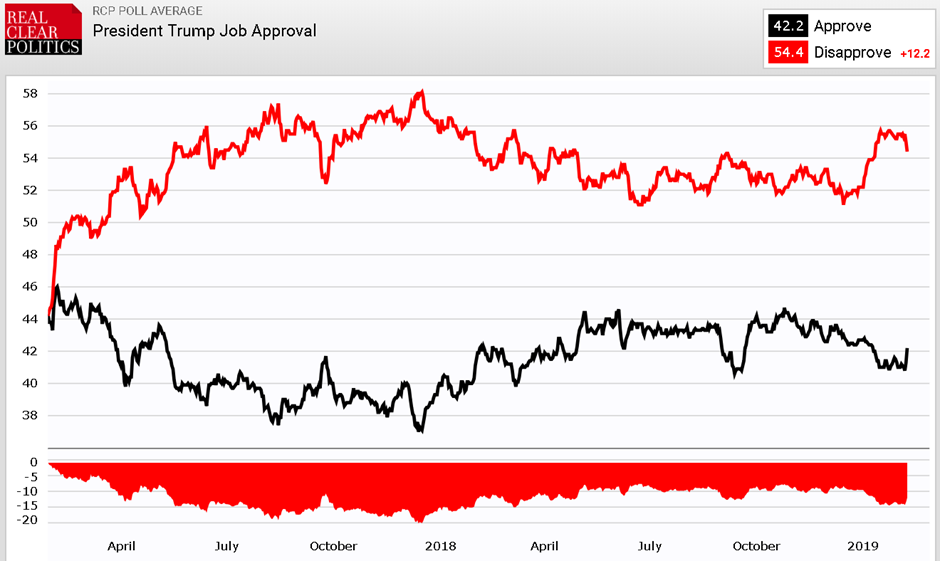
There have been numerous opportunities for Trump to moderate and try to appeal to independents, but he has careened from one embarrassment to another. He has had the great fortune that the momentum of the American economy has not faltered and the only disasters that have hit have have not hit places where Trump could lose many voters.  The big hurricane that hit Puerto Rico didn’t cost many votes because it is about the only place on earth where American citizens cannot vote and the big wildfires have hit sparsely-populated areas and often in Democratic areas like California.

Trump was lucky to have begun his political following with racist birther appeals at a time when the white racial identity had been evoked by the presence of America’s first non-white president.  This temporarily boosted the appeal of the alt-right and nativists who have been thrilled with Trump’s thinly veiled racist rhetoric and policies such as his Muslim ban and family separation to punish undocumented immigrants from Latin America.  This is NOT to say that most Trump voters are white racists, but they have been able to tolerate their President repeatedly making statements that most Americans, including Republican leaders like Paul Ryan, considers ‘textbook racism.’

But that kind of racist appeal has been on decline for decades.  It was only temporarily activated in a minority of Americans by our first non-white president.  What’s more, American demography is inexorably becoming more racially mixed every year even without immigration due to lower birth rates among white Americans and demography is destiny.

A similar dynamic played out in California which had been a reliably Republican state until the California Republicans abandoned the pro-immigrant stance of Ronald Reagan (California’s most popular Republican) and refocused on nativism in the early 1990s.  That strategy worked temporarily to boost a certain segment of white turnout, but it so tarnished the Republican Party in the state that California soon became one of the most solidly blue states in the nation.  Trump could be doing something similar to the Republican Party for the nation as a whole.

Trump ran as a populist who promised to soak rich people like himself to pay for universal health insurance that would be better than Obamacare.  But he has governed like an elitist who cut taxes on rich people (especially those with his own circumstances) and has been trying to take away health insurance from Americans with only limited success so far.   Most of his signature political ideas are unpopular regarding climate change, immigration, international trade,  LGBTQ rights, warmer ties with Russia (vs. our traditional NATO allies), solar power, government shutdowns, taxes, etc.  And his positions on these issues have gotten less popular since he was elected, not more.

Trump is popular with older, rural, low-education voters who are slowly dying off, moving to cities, and getting educated.
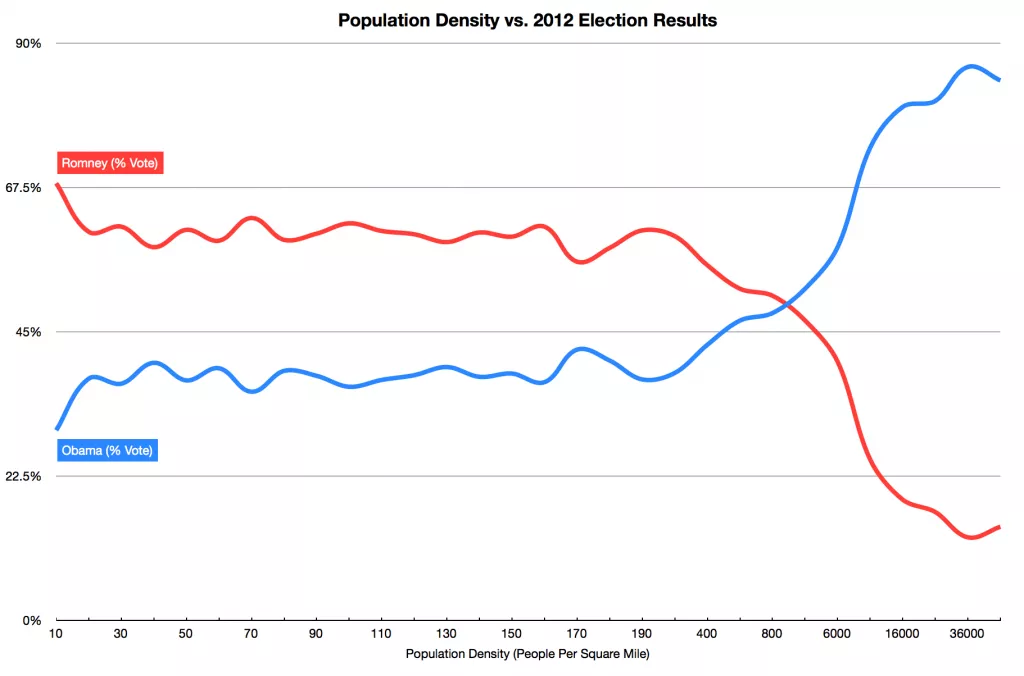
rural

Trump is not popular with the growth demographics and even a 1% demographic shift over four years would result in an insurmountable barrier to Trump’s re-election.

Trump has been exceptionally lucky so far to be elected when the unemployment rate is about as low as it has ever been.  And we will soon have achieved the longest economic expansion in US history. As the FRED data below shows, GDP has been growing continuously for nearly ten years now and unemployment has been shrinking.
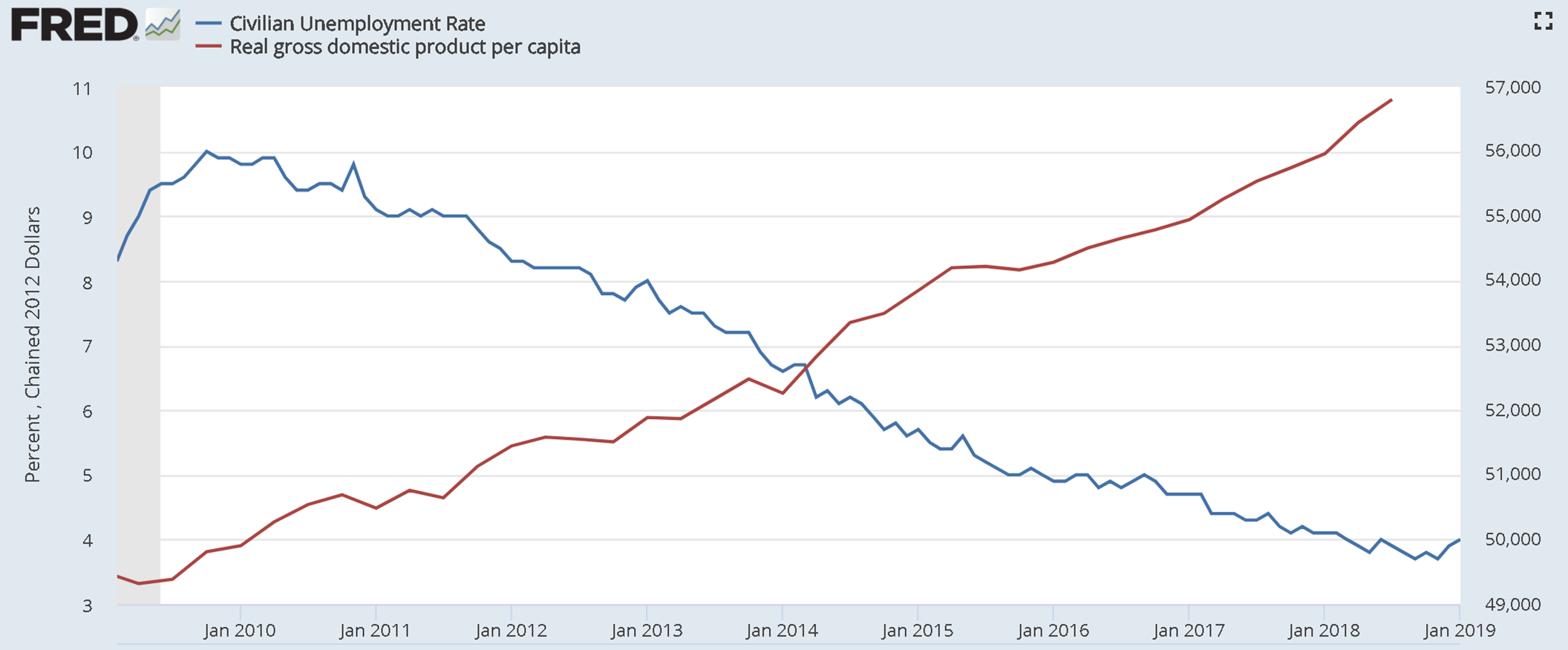
Most Americans give the President credit for the current state of the economy which is ALMOST completely irrational. There hasn’t been any difference in economic performance in the last two years compared with the six years before that under President Obama and neither president should get much credit nor blame. Economic performance is the ONLY thing that Trump polls well on, but that is mostly a matter of lucky timing.  There is significant chance, through no fault of Trump’s, that the economy will turn to recession before the next election and as Trump has reaped undue reward for the great economy we have today, he will also suffer undue blame for the next slowdown.

It theory it would be possible for Trump to become more presidential, manage more effectively, and change his rhetoric and policies to broaden his appeal, but there is zero evidence that he has been moving in that direction during his first two years, and if he couldn’t do it to avoid hurting his party in the midterm elections, there is vanishing chance he’ll suddenly be able to re-invent himself in the next two years.  He is looking more and more like a dinosaur that can’t change with the climate.

In the history of American business, there are lots of stories of bailouts by government or, as in Trump’s case, money from daddy or by defrauding gullible suckers.  The history of American politics is different.  There is nobody who can give you a bailout when a presidency turns out to be bankrupt.

The closest thing to a bailout in presidential politics is an attack by a foreign power.  For example, 9/11 was the best thing that ever happened to George W. Bush’s presidency which boosted his approval from being worse than most presidents in history to the highest approval rating of any president!
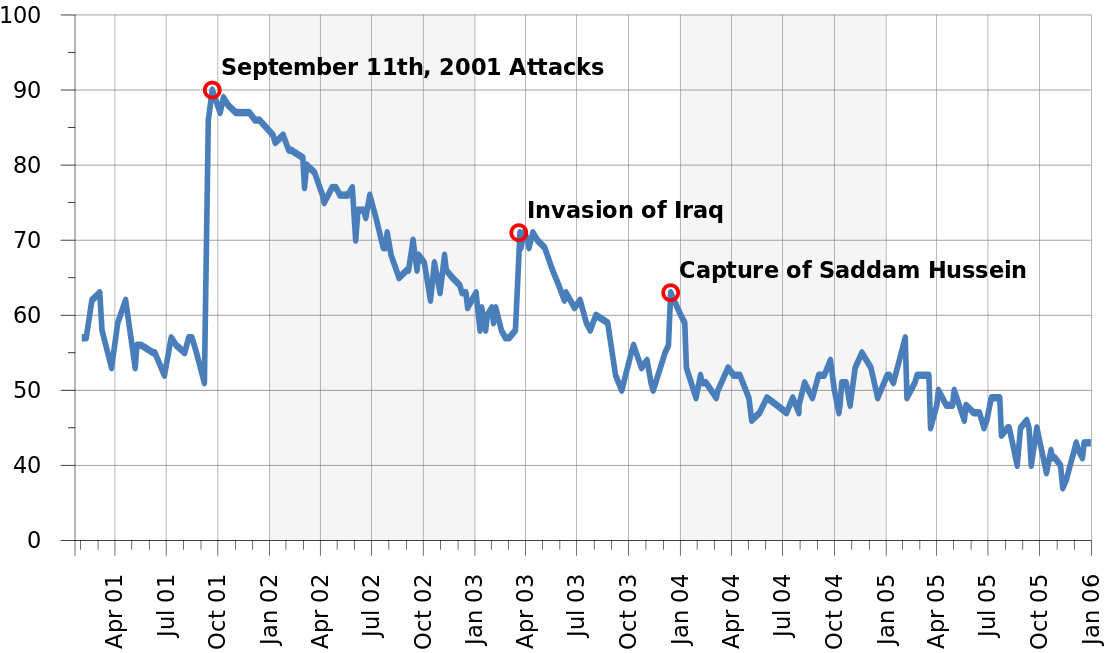
1113px-george_w_bush_approval_ratings_with_events.svg_

That 9/11 boost in political capital allowed Bush to do something that had long been on his neo-con bucket list.  He wanted to invade Iraq, the one Muslim nation that had been the most opposed to Al Queda and one of the few with zero involvement in 9/11.  By selling the Iraq war as a way to make America safe from terrorism, the beginning of the Iraq invasion was the second best thing that happened to Bush’s political popularity and he got a second boost in political power.  The loud drum beat of war during the midterm elections undoubtedly boosted Republican fortunes, but it ultimately turned into a political disaster a few years later.

Donald Trump has long recognized the power of a well-timed war to win elections.  He made multiple predictions that Obama would start a war saying:

In order to get elected, @BarackObama will start a war with Iran.

“Now that Obama’s poll numbers are in tailspin – watch for him to launch a strike in Libya or Iran. He is desperate.”

“I predict that President Obama will at some point attack Iran in order to save face!”

It turned out that Obama’s poll numbers never got so bad that Trump’s theory was tested.  Obama never needed a war to get re-elected, but Trump’s polls have consistently been much worse than Obama’s.  An invasion might work to boost Trump’s popularity, but it is a risky proposition so soon after the Iraq war with it’s the ugly memories and it would be particularly risky for Trump who most loudly argued against American foreign wars during his 2016 campaign.

Although another invasion might boost Trump long enough to win an election, it is unlikely to help Trump’s long-run fortunes nor the popularity of the Republican Party any more than the Iraq war did.

It is hard to see how the Trump era can end well for the Republican Party unless Republican senators decide it is time to cut their losses and put a safer, more responsible, less unpopular, more competent Republican–Pence–in the oval office.  The one sure thing is that as long as Trump is in the White House we will have a lot more drama because he is an extraordinary game master in the reality TV show he has constructed around his life.

Posted in Pence2018

Gravity equation of trade

Suppose you have a big import-export business in Puerto Rica located between the Caribbean Sea and the Atlantic Ocean. What countries would you want to trade with most? The most convenient locations would be the closest nations, but the closest nations are relatively poor like Haiti and the Dominican Republic. That means they don’t produce much for you to import and they don’t have much money to pay for your exports. The countries with the most money to buy your exports are the countries with the highest GDP and they also produce the most (because the P in GDP stands for Production) so they have the most goods for export too.

Most of volume of bilateral trade can be predicted if you just know the distance between the two countries and the GDP of each country using the gravity equation of trade:

In this model, Fij is the flow of trade between countries i and j. G is a constant which can be ignored for the purposes of understanding the theory. Mi is the “mass” of country i as measured by the amount of GDP. Mj is the same for country j. Dij is the distance between country i and country j. So as the distance increases, the trade flows decrease and as the GDP of either of the countries increases, trade increases too.

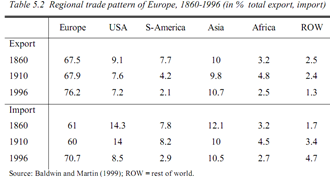
The gravity model helps explain why regional trading patterns stay remarkably constant over the course of centuries too. Geography doesn’t change, so the distance part of the gravity equation always shapes trade routes in the same way:

The death of distance?

Should a rich (capital-abundant) country like the US trade more with poor (labor-abundant) countries or mostly with other rich countries? For most of American history the US mostly imported and exported to other rich nations. One reason was the gravity model. Rich nations have bigger GDP and that naturally means that they tend to trade more with each other than with poor nations. Most rich nations were also spread around the North Atlantic in closer proximity than many of the poor nations of the global south. Most nations also had higher tariffs until recent decades, and the majority of the world’s poor population lived in nations that severely restricted trade due to their socialist ideologies that went out of fashion in the 1990s. Notable examples include China, the Soviet Union, India, Vietnam, and their allies in Asia, Africa, and Latin America. Most of these nations had been forced to “trade” at gunpoint by colonial powers until colonialist ideology started going out of fashion in the mid-20th century and that kind of rapacious international “trading” relationship had left them poor. They were hesitant to continue trading with former colonial masters in rich nations for decades. But that old ideology changed dramatically around the end of the cold war in 1989 and poor nations began opening up toward greater international trade. At the same time their economies began growing more rapidly.

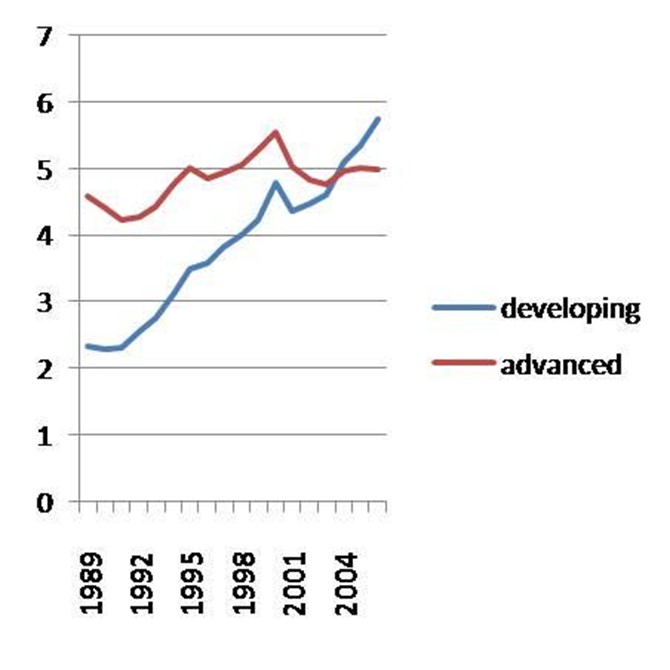
Below is a graph of US imports of manufactured goods from developing countries as a percent of GDP that shows how rapidly the poor, developing nations expanded their share of US imports.

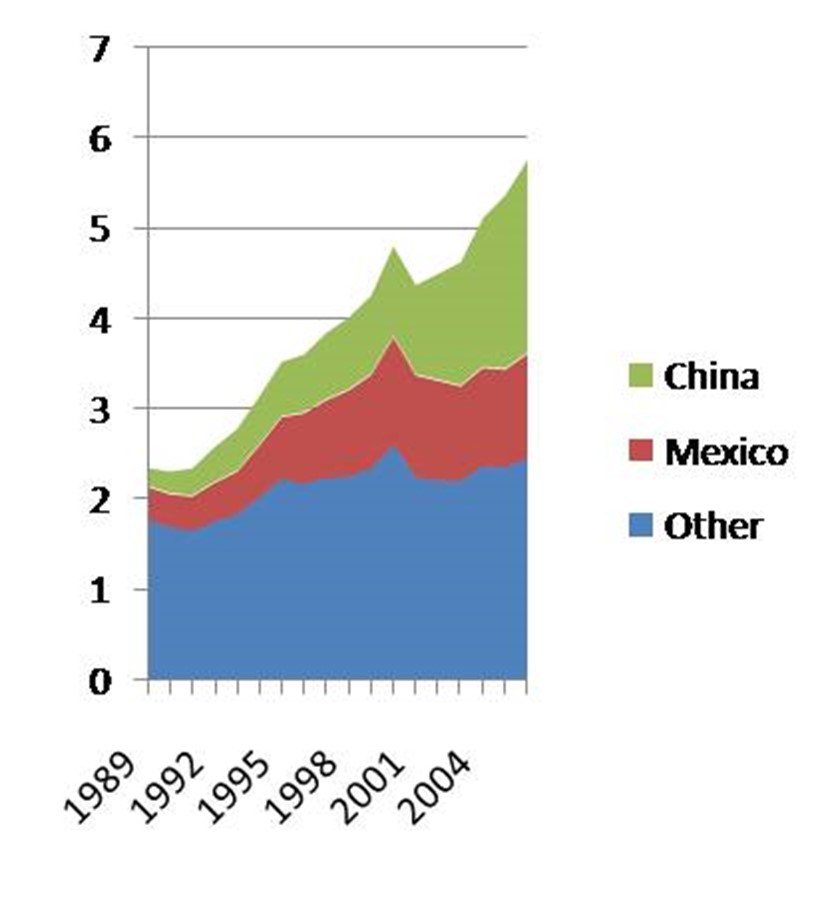
In 1989, the US imported twice as many manufactures from other rich countries as from poor countries, but imports from developing countries were growing extremely rapidly and by 2006, the US was importing more from developing countries. The big story that explains most of this change was the dramatic rise in imports from Mexico (partly due to NAFTA in 1994) and China as the following graph shows. This is the same as the developing country imports line in the above graph, but breaks it down into three sources.

One big reason why trade with low-wage countries rose is that they decided to reduce their tariffs because there was an ideological revolution around the world in the 1990s and politicians decided they wanted more trade:

low income tariffs

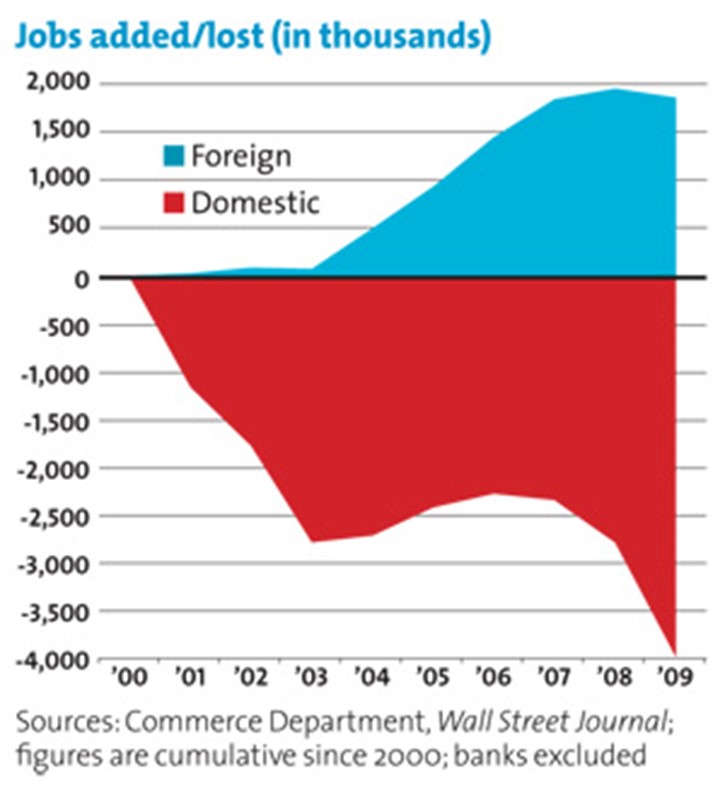
The expansion of trade with low-wage countries also had an effect on low-skilled wages in America too. Although it has been fantastic for the owners of corporations (wealthy people mostly), workers have seen wages stagnate as our largest corporations developed more flexibility to move jobs to the countries that have the greatest comparative advantage. The US added high-skilled jobs which boosted the demand for college degrees in America, but lost lower-skilled jobs which were moved overseas. The following graph shows the number of jobs that domestic corporations offshored to foreign countries (in red) versus the number of jobs that foreign corporations added in the US (in blue).

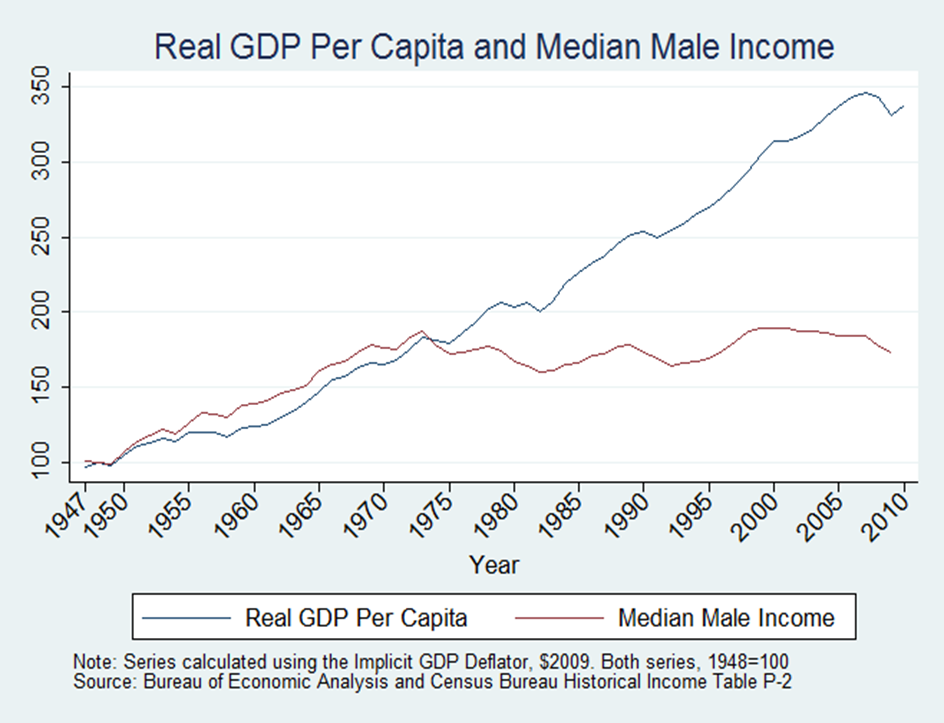
Partly due to increasing global trade with low-wage countries, median wage growth has been stagnant even though the richest Americans are getting rich so fast that they alone are boosting GDP as this graph from Marginal Revolution shows:

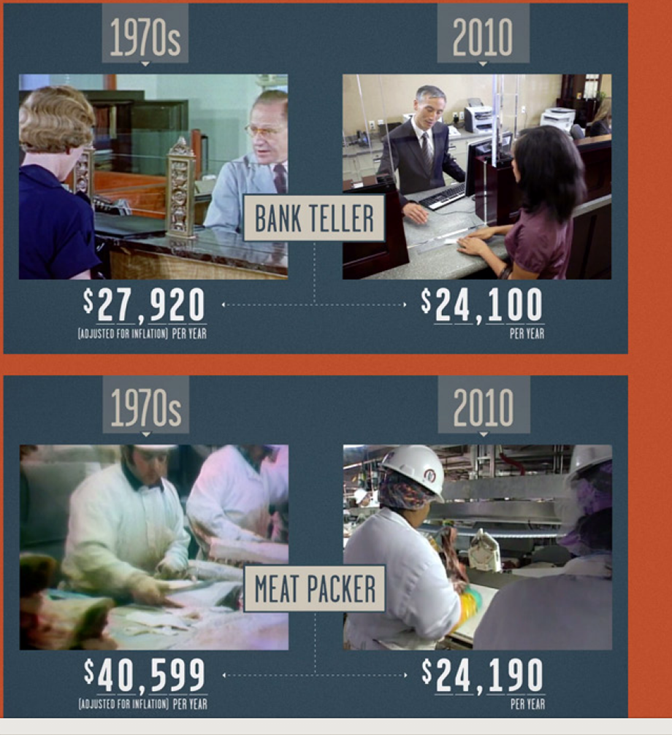
And here is an infographic examining the fall in real wages in two different professions:

Distance isn’t everything. Geographic features matter too.

Although the gravity equation predicts trade flows between nations very well just with GDP and distance, the gravity model assumes the world is a flat plane without barriers, but other geographic features matter. For example, Raballand (2003) found that landlocked countries trade about 80% less than the gravity model alone would predict due to the much higher costs of land transportation than sea transport. The entire world really is flat at sea level, but land is very lumpy.

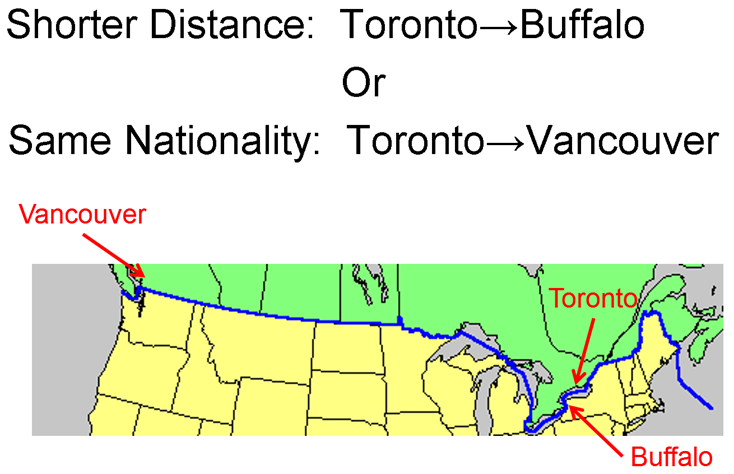
National borders matter a lot too. If not, then a firm in Toronto, Canada would do much more business with firms in nearby Buffalo, New York than with firms in Vancouver, Canada on the opposite side of the continent, but in reality Canadian firms prefer distant Canadian customers over nearby foreign customers.

This “home bias in trade” was first documented by John T. McCallum in 1995 who found that that domestic trade was 20 times larger than international trade. This home bias has decreased according to some later estimates (partly due to NAFTA again?), but it remains a mystery why it is so large. It even exists between states within the US. For example firms in northwest Ohio do much less business with nearby firms in Indiana and Michigan than with more distant firms on the other side of Ohio.

The home bias is one reason why large nations like the US have lower trade as a percent of income than small countries like Singapore.  Singapore exported 173% of GDP in 2017 whereas the US only exported 12% of GDP.  Small countries can’t afford to have much home-country bias because they don’t have enough size to reach economies of scale in very many industries and so they import most of what they use and export most of what they produce in cases like Singapore.

A related puzzle is the “equity home bias” with refers to the fact that people own much less foreign equity (stocks) than would be ideal in their investment portfolios.

The benefit from holding a more equally diversified portfolio of domestic and foreign assets is a lower volatility portfolio. On average, US investors carry only 8% of their assets in foreign investments. Historical data indicates that holding an entirely domestic US portfolio would result in lower volatility of returns than an entirely foreign portfolio. A study conducted by economist Karen Lewis found that a weight of 39% on foreign assets and 61% on domestic US assets produced the minimum volatility portfolio for investors. Foreign asset exposure has been on the rise in the past few years, however with the average US portfolio carrying 28% foreign assets in 2010 as opposed to just 12% in 2001.

Again, the same effect is true within American states. People tend to invest more money in companies based in their home state than is ideal for their own wellbeing. The most extreme version of this is the fact that many people irrationally buy too much stock in the very company where they work. That is the very worst company to invest in unless you have insider information and even then, insiders should be just as good at using their insider information to sell their own stocks as to buy it, so insider information should not cause people to buy and hold the stock of their employer.

Posted in Globalization & International

Corporations see a high-income world even though it is mainly middle-income

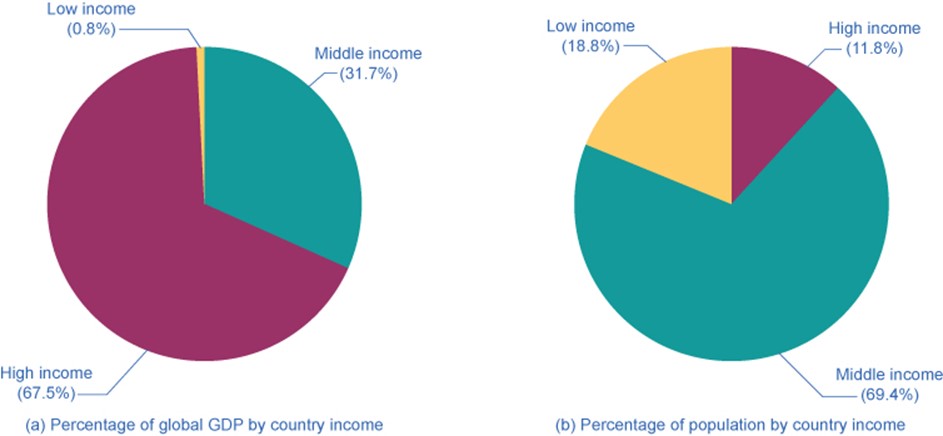
OpenStax is another high-quality open-source economics textbook provider and they produced a graph comparing the distribution of global income versus the distribution of global population. Hans Rosling found that most people incorrectly think that most of the world is poor, but actually most of the world is now middle income as the following OpenStax graph shows.

Figure 32.2 Percent of Global GDP and Percent of Population The pie charts show the GDP (from 2011) for countries categorized into low, middle, or high income. Low-income are those earning less than $1,025 (less than 1% of global income). They represent 18.8% of the world population. Middle-income countries are those with per capita income of $1,025–$12,475 (31.7% of global income). They represent 69.4% of world population. High-income countries have 67.5% of global income and 11.8% of the world’s population. (Source: World Bank)

However, contrary to Pralahad’s “Bottom of the Pyramid” theory, for-profit companies care about money, not people and there is too little money at the bottom of the pyramid of human income to be worth much attention from private firms.  The poor countries altogether have less than 1% of total global income, so for-profit companies care about them less than 1% as much as they care about everyone else. About 68% of the attention of for-profit companies will go towards the 12% of people living in high income countries.

Posted in Development, Globalization & International

Odd patterns in American foreign investment

Core Economics is an open-source economics textbook project based in Europe which has produced an innovative approach to teaching economics. They produced the graph below which shows “the destination of investments by US companies when they invested directly in other companies abroad between 2001 and 2012.” This is interesting for a couple reasons. First, although America has higher average income than almost all of these countries, America’s much higher inequality helps explain why manufacturing wages are lower than in so many other countries. Second, the majority of American investment goes to countries with higher manufacturing wages than America, so the data doesn’t show that America has been primarily outsourcing to poor countries. The combined investment to all of Africa, India, and China together merely accounts for less than 4% of US foreign investment even though the vast majority of all humans live in those three areas. Luxembourg is much richer than the US and gets nearly 9% of US investment than that even though Luxembourg is one of the smallest countries in the world. Why Luxembourg?? It is hardly more than just a city state.

Most people think Americans are outsourcing a lot of wealth to poor nations, but the majority of US foreign investment goes to countries where manufacturing wages are higher than in the US, and this is the kind of labor cost that matters most for international trade. Most of the rest goes to middle-income nations. Very little goes to poor nations.

United Nations Conference on Trade and Development. 2014. Bilateral FDI Statistics. Note: Data is for US FDI flows abroad. The countries shown to have manufacturing wages higher than the US are those that are classified by the US BLS International Labor Comparisons as having higher hourly compensation in manufacturing than the US on average over the 2005–09 period.

Posted in Globalization & International

World inequality updates

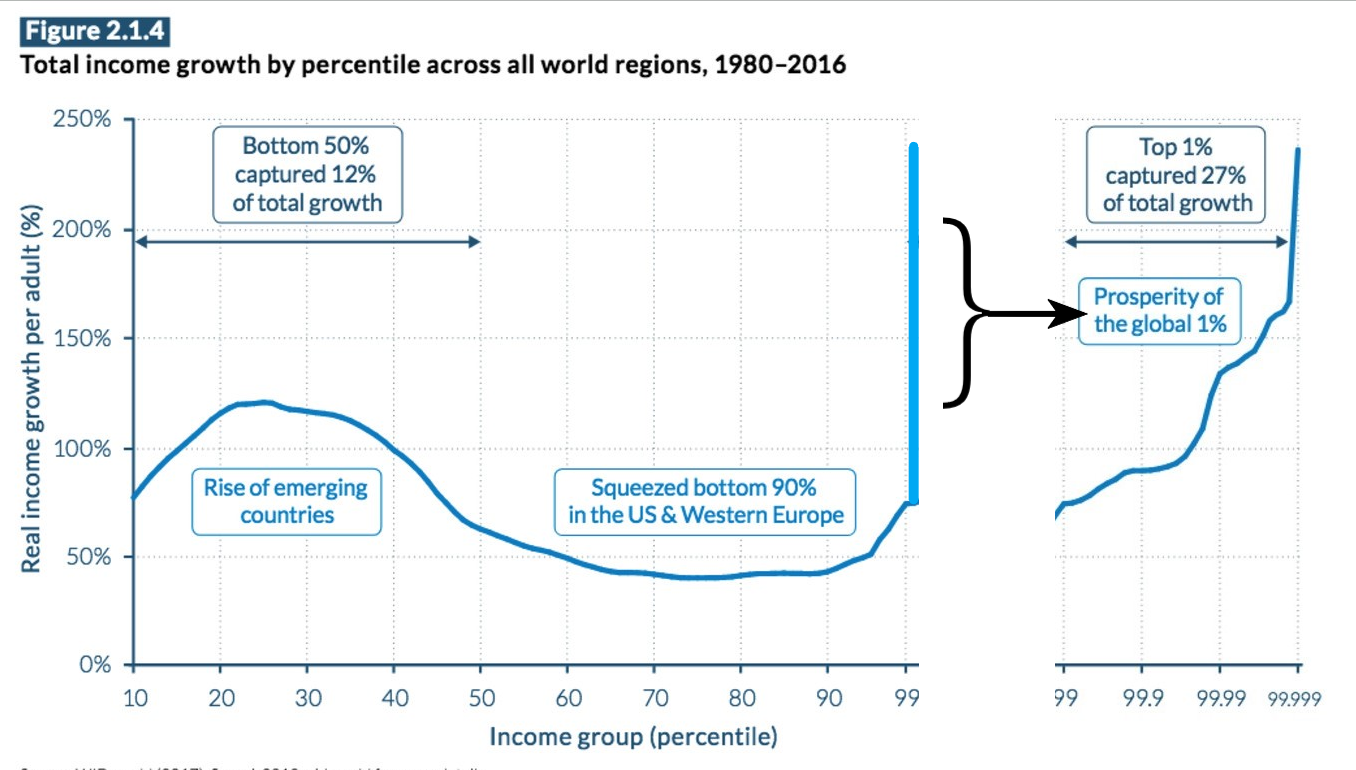
Last month the World Inequality Lab, located at the Paris School of Economics, released their first World Inequality Report. Here is one result:

inequalitygrowth.PNG

The top 1% richest people saw their income growth skyrocket and the poorest people in the world did pretty well, but the global middle class and upper-middle class did the worst.

Oxfam also published their latest accounting of global wealth inequality and made social media go nuts when they concluded that the 26 richest people on earth in 2018 had the same net worth as the poorest half of the planet. In other words 26 people owned as much wealth as the 3.8 billion poorest people. That isn’t actually as bad as it sounds because a whole lot of the people Oxfam includes in the bottom half are net debtors in rich countries like recent college graduates with large student loans that they will easily repay. Even people like Donald Trump would have been categorized as part of the poorest half of the world during the times when The Donald went bankrupt and owed millions of dollars more than he had. It takes a fairly rich person to acquire big debts and some of Oxfam’s “poor” people are actually in that category.

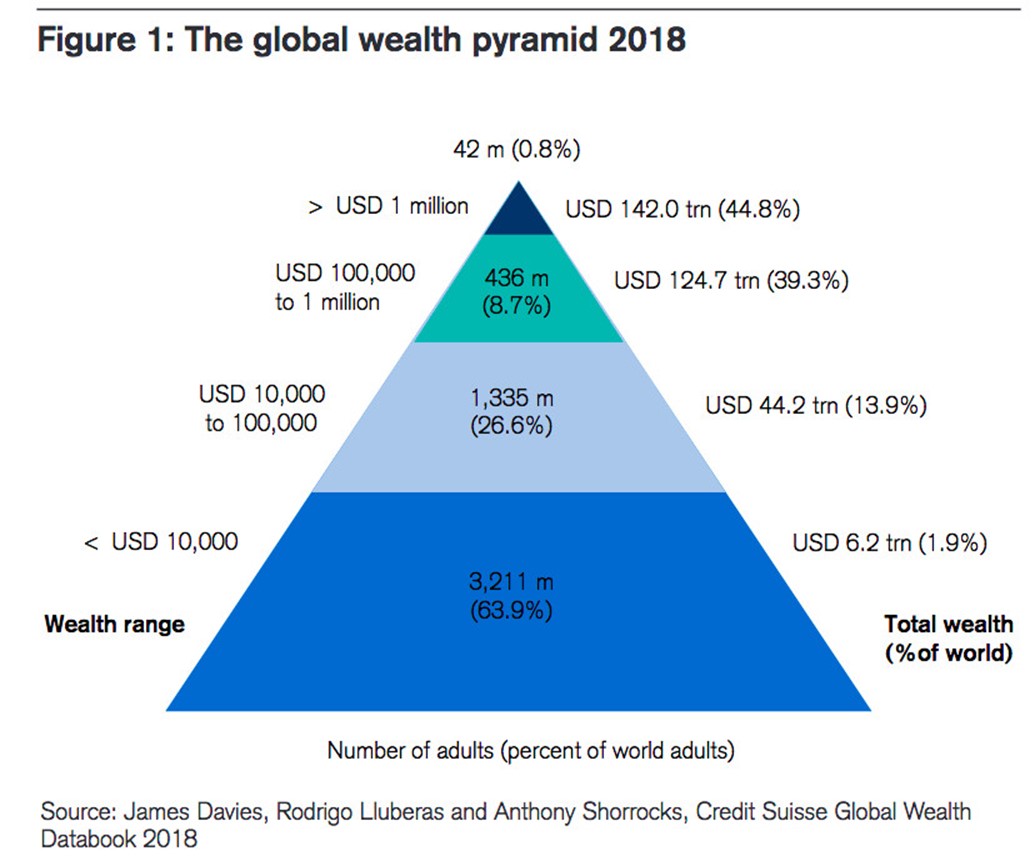
But that doesn’t mean that the data is wrong.  For example, Credit Suisse also just published their latest Global Wealth Report which includes this data:

By their estimate, 63.9% of the world’s adults own 1.9% of the total world wealth and the top 0.8% own 44.8% of the world’s wealth. If we round these numbers a bit, the rule of thumb to remember is that about the top 1% richest people in the world collectively own about half of the world’s wealth. That includes anyone who has at least a million dollars of wealth and as the first graph showed, their incomes are skyrocketing.

If you want more details, Dylan Matthews wrote a nice summary.

Posted in Inequality

Enter your email address to follow this blog and receive notifications of new posts by email.

Join 75 other subscribers
Blog Archive
Pages