Rolling out a new kind of “death panel” claim to try to scare senior citizens

Before becoming president, Donald Trump was a long-time proponent of single-payer health insurance (aka Medicare for All).  That shouldn’t be surprising given that Trump was a liberal Democrat for most of his life until Obama was elected and then Trump’s dislike for Obama seems to have motivated him to become a staunch Republican for the first time. Trump first gained prominence in the party by promoting birther theories against Obama.  Trump wrote about single payer at length in a book and repeatedly promised: “We’re going to have insurance for everybody” and “​I am going to take care of everybody…  The government’s gonna pay for it.”

He campaigned for single payer during the Republican primaries and although he gradually moved towards the standard Republican Party platform, after he became president, he still sometimes praised single-payer systems abroad like the system in Australia.

In today’s USA Today, Donald Trump published an op-ed that has been widely ridiculed for deceptions and/or errors.  The Washington Post’s fact checker said, “almost every sentence contained a misleading statement or a falsehood.” Among the falsehoods are targeted attacks on Medicare for All claiming that proponents really want to cut Medicare not expand it.  For example, Trump said:

  • Democrats favor “eliminating Medicare as a program for seniors”;
  • “the Democratic Party’s so-called Medicare for All would really be Medicare for None”
  • “under the Democrats’ plan, today’s Medicare would be forced to die.”

This is how he is attacking the people who want to expand Medicare AND make it more generous.

The only age demographic in which a majority consistently opposed Obamacare was Americans older than 65 because they feared that Obamacare might take resources away  from their socialized health insurance system: Medicare and Medicaid.  US News listed several of the fears that senior citizens have had about that. Seniors were opposed to Obamacare even though it wouldn’t affect them at all largely because the Republican political elite succeeded in making them fear “death panels.” This was the idea that Obamacare would cut lifesaving Medicare benefits. Similarly, organizations like the Heritage Foundation that wants to cut Medicare and Social Security misleadingly criticized Obamacare by claiming it cut Medicare’s generosity to Senior Citizens by $700 billion. In reality, $700 billion was saved through greater efficiency and no benefits were cut. Heritage opposed Obamacare because it was too generous, not because it was spending less, but that would be a political loser, so they made Senior Citizens afraid of benefit cuts instead. Trump’s new op-ed is a another attempt to whip up new fears of death panels. He is literally claiming that Medicare for All would actually mean Medicare for none!  This is Orwellian. Up is down!

The Republican party leadership, such as Paul Ryan, has a long history of promoting numerous proposals that really would have cut Medicare spending and privatized it.  Ironically, Trump distinguished himself during the Republican primaries by consistently pushing back against that direction of the party elites during his campaign. He was correct when he proudly tweeted:

I was the first & only potential GOP candidate to state there will be no cuts to Social Security, Medicare & Medicaid.

Trump’s generosity towards senior citizen welfare programs is one reason why Trump’s supporters skewed more elderly than previous Republican presidential candidates. But Trump tried to break his signature promise after the election when he promoted every Affordable Care Act repeal proposal, all of which included large cuts to Medicaid.

Meanwhile, some studies suggest that one reason the US has lower longevity than any other rich country despite spending more on healthcare (per person) than any other country on earth is that there are many Americans who lack adequate health coverage. Below is one such estimate.
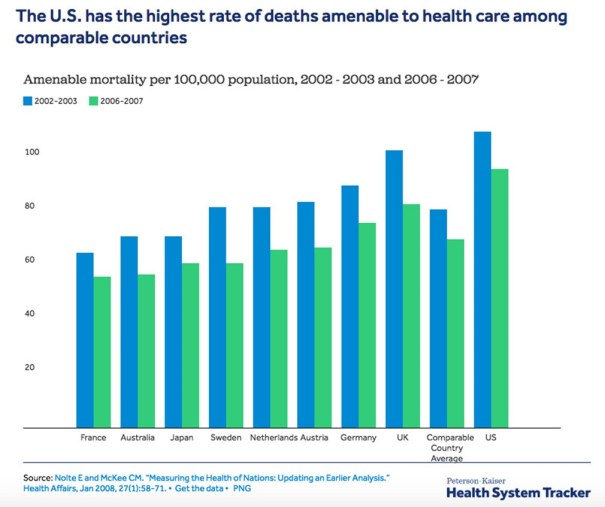
All the other countries have universal health insurance. Maybe we could save lives and cut spending if we copied one of them? The Mercatus Center is another Republican think tank that with similar views to the Heritage Foundation.  Mercatus did a recent analysis of single-payer healthcare which was supposed to be critical of it, but actually came to a number of conclusions that make it sound great. They fear that Medicare for All proposals will

  • “substantially reducing drug prices and administrative costs”.  Sounds good to me.
  • “become responsible for financing nearly all current national health spending.”  That implies less out-of-pocket spending, yea!
  • “expand the range of services covered by federal insurance (for example, dental, vision, and hearing benefits)” which would be more generous than in most single-payer systems like Canada.
  • And reduce overall healthcare spending by over 2 trillion dollars over the first ten years despite more healthcare access! Here is their data in a chart by Kevin Drum:
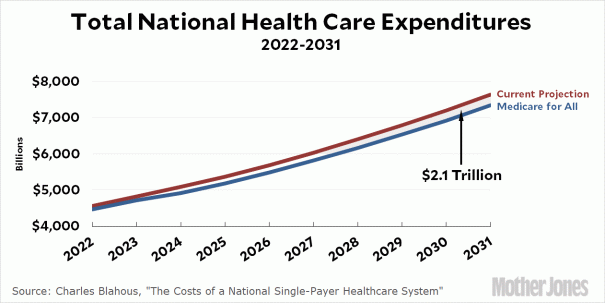
Of course, they oppose this plan to expand healthcare and lower total spending because

  1. They think that moral hazard is a huge problem that would only get worse if people had better health insurance. In reality the moral hazard of patients isn’t a significant problem because doctors already ration all the expensive tests and treatments.  Patients only have control over relatively cheap office visits and 99% of us don’t wants to go to any more doctor visits than the absolute minimum necessary for our health.  Most Americans could probably benefit from more office visits. Other countries with single payer healthcare don’t have a worse problem with it than the US.
  2. They worry that spending less on healthcare would reduce the quality of healthcare. But for all of you who have a really generous ‘Cadillac-quality’ healthcare policy now, you will still be able to buy a supplemental private healthcare policy that tops off the generosity of the public plan if you want to just like most senior citizens buy supplemental private insurance to top off our existing Medicare insurance. Few people opt for supplemental insurance in nations like Great Britain because most people feel like their free insurance is good enough, but some British citizens want to additional private insurance and they are free to choose to spend more on even better healthcare. Universal healthcare generally only puts a floor on the minimum healthcare citizens can get. The only place I know of where there is any ceiling restricting the maximum is Canada, but I haven’t heard of American politicians proposing any limits on additional insurance that private individuals might want to add to the public plan.
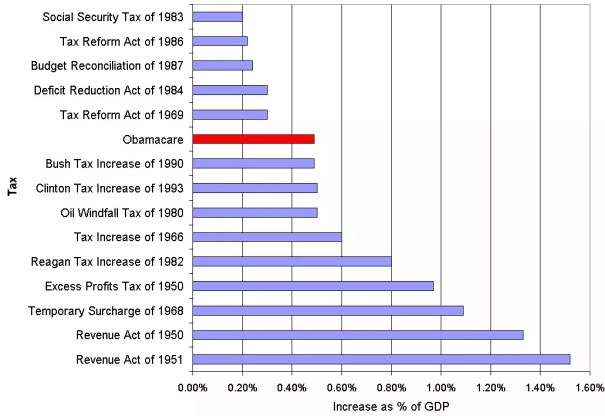
  3. It would increase taxes massively. Although Americans would have more disposable income on average because private insurance spending would drop more than taxes would go up, Mercatus really, really hates taxes.  They are the kind of ideologues who would rather give $10 to a private health insurance company than pay $9 in taxes for a public health insurance plan that gives more coverage!  This is also a major reason why they hate Obamacare.  Most Americans don’t realize it because most of the burden fell on rich people and corporations, but it was one of the biggest tax increases in American history as this graph from the Incidental Economist shows:
Obamacare-tax.0

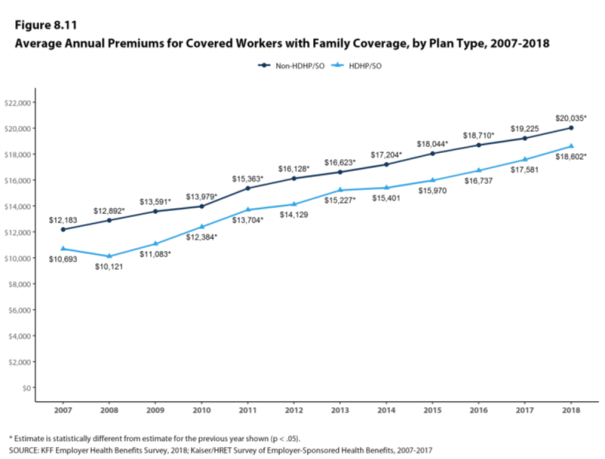
But turning most of the private insurance payroll deduction into a public insurance system would certainly mean that payrolls would have much higher taxes. The average cost of private insurance is over $20,000 per year for an average family policy with normal deductibles and over $18,600 for stingier family policies with high deductibles as the following graph shows.  The full cost of healthcare for a family of four is sometimes estimated at about $28,000 per year on average! Even though single-payer would be cheaper, there is no way to replace private insurance without raising taxes a lot.  Now, paychecks should still go up after taxes according to this analysis because the new taxes are projected to be less than the insurance they replace, but if you hate paying 95 cents of taxes more than a dollar of insurance payments, then this is a worse scenario.
Ronald Reagan also made similar ‘death panel’-style arguments against the original creation of Medicare in the 1960s.  It is humorous in hindsight, particularly when combined with some funny video imagery from the era:*

Whereas Reagan said that Medicare would turn America into a socialist Russia, Trump’s op-ed is warning that it will turn America into a socialist Venezuela!  It is the same fear all over again.

But Medicare for All is already much more popular than Obamacare ever was because it is based on a proven program that is even more phenomenally popular, Medicare, and everyone understands what that is.  In contrast, Obamacare is confusing and complicated to explain. Some recent polls are finding that 70% of Americans are in favor of Medicare for All versus only 20% opposed.

Although Trump is an incredibly talented salesman, I don’t think his recent death-panel style attack on expanding healthcare coverage will work because Medicare is something Americans already know and love and it will be hard to convince Americans that expanding it is really cutting it.

In the remote chance that the Democrats end up winning a majority of both the House and the Senate in November and thereby getting the power to pass legislation, I’d be surprised if Trump didn’t sign it into law. He is rarely ideologically consistent and he has a long history of supporting this idea.  Plus, it would be a great way to become popular and show that he can reach across the aisle to make deals with the Democrats.   Ironically, Medicare for All could help him get re-elected in 2020!

Update: Trump’s White House released a book-length whitepaper arguing that Medicare for All would be a disaster because socialism is disastrous.  Evidence for this argument includes the horrible famines that happened in the USSR’s Holodomor and Communist China’s Great Leap Forward.  And it spends an entire page explaining that it is more expensive to buy and operate a Ford Ranger XL pickup in the socialist hellholes of Scandinavia than in the USA.  That should turn some heads on Fox News, but it isn’t clear what it has to do with Medicare.  Finally, it argues that Socialist medicine has longer wait times in some other nations than Socialist Medicare has in the US.  It seems Trump’s advisers forgot that Medicare is socialist health insurance when they were praising its virtues in comparison with foreign socialist health insurance.

*If you want to hear the complete 12 minute recording of Reagan’s 1961 warning about the evils of Medicare, the original is available from the Reagan Presidential Library.  When Reagan made the recording for the AMA, Medicare for All was the original plan and doctors opposed the idea of a universal insurance for all Americans because they were afraid that it would reduce their wealth and power.  But Johnson compromised with the AMA and cut back Medicare into a program that only gave universal insurance to the elderly who rarely had been able to afford insurance anyhow.  The AMA approved of this change because they figured that providing Medicare only to the elderly population would dramatically raise doctor incomes because the elderly had mostly been previously uninsured anyhow. Reagan also reversed his position from what he said in the above recording and he became such a big supporter of Medicare that he raised the payroll taxes that fund it (and Social Security) by more than any other president.  He also tried to expand Medicare to cover pharmaceuticals and more.
Posted in Health

OTC hormonal birth control is a simple way to cut costs and improve health

On the one hand, deregulating the market for the pill would improve health, lower costs, reduce abortion, and eliminate a political football.

On the other hand, it would reduce incomes for physicians and drug manufacturers, a small passionate minority thinks birth control is immoral, and it is easy to scare the public into resisting change.

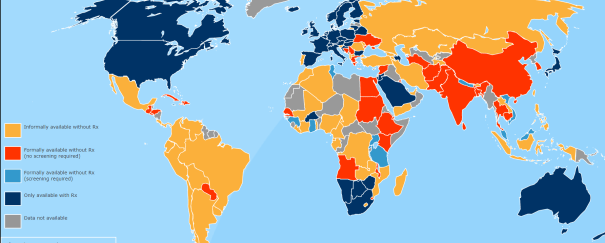
Birth control pills are available without a prescription in most countries of the world. Generally most (but not all) rich countries require a prescription as denoted by dark blue on the map and most (but not all) poor and middle-income nations do not as denoted by the other colors.

Over-regulated rich countries could learn from our poorer friends abroad. For example, women who live along the US-Mexico border frequently buy their birth control pills on the Mexico side of the border because they are cheaper, more convenient, and don’t require an expensive doctor appointment.  As Virginia Postrel says:

Partly because birth-control pills are available only by prescription, people tend to think they’re more dangerous and less well understood than they actually are. In fact, “more is known about the safety of oral contraceptives than has been known about any other drug in the history of medicine,” declared an editorial in the American Journal of Public Health back in 1993. That editorial accompanied an article arguing for over-the-counter sales…. Nearly two decades later, birth-control pills look even safer than they did then, and recent research indicates that women are both able and eager to manage their own purchase decisions.

….Aside from safety, the biggest argument for keeping birth-control pills prescription-only is, to put it bluntly, extortion. The current arrangement forces women to go to the doctor at least once a year, usually submitting to a pelvic exam, if they want this extremely reliable form of contraception. That demand may suit doctors’ paternalist instincts and financial interests, but it doesn’t serve patients’ needs.

….Right now, the American women who have the most choice are those who live near the border with Mexico, where pharmacies sell oral contraceptives without a prescription, generally for about $5 for a one-month supply. A group of researchers [] conducted extensive interviews with more than 1,000 women who live in El Paso, Texas….One result from the El Paso study surprised researchers. “Women who got the pill in clinics were significantly more likely to stop using it during the study — even though they still didn’t want to get pregnant,” Grossman says. That’s a big deal. In fact, he says, “my hope was that we would show that continuation was no worse for the OTC group, but in fact we showed it was better.”

Kevin Drum comments:

It’s not just doctors who resist making oral contraceptives available over the counter. Pharmaceutical companies usually resist it too. After all, it costs them money for extra testing and produces lower profits at the same time, since OTC meds generally have lower margins than prescription meds. That’s a lot of resistance to overcome.

another study done in California …compared continuous use of contraceptives among women who got monthly supplies vs. women who got yearly supplies. Over the following 15 months, the women who got yearly supplies were less likely to run out, less likely to get pregnant, and less likely to have an abortion.

Making oral contraceptives available over the counter might be a good idea, but it’s not something likely to happen any time soon. In the meantime, though, providing women with annual supplies instead of making them visit a clinic or refill their scripts every month might have nearly the same benefit. This would require both doctors and insurance companies to change the way they do business, but given the safety of the drugs and the danger associated with running out, annual prescriptions probably ought to be the default.

Although 99% of American women use birth control at some point, many politicians and religious leaders objected to the Obamacare regulation that birth control be covered by health insurance plans.  Their objections culminated in the the US Supreme Court’s Hobby Lobby decision.  Offering oral birth control over the counter would eliminate the need for them to be covered by health insurance because it would dramatically reduce their cost and increase accessibility. Anna Reisman argues that many other over-the-counter medications like aspirin are more dangerous than birth control and reducing unwanted pregnancy and abortion would do more to improve women’s health than the small risk of adverse side effects that are easily prevented with simple screening done at pharmacies.

[With] the reluctance of religious institutions and hospitals to cover the cost of contraceptive services, the time is ripe for women to make it as easy as possible to get oral contraceptives themselves. The obvious solution is to make the Pill available over the counter. But isn’t that dangerous? Don’t certain oral contraceptives interact in scary ways with other common medications, such as antibiotics? And don’t we need a doctor to help us navigate this complicated maze of information?

Not exactly. First, there are clear guidelines easily available online to determine which women shouldn’t take the Pill at all and which women should have physician oversight. The guidelines are really medical history questions; other than a blood pressure check, a woman can look through the list on her own and determine if she’s a candidate for the Pill. With the combination pill, for example, which contains both estrogen and progestin, women over 35 who smoke and those with chronic medical conditions (including high blood pressure or diabetes, liver disease, specific types of migraines, or a history of blood clots) may be advised not to take the Pill or to take it only with medical supervision. The progestin-only “minipill” can be a good option for women who cannot take an estrogen-containing Pill, since it has fewer risks. User-friendly online guidelines plus a very clear list of risks spelled out on the pill package could make this information easily accessible.  Even serious complications such as blood clots and allergic reactions are not a reason not to make the Pill more easily available. Those are extremely rare, and women would have them whether they got the Pill with a doctor’s prescription or not… In many ways having the Pill available over the counter would make it more effective, not less. While the Pill has an impressively low failure rate on paper—0.3 percent in the first year; in practice, the actual failure rate is about 8 percent. One important—and fixable—reason: missed pills and gaps in prescriptions. Some physicians won’t provide a refill prescription unless a woman comes in for an appointment (with some doctors insisting on an often unnecessary pelvic and Pap in many cases). And so for women who can’t get an appointment when they need one, or lack health insurance and can’t afford to see a doctor, or can’t get time off of work to get to an appointment, the story is sadly familiar: missed pills, less effective backup methods, and unintended pregnancies… Pharmacies in metropolitan Seattle have experimented with [one of several models] of “safe use”—the Direct Access study—of making contraceptives available over the counter, in which community pharmacists were permitted to dispense hormonal contraceptives after a woman completed a self-administered screening tool and had weight and blood pressure measurements; both women and pharmacists were satisfied with this experience. Pharmacists already often counsel patients about medications, so it makes sense that they could also play a key role in helping women choose whether an oral contraceptive over the counter would be a good option.

Fortunately, some states are starting to deregulate the market for hormonal birth control:

8887-02-figure-3


Posted in Health

Optimal pricing of cancer drugs

The Nobel Prize for medicine went to cancer researchers this week who developed immunotherapy drugs that can be miraculously effective, but as Julia Belluz reports, the prize is also a reminder of how expensive the cancer treatments they developed have become:

Getting a cancer immunotherapy treatment costs more than a house in many cities in the US, more than putting a few kids through private college. The average cost of cancer drugs has increased from $50,000 per patient in the mid-1990s to $250,000 today. That’s four times the median US household annual income.

Immunotherapies in particular often cost more than $100,000 per patient. Doctors now use immunotherapies in combination, which means those costs can quickly double or triple. For some of the newest immunotherapies, the price tag is even steeper: When you include the value of the medical support necessary to deliver these treatments, a price tag of $850,000 per patient is not unheard of, according to Emanuel. “The drug companies say that they offer significant discounts to many patients, but because they won’t release this data, the list price is all that we have to go on,” he wrote.

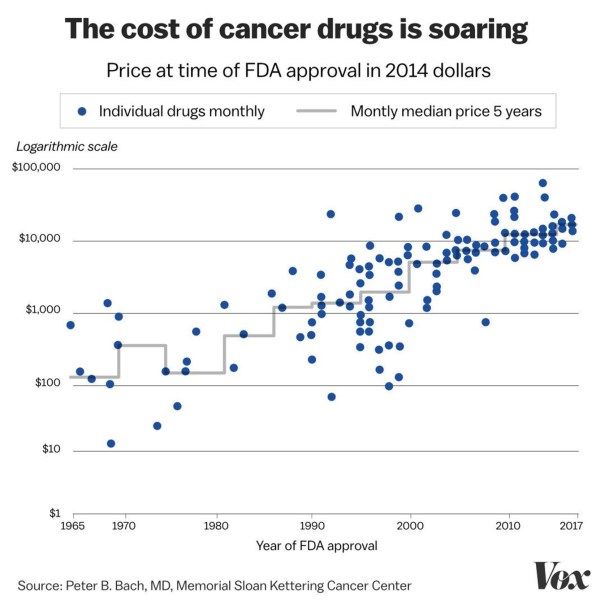
This chart from Peter Bach …says it all.

(Keep in mind that the y-axis here is logarithmic, not linear…) Patients with health insurance can be denied coverage for immunotherapies, even when it’s recommended by their oncologists.

The Washington Post reported on medical trials using a blood cancer drug called Imbruvica. Oncologists discovered that it was just as effective at lower doses than had been standard practice.

The researchers at the Value in Cancer Care Consortium, a nonprofit focused on cutting treatment costs for some of the most expensive drugs, set out to test whether the lower dose was just as effective — and could save patients money.

The researchers saw as a breakthrough because the pill had cost $148,000 per year. But when the manufacturers discovered the new research, they tripled the price per pill:

Within the next three months, the companies will stop making the original 140-milligram capsule, a spokeswoman confirmed. They will instead offer tablets in four strengths — each of which has the same flat price of about $400, or triple the original cost of the pill.

Just as scientific momentum was building to test the effectiveness of lower doses, the new pricing scheme ensures dose reductions won’t save patients money or erode companies’ revenue from selling the drug. In fact, patients who had been doing well on a low dose of the drug would now pay more for their treatment. Those who stay on the dose equivalent to three pills a day won’t see a change in price.

“That got us kind of p—ed off,” said Mark J. Ratain, an oncologist at the University of Chicago Medicine who wrote about the issue in the Cancer Letter, a publication read by oncologists. “We were just in the early stages of planning [a clinical trial] and getting it organized, and thinking about sample size and funding, and we caught wind of what the company was doing.”

Kevin Drum defended the pharmaceutical company, arguing:

what did these oncologists expect? Everyone knows that the price of drugs like Imbruvica doesn’t depend on the cost of actually manufacturing the stuff. Whether it costs a penny a pill or $100 a pill is irrelevant. These drugs are priced to recover their R&D costs based on the number of patients who are likely to use them. …there’s really no argument that the price of a cancer drug should decrease if it turns out you can use less of it. …The pharmaceutical company still has to recover its development costs, and that doesn’t change regardless of how big a dose is typically required.

This isn’t quite correct. First, and most importantly, a for-profit company never does pricing to recover R&D costs. Ever. R&D costs are sunk and for-profit companies price to maximize profits. R&D expenditures are irrelevant for determining pricing, but they are important for determining profit levels and that is important for determining whether a company goes bankrupt or not. But if a drug company goes bankrupt because it cannot repay the loans that financed R&D, then some other company will buy up the patent rights to sell the drugs if it can price the drug over the cost of manufacturing the stuff. That is the second part the Kevin Drum gets wrong. The manufacturing price always influence pricing because for-profit companies care about markup which is the price minus the marginal cost (manufacturing cost in this case). Suppose a company has been getting a $1000 markup, and the manufacturing cost was $200. If the manufacturing cost drops down to $100, the rational thing for a for-profit company to do is drop the price! The mathematical logic is hard to explain in words, but basically, if the profit-maximizing markup was $1000, then it doesn’t suddenly rise to $1100 simply because the manufacturing costs drop. The optimal markup is determined by the elasticity of the demand curve and unless demand is perfectly inelastic for some reason, the company can boost revenues by dropping the price and selling a higher quantity. Now, you could argue that the demand for drugs is very inelastic because people will die without them, but they aren’t perfectly inelastic or for profit companies would earn infinitely much money from selling them. So when for-profit companies get more efficient at manufacturing goods, they increase profits by reducing their selling prices.

Kevin Drum argues that setting the same price per patient regardless of the dosage makes the new pricing scheme fairer:

the new pricing model for Imbruvica may be fairer than the old one. Should a 300-pound person pay more than a 150-pound person just because their body requires a bigger dose? Should people with higher cancer loads pay more than those with lower cancer loads? That’s not at all clear, is it?

It is probably fairer to charge every patient approximately the same amount of money regardless of how much of the drug they acutally take because sicker or bigger patients generally don’t have more money. It is certainly more profitable to price this way. Although it might be fairer to patients, doctors don’t like the new pricing regime because it makes harder and more expensive to change dosages to respond to side effects and patient needs.

But the new regimen could undermine patient safety, Ratain and colleagues argue. People on Imbruvica often need to have their doses adjusted, because it can interact with other drugs. Physicians also may try lower doses when people have trouble tolerating the drug because of side effects, such as extreme joint pain.

The companies said in their statement that a dose exchange program with rapid shipment would allow physicians to make those changes. Under the old regimen, doctors could adjust the dose immediately by telling a patient to take one or two pills a day, instead of three, then return them to the higher dose when necessary. Under the new regimen, physicians will have to initiate a dose-switching protocol that requires paperwork. The phone number physicians have been given to call is only open Monday to Friday during business hours, several oncologists noted.

“I do share their concerns,” said Jennifer Brown, director of the Center for Chronic Lymphocytic Leukemia at the Dana-Farber Cancer Institute, who was not an author of the Cancer Letter paper. “We frequently change the dose of this drug, in relation to drug interactions in particular, and usually we need to do that basically instantaneously.”

Presumably the pills cannot be cut into smaller pieces for some reason or else everyone would just buy the maximum dose and cut the pills down to size. So every time a patient’s dosage is adjusted, another $148,000 set of pills must be bought and the unused pills returned for a refund. That is a lot of administrative expense.

The good thing about these outrageous prices is that they encourage more research to develop more therapies and more Nobel Prizes. The bad things about high prices is obvious to everyone. And prices are the highest in the USA. America accounts for less than 4.3% of the world population, but 45% of the world’s pharmaceutical expenditures in 2016! Americans use fewer drug prescriptions than many rich nations (Japan prescribed 60% more per person), but our prices are much higher which means that the USA provides the global pharmaceutical industry with much more than 45% of their profits. The US is also unusual in that nearly 75% of US drug expenditures went to branded drugs (as opposed to generics) even though 84% of prescriptions in the US specified cheap generics (the highest percent utilization of generics of any rich nation). So the US is paying the majority of the world’s pharmaceutical profits plus a tremendous amount of government-sponsored research in our state universities and grants to research hospitals and that buys a lot of Nobel Prizes.

Posted in Health

Oats, the neglected superfood

Plain, raw oats are the ideal breakfast cereal because they are full of fiber and other nutrients and are cheap and easy to make.  I’m a bit of a raw oatmeal fanatic.  It has been my main staple for breakfast ever since I spent a semester in London in 1989 where I discovered muesli. Muesli is like granola except it is untoasted and the ingredients are loose instead of glued together by sugar and oil into clumps.  Muesli is just a mix of rolled oats (I much prefer quick oats), nuts, seeds, some cereal flakes, and dried fruit.  My favorite brand when I was a student in Europe even had some powdered milk already mixed in:

alpen

Pretty much anywhere I went in Europe, I could go into any convenience store and buy a box of muesli for a nutritious meal that was light weight, non perishable, compact for stowing in a backpack, and cheaper than fast food. I generally tried to eat it with milk (powdered was the most convenient for travel), but when milk was hard to find, it is still fine in a pinch.  Although oats are nutritionally more complete with milk, and I like it a lot better that way, it is still pretty good with just water.  I’ve even used raw oats with Thai curry when we were travelling and ran out of rice and it worked pretty well.

Ever since then, my staple breakfast has been plain, raw rolled oats mixed with fruit, milk, nuts, seeds, and a sprinkle of bran flakes or corn flakes on top (after the milk) for crunch. A bowl of raw (or toasted) oats and seeds tastes great and keeps you full for a long, long time. Quick oats are easier to chew than the old-fashioned or steel-cut oats, and I like to soak my breakfast oats in milk for at least 15 minutes while I shower to make it tastier and easier to chew. I’ve experimented with soaking steel-cut oats overnight to make them chewable.   They eventually gets soft enough to be edible, but steel-cut still too chewy.

Soaked oats taste better and soaking makes their nutrients more bioavailable.  Oats contain a substance called phytate that can block absorbtion of some of the minerals in your oats, but soaking your oats helps decrease phytate and make them more digestible.  Heating also destroys phytate and that is another reason to prefer to eat ‘uncooked’ quick oats because quick oats aren’t truly raw: they are briefly pre-cooked and then dehydrated.  Another advantage of quick oats is that they virtually never go rancid unlike other oats and whole grains.

The Washington Post food columnist, Tamar Haspel, argues that oats are the best superfood on the planetLydia Ramsey says oats pack “the most nutrients per calorie of any of the grains”. Hrefna Palsdottir agrees, “oats are among the most nutrient-dense foods you can eat” and are high in antioxidants called avenanthramides.  Although rice cereal is the most popular first baby food, it is often high in arsenic and oatmeal is healthier.  Harvard’s School of Public Health also recommends oats for their unique nutritional benefits.

The primary type of soluble fiber in oats is beta-glucan, which has been researched to help slow digestion, increase satiety, and suppress appetite. Beta-glucan can bind with cholesterol-rich bile acids in the intestine and transport them through the digestive tract and eventually out of the body. Whole oats also contain plant chemicals called phenolic compounds and phytoestrogens that act as antioxidants to reduce the damaging effects of chronic inflammation that is associated with various diseases like cardiovascular disease and diabetes…

Beta-glucan fiber may help to prevent sharp rises in blood sugar and insulin levels after eating a meal, and may benefit gut health as the fiber is broken down and fermented by intestinal bacteria.

Dietary fiber should be considered a superfood because it reduces heart disease, reduces risk of diabetes, and makes the gut biome healthier which has all sorts of mental health and other benefits science is just beginning to understand.  Fiber is the world’s best food for weight reduction because it is the only food with zero calories that actually makes you healthier while feeling fuller and less hungry.  With all these benefits, you would think that diet-conscious Americans would be loading up on fiber, but Americans have been steadily eating less and less fiber.  The average American only eats half of the recommended amount.

Raw oats are also high in resistant starch at about 24%.  The resistant starch percentage is diminished by cooking, so this is another reason to eat them raw.  Resistant starch is like a kind of fiber in its digestibility and is particularly good as a prebiotic for encouraging healthy gut flora. A single cup of raw oats gives about 16g of resistant starch which is approaching the amount needed to observe physiological effects.

Oats have a higher protein content of 11–17 % compared with other grains like wheat, rice, or corn and because oats are also one of the less expensive grains, that means that they are one of the very cheapest sources of protein that you can buy.  Oat protein is a relatively complete protein that is rich in high-quality branched-chain amino acids, at about 17-18% of the protein and its amino acid profile pairs particularly well with milk.  Combined with a cup of milk and the ground-up seeds that I put on my oats, I’m getting about 35g of protein for breakfast which is over 60% of my recommended daily protein just from my bowl of cereal each morning.

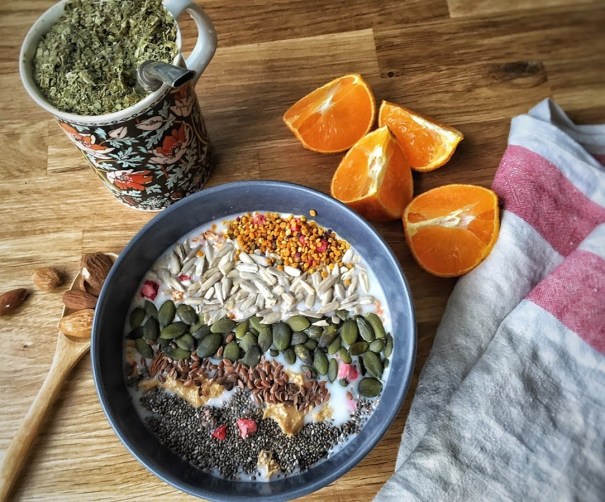
This is what it looks like when miniature Nordic walkers traverse my superbreakfast:

My current practice is to soak chia seeds, quick oats, and raisins for about 15 minutes while I’m getting ready in the morning. Then I slightly grind sunflower seeds, flax seeds, and pumpkin seeds in a “coffee grinder” that only grinds seeds. I grind them fresh every morning because seeds go stale quickly after they are ground up and their oils begin to oxidize whereas whole raw seeds are living creatures that are designed by nature to last for years. I prefer to only partially grind the seeds because I prefer to keep the texture of some small pieces of seeds that makes it a bit chewy.  Over-grinding creates a powder which can gets gooey in milk. For the same reason, I don’t soak ground flax seeds because they develop texture that becomes too gummy for my tastes, but I like the texture of soaked chia seeds.  Hemp seeds are too soft to need grinding and they taste best without soaking.  Almond slivers and crushed walnuts are good no matter how you add them.

Fruit can be added at any time. This is what my breakfast would look like if I didn’t grind up my seeds before pouring them on top of my oats:

One reason I prefer not to cook my oats is that it keeps me full a lot longer than cooked oatmeal.  Raw oats don’t digest nearly as quickly, so I don’t get hungry a few hours later.  In fact, I routinely skip lunch after my superbreakfast. Although a 3/4 cup serving of raw oats has more than double the potential calories of the same size serving of cooked oats, the cooked oats digest more completely and more quickly, so you don’t necessarily actually digest double the calories from the raw oats and it takes a lot longer.  Similarly, keeping the seeds ground up a bit coarse helps them digest more slowly too.

Another reason to prefer raw oats is FODMAPs which cause indigestion for many people. Monash University rates uncooked oats as being low FODMAPs whereas cooked oats have moderate amounts.  This is probably because cooking pre-digests food so that it is absorbed more quickly.   Raw oats should be much better for people who are sensitive to FODMAPs.

Unfortunately, oats are increasingly being contaminated by Roundup because of changing agricultural processes, so it is probably worth paying a few cents extra to get organic oats nowadays.  Most Roundup is sprayed on genetically modified crops, but that isn’t the problem with oats because with GMO crops, the Roundup is sprayed when the crop is young and it biodegrades fairly rapidly so that by the time the crop is harvested, there is hardly a trace in the food.  Unfortunately, the Environmental Working Group has found that most conventionally-grown oats have had high levels of Roundup (AKA Glyphosate) because chemical corporations found a new way to use Roundup:

Increasingly, glyphosate is also sprayed just before harvest on wheat, barley, oats and beans that are not genetically engineered. Glyphosate kills the crop, drying it out so that it can be harvested sooner than if the plant were allowed to die naturally.

That is the absolute worst time to spray pesticides on crops.  It guarantees that the chemicals will persist on your food after harvest and Roundup causes cancer.

But organic oats never use pesticides and even organic oats are super cheap. They have one of the highest ratios of nutritional value per dollar that you can buy.  Plus it makes a super tasty and convenient meal that is nutritionally dense and if you add a few seeds and a little fruit, it is nutritionally complete. It is also nonperishable and portable so when I am on a long trip, I always like to bring a little bag of my homemade muesli mix (with dried fruit and milk powder pre-mixed in) for a quick meal anywhere, anytime.

Posted in Personal (not econ)

Democratic corporate governance

Are corporations authoritarian or democratic?  Corporations are hierarchical institutions in which workers often feel like they are working within a communist dictatorship, but compared with privately-held companies, corporations are extremely democratic.  A privately-held company can be owned by one person who calls all the shots whereas a public corporation is usually owned by thousands or even millions of people who in theory should have a democratic voice in how the corporation is governed.

Most people don’t think of a corporation as a form of democracy because corporate democracy violates the democratic ideal of one-person, one-vote.  Corporations are plutocratic democracies where wealthier people get more votes.  Each shareholder votes as many times as the number of shares she has.

Just as mass democracies could not exist before the spread of literacy and cheap communication that Gutenberg’s printing press brought about, corporations were impossible for all of history for the same reason.  It was simply impossible to communicate with numerous voters who were spread across a wide geographic area.  Even for shareholders with non-voting shares, information flow is crucial because they can still vote with their feet and sell shares in a company that is making bad decisions.  It would be irrational to buy shares in a company that doesn’t communicate well about what it is doing.

This requires accounting and which was unknown until the printing press could first spread what was one of the first bestselling management self-help books.  It was Luca de Pacioli’a Summa de Arithmetica which introduced double-entry bookkeeping to the world for the first time. It seems to have developed in a few Renaissance cities in northern Italy over the prior two centuries, but it immediately spread widely across Europe after this book was published.  The book not only spread the foundations of accounting, but also some radical changes in mathematics such as the concepts of negative numbers, zero, and the Arabic numerals that gradually replaced Roman numerals across the West along with the new math called algebra that the the Arabic numbers represented.

Before the printing press it was difficult to communicate mathematics and accounting information to a large population because copying errors are too common in other methods of reproducing information.  The printing press enabled the spread of accounting standards that could be used the same way everywhere and without those accounting standards and the means to accurately communicate accounting information, corporations could not exist.

Glyn Holton noticed that early forms of corporations first appeared in nations that had democratic governments.  The earliest progenitors of the modern for-profit corporation were the publicani of the Roman Republic which were phased out when Rome abandoned democracy and became an empire.  A similar corporate structure later arose in the democratic city states of northern Italy such as the Genovese maone.  The first stock exchange was set up in the Dutch Republic and were soon copied by their democratic neighbors across the English channel.  Could it be a coincidence that so many of the earliest examples of republican governments also set up republican forms of business?

But just as there are many forms of democratic governments (parliamentary, presidential, electoral college, direct vs. representative, etc.) there are many possible forms of corporate government that are dictated by the laws of the countries where the corporations are chartered.  One of the big differences is whether other stakeholders besides shareholders have any votes or representation on the board.  The US is unusual in that our government gives exclusive sovereignty to shareholders.  In many countries other stakeholders also share power on corporate boards such as employees, creditors (usually banks), and/or government representatives.  For example, most OECD nations require some amount of codetermination whereby employees are guaranteed representation on corporate boards.  Germany decided that banks have the right to representation on corporate boards when corporations borrow a lot of money from them.  In China, the Communist tradition has always given the government considerable direct power over the management of large corporations partly because the government owns shares in most large companies among other mechanisms.

Justin Fox examined how it has worked to put workers on corporate boards in Germany in order to asses how it might work in America.

one of the world’s most successful capitalist nations, Germany, currently requires 50 percent employee representation on the supervisory boards of large corporations, and …most countries in the European Union now also encourage or require some such form of employee “co-determination.”.. How did German corporations end up giving all those board seats to employees?  … The short answer is that in the aftermath of World War II the managers and owners of Germany’s large industrial concerns were discredited, with some headed for trial in Nuremberg as war criminals, while the country’s trade unions, which had been banned by Adolf Hitler in 1933, were considered by the Allied occupying forces to be free of Nazi taint. The most heavily industrialized part of the country was in the hands of the British, who were in the process of nationalizing several major industries back home and were inclined to do the same in Germany. Having experienced de-facto nationalization under the Nazis, though, the leader of the union movement in the British zone …pushed instead for negotiated deals with company owners to give workers equal board representation. Greatly preferring this to nationalization, several big iron and steel concerns in the British zone assented.

It helped that German businesses and workers already had some experience with co-determination. It had been a major if inconclusive topic of debate at the country’s first democratic assembly, the short-lived Frankfurt Parliament of 1848 and 1849, and in subsequent decades German business owners experimented with various systems to give workers a voice in company affairs, mainly in the form of employee-chosen “works councils” that deliberated over workplace conditions. In 1916, wartime labor shortages led to a law that required every adult male in the country to work but also required employers of 50 or more to institute works councils. At the Great War’s end, unions and employer groups agreed to make the councils permanent. This was ratified into law in 1920; a year later the Weimar government followed up with a requirement that workers get one or two seats on company supervisory boards, depending on board size… After the war… West Germans elected their first government in 1949, and Christian-Democratic Chancellor Konrad Adenauer soon moved to make co-determination the law of the land for companies in the coal, iron and steel industries … with more than 1,000 employees. That legislation was enacted in 1951. … In the 1960s, the union movement renewed its push for full co-determination. Business leaders were vocally, often histrionically opposed — the left-leaning Der Spiegel ran a cover story in 1968 ironically titled “Co-Determination: End of the Market Economy?” — but the mostly positive experience of the iron and steel industry and the election in 1969 of Germany’s first Social-Democratic chancellor since 1930 (Willy Brandt) eventually led to the Co-Determination Law of 1976, which requires almost all German firms of more than 2,000 employees to have half their supervisory boards chosen by employee vote.

In a 1979 paper that hasn’t aged well, American economists Michael Jensen and William Meckling — the scholars probably most responsible for the widely held belief in the U.S. that the sole role of the corporation is to maximize shareholder returns — predicted that the new German law would turn out to be either irrelevant, as weak and divided worker representation allowed shareholders to continue to exercise “complete control over the affairs of the firm,” or transform the German economy into a “Yugoslav-type system” characterized by underinvestment, stalling growth and heavy government interference.

Neither happened. German corporate governance is markedly different from the Anglo-American variety, with German companies seemingly placing more weight on worker concerns like job security and less on short-term shareholder value maximization. But the German economy hasn’t stalled; in fact, the country’s annualized growth in real per-capita gross domestic product since 1976 (1.8 percent) has been a smidge faster than that of the U.S. (1.7 percent).

And Justin Fox follows up by explaining the history of how this kind of democratic capitalism where labor and management jointly decided policies had evolved in the US, but was squashed by laws that were ironically intended to help private labor unions (as opposed to the sort of company worker organizations that used to help run companies):

…The U.S., it turns out, also used to have entities much like works councils, which went under names like “employee representation plans,” “company unions” and just plain “industrial democracy.” They came into vogue later than in Germany, but constituted a major movement from about 1915 through 1935, when Congress put a stop to them …

In the late 1800s, as European workers joined forces in labor unions and some European employers strove to amplify workers’ voices, the U.S. remained uniquely hostile to all forms of worker organization. …The U.S. government in those days was spectacularly corrupt, and industrialists and financiers had far more money than anyone else with which to corrupt it.

Although the courts and law enforcement remained reliably on the side of business owners and against attempts to organize workers well into the 20th century, the political and intellectual tides in the U.S. began to shift in the 1890s. The first significant business experiment in giving workers a voice in the U.S. began in that decade as well.

This occurred at Filene’s, the Boston department store, where company president Edward Filene in 1898 enlisted a committee of employees to help administer an insurance plan and medical clinic. By 1905 the employee-run Filene Cooperative Association was not only running benefit programs but also had the right to change any store rule by a two-thirds vote. The association’s arbitration board adjudicated disputes between management and workers, ruling against management 46 percent of the time, while an accountant hired by the association pored over the company’s books to make sure they were on the up and up.

Filene, … seems to have been concerned mainly with motivating his workers and making their jobs more fulfilling. For a lot of the other company executives who started works councils in subsequent years, fending off unionization was a top priority.

The most famous works council plan was instituted in 1915 at Colorado Fuel and Iron Co., then the nation’s second-largest steelmaker. After company efforts to break a coal miners’ strike led to the notorious 1914 “Ludlow massacre,” John D. Rockefeller Jr., whose family was CFI’s biggest shareholder, turned to Canadian labor relations expert and future prime minister Mackenzie King for help. King devised a system of elected employee representation that became known as the Rockefeller Plan and was widely imitated.

The combination of wartime labor shortages and the first overtly union-friendly presidential administration led to big gains for both organized labor and works councils during World War I. Amid labor unrest in 1918, President Woodrow Wilson created the National War Labor Board to adjudicate company-labor disputes, and the board frequently pushed companies to create works councils as part of the labor deals it devised. While the pressure from Washington eased soon after that, works councils and company unions kept being formed. By 1926, according to labor historian Greg Patmore, there were 432 U.S. companies with employee representation plans covering almost 1.4 million workers…

My favorite among the employee representation approaches was what became known as the Leitch Plan. Stockyard-worker-turned-business-guru John Leitch wrote an entertaining 1919 book about it, “Man to Man: The Story of Industrial Democracy,” which describes production workers electing a House of Representatives and foremen and other middle managers electing a Senate, with this legislature empowered to propose workplace changes to a cabinet composed of top management. At Goodyear Tire and Rubber Co., which seems to have implemented its plan without any help from Leitch, production workers elected both House and Senate, and in 1922 those two bodies voted workers a 15 percent pay raise, then successfully overrode a cabinet veto.

Even at the companies most enthusiastic about worker participation, though, there was still the awkward question of who really called the shots. “Capital and labor are not alike,” Leitch wrote. “They travel the same road up to the division of profits; there the road forks and we do not yet know just how the profits may reasonably be divided.” At Filene’s, younger brother Lincoln Filene finally got fed up with the way Edward was dividing the profits and united with other shareholders to seize control of the company in 1928 and merge it with the Federated Department Store chain (now Macy’s Inc.). …

The political equation changed too, as a Democratic Party committed to empowering independent trade unions — and suspicious of company unions — took power in Washington after the 1932 elections… [They] pushed through a National Labor Relations Act [NLRA] in 1935… arguing that company unions made “a sham of equal bargaining power,” his legislation no longer allowed employers “to dominate or interfere with the formation or administration of any labor organization or contribute financial or other support to it.”

…Arms-length negotiations between corporations and unions became the rule, big increases in unionization followed, and big pay increases for working Americans followed that. For a long time, labor economists and historians adjudged this to have been the right move for workers. Since the 1980s, though, revisionist scholars have been showing that some company unions actually did a pretty good job of promoting both employee well-being and company productivity. And with unions now absent from most of U.S. economic life — only 6.5 percent of private-sector workers belonged to one in 2017 — the lack of any kind of organized worker representation today is glaring…

In 1994, a commission appointed by Commerce Secretary Ron Brown and Labor Secretary Robert Reich recommended that Congress revisit the NLRA to provide a safe harbor for employee involvement programs. The next year, the Republican-majority House and Senate did just that with the Teamwork for Employees and Managers Act of 1995, but in the face of opposition from organized labor, President Bill Clinton (Brown’s and Reich’s boss), vetoed it…

Recently there have been proposals in the US to once again make it easier for employees to go back on US corporate boards and although wealthy CEOs don’t like this idea because workers don’t vote for higher CEO pay as much as the typical board crony.  Workers also have more inside information than the typical outside board member, so workers can hold CEOs accountable in ways that ordinary outside board members cannot.  Workers have more inside knowledge about what is happening in a company because they are in the company year round and know hundreds of other workers.  Ordinary board members are outsiders who only know a few top managers (and are often their cronies) because they only visit for board meetings a few times per year.  It is definitely good to have some outside experts on a corporate board, but employees certainly have additional information that is useful for decision making too and they have a different perspective because they have more of their portfolio at stake in a company than most outsiders. Having employees on the board can also improve the morale of employees and improve communication between management and employees.  That is why corporate owners have invited employees to join the board at many times in history both in America and abroad.  The US made this illegal in 1935, but it is time to revisit that ban and give US corporations more freedom to include workers on their boards of directors.

One of the pathologies of American corporate culture is the commonplace antipathy between management and labor.  These people need to work together and a team in symbiosis for the company to be successful, but the artificial dichotomy between management and labor has often created a culture of mistrust or even mutual hatred within corporations in America.  Codetermination increases communication and blurs the artificial line between management and labor and can create the kind of synergy that is more commonly seen in successful Japanese and German manufacturers.

Employee representation on corporate boards even works well when taken to the extreme where corporations are entirely employee owned.  Worker-owned companies are often structured as cooperatives and some countries like Costa Rica have policies that encourage cooperative employee ownership. Costa Rica’s economic model seems to have worked better than most of its neighbors.   If purely employee-run corporations can work well, then surely a tiny bit more balance between owners and workers would also work in America.  One of the advantages of a democracy is the greater ability to aggregate the information and wisdom of the crowds.  Including a few employees on corporate boards would bring in new sources of information and hopefully lead to wiser leadership and maybe reduce some of the perennial tensions between management and labor.

Posted in Labor, Managerial Micro, Public Finance

PBM: The healthcare bureaucrats that you have probably never heard of.

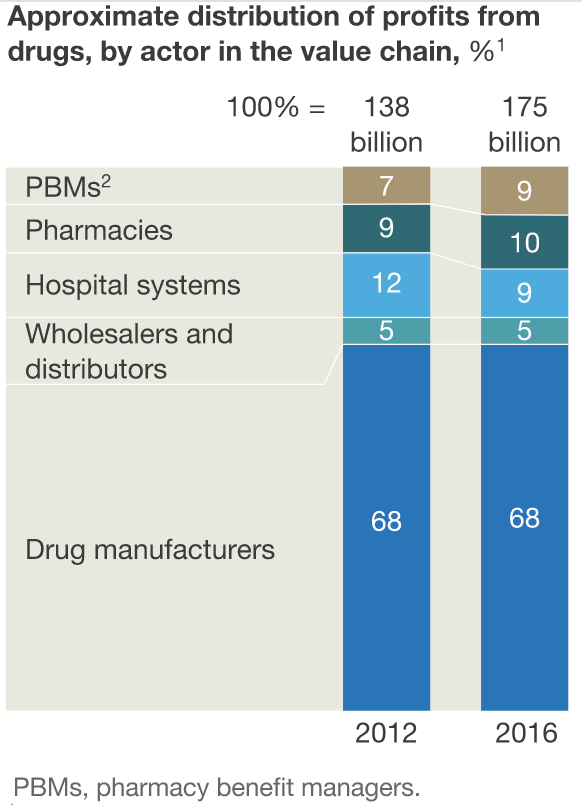
Most people have never heard of a Pharmacy Benefit Management company (PBM), but a PBM probably has tremendous control over the kinds of medicines you are prescribed and sets the prices you pay for them. It has been one of the fastest growing sectors in healthcare since 2000 and they are so new and so buried within our health administration bureaucracy that most people have no idea how important they have become.  According to The Pharmacy Times, “the top 3 PBMs within the country manage the drug benefits for approximately 95% of the US population or 253 million American lives.” Mckinsey shows how fast PBMs grew over just four years and how they ate away at the revenues of hospitals as they reshaped the pharmaceutical marketplace:

PBMs and retail pharmacies captured a greater share of total profits from the pharmaceutical value chain in 2016 than in 2012… This increase came almost entirely at the expense of hospital systems’ share of profits from drugs; manufacturers were largely able to maintain their share. During this time, hospitals saw their margins from drug sales decline by almost 30%. Hospital spending on drugs grew by 7% to 11% per year, far outstripping growth in reimbursements from both commercial and government payers

PBMs are middlemen between the insurance companies (and sometimes individual patients) who pay for drugs, the medical practices who prescribe them, the pharmaceutical manufacturers who make them and the retail pharmacies that distribute the drugs to patients. PBMs make money in 3 main ways: 1) rebates; 2) administrative fees; and 3) pharmacy spread:

  1. A rebate is a fee (or bribe if you are less charitable) that a pharmaceutical manufacturer pays a PBM for including a drug on an insurance plan or hospital formulary. This is a surprisingly big part of the industry:

    Approximately one-third of the net price paid for prescription drugs is traceable to these rebates and, as a result, consumers may already be paying one-third more from rebates alone.6 In addition, patients are often forced to switch their drug therapy based upon these rebates that dictate the plan’s formulary regardless of their efficacy. If patients or their providers want the patient to stay on the original drug therapy, then they are forced to obtain a prior authorization before the PBM will authorize coverage for the drug product. This practice is alarming since a patient’s drug therapy may be interrupted as a result and can lead to patient harm.

  2. An administrative fee is charged to the insurance company or hospital for managing the plan’s formulary.
  3. The pharmacy spread is the gap between what the patient and/or insurance company pays for a drug and the price that the PBM has negotiated with a particular pharmacy.

PBMs are paid by insurance companies to negotiate for lower prices from pharmacies and select the most cost effective drugs for any particular treatment (the formulary). Most countries have national treatment guidelines and/or formulary manuals, but in the US there is no national best practice and formularies are fragmented: each hospital and/or insurance plan can have a different formulary. PBMs help them figure out what drugs are the most cost effective for treating different diseases which is also dependent upon how cheaply the PBM can get each drug by negotiating a bulk discount from pharmacies. PBMs generally create formularies with different tiers of pricing. For example, a formulary for an insurance company typically has drugs that are not covered at all, drugs that have higher percent of the cost paid by the insurer (typically generic drugs), and drugs for which the insurer pays a lower percentage to discourage their use.

PBMs also help hospitals create formularies and there are sometimes problems when patients are given one drug in the hospital as dictated by the hospital formulary and then have a different formulary for outpatient care and have to switch medications after discharge.

In addition to these problems, unfortunately, the business model of PBMs is badly aligned with the interests of society, so it is unlikely that they make the kind of rational cost-benefit analysis in selecting formularies and pricing that would lead to the healthiest population for the amount of spending that we do.  For example, PBMs make money from insurance companies for saving them money on drugs, not for providing quality care and so PBMs are blamed for causing delays such as, “Nurses spend 16 hours on the phone, medications take months to arrive, and patients suffer as they wait.”

Their first and third sources of revenues listed above give them perverse incentives to put profits over patients.  First, they take bribes from drug manufacturers to skew their formularies in favor of manufacturers who pay the biggest bribe rather than selecting the most cost effective drug.  That should be illegal and if you want to argue (as in the Citizens United ruling) that corporations are people and money is their main form of speech which cannot be banned due to the constitutional right to freedom of speech, then at least they shouldn’t be doing it under the table.  We deserve to at least know who is buying influence over us by “speaking” with cash and how big a part of the PBMs’ budget is coming from different manufacturers.  The PBMs’ third revenue stream is having patients pay more for drugs than the price the PBM negotiated with the pharmacy.  This gives the PBMs zero incentive to pass on lower prices to consumers. I have sometimes found that the regular retail price for people without insurance was lower than the “discount” price my insurance company’s PBM has negotiated.  That either means that my company’s PBM is utterly incompetent at negotiating prices or else they are skimming a healthy profit by getting people like me to pay a higher that normal price from the pharmacy and getting a kickback.  It is always worth checking both the regular retail price and your insurance company’s “discount” price when you buy drugs.  Otherwise you won’t know how well your PBM is doing its job.

PBMs get discounted drugs because they have more negotiating power because they negotiate for millions of patients. If you try to negotiate a lower price as an individual, sellers will laugh at you because you have no negotiating clout. You are a price taker. But if you could band together with a million other patients in a kind of consumer’s union, you would have a lot of market power to demand lower prices for the group. PBMs buy more drugs than individual hospitals or even insurance plans, so they can negotiate cheaper prices. That is one way PBMs make money. In fact, PBMs are so anxious to get more patients in their network, some will let you join their discount plan for free. I actually tried this. I bought a vaccine last year with a free “discount drug card” that gave me a lower price than what I would have paid through my insurance (which uses some other PBM).  Ironically those free PBM discount cards may have more incentive to lower prices than your insurance company’s PBM because if you get insurance from your employer, you are a captive customer whereas the PBMs that give out free cards at least face some competition and have to have some reputation for negotiating better prices or nobody will bother joining.

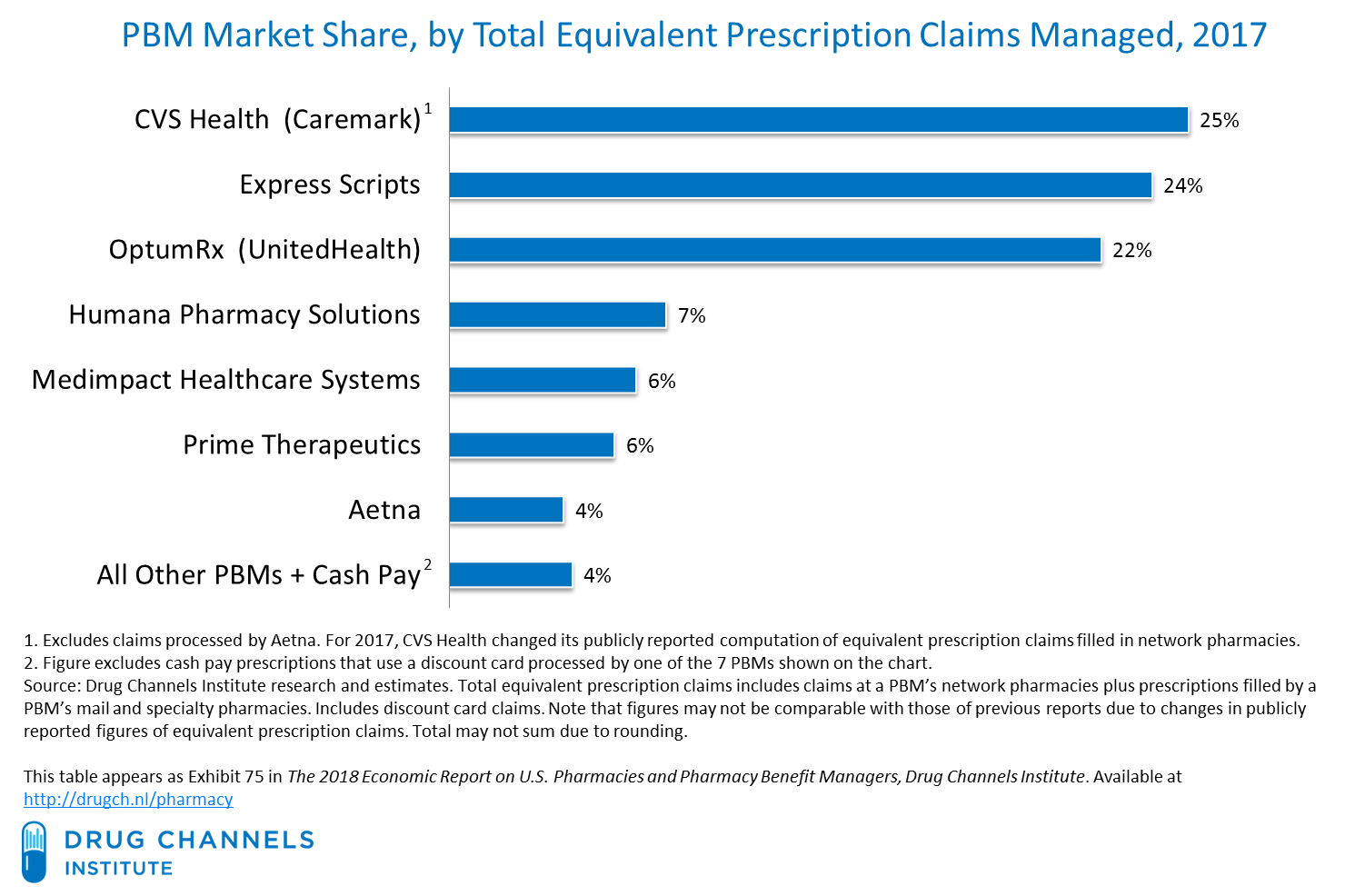
Because bigger PBMs have more negotiating power, smaller PBMs are at a disadvantage. That is why three PBMs already dominate the entire market. The top three companies already covered 75% to 80% of Americans in 2014.  They represent three very different types of company according to Cole Werble at Health Affairs:

The current top-three firms represent three different models: the standalone PBM (Express Scripts); the PBM aligned with a major retail drugstore (CVS Health); and a PBM associated with a major health insurer (OptumRx, UnitedHealth Group).

Adam Fein has a graph showing the dominance of these top three companies:

PBM_Market_Share.pngAt this point already, all the pharmacies other than CVS just have two big independent PBMs that they can work with and all the health insurers other than UnitedHealth also just have two big independent PBMs. I predict that Walgreens (the second largest pharmacy retailer after CVS mentioned above) will try to acquire PBM capacity too to cut out that middleman and Anthem (the second biggest health insurer after United Health mentioned above) will try to acquire with a PBM for the same reason. But Walmart (the third biggest pharmacy retailer) and even Amazon will probably be trying to squeeze the PBM industry too. Mckinsey predicts that the pharmaceutical market is ripe for disruption by online retail and Amazon will soon try to disrupt it:

The threat of technology-driven disruption of the pharmaceutical value chain is also becoming real. This threat made headlines with Amazon’s apparent intention to enter the market, as reflected in its hiring of pharmacy professionals in May 2017 and its acquisition of wholesale drug, medical device, and supply licenses in at least 12 states by October 2017.15 Retail pharmacies are already acutely aware of the potential of technology-driven disruption, as front-of-store pharmacy revenues have been virtually flat since 2012 due to the digital transformation of the retail industry. (The pharmacies have experienced revenue growth below 1% for general merchandise and 2% for over-the-counter medications; the comparable numbers in the overall US market are about 2% and 4%, respectively.16 ) Although the opportunities for Amazon or a similar technology entrant are significant, so are the challenges.

Several primary arguments underlie the belief that such a company could successfully disrupt the pharmaceutical value chain. First, the size and attractiveness of the market ($500 billion in revenues) could warrant aggressive investment. Indeed, pharmacy is the second-largest retail category in the United States and the only large category in which Amazon does not yet have a meaningful presence. Second, the economic spread across the value chain is large and could be ripe for potential disruption. Nearly $100 billion in gross margins are being retained by intermediaries across the pharmacy value chain. Finally, evidence exists that demand for direct purchasing of drugs online by consumers could be on the rise.

One of the big problems of the PBM industry is that they reduce price transparency.  Each person buying drugs gets a different price depending on what their PBM has negotiated.  That makes it difficult to comparison shop because there isn’t a single price that everyone pays.  Each customer has to give their insurance card (or separate PBM discount card) to a pharmacist and ask for their customized price.  Hopefully, the advent of online drug retailers of will reduce that problem by making prices easier to comparison shop.

Another barrier to comparison shopping that has arisen during in the PMB era is the decline of universally transferable prescriptions.  In the twentieth century, doctors gave patients paper prescriptions that they could take anywhere which made it easy to comparison shop.  Nowadays my doctors usually want to send a single electronic prescription to a single retailer which locks me in and makes it hard to comparison shop.  If you find that your pharmacy has ridiculous prices you have to go back to your doctor and request another electronic prescription.  It would be simple in the information age to have a transferable electronic prescription that worked better than the old paper system, but the people who have designed our electronic prescription system have made it more profitable for the pharmaceutical industry by reducing consumer power.  Are PBMs partly to blame?  Well they call themselves the managers of our pharmaceutical benefits and they took over this role shortly before the transition to the electronic system.  If they wanted a better electronic system that gave consumers as much flexibility as the old system, they have a lot of behind-the-scenes power to manage how pharmaceuticals are sold.

This power has made them a lot of enemies.  The drug manufacturers blame them for inflating drug costs and  creating and “unfair”, “complex” and “opaque” system with “broken incentives”.  The American Prospect magazine agrees and argues that hospitals and pharmaceutical retailers haven’t been able to do anything about the problem because PBMs have acquired so much monopoly power over the industry.  For example, CVS is using the monopoly power of its enormous PBM to put small mom-and-pop pharmacies out of business and then they buy up the closing pharmacies for cheap.  This is what happened to my local pharmacy in Bluffton Ohio last year. Health Affairs magazine also agrees about the evils of PBMs and Michael Carrier wrote an editorial there suggesting several possible ways the government could fix the system with regulatory changes. 

Posted in Health

Progress often means cheaper, not necessarily better

The best clothing you can get is “bespoke” clothing. Bespoke clothing is sewn by hand to fit each individual and because it is custom made, it can be designed with exactly the kind of cloth, colors, and shape that you want. If a design isn’t quite right, it is altered by hand to fit, feel, and look better.

One of the first big sources of economic development was the industrial revolution which automated this process and mass produced clothing that is much, much cheaper and a little worse. Mass produced clothing rarely fits as well as bespoke clothing and isn’t infinitely customizable. In fact it is worse in every way except that it is way, way cheaper. That is why economic progress has almost entirely wiped out the bespoke clothing industry and replaced it with inferior mass produced clothing. There are many examples of industrial products that are a little worse than the products they replaced except that they cost a lot less. Frozen dinners are worse than restaurant (or home cooked) food, but cost a lot less money (or time). Video on demand is generally worse than a movie theater, except that it is cheaper to watch at home. Ikea furniture is generally worse than custom furniture, but it is really cheap.  Recorded music is worse quality than a live concert, but cheaper music is better than live performance most of the time. 

In world war II the Americans made “liberty ships” which were cheap and slow, because a “disposable” ship was best when lots of cargo ships were getting sunk anyhow.  Similarly, cheap guns are often better during wartime than expensive, fancy guns.  The AK-47 is the most popular gun of all time not because it is the best, but because it gives the biggest bang per buck. 

There is potential for a similar effect in medicine. We have numerous technologies that can save a life for $5million, but many people are dying of illnesses can could be cured for less than that because they cannot afford the high cost of health insurance. Suppose we have a drug that can cure a rare cancer that afflicts 1,000 people per year. The drug costs $200,000 per treatment and cures a little more than half of the people with the cancer. Specifically it cures 510 of the 1,000 people who get the cancer. That is a bargain compared with the treatments that cost $5million to save lives.

Then researchers develop a new treatment for the same cancer that isn’t quite as effective because it would only save 500 lives rather than 510 lives, but it costs half as much at $100,000 per treatment. Should the healthcare system adopt the new treatment because it is cheaper? That would cause 10 more people to die of the cancer per year, but it could actually save at least 20 lives because the resources could save twice as many lives if they were directed to more cost-effective treatments in an economy where few people can afford to spend $5million to save a life.

The total cost of the first treatment is $200,000,000 because 1,000 people are each getting a treatment that costs $200,000. The total cost of the new treatment is $100,000,000 because it costs half as much to cost each person. Thus, adopting the new treatment would save a total of $100,000,000. The marginal benefit of the new treatment is just ten lives saved, so $100,000,000/10 = $10 million per life saved. When a healthcare system spends $10 million per life, it drives up the average costs of health insurance which causes people to go uninsured because they cannot afford it and that is how expensive treatments kill people.

The new drug is so much more cost effective than the old drug, that it would save lives to let ten more people die of cancer so that at least 20 more people can be saved by spending the savings on treating other people with existing technologies that cost less than $5million per life saved. More details in the video below.

A lot of Americans die of diseases that would cost less than $5million to treat because they do not have decent health insurance and lack access to cost-effective care such as preventative prenatal care, vaccines, and inexpensive treatments because the American healthcare system is extremely expensive and aimed at elites who want the highest quality without regard for the cost.

We haven’t been willing enough to look for slightly worse treatments that are a whole lot cheaper. In fact, the existence of medical organizations that license doctors and nurses and other providers is one reason why cheaper options are not explored. The licensing organizations keep trying to raise the quality of medical providers to justify higher wages and lobby to make cheaper alternatives illegal.

The whole point of licensing is to raise quality and eliminate competition from cheaper alternatives. If you go to the dentist regularly to get your teeth cleaned, you’ve probably noticed that the dentist doesn’t actually clean your teeth. A dental hygenist does. So why don’t the hygenists band together and cut out the dentist? Well, in most states they can’t because of lobbying by dentists:

many states have regulations preventing dental hygienists from practicing without the supervision of a dentist. Dentists have an average of six years more schooling than a hygienists, who on average have 2.6 years of post high-school education. In addition, dentists make on average $100 an hour, and are 80% male, whereas hygiensts are 97% female and make around $37 an hour. Kleiner and Park find that these regulations transfer $1.5 billion dollars a year from hygiensts to dentists. This is a highly regressive transfer to a male dominated, higher educated, higher paid job from a female dominated, lower educated, lower paid job. In a very similar vein with likely similar impacts, many states restrict the ability of nurses to practice without the supervision of doctors. In fact these regulations are currently growing as regulators rush to restrict the number nurses working in retail health clinics in a variety of ways to prevent them from competing with doctors.

Not only does forcing hygenists to be “supervised” by a dentist raise the price of routine tooth-cleaning, it also raises the price of dental health services that really do require a dentist’s skill and training since it induces dentists to spend a share of each day shaking hands with patients who don’t need their expertise. This creates artificial scarcity in the supply of high-end dental services.

The bigger issue — though harder to estimate — is the way that these rules stifle potentially enormous gains from organizational innovation. Imagine a world in which in order to make clothes you needed a license from the State Board of Tailors, and the tailor lobby manages to persuade the state to extend the tailor’s monopoly by saying that to sell clothing you need to be under the supervision of a tailor. This set of rules doesn’t just reduce competition in the fields of clothing manufacturing and retailing. It prevents the technological and organizational innovations that have brought us mass-produced clothing, and retail chains. The cartel would justify its existence in the name of high-quality and consumer protection. And it’s even true that if we all went to work in handmade shirts and bespoke suits that we’d be wearing higher-quality clothing. But the impact on overall living standards would be devastating. There’s no H&M; or Ikea of the health care sector, and there never will be without some relaxation of the rules governing who’s allowed to be a provider of health care services.

Progress doesn’t always mean better quality products. Often it means slightly worse products that are a lot less expensive. Less stringent licensure could be worth some reduction in mandated minimum quality because costs would drop and Americans could afford more health care.

As you can see from Imagur’s graph of average salary data in the US, healthcare occupations (in bright pink) have some of the highest incomes.  One reason is the excessive scarcity imposed by licensure regulations.  Lots of Americans resent CEOs for their high salaries (the top green bar below), but the average specialist physician makes more money than the average CEO!

(If you look at the full occupation graph, you’ll see that there are also a lot of the pinkish occupations near the bottom of the graphic, but that isn’t healthcare workers.  It is a confusing color scheme. A slightly more purple shade of pink represents entertainers and media producers near the bottom.)

The COVID epidemic gave another example where cheaper and lower quality could actually be better. The FDA was slow to give approval for $2 instant paper COVID tests because they were not as accurate as the PCR tests (that generally cost >>$100), but the there weren’t enough PCR tests anyhow and instant tests could have helped fill the gap. Plus the PCR tests are so slow for most Americans that they were not very helpful for slowing the disease since many people don’t get results until after they were no longer infectious. Finally, the PCR tests are highly accurate at detecting the COVID RNA, but many people who still have trace amounts of COVID RNA are no longer infectious. The paper test is the most accurate for people with high viral loads who are truly infectious. The more infectious, someone is, the more likely it is that the paper test will give an accurate positive result. America might have been better off giving a $2 instant test every week all year to all Americans (costing about $100) and doing one less PCR test per person (saving about $100).

New products make old products obsolete even when the new product is a bit worse quality IF the new product is a whole lot cheaper.

Posted in Health, Managerial Micro, Public Finance

Enter your email address to follow this blog and receive notifications of new posts by email.

Join 75 other subscribers
Blog Archive
Pages