Why I was wrong about the coming collapse of Obamacare

I’ve been teaching the conventional wisdom which says that a Bismarck-style universal health insurance program like Romneycare and Obamacare is like a three-legged stool. The three legs that hold up universal healthcare Bismarck systems like Obamacare are supposed to be:

  1. A mandate to buy insurance with penalties.
  2. Regulations that prevent insurers from charging extra for people with pre-existing conditions (nor any other exclusion).
  3. Subsidies for poor people who cannot pay.

Here is how one of Obamacare’s architects, Jon Gruber, explains it:

At the health law’s core is a “three-legged stool” approach… But some confusion exists about how the stool’s three parts fit together—confusion that’s compounded by claims that some parts will work without others and by efforts to repeal key elements of the new law.

The truth is that all three legs of the stool are necessary to assure affordable coverage. The first “leg” is regulations that require insurance companies to offer insurance to any applicant with premiums based on age (and tobacco use) and not on underlying health status. Insurance companies are also prohibited from excluding coverage due to preexisting illnesses.

This is a highly popular reform, but it doesn’t work in a vacuum. If insurance companies must charge the same price to people whether they’re sick or healthy many healthy people will view this as a “bad deal” and not buy insurance. This results in higher prices that chase even more people out of the market. The result is a “death spiral” that leads only the sick to purchase insurance at very high prices. Several states tried such community rating reforms—offering health insurance policies within a given territory at the same price to all persons without medical underwriting—in their nongroup markets over the past two decades, and sharp rises in insurance prices ensued along with rapidly shrinking market size.

This fact motivated Massachusetts in 2006 to add a second “leg” to the stool: a requirement that all residents purchase insurance. In this way the state could ensure a broad distribution of health risks in the market and fair “communityrated” pricing to all.

The problem with this solution in a vacuum, however, is that many families cannot afford health insurance at those community-rated prices. Massachusetts therefore added a third “leg” in the form of subsidies that make health insurance affordable for those below three times the poverty line (as well as some targeted exemptions from the mandate for those who were above the subsidized level but could not afford coverage). This reform has shown very encouraging results, with the number of uninsured in the state falling by 60 percent and nongroup premiums falling by 40 percent.

The Affordable Care Act is similarly designed as a three-legged stool. …Critics who propose to “repeal and replace” the Affordable Care Act don’t seem to understand that all three legs of the stool are critical for reform. Pulling out any of the legs while leaving one or two intact will critically undercut gains from reform…

Both the mandate and subsidies are crucial to keeping exchange premiums low: The simple logic imbedded in the law is that it is potentially destructive to reform insurance markets without mandating purchase because only the sick buy insurance and prices remain high. We have seen examples of this in states such as New York and Massachusetts (before its most recent reform), which both imposed modified community rating without a mandate and saw prices skyrocket in their nongroup markets. …Removing the individual mandate cuts the reduction in uninsured by more than three-quarters. Rather than covering almost 60 percent of the 55 million uninsured in 2019, the bill without the mandate would cover only about 12 percent of the uninsured…

The mandate means much more “bang for the buck”: While removing the mandate cuts the legislation’s coverage gains by more than 75 percent, it only reduces the spending under the legislation by less than one quarter. This is because without the mandate the uninsured gaining coverage are the sickest ones taking advantage of the market reforms and subsidies, while the healthy uninsured remain out of the system. Repealing the mandate further increases federal spending by creating a large movement out of employer coverage and into public insurance and the subsidized exchange.

This has been the conventional wisdom; if one of those legs were cut off, the whole system would collapse. Now Trump has announced that he will cut off the only unpopular leg next year: the mandate that everyone must buy health insurance. I had been thinking that that would destroy the health insurance market, but Dylan Scott had an insightful analysis that convinced me I’m probably wrong. Trump won’t kill Obamacare next year because the mandate hasn’t actually been working as well as we thought it would.  It is just too small and too easy to avoid to have been a significant leg of support for Obamacare.  Dylan says that,”In 2016, 6.5 million Americans paid an average fine of $70 for not being covered the year before” and Obama already created numerous exemptions to help people avoid the fine because it was unpopular.

The fact that it was just too small to do much also explains why Obamacare never achieved anything close to universal health insurance. Originally Obamacare was intended to get close to universal coverage by ratcheting up the penalty over time.  That would have made the mandate an important part of Obamacare, but politicians became timid because it was unpopular and now the mandate is going away entirely.

I had thought that the mandate must have been a big deal because it generated such a large amount of controversy and negative press. It was the only part of Obamacare that was unpopular with a majority of Americans. I’m surprised that it is so unpopular given how trivially small it is.  In comparison, the penalty is large in European universal systems and a penalty is accepted in Europe because they think people who don’t buy insurance are free riding on the hope of getting charity if they get an unexpected illness.  They think everyone should take personal responsibility for funding their fair share of their own expected healthcare costs so they don’t burden others with uncompensated expenses.  Other rich nations achieve truly universal health insurance (unlike Obamacare) because they have huge penalties and few exemptions.  That forces everyone to buy insurance. Uwe Reinhardt explains:

When you do this as the Swiss or Germans do, you brutally enforce the mandate. You make young people sign up and pay. But we are too chicken to do that, so we allow people to stay out by doing two things: We give them a mandate penalty that is lower than the premium. And we tell them, If you’re really sick, we’ll take care of you anyhow.

When [the Europeans] run these exchanges, they accompany them with a very harsh mandate. If you don’t obey the mandate, the Swiss find out, and they go after you and garnish your wages. If you’re not insured, they’ll look at your wages and recoup the premiums you owe. They’re very tough. And we’ve never been tough.

So the main work of Obamacare to increase health insurance coverage has been giving subsidies that encouraged more people to buy insurance and the new regulation that enables sick people with pre-existing conditions to buy affordable healthcare.  Both of those two ‘legs of the stool’ are tremendously popular and a lot harder to cut (as the Republican Party discovered after many attempts last year) than the mandate. The mandate is easy to cut because it was the only part of Obamacare that was ever unpopular with the masses.

Now that the mandate is gone, Obamacare will become even more popular because everything else was always popular and now it will be much harder to campaign against.  Plus, without the mandate, the population of uninsured will grow again which will make healthcare a slightly more prominent issue on the public’s list of domestic political priorities.

On the other hand, even though Obamacare only had a trivial penalty averaging only $70/year, perhaps it created a much greater perceived impetus for people to buy health insurance.  Many people (including Trump) have the misconception that Obamacare has been repealed when the mandate was repealed and so perhaps signups will collapse next year.  Trump is certainly also making other changes to help Obamacare collapse so even though the end of the individual mandate shouldn’t have much effect by itself, is there still the possibility that Obamacare will enter a crisis next year?  The smart money says no.  The healthcare industry should have the best analysis because their money depends upon getting the answer right and their lobbyists are not freaking out.  If they really thought that the Obamacare markets were going to collapse, they would be working overtime and they are not.  Now I finally understand why the insurance industry is so nonchalant about the end of the individual mandate to buy health insurance.

Posted in Health

Robin Hood and broken window facts and fallacies

Note: This is an update of two previous posts.

The broken window ‘fallacy’ is an enduring parable invented by Frédéric Bastiat in 1850, and popularized in English by Henry Hazlitt (chapter 2) in his attempt to combat the dominance of Keynesian macroeconomics after the Great Depression. The parable is primarily misused by austerians* in an effort to discredit Keynesian economics by associating it with a story about stupid policy: breaking windows. Austerians who misuse Bastiat’s parable of the broken window to refute Keynesianism are committing a Petitio Princpii fallacy. They assume what they purport to prove. They assume that breaking windows cannot help mitigate because there is already full employment which means they are assuming there is no recession to begin with.

In Bastiat’s parable, breaking a window would simply redirect workers from doing other work they had been planning to do. In Bastiat’s original example, the person whose window had been broken was planning to spend the time creating new shoes and ended up repairing the broken window instead so there is no change in employment because he is already working as much as he wants to work. Because the parable assumes no resources are unemployed, obviously a broken window cannot reduce unemployment and reduce the problems of a recession. But this is a straw-man argument because nobody argues for Keynesian stimulus when unemployment is low. Bastiat parable essentially assumes that unemployment is zero and then says breaking a window cannot reduce it which is true because unemployment cannot go below zero. This reasoning agrees with Keynesian theory because Keynesians support austerity when unemployment is zero, but when a recession creates high unemployment, a fiscal stimulus can do some good.

This Keynesian theory can be illustrated using a parable about Robin Hood breaking windows. Suppose the Sheriff of Nottingham decides to hoard as much money and other resources as possible. Rather than spending, he doesn’t buy services from the villagers. And the Sheriff wants to hoard the game animals in Sherwood Forest, so he does not let villagers hunt. This creates unemployment. In the Robin Hood legend, Robin creates work for his band of merry unemployed men by illegally hunting the Sheriff’s game animals in Sherwood Forest to feed the villagers.

This is tantamount to breaking windows, but they are destroying wild animals instead of destroying glass. Robin Hood is famous for stealing from the rich and giving to the poor. In this case he is not only redistributing resources, he is also increasing GDP by putting unemployed people back to work (hunting) and using underutilized capital (Sherwood Forest). It would be even more productive to farm the forest land, but the Sheriff’s men can easily control farmland and Robin Hood doesn’t have the military might to secure land for farming. The best Robin Hood can do is steal illegal game in the lightly-guarded forest. Robin Hood would prefer to steal the Sheriff’s gold, but that is impossible to steal because it is locked inside the heavily-guarded castle and Robin Hood cannot create jobs by employing the villagers to steal anything else.

If Robin Hood cannot steal the Sheriff’s unproductive gold hoard inside the castle, another way for Robin to create jobs for the villagers is to get the sheriff to spend some of his hoard by destroying something the Sheriff will want to rebuild. A simple way is for Robin Hood to use his arrows to break some castle windows. That gets the greedy Sheriff to spend some of his hoard to hire unemployed villagers to rebuild the windows (and perhaps hire more villagers to guard against Robin Hood). This grows GDP by making unemployed resources become more productive. Unemployed workers can produce windows and earn a living to feed their families. And some of the unemployed gold that the greedy Sheriff had hoarded becomes productive once again by circulating in the economy rather than just sitting idle in his treasury. Money is only productive when it is circulating and facilitating economic exchanges, so getting the money out of the Sheriff’s vault also acts as a monetary stimulus too.

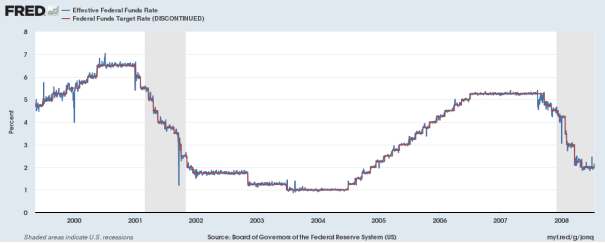
Monetary and fiscal stimuluses work the same way. Both get money from hoarders and use it to increase spending. A fiscal stimulus is an increase in government borrowing that takes money from hoarders and tends to increase the interest rate that they earn. A monetary stimulus reduces the interest rate (and/or increases the inflation rate) which encourages hoarders to lend more money because it makes it harder to earn interest in safe investments. A monetary stimulus redistributes resources and ends recessions by punishing hoarders and encouraging spenders. Monetary stimulus is painful for savers. Although a fiscal stimulus would seem like it would be less politically painful because nobody pays any price in the short run ironically, the opposite is true. Fiscal stimuluses are almost never deliberately used whereas monetary stimuluses are routine. The Fed announces changes in monetary stimulus eight times per year, every single year. For example, as you can see in the graph below, the Fed sometimes changes the Federal Funds Rate eight times per year, and this is only one of several monetary policy tools at the Fed’s disposal.

So breaking windows can be a useful stimulus if there is a recession caused by a shortfall in demand (hoarding) which has been the main problem in almost all recessions in the past century (with the possible exception of the oil-shock recessions of the 1970s which also had notable supply problems). A recession caused by hoarding is a kind of market failure that wastes resources (unemployed labor and capital) sort of like breaking windows is usually a waste of resources. Ironically, when there is a market failure (hoarding), adding another market failure (breaking windows) can potentially make things better instead of worse! This is known as the theory of the second best and it is true in the Robin Hood example where Robin’s vandalism redistributes under-productive resources from hoarders to consumers which stimulates the economy and makes everyone better off except the Sheriff, and even he doesn’t suffer because he wasn’t using his hoarded resources anyway.

But breaking windows would be a ridiculously wasteful kind of stimulus that nobody would advocate except if all other options are impossible. Robin Hood would much rather simply steal resources from the Sheriff and redistribute them to the poor because that would be a much more efficient stimulus. Robin Hood doesn’t want to break window just to be spiteful. His purpose is not make the Sheriff suffer. His goal is to help the poor and although breaking windows is a stupid way to do it, it may be the best choice in this unfortunate scenario where the Sheriff’s stupid hoarding is keeping everyone else desperate and unemployed.

Similarly, Keynesians don’t promote spending money on wasteful projects like breaking windows because there are so many actual needs that new projects could try to serve. Keynesians are often quoted out of context in an attempt to discredit their ideas. For example Keynes is often ridiculed for writing that we could stimulate the economy by burying money in the ground and then letting others dig it up. He actually wrote that simple parable to ridicule the defenders of the gold standard who implicitly argue that we should pay miners to dig holes in order to create a monetary stimulus. He pointed out the absurdity of this idea because it would be cheaper and more efficient to print money and then use the money to pay some people to bury money and let people to dig it up again. He was not suggesting this as his preferred stimulus plan. He was merely pointing out that it is no more absurd than the gold standard. If you read the context of the quote Keynes was ridiculing the wastefulness of digging holes looking for money (gold). Later in chapter 16, Keynes repeats his criticism of the wastefulness of digging holes looking for money and wasteful government projects like building Egyptian pyramids. He reiterates that although it would work as a stimulus, it is ridiculous to think that such wasteful spending could be the optimal choice when there are many more useful things to do.

The Robin Hood parable illustrates why Keynesian economics is so politically polarizing. Keynesian economics only works by redistributing money from savers to consumers and that means redistributing from people who are richer than the median to people who are less-rich than the average. That is one reason why many rich elites are so passionate about opposing Keynesianism. Economists rarely acknowledge this fundamental reason for political tension because economists shy away from talking about redistribution, but it is baked into the Keynesian cake. The Robin Hood parable makes it memorable. The burden of government spending disproportionately falls on wealthy people in democracies. Wealthy people prefer to promote tax-cut Keynesianism as an alternative to Keynesian spending, but both forms of Keynesianism work in the same way.

In the Disney version of Robin Hood, the Sheriff taxes the villagers too much and Robin Hood steals from the Sheriff and gives money back to the poor like a tax rebate. This is another form of Keynesian stimulus. Tax cuts only work to stimulate the economy if they increase the incomes of consumers who will spend the money. Tax cuts do not work if they increase the incomes of hoarders who simply lock more money away. Giving a tax cut to the Sheriff would do nothing except encourage even more hoarding. Because the poor and middle class are better consumers than rich elites, a tax cut for the poor works much better to stimulate the economy than a tax cut for the wealthy people that pay the highest tax rates. Unfortunately, some of the tax-cut Keynesians are elites who just want an excuse to reduce their own taxes. Tax cuts for elites who hoard the money are ineffective stimulus compared with tax cuts for the median and below who have more needs to spend money on.

The tax-cut ‘Keynesians’ who want to cut taxes for corporations and the wealthy have it backwards. Tax cuts for the middle and bottom of the income distribution are much more stimulative than tax cuts for the rich because non-rich people tend to spend money whereas the rich just tend to add it to their hoard. That is exactly what happened to much of the tax rebate checks that George W. Bush sent out in 2008. High-income households pay the most income taxes and so a disproportionate amount of the tax rebate went to them and they tended to hoard it rather than spend it. Only the part of the tax cuts that went to the median household (and below) was spent and stimulated the economy. Research found little stimulative effect because of this and because even many of the low-income people used the rebate to pay back debt and thereby returned their money to the hoarders rather than directly spending it.

A reverse example is the payroll tax hike of 2013 which reduced take-home pay by 2 percentage points, but only on wages under $113,000. That means that almost all American workers had a tax increase this in 2013, but billionaires were scarcely affected. Whereas there was a tremendous fight in Congress at the same time about whether to raise taxes on the top 2% richest Americans, all workers saw our taxes rise without any complaint in Washington because Congress only cared about preventing tax hikes for elites rather than tax the tax hike that hit all ordinary workers.

Keynesian economics is favored by mainstream economists on mmutilitarian grounds–because it increases GDP–and Bastiat’s is smart to ridicule mmutilitarianism. Bastiat’s parable shows one way mmutilitarianism could go astray. Breaking windows (or a war, natural disaster, or pollution) never decreases GDP, so it is never bad according to naïve mmutilitarianism. Professional economists are rarely this naïve, but defenders of military spending sometimes come close. For example, Paul Ryan and Mitt Romney were criticized by libertarians for using this sort of mmutilitarian economic reasoning to support increased defense spending. Unfortunately Ryan and Romney had often used austerian logic against government spending that they opposed. So Ryan and Romney agreed with Keynesian logic for defense spending and tax cuts, but opposed Keynesian logic for many social programs. I supports Keynsianism because it tends to help the median of the income distribution (and below) AND it tends to increase GDP, and I have no problem with increasing the size of the economic pie (GDP) when the benefits are broadly shared.

Bastiat attacked the mmutilitarian logic that defense spending is always good for GDP. This is often derided by calling it military Keynesianism, but that is a misnomer because most of those people are just in favor of higher military expenditures regardless of the business cycle. Keynesians are often mischaracterized as always supporting increased government spending, but they support cutting government spending (to cut deficits) when unemployment is low. Military spending, like all government spending, is only good if it is more productive than its opportunity cost and the opportunity cost rises during economic expansions when businesses need more workers. In 2012, Ryan and Romney’s military spending priorities agreed with Keynesian logic because there happened to be high unemployment at the time and so there was a Keynesian justification for military spending. But Keynesians should support decreasing government spending when unemployment is low and Bush’s chief economic adviser, Michael Boskin always opposes defense cuts. For example, he opposed defense cuts in the mid 1990s when unemployment was extremely low and he made the nonsensical argument that it would increase unemployment at a time when unemployment was arguably too low. That is not Keynesianism, it is a true example of the broken window fallacy. Keynesianism recommend cutting government spending because unemployment was so low. When resources are fully employed, Keynesians agree with the broken window fallacy.

When hoarding (wasteful saving) causes a recession, the opportunity cost of government spending is extremely low when spending redistributes resources from unproductive hoarders who have too much money to the unemployed who have too little. During economic expansions when unemployment is low, savings (mostly of older, richer people) is productively channeled by financial institutions to borrowers who need the money more than the savers. Like an invisible hand, finance channels the impulse to save and hoard into productive activity by lending savings to people with a greater need of the resources. When a recession happens, the invisible hand of finance stops channeling savings to put people to work. Instead, the invisible hand of finance puts savings into unproductive hoards. The money leaves the economy which makes the economy poorer. Workers lose their jobs due to the lack of spending and factory owners go bankrupt because their factories sit idle. Keynes’ genius was in realizing how monetary and fiscal policy can be used to make the clenched hand of finance relax and release the hoards to get people (and our capital equipment) working productively again.

Robin Hood In Glassland

In the middle ages when Robin Hood lived (according to legend), glass windows were incredibly valuable and only the elites could afford them. The rareness of glass made stained-glass cathedral windows appear miraculously heavenly. Glass was still so rare in the early 1700s, that wealthy Americans could rarely afford much in the way of glass windows. At the time, stained glass exemplified the state of the art of glass technology although it evolved out of the technological limitations of the era. Glass panes were impossible to make smooth, clear and large anyhow, so glaziers might as well dope their off-color glass with extra color and fit the little pieces together into big stained-glass windows. Glass was still so valuable in the 1800s that it was still being used as money in some parts of the world.

Medieval Europe was bestowed with a relatively generous endowment of gold and silver, but it those metals had been as scarce as diamonds in Robin Hood’s England, ordinary people might have used glass as money like they did elsewhere in the world. If glass had been used as money, the parable of Robin Hood Breaking Windows would explain Keynesian economics even more clearly. Suppose the Sheriff was hoarding panes of glass rather than gold and silver, then even if Robin Hood could not directly steal the glass from the castle, he could indirectly ‘steal’ some of the Sheriff’s glass and give it to the poor by breaking the Sheriff’s windows. The Sheriff would have to pay peasants some glass to put them to work replacing his windows.

In a commodity money economy like this, Keynesian hoarding theory is even more obvious than in a paper-money economy like today. For example, imagine a society using iron as money. A recession happens when people start hoarding money (and rich elites have the most to hoard). Because they are hoarding a commodity money, it is clear that money hoarders are hurting the economy because they are hoarding iron which is useful. Hoarded iron is unproductive and people cannot work if they don’t have enough iron to make things. Hoarding is wasteful just like breaking things is wasteful. In an economic expansion, the invisible hand of finance would direct the iron hoarders to loan some of their unemployed iron to unemployed workers so that they can make more plows and pots and make everyone richer. In capitalism, flows of money are required to facilitate productive exchanges and induce people to be productive making plows and pots and other goods. It does not matter if the money is iron, paper or electronic. In a recession, the invisible hand of finance has a spasm and clamps too much of money in unproductive hoards.

Keynesian fiscal and monetary policies are all about loosening the cramped hand of finance to get the hoarded money–and the productive resources that the money commands–back out in the economy to can get people working again. Economics needs to expand its vocabulary to be able to explain recessions better. We need to be able to distinguish between savings and hoardings. When economists talk about ‘savings’ they usually mean lendings. A dollar saved is usually really a dollar lent to someone else because when you put it into the bank (or another financial institution), you have lent the dollar to the bank which promises to pay it back, often with interest. Saving is great for the economy when it increases capital investment and productivity and that is normally what happens. One person has more money than they currently have productive use for can help other people with a money shortage become more productive.

Hoarding is when money is taken out of the economy and hoarded for oneself without being lent out to someone who can use it. Hoarding is taking money, and the production that it represents, out of the economy for a time. During the Great Depression, many Americans hoarded their money by hiding it in mattresses or in buried jars because they understandably did not trust the banks to pay back their savings. In the modern economy, hoarding sequesters money in different kinds of places, but the effect is the same. For example, the Great Recession of 2008 was partly caused by banks hoarding money as excess reserves that sat unproductively at the Fed, but it had the same effect as if people were hoarding their money in their mattresses. It was also partly caused by banks hoarding money in complex securities like CDOs that got stuck because of defaulting homeowners and banks until the time-consuming legal process could sort out the complex contracts and decide how to divide the assets and liabilities that remained.

Another place Americans hoarded their money during the Great Recession was in government bonds. A government bond is normally a form of savings because it is a way to lend money to the government. But it is impossible to call it ‘lending’ to the government when government bonds pay a negative real interest rate. Real lending involves taking a risk and thereby earning a positive real interest rate. If a business in a competitive market could borrow money for a negative real interest rate, it would do anything it could to expand. That is because loans are free and if you don’t use free money to expand, your competitor will expand at your expense. The government doesn’t work that way. It does not spend and invest more money simply because private individuals are willing to pay the government to store hoards of money. The government was borrowing money at zero percent nominal interest and negative nominal interest rates became more widespread than ever before in history. That is just hoarding.

Any money that is kept as a store of value rather than as a medium of exchange is being hoarded rather than saved. Principles of economics teaches that money is useful for three purposes: 1) a medium of exchange, 2) a store of value, and 3) a unit of account. There is an inherent tension between the first two purposes because whenever money gets used as a store of value, it stops being used as a medium of exchange and that is what causes a recession. Money used as a store of value is hoarding. When money stops being used as a medium of exchange, goods and services stop being exchanged. Savings are different than money because savings pay positive interest and money does not. Savings should be used as a store of value, not money. Durable consumption goods like housing and clothes are another common store of value that earn a return because of use even if we never exchange (sell) them. Money is different from all other stores of value because money would be worthless if it could not be exchanged for something that is directly useful to have. Money is only valuable because it is easier to exchange than anything else. A positive real return on holding money is called deflation and deflation is particularly harmful because it encourages people to hoard more money. Good monetary policy should strive to prevent deflation and reduce the tendency to use money as a store of value. One of the reasons that recessions were so frequent under the gold standard was the fact that deflation was a regular recurrence whenever the price of gold (and therefore the value of money) increased.

If money gets used more as a store of value than as a medium of exchange, that is hoarding and that is what causes a recession, but for some reason, economists have ignored the central problem of hoarding and rarely use the word, so there is no agreed-up definition of what counts as hoarding, but I’ll give it a try. Interest rates should help distinguish between savings and hoardings because only money can be hoarded. Savings that are lent out at a positive interest rate means that the money is merely being transferred to a borrower who has an incentive to spend the money on something productive because the borrower is paying a real interest rate that prevents hoarding. That is why savings continue to circulate in the economy and hoardings don’t. Savings are lendings that are used to buy durable goods the yield a real stream of benefits and hoardings are where demand is simply sucked out of the economy altogether. Any financial asset that is being lent at a zero nominal interest rate (like T-bills during the Great Recession) is clearly being hoarded because a zero nominal interest rate is the same interest rate as money. Similarly, money that is saved at a negative real interest rate (when the nominal interest rate that is less than the expected inflation rate) is probably being hoarded because a negative real interest rate signals that the savings are achieving zero productivity.** Because risk is proportional to return, a negative expected return signals the low risk tolerance of a hoarder. Similarly, any for-profit business that keeps persistent balances at zero real interest or less (above the amount of cash needed to manage cash flow) is hoarding. Unfortunately, during the Great Recession, many private business like
Apple were run by executives with so little imagination and so little competition that hoarded billions of dollars at negative real interest rates rather than spending it on something productive. So big, profitable corporations were also guilty of hoarding.

It is harder to use interest rates to determine when the median individual is hoarding because average people are often liquidity constrained, have higher transactions costs, and have little knowledge of how to invest at a positive real interest rate, but the same kind of logic would apply if we could actually measure the money stocks that each individual holds, but we cannot, so the true quantity of money that is being hoarded will always be unmeasurable.

* ‘Austerians’ are people who want the opposite of Keynesian policies. In many cases it is because they actually believe the broken window fallacy is a fallacy. Unfortunately, there has been little support for Keynesian policies in government after the beginning of the 2008 recession. Obama was Keynesian only for his first year in office and then he abandoned Keynesianism and became an austerian for the remainder of the recession and focused on deficit reduction. I defend Keynesian analysis against austerians like the latter-day Obama, Michael Kinsley, and the BIS.

**During deflationary periods (negative inflation), the interest-rate definition of hoarding is a bit different because hoarders get a positive real return by simply hoarding cash. There is always a positive real return on hoardings during deflation which is why hoarding gets so bad during deflation. During deflation, hoardings are balances that are expected to earn zero nominal interest. If inflation is positive, hoardings are balances that expect to earn zero real return (or less) for at least six months. Savings are balances that earn an income greater than hoardings without any turnover for at least six months. Some balances that do not earn a real return are used for short-run transactions. This is a transactional balance that turns over with cash flow. That is neither part of savings nor hoardings because it is not intended to be used as a store of value, but as a medium of exchange.

Postscript

For further reading describing a more formal model, see how the textbook macroeconomic model of recessions should be written.

Hoardings cease to be used as money for facilitating transactions. Even when the government borrows at a negative interest rate, corporate bonds usually pay a positive real interest rate.

Savings is a hybrid between money and durable consumption goods because savings are lent to people who use the money to buy things that earn them a value in use and then they pay the saver part of the use value in use in the form of an interest payment. The only way to keep deflation from increasing hoarding is if the real return on investment for lending is high enough to keep the nominal interest rate from reaching zero.

Posted in Macro

Why tariffs won’t boost the economy like Trump thinks

Trump tweeted

We are not in a trade war with China, that war was lost many years ago by the foolish, or incompetent, people who represented the U.S. Now we have a Trade Deficit of $500 Billion a year, with Intellectual Property Theft of another $300 Billion. We cannot let this continue!

and he followed up by tweeting,

“When you’re already $500 Billion DOWN, you can’t lose!”

Mattew Yglesias comments that.

This reflects a view that Trump has consistently maintained in his personal rhetoric and that has been reflected in the official documents put out by some of the members of his trade team — trade deficits are per se bad, reducing them induces prosperity mechanically, and so there is no downside to a trade war with a country with whom the United States runs a large trade deficit.

One big question hanging over Trump even since the campaign has been whether this is something he really believes and is prepared to act on as president, since it happens to be totally wrong. And while so far nothing Trump has actually done on trade is all that significant in the grand scheme of things [so far], perpetually making policy on the basis of a total misunderstanding of the issue is potentially quite dangerous.

…[Trump’s] Commerce Secretary Wilbur Ross and trade adviser Peter Navarro were the co-authors of an important policy paper the Trump campaign put out during the election season that… was incredibly shoddy. George Mason University’s Scott Sumner describes it as “a complete mess,” which, if anything, is too kind. When Adam Davidson profiled Navarro for the New Yorker, he wrote that …Navarro …couldn’t find a single other economist who fully agreed with him on trade and China. Which is about what you would expect, since the Ross-Navarro trade policy analysis is based on a mistake that would get you flunked out of an AP economics class.

“When net exports are negative,” Ross and Navarro write, “that is, when a country runs a trade deficit by importing more than it exports, this subtracts from growth.”

Ross and Navarro believe that tariffs will automatically increase GDP by eliminating the trade deficit:

“To score the benefits of eliminating trade deficit drag, we don’t need any complex computer model… Trump proposes eliminating America’s $500 billion trade deficit…. Again assuming labor is 44 percent of GDP, eliminating the [trade] deficit would result in $220 billion of additional wages. This additional wage income would be taxed at an effective rate of 28 percent (including trust taxes), yielding additional tax revenues of $61.6 billion.”

This idea is ^%@#$^!. The trade deficit means that imports are larger than exports. Ross and Navarro advocate using tariffs to eliminate the trade deficit by reducing imports, but that would only boost GDP if the tariffs had no effect on anything else. That is ridiculous. Nearly half of the trade deficit is the deficit in petroleum. We could eliminate that deficit by imposing a tariff of 200% because domestic prices would rise so much that American consumers would buy less petroleum products and American oil producers would extract more domestic oil by fracking more aggressively. However, we know from experience that GDP would not rise because we have been through this kind of experience before.

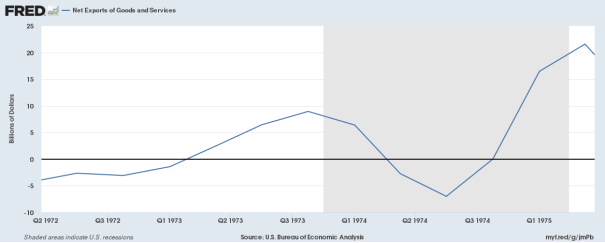
For example, in 1973, OPEC imposed an oil embargo on the US as punishment for US support of Israel in the Yom Kippur war and US oil imports plummeted, but oil higher prices hurt household consumption and caused a nasty recession. Plus, as the following graph shows, net exports didn’t change much because there are other forces (such as national savings rates) which cause imports and exports to tend to move in parallel. If Trump imposes tariffs, that will reduce imports, but it will also tend to reduce exports which will hurt jobs in export-oriented industries.

Then it happened again in 1979 due to the Iranian revolution shutting down its massive oil exports. Again, US oil imports dropped, prices rose and the US suffered a nasty recession.

Ross and Navarro are essentially arguing that if the US would ban oil imports, that would eliminate half the trade deficit. Suppose the US had a $100 billion trade deficit (is it much bigger, but let’s use round numbers to simplify the arithmetic). And Trump used the same numbers when he tweeted, “…when we are down $100 billion with a certain country and they get cute, don’t trade anymore-we win big. It’s easy!”

Trump argues that banning this import would automatically boost GDP by $100 billion! His economic team (Ross & Navarro) calculated that because “labor is 44 percent of GDP” their logic figures that $44 billion of that income would go to household wages. They calculate, “that additional wage income would be taxed at an effective rate of 28 percent” which would yield additional tax revenues of ($44b * 28%) = $12.3 billion. Super simple, right?

This analogy was inspired by an example from Mattew Yglesias who goes on to ask:

So why doesn’t Congress take this simple, easy step to boost growth and create jobs [by banning oil imports]?

Well, because it’s ridiculous.

What would actually happen is that gasoline would become much more expensive, consumers would need to cut back spending on non-gasoline items, businesses would face a higher cost structure, and the overall economy would slow down with inflation-adjusted incomes falling. Modeling the precise impact of a total shutdown of oil imports is hard (hence the computer models). But we know from experience that the directional impact of sharp disruptions in the supply of imported oil, and it’s not at all what Ross and Navarro say it would be.

Ross and Navarro made a subtle but basic error

…Gross domestic product (GDP) is meant to measure the dollar value of everything produced in the United States. To calculate GDP, you take everything the government purchases (G for government purchases), then add everything households purchase (C for consumption), then add everything businesses buy but don’t sell to customers (I for investment). That gives you a picture of everything that was bought in America. But then you need to adjust for the fact that Americans buy some foreign-made stuff (imports) and sell some stuff to foreigners (exports) — so you add that together and get net exports (NX), which need to be added or subtracted from the total.

That’s written down as an equation: GDP = G + C + I + NX.

But this is an accounting procedure, not a causal theory. The accounting procedure says that government purchases are an element of GDP — higher G means higher GDP, and absolutely everyone agrees on that. But whether increasing government spending will boost or harm the economy is obviously a hot topic of political debate. A sensible high-level take would be “it depends.” It matters what you spend the money on; it matters how you raise the revenue and what the larger economic situation is.

The net exports situation is just the same. If America’s net exports grow because America becomes a fashionable tourist destination and sales of Boeing airplanes surge, then that will boost the economy. But if America’s net exports grow because new Trump-imposed taxes cause the price of imported goods to surge, then the economy is going to shrink.

It is reasonably common for [uneducated] people to make the kind of mistake that Ross and Navarro are making here, which is why [economists] generally make it a point of emphasis when introducing the GDP concept to students. Why a credentialed economist would do it in a policy paper for a presidential candidate is [^%@#$^!].

In theory, a tariff could boost GDP, but in practice it is nearly impossible and I’m not aware of any real-world example where it actually worked. It certainly hasn’t ever worked for the US. For a tariff to boost GDP would require several preconditions that we do not have. A tariff could only work to boost GDP IF

  1. There is no trade war. If other nations retaliate by raising tariffs of their own, then net exports will not rise and all nations will suffer because production will simply fall everywhere. Trump was wrong when he tweeted, “trade wars are good, and easy to win.” That was the day after Trump imposed new tariffs on steel and aluminum, so he is serious about it, but he is wrong.
  2. There is slack in the economy (i.e. a recession) so that there is flexibility to increase production without merely reshuffling production from somewhere else. If there were zero unemployment, it would be impossible to increase GDP by increasing tariffs because everyone is already working as much as they can. We are pretty close to full employment right now, so tariffs would be particularly useless as a boost to GDP at this time.
  3. The eliminated imports can be efficiently substituted with domestic production. This was a big problem during the oil shocks of the 1970s, and because oil is still about half of our trade deficit, it is still a substantial problem today. US producers simply cannot produce everything as efficiently as foreigners. Chinese-made clothing, computers, and TVs will simply rise in price which will hurt consumers and reduce their demand for American-made goods due to higher prices.

There are more conditions too such as needing domestic savings rates to rise, but listing everything would be like beating a dead horse. The fact is that I know of no PhD economist who doesn’t work for Trump, zero, who agrees with Trump and his economist flunkies, Ross and Navarro, about tariffs and trade wars.  Navarro couldn’t come up with anyone either.  No Keynesians on the left like Paul Krugman, nor Keynesians on the right like Greg Mankiw, nor conservative libertarians like Scott Sumner, nor probably any Real Business Cycle theorists although it is hard to know what they would say because they don’t usually come out of their ivory towers to sully themselves with commenting on policy much.

Posted in Globalization & International, Macro

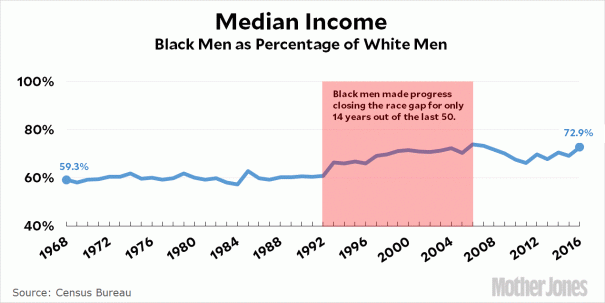
Median income of black men compared with white men in America

Via Kevin Drum. Presumably this is using personal income.  There has been progress towards greater equality in the past half century.  The ratio went from 59% up to 73% over this time, but nearly all of the change happened between 1992 and 2006.

Posted in Discrimination

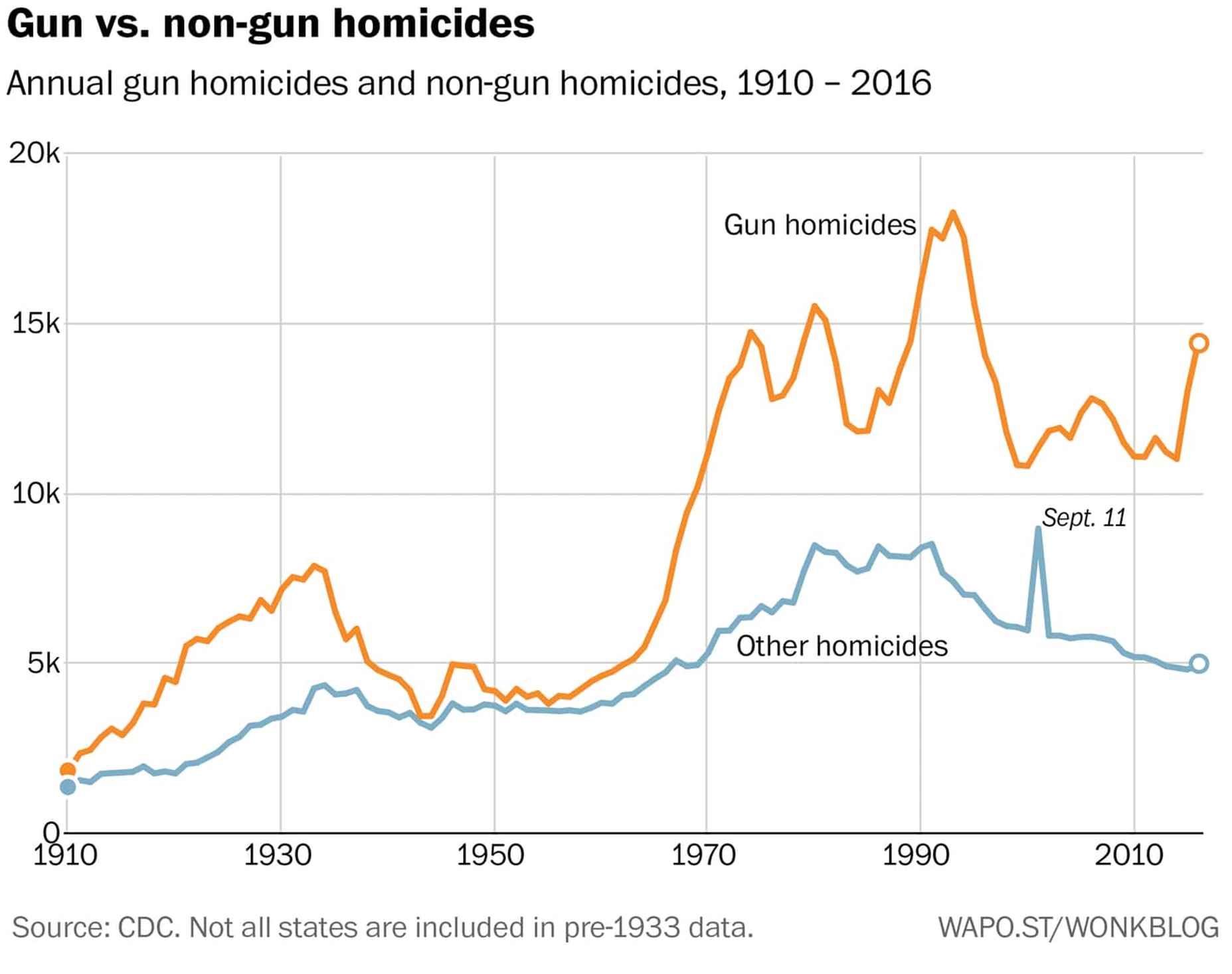
Why are Americans suddenly more interested in gun control? Perhaps because of a 9/11-size spike in gun homicides.

Although I’m a pacifist (and a pragmatic one not a fundamentalist*), I don’t get particularly passionate about gun control because despite the fact that it generally reduces homicides and suicides, because other factors are even more important for reducing homicides. Furthermore, homicide isn’t the most important cause of death.  There are a lot of other public health issues that are more important such as tobacco, alcohol, and other drug use and even traffic safety. The recent focus on mass shooters is an even lower priority for me than guns in general because mass shooters are so rare.

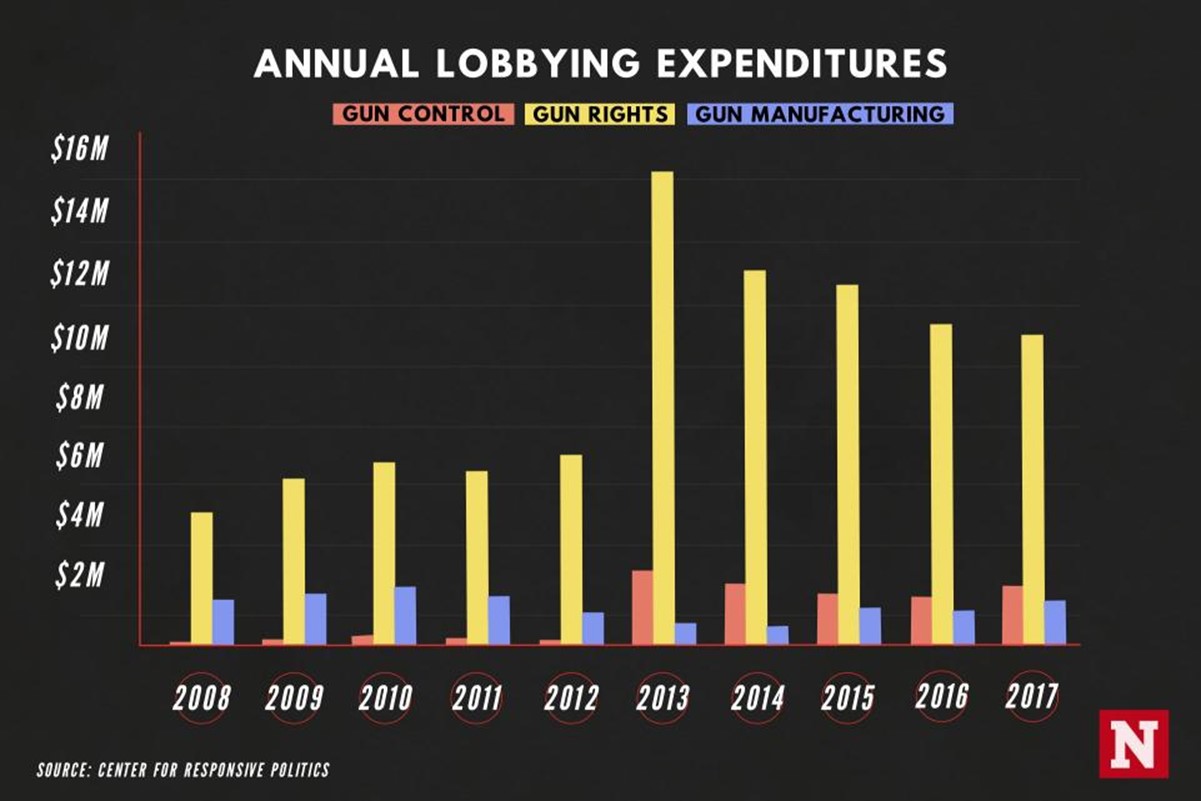
Another reason I’ve been reluctant to put effort into control is that I’ve been pessimistic about the tremendous political effort that would be required to buck the gun manufacturing lobby whose funding is the true power behind a lot of the “gun rights” work of the NRA:

The NRA promotes the idea that they don’t give much money directly to political candidates, but they spend an enormous amount on political lobbying and pressure in addition to the cash they give directly to politicians.  Political interest groups like the NRA are legally banned from giving unlimited political lobbying money directly to candidates, but they can spend an unlimited amount of money on other kinds of political influence peddling so that is where the big money goes.

I have been apathetic about adding any gun control measures because they would require a large investment for a relatively small health gain. But the political winds are suddenly shifting. Most pundits are giving the credit to the Parkland shooting survivors who certainly deserve kudos for being remarkably effective for a bunch of “mushy brained” teenage “clowns” who are too dumb to get into college.

But some Wonkblog data today shows another possible reason. Although homicides by weapons other than guns has been declining for a quarter century, the last couple years has seen a sudden spike in gun homicides that is larger than the spike created by the 9/11 terrorist attack.

Nobody knows what caused this spike, but if it continues, it could have an effect on society like the homicide wave of the 1970s which dramatically changed politics including gun politics and led to America’s obsession with mass incarceration. Or consider how the spike of deaths of 9/11 reshaped politics by creating more domestic spying, torture, and leading to the Iraq war. This time the spike in gun deaths might result in more gun control like spikes in gun violence did in Australia, England, Canada, Finland, and Norway.

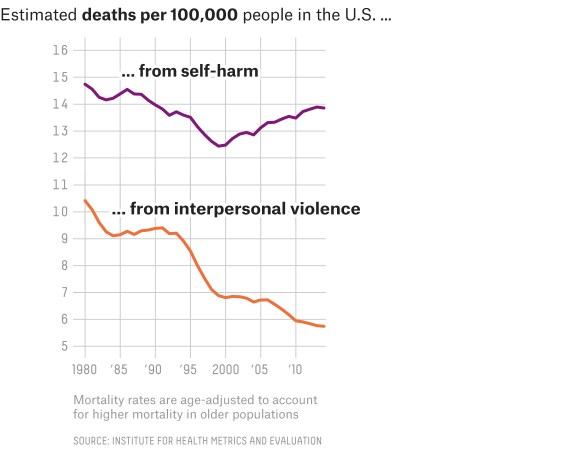
Suicides have also been rising in tandem with gun homicides perhaps due to the fact that guns make suicides much, much more deadly.

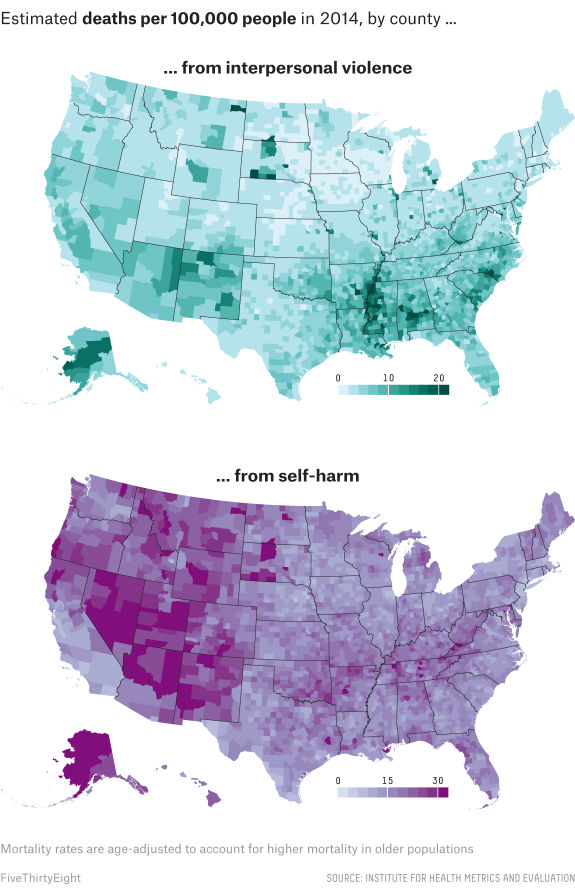
The above graph is from Ella Koeze and Anna Maria Barry-Jester at 538 who also show that the rise in suicides is more of a phenomenon of rural counties than urban ones and the rise in homicide (which is entirely due to rising gun homicide) is also mostly in rural areas with a few urban exceptions like Gary Indiana, Indianapolis, Detroit, and a few southern metropolitan areas:

It would be interesting to see if there is any relationship between gun prevalence and the above maps, but the government cannot collect that kind of data, partly because it has been banned from studying the effect of guns on health and safety so nobody knows.  There is mandatory gun ownership in some American towns, and the goverment is banned from studying whether these kinds of gun laws help or hurt the rates of violent deaths.  Perhaps public health would be better served if we abolished our attempt to move towards universal health insurance, Obamacare, and instead used the savings to buy guns for everyone and move towards universal gun ownership. We could call the program Obamaguns to market it to the Democrats.  Switzerland has nearly universal gun training for young men and the Swiss government issues military weapons to nearly any young man that wants to take one home, but they have a very low rate of homicide compared with the US.  Although the Swiss have a strong gun culture and the third highest gun prevalence in the world, it is much lower than in the US and they have much stricter gun regulations.


*I define pragmatic pacifism as trying to minimize violence using realistic tools which can even include violence!  Fundamentalist pacifists don’t believe any violence is ever justified.  Although nearly everyone wants to minimize violence and could identify as a pragmatic pacifist in theory, hardly anyone who says that they want to minimize violence identifies as pacifist because most people (the non-pacifists) are convinced that violence is frequently redemptive when ‘good guys’ intentionally use violence and believe that just war is common.  Most people believe that nearly all wars that us ‘good guys’ get involved in are just going to be just.  Pacifists are highly skeptical that wars can ever be just in practice (although pragmatic pacifists believe that it is possible in theory just like it is possible for a camel to go through the eye of a needle).  All pacifists are highly skeptical of warfare being just however pragmatic pacifists believe that policing and criminal justice can often be just because although police use violence, they really do minimize total violence when they do their job efficiently.  Whereas most soldiers expect to kill during wartime, most police expect to never kill anyone.  That is a big difference.

Posted in Violence & Peace

Occupational licensing is the new unionization

Back in 2011, which kind of license would cost more money to obtain in New York City,

A) a license to practice medicine

or

B) a license to drive a taxicab?

In 2011, a taxi cab license cost over $1 million. That was about eight times more than doctors had been paying for their medical licenses.  According to the AMA, the average debt facing medical doctors graduating in 2009 was only $156,000 plus out-of-pocket tuition averaging approximately $45k according to my calculations. Meanwhile, in 2012, New York City had hundreds fewer cab licenses than it had in 1937! Taxicab license owners caused a shortage of taxis and bad taxi service because of low availability and high prices.
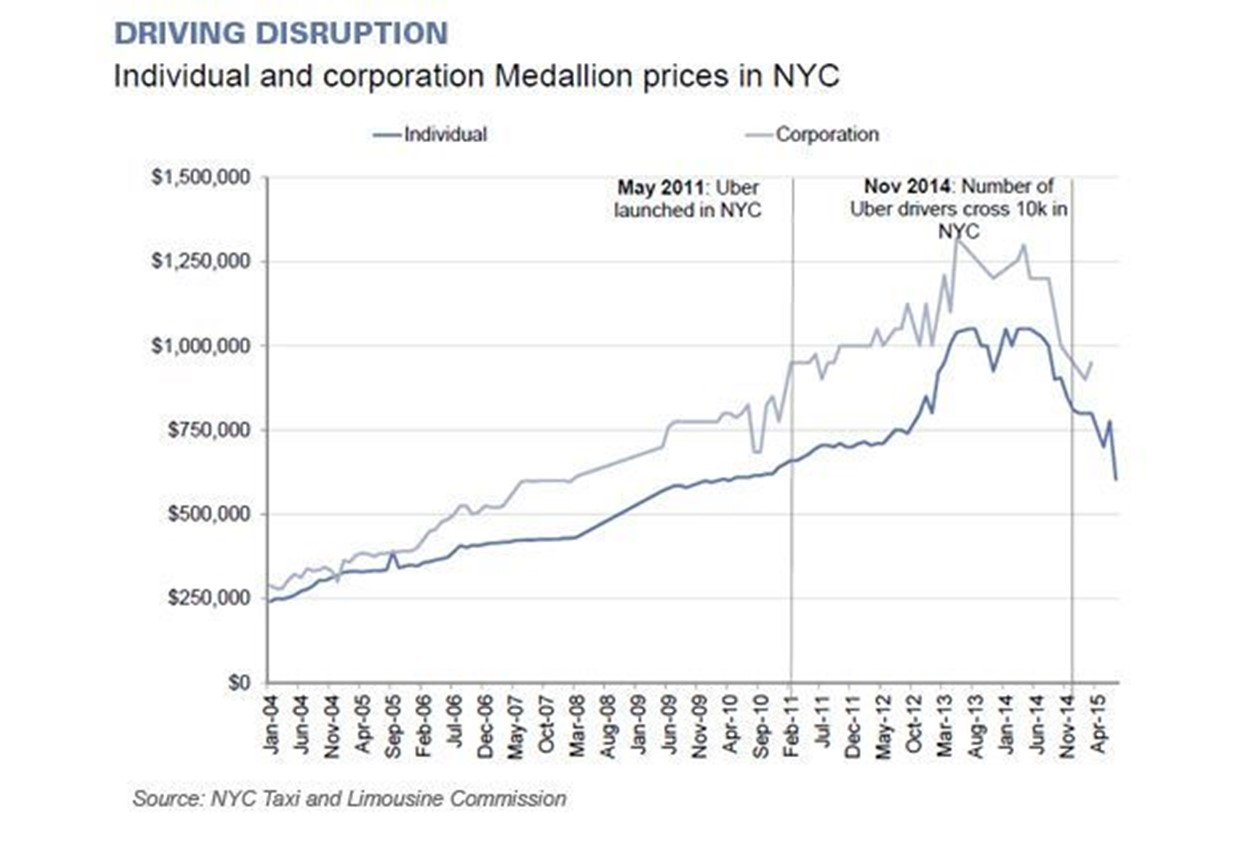
The reason there is a BIG difference in pay for doctors versus taxi drivers is that that each worker was licensed in medicine whereas each vehicle was licensed for taxis.  The owners of scarce resources get the income boost, so whereas doctors owned the scarce ability to practice medicine, the owners of the taxis owned the chokepoint and got most of the taxi revenues.  The wealthy taxi owners typically rent out the vehicles to low-paid drivers and extract most of the profits from the high taxi fares. 

Occupational licensing is growing

Adam Smith famously said, “People of the same trade seldom meet together, even for merriment and diversion, but the conversation ends in a conspiracy against the public, or in some contrivance to raise prices.” Occupational guilds are an ancient example and modern licensure in the USA dates back to the Flexner Report in 1910 which exposed poor quality doctors and medical education.  It described medical schools as, “private ventures, money making in spirit and object… No applicant for instruction who could pay his fees or sign his note was turned down.”  Anyone could practice medicine whether they had any education or not.  The Flexner Report led to licensure of medical doctors and medical schools which dramatically raised the standard of care and wages.  Other occupations soon copied the same strategy.  

James Bessen wrote :

In the 1950s, only 70 occupations had licensing requirements, and these accounted for 5 percent of all workers. By 2008, more than 800 occupations were licensed in the various states and they accounted for 29 percent of all workers. Licensed occupations include everything from barbers and interior designers to nurse practitioners and physicians.

Whereas 35% of Americans working for the private sector were union members in the 1950s, by 2017, that number dropped to only 6.5%. Today licensure has replaced unions as the main mechanism whereby workers band together to raise their wages as demonstrated by the following graph by Morris Kleiner and Alan Krueger:
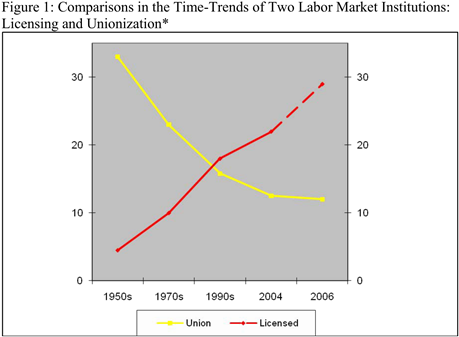
Kleiner and Krueger found that licensure boosts wages about 15% which is similar to what unions achieve for workers. As of 2008, 29% of workers had a government license for their job. 
Unfortunately, the economics textbooks are still stuck in the 1950s. Uwe Reinhardt surveyed labor economics textbooks and found that the median amount devoted to unionization was an entire chapter versus zero pages about occupational licensure.

Mechanisms for restricting competition

Licensing boards limit competition through various kinds of requirements:

  1. Training programs. They regulate accreditation of schools and/or limit the number of openings available for incoming students.
  2. Experience as a low-paid apprentice to a licensed practitioner. This creates a barrier to entry and directly boosts the income of the cartel members by giving them cheap labor. At one time, it took longer for an apprentice to become a master plumber in Illinois than for a medical student to become a Fellow of the American College of Surgeons after getting the basic medical degree. Physician interns are routinely kept awake for 24hr shifts which may lead to increased patient deaths because “practicing medicine while
    sleep-deprived is akin to working while drunk.” There is no educational rationale for making the least experienced doctors work while fatigued and sleep deprived, but many doctors who have passed through this initiation rite defend it with cult-like devotion and it does provide a lot of cheap labor for their supervisors and makes a great barrier to make it harder to become a doctor.  Medical students typically work 80 hours per week on shifts often lasting 24 hours at a time for years during their residencies and that reflects a considerable cutback due to new regulations in the 2000s.
  3. Entrance exams. Licensure boards often make exams harder to reduce competition, but none of the existing practitioners ever has to retake the new “improved” exams. Some exams have little relationship to the actual services of the occupation. For example,
  4. Fees. This both creates a barrier to entry and helps fund the professional organizations that maintain the barriers to entry.
  5. Personal characteristics: Age requirements, citizenship, residence, bans on ex-convicts, etc. Many of these requirements are unconstitutional, but they often remain on the books in many states because the people who are hurt by these restrictions (unlicensed workers and consumers) do not challenge the laws in court.
  6. Operating separate requirements in each state to prevent competition from people in other states. This makes life particularly hard for military spouses that move frequently across state lines which makes licensure nearly impossible. And servicemembers also learn valuable expertise in the military, but after discharge, their military training rarely qualifies them for a civilian license in their home state.

Licensing increases wages for practitioners by raising costs for consumers.

A third of Americans don’t get dental care each year and the main reason Americans get poor dental care is high costs. For example, a study of Air Force cadets found that cadets from states that have stricter licensure for dentists did not produce better dental health. James Bessen:

Dentistry provides a striking example of how excessive regulation can harm patients. Dental fees are substantially higher in states that do not recognize out-of-state licenses for dentists. The Federal Trade Commission found that just the regulations on the roles of dental hygienists and the numbers working per dentist raised dental fees by 7 to 11%. Excessive licensing also reduces access to services. Facing higher fees, consumers purchase fewer services, including health care. State regulations on dental hygienists have been shown to be associated with fewer office visits, which can lead to poorer health.…The figure shows that on average, states with stricter regulations of dental hygiene perform worse on one measure of oral health: the percentage of adults who have lost teeth from tooth decay or gum disease. Dental hygienists provide preventive care that can avert tooth loss. States with the most restrictive occupational regulations have about twice as many adults who have lost teeth. While factors other than regulation affect oral health, careful studies (and this one) find a robust relationship between regulation and access to care.
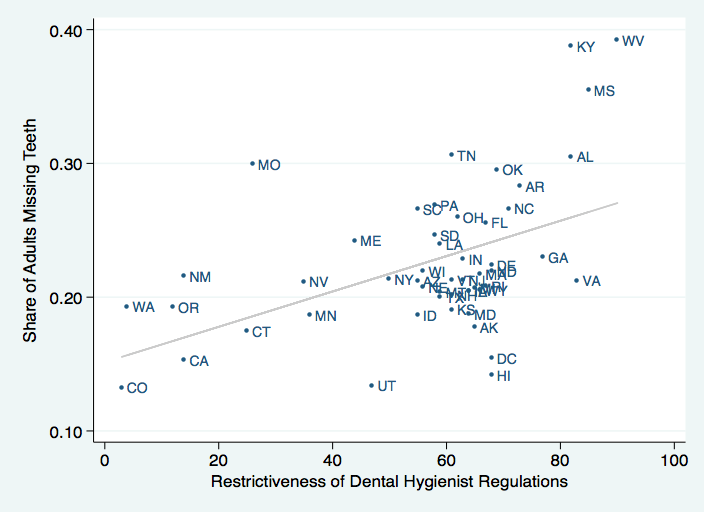
In some states, dental hygienists can work independently of dentists and in other states, they can only work for a dentist. Forcing dental hygienists to work for dentists, increases the wages of dentists and reduces the wages of dental hygienists thus harming dental patients by reducing affordability. There is a similar dynamic happening by forcing nurse practitioners to work under the supervision of doctors. For example, nurse practitioners in North Carolina pay about $12,000 per year to doctors to sign forms to permit the treatments the nurse practitioners are trained to provide. In 22 other states they have “full practice authority” to work independently.

Sidney Carroll and Robert Gaston found that electrocution rates are higher in states with more restrictive licensing laws for electricians possibly because there is more do-it-yourself electrical work where it is harder to hire a professional. James Bessen says there is no measureable relationship between quality and licensure of interior decorators:

In the states where [interior decorators are licensed, they] are required to pass a national exam, pay fees, and devote six years to education and apprenticeship. Yet studies show little safety or quality benefits: interior decorators do not have lower insurance premiums, lower rates of fire deaths, or fewer complaints to the Better Business Bureau in states that impose these requirements.

The transitional gains trap of licensure

Usually a new licensure system ‘grandfathers’ all the existing workers and only applies to newcomers. The way it works is that a group of professionals like hairdressers meets for a state convention and decides to lobby the government to make licensure mandatory. The new fees and requirements reduces the supply of hairdressers and raises wages, but the newcomers don’t really benefit from the boost in wage because it just becomes a compensating wage differential that matches the amount they paid to get the licensure.

Gordon Tullock calls this the transitional gains trap of licensure. When licensure limits the supply of workers and raises wages, the 1st generation of incumbent workers benefit from licensure because they are grandfathered in and do not have to pay a price for licensure and purely benefit from the higher wages caused by limited supply.

Subsequent generations don’t benefit from higher wages because they have to pay the price of licensure. But after they have paid the price, they want to keep licensure because they do not want additional competition.

Thus, it is a trap that only gives a transitory benefit to the first generation and no benefit to subsequent workers, but they want to keep it nonetheless.

Political determinants

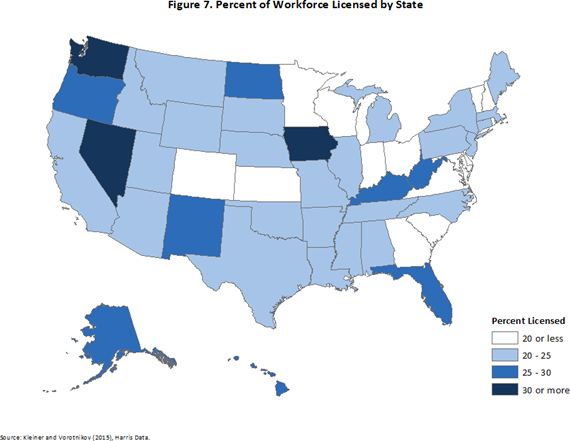
The Institute for Justice is fighting to reduce occupational licensure requirements and they ranked the states using various metrics to assess which states have the most burdensome licensure. Can you guess whether conservative states or liberal states have more burdensome regulations? It turns out that there is no discernable partisan tendency. Some states simply have more organized professional associations. A 1991 study found that the main reason for differences in licensure requirements between states was whether a local professional association funded a lobbying effort to require licensure in each state.
Licensing requirements are often irrational and enforcement is bizarre

The White House CEA found that there is too much variance in licensing requirements in different states to be explainable by any rational need for the requirements.

Estimates suggest that over 1,100 occupations are regulated in at least one State, but fewer than 60 are regulated in all 50 States, showing substantial differences in which occupations States choose to regulate. For example, funeral attendants are licensed in nine States and florists are licensed in only one State. The share of licensed workers varies widely State-by-State, ranging from a low of 12 percent in South Carolina to a high of 33 percent in Iowa… States also have very different requirements for obtaining a license. For example, Michigan requires three years of education and training to become a licensed security guard, while most other States require only 11 days or less. South Dakota, Iowa, and Nebraska require 16 months of education to become a licensed cosmetologist, while New York and Massachusetts require less than 8 months.

Licensure requirements are sometimes bizarre:

Entrepreneur Taalib-Dan Abdul Uqdah runs Cornrows and Company, a Washington, D.C., salon that specializes in braiding the hair of black women. Starting with $500 in 1980, Uqdah had created a $500,000-a-year hair-care business by 1991. He refuses to use chemicals and, instead, weaves the hair into hundreds of tiny braids. The District of Columbia government has tried at least four times to prosecute Uqdah for operating his shop without a license. Anyone who works with hair in D.C. must spend nine months in cosmetology school, at an out-of-pocket cost of about five thousand dollars. Yet such training would be useless for Uqdah and his employees because the schools do not teach his methods; because braiding does not use chemicals, it is not regarded as cosmetology. Uqdah tried to get the law changed by having the D.C. Board of Cosmetology create a license for braiding, but the board refused. When he appealed to the City Council, the board successfully lobbied against him. The board recently fined him one thousand dollars for “operating an unlicensed beauty shop.” At this writing he faced the possibility of a prison sentence.

Yes, cutting hair without a license can lead to jail time. It can even bring on the SWAT teams:

In Florida, up to 14 armed police raided over 50 barbershops in predominantly black and Hispanic neighborhoods without warrants.  The police were in SWAT gear, armed with masks and guns and police dogs, according to Reuters. Over 30 barbers were handcuffed, in front of customers, on criminal charges of barbering without an active license.

At one barber shop, the scene looked like this:

They blocked the entrances and exits to the parking lots so no one could leave and no one could enter. With some team members dressed in ballistic vests and masks, and with guns drawn, the deputies rushed into their target destinations, handcuffed the stunned occupants — and demanded to see their barbers’ licenses…

the shop was filled with anywhere from ten to twenty-five waiting customers. As the first day of the school year was approaching, several of the customers in the shop were children… The officers immediately ordered all of the customers to exit the shop and announced that the shop was “closed down indefinitely.” …Anderson was handcuffed by a masked officer…

While Trammon, Anderson, and Berry were restrained [in handcuffs on the floor], Inspector Fields and the OCSO officers conducted their “inspection” of the barbershop. …At the conclusion of the inspection, it was determined that all of the barbers had valid licenses and that the barbershop was in compliance with all safety and sanitation rules. No criminal violations were discovered, and Berry, Anderson, and Trammon were released from their handcuffs…

Whereas the police do not help unions bust their competition, the strong arm of the government does the expensive dirty work of keeping outsiders from competing for work against the wishes of licensure organizations. Most Americans seem content with this arrangement because they are told that it help them get higher quality services.

Medical and legal services have the most licenses

Milton Friedman wrote:

“Would it not… be absurd if the automobile industry were to argue that now one should drive a low quality car and therefore that no automobile manufacturer should be permitted to produce a car that did not come up to the Cadillac standard. …[Doctors] argue that we must have only first rate physicians even if this means that some people get no medical service—though of course they never put it that way.

Once when Friedman told this to a group of lawyers, one of the lawyers said that we SHOULD only accept the best quality (Cadillac) lawyers. The lawyer unabashedly argued that we should ban mediocre-quality legal services because anything but the best would be too dangerous to the public. The Economist magazine disagrees because US lawyers have a greater monopoly on preventing competition than almost any other profession rivaled only by healthcare.

Almost every American state forbids those who do not have a three-year law degree from providing most legal services. Bar associations—composed of lawyers themselves—often define what counts as legal practice. In 2000 the American Bar Association, after rejecting a proposal to allow lawyers to split fees with non-lawyers, asserted that “the maintenance of a single profession of law” was a core priority. “In no other country does the legal profession exert so much influence over its own regulatory process,” writes Deborah Rhode of Stanford University in her book “The Trouble with Lawyers”. Outsiders typically cannot even invest in law firms, limiting funding for innovative new business models, such as providing fixed-fee legal advice over the internet, or through retailers. Even those who are qualified can struggle to compete across state boundaries, because of the need to pass a separate bar exam.

Advocates for reform compare America’s model unfavourably with that of Britain. There, non-lawyers have a built in majority on legal regulatory bodies, which are tasked with promoting competition as well as protecting consumers. Outside court, anyone can offer legal advice, or provide basic legal services like drafting documents. The result seems to be cheaper access to justice, and more innovation. The World Justice Project ranks America 96th of 113 countries for access to and affordability of justice, sandwiched between Uganda and Cameroon. (It does not help that there is hardly any legal aid [for people who cannot afford a lawyer in the USA].)

And because legal services are much more expensive in the US than in other nations, the meagre legal aid does not stretch to serve very many people.

The supposed rationale that every professional organizations has for is licensure requirements is to increase quality. However, there is scant evidence that most licensure requirements produce benefits at all and when there are benefits, they rarely suffice to justify the increased costs. If professional organizations really wanted to increase the quality of their services (rather than just increase their incomes) a more important way to prevent bad quality work would be to punish professionals who do bad quality work. Unfortunately, as S. David Young explains, that rarely happens.

licensing agencies are usually more zealous in prosecuting unlicensed practitioners than in disciplining licensees. Even when action is brought against a licensee, harm done to consumers is unlikely to be the cause. Professionals are much more vulnerable to disciplinary action when they violate rules that limit competition. A 1986 report issued by the U.S. Department of Health and Human Services claims that despite the increasing rate of disciplinary actions taken by medical boards, few such actions are imposed because of malpractice or incompetence.

The evidence of disciplinary actions in other professions, such as law and dentistry, is no less disturbing than in medicine. According to Benjamin Shimberg’s 1982 study, for example, as much as 16 percent of the California dental work performed in 1977 under insurance plans was so shoddy as to require retreatment. Yet in that year, the dental board disciplined only eight of its licensees for acts that had caused harm to patients.

Licensure associations are happy to send the SWAT teams out to bust unlicensed workers (regardless of whether they are doing quality work), but they can hardly be bothered to investigate dangerous quality work of card-carrying members of their association.

The following graph from Thomas Getzen shows the number of new medical doctors in the US. The Health Professions Educational Assistance act of 1963 & 1965 increased the number of medical schools in the United States and over the following two decades, the number of students in US medical schools doubled and new physicians entered the workforce at three times the rate that older doctors left practice. Then in 1982, the Graduate Medical Education National Advisory Committee (GMENAC), recommended that U.S. medical schools decrease enrollment levels by 10 percent relative to the 1978 level and for three decades, there was less production of new medical doctors than there was in the 1970s even as the demand for doctors continued to grow.

Between 1978 and 2008, the population grew 36%, the average age of the population rose, and new technologies like the MRI were developed, all of which increased the need for US doctors even though the medical cartel did not increase production.

This is why the US has fewer doctors per capita than all other rich nations except Japan, Canada, and Singapore. Although the US is far behind almost all rich nations, Americans can take comfort in knowing that at least America surpasses most poor countries as shown in the World Health Organization graph below. Darker colors mean more physicians per 1,000 people. Cuba tops the list with almost three times more doctors per capita than the US. Whereas the US doctor shortage created in the above graph, makes the US a huge importer of doctors, Cuba has a comparative advantage in producing doctors and is a major exporter of doctors’ services. In 2014 the Cuban government had contracted out 37,000 doctors working in 77 countries generating $8 billion in foreign exchange plus there were many more doctors that permanently emigrated from Cuba. Over 7,000 Cuban healthcare professionals had come to work in the US as of 2015.

Not only does the American medical cartel determine the number of US medical school graduates, they also get the government to pay the bulk of the costs of educating doctors through various subsidies.  Yes, medical school students pay a lot for tuition, room, and board over the seven years or more that it takes to become a doctor.  I estimated above that medical school students paid roughly about $200,000 in 2010. But medical school is taught by top doctors with small classes.  You know how much a 15-minute office visit with a specialist costs? Well medical school is as expensive as spending hours every day with top specialists for a minimum of seven years plus several more years for doctors who want to become specialists themselves.  Most of that is paid for by the government via Medicaid and Medicare payments for patient fees at teaching hospitals, research grants, and other subsidies.

Not only does the US have fewer doctors than most rich nations, the US had more doctors in the 1800s according to census data:

Picture1

The rise since 1980 was mostly due to an increase in immigration of foreign doctors to the US.  For example, 55% of the increase in doctors from 2000 to 2007 in the US were immigrants from foreign countries.  In contrast to a century of declining numbers of doctors, the quantity of nurses exploded over the same time period which is only natural given the rapid rise in healthcare expenditures and services during this time.  According to this data, we had over five nurses for each physician in the US in 2000.

Picture2

Police have much less training than you would expect!

Whereas some occupations have too much licensure requirements others may have too little.  As Colin Kaepernick said, “You can become a cop in six months and don’t have to have the same amount of training as a cosmetologist. That’s insane. ”
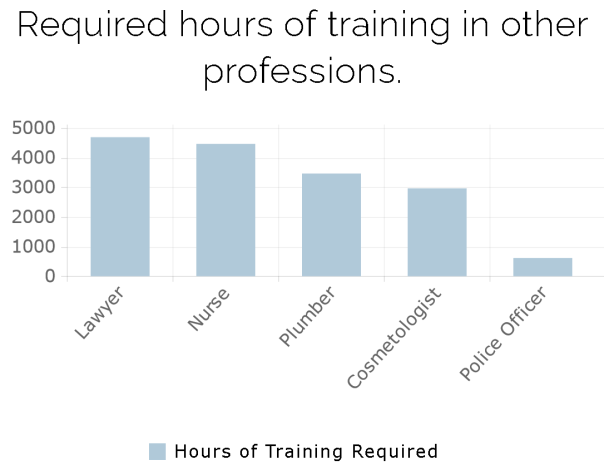
Police officers get far more training in most nations of the world.  The US also has a much bigger problem with police killing civilians than in other rich countries, so perhaps policing is one area where stricter licensure standards would be beneficial.

Inequality

The Economist magazine points out that whereas unionization tended to decrease inequality, many kinds of licensure has the opposite effect:

Lobbyists justify licenses by claiming consumers need protection from unqualified providers. In many cases this is obviously a charade. Forty-one states license makeup artists, as if wielding concealer requires government oversight. Thirteen license bartending; in nine, those who wish to pull pints must first pass an exam. Such examples are popular among critics of licensing, because the threat from unlicensed staff in low-skilled jobs seems paltry. Yet they are not representative of the broader harm done by licensing, which affects crowds of more highly educated workers like Ms Varnam. Among those with only a high-school education, 13% are licensed. The figure for those with postgraduate degrees is 45%.

More educated workers reap bigger wage gains from licensing. Writing in the Journal of Regulatory Economics in 2017, Morris Kleiner of the University of Minnesota and Evgeny Vorotnikov of Fannie Mae, a government housing agency, found that licensing was associated with wages only 4-5% higher among the lowest earning 30% of workers. Among the highest 30% of earners, the licensing wage boost was 10-24% (see chart 1). Forthcoming research by Mr Kleiner and Evan Soltas, a graduate student at Oxford University, uses different methods and finds no wage boost at the bottom end of the income spectrum, but a substantial boost for higher earners.
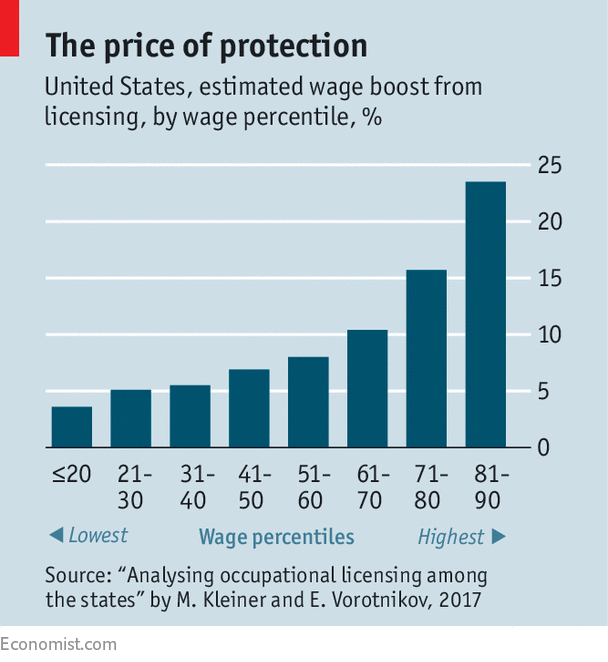
The medical and legal professions [are the most dominated by licensure and they] account for around a quarter of the top 1% of earners, whose incomes have grown faster in America than in other rich countries in recent decades. A study published in Health Affairs, a journal, in June 2015 found that the average doctor earns about 50% more than comparably educated and experienced people in other fields. Another study, from 2012, put the wage premium from working in law at 23%.

[American] Doctors are also unusually well-paid compared with …other countries. The average general practitioner earns $252,000 and the average specialist $426,000 [in America. That is approximately double the average salaries in other rich nations after adjusting for living costs].

More competition would surely bring both wages and prices down. And less licensing across the board would make entrepreneurship easier. It might even palliate populism, which is partly driven by voters’ sense that the economy is rigged to benefit the rich and powerful—a hypothesis which the evidence on licensing plainly supports.

The following graph shows that there are some people working in healthcare and the legal professions whose jobs do not require licensure, but they typically work for bosses who have a license and use it to squeeze more money out of the industry so licensure increases inequality even when you just examine inequality among workers within industries like healthcare and the law.

Whereas the old manufacturing unions organized low-paid assembly-line workers so that they could negotiate more money out of their bosses, licensure often works the opposite way. Licensure in law and medicine would be more analogous to a manufacturing system whereby the factory owners banded together to prevent competition from outsiders and achieve greater control over their workers by lobbying the state to enforce regulations that give the factory owners greater control over what happens in the manufacturing industry.

Most union jobs do not required workers to pay for testing, training, and apprenticeships before they can join.  In contrast, the rising share of American jobs that require licensure are only accessible to people with the time and money to complete lengthy licensing requirements. One study found that even for a subset of low- and medium-skilled jobs, the average license required around 9 months of education and training. That is fine for people with time and money, but it could create a kind of poverty trap for less fortunate workers.

One of the most remarkable features of the US economy was the dramatic drop in inequality that happened beginning around the end of the Great Depression through WWII as you can see in the red line in the graph below.
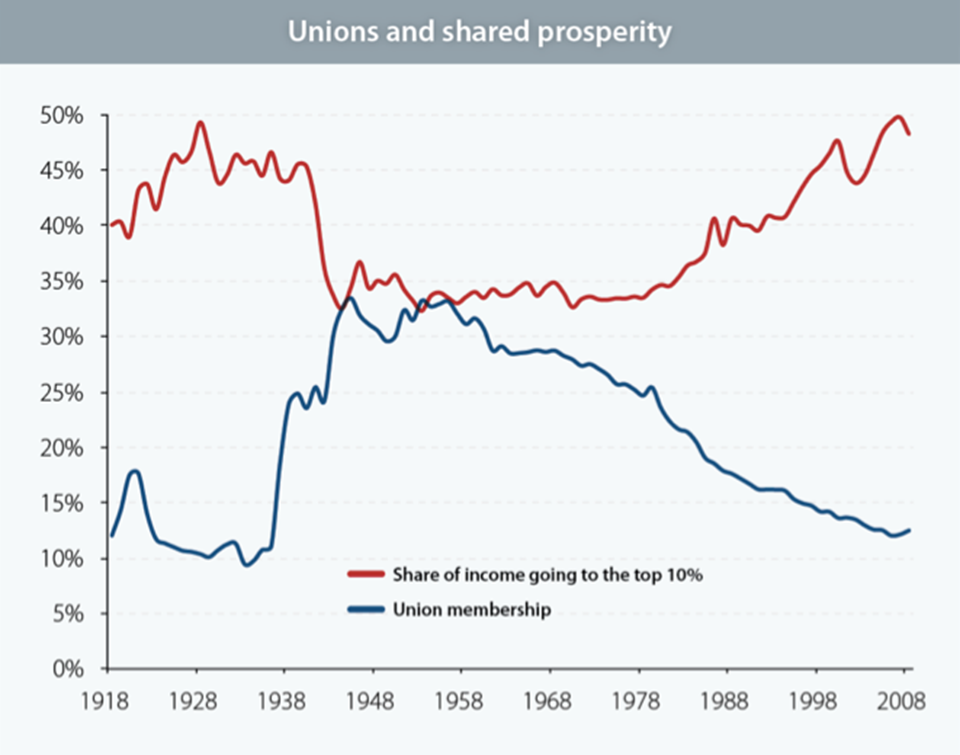
One of the factors that might have contributed to the fall and then rise in American inequality is the rise and then fall in unionization. As unions have disappeared since the 1970s, licensure has been growing and has replaced unions as the dominant way workers have been organizing, but licensure had had the opposite effect on inequality. This is not to say that unionization and licensure are THE cause of inequality, but they likely contribute.

Taxi cab licensure is a good case in point showing how licensure can increase inequality.  Taxi licensure likely began when cab drivers banded together to limit the number of cabs and control the quality of the vehicles.  Unlike most forms of occupational licensure, it doesn’t directly restrict the people who can do the work.  It restricts the vehicles that can do the work.

As the value of cab licenses or “medallions” rose, their ownership became too expensive for cab drivers to afford.  Only a multi-millionaire can afford to invest in a medallion for a single taxi that costs $1.25million.  Cab drivers had to rent a medallion to be able to work.  Renting the medallion became the most expensive part of cab driving in New York City and elsewhere with medallions.  The medallions became more valuable as the demand for cabs rose because the supply of cabs was fixed and that increased the price of cab fares.  That was also what made this market so appealing for disruption by Uber and Lyft which destroyed the value of medallions by getting around this licensure restriction and offering lower fares. 

The medallions ended up increasing inequality because the millionaires who owned them got all the benefits of the higher prices. The taxi drivers had to pay the medallion owners a lot more of their fare money than they got to keep even though they did all the work. The medallion owners defended the system by arguing that it was necessary to ensure the quality of taxis, and it is true that they had some interest in preventing the worst kind of quality problems, but the licensure system was a kind of cartel which has zero incentive to reduce prices and only very minimal incentive to improve quality.

The laziness of the taxi cartels was one reason Uber was able to destroy them.  Their monopoly power had provided no incentive to improve and they were offering mediocre quality at a very high price.  Unfortunately, Uber did not fix the inequality issue.  Uber drivers probably earn even less than the cab drivers because Uber has figured out how to take advantage of the fact that most drivers fall prey to the hidden-cost fallacy and don’t factor in any cost of capital for vehicle depreciation per mile.

MIT estimated that the median pay for Uber in the US is about $3.37 per hour!  Larry Mishel of EPI estimated that Uber drivers earn $9.21/hour and Noah Smith estimated that it might be as high as $10 per hour which is much better, but that would still put full-time drivers at the poverty line unless they were single adults without any dependents.  Most drivers quickly figure out how bad the pay is and that is why 96 percent of Uber drivers quit working for Uber in less than a year. 

Voluntary Certification vs. Mandatory Licensure

The bachelor’s degree is a certification that gives a signal of worker quality, but it is purely voluntary.  Any employer can choose whether to hire someone with this certification or not.  Workers with bachelor’s degrees earn about 80% more than workers without, so it is a valuable certification, but nobody has to pay this wage premium.  Most workers do not have this certification and anyone can hire them, so the only reason to pay extra is because people with a bachelor’s degree are more productive and this gives an incentive for people to learn productive skills in getting their degree.  

Licensure eliminates the choice whether to legally hire someone without a license, so there is little incentive to actually become more productive.  The only justification for preferring mandatory licensure over voluntary certification is if customers are incompetent at judging the quality of workers.  There is an argument that most people cannot judge how good their doctor is, but rather than give one licensure organization a monopoly over medicine, it would be better for society if there were competition between multiple organizations that offered licenses because they would compete to demonstrate that their group is better quality than the other.  

Posted in Inequality, Labor

#Pence2018: What gay bunnies mean for a Pence administration.

Whereas in 2009 nearly 50% more Americans opposed gay marriage than supported it, as of the latest poll, a mere eight years later, there are nearly twice as many Americans who support gay marriage than those opposed according to Gallop.

This is the most dramatic change in public opinion I have ever seen in my life.

Now that gay marriage is overwhelmingly popular among Republicans and Democrats alike, a lot of Americans are concerned that a Pence administration would cause backsliding on gay rights. Mike Pence gained the national spotlight as governor of Indiana by fighting for the rights of homophobic people to be able to discriminate against gay people and that is the most salient fact that a lot of Americans know about Mike Pence. But rest assured that there are several reasons why a president Mike Pence wouldn’t do more than Donald Trump to curtail gay rights.

First of all, most people don’t realize it, but Donald Trump has already had a remarkably homophobic administration. This is all the more remarkable because Trump himself has never been particularly homophobic. He has always had very cosmopolitan, free-wheeling views about sexuality his entire life as you can see from his personal behavior. However, he has filled his administration with a lot of homophobic people (like Mike Pence) and to a large extent the president makes policy by making personnel choices because presidential appointees have wide latitude in deciding how they execute the law. Trump himself has little interest in policy details, so the people around him control the show when it comes to actually administrating the more than 4 million people who directly work under the president plus the millions of additional Americans who indirectly work for the executive branch as contractors. Trump has no clue what all those people are doing and has shown less interest in learning the details than any other president in living memory.  So Trump’s anti-gay appointees have been quietly doing the kinds of things you would expect a Pence administration might do.

Secondly, the graph above shows that the electorate is at a completely different place now from where it was when Pence was defending the rights of homophobic people. Pence’s position was overwhelmingly popular in 2009, but you don’t see him openly advocating for the right to discriminate against LGBT people anymore because it is a political loser now. The Trump administration has been implementing homophobic policies as quietly as possible and it is easy for them to keep their everyday activities out of the headlines when the news is always dominated by scandals and other outrageous things that are constantly happening in Washington. In a boring, normal Pence administration, ordinary policy changes like allowing the government and its contractors to discriminate against LGBT people would have a chance of getting into the news that Americans see. I bet you didn’t even know that Trump did that (and lots of his other unpopular policy changes) because the latest Trump Reality Show drama drowns out the relatively boring, but consequential actions of his administration. The news is dominated by Trump tweeting childish taunts at North Korea or suing his porn-star friends to censor them from talking about their relationships with Trump. It is easy to keep quiet about LGBT policy when Trump is a natural-born click-bait headline generator.  A President Pence would get away with a lot less than Trump because Pence would not be nearly as good at distracting the public with the constant smoke and mirrors show that Trump can’t help but put on.

Thirdly, Pence himself has shown evidence of becoming more accepting of LGBTs. He stopped campaigning about it long ago and is now denying that he ever had some of the positions that he used to be associated with such as “conversion therapy” to “treat” homosexuals and turn them straight. For example, in 2000, his website said he supported funding to assist “those seeking to change their sexual behavior” in order to combat the spread of HIV.  Naturally given Pence’s reputation, and long, close association with groups that promote conversion therapy such as James Dobson’s Focus on the Family, this was widely interpreted to mean conversion therapy and Pence never tried to reject that interpretation for 16 years.  But in 2016, Pence finally came out as definitively rejecting conversion therapy and denied that he ever supported it.

Now the number one bestselling book in America is about a little gay bunny who belongs to Vice President Mike Pence.   This illustrated children’s book is about a gay romance between two bunnies.  It is a parody of a children’s book by Mike Pence’s daughter Charlotte who said that “we can all get behind,” the gay rights charity that the gay bunny book supports.

Nothing illustrates change better than the Pence family getting behind a children’s book about their gay bunny that becomes the #1 bestseller in America.  A decade ago I never would have guessed this would happen today.

The gay bunny book was thought up by comedian John Oliver whose video about Pence tries to make him seem like a terrible person, but except for Pence’s homophobia, John Oliver just proves that Pence is a lot better than Trump. For example, John Oliver bashes Pence for lying, but his evidence is weak.  When Pence was asked to defend Trump’s baldfaced lies claiming Trump won the popular vote, Pence dissembled and deflected like a normal politician.  He didn’t call out his boss as a liar, but he also refused to confirm Donald Trump’s baldfaced lies.  The worst you can accuse Pence of doing is saying that nobody knows whether Trump’s lies are true or not which is probably a lie, but perhaps Pence is just a committed postmodernist!  (Ok, now I’m lying.)  But at least Pence looks uncomfortable when he is confronted with Trump’s lies which is a big improvement over Trump.

Pence for president, 2018.

Posted in Culture, Pence2018

Enter your email address to follow this blog and receive notifications of new posts by email.

Join 75 other subscribers
Blog Archive
Pages