Textbook examples of ‘moral hazard’ are not morally hazardous

I opened a copy of James Henderson’s 2012 Health Economics & Policy textbook today and saw a criticism of 3rd-party insurance payment illustrated by this example on page 7:

Spending Somebody Else’s Money

A Wall Street Journal article [by James P. Weaver, November 19, 1992] provides an interesting example of how spending someone else’s money distorts the decision-making process. A 70-year-old man suffering from a ruptured abdominal aortic aneurysm was brought to the hospital. After several weeks in the intensive care unit—with all the modern technology that goes with it—and a three-month stay in the hospital, the bill approached $275,000, none of which would be paid out-of-pocket by the patient. The man’s physician determined that his poor eating habits, caused by poorly fitting dentures, were contributing to his slow recovery. He requested that the hospital dentist perform the necessary adjustments. Later, the doctor discovered that the man had not allowed the dentist to adjust the dentures. When asked the reason, the man replied, “$75 is a lot of money.” It seems that Medicare would not pay for the adjustment, so it would have been an out-of-pocket expenditure for the patient. When you’re spending somebody else’s money, $275,000 does not seem like a lot. But when you are spending your own money, $75 is a lot. Our reliance on a third-party payment system is the major institutional feature that contributes to rising costs and increased spending. Cost-conscious consumers have little or no role in a system dominated by third-party payers.

The next page explains that this is called “moral hazard” which is defined as people consuming too much because of insurance.  Moral hazard is an obsession among American economists, but think about the alternative in the above example.  Without some sort of health insurance payment we would have to let him die.

In calling this an example of moral hazard, Henderson implicitly says that it is immoral to pay for the expensive treatments that saved a poor old man’s life.  It is possible that $275,000 is too much money to spend saving someone’s life, but the textbook is not making that argument.  It is using the mmutilitarian assumption that the primary moral consideration that determines the morality of helping the old man is how much money he has to spend. That is the idea that moral hazard is based upon.

To me, a bigger moral failure in this story than the alleged ‘moral hazard’ is the wastefulness of a system that does not spend a little money on prevention to prevent enormous bills and traumatic surgery.  If our healthcare system were smart enough to spend $75 on denture adjustment, we might avoid $275,000 surgeries.  This is one reason the US healthcare system is by far the most expensive in the world and gets mediocre results: we are penny wise and pound foolish.  If moral hazard of insurance were a big problem, then countries with universal insurance would have much bigger health expenditures than the US, but they don’t.  In Britain, the man’s insurance would have paid for a free denture adjustment and he would have had no need for the expensive surgery.

Even though most people don’t know what moral hazard is, it is an important concept because US policymakers are obsessed with combating it and that leads them to want to make the healthcare system crueler by increasing the costs that needy patients pay out of pocket because they hope to cut expensive healthcare services like the surgery in the above example by making it unaffordable to more people.  Instead we should focus on ways to make the healthcare system more efficient by expanding the most cost effective healthcare like denture adjustments so that expensive surgeries can be avoided without cruelty.

Dentistry also gives evidence against the idea that the moral hazard of insurance has caused high price inflation in healthcare.  Max Ehrenfreund at the Washington Post wrote that overall expenditures on dental work has been rising at about the same rate as medical expenditures and dentists’ incomes have been rising faster than doctor incomes.  The government only provides dental insurance for about 9% of the US population.

Posted in Health

Seed Corn Is Not Food & Bank Reserves Are Not Money.

Banks are merely financial intermediaries that don’t use money as a medium of exchange for buying anything that contributes to GDP.  If local banks save money at the central bank (the Fed in the US), it is merely the local bank lending to another bank.  This is called bank reserves.  Because banks never use their reserves to buy real goods and services, they are not money.  Money is defined has being a medium of exchange, and bank reserves are never used as a medium of exchange.

Bank reserves are related to money in that reserves can be used to create real money, but reserves are not money any more than seed corn is food.  Seeds are planted in order to multiply them and create food, but the seed corn is not food unless it is actually eaten rather than planted (or hoarded).  Bank reserves are similar.  If banks hoard reserves instead of using the reserves to create loans, then the hoarded reserves are called “excess reserves” because they are not being used.  That is no more part of the money supply than stockpiles of unused seed corn is part of the food supply.  The hoarding of excessive seed corn and the hoarding of bank reserves can both produce a kind of famine.

For example, Amartya Sen wrote a history of the Bengal famine of 1943, in which he claims that there was enough grain available to feed everyone, but that millions starved due to excessive hoarding of grain.  When speculators started hoarding grain, they took it out of the markets which reduced the real supply and grain prices rose which made it too expensive for the poor to buy. As a result, two or three million people died. There is some dispute about how much grain hoarding was done by speculative Bengalis, but there is no dispute that there was plenty of grain in the world to feed Bengal and someone hoarded it away from the millions of dying Bengalis because it was not profitable enough to send it to them. Similarly, in the US and other developed nations, banking systems have been hoarding money in reserves since 2008.  That hoarding has not been benefiting the unemployed capital and workers that were sitting idle in the aftermath of the Great Recession of 2008.

Bank reserves are often called “high-powered money” because it could be multiplied into large quantities of money if banks use their reserves to increase lending and get real money to real businesses and consumers.  But “high-powered money” is a misnomer because it is not money.  Bank reserves are never actually used to exchange goods and services and it is the goods and services that matter.  It is just like seed corn can be multiplied into large amounts of food.  But seed that is not multiplied into food has no power at all.  Similarly, bank reserves can produce multiples of money if they are lent out to people who can use money, but the reserves themselves are never used just like seed corn is never eaten.  If germination rates drop in half due to being stored too long, the power of seed-corn drops in half.  Similarly the power of bank reserves solely depends upon whether it is used to make real money.  The power of the monetary base (mostly bank reserves) is called its multiplier.

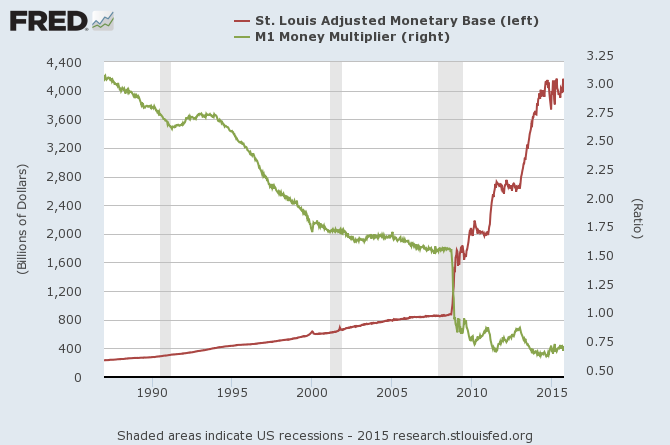
money multiplierFRED

As you can see in the above graph, in 2008, the monetary base (red line) suddenly doubled in 2008.  However, it’s power at creating money (M1 in green) simultaneously plummeted just as fast.  The quantity of bank reserves doesn’t matter unless banks use them to create real money that can be spent on goods and services.  Only real money matters because that is what is used to exchange of goods and services.  The 2008 recession definitively demonstrated that reserves are not money.  The FED pumped more money out to the banks, but they banks just hoarded the new money as excess reserves rather than letting the new money out into the economy where it could do some good to help feed people.

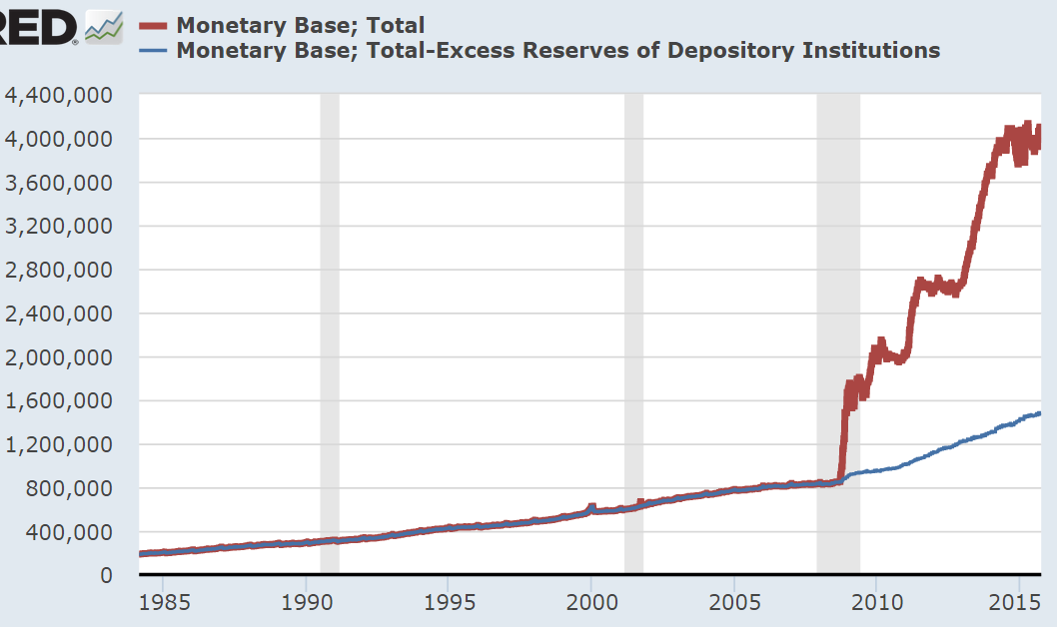
A better measure of the monetary base would exclude the excess reserves that are being hoarded in the bank vaults:

monetary base n excess reservesFRED

The blue line in the above graph shows the amount of bank reserves that have actually been used in the economy.  The gap between the red line and the blue line is the vast amount of hoarding (excess reserves) at US banks.  At the peak, almost twice as many bank reserves were being hoarded as were being used to influence the economy!

Numerous pundits have been warning about inflation because the Fed has quintupled the money supply since 2008 as the red line seems to show.  These people have been predicting that this unprecedented increase in “high-powered money” will cause hyperinflation and chaos, but their fears are misplaced because they are not understanding the difference between unused seed corn that is hoarded (like excess reserves) and corn that is available for food (like money).  The blue line shows the real change in the effective monetary base which is about the same as its growth during rest of US history.

The monetary base is not money and economists understood that when they created the main statistics for measuring money: M1, M2, M3, and MZM.  These are our best attempts to measure the money supply and none of them include any money that is hoarded in bank vaults because this is never part of the money supply.  Banks never directly use any of it for buying anything, so it isn’t really money and it doesn’t have any direct effect on the real economy.

Posted in Macro

A parable of how to solve a financial crisis

 Lasse Lien posted a simple story about how a change in the money supply can reduce transactions costs and eliminate debt.  When the money supply increases, the circular flow of money tends to speed up.

A rich tourist came to a small town in the middle of the financial crisis. He went into the local hotel, placed a 200-dollar bill on the counter and went upstairs to check out what kind of rooms the hotel had to offer. In the meantime the hotel manager grabbed the bill, walked over to the butcher and used the bill to pay his debt. The butcher then took the bill to the cattle farmer and paid his debt to him. Next, the cattle farmer took the bill to the cattle feed supplier and paid his debt there. The cattle feed supplier then paid his debt to the local prostitute. The local prostitute brought the bill back to the hotel and paid her debt to the hotel manager. The hotel manager put the bill back on the counter. Then the rich tourist returns down the stairs and proclaims that he didn’t like the any of the rooms. He grabs the bill and leaves the city. A pity, but more importantly, the town was now debt free and optimism was back.

This story has Keynesian implications.  Debt cycles are one of the important reasons for recessions and cycles of optimism (or “animal spirits”) in Keynes’ story are another reason.  Plus, it is a story about the circular flow model of the economy.

Five_Sector_Circular_Flow_of_Income_Model

Because this was posted on an Austrian Economics website, most of the comments criticize the story, but the critics are off the mark.  For example, one commenter complains that “money needs to keep appreciating.”  That’s ridiculous.  An appreciating currency is one that is suffering from deflation which fortunately has been a rare phenomenon since the Great Depression because deflation is generally harmful.

Normally we have a modest amount of inflation (a measure of the depreciation of money) and an unexpected increase in inflation gradually reduces debts and would serve the same function as the tourist’s money for wiping out the value of the debts.  Modest inflation and/or interest rates are irrelevant to the story.  For example, if everyone earned 10% interest (and paid 10% interest), it would make no difference. It would only complicate the story with irrelevant details that don’t fundamentally change the conclusion.

Another commenter objected that, “Everyone exchanged $200 owed for them for $200 owed TO them; this is a simple settling of outstanding accounts and didn’t affect anyone’s net position.”

Again, this too is a misunderstanding of basic macroeconomics.  Financial accounts always net out to zero (when the entire financial system is examined as a whole) because every debt is someone else’s asset.  My money only has value if others consider it to be a debt that they owe me.

Money helps reduce transactions costs and solve the dual coincidence of wants problem in the story.  Everyone in the story wants to get $200 from someone, but doesn’t know if he or she will ever get paid.  Meanwhile each person also is certain that they owe a debt to someone else.  If the loans were all legally due on that same day, everyone in this parable would have gone bankrupt if not for the unwitting loan from the tourist.

It is no accident that this story was written in the aftermath of the financial crisis because that was a similar situation.  There was financial gridlock because banks were unsure if they would get paid back the loans that they were owed and that prevented them from paying their depositors which prevented depositors from paying their debts too.  When the government’s TARP program bailed out the banks by effectively lending them cash, it ended financial gridlock and the economy recovered and optimism returned.  In the end, the banks paid back pretty much all the money to the government, so the net cost of the bailout to the US Treasury will be about zero percent (give or take a few).*  That is pretty much identical to the ending of the parable.

*The net TARP costs are “about zero” as of 2015, and I can’t give a definitive cost because the TARP program isn’t over yet, but the government projects that the net costs will be minimal.  Some moneys were not repaid, but other loans and investments made enough money in interest and capital gains that the bank bailout will probably end up making a nominal profit. The TARP funds were also used to subsidize some other sectors of the economy like the car manufacturers and home owners.  Some sectors have had lower repayment rates than the banks so the TARP program as a whole is expected to have some net cost to taxpayers, but even so, the total cost will only be a tiny fraction of the total bailout program of $700 billion.

Posted in Macro

A timeline of the big three US welfare programs: Health, Education, and Pensions.

In every welfare state, the most expensive social programs are education, pensions, and healthcare.  These three categories, plus national defense, will account for about 74% of total US government spending in 2015.*  Most people think of ‘welfare’ as assistance for the poor, but the most expensive programs that assist the poor are programs that assist all Americans. The biggest welfare programs provide benefits that are targeted for education, pensions, and healthcare.  Programs that are solely focused on reducing poverty like food stamps, housing assistance, and cash assistance are all relatively small and much less popular than the expensive social programs that benefit everyone.  Unemployment insurance is somewhere in between.  It benefits everyone in theory since everyone, including millionaires, get unemployment checks.  And it is also an anti-poverty program because most of the money really does go to relatively needy families partly because high-income people are not unemployed as much as low-income people.   Unemployment insurance is a lot smaller and less popular than the three big-dollar social programs, but it is more popular than welfare programs that exclusively help the poor.

Here is a brief timeline of changes in the big three social welfare programs in the US, focusing on healthcare because it has the most tortuous history, it is the biggest spending category, and it is the only category that is expected to continue growing much faster than GDP.

1800s: The US was one of the first nations to socialize education. Education became both an entitlement and required by mandate.  Most Americans don’t think about the government takeover of education as being a form of socialism any more than they think of the military as being socialist, but both meet the quintessential definition of a socialist activity in which the government owns the means of production and directly hires the workers.  Government production dominates education spending (and defense) in every country of the world today.  Whereas education is a federal program in most countries, in the US, education was mostly socialized by local governments.  For all of US history until about 2007, education was by far the single biggest social program in the US.  My dissertation adviser, Joe Persky, told me that it was also the single largest welfare program (in the ‘anti-poverty’ meaning of welfare) since education spending has always been so enormous and because American kids disproportionately live in relatively poor households.

1935: Franklin D. Roosevelt socialized pensions by creating social security.

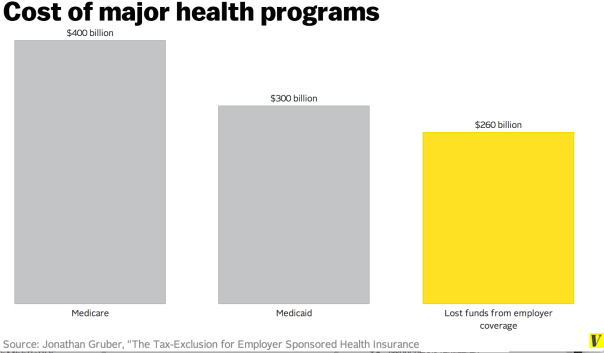
1954: Eisenhower created the employer-provided-insurance tax subsidy.  This is the third most expensive government healthcare program after Medicare and Medicaid.  Although most Americans don’t realize it exists, most economists (on both the left and the right) think it should be repealed because of their obsession with moral hazard. According to a lecture Timothy Jost gave at Bluffton, it led to a dramatic increase in employer-provided insurance.

3biggest health programs

1965: Lyndon B. Johnson created socialized universal health insurance for the elderly (Medicare) and the poor (Medicaid).  Johnson gave universal, free healthcare to all Americans over age 65.  He dramatically expanded the US healthcare entitlement beyond veterans who always had socialized healthcare beginning during the revolutionary war.

1972: Richard Nixon expands Medicare to cover the disabled.

1983: Ronald W. Reagan created the first truly universal healthcare system in the US: The Emergency Medical Treatment and Active Labor Act or EMTALA. It is the entitlement for all people in the US to get guaranteed hospital treatment through emergency rooms without regard to ability to pay or citizenship status. And once anyone is admitted, they cannot be discharged until their condition is stabilized regardless of the costs for treatment.  Between EMTALA and Reagan’s efforts to expand Medicare and Social Security, Reagan is one of the main architects of the American welfare state.

1997: Clinton expanded Medicaid to cover many more children and pregnant moms.  Children’s Health Insurance Program (CHIP) resulted in about half of all births being covered by Medicaid.  It is the main legacy of Hillary Clinton’s failed efforts to pass universal health insurance.

2003: George W. Bush expands Medicare to add a drug benefit.

2010:  Barack Obama passes the Affordable Care Act.

That is a brief overview that covers the social welfare programs that have had the biggest impact on the economy.


*This was an unofficial 8/17/2015 estimate of government spending and it might change slightly as new data comes in.  It comes from an unofficial, third-party source because no official government agency aggregates data for state, local, and federal spending.  I excluded interest payments from my calculation because interest is just a transactions cost that is used to pay for our government programs.  The category which has historically produced the biggest budget overruns is national defense, so if you want to attribute interest costs to a particular program, national defense should get the biggest share.

Posted in Public Finance

Hoarding causes recessions

A recession can either be caused by a lack of supply or a lack of demand.  A lack of supply could be caused by a drought reducing agricultural output or a war reducing the productive capacity to supply goods and services.  A lack of demand is caused by the hoarding of money. The idea that hoarding can cause a demand recession was probably first developed in the 1700s by French Physiocrat, Francois Quesnay who argued that money is more productive in the hands of poor people because they will spend it than in the hands of the rich who can afford to hoard it.

The cause of demand recessions became an active area of debate in economics in the early 1800s, but as Brad DeLong wrote, there is a simple explanation about why recessions happen:  hoarding of money.

The desire to hoard money varies at different times and whenever there is too little money relative to the amount of goods and services that could be produced, a recession, or “general glut” happens because some people hoard money rather than buying goods and services.

The opposite of a general glut is when there is too much money which causes inflation:

Sometimes when you go the market, you find the money prices that you have to pay higher than you expected—perhaps 10% higher than you expected last year when you made your plans. It seems that, somehow, there is too much spending money chasing too few goods.

When the money supply grows faster than the supply of goods, we get inflation because people have more money without getting more goods and so they become willing to spend more money on each good they buy.  That is a rise in prices (inflation).

Conversely, we can have the opposite problem—not a glut of money relative to goods, but what early-nineteenth century economists used to call a “general glut” of unsold commodities, idle factories and workshops, and idle workers all across the economy. Economists have important things to say about how to try to prevent these episodes and what to do when they happen to cure them…
Back in the 1820s the question of whether the circular flow of economic activity as mediated by the market system could break down and the economy become afflicted by a “general glut” of commodities was a live theoretical question. Everybody agreed that there could be particular gluts [in the market for a particular good like electricity, but there was disagreement whether all goods and services markets could have a glut at the same time].

Consider what happens should households decide that they want to spend less on electricity to power large-screen video and audio entertainment systems and more on yoga lessons to seek inner peace. The immediate consequence… of this shift in preferences is excess demand for yoga instructors and excess supply of electric power. Prices of electricity (and of large-screen TVs, and of audio systems) fall as unsold inventories pile up in stores and as generators spin down and stand idle. Yoga instructors, by contrast, find themselves over scheduled, working ten-hour days, and stressed out—and find the prices they can charge for their lessons going through the roof. Workers in electric power distribution and in video and audio production and sales find that they must either accept lower wages or find themselves out on the street without jobs.
Over time the market system provides individuals with changing incentives that resolve the excess-supply excess-demand disequilibrium. Seeing the fortunes to be earned by teaching yoga, more young people learn to properly regulate their svadisthana chakra and teach others to do so. Seeing unemployment and stagnant wages in electrical engineering, fewer people major in [it]. The supply of yoga instructors grows. The supply of electrical engineers shrinks. Wages of yoga instructors fall back towards normal. Wages of electrical engineers rise. And balanced equilibrium is restored. Thus we understand how there can be a glut of a particular commodity—in this case, electric power. And we understand that it is matched by an excess demand for another commodity—in this case, yoga instructor services to properly align your svadisthana chakra.
But can there be a general glut, a glut of everything?
Some economists early in the nineteenth century said yes. Other said that the idea of a “general glut” was logically incoherent. Jean Baptiste Say, for example, [in his 1821 Letters to Mr. Malthus]:

I regret to say, that I find in your doctrines some fundamental principles which… would occasion a retrograde movement in a science….
What is the cause of the general glut of all the markets in the world, to which merchandise is incessantly carried to be sold at a loss?… Since the time of Adam Smith, political economists have agreed that we do not in reality buy the objects we consume, with the money or circulating coin which we pay for them. We must in the first place have bought this money itself by the sale of productions of our own. To the proprietor of the mines whence this money is obtained, it is a production with which he purchases such commodities as he may have occasion for…. From these premises I had drawn a conclusion… “that if certain goods remain unsold, it is because other goods are not produced; and that it is production alone which opens markets to produce.”…
[W]henever there is a glut, a superabundance, [an excess supply] of several sorts of merchandise, it is because other articles [in excess demand] are not produced in sufficient quantities… if those who produce the latter could provide more… the former would then find the vent which they required…

Yet Say changed his mind. By 1829, in his analysis of the British financial panic and recession of 1825-6, Jean-Baptiste Say was writing that there could indeed be such a thing as a general glut of commodities after all: “every type of merchandise had sunk below its costs of production, a multitude of workers were without work. Many bankruptcies were declared…” The general glut, Say wrote in 1829, had been triggered by a panicked financial flight… in financial markets. What was going on? The answer was nailed by John Stuart Mill:

Those who have… affirmed that there was an excess of all commodities, never pretended that money was one of these commodities…. What it amounted to was, that persons in general, at that particular time, from a general expectation of being called upon to meet sudden demands, liked better to possess money than any other commodity. Money, consequently, was in request, and all other commodities were in comparative disrepute…. The result is, that all commodities fall in price, or become unsaleable…. [A]s there may be a temporary excess of any one article considered separately, so may there of commodities generally, not in consequence of over-production, but of a want of commercial confidence…

Note that these financial excess demands can have any of a wide variety of causes: episodes of irrational panic, the restoration of realistic expectations after a period of irrational exuberance, bad news about future profits and technology, bad news about the solvency of government or of private corporations, bad government policy…, et cetera.
It seems as if there is …almost always something that the government can do… that promises a welfare improvement over, say, waiting for prolonged nominal deflation to raise the real stock of liquid money, of bonds, or of high-quality AAA assets. Monetary policy open market operations swap AAA bonds for money. Quantitative easing that raises expected inflation diminishes demand for money and for AAA assets by taxing them. Non-standard monetary policy interventions swap risky bonds for AAA bonds or money. Fiscal policy affects both demand for goods and labor and the supply of AAA assets–as long as fiscal policy does not crack the status of government debt as AAA and diminish rather than increasing the supply of AAA assets. Government guarantees transform risky bonds into AAA assets. Et cetera…
And what if there is a glut not of commodities but inflation? Simply apply the same policy tools in reverse.
That is the last of the six things economists have to say in the public square: that the economy does not consistently balance itself at high employment with stable prices. The principle that it does economists have called Say’s Law—even though Say abandoned it by 1829. And it is important for economists to say, loudly, that Say’s Law is not true.

Modern era recessions are almost always caused by someone hoarding money without even realizing that they are doing it. GDP statistics divide up spending among four groups of people: 1. Households (Consumption spending), 2. Businesses (Investment spending), 3. Government, and 4. Foreigners (Net export spending).  In the US, you can mostly blame businesses for increasing hoarding during a recession.  That is why we commonly call a recession and expansion a “business cycle”.  When businesses get scared about future profits, they cut their spending on capital investment to hoard more of their money for the hard times that they foresee and that is the main cause of recessions as measured in the GDP statistics.

Banks can also hoard money during recessions because they get scared about lending out savings and they raise their lending standards.  That further depresses business investment spending because savings don’t get lent back out to stimulate the circular flow.

Households try to pay down debt during recessions which just increases the money that is being hoarded by banks. Consumers are forced to hoard money because unemployment rises and unemployed people have to cut back spending.  Even workers who keep their jobs are more worried about layoffs and tend to delay buying new cars or any purchases they can put off.  Even so, American consumers are so dedicated to consuming that overall consumption spending doesn’t change much, but it does have an impact.

For a more formal explanation, see my algebraic hoarding model.

Posted in Macro

Why read Paul Krugman for macroeconomics?

I assign some Paul Krugman readings in my Macroeconomics class and because he is such a polarizing character, some people on both the right and the left seem to think he is just a blowhard.  If you are one of them, I think it is worth reading why you should read some of Krugman’s economics.

Although Paul Krugman is a controversial public intellectual, he has garnered tremendous professional respect. His Wikipedia entry lists numerous professional honors that he has won for his accomplishments including the Nobel Prize in Economics in 2008.  Although he is an outspoken liberal in his politics, he also gets a lot of attention and even respect from many conservatives for his economics.  For example, he was the favorite liberal economist among the conservatives at Econlog, a conservative (libertarian) organization. Another libertarian organization called Econ Journal Watch found him to be far and away the most popular economist under age 60 in a poll of professional economists (PDF).  Unlike most academic economists, he is a good writer who has a long history of explaining economics for general audiences.  According to web traffic, he has been by far the most read economics news and commentary writer on the internet since at least 2007, and his blog has sometimes gotten about as many readers as entire websites like The Onion.

Krugman was one of the few people who predicted some important parts of the the 2008 economic crisis. His predictions were not good enough to make money on like the guys Michael Lewis wrote about in The Big Short (an incredible story), but Krugman did predicted that the end of the real estate bubble would cause an economic crisis and once we were in the crisis, his predictions about inflation and monetary policy were better than most.

In addition to writing about economics, Krugman writes about politics and music on his blog.  Although Krugman is a great economist whose economic judgment I respect, I don’t see any reason to regard his ideas about other matters like politics and music as having more expertise than the average writer about these matters.

Once you separate Krugman’s economics from his politics, you can see that many of his economic theories have gotten a lot of support from conservatives.  One year when I taught Macroeconomics with a class of majority conservative students I assigned Krugman’s Return of Depression Economics and Raghuram Rajan’s Fault Lines. Although Rajan is a conservative economist and Krugman is a liberal, my students had a hard time finding much partisan bias in either book and some actually felt like Rajan’s thesis seemed more liberal because blamed rising inequality in the US as one of the root causes of the financial crisis.

Although it is impossible to completely separate economics and politics, most of the politics that influence macroeconomic theories are completely different from the political values that 95% of non-economists care about, so most of my students don’t see any strong political valence in most of the economics we read.

Posted in Macro

“Rationing” is not a rational objection

There are two dictionary definitions of the verb ration in which one person directly affects the consumption of another.

  1. to supply something equitably.
  2. to control the amount an individual can use.

The first definition means to give something for free and It would be odd to object to this.  In fact, we have folk sayings that admonish people who ungrateful about getting a gift: never look a gift horse in the mouth, and beggars can’t be choosers. But healthcare is different.  People frequently object to the rationing of free healthcare that is provided by governments and insurers.

The second definition of ration is when the government restricts you from buying something with your own money such as when the US government issued ration coupons for necessities like foods, fuels, and clothing.  Even the richest man in America was legally forced to limit his consumption of gasoline, tires, sugar, meat, cheese, coal, shoes, and many other basics due to rationing.  Today the government rations drugs in this manner.  The government requires prescriptions for purchasing medicine and a prescription is like the WWII ration coupons for gasoline and butter.

Today one of the common criticisms of government financing of healthcare is that the government should not ‘ration’ healthcare.  For example, Forbes published a critique by Scott W. Atlas, MD which objected to government funding of healthcare because of rationing:

government can forcibly reduce the expenditures on medical services by only two methods: 1) restricting the use of medical services, and 2) lowering the payment for such services. And regardless of what Congress and the administration may claim, ultimately, these two boil down to one: the “R word”–direct or indirect rationing of medical care.

Critics like Scott Atlas who complain about government ‘rationing’ of health care don’t mean the second definition of ration; that the US government will block you from buying health care with your own money.  They are complaining about the first definition of ration; that the government will supply free healthcare equitably.  Scott Atlas goes on to complain that the free healthcare won’t be funded generously enough and uses this as an argument in favor of eliminating government funding entirely.  That is odd reasoning.

We do not call it ‘rationing’ when the government funds other services.  For example, when a government-run school system cuts their music program we do not say that the government is rationing music.  If the government music program is not good enough, parents can still buy music lessons privately.  It is the same way with healthcare and it is odd to criticize the idea of expanding health insurance as being a form of increased rationing, but many critics do just this.

True, the government often does restrict the medical services that the government will pay for (no medical marijuana, for example), but this is not really rationing because it does not prevent anyone from spending their own money for legal medical services at any price.  This is a far cry from real rationing like the US government did during WWII.

Perhaps the real reason healthcare providers, like the doctor quoted above, complain about rationing is out of self-interest. The government has a lot of bargaining clout to reduce market prices.  Whenever the government funds free healthcare, most citizens decide that the free government care is good enough and few people spend their own money to buy more of something that the government already provides.  Many healthcare providers have justifiable fears that more government involvement in healthcare will mean lower incomes.  That would feel like rationing indeed.  David Leonhardt argues that most people who use the word ‘ration’ to criticize healthcare policies are being disingenuous.

…the case against rationing isn’t really a substantive argument. It’s a clever set of buzzwords that tries to hide the fact that societies must make choices.  In truth, rationing is an inescapable part of economic life. It is the process of allocating scarce resources.

People like Leonhardt have broadened the definition of rationing to incorporate all of economics.  Economics is often defined as the study of the distribution of scarce resources.  In other word, it is the study of rationing.  Economists primarily focus on studying markets and in healthcare markets, as James Hamilton says, “If… you don’t have the money yourself to pay for it, then you do not receive the treatment.”

This is sometimes called ‘price rationing’, and it is just the way free markets work.  They ration goods according to people’s ability to pay.  It is just everyday life under capitalism.  If I don’t have enough money to pay for a Porsche, then the market will ‘ration’ it away from me in favor of someone with more money.

Some form of rationing is a feature of every medical system.  For example, all medical treatments are legally rationed by medical doctors whose services are rationed by licensure.  Triage is the emergency room’s protocol for rationing immediate care according to need.  Human organs are rationed according to a formula of expected benefit rather than according to ability to pay.  Whenever there is non-price rationing, there is also usually a black market where richer people pay bribes to get more than their ration.  Illegal payments sometimes help people get organ transplants faster.  Only a small minority of Americans, like a textbook author I use (Froeb), thinks that human organs should be allocated by free market price rationing rather than by medical benefit.

In addition to price rationing and prescriptions, David Leonhardt (mentioned above) points out three more ways that our healthcare system imposes rationing upon us.

The first is the most counterintuitive, because it doesn’t involve denying medical care. It involves denying just about everything else.  The rapid rise in medical costs has [taken money away from everything else in life].  …Research by Katherine Baicker and Amitabh Chandra of Harvard has found that, on average, a 10 percent increase in health premiums leads to a 2.3 percent decline in …pay. Victor Fuchs, …and Ezekiel Emanuel, …published an article in The Journal of the American Medical Association last year that nicely captured the tradeoff. When health costs have grown fastest over the last two decades …wages have grown slowest, and vice versa.

So when middle-class families complain about being stretched thin, they’re really complaining about rationing. Our expensive, inefficient health care system is eating up money that could otherwise pay for a mortgage, a car, a vacation or college tuition.

The second kind of rationing involves the uninsured. The high cost of care means that some employers can’t afford to offer health insuranceand still pay a competitive wage. Those high costs mean that individuals can’t buy insurance on their own.

The uninsured still receive some health care, obviously. But they get less care, and worse care, than they need. The Institute of Medicine has estimated that 18,000 people died in 2000 because they lacked insurance. By 2006, the number had risen to 22,000, according to the Urban Institute.

The final form of rationing is …the failure to provide certain types of care [like cheap, effective preventative care], even to people with health insurance. Doctors are generally not paid to do the blocking and tackling of medicine: collaboration, probing conversations with patients, small steps that avoid medical errors. Many doctors still do such things, out of professional pride. But the full medical system doesn’t do nearly enough.

That’s rationing — and it has real consequences.

Leonhardt wrote the article to advocate for comparative effectiveness research.  Any comparative effectiveness research impacts healthcare providers’ incomes because it is the search for unproductive care.  For example, when researchers found that mammograms were overused on younger women, many interest groups immediately opposed the findings. How much of the opposition was due to self-interest?  Doing more mammograms is more profitable than less.  Many opponents of comparative effectiveness research use the word ‘rationing’ to object to any kind of research that suggests that some kinds of care are inefficient.  As Leonhardt says,

…The comparative-effectiveness research favored by the [bipartisan panel led by Howard Baker, Tom Daschle, Bob Dole and George Mitchell] and the White House has inspired opposition from some doctors, members of Congress and patient groups. Certainly, the critics are right to demand that the research be done carefully. It should examine different forms of a disease and, ideally, various subpopulations who have the disease. Just as important, scientists — not political appointees or Congress — should be in charge of the research.

But flat-out opposition to comparative effectiveness is, in the end, opposition to making good choices. And all the noise about rationing is not really a courageous stand against less medical care. It’s a utopian stand against better medical care.

Posted in Health

Enter your email address to follow this blog and receive notifications of new posts by email.

Join 75 other subscribers
Blog Archive
Pages