Health is much more than medical

Most of the improvement of disease outcomes over the past two centuries is due to better prevention rather than better treatments.  And most of the things that have prevented disease were done for creature comfort rather than for disease prevention.  Many diseases decreased in the 1800s before scientists even realized that germs exist and cause infections.  That happened in areas where people got richer and consumers spent  money increasing their comfort and quality of life.  Public health was already improving because people didn’t like drinking sewage and wanted better foods and more comfortable housing with running water and sewage.  Vanessa Heggie wrote that one of the first examinations of this trend was discovered in regards to the decline of tuberculosis.

[Tuberculosis] eventually killed [George Orwell] in 1950 at the age of just 47.

Tuberculosis was a major European health concern in the nineteenth and early twentieth century… At times it was probably the single biggest killer of young adults, feared particularly because it seemed to attack those in the prime of their lives. Treatments were varied and sometimes desperate: Sulfa-based drugs, open air treatment, bed rest, and surgery (including a phrenic nerve crush) were all tried on Orwell.

The first effective drug treatment for tuberculosis, streptomycin, was only released in 1947 – and it was too expensive for many sufferers (Orwell used the proceeds from the American sales of Animal Farm to fund his treatment). The first preventive, the BCG vaccination, was introduced in 1953.

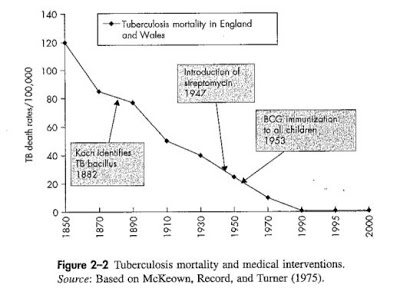
We might expect that these drugs were crucial in the fight against tuberculosis, but in the 1960s and 1970s… Thomas McKeown argued that something else had caused the massive decline in deaths from this disease. In The Modern Rise of Population (1976) he did something deceptively simple: he plotted the rate of death from tuberculosis in England and Wales over time, and marked on the graph the introduction of drugs and vaccines… It’s immediately obvious that the major decrease in the disease happened long before streptomycin was invented.

McKeown argued that it was not drugs, or vaccines, or scientific medicine which conquered this infectious disease, but money [and]… the crucial factor was improved nutrition – this became known as the McKeown Thesis. Many doctors, biologists and pharmacologists rejected this conclusion… In particular the historian Simon Szreter has done some meticulous work on statistics and death records, and suggested that sanitary measures, clean water and public health are the real causes of the decline in tuberculosis mortality (he’s also made it clear how political this process of interpretation can be…)

Heggie points out that McKeown’s graph may overstate the reduction in tuberculosis mortality before antibiotics because of overdiagnosis, but McKeown’s overall point remains valid. Danika Barry reproduced the graph:

TB

Posted in Development, Health

The repugnant conclusion is irrelevant because people find it repugnant

Vox is embroiled in a bit of controversy because the online magazine solicited an article from a Swedish philosopher, Torbjorn Tannsjo, endorsing the repugnant conclusion and then decided that Tannsjo’s conclusions were too repugnant to publish.  My advice is to go ahead and publish because it won’t lead to any repugnant consequences.  Nobody is going to change their actions based on Tannsjo’s philosophy in the article.

The repugnant conclusion is a challenge to utilitarianism that the Stanford Encyclopedia of Philosophy calls, “one of the cardinal challenges of modern ethics” and explains it thus:

In Derek Parfit’s original formulation the Repugnant Conclusion is characterized as follows: “For any possible population of at least ten billion people, all with a very high quality of life, there must be some much larger imaginable population whose existence, if other things are equal, would be better even though its members have lives that are barely worth living” (Parfit 1984).

Although moral philosophers care a lot about it, pretty much nobody else does.  Even Parfit didn’t like it which is why he called it “repugnant”.  That is why Vox shouldn’t worry about publishing the repugnant article.  Nobody is going to be convinced.  Religious movements that encourage maximum fertility have been much more influential, but they don’t use the repugnant conclusion’s utilitarian reasoning and even they have not been that successful at convincing people to have large families.  For example the Catholic Church promotes anti-birth control policies that could lead to large families, but almost no Catholics  abide by the church’s official teaching on the matter.

A few families can have nineteen kids because the rest of society provides them with support, but if everyone had that number of children, we would see hardship.  For example, the Nineteen Kids and Counting family is rich and can hire people to work building their house, growing their food, and providing their healthcare.  The American health insurance is regulated to subsidize large families.  Each American spends over $8,000 per year on healthcare on average, but families pay the same premium for insurance regardless of how many kids they have.  This is one of many ways Americans subsidize other people’s kids.  The average baby costs over $30,000 in healthcare, but almost no families pay the full cost.  If the Duggars paid an actuarially fair price for health insurance for each birth, they would have expected to pay $570,000 just for the births.  Almost half of all births were paid for by Medicaid even before Obamacare and it is undoubtedly more now.

Most rich families choose to have small families and poor families have more children on average.  Poor families also rely upon numerous supports from the rest of society.  We subsidize other people’s kids because America need somebody to have kids to support us in our old age and despite all the subsidies for kids, average family size is shrinking.  The US spends over $12,000 per child in public education (and more for the average year of college education).  That would total $216,000 for eighteen kids to get one year of public schooling.  It simply isn’t feasible for a society to afford quality education for every child if every family has eighteen kids and counting.  We wouldn’t have enough teachers when all our parents would be too busy to work outside the home.

This is one reason why most people don’t support the repugnant conclusion that they should maximize their children.  They realize that large numbers of children create large costs and they aren’t willing to pay those costs themselves nor impose them on others.  But there are numerous ways to avoid the repugnant conclusion as you can see listed in Wikipedia or the Stanford Encyclopedia at the links above.  Medianism is one simple way out of the repugnant conclusion.  If your goal is to maximize the happiness of the median person, then you don’t want to maximize population.

But I’m not going to put any effort into promoting medianism as a way to solve this “cardinal challenge… of modern ethics” because the repugnant conclusion isn’t a challenge to most people’s way of thinking.  As Kevin Drum mentions, most people don’t care about it.  What people do care about is cost-benefit analysis and mean GDP, which also happen to be ways to reject the repugnant conclusion.*  These are the main modern ethical systems that run our economies and Medianism is a way to challenge and slightly improve on them.

Many people, including Kevin Drum and numerous people in his comment thread, try to solve the repugnant conclusion by rejecting utilitarianism:

Why on earth would anyone take Tannsjo’s argument seriously in the first place? The entire thing hinges on the premise that we all have a moral duty to maximize the absolute amount of felt happiness in the universe. If you don’t believe that, there’s nothing left of his essay.

But virtually no one does believe that. And since Tannsjo never even tries to justify his premise, that makes his entire piece kind of pointless. It would have taken me about five minutes to reject it.

Utilitarianism is the idea that we have a moral duty to maximize the amount of happiness or ‘utility.’ Lots of people follow utilitarian thinking whether they realize it or not.  For example cost-benefit analysis is an extremely influential kind of utilitarianism (called mmutilitarianism). Some of Kevin Drum’s own writing reflects this kind of moral thinking so his argument against utilitarianism is incoherent in the context of his own broad moral thinking.  His core argument against the repugnant conclusion is a remarkably sloppy and un-self-reflective considering that there are many other ways to argue against it including an offhand remark he makes later in his article: “We care about lots of things; they often conflict; and we always have to end up balancing them in some acceptable way.”  That makes a lot more sense than claiming to reject utilitarianism.  Like all simple moral theories, utilitarianism is imperfect and so we all balance utilitarian thinking against other kinds of simple moral heuristics which also have their flaws too.  All tools have their limits.  There is no need to deny that hammers have value just because you come across a loose screw now and then.

*Note that cost-benefit analysis could support the repugnant conclusion in theory, depending on the methodology, but in practice, I have never seen any cost-benefit analysis that actually does support the repugnant conclusion, so it is not a de facto issue for this highly influential ethical tool.

Posted in Medianism

Raising Medicare’s eligibility age would increase US health spending

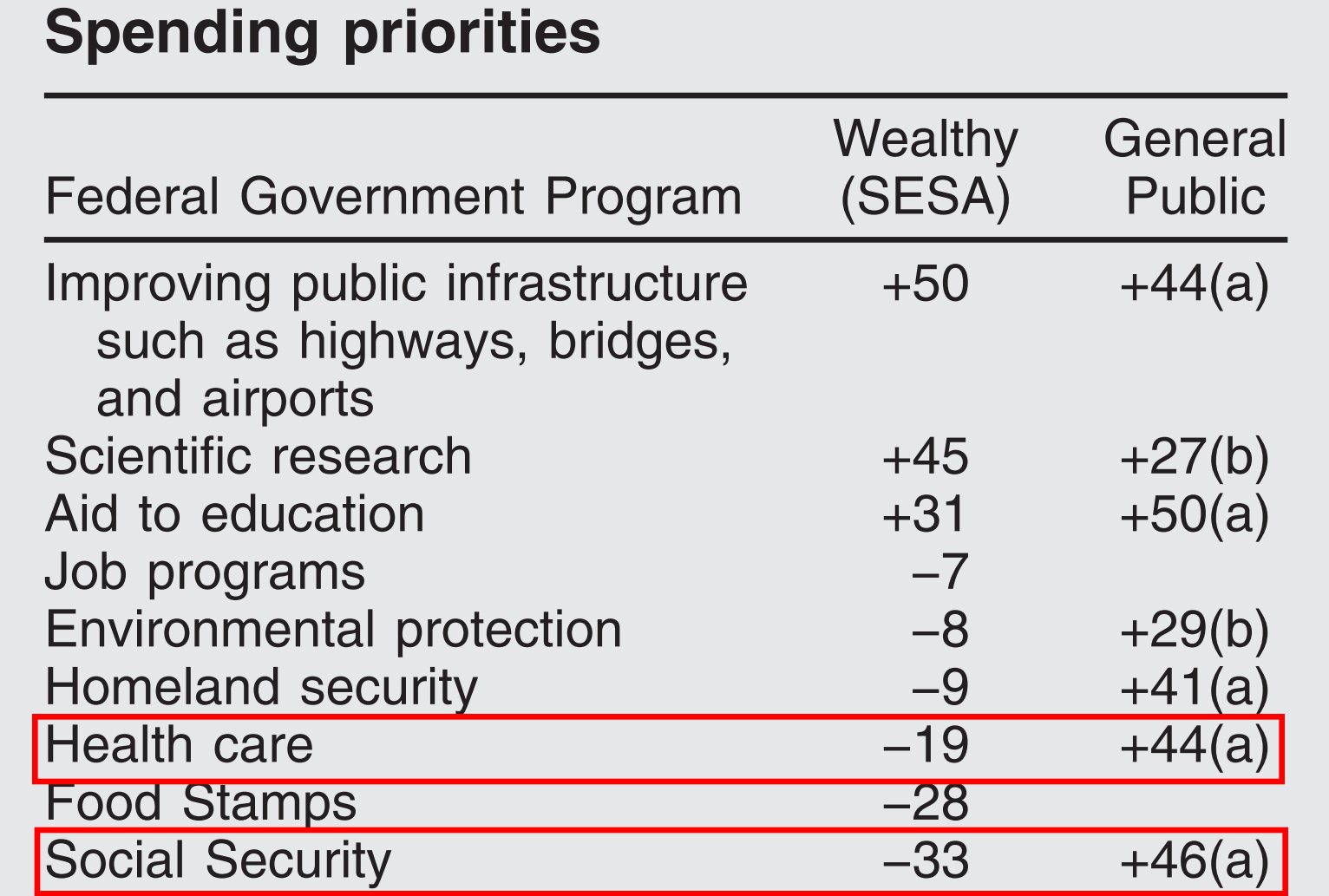
There has been a longstanding debate in America between groups that want to expand Medicare and Social Security versus groups that want to cut these enormous federal social programs. Ronald Reagan did both.  In in 1983, Reagan raised taxes to increase funding more than any other president and at the same time he cut Social Security benefits for 65-year-olds by phasing in a gradual increase in the retirement age. Today’s retirees must wait until age 67 to get full benefits. Many elites would like to do the same for Medicare.  However, cutting Medicare (& Social Security) is extremely unpopular among rank-and-file Republicans and Democrats alike.  Benjamin I. Page et al. published the graph below showing that there are 44 percentage points more people in the general public that want to expand Medicare and Medicaid than want to decrease these healthcare programs.  Wealthy elites (roughly the top 1%), have nearly the opposite opinion.  There are 19 percentage points more wealthy elites who want to cut them than expand them.

elites vs averageSo cutting Medicare is only politically feasible if it is done in a stealthy way, by cutting it for future beneficiaries who are not presently paying attention. The most politically feasible way to do it is what Reagan did with Social Security: raise the age of eligibility.

Unfortunately, this wouldn’t reduce healthcare spending.  Although the American government could save a little bit of money by raising the Medicare age, American citizens would spend even more money than the government would save. That would increase total national health spending.  Because the healthcare lobby generally wants higher spending, it has been pushing behind the scenes to raise the eligibility age as the Washington Post reports

The Health Leadership Council, a consortium of 47 health industry leaders including Aetna, Pfizer and the Cleveland Clinic, endorsed today to raise Medicare’s eligibility age from 65 to 67… 
There’s a pretty simple explanation for why hospitals and some insurers would favor raising the eligibility age: Hospitals receive higher payments from private insurance than they do from Medicare. The payments that hospitals receive from private insurers are 28 percent above the break-even point for providing treatment, according to a recent report from the Blue Cross Blue Shield Association. Medicare pays only 91 percent of what it costs a hospital to provide care.
…Heath insurers, too, could stand to benefit if 5 million seniors in that age bracket move into the private market. A number of health reform provisions — in particular the mandated purchase of insurance …would presumably push those seniors to buy health insurance rather than go uninsured.

….the American Hospital Association is lobbying the supercommittee to raise the Medicare eligibility age from 65 to 67. As Politico reported last week, “The association is urging its nearly 5,000 members to lobby Congress to raise the Medicare eligibility age from 65 to 67.”

…“This policy …simply shifts substantial costs from Medicare to other parts of government and to private and public employers.”
The Budget and Policy center estimates that if the Medicare eligibility age were raised, seniors under age 67 would have to spend $3.7 billion more in out-of-pocket cost. For many in the political system, that’s enough to reject the idea out of hand. But for some in the health-care system, that’s a profit waiting to be made.

The only age demographic where a majority consistently opposed Obamacare was Americans older than 65.  They feared that Obamacare might take resources away their socialized health insurance.  (US News lists several of the fears that senior citizens have had about it).  But it turns out that our seniors may have been right.  Now that Obamacare provides a viable alternative mechanism for insuring senior citizens, the healthcare lobby is already talking about cutting Medicare so that more people can be pushed onto Obamacare instead.  But why stop at 67-year-olds?  It would save the government even more money to completely eliminate Medicare and put all senior citizens on the Obamacare exchanges.  Indeed, House Budget Committee Chairman, Paul Ryan’s longstanding goal has been to replace Medicare with a voucher program that would use exchanges similar to Obamacare.

The CBO estimates that eliminating Medicare benefits for 65 & 66 year-olds wouldn’t even save the government significant money because those are the healthiest seniors in Medicare.  Many of the most expensive 65 & 66 year-olds would still qualify for Medicare due to disability benefits or else they would go on Medicaid.  It would only save the government 0.01 percent of GDP between 2016 and 2023 and that is merely by cost-shifting onto seniors who would pay more than the government saves.

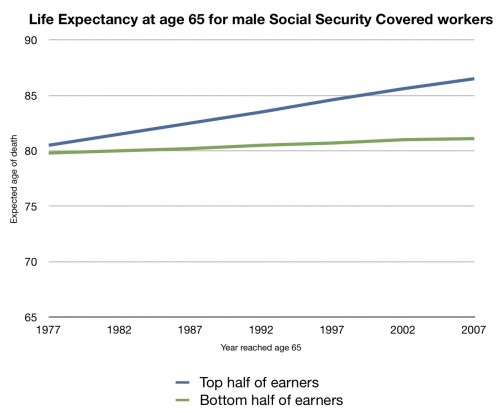
Raising the eligibility age for Medicare is more popular among people in the top half of the income distribution than among the poorer half, but the media mostly pays attention to the richer half because most media professionals and the politicians they report on are in the richer half.  Part of their rationale for raising the age of retirement is that life expectancy is raising the costs of these retirement programs.  But this idea would hurt the poorer half of Americans much more than the richer half because poor and lower-middle-class Americans are not living longer.  The divergence in US life expectancy in America is striking:

life expectance by earningsIt is easier for wealthier Americans to contemplate working two more years because they are more likely to work in relatively cushy jobs that are easier to continue despite reduced physical strength in old age.  Poorer workers are more likely to have physically demanding jobs that are harder to continue past age 65.  Most people think of Medicare as being a progressive program, but it is not.  It actually redistributes from the poor to the rich.  There are two reasons why.  First, the rich live longer.

“by cheating death, the rich collect benefits longer. Secondly, the wealthy demand more intensive use of more expensive medical care. Among individuals over 85, the wealthiest 10% of the population claim nearly 40% more in Medicare expenditures than the poorest 10%.”
Proposals to raise the Medicare age would make Medicare even more regressive.  There are many other ways to cut Medicare expenditures. We could making medicare less generous for all recipients by cutting benefits a bit. For example, we could cut the drug benefit that President Bush added, but that would upset the drug lobby. Or we could reduce payouts to providers down to the levels that Medicaid pays but that would upset all the health lobbies. None of these ideas as popular as raising the Medicare age which has significant lobbyist support going for it.
Posted in Health

Health insurance companies deny too many claims.

Health insurance companies deny claims because they are trying to save themselves the money, but this just increases overall costs because it increases administrative costs for the providers and the patients who have to sort out how to get payments.  Somebody has to pay so it doesn’t really reduce costs to just capriciously reject claims. It just increases costs for someone else.

Atul Gawande claimed that “insurers find a reason to reject payment in up to 30% of the bills they receive… A well-run office can get the insurer’s rejection rate down from 30 percent to, say, 15 percent. That’s how a doctor makes money. … It’s a war with insurance, every step of the way.” (Gawande, 2008, pp118-120). David Cutler gives a dramatic example of how this drives administrative costs in the US:  “Duke University Hospital, …one of the finest hospitals in the nation… has 900 beds and 1300 billing clerks.”  In Canada, hospitals spend less than a quarter as much on administration compared with US hospitals because one insurance company pays for almost all the hospital bills. Canadian doctors are more sure about what claims might be rejected and which ones won’t because they mostly deal with a single payer, so they are less likely to submit claims that the insurance company will find dubious.

Lisa Girion at the LA Times reported that:

California health insurers reject [over] 1 in 5 medical claims. Six of the state’s largest insurers rejected 45.7 million claims for medical care, or 22% of all claims, from 2002 to June 30, 2009, according to the California Nurses Assn.’s analysis of data submitted to regulators by the companies. …said Nicole Kasabian Evans, spokeswoman for the California Assn. of Health Plans. “It appears that a good deal of the so-called denials are merely paperwork issues,” she said. Brown’s office said that his deputies would soon review records and complaints. “These high denial rates suggest a system that is dysfunctional, and the public is entitled to know whether wrongful business practices are involved,” Brown said. Doctors complain that too often insurers delay, shortchange or deny legitimate claims. “Getting health insurers to pay their fair share of medical claims can be as much of a headache for physicians as it is for patients,” said Rebecca Patchin, an anesthesiologist at Loma Linda University and board chairwoman of the American Medical Assn. She said each insurer has a different set of “obscure, bureaucratic rules for processing and paying medical claims” that result in as much as $210 billion of “unnecessary cost” annually, studies have shown.

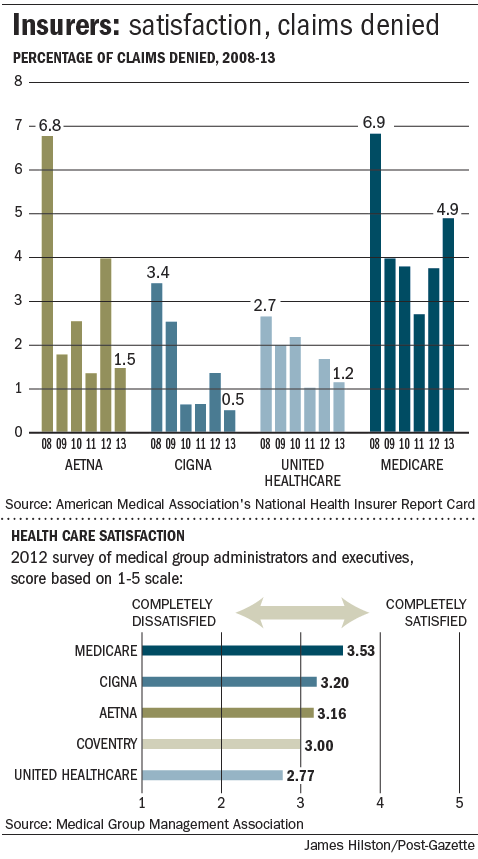
Oddly there is wide disagreement among studies about how many insurance claims are denied.  They range from 30% (above) down to under 5%:

Whereas the AMA lists Medicare as worse than any private insurer, the Medical Group Management Association polled healthcare administrators about their satisfaction with insurer and found that administrators liked Medicare the best.  Here is a graphic from the Pittsburgh Post-Gazette showing these two contradictory results:

insurerspayment

Posted in Health

Wacky healthcare prices in America.

In a well-functioning market, the Law of One Price should hold true.  The law says that the price of a barrel of oil should be approximately the same all around the world plus some adjustment for transportation costs which are generally very small for oil, at least within a few hundred miles of an ocean or a pipeline.  The law holds for most markets, but not for healthcare.  Within California alone, the price of a basic X-ray varies by over 1000% as this chart from Health Affairs displays.

hospital prices And it isn’t just X-rays. All hospital prices vary tremendously from hospital to hospital even within the same city. USA Today: 

It isn’t just $5-a-pill aspirin. Daily room charges exceed $5,000 in some New Jersey hospitals. An appendectomy in California, including about two days in the hospital, has an average list charge of $18,000. Nationally, federal data show the median charge for treating a heart attack is more than $20,000. … In California, if you get your brakes fixed on a car, the mechanic has to give you an estimate before doing the work. That’s not true if you go in for major surgery.” 

Patients in other states say they want such information.
When Karen Hamers’ teenage daughter Michele needed knee surgery, Hamers called several hospitals near her home in Vero Beach, Fla., and asked how much the surgery would cost. At the time, her family did not have health insurance. After choosing a hospital, Hamers paid the surgeon and then also paid the hospital what it said the surgery would cost: $4,200.
“Six days after surgery, we receive a letter from the hospital asking for an additional $21,000,” Hamers says. She asked for an explanation and got an itemized bill.
“It was two pages of gobbledygook,” Hamers says. “We could not understand it. They could not explain it. We showed it to our doctor, and he didn’t understand it.”
Hamers had kept a detailed log of her daughter’s 20 hours in the hospital, including a list of all the staff who cared for her and what drugs she was given. After reviewing the log and its own records, the hospital reduced its additional billing to $610.
…Hospital charges are similar to the list price on a car. Few pay the full amount because insurers negotiate discounts, and Medicare tells hospitals what it will pay. Still, some insurers do pay full charges, such as when a policyholder goes to an out-of-network hospital with whom the insurer does not have a negotiated discount. …Charges have gone up quickly in recent years and often bear little relationship to the actual cost of services. “It’s not unusual for a hospital’s billed charges in a market to increase 25% to 30% in one year,” says John Bauerlein, senior partner Milliman USA, a firm that tracks health care spending. …[In 2003 Glenn Melnick] says, the national average [hospital] charge was 211% higher than cost. In some states, those ratios are even higher. California, Florida and Nevada have some of the highest hospital charges, close to 300% higher than costs, according to his research.
Whereas hospitals universally charge vastly inflated sticker prices the average profit margin at the nation’s corporate hospitals is low.  They averaged only 4.3% on the latest 2015 information.  That is because few patients actually pay the full price.  Most insurance companies negotiate a lower price and many people who lack insurance simply don’t pay because they run out of money. Furthermore, although Professor Melnick said that hospital prices are more than double the ‘actual’ costs, he seems to be equating ‘actual costs’ and ‘marginal costs’.  He is not including fixed costs like administrative costs and the uncompensated care for under-insured hospital patients.  These costs have to be paid by someone.  Hospitals have to charge an inflated fictional list price that very few patients actually pay because it allows them to price discriminate to recoup their fixed costs.
It is hard to get accurate pricing and cost statistics from hospitals, so there are varying estimates of how much hospitals mark up their sticker price. For example, Uwe Reinhardt estimated that hospital prices are even more inflated than Professor Melnick.  Reinhardt estimated that in 2004: “U.S. hospitals were actually paid only about 38 percent of their “charges” by patients or their insurers.”  That means that the hospitals billed charges that are over two-and-a-half times greater than what they actually got paid.
Andrew Kurz investigated the prices that hospitals billed Medicare in 2011 and found that hospitals billed Medicaid widely different prices in different states.  Medicare only paid New Jersey hospitals 16% of the prices that they billed for whereas Medicare paid Maryland hospitals 94% of what they billed.  Medicare doesn’t care what hospitals bill, and uses its own methods for deciding what to pay but that doesn’t mean that Medicare pays everyone the same price either.  Kurz found that whereas the average hospital bill per patient was $9,754, California hospitals got paid almost $3,000 more than average whereas Alabama hospitals got paid over $2,000 less than average.
Posted in Health

How Ronald Reagan’s secret entitlement program will eventually end homelessness.

Which is the cheapest accommodation?

  1. A one-room apartment.
  2. A jail.
  3. A hospital room.

Which is the cheapest labor?

  1. A social worker.
  2. A criminal-justice worker (police, lawyer, judge, etc.)
  3. A healthcare professional (doctor, nurse, etc.)

For both questions, #1 is the cheapest and that is why giving housing to the homeless is three times cheaper than leaving them on the streets.  Nobody likes keeping homeless people on the streets, but there are only two ways to get rid of them.  You can give them housing in apartments or you can criminalize homelessness and lock them up in jail.  Giving them housing in ordinary regular apartments with social worker oversight is a lot cheaper than housing them in a jail with guards plus putting them through the court system where highly paid lawyers and judges pile on more fees.

Central Florida Commission on Homelessness study indicating that the region spends $31,000 a year per homeless person on “the salaries of law-enforcement officers to arrest and transport homeless individuals — largely for nonviolent offenses such as trespassing, public intoxication or sleeping in parks — as well as the cost of jail stays, emergency-room visits and hospitalization for medical and psychiatric issues.” By contrast, getting each homeless person a house and a caseworker to supervise their needs would cost about $10,000 per person.

It is easy to see why it is cheaper to get them an apartment than to put them in jail, but why is it so expensive to just let them live on the street?

Because when Ronald Reagan created a little-known program called EMTALA, he turned the economics of homelessness upside down. EMTALA guaranteed healthcare to all comers in any emergency room.  Without the EMTALA guarantee, hospitals could refuse to treat the homeless and they could die cheaply under a frozen bridge. Because of EMTALA, homeless people cost the medical system millions of dollars due to homelessness-related illness.  An emergency room is an extremely expensive place to provide healthcare.

Over the past two centuries, average longevity in the US almost doubled and improved housing was one of the main contributors to improved health. Clean running water (for drinking and handwashing), sewage treatment, heating, refrigerated food storage, and air conditioning have saved more lives than all our medical technologies combined. The homeless on the street forgo these mortal technologies and develop more illnesses as a result.  Clean tap water prevents many of humanity’s most lethal infections and without heating, a simple cold can turn into a life-threatening crisis.

Plus, without a regular address, it is expensive if not impossible for social workers and healthcare providers to provide education, treatments for drug abuse, and other services that prevent illness and help people become more productive and get jobs.

American policymakers are only just beginning to realize that we could save money by ending homelessness.  Malcolm Gladwell wrote an excellent story entitled Million Dollar Murray about a homeless man who Gladwell claims had the highest annual medical bills of anyone in the state of Nevada.  As Gladwell says, “living on the streets in a state of almost constant intoxication was a reliable way of getting sick.” Plus, Murray created huge criminal-justice-system costs. He sometimes got arrested multiple times on the same day.

Atul Gawande wrote a similar account about a man he called call Frank Hendricks who was the most expensive patient in Camden New Jersey.  What Hendricks really needed was cheap visits from a social worker, but instead America lavished him with repeated, all-expense-paid visits to emergency rooms.  These are both examples that show why Elizabeth Bradley argues that a little more social service spending could save money by reducing healthcare costs.

Because of EMTALA, America could save money be being more generous to homeless people. We have been penny wise and pound foolish, but a major impediment to saving money is the compartmentalization of our social services. Ending homelessness would save money that goes to our police, courts, prisons, and especially our private hospitals, but they don’t know how to run a homeless program.  Plus, our for-profit prison lobby is happy to have the business.  Meanwhile, the social workers who know how to help the homeless don’t get the funding to house the Million-Dollar Murrays partly because Americans are so cash strapped after paying for our hospitals, lawyers, and prisons, that we don’t want to pay taxes to support homeless people.  It is hard to convince voters that reducing homelessness is an investment that would save money in the long run if we did it right.

Posted in Health, Inequality, Labor

Ronald Reagan is one of the main architects of the US welfare system.

Most people think Ronald Reagan cut the US welfare system.  Reagan did cut anti-poverty and education programs, but overall, he greatly expanded the US welfare system by increasing resources for pensions and healthcare.  Reagan increased funding for these programs more than any other president in history by raising the payroll tax rate from 12.26% in 1980 to 15.1% in 1988.

In 1986, Reagan’s COBRA act mandated that employers must continue to offer health insurance to former employees (even for most employees that they had fired) for up to three years.  In 1986, Reagan also announced plans to expand Medicare to add coverage for catastrophic care, pharmaceuticals and other benefits and in 1988 he passed the Medicare Catastrophic Coverage Act with strong bipartisan support.  Most people don’t remember the act because it was repealed by George Bush in 1989, before it could go into effect.  Voters objected to the large tax increase that funded it and feared how it would change their benefits.

Most significantly of all, Reagan created the first universal healthcare entitlement in US history: The Emergency Medical Treatment and Active Labor Act or EMTALA. It is the entitlement for all people in the US to get guaranteed hospital treatment through emergency rooms without regard to ability to pay or citizenship status. And once anyone is admitted to a hospital, they cannot be discharged until their condition is stabilized regardless of the costs for treatment.

EMTALA is rarely recognized as a major welfare-state program because it did not cost the government any money.  It was an unfunded mandate, but it is one of the most costly healthcare programs.  In 2007, 55% of ER care was uncompensated, in large part thanks to EMTALA.

There is a constituency of Americans who would prefer to refuse treatment to the uninsured.  Wolf Blitzer asked Ron Paul if he would just “let ‘em die” at a presidential debate in 2011.  It is a bit chilling to hear a few people in the audience scream, “YEA”, in support of “let ‘em die”.  Oddly, nobody mentioned that that is illegal due to Reagan’s legacy.  Although few Americans have heard of EMTALA, the values that it embodies are extremely popular and although some libertarians like the Hoover Institute Fellow Richard A. Epstein want to eliminate it, no national politician has dared to sponsor a repeal.  All Americans get some benefit from it.  For example, if you were injured in a traffic accident and the highway patrol finds your unconscious body on the side of the road, you won’t want the local ER to refuse to care for you simply because your insurance card fell out of your pocket.  EMTALA provides that security for us all.

My aunt and uncle didn’t have any health insurance when they were hit by a car. EMTALA assured that they got hospital care despite lacking insurance.  Eventually, the other motorist’s liability insurance covered their enormous medical bills, but it took a lot longer for the liability to be established than it would have taken for them to die from internal bleeding without surgery while the lawyers sorted things out, so EMTALA might have saved their lives.

Ron Paul claimed (in the ‘let em die’ link above) that charity care could cover uninsured people in situations like this because that is what happened before Medicare.  But charity didn’t always work which is why Reagan passed EMTALA.  There was a long tradition in the segregated south (including the state of Texas where Ron Paul practiced medicine) of denying hospital treatment to people of the wrong color.  In 1959, only 9% of Southern hospitals treated blacks and whites equally.  That was banned by the 1964 Civil Rights Act.  Ever since then, new medical technologies developed every year which increased the costs of hospital treatment.  This gradually increased the economic motives to deny treatment.  Ability to pay gradually replaced race as a motive for denying treatment and the numbers had been growing until Reagan put a legal end to it.

Ironically, EMTALA was the only health insurance that Ron Paul’s campaign manager had when he died in 2008 with an unpaid $400,000 hospital bill.  EMTALA didn’t save his life in 2008, but he went in to the hospital hoping that it would.  EMTALA is horribly bad health insurance that doesn’t cover most health needs.  It only covers emergency healthcare and active labor.  It won’t provide a mammogram to prevent breast cancer nor provide insulin to prevent diabetic gangrene, but it is a lot better than nothing, especially in a crisis.  Once breast cancer or gangrene becomes life threatening, EMTALA will spare no expense to treat the complications of cancer or amputate the gangrene.

EMTALA has had far-reaching effects on government policy. It resulted in hospitals being forced to shut down in poor areas due to the rise in uncompensated care.  It caused the government to alter the formula for Medicare reimbursements to try to reimburse some of the uncompensated care costs.

EMTALA is revolutionizing homelessness policy because it is cheaper to give free housing to the homeless than to let them live on the street.  Life on the street leads to a lot of expensive ER visits that only housing can prevent.

EMTALA is a major reason why the American Hospital Association was a strong supporter of the Affordable Care Act and wrote many position papers to lobby in support of the ACA.

By any measure, Reagan’s EMTALA deserves a prominent pace in the history of the US welfare system.

Posted in Health

Enter your email address to follow this blog and receive notifications of new posts by email.

Join 75 other subscribers
Blog Archive
Pages