Marginal value is a misnomer. Market prices reveal the median value.

Ever since the Marginal Revolution of the late 19th century, economics has been defined by marginal benefit and marginal cost. That is what determines the most famous picture in economics, the supply and demand graph.  The demand curve is really the marginal benefit curve (measured in mmutility) and the supply curve is really the marginal cost curve.  The equilibrium market price is where the marginal cost (as estimated by sellers) is the same price as the marginal benefit (as estimated by buyers).  All buyers value the good at the market price or higher and all other sellers value the good at the market price or lower.  This means that the market price is the median valuation among market participants.  If you lined up the valuation of each market participant for each good from lowest to highest, the market price is right at the median valuation.  That point also happens to separate the valuations of the sellers from that of the buyers.

In effect, a market is a like a voting mechanism where people vote with dollars to determine the median valuation.  The main difference from democracy is that people with more resources get more votes in markets. It is the median valuation of the participants that determines the market price. For this reason, it was misleading for Noah Smith to say that:

nearly everyone on Wall Street was eager to tell you back in 2012 that QE would cause a big rise in inflation. But when you looked at TIPS spreads, it was clear that the marginal investor wasn’t putting his money where his mouth was.

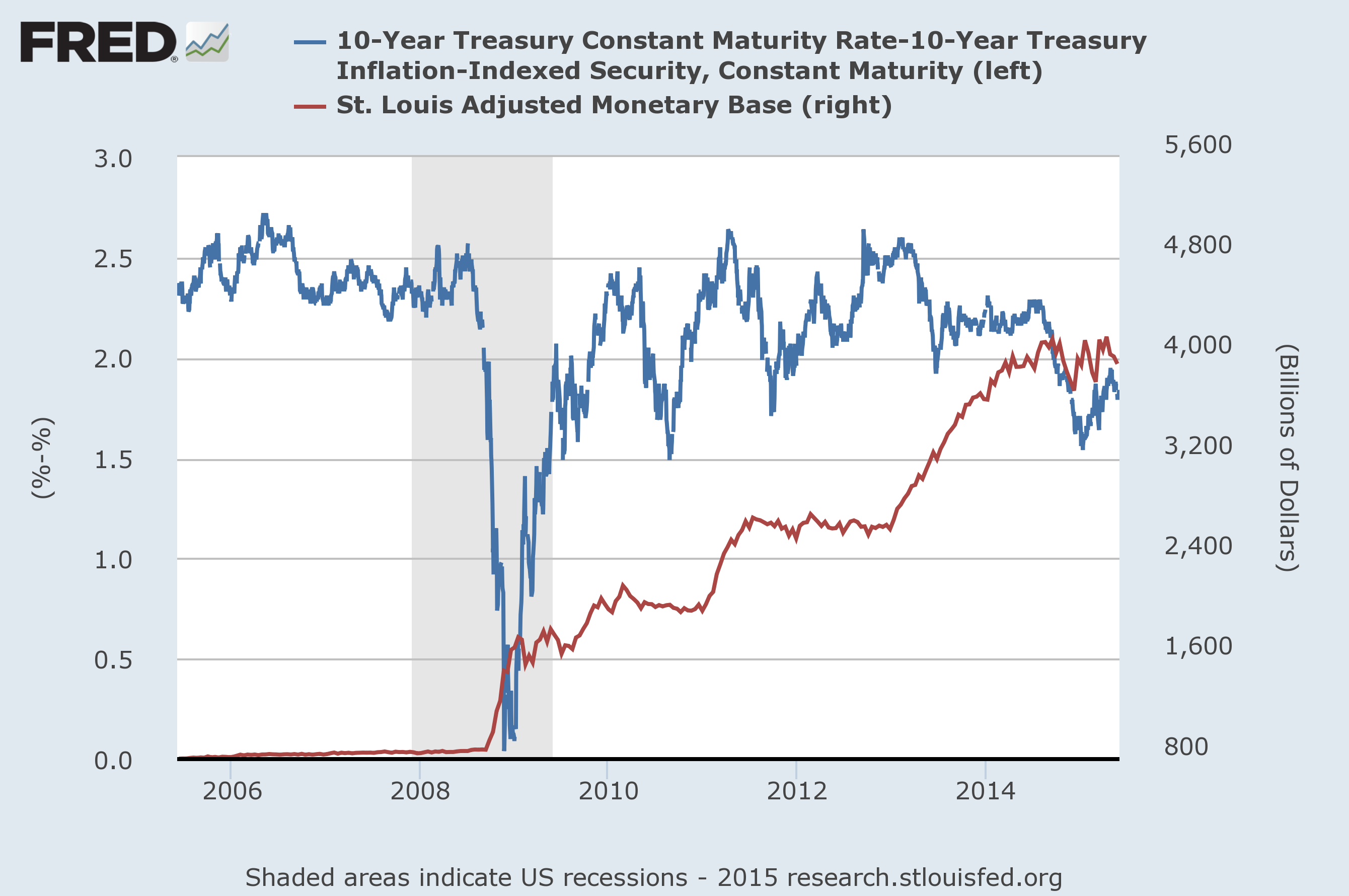
Noah Smith appears to be saying that only a “marginal investor” was betting against inflation.  What he really meant to say is MUCH stronger.  He meant to say that the median investor dollar was betting against inflation.  You can easily search Google News for 2012 and see that Wall Street tycoons and media outlets were predicting (again) that the third round of quantitative easing would cause big inflation.  Meanwhile the median investor dollar was generally expecting slightly lower inflation than before.  Investors who feared inflation could buy inflation-protected government bonds (called TIPS), but the interest-rate spread between TIPS and regular bonds did not rise.  TIPS pay their interest rate plus the inflation rate whereas regular bonds just pay their interest rate so the spread between TIPS and regular bonds is the median bond market prediction of future inflation.

Below is a FRED graph showing how the median investor did not predict higher inflation during any of the three periods of the most massive quantitative easing in US history (when the red line jumped).  The monetary base is now five times larger than it was from 2005-2008 and since quantitative easing began the bond market has been showing lower 10-year inflation expectations than it did before quantitative easing started.

inflation tips spread QE

Noah Smith meant that when a market price changes a little bit, it only necessarily means that a few of the people with valuations near the median have changed their minds about the price.  All we can say about all the other valuations is that half are higher and half are lower.  But when economists talk about “marginal investors”, ordinary people are going to think about the ordinary English definition of “marginal” and think that that means “fringe investors” are betting on low inflation. In reality Noah Smith meant that the median investor dollar was betting that inflation would not rise.  A better way to say it is that a majority of investor bets were predicting low inflation.  That sounds very different than what Noah Smith wrote.

Posted in Macro, Medianism

Is a “Death Tax” worse than an “Estate Tax”?

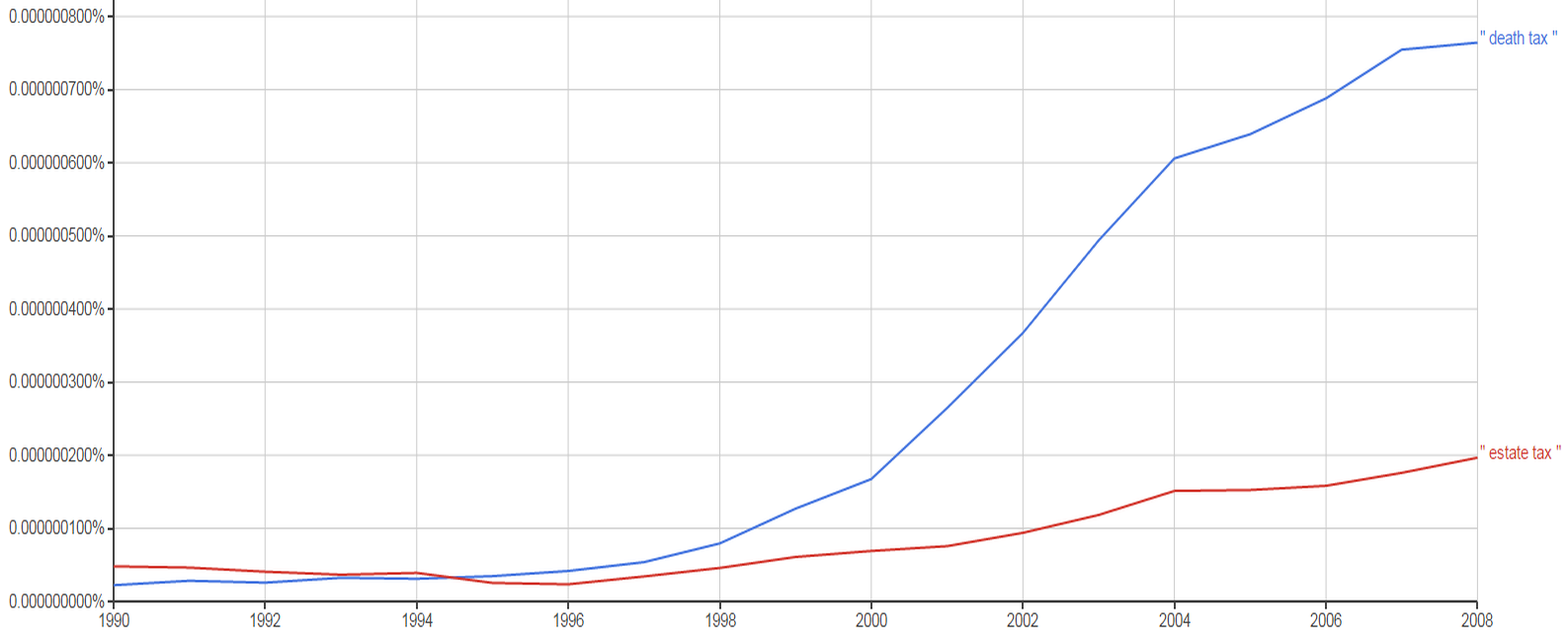
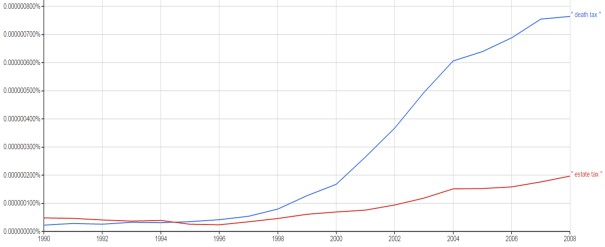
Most Americans think that the estate tax (popularly known as the ‘death tax’) should be reduced or eliminated.  Wealthy families started funding a campaign in the mid 1990s which successfully rebranded this tax on large estates into a tax on death. Google’s Ngram Viewer shows how the term ‘death tax’ was half as common as the term ‘estate tax’ in written English in 1990.  As of the most recent data the term ‘death tax’ has skyrocketed to become almost three times more common than the more accurate term.
death estate tax

It isn’t a “death tax” because, according to the Center on Budget and Policy Priorities (CBPP), “99.86 percent of estates owe no estate tax”, so perhaps a better name for it would be the dynastic estate tax since estates worth less than $24million for a married couple are not subject to the tax at all (as of 2022) and this is just the minimum exemption because there are many ways to hide even more money from the estate tax.

Republican pollster Frank Luntz promoted the term ‘death tax’ because it  “kindled voter resentment in a way that ‘inheritance tax’ and ‘estate tax’ do not”.  But ‘death tax’ is a misnomer because there is almost zero correlation between death and the tax.  Only about 1 in 700 deaths are subjected to the estate tax.

The Washington Center for Equitable Growth sponsored a poll showing that only 17% of Americans support the “Death Tax”, but when they learn that it only affects a little more than the top tenth of one percent of the wealthiest Americans’ estates, the majority (53%) supports it.  estatetax
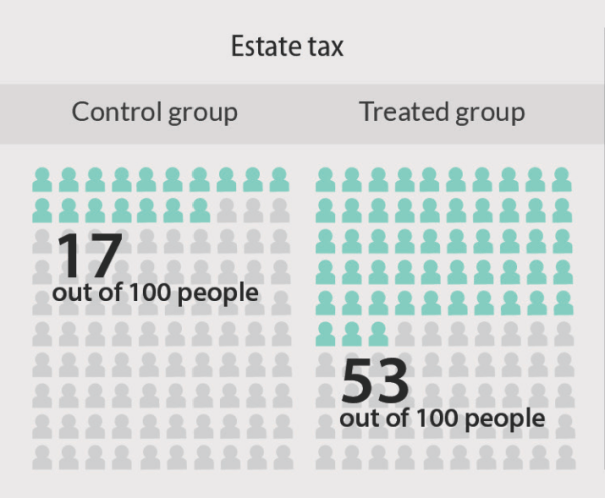
Jordan Weissmann says that the American public turned against the estate tax due to the success of the campaign to get Americans to think it is unfair to tax ordinary people when they die.  Most Americans want to raise taxes on the wealthy, but they have been misled to think that the estate tax is a death tax that hurts most Americans at a time when they are already going through one of the most difficult times of their lives: death. The same campaign to rebrand it as a death tax has also spread the myth that it mainly hurts small businesses and farmers.   When Americans learn that the estate tax really is a tax on extreme wealth, a majority supports it.  Misinformation is the why American support for the estate tax has waned.

The Center For Effective Government (CEG) estimates that, “of the 2,662,000 Americans who died in 2013, just 3,700 of their estates paid any estate tax – one out of every 700 estates.”  Of the estates that paid the tax, only 120 were family businesses or farms.  Those were pretty rich farmers because in 2013 there was no tax on the first $5.4 million ($10.8 million for couples) of estate plus further exemptions that often save billions more through loopholes.  In 2001 the American Farm Bureau Federation could not cite a single example of a farm having to be sold to pay estate taxes because most farms and small businesses have enough liquid investments on hand to pay the tax and the remainder can pay it gradually over 15 years.  Dylan Mathews wrote about another study in 2005:

 a 2005 analysis by the CBO found that under the 2009 estate tax, only 182 estates — and only 13 estates of farmers and 41 estates of people with family-owned businesses — wouldn’t have enough liquid assets (bonds, stock, cash, etc.) to pay their estate tax liability. The current estate tax law is even more generous than it was in 2009, meaning it’s likely even fewer estates are in that situation today. Moreover, as CBPP’s Huang and Brandon Debot note, “special estate tax provisions — such as the option to spread payments over a 15-year period and at low interest rates — allow the few taxable estates that would face any liquidity constraints to pay the tax without selling off any farm assets.”

The CEG estimates that if the government just collected the full value of the current estate tax on the 25 richest Americans, it would bring in $334 Billion in revenue. Just taxing the 25 biggest estates (if they didn’t evade the tax) would bring in enough to give a $10,000 inheritance (or tax cuts) to every child born in America for the next nine years!  That could pay for a lot of college education. Here is the CEG’s list of how much the top 25 richest Americans would pay:

Billionaire Wealth Source Wealth
(in $ Billions)
Estate Tax @ 40%
(In $ Billions)
Bill Gates Microsoft 81.0 32.4
Warren Buffett Berkshire Hathaway 67.0 26.8
Larry Ellison Oracle 50.0 20.0
Charles Koch Inherited — Koch Industries 42.0 16.8
David Koch Inherited — Koch Industries 42.0 16.8
Christy Walton Inherited — Walmart 38.0 15.2
Jim Walton Inherited — Walmart 36.0 14.4
Michael Bloomberg Bloomberg plc 35.0 14.0
Alice Walton Inherited — Walmart 34.9 14.0
S Robson Walton Inherited — Walmart 34.8 13.9
Mark Zuckerberg Facebook 34.0 13.6
Sheldon Adelson Las Vegas Sands 32.0 12.8
Larry Page Google 31.5 12.6
Sergey Brin Google 31.0 12.4
Jeff Bezos Amazon.com 30.5 12.2
Carl Icahn Icahn Enterprises (private equity) 26.0 10.4
George Soros Soros Asset Management 24.0 9.6
Steve Ballmer Microsoft 22.5 9.0
Forrest Mars Jr Inherited – Mars Candy 22.0 8.8
Jacqueline Mars Inherited – Mars Candy 22.0 8.8
John Mars Inherited – Mars Candy 22.0 8.8
Len Blavanik Access Industries (private equity) 21.5 8.6
Phil Knight NIKE 19.9 8.0
Michael Dell Dell Computer 17.7 7.1
Laurene Powell Jobs Inherited — Apple 16.6 6.6
Total 333.6

But most of that wealth won’t be taxed for various reasons.  For example, Bill Gates and Warren Buffett have exempted most of their wealth by directing their estates to give most of it away to charity.

Many of these people are in favor of the estate tax.  For example, the CEG notes that ” Bill Gates, Warren Buffett, George Soros, and Carl Icahn have all campaigned publicly in favor of a high estate tax.”

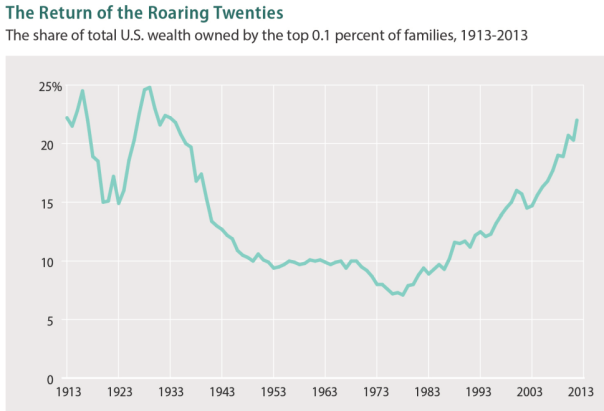
There is a well-documented cultural difference between rich people who were born rich and rich people who did not grow up in the top 1%.  Billionaires who weren’t born rich and didn’t already feel the pinch of the inheritance tax are more likely to be in favor of the estate tax.  In contrast all of the people on the list (underlined above) who inherited billions of dollars have given money to try to eliminate the estate tax. The one exception that proves the rule is Steve Job’s widow at the bottom of the list.  But she was not born rich and did not pay any estate tax because spouses are exempt.  Given that her philanthropic priorities include efforts to reduce inequality, she would probably support the estate tax because she is trying to give away most of her money and the estate tax is one of the best ways to reduce the inequality of the top tenth of one percent richest Americans as shown here:
roaringtwenties

Forbes magazine is run by an old money family and has been campaigning to eliminate the estate tax.  Ryan Ellis is part of the campaign and he claims that it is futile to try to tax the wealthiest Americans because:

The uber-rich can afford these “teams of lawyers and accountants” to “develop and exploit loopholes” for their clients. First and second generation business owners and family farmers cannot.  As a result, Paris Hilton will be ‘death tax’ess owners will either have to pay the death tax or funnel scarce capital into their own little army of tax nerds and lawyers.

This is part of the campaign to make it seem like a regressive tax on small businesses, but it is not.  “Startup business owners” don’t have a problem because the tax only affects multi-million-dollar estates and anyone with a multi-million-dollar estate can afford lawyers and accountants to help them exploit loopholes. Furthermore, “startup business owners” rarely have estates worth more than $22 million (the 2022 exemption for couples) and the few multi-million-dollar children who inherit expensive startups without exploiting the loopholes can always raise funds for the tax by selling shares to outside investors or by getting a loan.  These are the same old-fashioned funding mechanisms that most startups have to use.  Approximately zero startups get their money from daddy’s death.

And if the problem is tax evasion, then the solution is simple.  Eliminate loopholes so that Paris Hilton has to pay.  As long as there are tax loopholes then it isn’t fair to the thousands of multimillionaires who dutifully pay the tax that some scheme up ways to evade it.  Ellis says estate tax evasion is a problem, but he wants to abolish the tax which is tantamount to universal tax evasion.

Ellis also says we should eliminate the estate tax because it “collects almost no tax revenue” and is “a declining source of federal revenue”. True, the estate tax generated more than twice the revenues before his campaign succeeded in reducing it.  The top estate tax rate fell from 77% in 1976 down to zero percent in 2010. It is back up to 40% now which is only about half its peak rate, but the effective rate is much lower today than it was during most of the golden age of America’s middle class wage growth.  Ellis argues that the past success of his campaign to reduce the estate tax is a reason to reduce it further because they have already shrunken the tax down so small that they might as well kill it off.

Ellis dismisses the debate over the estate tax as “class warfare,” but all debates over tax policy are always class warfare. That is what makes tax reform so hard to do.  Ellis demonstrates that “the uber-rich” have been winning the class war over the estate tax, and he concludes that ordinary Americans should surrender and let inheritance continue to increase inequality as it has since the 1970s.  Sadly, most Americans agree with him because his campaign has succeeded in fooling most Americans into thinking that the estate tax increases inequality by hurting small businesses while the Paris Hiltons evade the tax.

Raising the estate tax would encourage more investment in meritocracy and less expenditures on lavish consumption for heirs.  Currently, there is little point in investing in the human capital of heirs like Paris Hilton*.  She doesn’t need an education because she will never need to work.  Perhaps that is why she dropped out of high school.  A bigger inheritance tax would help produce more imperative to invest in children to help them learn to earn future wealth and status rather than just giving them money.  Because wealthy elites have disproportionate ability to set social norms, if the scions of the wealthiest elites spent more time working and less time partying, some of that ethos is likely to trickle down to the merely well-off.

*A backstory about inheritance within the Hilton family is that Paris’ great-grandfather, Conrad Hilton was the entrepreneur who made the family fortune, and he had planned to leave 97% of his estate to charity, but his son Barron contested the will and kept most of the fortune for himself instead.  Thirty years later, Barron said he had become embarrassed by his granddaughter Paris’ behavior, and he would give 97% of his estate (estimated at $2.36 billion) to charity, which would leave his heirs with only 71 million dollars.  But we will see if his heirs follow the family tradition of contesting the will when the time comes to keep the gravytrain flowing.

A higher estate tax would encourage more charitable donations and make it less lucrative for heirs to subvert the wills of the deceased.

Posted in Public Finance

A global environmental regulation saved the planet from disaster.

CBS News had an uplifting story about the environment:

Here’s rare good news about an environmental crisis: We dodged disaster with the ozone layer.

A NASA study about ozone-munching chemicals [CFCs] from aerosol sprays and refrigeration used a computer model to play a game of what-if. What if the world 22 years ago didn’t agree to cut back on chlorofluorocarbons which cause a seasonal ozone hole to form near the South Pole?

NASA atmospheric scientist Paul Newman said the answer is a “bizarre world.”  By 2065, two-thirds of the protective ozone layer would have vanished and “the ozone hole covers the Earth.” And the CFCs… would have pushed the world’s temperature up an extra 4 degrees.

In mid-latitudes like Washington, DNA-damaging ultraviolet radiation would have increased more than sixfold. Just 5 minutes in the summer sunshine would have caused a sunburn, instead of 15… Summer thunderstorms in the Northern Hemisphere would have been much stronger. “[This world] is a real horrible place,” Newman told The Associated Press.

The history of CFCs began when Thomas Midgley invented them in the 1930s.  Midgley’s other famous invention was leaded gasoline which was perhaps the second worst chemical innovation in human history.  Leaded gas poisoned generations until it too was banned around the world.  Whereas everyone knew that lead was poisonous all along, it wasn’t until 1974 that scientists first realized that CFCs were silently causing environmental problems.  Sherry Rowland and Mario Molina raised the first questions about CFCs and ultimately won the 1995 Nobel Prize for chemistry for their work.  The Nobel committee credited them with helping avoid a global environmental disaster. As a result of Rowland and Molina’s work, the US banned CFCs from aerosols in late 1978 despite the efforts of the CFC manufacturers who fought against the scientific evidence.  Jeffrey Masters explains how the CFC industry reacted:

DuPont, which made 1/4 of the world’s CFCs, spent millions of dollars running full-page newspaper advertisements defending CFCs in 1975, claiming there was no proof that CFCs were harming the ozone layer. Chairman Scorer of DuPont commented that the ozone depletion theory was “a science fiction tale…a load of rubbish…utter nonsense.” (Chemical Week, 16 July 1975).

The aerosol industry also launched a PR blitz, issuing a press release stating that the ozone destruction by CFCs was a theory, and not fact. This press release, and many other ‘news stories’ favorable to industry, were generated by the aerosol industry and printed by the New York TimesWall Street JournalFortune magazine, Business Week, and the London Observer (Blysky and Blysky, 1985). The symbol of Chicken Little claiming that “The sky is falling!” was used with great effect by the PR campaign, and appeared in various newspaper headlines.

Such biased news reporting is hardly unusual in American journalism; several studies have shown that press releases are the basis for 40 – 50% of the content of U.S. newspapers (Lee and Solomon, 1990; Blysky and Blysky, 1985). The material appears to be written by the paper’s own journalists, but is hardly changed from the press release.

The CEO of Pennwalt, the third largest CFC manufacturer in the U.S., talked of “economic chaos” if CFC use was to be phased out (Cogan, 1988). DuPont, the largest CFC manufacturer, warned that the costs in the U.S. alone could exceed $135 billion, and that “entire industries could fold” (Glas, 1989). The Association of European Chemical Companies warned that CFC regulation might lead to “redesign and re-equipping of large sectors of vital industry…, smaller firms going out of business… and an effect on inflation and unemployment, nationally and internationally”….

CFC industry companies hired the world’s largest public relations firm, Hill & Knowlton, who organized a month-long U.S. speaking tour in 1975 for noted British scientist Richard Scorer, a former editor of the International Journal of Air Pollution and author of several books on pollution. Scorer blasted Molina and Rowland [whose work later won the Nobel Prize], calling them “doomsayers”, and remarking, “The only thing that has been accumulated so far is a number of theories.” Molina’s response was, “The gentleman is good at attacking. But he has never published any scientific papers on the subject.” (Roan, 1985).

Jeffrey Master’s article also shows how the ozone political battle featured some of the same PR companies and scientists as the public debate over the dangers of tobacco and the later efforts to discredit the scientific findings about global warming.

DuPont and other CFC manufacturers funded the “Alliance for Responsible CFC Policy” to fight against the scientific evidence about CFCs and they battled against the scientists for about a decade to prevent regulations that could cut into their profits from producing CFCs. Then the CFC industry abruptly abandoned their fight and joined forces with the environmentalists.  They suddenly agreed that CFCs should be banned!  One reason was fear of legal liability for causing skin cancer, particularly in the litigious United States:

DuPont acted faster than their European counterparts as they may have feared court action related to increased skin cancer, especially as the EPA had published a study in 1986 claiming that an additional 40 million cases and 800,000 cancer deaths were to be expected in the US in the next 88 years.[8]  (Wikipedia)

One reason why opposition to CFCs strengthened in the mid 1980s was the discovery of an ozone hole over Antarctica.  Vivid images of the hole were published in 1985 and the images made the issue more salient to the public than the statistics had been.  Images are much more powerful for mobilizing public opinion than abstract data.  Perhaps they finally also convinced the CFC industry to re-evaluate their business model and look for profits elsewhere.  As Stuart Fox notes:

Three British scientists shocked the world when they revealed on May 16th, 1985… that [CFCs] had torn a hole in the ozone layer over the South Pole. The ozone layer, which protects life on Earth from damaging solar radiation, became an overnight sensation. And the hole in the ozone layer became the poster-child for mankind’s impact on the planet.

Today, the ozone hole — actually a region of thinned ozone, not actually a pure hole — doesn’t make headlines like it used to. The size of the hole has stabilized, thanks to decades of aerosol-banning legislation …the 1989 Montreal Protocol.

…Additionally, the ozone layer is blocking more cancer-causing radiation than any time in a decade because its average thickness has increased, according to a 2006 United Nations report. Atmospheric levels of ozone-depleting chemicals have reached their lowest levels since peaking in the 1990s, and the hole has begun to shrink.

Below is the original 1985 picture of the ozone hole from NASA that helped spur the political will to ban CFCs.

688616main_1sthole

There are more beautiful pictures at NASA’s Ozone Hole Watch.

Perhaps the biggest reason for DuPont’s change in heart is that they saw that they could make higher profits by supporting a CFC ban.  One of DuPont’s strategic CFC manufacturing patents expired in 1979 which reduced their incentive to fight and their new patents for HCFCs would be much more profitable if CFCs were eliminated from competition.

In a 1986 turnabout, DuPont with new patents in hand, publicly condemned CFCs.[13] DuPont representatives appeared before the Montreal Protocol urging that CFCs be banned worldwide and stated that their new HCFCs would meet the worldwide demand for refrigerants.[13]  (Wikipedia)

When the CFC industry got their new patents, they abruptly reversed course and the CFC ban was rapidly enacted because the big corporate interests and the environmentalists both agreed that it should be banned.

People often say that the Montreal Protocol gives hope for reaching international agreement on global warming, but the political battle over CFCs is completely different from the battle over global warming because:

  1. The CFC ban was swift and successful because the CFC companies saw that the ban could get them more profit by producing the replacement for CFCs. Unfortunately, a reduction in fossil fuels is not going to be profitable for the fossil fuel industry.  Several oil companies like BP have tried to become leaders in alternative energy, but that simply isn’t their competitive advantage.  Oil firms are good at extracting oil.  Other kinds of firms have the very different skills that make them better at producing alternative energy.  When petroleum replaced whale oil for lighting (lamps), the whaling companies did not become oil companies.  They went bankrupt.  When we reduce reliance on fossil fuels (and it is inevitable since fossil fuels are finite) the fossil fuel companies will have justifiable fears of becoming fossils themselves.  Therefore, they won’t have a sudden policy reversal like the CFC companies had.  The fossil fuel companies will fight to the death since fossil fuel is the lifeblood of fossil fuel industry and it is very unlikely that they will be able to shift to alternative sources of energy.
  2. There are thousands of times more dollars at stake in the fossil fuel industry than the CFC industry.  Shell alone has revenues that were 12 times bigger than DuPont’s in 2013 and there are dozens of fossil fuel companies that are at least double the size of DuPont.  Whereas CFCs only produced a small fraction of DuPont’s revenues, fossil fuel companies get nearly 100% of their revenues from fossil fuels. The CFC industry was a tiny pipsqueak compared with the combined might of the oil, gas, and coal industries, but even so, the CFC industry managed to dominate the public debate about the issues. Whereas the CFC industry only earns a few billion dollars in revenues, the fossil fuel industry has revenues that are hundreds of times higher.
  3. There aren’t any pictures that help the public directly visualize global warming like the dramatic ozone hole pictures demonstrate the physical effect of CFCs.  Ordinary people simply don’t get excited about statistics and that is the only kind of evidence that climate scientists can show.
  4. People have an immediate fear of skin cancer that makes ozone feel more immediate than the dangers of global warming.  Ronald Reagan had surgical operations to remove skin cancers shortly before he signed the Montreal Protocol and that personal experience may have boosted his enthusiasm for the treaty.

The first global environmental threat to humanity has a happy ending, but it isn’t likely that the global warming story will play out in the same way.  In fact, CFCs and HCFCs are both potent greenhouse gasses and the same group that banned CFCs is trying to replace them with climate-friendly refrigerants like Ammonia, but the US won’t sign the agreement.

Here is a good video about the history of CFCs

There are a few other international environmental successes, but none of this scale.  One is the International Convention for the Regulation of Whaling which helped save whales from extinction and the Partial Nuclear Test Ban Treaty which has greatly reduced the amount of nuclear fallout that is released into the atmosphere from nuclear weapon testing.  Previously nuclear explosions has been tested in the open air (or in the ocean) and now they try to keep it sealed underground.

Posted in Globalization & International

Is The US Constitution The Oldest In The World?

Encyclopedia Britannica is among those who claim that the US has the oldest constitution in the world of any sovereign state.  That is true if you define a constitution as a single document. There are much older constitutional documents like the 1215 Magna Carta (Latin for Great Charter) which remains the oldest foundation of English constitutional law.  It was “the Great Charter of the Liberties” that signified the end of absolute monarchy and beginning of constitutional monarchy that persists to the present day.  The UK doesn’t call it a constitution because the UK doesn’t formally recognize a single constitution. The Magna Carta is one of “the fundamental parts of constitutional law” which also includes documents such as the UK’s 1689 Bill of Rights.  Although the UK has a body of constitutional law, they just don’t call it a “constitution,” but a rose by any other name is still a rose.

The sovereign city state of San Marino also has an older constitution dating back to 1600, but some Americans argue that it is separated into several books and so the US constitution is the oldest single-document constitution.  This is an odd, trivial distinction.  One reason their constitution is separated into several books may be that it is so old. In 1600, book binding technology was still relatively bad at binding large books into a single volume, so books were commonly divided into multiple volumes that were easier to manage.  The Bible is a similar example.  The bible was originally divided into 72 separate books because it was too heavy and expensive to try to combine them into into larger groupings.   We still call them the books of the Bible because the Bible was originally a library of a bunch of separate books.  A complete Gutenberg Bible printed on paper weighted about 30 pounds and nearly 50 pounds printed on parchment, so a single volume would have been impossible to handle.  As close as you can get are paper Bibles that were bound into just two 14-pound volumes and that represented a huge improvement in paper and bookbinding technology over earlier centuries.

To say that San Marino’s constitution isn’t a true constitution because it wasn’t originally printed in one volume is like claiming that the Bible is not a true book, because it was originally printed as a library. The claim that the US constitution is the oldest true constitution is an example of the “no true Scottsman” fallacy.  By any impartial definition of a constitution, San Marino has one and it is much older than the US constitution.  Why would it matter how many volumes a written work is split into for printing or even whether it is just read on a computer screen?

In any case, older is not necessarily better.  Nobody views any of the older documents as a model for government today.  They are all a bit obsolete.  The Magna Carta was written to limit the powers of the king for the benefit of other hereditary nobility, not for the ordinary people much less the slaves.  The US constitution is flawed in part because it was founded on the institution of slavery.  When the US has set up governments in foreign nations we haven’t recommend anything like our own form of government.  That is because we know a lot more about the machinery of democracy now than we did in 1787. When we set up a foreign government, we avoid a lot of the undemocratic features in the US constitution. We usually set up a parliamentary government which has a lot of advantages over the US system.  That is what the US implemented after occupying Germany, Japan, and Iraq.  The US did set up a presidential republic in Afghanistan, but their constitution is not very similar to the US and Afghanistan is still not an example of a successful democracy so far.

Furthermore, if older is better, then our present constitution is clearly unconstitutional because it is actually the second constitution of the United States and it violates the first constitution. The full name of our first constitution was, “The Articles of Confederation and Perpetual Union.”  That’s right, “Perpetual.”  A bunch of elites unconstitutionally broke the rules of our first constitution of “Perpetual Union” and replaced it with our current constitution which does not even claim to be a “perpetual union” anymore!  And the reason for abolishing the first constitution? In the words of George Washington, “no money.” He and the other founders considered the first constitution so bad that they scrapped it and started over fresh.  We have subsequently scrapped important sections of the new constitution too which were invalidated by later amendments like the one abolishing the 3/5th compromise of slavery.   In fact, after amending it 27 times, most of our current constitution is younger than the original publication date, so in some ways it is a relatively fresh, young document, and a better document for that too.

Posted in Public Finance

How much inequality is ideal within your workplace?

Nicholas Fitz at Scientific American has a good summary of recent research about American perceptions of inequality. Answer two questions below to test yourself and see how your answers compare with the average American.

1) How much more should CEOs get paid than their lowest-paid full-time employees?

  • 3 to 1
  • 5 to 1
  • 7 to 1
  • 10 to 1
  • 20 to 1
  • 30 to 1
  • 50 to 1
  • more than 100 to 1

Don’t continue reading until you pick an answer.  

The average American thinks that a 7-to-1 ratio is ideal for balancing fairness and efficiency.

2) In reality, how much more do you think American CEOs earn than their lowest-paid employees?

Don’t continue reading until you pick an answer.  

ceo

Dubai skyscrapers Photo by Michele Solmi

The average American thinks that American CEOs earn 30-to-1 relative to their low-skilled workers.  The reality is that in 1965, American CEOs only eared 20 times more than their low-skilled workers.  Today the reality is 354-to-1.

It is amazing how ignorant Americans are about inequality within the big businesses where most Americans work.  A possible advantage of inequality is to give people at the bottom more incentive to work hard to try to rise to the top. If most people aren’t aware of the enormous incentives at the top, then they aren’t going to work hard to achieve it.

Too much inequality can also be bad for business.  The first Nobel-Prize winner in economics, Jan Tinbergen, thought that, “if the ratio between the greatest and least income in a company exceeds 5, it will not help the company and may be counterproductive.”  That idea used to be called the “Tinbergen Norm,” but this ‘norm’ was abandoned when CEO pay soared after the 1960s.   Marketplace concurrs:

Bill George, the former CEO of Medtronic and author of the “True North” series of books, says wide pay gaps can erode trust inside companies and hobble their performance.

Each company should be required to publish basic pay distribution statistics so that Americans stop being so ignorant about the wage at the top.  It could inspire people at the bottom to work harder to get more pay either by working harder to rise to the top (or to work harder to increase wages at the bottom).

James Cotton started advocating in the 1990s to require corporations to publish the ratio between the CEO pay and average pay within each corporation. His recommendation ultimately got written into Dodd-Frank.  But mean pay is misleading because pay is approximately log-normally distributed within organizations.  That means pay is heavily skewed in favor of the CEO at the top.  Cotton’s measure, mean pay, would work better for a normal distribution where there are few people getting low pay rather than most people getting low pay.  Using mean pay makes the CEO’s pay seem smaller in relation to everyone else than it really is.  For example, if the CEO quadrupled his own pay without giving anyone else a raise, it would raise the mean pay, but it would have no effect on median pay.  Using mean pay as James Cotton’s recommends does not fully measure the actual increase in inequality.  Secondly, median pay would be a better statistic for morale because the average employee is closer to the median pay than to the mean pay.  That would help employees feel better about how much their work is valued at the firm because it would more realistically reflect where they are within the hierarchy. Median pay is a much better statistic than mean pay for measuring the pay of the average employee.

Secondly, we should not ignore the different number of hours of work that different people do.  Part-time workers should be included in the measure and the best way to incorporate part-time work is to use hourly wage rather than annual pay. Companies have really good measures of how much part-time and hourly employees work, but they rarely keep track of hours for salaried workers.  If salaried people do not keep track of their time, then they could be simply assigned the company’s standard estimate of how many hours/year is expected of all salaried workers. That would be a healthy discussion to have.

CEOs typically work more than the average employee and using hourly pay would be a way to adjust for that.  Let the CEO inflate his hours to 80/week to help justify his pay.  It still wouldn’t make a huge difference in the 354-to-1 ratio of top to bottom.  And if the CEO is counting business meals as work time, then his employees will see that the company norm is to count lunch as paid time too!

We should require companies publish thee ordinal measures of pay:

  1. Top pay/hour,
  2. median pay/hour, and
  3. bottom pay/hour.

Then it would be easy to see the ratio of how much more the CEO makes relative to his average worker (the median) and relative to his poorest worker.  Investors, employees, and customers would all be interested in this information.  But CEOs hate sharing this basic information about the incentives at their companies, so it is hard to find.

If you are interested in more studies about ways that inequality in America is much greater than most Americans think, you can read more at the Scientific American article I mentioned above.

Posted in Inequality, Managerial Micro, Medianism

Welfare For Entrepreneurs


health

 'Extraordinary Bodies (Photo Exhibition)' by Chris

Big businesses is the most important part of the economy to get right because big organizations are where most productivity-enhancing innovations are created.  The vast majority of entrepreneurs work in low-productivity-growth businesses.  But entrepreneurship is important too and The Atlantic Monthly has been much more worried about the 30-year decline in American entrepreneurship than I have been.  Now, Walter Frick at the Atlantic argues that the decline in the US safety net is an important reason why entrepreneurship has declined. He says that ordinary Americans can’t afford to take as much risk to start businesses with a weaker safety net.  In some cases he is undoubtedly right. This is one reason why I think it is important to study how greater equality can increase economic efficiency.

Most Americans want greater efficiency and greater equality and economists have the unfortunate tendency to obsess about cases where there is a trade off between the two.   Instead, we should be spending more efforts to develop synergies for simultaneously creating both.

Frick gives some good arguments for a number of ways social programs that increase equality could increase efficiency, but he largely skips over two of the main social programs that have that effect. Universal health insurance systems are more equal and more efficient (cost effective) and it boosts entrepreneurship.  The US healthcare system is the least equal of any developed nation and it is the least efficient.  The old US employer-based healthcare system discouraged entrepreneurship for anyone who wasn’t young, male, and healthy.  It was extra expensive or impossible for most potential entrepreneurs to get health insurance.  Hopefully, our move towards universal health insurance will give Americans greater freedom to become entrepreneurs.

Entrepreneurship also requires educated people and nations with greater equality of educational opportunity will have more successful entrepreneurship.  Even people with zero education can find menial jobs working for someone else, but productive entrepreneurs need to manage marketing, accounting, technology evaluation, purchasing, and many other complex tasks that require high levels of literacy and analytical skill.  There is no country ever in the history of the world that achieved a high median income without a successful public education program that produced high-quality universal education.  As with healthcare, the US has a much less equal public education system than most rich nations and it is one reason why other nations are surpassing the US in average educational attainment.

Posted in Development, Inequality, Labor, Managerial Micro

The minimum wage is a nothingburger unless your wage depends on it.

Opponents of the minimum wage think that it creates all sorts of horrible problems for the economy.  For example, Millionaire Fast-Food CEO, Andrew F. Puzder has been fighting the minimum wage because he claims that it is the reason why the US has had high unemployment.  He even claims that the minimum wage is causing young people to stop looking for work:

Since January of this year, the percentage of 16- to 29-year olds working or actively looking for work has repeatedly hit historic lows.

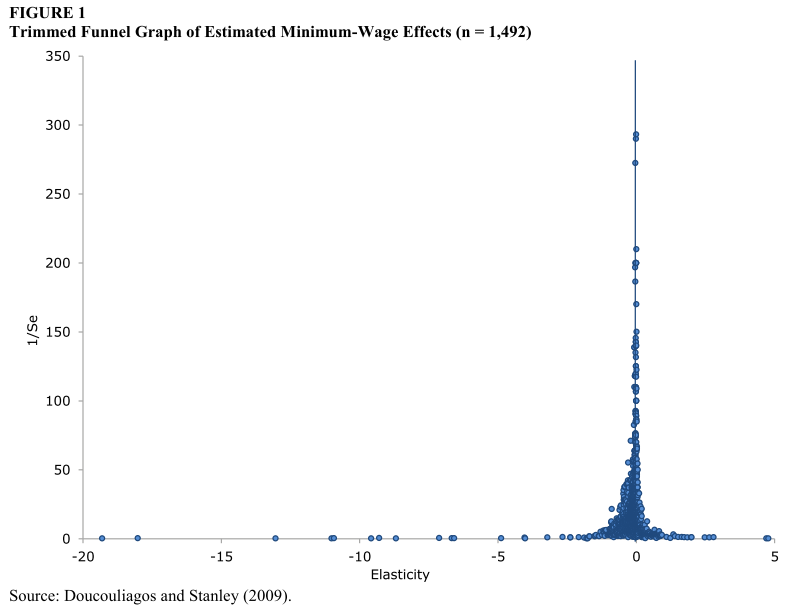
That quote shows that he doesn’t understand how the minimum wage is thought to create unemployment.  When wages rise, more people have an incentive to actively look for work, but the number of jobs doesn’t rise.  If anything, the number of jobs should fall.  That would be the real tragedy of raising the minimum wage too much.  Unemployment can be created by an increase in people looking for work or a decrease in the total number of jobs.  The latter would be a much bigger tragedy than the former.  Fortunately, most academic studies show approximately zero effect of minimum wage laws on the total number of jobs.  If the minimum wage rose high enough, I’m sure it would reduce jobs, but it is generally pretty close to equilibrium wage, so it is hard to find an effect on the number of jobs. Don’t take my word for it, look at a meta analysis of multiple studies.

meta min wage

Most studies found no significant effect.  That is the big spike.  Many published studies have even found that the minimum wage is associated with increased employment!  Overall, the minimum wage in the US has been so modest that it just hasn’t had a measurable effect on anything in the economy except the incomes of the people working for the minimum wage and the people in charge of them.  Fast food CEOs’ wages are also dependent upon minimum wage legislation, so restaurant CEOs care about the minimum wage.  A lot. Perhaps that is what motivates their opposition.

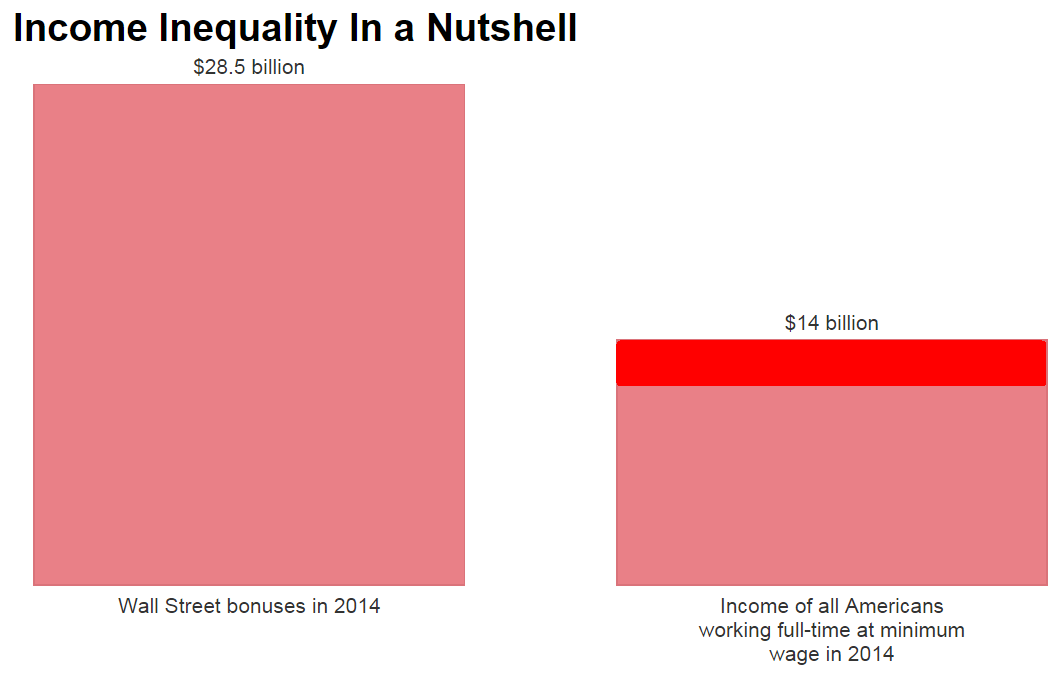
The relative insignificance of the minimum wage to the overall economy is demonstrated by this data from the Institute for Policy Studies

wall st vs min wage

The minimum wage is simply a nothingburger to the US economy compared to the BONUSES of Wall Street.  That isn’t total Wall Street compensation.  Only executive bonuses.  And most of the money paid to the millions of Americans who work a minimum wage job would have been paid even without the minimum wage because the minimum wage is pretty close to the equilibrium wage anyhow.  The minimum wage only adds a bit to the top of the wages that they would have earned without a minimum wage.  I added a little red rectangle that shows my educated guess at how much money the minimum wage might add to low-wage incomes.  The little red box REALLY shows what a nothingburger the minimum wage is.

Unless your wage depends on it.

Yesterday I wrote about an easy way to fix problems with the minimum wage that would make it work better. Fast food CEOs probably won’t agree.

Update: Menzie Chin pulled a great quote out of the meta analysis cited above:

The [meta analysis] suggests the existence of a very small, but statistically significant, negative minimum-wage effect. A 10 per cent increase in the minimum wage reduces employment by about 0.10 per cent (see column 4 of Table 3). But even if this adverse employment effect were true, it would be of no practical relevance. An elasticity of -0.01 has no meaningful policy implications. If correct, the minimum wage could be doubled and cause only a 1 per cent decrease in teenage employment.

The 1 per cent decrease in employment is pretty much a nothingburger, but a doubling of wages is a big deal for the people affected.  The US has more teenagers working than in any other rich country that I am aware of.  They should be studying harder rather than flipping burgers because focusing more on education would pay off more in the long run.  A slight decrease in teen employment could help increase long-run productivity by keeping more kids in school.  And increasing their wages would help them afford more college.

Posted in Inequality, Labor

Enter your email address to follow this blog and receive notifications of new posts by email.

Join 75 other subscribers
Blog Archive
Pages