
Dramatic rise in median household income released today

I just finished listening to the Census Bureau press conference about their latest releast of median income, poverty, and healthcare data.  The startling news is this:

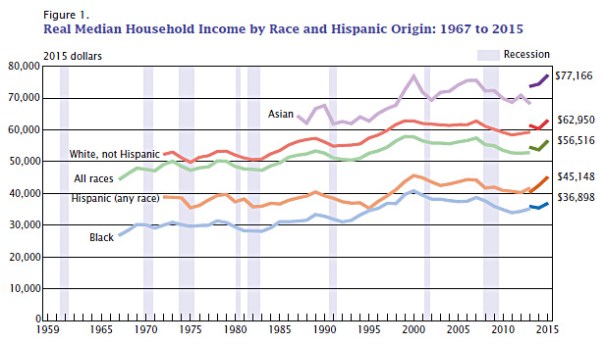
Real median incomes in 2015 for family households ($72,165) and nonfamily households ($33,805) increased 5.3 percent and 5.4 percent, respectively, from their 2014 medians. This is the first annual increase in median household income for family households since 2007.
census-median

5.4% is a HUGE increase in real median income!  Another year like that and we will be higher than ever before.  We are now only, “1.6 percent lower than the median in 2007, the year before the most recent recession, and 2.4 percent lower than the median household income peak that occurred in 1999.”

The bad news is that real median income is still only slightly above where it was in the early 1970s, but at least we have had a great year.

There have been a lot of stories in the press that try to argue that the political success of Donald Trump is largely due to economic difficulties among working class whites who blame immigration and trade for their economic woes, but there isn’t any data to support that idea and the latest Census data demolishes it.  All the latest economic statistics in the report look really good.  There just isn’t anything in the report to support the popular media narrative that working-class whites have been experiencing more economic hardship which has driven them to vote for Trump.

Ordinary Americans were doing better economically in 2015 than they were at any time since the peak of the economic bubble at the end of the Bush administration in 2007 and although we don’t have median income data for 2016, there is nothing in any of the more up-to-date economic statistics to suggest any significant problems.

Although the Census data is aggregate data, in the past that kind of economic data has been an excellent predictor of voter sentiment.  However, this year it is failing and so it is important to look at data comparing individual Trump supporters with individuals opposing him to better understand their situation.  Jonathan Rothwell at Gallup did just that in a publication last week.  Rothwell’s data also contradicts the narrative that Trump supporters have rejected mainstream Republican candidates as a reaction to economic hardship.   Dylan Matthews summarizes:

both across the overall population and among whites, support for Trump is correlated with higher income, not lower.  ….”The individual data do not suggest that those who view Trump favorably are confronting abnormally high economic distress, by conventional measures of employment and income,” he concludes.

Nonetheless, Trump supporters tend to be blue-collar and less educated: …[This] suggests that his sweet spot is less-educated people in blue-collar fields who are nonetheless doing pretty well economically.

Trump does well in racially segregated areas: Turning to the geographic data, Rothwell finds that segregated, homogenous white areas are Trump’s base of support. “People living in zip codes with disproportionately high shares of white residents are significantly and robustly more likely to view Trump favorably,” he writes. “Those living in zip codes with overall diversity that is low relative to their commuting zone are also far more likely to view Trump favorably.” Put another way: If you’re in the whitest suburb in your area, you’re likelier to back Trump.

Trump doesn’t do well in areas affected by trade or immigration: This is perhaps the most surprising finding. Contact with immigrants seems to reduce one’s likelihood of supporting Trump, as areas that are farther from Mexico and with smaller Hispanic populations saw more Trump support.

Many of the Trump voters I know don’t really like Trump, but merely hate Hillary Clinton more and find Trump to be the lesser of two evils.  In a poll published three days ago, about 1/6 of the Americans who plan to vote for Trump indicated that he is unqualified to be president because 41% plan to vote for him, but only 36% think he is qualified!

It is possible that a few of the Trump supporters in Rothwell’s surveys are mainstream Republicans like Paul Ryan and Mitt Romney who dislike Trump, but will begrudgingly vote for him because they hate Clinton worse, but this issue is probably trivial because Rothwell was only looking at the 33% of American respondents who actually said that they view Trump favorably, not whether they intended to vote for Trump, and many of the surveys were done during the primaries when conservative respondents had many other viable candidates to oppose Hillary.

Update: The good economic news isn’t quite as good as it first appears.

Posted in Medianism

Unmasking Millionaire Superheroes: Nils Bohlin

Dylan Matthews at VOX shows a graph from the WHO that the trend of rising life expectancy has been continuing since 1990:

life expectLife expectancy has been rising fastest in low income countries which have the lowest life expectancy, but average life expectancy has risen significantly everywhere from 1990 to 2012.  On average life expectancy has risen 6 years in the past 22, and in poor countries it rose by nine years.  If life expectancy rose just a little more than two times faster than that, it would rise more than a year per year which means that some people would never die, so life expectancy in poor countries is advancing so fast, it is almost half way to the speed required to reach immortality!

Lots of small advances have contributed to this trend.  For example, Nils Bohlin was an automotive engineer at Volvo who invented the three-point seatbelt which he patented in 1959. They made the design free for public use in 1968 and the US Department of Transportation required it in all American cars.  Nils Bohlin died in 2002, and in its obituary, the New York Times reported that his invention is estimated to save more than 11,000 American motorists each year in the USA alone.   Nils Bohlin’s invention may not have saved a million lives around the world yet, but he is well on his way to becoming a millionaire superhero.

seatbelt

Posted in Millionaire Superheroes

Government debt is not like individual debt

Note: This is an update of an old post.

Paul Krugman explains why US government debt never has to be repaid.

Deficit-worriers portray a future in which we’re impoverished by the need to pay back money we’ve been borrowing. They see America as being like a family that took out too large a mortgage, and will have a hard time making the monthly payments.

This is, however, a really bad analogy in at least two ways.
First, families have to pay back their debt. Governments don’t — all they need to do is ensure that debt grows more slowly than their tax base. The debt from World War II was never repaid; it just became increasingly irrelevant as the U.S. economy grew…
Second — and this is the point almost nobody seems to get — an over-borrowed family owes money to someone else; U.S. debt is, to a large extent, money we owe to ourselves.
This was clearly true of the debt incurred to win World War II. Taxpayers were on the hook for a debt that was significantly bigger, as a percentage of G.D.P., than debt today; but that debt was also owned by taxpayers… So the debt didn’t make postwar America poorer. In particular, the debt didn’t prevent the postwar generation from experiencing the biggest rise in incomes and living standards in our nation’s history.
But isn’t this time different? Not as much as you think.
It’s true that foreigners now hold large claims on the United States, including a fair amount of government debt. But [Americans now hold large claims on foreign nations too.] Every dollar’s worth of foreign claims on America is matched by 89 cents’ worth of U.S. claims on foreigners. And because foreigners tend to put their U.S. investments into safe, low-yield assets, America actually earns more from its assets abroad than it pays to foreign investors. If your image is of a nation that’s already deep in hock to the Chinese, you’ve been misinformed. …
Now, the fact that federal debt isn’t at all like a mortgage on America’s future doesn’t mean that the debt is harmless. Taxes must be levied to pay the interest, and …taxes impose some cost on the economy, if nothing else by causing a diversion of resources away from productive activities into tax avoidance and evasion. But …nations with stable, responsible governments …have historically been able to live with much higher levels of debt than today’s [levels]. Britain, in particular, has had debt exceeding 100 percent of G.D.P. for 81 of the last 170 years. When Keynes was writing about the need to spend your way out of a depression, Britain was deeper in debt than any advanced nation today, with the exception of Japan…

If countries can have government debt that is higher than 100% of national income (GDP), then why not always borrow?  Too much government debt could create higher interest rates.  If the government borrows too much, it could suck up all of the cheap loanable funds which would cause higher interest rates for everyone.  An interest burden should only be taken on when the benefit exceeds the deadweight loss of the extra taxes to pay the interest.  The basic rule is that you should borrow money to pay for an investment with a long payback period where the return on investment is greater than the interest payment.  But in a recession, additional government borrowing does not raise interest rates because the government merely borrows hoarded money (excess savings).

When the American government borrowed money from Americans to pay for the Iraq war, that did not shift any burden to future generations of Americans at all.  It merely required that the government must tax some future Americans to pay other future Americans back.  There is zero generational debt burden shift because every debt is always someone else’s asset so net debt is always zero.  The only possible way for government debt to shift debt from the current generation to future ones is if the future generations can be persuaded to pay debts to foreigners.   If the US government could only borrow money from Americans, it could not create any net debt.  It would just be Americans owing Americans.   That means that we will commit to collect taxes from future generations in order to pay the future heirs who will inherit the bonds.  It is just a transfer from future taxpayers to the heirs of people who are currently lending to the government.  As Moneybox writes:

If you think about a household that’s facing some obvious future expense (retirement or kids going to college) the thing you want to do is reduce consumption below income. The idea is to accumulate financial assets—stocks and bonds and bank accounts… Then in the future when you need consumption to exceed income you can liquidate your financial assets. This same strategy also works great if you’re Norway or Abu Dhabi or some other small country.

American debt to foreigners isn’t much problem for two reasons.  First, only about a third of total federal debt is owed to foreigners.  If you are worried about that, then you could simply ban Americans from selling debt to foreigners.  Those foreigners hope to be paid back in full with interest and there are two ways we could do this.  One way is to pay them back by exporting more goods than we import.  Every car we export either causes foreigners to send us equally valuable stuff in exchange or else it causes a foreigner to tear up a car’s worth of debt that we owe them.  Increasing net exports would have a stimulus effect on the US economy, so it isn’t necessarily a bad thing.  In fact, many Asian governments including China and Japan have been deliberately doing this for decades and this is why they have been lending so much money to the US government.  They have been trying to subsidize their exports to the US by lending money to the US government.  The other way to pay back foreigners is to simply print money and send them pallets loaded with US cash.  That would likely cause inflation, but inflation is also stimulative and it is a lot easier to manufacture and export paper money than to manufacture and export other kinds of goods, so it might be a tempting option for future US policymakers.  It is that simple.  Nobody in the history of the world has ever had a debt problem when they can print the currency that denominates their debts.  The only way to get a debt problem is if you owe debts in a currency that you cannot print (like Greece in 2008 or Argentina in 2001).

Just as I cannot bankrupt myself by borrowing money from myself, I cannot save money by lending money to myself.  To “save money” means to lend it to someone else.  The only way for a country to increase net savings is to lend money to foreigners.  Norway, Abu Dhabi, Japan, and China are examples of countries that are doing just that.  They are all sending out net exports in exchange for IOUs from foreigners (and purchases of foreign assets).  Norway is explicitly trying to save retirement money for their greying population this way.  In the future when they have a lot of retirees, they intend to spend down their national savings held abroad, and that will help pay for elder care as it will allow them to reverse their net exports and begin to import more than they export.  The entire population of Norway is only a few hundred thousand larger than the Detroit metropolitan area, so they can get away with lending money abroad to save for retirement.  But the US is over 20% of the world economy and that massive size makes it much less practical for us to save for retirement by lending large amounts abroad.

The result is that we’re basically left with a much more primitive kind of savings problem. Something closer to a farmer in the pre-industrial era who’s trying to save up for winter. To save for winter you can’t just sell your surplus food during the fat months and stockpile financial assets. During the lean months there won’t be any food for sale. You need to actually stockpile surplus food and other tangible commodities. That means smoking meat, finding a dark cool place to stash your potatoes, chopping a bunch of firewood, etc.

…The idea is to tradeoff [current] consumption in order to obtain long-lasting goods. The federal government, …unfortunately, doesn’t engage in proper balance sheet accounting. So if you borrow $10 million to do road repairs, that shows up as an increase in indebtedness. The right way to think about it, however, would be that the road is a depreciating asset that has a value. Every year it goes unrepaired, its value declines. So borrowing $10 million to fix the road might improve the government’s net financial position, depending on [how much value the project creates]. Right now we’re at a time when it’s never been cheaper to finance federal borrowing. Consequently, borrowing money and spending it on sound projects of long-duration is the best way we have to “save” for the future even though it technically adds [financial] debt. Now of course spending money on something dumb doesn’t help. But deferring repairs and useful investments for the sake of borrowing less is going to leave us poorer in the future rather than richer.

To add to this last point, if you were running a huge corporation, and sometimes it costs 15% interest to borrow money and other years it costs 2.5% interest.  When would you borrow more money to pay for long-lasting infrastructure investments, when interest rates are high or when they are low?
FRED Graph

The main threat of excessive government debt is the possibility that it will drive up interest rates and crowd-out private investments that might be more productive for future generations than what the government is doing.  A debt cannot hurt future generations unless it changes future productivity by reducing investments that will help the future.  But it doesn’t look like that could be a significant problem given that interest rates are at near record lows.

One more question:  If rapture happened and the only people left behind on earth were you and a group of 30 friends, how would you save for retirement?

Posted in Macro, Public Finance

Krugman is confused about whether inflation or taxation is more contractionary!

Krugman writes:

…a deficit ultimately financed by inflation is just as much of a burden on households as one ultimately financed by ordinary taxes, because inflation is a kind of tax on money holders. From a Ricardian point of view, there’s no difference. …I’m confused – [¡¿]and I hope it’s not because I’m stupid[¡]

Krugman uses a lot of sarcasm and he definitely doesn’t think he is stupid, so he really should use sarcasm marks in that sentence.  But I don’t know why he is confused about the difference between the contractionary effects of taxes and the relatively stimulative effects of inflation.  Taxation is contractionary to different degrees.  Income (& payroll) taxes discourage working and sales taxes  (& VAT & excise taxes) discourage spending.  In contrast, inflation is more stimulative than taxation because, as Krugman says, inflation is like a tax on money holders and this discourages the unproductive hoarding of money and encourages people to lend or spend their hoardings which stimulates production.   That is exactly what is needed during a recession.  Most recessions are caused by hoarding money and a stimulus only works when hoarded money gets loaned out or spent again.

When the US government spends money, that generally increases GDP, but the government has to get the money from somewhere and some sources of revenue are more contractionary than others.  For example, the estate tax is relatively benign during a recession because it only affects estates that are so large that the money is difficult to spend (a problem examined in the story of Brewster’s Millions).  Whereas people who inherit large estates have hoarding tendencies, the government spends the money immediately which stimulates the economy.

But if the government gets its spending money by taxing poor people who spend everything that they get, government spending would have no stimulus effect at all.

But most taxation is at least partially contractionary which is why fiscal stimulus mainly happens via borrowing.  The government borrows money from hoarders and spends it thereby stimulating the economy.  If the government would get spending money by printing it and creating inflation, that would also be more stimulating than taxing people because it is more like borrowing the money.   When printing money creates inflation, that is a bit like borrowing a certain percentage of everyone’s money holdings without paying them any interest.  Krugman’s confusion seems to stem from a version of the Ricardian Equivalence fallacy and he even uses the word ‘Ricardian’ to show that he is using that kind of (fallacious) logic.  That is ironic because he is one of the people who is most consistent in arguing that it is a fallacy.

Posted in Inequality, Macro, Public Finance

Ricardian Equivalence and Hoarding

Ricardian equivalence is the theory that a rise in government deficits will cause taxpayers to increase their savings because they know they will have to pay for it in a future tax increase. Ricardian Equivalence stems from economic models that made recessions impossible because they omitted hoarding which is the most common reason for a recession.  The theory of Ricardian Equivalence was first promoted by Harvard economist Robert Barro in 1974 and he named it after the great 19th century English economist, David Ricardo, as part of his effort to promote the idea. Ricardo did mention the idea but he immediately rejected it at the same time.  He never promoted it.  Robert Barro first promoted the idea and it has become a kind of zombie theory ever since.  It has been killed numerous times, but somehow continues to live on and infect new believers nonetheless.

There are several flaws in Barro’s theory, but the only way his theory could work would be if the money supply were fixed, there were no recession and the economy was already operating at full employment and people had low discount rates.  Then Ricardian Equivalence would be approximately true.  If everyone is already working as much as they want to work and the government tries to spend money to get people to do more work for the government, then total GDP cannot increase and the government merely shifts workers from private-sector work to doing government work.  In this case there would be rough equivalence between government spending that is financed by immediate taxation or by borrowing.

For example, if the government immediately taxes people to pay for increased government spending, then households cannot spend that money on household goods and so there is just a shift from household spending to government spending.  Equivalently, if the government borrows the money, then people’s savings must go to the government rather than going to private borrowers.  Barro gave a flawed rational expectations story for Ricardian Equivalence in which taxpayers naturally see that the government will have to pay for the new spending with higher taxes and so they rationally increase savings (thereby reducing household consumption) so they will be able to pay for the higher taxes that they expect to have in the future. This doesn’t really change the story however that Ricardo assumes that government borrowing has exactly the same effect on output as an immediate tax hike.  The only way that could be true is if there were a fixed money supply and no hoarding.  But hoarding is the main reason for recessions, and if there is hoarding, then the government can borrow the hoardings without reducing household spending because there are more savings than borrowers know what to do with.  During a typical recession, government borrowing reduces hoarding in the loanable funds market.  In the labor market, hoarding also causes a problem: unemployment. When the government spends some of the hoarded money, it will help get people working again.  It is that simple.

So I would agree with Barro’s theory in times when unemployment and hoarding are very low, but that is the standard Keynesian theory.  In times like that, governments should use austerity to reduce inflationary pressures.  But Barro argued that his theory is universal which is ridiculous.  It is a special case which only becomes approximately true in rare circumstances.

Posted in Macro

Capitalism rests on socialist foundations.

Yesterday I noticed that one of my colleagues, Dr. George Lehman, will be giving a presentation entitled, “Having it both ways: Costa Rica as an alternative to the capitalism-socialism debate.” George always gives interesting presentations and whereas I’ll probably agree with the content of the presentation, I don’t like the title.  If we define socialism as government production and capitalism as private-sector production, then capitalist systems have always relied upon some amount of socialism.  There is no pure capitalism without socialism.  The only argument is about how far socialism should go.

This is because capitalism is inherently fragile, particularly the kind of capitalism that produces a high median income.  Even primitive capitalism (which doesn’t create a prosperous median income) relies upon the private ownership of capital which is much easier to destroy than to create and that makes it fragile because anyone with a weapon can hold up the people who control capital.  Advanced capitalism requires banking, insurance, copyright, and property transactions and these institutions rely upon contracts and laws which are easier to break than to agree upon.  Without government to prevent vandalism and enforce contracts and laws, there is very little capital, much less capitalism.

George’s title does accurately reflect the popular perception that there is a dichotomy between libertarian capitalists and socialists. Libertarians want to reduce socialism and the socialists want to increase it, but both are already “having it both ways.”   Socialists (with a few communist exceptions) don’t want to eliminate capitalism.  They want to use capitalism to help generate wealth that can be used by government for social ends. And libertarians (with a few anarchist exceptions) don’t really want to completely eliminate socialism/government.  They just want to use socialism for the purpose of maximizing private production (capitalism) rather than for social welfare purposes like health care for the elderly.  There are a few anarchist libertarians out there who truly do wish to eliminate all socialism, but the big problem with anarchist ideology is that all examples of anarchy in history have had extremely little capitalism (private production). Anarchists have to imagine that anarchy could somehow permit prosperous capitalism even though it hasn’t ever existed anywhere at any scale.

Anarchist libertarians would agree with George’s title which implies that capitalism doesn’t rely upon socialism and there is a grain of truth to that depending upon how they define government.  I would argue that there is no pure anarchy without government because in the absence of formal governements, warlords and criminal gangs rapidly emerge and adopt some of the functions of government.  For example, they try to monopolize the use of force in their territory. Many people don’t define the violent organizations that arise in anarchy as primitive governments because they are so injust and inefficient that they don’t have much legitimacy and formal governments don’t recognize their sovereignty.  I subscribe to Mancur Olson’s definition of government as an organization that at least partially succeeds at monopolizing violent force within its domain and I place warlords at worst end of the spectrum of governments.

Anarchists imagine that anarchy would be just and peaceful.  The big problem with the anarchist dream is that there are many real examples of anarchy and they are all places where people are poor and life is nasty, brutish, and short because of bad management by warlords who produce too little socialist law and order, roads, and schools.  Although most people probably don’t think of the warlords of anarchy as producing a bit of socialism, most people don’t define anarchy as capitalistic either because markets are so limited and people are soo poor in anarchy.  There is little point in having markets when there is no effective governments to rein in criminals who can just steal rather than buying. Anarchy doesn’t look anything like modern paragons of socialism nor capitalism.

Anarchy isn’t really the complete absense of socialism, and at the other extreme, communism isn’t really the complete absense of private production (capitalism) either. In communism there are always some amount of black markets of private production and distribution that help make the system tolerable.  Communist economies even produce money which helps facilitate private production and markets.  Why bother to produce money if not to facilitate market exchange?  Pure communism without any private production would be difficult to achieve.

Realistic libertarians are not anarchists.  They recognize that some government production (socialism) is necessary for capitalism because a precondition for capitalism is the establishment of secure property rights which are created by socialism. Some libertarians also accept additional socialism for producing infrastructure like roads and sewage systems, education, and national defense because they recognize that without socialist funding and management, not enough would be produced to enable the level of capitalist prosperity that they desire.

Most of the leaders of our capitalist businesses are not libertarians because they want more socialist  production of criminal justice, infrastructure (roads etc.), education, healthcare, and national defense than people who identify as libertarians.  None of them would use the word socialism to describe government, but a substantial amount of socialism is what they want. The mainstream business community is already at a middle way between people who identify with libertarianism and those who identify with socialism.  In fact, the business community is one of the main political forces that has historically promoted socialist involvement in producing roads, schools and military bases. The white-collar business demographic generally oppose the people who call themselves socialists and the might not prioritize healthcare for the elderly and the homeless as much as the average citizen, but they also tend to oppose the hard-core libertarians.  Most of the business community wants a middle way between maximizing capitalism (libertarianism) and maximizing socialism (communism).

Whereas George echoes the popular sentiment that capitalism and socialism are two ends of a dichotomy, that isn’t realistic.  A more realistic scale would put anarchy at one extreme with minimum government and communism at the other extreme with minimum private business:

  • Anarchism – In the most utopian libertarian theory, markets completely replace  government.  Some of them call themselves anarcho-capitalists.
  • Libertarianism (maximal capitalism as a share of production)
  • Capitalism as represented by the US business community’s preferences (the system the US would have if only white-collar US business people could vote)
  • Capitalism as represented by the European business community’s preferences (the system Europe would have if only white-collar European business people could vote)
  • Socialism as is typically espoused by socialists who reject communism. They sometimes call themselves ‘democratic socialists’ to distinguish themselves from the autocracy of communism.
  • Communism (maximal socialism as a share of production).
  • Anarchism – In utopian communist theory, government will wither away when communism is perfected.

Everyone already has it “both ways” with a mix of both socialism and capitalism.  Even anarchy and communism have at least a bit of both.  Costa Rica is an interesting mix that I’d rank somewhere around European business preferences, but I’m not sure which side.

Posted in Development, Managerial Micro, Public Finance

The math behind whether condoms cause teen pregnancy

Via Sarah Kliff, I see that a new research paper found that schools giving out free condoms had a 10 percent increase in teen births.  This is contrary to the past studies I have seen which show that free birth control led to fewer pregnancies and abortions.  But the new study is convincing because it uses a large data set.  The authors give three hypotheses for their surprising result:

  1. Free condoms caused kids to have more sex.  This is also suggested by their finding that rates of gonorrhea were higher among teenage girls in schools with condom programs. However, there is no evidence to support this theory and all the research I have seen has shown that changes in birth control availability has caused insignificant change in the amount of sexual activity.  As you will see later, simple mathematical analysis blows this theory out of the water because if more condoms caused more births, the amount of increased sex would have to be epic.  It would be difficult to escape notice.
  2. Teens substituted condoms in place of more effective birth control methods like IUDs and hormonal implants.  This is a likely possibility because the same mechanism appears to be the main reason why teen birth rates (and abortion rates) have plummeted in the past 20 years.  Sexually active teens have moved away from condoms towards more effective birth control methods.
  3. Schools cut their budgets for other (more effective) means of pregnancy prevention when they funded free condoms.  This is suggested by the finding that the schools that eliminated sex education counselling had most of the problem.  Counselors would encourage more effective forms of birth control and explain how to use condoms to reduce their failure rate.  This could also help explain the increase in gonorrhea which can be stopped by knowledge of when to get treatment and knowledge of proper condom use.

Could theory #1 be true?  Could free condoms cause orgies which in turn causes an increase in pregnancy rates?  A little math and common sense demolishes the theory.  Condoms significantly reduce the risk of pregnancy and so the only way condom use could increase pregnancy is if they caused an even greater increase in sexual activity.  For example, although condoms reduce the risk of pregnancy by more than 50%, and even at that low level of effectiveness, teens would have to double the amount of sexual activity to just cause the pregnancy rate to break even (because 50% is half and if you take half of a doubling, you get right back to where you began).  Even at that extremely low-level of effectiveness, condom-using teens would have to increase their sexual activity levels by 120% in order to see a 10% increase in pregnancy and that is a truly epic change in sexual behavior, the likes of which have never been documented in a large population of kids over such a short time.  All the empirical evidence indicates that the demand for sexual activity is quite inelastic.  For example, one study in LA found approximately zero change in sexual activity due to free condoms.  Nearly half of US high school students have not had sex and the presence of free condoms doesn’t make or break their decision.  Similarly, the other half of students were already having sex before they got free condoms and condoms are hardly an aphrodisiac that dramatically increases sexual appetites.

If schools had distributed highly effective contraception like IUDs, they would have definitely seen reductions in pregnancy.  IUD’s are 99.7% effective per year which means that they must reduce the risk of each sexual act by more than 99.9%.  IUD users would have to increase their sexual activity more than a thousand fold in order to increase their pregnancy rate relative to unprotected sex!

inconcevable

It is similarly inconceivable for condoms to increase sexual activity enough to increase conception rates.  I’ll be looking forward to further research to learn more about what caused the increase in pregnancy in the schools with free condoms.  I’m betting it was a combination of theories #2 and #3, but I bet I’ll be hearing more editorials about theory #1 because it was already a meme with a strong appeal to some people even though there is no evidence for it.

Note that because IUD’s are 99.7% effective per year, they are extremely disappointing for about three of every thousand IUD users every year when they get pregnant. If you Google “IUD pregnancy rate” to find how effective IUDs are, you will see lots of stories claiming that IUDs aren’t at all effective because someone got pregnant, but no reversible method is more effective and the authors of these stories seem to mentally round up from 99.7% to 100%, but even tubal ligation isn’t 100% effective.  There isn’t any reverseable birth control that works significantly better than IUDs and hormonal implants.  Even abstinence has a much worse record because people who try abstinence fail at a much greater rate than IUD users.  In theory abstinence would work 100% if people were good at using the method, but in practice, abstinence has such a high failure rate that it should be considered a supplementary method for the average person.  Similarly, condoms are over 97% effective IF they are used correctly, but in practice condom users tend to use them imperfectly out of ignorance or sloppiness and their failure rate tends to be very high.  The above study shows that high school students who get condoms without any counselling have particularly high pregnancy rates.

Posted in Health, Managerial Micro

Enter your email address to follow this blog and receive notifications of new posts by email.

Join 75 other subscribers
Blog Archive
Pages