Ending The Tyranny of Temperate Climate

Humans co-evolved with our technological inventions for warming up in the cold: fire, shelter, and clothing.  Our large brains would not work without the precise temperature regulation provided by our nearly furless skin.  Even the remnant fur on our heads is there to insulate the most temperature-critical body part by shading it from intense sun and warming it from the cold while the naked skin on the rest of our body can radiate out the enormous heat created by our brains.  Although our brains are only about 2% of body weight, they generate 20% of the heat of our bodies and they don’t work well if they overheat.  Brains must be kept within a very narrow temperature range to work correctly. Because human skin is built to eliminate heat, humans have needed heating technologies to survive even moderate cold snaps: fire, shelter, and/or clothing.

Humans began pre-digesting their food outside of their bodies using a technology we call cooking.  This was necessary to allow them to develop the most energy-intensive organ, the brain, without needing to have an enormous stomach and spend half the day constantly chewing to fill it.  Humans have extremely tiny jaws and stomachs compared with the rest of our bodies because our ancestors figured out how to make food more digestible and energy-dense.  The great apes that are our closest biological relatives spend 4-7 hours every day just chewing their food and they would spend much more time chewing if they needed to feed human-size brains.

Fire allowed humans to feed the caloric needs of our brains without spending half the day chewing and warm up in cold weather so that our brains can function.  Warming and cooking technologies allowed humans to spread into nearly all the climatic zones of the globe.

Whereas humans have always had technologies for warming up, it was not until the 1950s that humans had an equally reliable technology for cooling down when trying to work in a place that is too hot.  And cooling down is crucial for our brains to function well.  Witness our naked bodies for evidence.  Before the air conditioner, people could not work when the weather gets too hot.  They were forced to siesta during the heat of the day and some of our nomadic ancestors used to migrate into the cool of the mountains during hot seasons.  The highland areas of Mexico and East Africa and South America never get hot because high-altitude areas are temperate even in the tropical parts of the globe.  That is why about half of the population of Mexico lives above 1-mile altitude.  There is temperate weather up there.

Here is an estimate from NOAA of how much less time humans can do physical labor outside in the tropics compared with temperate zones:

labor_capacity-1

By their estimate, people in the tropics can’t spend as much time doing physical labor as in the temperate zone.  When the temperature is cool, people can spend roughly 50% to 300% more time doing physical labor. The bottom graphs shows that this would get much worse with 3 degrees of global warming.

Our hunter-gatherer ancestors only spent a few hours a day working, so the heat of the topics wasn’t as much of a problem in that era, but industrialization requires long work hours and hot factories forging metals and using heat-producing machinery in large buildings with poor ventilation. Even early computers gave off massive amounts of heat.  Industrialization required particularly difficult working conditions in hot climates before the air conditioner.

Tragically, the idea for mechanically cooling living space was already invented in the 1840s by John Gorrie.  Unfortunately, he was unable to get financial backing and died bankrupt.  He marketed it as a remedy for malaria and yellow fever because he believed in the common theory of the day that malaria was caused by bad air (which is literally what the word ‘malaria’ means) and he believed that cooling the air could keep the poisonous gasses away.

Perhaps his idea was ahead of its time, but he might have just been targeting the wrong market.  He might have been more successful if he would have marketed it for industrial and luxury markets because that is how  Willis Carrier succeeded when he reinvented the air conditioner a second time in 1902.  He initially found success selling them to printing and textile factories to stabilize the humidity that wreaked havoc with production and that focus on humidity is why they got the name air conditioners rather than air coolers. Nobody tried using them to cool the air merely for human comfort until the first residential unit was installed in 1914 in Minnesota (of all places) and they became popular in the 1930s in movie theaters and finally revolutionized life in the sunbelt in the 1950s as the technology improved and costs dropped.

If the automobile is the invention that revolutionized 20th-century geography the most, the air conditioner should come in second place.  Rebecca Rosen explains:

During the Depression, few places could afford to install the systems, but one venue saw returns on such an investment: movie theaters. The air conditioning in theaters became an attraction in itself, and people flocked to them. Not coincidentally, what many consider Hollywood’s Golden Age began around the same time.  [How much of the early success and growth of Hollywood is due to the growth of the air conditioner?]

…Many of the central changes in our society since World War II would not have been possible were air conditioning not keeping our homes and workplaces cool. Florida, Southern California, Texas, Arizona, Georgia, and New Mexico all experienced above-average growth during the latter half of the 20th century — hard to imagine without air conditioning. In fact, the Sunbelt’s share of the nation’s populations exploded from 28 percent in 1950 to 40 percent in 2000. And hubs of business and technology in hot regions of the globe, such as Dubai, may never have taken off…

The advent of air conditioning has shaped our homes and family life as well. Houses are designed not for ventilation but for central cooling systems. Porches, where they exist, are relics of another age, and few new homes include them. Families gather inside, in the comfort of 72-degree living rooms, to watch TV. Would television have even gained its central place in American family life, were the rooms from which we watch it not so enjoyably cool?

Glass skyscrapers would not exist without air conditioning.  Before 1950, skyscrapers were built without large, open floorplans because architects didn’t think that they could rent out space that was more than 25 feet from an openable window.  Access to windows limited the footprint of early skyscrapers.

Today there are no openable windows in large new buildings.  The largest skyscrapers even have to use their air conditioners in the winter because they have so little surface area relative to their volume which contains numerous heat sources including humans and computers.  Even when it is 5 degrees outside, when the sun comes through an expansive solid glass wall, the sunny side of the building still needs cooling.  Rebecca Rosen:

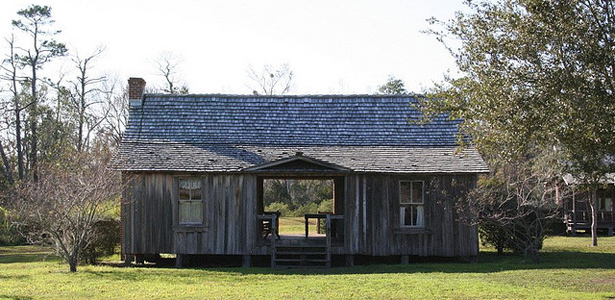
ImageBefore air conditioning, in a bygone and surely less comfortable era, people employed all sorts of strategies for keeping cool in the heat. Houses were designed with airflow in mind — more windows, higher ceilings. A style once prevalent in the American south, the dogtrot house, was really two smaller cabins — one for cooking and the other for living — connected under one roof with an open-air corridor between them. In addition, many homes had porches where families could spend a hot day, and also sleeping porches with beds where they could ride out a hot night. Many home designs took passive solar design principles into account….

Image

Besides housing design, people had other tricks: taking naps during the heat of the day, carrying hand-held fans around, and, of course, swimming. My grandmother told me she used to pay a bus fare and sit on the open, upper deck for hours, riding all around the city.

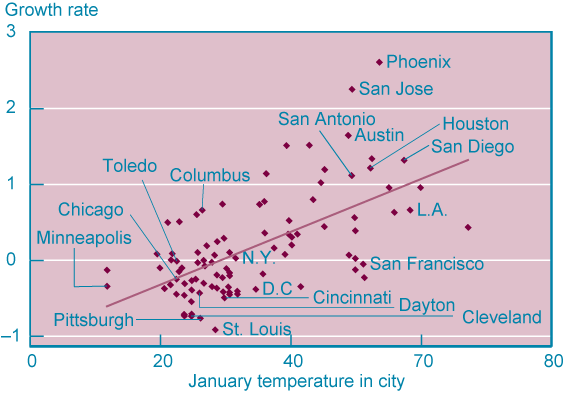
The southern US has been the poorest region for all of American history, but it has been growing faster and catching up.  Undoubtedly one reason it was poorer was that it was too hot for most of history and one reason for its catch-up growth is air-conditioning. Ed Glaeser found that the two main factors that are correlated with regional population growth in the  US after 1960 are warmth in winter and the prevalence of college educated workers.  Once the air conditioner became widespread, the South became the fastest growing region of the US .

The Cleveland Fed made a graph showing how the air conditioner contributed to shrinking cold-weather cities and growing hot-weather cities:
hot population

Cooler working temperatures simply make people more productive.  In Caribbean nations, short-term drops in temperatures are correlated with large increases in GDP.   Cooler temperatures seem to reduce crime and make people less impatient and violent. Installing air conditioning in public schools is a cost-effective way to raise academic achievement in America.  Air conditioners can bring higher productivity and more patience anywhere that indoor temperatures climb above 78 degrees, but even in the US where most buildings have modern air-conditioning, extreme heat still reduces economic output:

Tatyana Deryugina and Solomon Hsiang find that hot days are bad for the economy — not just in poor countries with an overwhelmingly agricultural workforce, but in the United States of America. Here in the US, “productivity of individual days declines roughly 1.7% for each 1.8°F increase in temperature above 59°F.” That means that “a weekday above 30°C (86°F) costs an average county $20 per person.”

…Hot days kill growth both because of negative impacts on agriculture and because it seems that, despite air conditioning, people simply work less efficiently when it’s hot. …Extreme cold is unpleasant, but as a society we can live through it and even thrive. Extreme heat saps our will to live in a more fundamental way, crushing the economy and driving long-term immiseration.

Housing is also more productive in warm regions because air conditioning is more efficient than heating.  It is cheaper to build and cool houses in regions that are too hot than to build and heat houses in regions that are too cold.  In fact, the easiest way to reduce your carbon footprint is to move to a warmer climate.  Emily Badger:

Michael Sivak, …compared Minnesota’s largest city (and the coldest major metro in the U.S.) with Miami (our warmest metro on average), looking at the energy it takes for the two just to keep themselves at livable temperatures.  Minneapolis  just talking here about heating and cooling  is three-and-a-half times as energy demanding as Miami,…

The ideal temperature inside your home is considered to be about 21 degrees Celsius (or 70 degrees Fahrenheit), the point at which you’d probably be perfectly comfortable without heating or cooling. But researchers look instead at the benchmark of 18 degrees Celsius, because humans naturally heat a house a few degrees just by living in it (and running the shower and cooking dinner).

“Think of it this way,” Sivak says. “Let’s say you would like to have 70 degrees indoors. Think of how cold it can get in Minneapolis or Chicago or Ann Arbor. It can get down to zero.” But on a really hot day in Miami, maybe the temperature tops out at 100. It takes a lot more energy to heat a room by 70 degrees than to cool a room by 30. In fact, it takes more energy to heat a room by one degree than to cool it by the same amount. And the typical air conditioner is about four times more energy efficient than the typical furnace or boiler.

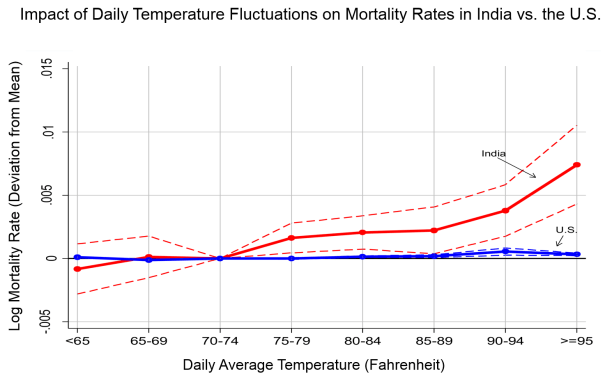
Before the air conditioner, heat waves were deadly in the US.  Now they are more of a mere annoyance that keeps people inside.

The above graph shows that before the air conditioner (red line), heat waves caused mortality spikes.  Since 1960, relatively few Americans have been unable to escape the heat and have had problems.  Because most Indians are too poor to afford air conditioning, they still have mortality spikes during heat waves.
Burgess, Deschenes, Donaldson, Greenstone, 2017

Posted in Development

Why military Keynesianism is less common outside of the US.

Most Americans think that war is good for the economy.  This is a fairly unique perspective.  I doubt people in many other nations have this perspective because the US has exclusively fought our wars somewhere else since the Civil War whereas most other nations remember wars as reaching their homeland.  For example, Sarah Kaplan and Nick Kirkpatrick write that this year in London, an entire neighborhood was evacuated in the night because

A 500-pound bomb had been found… It’s an alarming message for anyone to receive while standing in their pajamas.

…In the small farming towns of France and Belgium, undetonated World War I explosives that turn up during each year’s spring planting and autumn plowing are known as the “iron harvest.” More than a billion shells were fired during the conflict, according to the BBC, and as many as a third never exploded. In 1996, the French Interior Ministry estimated that 12 million shells still slumber in the soil near Verdun alone. So many explosives linger from century-old battles that residents often see their discovery as utterly banal.

…Since 1946, when France’s Département du Déminage (Department of Mine Clearance) was established, more than 630 démineurs (deminers) have been killed in the line of duty, according to Donovan Webster’s book “Aftermath: The Remnants of War.” So have an uncounted number of civilians.

…According to a 2008 article in Der Spiegel, discoveries of unexploded ordnance are a weekly occurrence in Germany.

…But nowhere is the threat of unexploded ordnance more pervasive than Laos, which has the distinction of being the most heavily bombed country per capita in history.

According to the advocacy organization Legacies of War, more than 2 million tons of ordnance were dropped on Laos by the United States during the Vietnam War — the equivalent of a planeload of bombs every eight minutes, every day for nine years. Up to a third of those bombs didn’t detonate, Legacies of War says.

…more than 8,000 people have been killed and 12,000 wounded by leftover live explosives, the New York Times reported in April. Much of the harm is caused by cluster bombs, which spew dozens of smaller bomblets.

…The tennis-ball-size explosives, known as “bombies,” are often triggered by farmers or playful children. The Christian Science Monitor spoke with a woman whose 9-year-old brother was killed when he struck a bomb with a hoe. The Times told the story of two children who tossed one around, thinking it was a pétanque ball (used for a French game similar to bocce). When the “ball” burst, one child was killed instantly. Another, along with a mother who had been standing nearby, died of their injuries days later. Two others were left limping by the blast, their injuries untreated a year later.

People in Laos won’t think that war is good for the economy.  Everyone there would agree that military Keynesianism is an example of the broken window fallacy.  The increased government spending of wartime can stimulate an economy as it did during WWII, but whereas Americans remember how the war finally ended the Great Depression, nobody thinks the economic stimulus is worth it if there is fighting on the homeland which destroys more than what is created.  Residents of many countries constantly get that reminder as they continue to suffer damage from past wars.

Another reason why Americans believe in military Keynesianism more than other nations is that our military-industrial complex lobby is much bigger than in any other nation and they promote the idea too.

Posted in Macro

Is there enough gold in the world to go back on a gold standard?

Update: 2018

Presidential candidate Ted Cruz wants to return to the gold standard.  Is there is enough gold to do so?  The short answer: Yes, there is enough gold in the world to go back on a gold standard, but it would require a huge sacrifice.

First of all, there is nothing stopping anyone from using pieces of gold to pay for all your shopping right now if you want to.  It is just that that pieces of gold are much less convenient than credit cards, checks, or even cash. It would be impossible for everyone to use pieces of gold as money because there is too little gold in the world to directly use as a commodity money. That was always a problem with using gold as money, so under the “gold standard” almost nobody ever actually used gold as money.  Instead, everyone mostly used paper money and checks.  In theory that paper money could have been exchanged for metallic gold at a fixed exchange rate, but in practice, there was never enough gold held in bank reserves to cover all the bank deposits and paper money in circulation.  As Joshua Greenberg points out, there was never enough gold to manage all the economic transactions people wanted to make, so banks created paper money that was more plentiful and convenient than gold.  The banks made a “promise” that the paper money was “backed” by gold, but that was always a bit of a lie. In reality, paper money was mostly just created out of thin air with the hope that only a small percentage of it would ever be redeemed for gold because if more than a tiny percent of the money were to be redeemed for gold, it would cause a bank run that would collapse the monetary system.

Today, all money is 100% fiat money that is created out of thin air and this is more honest than the fiction under the gold standard that money was based on gold.  Only a tiny fraction of the money was ever based on gold.  One problem with returning to a gold standard is that it would require raising taxes because the government would have to buy a massive amount of gold in order to base our monetary system on gold again.

Whereas under our fiat system, the government makes a profit from creating money and that helps reduce taxes, under a gold standard, the government would have to raise taxes to buy gold just to increase the monetary base and that is only a small part of the sacrifice of going on a gold standard.  I would rather that our taxes buy useful services and produce public goods rather than buying gold that is destined to sit idly in government vaults as a monetary base when fiat money can be produced for free.

The crucial problem of a gold standard is the same as the problem of bitcoin as a monetary base.  The quantity is basically fixed and as the economy grows and requires more money, the money supply cannot grow with the economy.  Charles Wheelan likens it to a poker game that started decades ago with five players and fifty chips.  If there are hundreds of tables playing poker later due to a growing economy, but still only 50 chips, the monetary system breaks down.

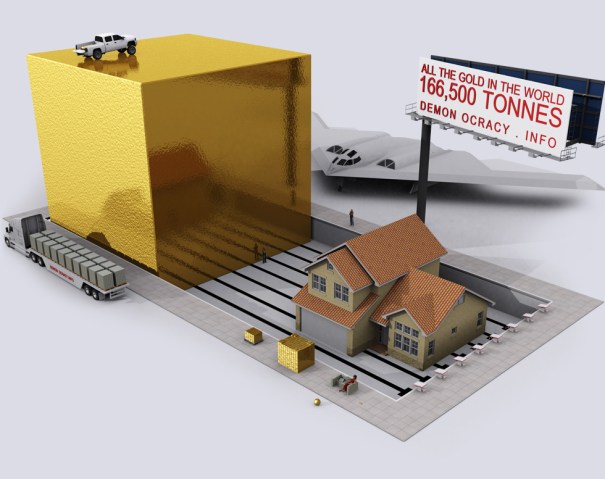
How much gold is there in the world?  According to BBC, there are about 171,300 tonnes of gold in the world. If melted down into a cube, it would only be about 20.5m (22 yards) longVisual Capitalist shows how big that would look compared with some vehicles, a house or an olympic swimming pool.  If it were melted down into the pool, it would fill a bit more than three swimming poolsgold-in-world-cube

At a current price of under $1,100/oz, the total value of all the gold in the world is about $6 trillion.  In comparison, the monetary base of the US alone is $3.9 trillion, so if the US were to go back on the gold standard, we would need to buy over half of the world’s gold to fully back the US monetary system at current prices.  In 2018, the US government gold reserves were only worth about $11 billion, so the US Treasury would have to more than double Federal taxes for a year just to pay for enough gold to use as reserves.

On the other hand, the US monetary base was inflated by quantitative easing beginning in 2008 and in normal times, the US monetary base might only be about $1 trillion.  And the monetary base of the EU is $1.7 trillion. Thus, in normal times there would be enough gold in the world for both the US and the EU to go back on the gold standard.  But the US has only 16% of world GDP and the EU has 17%, so the entire world could not fully base the world’s economies using gold as 100% of the global monetary base at the current gold price even if the governments of the world somehow managed to buy all of the gold away from private owners.

Nevertheless, there are three ways it would still be possible for the entire globe to adopt a gold standard.  First,  governments rarely if ever fully funded their monetary base with gold.  For example, the US generally only kept less than half of its monetary base in gold.  Under-funding the monetary base would help make a global return to the gold standard feasible, but it also makes a gold standard less stable because it causes financial panics when people start exchanging their paper money for actual gold thus further depleting the monetary base.  When people know there isn’t enough gold for everyone and only the first people to exchange money for gold will actually get the gold, there are periodic bank rushes which cause economic collapses.  The last time this happened was the Great Depression when the gold standard system collapsed for good (although gold was still used to help managed the fixed exchange rate system after WWII through about 1970 as will be explained shortly).

Secondly, and most importantly, if the governments of the world started buying up the world’s gold to run our monetary systems, it would dramatically increase the price of gold which would reduce the tonnes of gold that would be needed for running the global monetary system.

Under the gold standard, an increased demand for money would literally create more monetary base out of thin air by raising the value of gold.  That would be great for the world’s gold producers who are constantly lobbying for a return to the gold standard, but it would be a tremendous waste to have to raise taxes to buy all the necessary gold.  A return to the gold standard would dramatically increase the wealth of people who are already hoarding a lot of gold.

The massive increase in the demand for gold for use as the monetary base would suck up most of the world’s gold supply and cause the price to skyrocket which would be bad for industries that need gold to make things such as electronics and jewelry.  I’d speculate that the price of gold might skyrocket up to $10,000/oz (from under $2,000 today) because of all the gold that governments would have to buy.  And they would just waste it because it would all get hoarded in central bank vaults.

In fact, under the gold standard the US government got so desperate for gold that it banned the private ownership of gold. For example, the US banned the private ownership of gold from 1933 to 1974 because the government felt it needed to monopolize the entire stock of gold just for managing foreign exchange policy.  This wasn’t a true gold standard because money must be interchangeable for gold under the true gold standard, and if people can’t own gold, then there is no point in saying that a dollar is worth a certain amount of it.  But the US government let foreign governments exchange dollars for gold during this period (in theory at least) which meant that the US foreign exchange system was still on the gold standard.*

The third mechanism by which the world could go back onto the gold standard is to simply reduce the amount of money in the economy which would cause the value of money to rise (also known as deflation).  Under the gold standard, government monetary authorities regularly engineered deflations partly for this reason.  A deflation is a drop in the prices of everything except money which rises in value.  When the money supply cannot grow as fast as the economy grows, deflation is necessary to adjust prices downward due to the equation: MV=PY.  Alternatively, if the amount of gold reserves shrinks for some reason such as high net imports of goods and services that are paid for with gold, a deflation is necessary to rebalance the monetary system.  In fact, one of the main problems with a gold standard is that it tends to force periodic deflations which causes recessions that would be completely avoidable under any modern monetary system.

*Nearly the entire world had to suspend the gold standard during the Great Depression and World War II because that is what always happens under the gold standard during an economic crisis.  By the end of the war the US had accumulated 2/3 of the entire global stock of gold.  Thus, it would have been very difficult for anyone else to go back on the gold standard at that point because they would have had to buy lots of gold from the US and their war-torn economies didn’t have resources to spare.  Instead, most of the world’s economies adopted the Breton Woods system for monetary policy in which the US pledged to fix the value of the US dollar to 1/35 an ounce of gold and all the other nations agreed to fix their currencies to the dollar.

The rest of the world effectively went on the dollar standard while the US kinda held to the gold standard for foreigners only!  Americans were banned from buying gold or even keeping their old stocks of gold except for limited amounts in the form of jewelry, rare old coins, or amounts that were going to be immediately consumed for industrial purposes.  This Breton Woods system was a way for the world to kinda go back onto a foreign-exchange version of the gold standard with an even smaller amount of gold in reserves than would have been needed for a full gold standard, because the gold was only used to fix foreign exchange rates and only had to be enough to back foreign exchange transactions.  But as global trade increased, the monetary base got more leveraged and the more leverage there is, the less stability.  The system collapsed in the early 1970s and hardly anybody has succeeded in going back on any kind of gold standard since then.

One brief exception was when OPEC briefly tried to stop pricing oil in dollars when the dollar was decoupled from the price of gold in the 1970s and started pricing oil using gold for a short time, but they soon found it more convenient to price oil in dollars and returned to their previous practice.

Actually, Richard Cooper shows that the gold standard itself was a very brief part of monetary history. “The international gold standard proper dates only from the 1870s. It lasted until 1914, and then had a brief revival in the late 1920s.” It came about by an accident of history when Sir Isaac Newton made a mistake in managing the bi-metalic monetary system in Britain in 1717 and overvalued gold relative to silver. That caused ordinary people to favor gold and eventually Britain officially abandoned silver altogether during the Napoleonic wars in the early 1800s.  Then as Britain’s economy grew, the rest of the developed world started to copy it’s gold-standard system partly in order to facilitate trade with the British Empire.  But the system fell apart in WWI and again during the Great Depression.  So although gold has always been valuable, it was only commonly used as a basis of monetary systems for a fairly brief window in the history of civilization.

Posted in Macro

Help the poor by helping the median

A lot of Americans actively dislike poor people and according to recent research, this trend has gotten stronger in recent years. Alec MacGillis summarizes some of the research:

surveys… show a decades-long decline in support for redistributive policies and an increase in conservatism in the electorate …as inequality worsens. …Meanwhile, researchers such as Kathryn Edin, of Johns Hopkins University, have pinpointed a tendency by Americans in the second lowest quintile of the income ladder — the working or lower-middle class — to dissociate themselves from those at the bottom, where many once resided. “There’s this virulent social distancing — suddenly, you’re a worker and anyone who is not a worker is a bad person,” said Edin. “They’re playing to the middle fifth and saying, ‘I’m not those people.’”

In short, low-income working Americans love the middle class and hate the poor and have been voting to eliminate policies that help the poor even though many of those policies also help the low-income working Americans who vote against them.  To gain political acceptance, policies that help the poor should help everyone at least up to the median income.  That will make them more popular and give them better management.

Medicare is managed better than Medicaid because the former is universal insurance for every American who lives past age 65 whereas the latter is just for poor people.  Public education is managed well in places where poor people go to the same schools as rich people, whereas education programs that just serve poor people tend to be actively neglected and managed poorly.  One reason why the US has worse public transit than other rich countries is because transit came to be seen as a kind of welfare program in the US whereas in other rich countries it has always been seen as a form of infrastructure that everyone uses like roads in the US.  Public transit only works well where middle class people use it and when transit works well, poor people are better off than in places where it is seen as a welfare program.

Government programs that directly benefit middle-income Americans (and rich Americans) are simply managed better than welfare programs because there is more political will to keep them working well and a program that works well will help the poor more than a welfare program.  Similarly, a universal health insurance program like in Canada and the UK work better for poor people than a welfare program like Medicaid (and EMTALA) in the US.

Posted in Medianism

Good monetary policy raises inflation during recessions

Fed chair Ben Bernanke thinks he had the best record on inflation since WWII because he held inflation down so low, but Moneybox argued that he actually had the worst because higher inflation would have been beneficial to the economic recovery:

Testifying before Congress recently, Ben Bernanke bragged, “my inflation record is the best of any Federal Reserve chairman in the postwar period, or at least one of the best, about 2 percent average inflation.”

Catherine Rampell’s numbers show that Bernanke has, in fact, delivered the lowest inflation of any postwar Fed chair, coming in at an average of 2 percent. On the other hand, Floyd Norris notes that unemployment under Bernanke has been second-highest of any postwar Federal Reserve chairman. Now if you ignore the “postwar” qualifier, the picture looks different. Several Depression-era Fed chairs had less inflation and more unemployment than Bernanke. And putting those Depression-era bankers into the mix serves to highlight how absurd Bernanke’s boast is. No sensible person would look at America’s economic performance in the 1929-1933 period and say “man, they did a great job of fighting inflation.”

It is true that inflation was very low—indeed, negative—for most of this period, but that simply goes to show they were doing a terrible job.

Suppose Ben Bernanke resolved to deliver enough aggregate demand to get the inflation rate up to its Greenspan-era average of 2.6 percent. Unless you believe there is literally zero slack or excess capacity in the economy, that would create some extra jobs and real growth. And was inflation so terrible in the Greenspan years? Nope. At the time, Greenspan-level inflation was considered a historic victory in the war on inflation.

During the years of slow recovery following the Great Recession there were many prominent academics calling for higher inflation from both the political right and the left, but almost nobody at the Fed was voicing that concern and that is the only place that really matters.  It didn’t happen.

Many prominent people on Wall Street were opposed to higher inflation and that opinion got more sway at the Fed because the Fed is biased in favor of the interests of Wall StreetMatthew Yglesias explained that Wall-Street also convinced Washington politicians to favor low inflation:

I regularly give Ben Bernanke a hard time for the excessively tight monetary policy he’s run at the Federal Reserve… But in Bernanke’s defense I should say that the really striking thing about his appearance is the utter and total lack of influence of dovish monetary policy views on Capitol Hill.

If you read a lot of economics coverage on the Internet, you’ll be struck by the amazing success of “dovish” monetary policy views. I’ve been pushing them here at Slate, Ryan Avent pushes them at the Economist, Matt O’Brien pushes them at The Atlantic, Tim Fernholz and Miles Kimball push them at Quartz, Josh Barro and the Stevenson/Wolfers team push them at Bloomberg, Ramesh Ponnuru pushes them at National Review, Ezra Klein pushes them on Wonkblog, Paul Krugman and Tyler Cowen have both pushed them in the New York Times, etc. It’s not like an overwhelming consensus or anything, but normally a political stance with this much representation in the media could find at least one significant politician to stand up for it. But while we have Obama’s former Council of Economic Advisers Chair and the chief economist at Goldman Sachs on our side, we seem to have zero members of congress.

This is not an excuse for the Fed’s too-tight policies …but it’s probably a reason for it. If nobody in congress objects to crucifying mankind upon a cross of [low inflation] targeting then realistically it seems unlikely to stop.

Inflation was too high in the 1970s and early 1980s because Fed economists had a poor understanding of when inflation is too high and how to control it.  Today inflation is too low because Fed economists have a poor understanding of the costs of inflation that is too low and how to raise it.  In some ways, we are suffering from the mirror image of the problems of the 1970s.  

Lowering inflation is simple.  Just restrict the money supply and clearly communicate the plan to shape public expectations.  Raising inflation is also simple.  Just expand the money supply and communicate a clear plan.  Today it seems amazing that economists did not understand this in the 1970s when inflation was too high and someday it will seem amazing that many prominent economists do not understand this today.

Some economists (including a Fed Vice President) are still puzzled why inflation did not explode when the Fed quadrupled the monetary base, but the reason should be obvious.  The rise in the monetary base was almost entirely Fed cannot raise inflation merely by expanding bank reserves because reserves are not money.  The monetary base is equal to bank reserves plus physical currency.  Only the physical currency that is in circulation is ever part of the money supply.  Here is the graph of how much the Fed expanded the part of the monetary base that is used as money:

The only part of the monetary base that is used as money did not explode at all and for this reason it should not be surprising that the explosion of the monetary base failed to ignite inflation. The “monetary base” is poorly named because it is mostly bank reserves which is not money.

But some economists have interpreted this as evidence that the Fed is powerless to raise inflation!  That is a weird claim since every 2-bit, 3rd-world central bank has not only been able to increase inflation, but generally had problems with too much inflation.  If they can do it, the much more powerful and intelligent Fed can too.  The same economists claimed that it was impossible for Japan’s central bank to raise inflation, but Japan succeeded by committing to doing as much quantitative easing as it would take to raise inflation to the target level.  The US Fed hasn’t even said that it wants higher inflation, much less taken specific actions to accomplish it.  If you can’t even find the will to say it, you probably can’t do it.

Japan’s move was big news because it was the first time in history that a central bank announced that is was deliberately trying to increase inflation.  Central banks often accidentally increase inflation due to attempts to stimulate the economy, but it always been an unintended byproduct and is often unwanted.
There are many things that the Fed could do to raise inflation if it wanted to.  The US Fed could do more quantitative easing, cut interest rates on bank reserves, or even do some helicopter drops.  Even raising core inflation to a 2% average would be better for stimulating the economy.   The problem is a lack of will.  The first step would be for the Fed to decide that it wants to raise inflation and communicate that intention.  If the Fed doesn’t want more inflation, then it really is impossible to get.
Posted in Macro

If The Fed Could Not Raise Inflation

Moneybox explains a ridiculous theory expounded by really smart economists like Cochrane, Galbraith, and Summers, about the impossibility of inflation.

John Cochrane [is a conservative whose] opinion …about inflation is strangely widespread across ideological lines. He says that not only would it be unwise for the Federal Reserve to try to create inflation, it would be impossible as well:

The fact is, the Fed is basically powerless to create more inflation right now — or to do anything about growth. Interest rates can’t go below zero, and buying one kind of bond while selling another has minuscule effects.

I’ve heard this from economists like Jamie Galbraith on the left and Lawrence Summers in the middle as well, and I don’t buy it at all. The problem is that there’s a huge logical gap between the sentences. It is true that those particular things don’t create much inflation. But what if the Fed did other things? For example, consider the “minuscule effects” of quantitative easing. Those aren’t zero effects. In fact, inflation expectations have risen when the Fed has announced rounds of easing.

Have they risen a lot? No. Presumably because the Fed doesn’t want them to rise a lot. But suppose the Fed announced a big new round of Quantitative Easing and said “the purpose of this bond buying is to raise inflation expectations above 3 percent”? Suppose they said “the purpose of this bond buying is to raise inflation expectations above 3 percent and we’ll keep on buying bonds until it happens?

…that small tweak in strategy gets you from “miniscule effects” to bigger effects. The issue is that the Fed gets what it wants. If it wants to raise inflation expectations a little, it gets a small effect. If it wants a bigger effect it needs to communicate that fact, and [back that up with more easing and] it’ll get the effect.

The other way to look at it is …in terms of what might be possible if the Cochrane viewpoint were correct. The Fed could, on that view, simply buy all the outstanding debt in the country and then tear it all up. Wouldn’t that be a bonanza? Yes it would be “unfair” since the highly indebted would benefit more than the prudent. But virtually everyone has at least some debt or owns shares in companies that have debt, and absolutely everyone is implicitly responsible for different forms of public sector debt. And we’re not talking about a Universal Jubilee at the expense of creditors here. Every creditor would be paid in full by the Federal Reserve, and every debtor would receive complete relief from debts. Wouldn’t that be lovely? But of course it’s a fantasy. If you did that there would be tons be inflation.

So I’m not saying we should do that. What I’m saying instead is that Cochrane is wrong. But what I’m saying more broadly is that if you do think the Fed can’t create inflation, that’s a view with some wild implications for the world beyond boring monetary policy conversations.

If people are right that the Fed can’t create inflation, then there is no reason the Fed shouldn’t do “helicopter drops” of, say, $1,000 cash for every person in America.  Normally the only complaint of hard-money people like Cochrane about monetary stimulus is that it could cause inflation.  That is the only possible problem.  Period.  If inflation is impossible, then the Fed really should do “helicopter drops” to help ordinary Americans.

Tagged with:
Posted in Macro

Deflation is worse than inflation. Inflation can be good.

Most people hate inflation and think that deflation would be a wonderful thing because deflation means that the value of money is rising.  It sounds like money for nothing because your money grows in value as it sits in your pocket.  But deflation tends to cause recessions and unemployment.  We have seen this over and over throughout history and it is one of the main reasons why the gold standard was so harmful.  There was regular deflation during the gold standard which contributed to recessions including the Great Depression.

Krugman explains a few reasons why deflation is worse than inflation: “Inflation and deflation are not symmetrical. Four percent inflation does very little harm; four percent deflation is a disaster.”  There are several reasons why this is true:

  1. The problem in a recession is that people want to hoard more money and buy fewer goods and services.  Deflation gives consumers, more incentive to wait to buy stuff because it means that prices are coming down.  Hoarding cash becomes more attractive during deflation because it is going up in value.  If there is 4% deflation, that means people can earn a safe 4% real return on their hoardings by burying cash in their backyard.  So deflation compounds the hoarding problem during a recession.
  2. Deflation redistributes wealth from debtors to creditors.  That reduces spending because debtors tend to spend (which is one reason they are in debt) and creditors tend to save (which is why they are creditors).  In a recession, this just increases hoarding because if there is more savings without more borrowing, the money just sits in a hoard somewhere.
  3. Banks become less interested in lending money during deflation when they can earn a real interest rate by simply hoarding cash rather than lending it out to someone who may not pay it back.  The increased real interest rate burden of a loan (nominal interest rate plus the absolute value of the deflation rate) also makes borrowers more hesitant to borrow during deflation because it tends to increase the real interest rate.
  4. An increase in deflation increases the real interest rate of fixed loans which increases the real debt burden and increases bankruptcies.  Bankruptcy reduces the spending of both the debtor and the creditor until it is sorted out because during bankruptcy proceedings, there is no owner.  During the housing crisis of 2008, it sometimes took years to sort out who really owned houses after the mortgages defaulted.  During that time, millions of houses sat vacant and deteriorated due to lack of maintenance (frozen pipes and animal infestations) and vandalism.  Too much bankruptcy can paralyze legal and financial systems and this contributed to the severity of the 2008 financial crisis.  Even when bankruptcy can be sorted out quickly, it is an expensive process with high transactions costs (high cost lawyers, judges, auctioneers, appraisers, etc.) and reduces the productivity of an economy because it wastes resources which sit idle (and deteriorating) while ownership is sorted out.
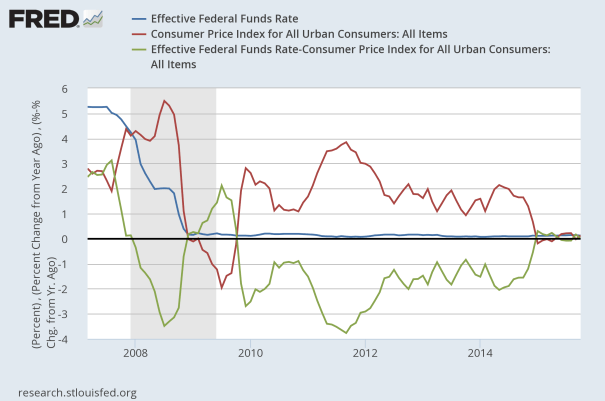
  5. Deflation can make monetary policy worse during a zero lower bound problem.  The Fed can always raise interest rates, but it is impossible to cut interest rates below zero, so deflation means real interest rates will likely be higher than the Wiksellian equilibrium during a recession.  This was a problem from 2008-2015 when the Fed would have liked to reduce the Federal Funds rate which was stuck at zero.  Meanwhile, there was deflation at times which pushed up real interest rates. In the graph below, the real interest rate is in green and the nominal interest rate is blue.  The Fed wanted the real interest rate to fall even farther, but it couldn’t make the nominal rate drop below zero, so the only way to further stimulate the economy was to get higher inflation. real fed funds rate(Graph from FRED)
  6. Nominal wages are sticky.  It has always been hard to get workers to accept nominal wage cuts, but in some situations (like Spain in 2008) wages can be too high.  Higher inflation can reduce real wages in a circumstance like this, whereas deflation just messes up labor markets even more.
  7. Deflation rewards criminals.  This is a fairly trivial concern, but it is a concern.  Who keeps millions of dollars in cold cash?  Big criminals, that is who.  It is hard to launder money because banks ask a lot of questions and so criminals keep a lot more cash on hand than normal people do.  Deflation rewards people for keeping cash on hand which helps criminals more than legitimate businesses that normally keep as little cash on hand as possible.  breaking bad

Although most people don’t believe it, during a recession, higher inflation is almost always better for reducing unemployment and getting people (and capital) back to work.

Posted in Macro

Enter your email address to follow this blog and receive notifications of new posts by email.

Join 75 other subscribers
Blog Archive
Pages