Small families are good for economic development.

According to the Economist magazine:

In the 1980s, population was regarded as relatively unimportant to economic performance. American delegates told a UN conference in 1984 that “population growth is, in and of itself, neither good nor bad; it is a neutral phenomenon.”

This was an active debate in the 1970s and 1980s. On one side were people like Julian Simon who believed that more population is always better and on the other side were people like Paul R. Ehrlich who were worried that overpopulation would cause a collapse in living standards which could lead to communist revolutions. In hindsight, both extremes were wrong and the truth is somewhere in the middle.

Before the 1970s, the Chinese government had believed in the conventional wisdom of emperors for millennia; that higher population growth would strengthen the nation. Mao Zedong oulawed birth control and encouraged big families.  That ideology developed among pre-industrial elites because they profited from higher population density as more unskilled labor helped raise land rents (and lower wages) and more people helped boost state power by filling their armies with soldiers. 

Although that made sense in a Malthusian economy, industrialization requires investment in education and capital so China suddenly reversed course in the 1970s and began encouraging birth control.  In 1979, inspired by the flawed predictions of the Club of Rome, China took the dramatic step of limiting parents to only one child and they enforced the one-child policy with financial penalties, forced abortions and sterilizations. Perhaps surprisingly, these draconian policies probably did not have much discernable impact on fertility rates as China’s fertility fell slower after the 1979 policy than before.  And neighboring nations without China’s One-Child policy actually had faster drops. 

fertility

Similarly, India’s mass sterilization program was inspired by similar fears and their coercive efforts also had no discernable impact on overall fertility.  Whereas coercive fertility programs do not have a good record, it can work for governments to support voluntary contraceptive use as can be seen in the Bangladesh miracle and in many examples in other nations. 

The Chinese leadership came to believe that smaller families would help China grow economically and China soon thereafter achieved over several decades of the fastest economic growth ever recorded.  China’s dramatic fall in fertility rates contributed to China’s success because:

  1. Population growth reduces the amount of physical and natural capital per person.  This is a core part of the old Malthusian equilibrium which humanity has escaped by increasing the economic growth rate above the population growth rate.  In 1970, China’s population growth rate was nearly 3%/year and so China had to grow their economy at 3%/year just to break even in per-capita income.  That isn’t easy to do.  The US economy has averaged less than 3% economic growth since 1980 and it is relatively rare in all of recorded history for nations to have achieved sustained economic growth above 3% for more than a few decades.  Some countries like Syria have had population growth rates above 6% which would require 6% economic growth just to prevent living standards from falling.  Development cannot happen without increasing the economic growth rate above the population growth rate and it is hard to to increase economic growth by 2 percentage points, but modern birth control has made it relatively easy to reduce population growth by 2 percentage points.  Thus the latter is an easier way to boost living standards by about 2%.     
  2. Smaller families produce children with more human capital.  They tend to be healthier, and better-educated than children in larger families.  This is because family resources are more concentrated on fewer offspring and so each child gets a larger investment.  In poor countries, the children in larger families are shorter than children in smaller families because the food doesn’t have to feed as many mouths smaller families.  There is a similar rule of thumb in biology known as r/K selection theory.  Some animals like rats and sea turtles produce high quantities of offspring and invest very little in each one resulting in very low rates of survival.  Other animals like whales, arctic terns and naked mole rats produce very few offspring and invest a large amount in the quality of each child so that most survive.  Humans face similar tradeoffs.  Although survival is no longer a problem for large families, they typically don’t invest as much in education per child when the family’s attention and dollars have to be spread out between more children. 
  3. Parental investment is only one part of what it takes to raise a child.  Some researchers go so far as to argue that parental involvement has almost no effect on child outcomes. This seems extreme to parents like me because I hate to think that my efforts are a waste, but it isn’t controversial to argue that peers, teachers, neighbors, and extended family have a bigger impact on teens than their parents.  There is a lot of truth in the cliché, ‘it takes a village to raise a child.’  One way the effect of family size on society is measured is the dependency ratio. It is the ratio of dependents (children and elderly) over the working aged population.  Countries with higher dependency ratios tend to develop slower than countries with lower dependency ratios.  Most countries grow faster during their “demographic dividend” when their dependency ratio is low. When dependency is low, national savings and investment are high, education is higher quality, and a higher percentage of the population is manufacturing goods instead of serving dependents and making goods is the activity that has the highest potential for productivity growth. 
  4. Imagine being able to increase labor productivity by 50%!  That can happen during the demographic dividend simply because women (and men) reduce their childcare burden and enter the labor market.  When women have fewer children, they can do work that boosts production instead of boosting population, and development typically ensues.  

In 1970, China’s median age was 19.5 years, so kids outnumbered adults. That makes it hard for adults to invest a lot in each kid. 

pop-grow-median-age

Gapminder

All these reasons boil down to the simple idea that many children dilute resources and lead to lower per-capita investment in building wealth. 

Diluting societal investment is probably more important than diluting parental investment in modern societies because all modern societies greatly subsidize child rearing.  So if a few American families have large numbers of children, there isn’t much penalty for each child because most of the cost of educating and providing healthcare for large families is paid by American society, not parents.

For example, private health insurance does not charge more for insuring a family with 13 children than a family with 1 child even though the actual cost of providing healthcare is 13 times larger.  The rest of us subsidize the difference through higher health insurance costs. 

Education is also mostly paid for by the public.  Most American kids go to public school and the average cost per student of a year of public high school in America was almost $11,000 in 2013.  It would be impossible for most Americans to afford to educate even one child through 12 years of public schooling and have savings left to pay for college.  College in America is also subsidized by government, but families also share much of the burden, so one of the main ways the government helps big families is by directing private schools to give big families much more financial aid through the FAFSA system.

A society with a high dependency ratio like Niger where the average family size is 7.6 is going to have less ability to invest in anything because after the average household has taken care of the bare necessities for 7.6 kids, there are few resources left that anyone can contribute to anything else. When the average number of kids is 7.6, then every family with 1 kid is balanced out by the equivalent of another family with about 14 kids.

But it is also possible to have fertility rates that are so low that they hurt long-run economic development. For example, if the fertility rate were zero, the world would come to an end after the current generation dies off.  The current generations would die off relatively young without retirement without any young people to care for us in our old age.  Zero fertility would be an economic and humanitarian disaster on a scale equivalent to a slow-moving global nuclear holocaust.

So what is the optimal fertility rate for economic development?  I’ve never seen anyone try to estimate it, but many scholars seem to idealize the replacement fertility rate as an approximate policy goal.  The Economist Magazine explains.

The move to replacement-level fertility is one of the most dramatic social changes in history. It manifested itself in the violent demonstrations by students against their clerical rulers in Iran this year [2009]. …It shows up in rural Malaysia in richer, emptier villages surrounded by mechanised farms. And everywhere, it is changing traditional family life by enabling women to work and children to be educated. At a time when Malthusian alarms are ringing because of environmental pressures, falling fertility may even provide a measure of reassurance about global population trends.

The fertility rate is …not the same as the birth rate, which is the number of children born in a year as a share of the total population. Rather, it represents the number of children an average woman is likely to have during her childbearing years, conventionally taken to be 15-49.

If there were no early deaths, the replacement rate would be 2.0 (actually, fractionally higher because fewer girls are born than boys). Two parents are replaced by two children. But a daughter may die before her childbearing years, so the figure has to allow for early mortality. Since child mortality is higher in poor countries, the replacement fertility rate is higher there, too. In rich countries it is about 2.1. In poor ones it can go over 3.0. …By about 2020, the global fertility rate will dip below the global replacement rate for the first time.

Modern Malthusians tend to discount the significance of falling fertility. They believe there are too many people in the world, so for them, it is the absolute number that matters. And that number is still rising… Populations can rise while fertility declines because of inertia, which matters a lot in demography. If, because of high fertility in earlier generations, there is a bulge of women of childbearing years, more children will be born, though each mother is having fewer children. There will be more, smaller families. Assuming fertility falls at current rates, says the UN, the world’s population will rise from 6.8 billion to 9.2 billion in 2050, at which point it [might] stabilise.

Behind this is a staggering fertility decline. …Between 1950 and 2000 the average fertility rate in developing countries fell by half from six to three—three fewer children in each family in just 50 years. …Things are moving even faster today. …The rate in Bangladesh fell by half from six to three in only 20 years (1980 to 2000). The same decline took place in Mauritius in just ten (1963-73). Most sensational of all is the story from Iran.

When the clerical regime took over in 1979, the mullahs, apparently believing their flock should go forth and multiply, abolished the country’s family-planning system. Fertility rose, reaching seven in 1984. Yet by the 2006 census the average fertility rate had fallen to a mere 1.9, and just 1.5 in Tehran. From fertility that is almost as high as one can get to below replacement level in 22 years: social change can hardly happen faster.

As of 2017, half of the world’s population had a fertility rate at or below the magic replacement rate of about 2.1 children per woman and global population growth has been slowing ever since it peaked in 1962.  National leaders can have a big impact by either restricting birth control or encouraging it as well as many other policies.  When the government of Bangladesh convinced their imams (religious leaders) to support contraceptive use, fertility rates plummeted.

Indonesia is another Muslim nation that promoted family planning enthusiastically.  They minted it right on their 5-Rupia coins from 1974 to 1996.  It has a picture of what they called the “happy family” which only had two kids and the slogan translates as, “FAMILY PLANNING, TOWARDS PEOPLE’S WELFARE”.

happyfamily

When my wife and I bicycled across part of Indonesia in the early 1990s, this family planning coin was in circulation as part of the government’s successful family planning program. The Indonesian government had decided that reducing population growth would help Indonesia prosper and as a result, they  changed the culture so much that strangers regularly asked us about birth control in everyday conversation.  The Indonesians we met were amazingly warm and friendly people and they loved to talk about family so a typical opening question was to inquire whether we had any children.  When we said no, many people followed up to ask if we were using birth control!  It often came up in polite conversation within minutes of meeting someone for the first time.  This isn’t a stereotypical conversation starter for conservative rural Muslims, but that was what we often encountered. 

Below are some wonkish excerpts from academic economists about research on demography and development in the 2001 book Population Matters: Demographic Change, Economic Growth, and Poverty in the Developing World by Nancy Birdsall, Allen C. Kelley, and Steven Sinding.

No social phenomenon has attracted more attention in the last half‐century than the ‘population explosion’—that surge of population numbers rising almost threefold from 2.5 billion in 1950 to over 6 billion at the turn of the millennium, and continuing at a diminishing pace to level out at as much as 11 billion in the middle of the twenty‐second century. Given the exceptional complexity and diversity of the various impacts of rapid demographic change and rising population numbers, assessments of the consequences of the population explosion have varied widely, ranging all the way from the view that more population growth leads to more prosperity to forecasts that rapid population growth would precipitate wide‐ranging catastrophes (famines, ecological collapses, wars, natural resource depletion, and the like).1

 the findings in this volume strike some new themes…

First, in contrast to assessments over the last several decades, rapid population growth is found to have exercised a quantitatively important negative impact on the pace of aggregate economic growth in developing countries. The finding, as discussed below, bodes well for the future, as population growth rates decline, even as it helps account for low economic growth in the past.

Secondly, rapid fertility decline is found to make a quantitatively relevant contribution to reducing the incidence and severity of poverty. Though an association between poverty and high fertility has long been noted, research in this area has rarely gone beyond association to causality, and has advanced slowly given the challenges of empirical assessment. The new findings suggest more strongly than before that past high fertility in poor countries has been a partial cause of the persistence of poverty—both for poor families that are large, and via the kinds of economy‐wide effects that Malthus theorized about, for poor families even if they are small. As with the finding that rapid population growth affects economic growth, this bodes well for the future, since fertility is declining almost everywhere in the developing world.

Dependency Ratios:

…John Bongaarts’s analysis of dependency burdens in the developing world (Ch. 3) is… a critical starting‐point for much of what follows in this volume. Bongaarts emphasizes that declining fertility, now under way to one degree or another in all regions of the world, will result in substantially changed age structures and distribution, with gradually reduced proportions of the population under age 15 and enlarged proportions over age 65. As countries move through the demographic transition of falling mortality followed eventually by falling fertility, they face first a period of increasing child‐dependency ratios, then of decreasing child‐dependency ratios as a larger proportion of the population moves through the working ages, and eventually of increasing old‐age‐dependency ratios.

The effect of fertility decline in the second intermediate stage (through which virtually all developing countries have passed and will be passing in the latter twentieth and early twenty‐first centuries) is a one‐time ‘demographic bonus’ or ‘window of opportunity’—a period of as many as 50 years during which an initially high ratio of the working age to the dependent population gradually declines. After a country has passed through this period, it returns to a more or less stable child‐dependency ratio (and a higher aged‐dependency ratio), at new lower levels of both fertility and mortality.

Changes in the dependency ratio are driven mostly by fertility decline and less by changes in mortality… So the duration and pace of fertility decline, and the extent to which mortality decline is disproportionately concentrated on infants and children, affect both the…duration and impact of the so‐called window of opportunity [also called the demographic dividend]. The faster the decline, the larger the potential benefits of a relatively high ratio of working‐age to dependent ages, but the shorter the period the window will remain open. The period of the window of opportunity is characterized by (1) more workers producing more total output, if they are productively employed; (2) greater accumulation of wealth, if savings occur and are productively invested; and (3) a larger supply of human capital, if appropriate investments are made in its formation.

Demography & Economic Growth

Declining fertility and mortality, and to a much smaller extent, larger populations and higher densities, have all spurred economic growth. The only trend that has apparently slowed growth for the average country is a decline in the growth rate of the working age population. Of course many of the poorest developing countries that are still in a relatively early stage of fertility decline can look forward to increases in the size of the working‐age population for many years to come.

Why should a relatively larger working‐age population contribute to positive economic growth? Economists have long theorized that savings contribute to higher levels of per capita income (by financing higher investment and thus higher output per person), and …that higher savings and investment may contribute to sustained rates of income growth as well…

Williamson …and others …see changes in age structure in East Asia in the last three decades as an important contributor to that region’s large upward swings in savings and investment over the same period. The resulting high savings and investment levels were one of many factors that set the stage for that region’s long and sustained period of historically unprecedented economic growth. Williamson concludes from cross‐country statistical analysis that demographic changes, especially the increase in the working‐age population and the increase in savings induced by changes in (p.11) dependency, can be associated with as much as one‐third of the total average annual per capita [economic] growth rate of about 6 percent in East Asia in that period.

…though fertility decline is the primary impetus to the change in age composition that generates the demographic bonus, the statistical results point to mortality decline as an important factor in raising economic growth rates, despite the obvious initial and partial result of higher population growth.7 Mortality decline has long been assumed by demographers to catalyze, with a lag, a subsequent fertility decline—this is at the heart of the theory of the demographic transition. In addition, the economic models suggest that mortality decline more directly improves growth prospects—possibly by increasing the private incentives to invest in human capital, or because it is associated with morbidity declines that raise productivity.

…At the same time, the likelihood of reverse causality out there in the world raises another issue. Reverse causality (…meaning that fertility and mortality decline may be outcomes …instead of causes of economic growth) creates a methodological problem. …Reverse causality, if present, implies that even an initially small impact of fertility decline in raising growth prospects (by reducing youth dependency for example) could, over time, induce a mutually reinforcing process with larger cumulative effects, as the resulting economic growth contributes to further fertility decline, leading to more economic growth and so on.

…Another point: …the …powerful impact of female labor force participation on economic growth, and the link between declining fertility and increased female labor force participation. Declining fertility and rising female labor force participation may both be the outcome of increases in the opportunity cost of women’s time in child‐rearing, in turn due to rising levels of education and/or to increasing demand for labor in the formal sector. Rising female labor force participation means that the growth in total work participation increases even faster than the growth in the size of working‐age population. The ‘demographic bonus’ thus may be realized not only through shifts in the age structure but through increases in the participation of women in the formal labor force that fertility decline encourages or at least permits…

Malthus noted …that high fertility would likely worsen income distribution and increase poverty by increasing the price of food and reducing the price of labor…

Robert Eastwood and Michael Lipton (Ch. 9) …estimate that had the average country in this group of 45 countries reduced its birth rate by 5 per 1,000 throughout the 1980s (as in fact many countries did) the average country poverty incidence of 18.9 percent in the mid‐1980s would have been reduced to 12.6 percent between 1990 and 1995.12 The statistical work suggests that about half the estimated decline in poverty over the period in the countries studied can be attributed to increases in economic growth and half to changes in the distribution of consumption that helped the poor.

Eastwood and Lipton also show that the poorer the country and the higher its initial level of fertility, the greater the effect of declining fertility on a decline in absolute poverty…

There is little debate that poverty and large family size go hand in hand. Eastwood and Lipton’s study and Thomas Merrick’s (Ch. 8) refer to dozens of empirical analyses confirming that in today’s developing countries larger households have higher poverty incidence. Moreover, among poor households, those that have more children invest less in children’s education and health, and systematically see worse health outcomes associated with pregnancy for mothers.14 …

Population, Agriculture, and Natural Resource Use

…though rapid population increase may encourage technological innovation that leads to increased output, such population increase can also have a negative impact, especially in the absence of an adequate policy and institutional environment—that is, an environment that creates incentives for individuals and societies to manage natural resources in a sustainable manner. On the one hand, the potential negative effect of population growth has been and can be mediated by policy and practices. This is particularly the case with respect to output and land productivity.22 On the other hand, …without collective action, population density can make things worse in terms of agricultural output, land productivity, and most important in terms of human welfare.
…Collective action includes in this instance the capacity of societies to develop the necessary policies, for example protection of property rights and appropriate pricing of water, and the necessary institutions, including rules for sustainable use of common property resources.
…In summary, the chapters in this volume, …strengthen the proposition that the demographic transition and the reductions in rates of population growth throughout most of the developing world in the last few decades have contributed and are contributing to improvement in the lives of that world’s poor.

In addition, small families are good for the planet.  Paul Hawken & Drawdown ranked the best solutions for reducing global warming and the number one most effective is a combination of educating girls and promoting family planning because these are very cost effective ways to reduce carbon footprint while also potentially increasing future living standards.  These two efforts could potentially reduce the equivalent of 120 gigatons of CO2 by 2050.  That is considerably more than the combined estimated benefit of both on- and offshore wind power put together (99 GT).  Wind power gets a lot more attention from the press, but birth control has had a much bigger effect.

The Economist Magazine explains more details about how small families can be good for economic development:

Indonesia’s Family Life Survey showed that, on average, each birth reduced by a fifth the likelihood that a woman would have a job—lowering household income and pushing some families into poverty. So smaller families made middle-class status more likely. Between 1974 and 1996, Bangladesh turned a district called Matlab into a giant demographic experiment: some villages and households got family planning, others did not. According to one study of the results, fertility in the areas that received help declined by around 15% more than in those that did not. And over the two decades of the experiment, indicators of the well-being of women and their children—health, earnings, household assets and so on—were all higher in the villages that got the planning…

One study in 2002 estimated that as many as a quarter of all pregnancies in developing countries in the 1990s were unintended. Yet another found that more African women say they want to use contraceptives but cannot get them (25m) than actually use them (18m). Unmet demand in turn implies that fertility in some countries could be even lower than it actually is if more family planning were available. The proportion of women using contraception in Latin America and East Asia is four times the African rate.

That points to another big reason why fertility is falling: the spread of female education. Go back to the countries where fertility has fallen fastest and you will find remarkable literacy programmes. …In Iran in 1976, only 10% of rural women aged 20 to 24 were literate. Now that share is 91%… Educated women are more likely to go out to work, more likely to demand contraception and less likely to want large families…

Slowing fertility has other benefits. By making it easier for women to work, it boosts the size of the labour force. Because there are fewer dependent children and old people, households have more money left for savings, which can be ploughed into investment. Chinese household savings (obviously influenced by many things, not just demography) reached almost 25% of GDP in 2008, helping to finance investment of an unprecedented 40% of GDP. This in turn accounted for practically all the increase in Chinese GDP in the first half of this year [2009].

Lastly, low fertility makes possible a more rapid accumulation of capital per head. To see how, think about what happens to a farm as it is handed down the generations in a country without primogeniture. The more children there are, the more the farm is divided. Eventually, these patches become so tiny they cease to be efficient. This is occurring in Bangladesh.

Immigration vs. Fertility

Does immigration have the same effect as fertility?  Both make population grow, but population growth isn’t the main problem with fertility.  The main disadvantage of having babies is the increase in the dependency ratio whereas immigration generally makes that better because the average age of economic migrants is in their 20s.  Very few people over 30 want to immigrate and very few children under 16, so immigration tends to reduce the dependency ratio even more than having babies and the receiving society escapes the cost of raising the children to adulthood.  

Falling dependency ratios boost economic growth, but it is temporary.

All the East Asian economic miracles happened when the average fertility rate plummeted which created a demographic dividend by lowering the dependency ratio.  This happened first in Japan then Taiwan & Korea and then China.  Singapore had one of the fastest fertility drops in history going from almost 6 babies per woman in 1960 to under 2 in 1975, after just 15 years. 

All of these nations went through economic miracles at the same time.  

The last major region where the dependency ratio has started to fall is Africa and as dependency ratios fall, catch-up growth is rising.  Demographic change could soon help Africa achieve the same kind of economic miracle that East Asia experienced.  

Because Africa’s population is still well above replacement, its population is projected to surpass Asia in the coming century.  That is why the IMF called the next century, The African Century.  

In contrast, the low fertility rates in East Asia and Europe will cause the dependency ratio to rise again as the population of elderly grows. This is already causing economic stagnation in Japan.  See how GDP growth in Japan (blue) compares with the US (red):

This is almost entirely due to Japan’s shrinking population because real G.D.P. per working-age population has grown at about the same speed in both countries because Japan’s productivity per worker is rising about as fast as in the US. 

So Japan’s companies are continuing to prosper, but there are a lot more old Japanese people who aren’t working nowadays and a shrinking population which reduces overall GDP. Plus, more workers have to switch from making things that will increase future productivity to helping care for elderly Japanese people. Japan’s apparent stagnation is entirely caused by their slow population growth and rising dependency ratio (blue to orange dots). The US dependency ratio (grey to yellow dots) has recently started to increase as American immigration slows and fertility has declined, but it remains far below Japan.

Fortunately a high dependency ratio with many elderly is much less harmful for economic growth than a high dependency ratio with many children. When there are many old people and few young people, society can easily invest a lot in each child’s education and health which increases future prosperity. Even though having many elderly causes economic growth to stagnate, it doesn’t cause a poverty trap like having too many children. Too many children creates a poverty trap because it is impossible to do a great job of educating children when there are a lot more children than adults in a society, and as Malthus pointed out, it is impossible to grow the economy as fast as the population can grow which increases future poverty.

Future growth requires a lot of investment in young people and having a lot of old people can even help a bit if some of the elderly can help raise the young, as has been the tradition in all human societies for all of time.
Posted in Development

Shocking ignorance at the St. Louis Fed

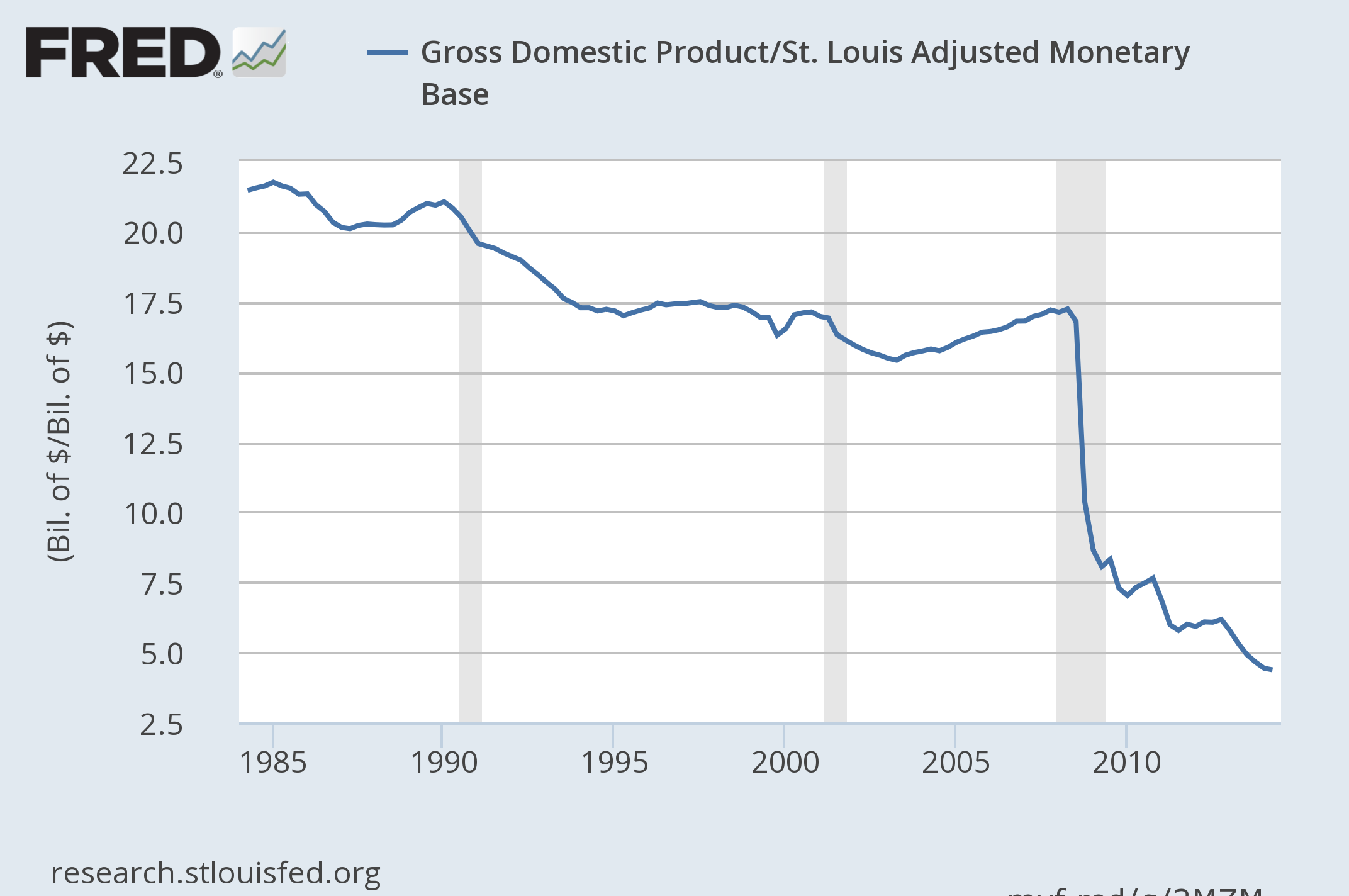
Yi Wen, the Assistant Vice President of the St. Louis Fed and his Research Associate, Maria A. Arias wrote an article which blamed the great recession of 2008 on, “the private sector’s dramatic increase in their willingness to hoard money instead of spend it.”  The evidence that they give is the collapse in velocity of the monetary base:

mbThe fact that someone is holding on to money longer without spending it (a drop in velocity) certainly is evidence of hoarding.  But Wen and Arias are completely clueless about who to blame.  They argue that the private sector had an “unprecedented increase in money demand”  so that people could “hoard money instead of spend it.” Wen and Arias go on to say:

[W]hy then would people suddenly decide to hoard money instead of spend it? A possible answer lies in the combination of two issues:

  • A glooming economy after the financial crisis
  • The dramatic decrease in interest rates that has forced investors to readjust their portfolios toward liquid money and away from interest-bearing assets such as government bonds

In this regard, the unconventional monetary policy has reinforced the recession by stimulating the private sector’s money demand through pursuing an excessively low interest rate policy (i.e., the zero-interest rate policy).

This is shockingly clueless.  First, it is not “people” in the “private sector” who are hoarding this particular measure of “money.”  It is entirely the banks hoarding reserves.  Fed economists should know this because the Fed literally houses all the bank reserves. Secondly, the monetary base is mostly bank reserves and that is not really money.

Thirdly, they blame LOW interest rates for causing hoarding.  This is contrary to basic supply and demand as illustrated by the Wicksellian loanable funds graph at the bottom of my article about hoarding. Standard monetarist theory says that overly high interest rates cause hoarding, not interest rates that are too low.

Fortunately, most of the Fed’s economists are smarter than this, but it is scary how many “hard money” people there are like this at the Fed.  They are always predicting higher inflation and calling for higher interest rates. They probably were taught the new-classical models* of the economy that give them no ability to understand real-world recessions. In this case, Wen and Arias say that, “inflation in the U.S. should have been about 31 percent per year between 2008 and 2013.”  Rather than looking at Keynesian models that predicted that inflation would stay low, Wen and Arias blame the private sector for hoarding money.

Money hoarding has certainly been a problem, but it is the banks that are hoarding reserves that are causing the above phenomena, not “people” in the “private sector” and one reason they are doing it is because the Fed is paying them to hoard the money. For the first time in history, the Fed is paying interest to the banks for hoarding this money.

Again, the problem is that the interest rate is too high, not too low.  The Fed should cut this interest rate back to zero to encourage the banks to stop hoarding.

*Wen got his PhD from the University of Iowa which has tended to favor useless “freshwater” or “new-classical” macroeconomics, so perhaps that is why he didn’t learn these basic useful macroeconomic ideas.

Posted in Macro

Money, Brahmagupta, and the big bang.

zero

Considering how important and obvious zero is to educated people today, zero is a surprisingly difficult concept.  Most children under the age of five cannot grasp it at all and it was unknown for most of human history.  The Romans somehow managed to run an empire without knowing zero and zero didn’t make it into European arithmetic until Fibonacci introduced it in 1202.  The power of zero was only fully discovered in AD 628 by Brahmagupta.  Some civilizations had used zero previously, but it was probably “something closer to a punctuation mark between real numbers, rather than a number in and of itself.” Brahmagupta was the first known mathematician to use zero for addition and multiplication and this has been heralded as and “a total game changer … equivalent to us learning language,” and “one of the biggest mathematical achievements in human history” because this was the essential foundation of algebra in which both sides of an equation cancel each other out.  This was also the foundation of accounting where zero is the essential concept of every balance sheet where assets and liabilities (plus equity) must always equal zero. Zero = balance.  In the natural world, negative numbers are less apparent than in finance so Brahmagupta may well have discovered the mathematics of zero by thinking about accounting. Negative numbers were not widely accepted in Western mathematics until the 19th century!

Similarly, monetary value is a kind of debt that is created out of nothing (zero). George Cooper wrote a clever exposition of the mathematics of how banks accomplish this:

Today few people in the West know of the 7th century Indian mathematician… Brahmagupta. This is a pity because he has a fair claim to have made the most important discovery in the history of mathematics.

Brahmagupta discovered nothing. More specifically he was the first mathematician to recognize the significance of zero – that it was a distinct number in its own right. Brahmagupta did not stop at nothing, he also saw that zero could be split into two equal but opposite components.

Zero, according to Brahmagupta, was the number which resulted from adding any number to its negative partner.

Zero is the sum of five and minus five, fifty and minus fifty, or of any… number and its negative partner.

Zero = X – X

This insight allowed Brahmagupta to become the first person to understand how to calculate with negative numbers. Today most of the rules laid out by Brahmagupta for calculating with zero and negatives still form the bedrock of modern mathematics…

Brahmagupta’s conceptual trick, splitting nothing into two equal but opposite components, continues helping us make sense of the world in surprising ways. On the biggest of all scales cosmologists use it as a way to conceptualize how the universe was created from nothing, in the big bang, and may one day return to nothing, in a big crunch. On the smallest scale particle physicists use Brahmagupta’s idea to explain how matter is created from nothing. Particles… can be created from nothing provided they are created together with their equal and opposite anti-particles.

Scientists at the CERN particle collider now routinely create particles and their anti-particles – electrons and positrons for example…

Surprising as it may sound Brahmagupta’s mathematics and the process of creating matter and anti-matter can help us think more clearly about the workings of our modern monetary system. It may even help us understand where macroeconomic policy is going wrong.

The connection between the mathematics of zero and that of finance becomes apparent when one looks at the language originally used by Brahmagupta to describe his mathematical laws. The following are three examples of his laws:

A debt minus zero is a debt.

A fortune minus zero is a fortune.

A fortune subtracted from zero is a debt

Note that Brahmagupta chooses to call his positive numbers fortunes and his negative numbers debts. He recognized, as do modern day accountants, that the combination of a fortune with an equally sized debt was exactly zero.

Recognizing that equally sized fortunes and debts sum to zero and therefore can be created from zero is the key to demystifying our banking and monetary system.

It is often said that banks have the power to create money from thin air and that this is the source of their fantastic profits. Although this is true it is, quite literally, only half of the story.

The scientists at CERN can create matter from nothing only if they also create its offsetting opposite anti-matter. Similarly banks are only able to create money from thin air provided they create, at the same time, the offsetting opposite amount of anti-money, otherwise known as debt.

In short our modern banks are the particle accelerators of the financial system. They conjure money and anti-money, fortunes and debts, from nothing.

Unfortunately, George Cooper’s analogy soon gets weaker:

It is informative to extend this analogy a little further. When particles and anti-particles are created from nothing energy is ‘consumed’ and when they later recombine to annihilate one another this energy is then re-released. There is an… opposite process of energy capture and release associated with the creation and destruction of money and debt.

When a bank makes a loan it splits zero into a fortune (money) and its equivalent debt. This process releases new spending power into the economy [and can produce] a burst of economic energy. Conversely when, at a later date, the money is recombined to annihilate the debt, both money and debt vanish and an equivalent amount of spending power, economic energy, is withdrawn from the economy.

This analogy fails to explain whether or not economic “energy” is created through creating money (debt) because it doesn’t always work.  For example, a monetary expansion can only create an economic stimulus during a recession when the creation of more money can get people to spend more and stimulate demand.  On the other hand, if everyone is already fully employed, and the amount of money doubles, no new energy would be created.  All that new money would just cause pointless inflation.

Similarly, if new money is created and given to people who will hoard it, no energy will be released.  That is what happened when the Fed nearly quintupled the monetary base by loaning over four trillion dollars to US banks.  The banks just hoarded the money and zero energy was released (and zero inflation).  Money creation ( = debt creation) is only useful if it motivates people to do more work.

And reducing debt/money doesn’t necessarily reduce economic energy either.  For example, bankruptcy eliminates debt=money and it should ideally increase work because it is designed to fix a situation where someone’s debts are too large to possibly repay.  An impossible financial situation is dispiriting and makes rational people give up.  Forgiving impossible debts creates the freedom to start anew and gives the incentive to start working again. The debt-forgiveness of our bankruptcy law is similar to the ancient Biblical ideal of Jubilee which was thought to be as wonderful as the word sounds.  Actually, it is fortunately that no full Jubilee ever actually happened because it would have wiped out all debt which would actually have been an economic disaster. But the selective jubilee of bankruptcy is an important way to create economic efficiency and justice.

Most people probably disagree with the idea that bankruptcy is important for economic justice and jubilee, but without bankruptcy, debt leads inevitably to slavery because if someone cannot escape a debt that is impossible to pay given their income, then that person becomes a kind of slave to his creditor.  Indeed, some scholars of slavery have argued that debt peonage is the main mechanism that causes slavery and bankruptcy is the way to avoid that.

Every person’s debt is another person’s asset (savings) so to see what happens to economic energy we also need to look at that other side of debt forgiveness too when debt/savings is destroyed.  Eliminating someone’s savings can increase work by the formerly wealthy person due to what is called the income effect or wealth effect.  For example, people who inherit great wealth or win the lotto typically work less as a result, and conversely, destroying the savings of extremely wealthy people tends to increase their desire to work and be productive too because they can’t just rely as much on their savings to support their lifestyle.

Whether or not ‘economic energy’ is created by creating money=debt=savings is a lot more complex than the analogy of matter/antimatter, but debt clearly does not hurt future generations (contrary to what most people think) because every debt for one person is always exactly equal to another person’s asset.  Total net debt is always zero just as Brahmagupta realized when he used this insight to develop the concept of mathematical zero.

One of the most important concepts in economics is the concept that total debt is always zero because debts and credits always add up to zero.  That is also the revolutionary concept behind double-entry bookeeping which is the foundation of modern accounting.

Just as there seems to be much more matter than antimatter in the universe (for unknown reasons), there is also more wealth than debt because although all financial wealth is balanced by debt, there is also real physical wealth like land and capital that exists independently of debt. 

Guess how much money I have earned from writing this blog?  Here it is:

$000000000000000000000000000000000000000000000000000000000000000000.00

I’m rich in zeros!

UPDATE: There is some debate about whether mathematicians in Cambodia used zero for arithmetic even earlier than Brahmagupta, and the Mayans independently developed a sophisticated usage of zero in Central America. When the Muslims brought zero to Europe where it was first popularized by Fibonacci, some authorities tried to suppress it.

Medieval religious leaders in Europe did not support the use of zero, van der Hoek said. They saw it as satanic. “God was in everything that was. Everything that was not was of the devil,” she said. Wallin points out that the Italian government was suspicious of Arabic numbers and outlawed the use of zero. Merchants continued to use it illegally and secretively, and the Arabic word for zero, “sifr,” brought about the word “cipher,” which not only means a numeric character, but also came to mean “code.”  

When Fibonacci introduced zero to Europe around 1202, it was part of his introduction of the entire Hindu-Arabic numeral system that the whole world uses today. Previously, Europe had used Roman numbers which do not include zero and were not compatible with algebraic manipulation. The first known use of the word zero in English was in 1598. Although division by zero is still undefined, that is a foundational concept underlying calculus so zero is important even in a situation where it is undefined.

Posted in Macro

There’s gold in them thar standards!

Note: This post is 3460 words--about a fourteen minute read.

Several presidential candidates have been in favor of the gold standard including Ron Paul in 2012 and Rand Paul and Ted Cruz in 2015.   In response, Megan McArdle, explained why almost all economists agree that the gold standard is a terrible idea.  McArdle describes herself as a libertarian, but whereas the gold standard is particularly popular among libertarians, she favors Milton Friedman’s version of libertarianism.  Friedman strongly advocated that monetary policy–the quantity of money, its value (inflation rate), and its price (interest rate)–should be determined by a government-run central planning agency (the Fed) and not be left up to private markets.  McArdle:

Money is a mysterious thing. It is a store of value, it is a medium of exchange. It is [a unit of account, which] in a fiat currency economy, [is] worth only what people think it is worth, and what they think it is worth can be oddly affected by what they think it may be worth in the future, resulting in self-fulfilling feedback loops (at least in the short term). Even in non-fiat currencies, such as the gold standard, the value of the underlying asset can be changed by rising (or shrinking) demand for money. Economists studying this fascinating topic tend to suffer from migraines as they suffer from all the mysterious–hell, nearly mystical–attributes of money.

However, over the last fifty years, economists have settled on some very broad areas of consensus. The first is, as famous libertarian monetary economist Milton Friedman wrote, “inflation is always and everywhere a monetary phenomenon”. When the supply of money outstrips the demand, prices rise. And this is by no means limited to fiat currencies; see the great Spanish inflation of the 16th & 17th centuries, thanks to the steady influx of gold from the New World. Or check out the price of basic commodities in mining towns during the Gold Rush, when all anyone had was gold.

The second is that a little bit of inflation is okay–possibly even beneficial, since it helps the economy to overcome the problem of sticky wages when the relative value of labour has fallen. But a lot of inflation is very, very bad. …[For every] economy that has had inflation… above the double-digit mark; the higher the inflation, the worse the economy did. The feeling that the currency will experience an unpredictable amount of inflation dampens the willingness of the citizens to save and invest, which is why so many third-world loans are denominated in dollars.

The third is that deflation is also bad, and at the lower percentage values, often even worse than inflation. This surprises/offends/meets with the frank disbelief of many “sound money” types, who think that, barring local shortage, in an ideal world everything ought to cost the same or less than it did when Grandpa was a boy. (These sorts of opinions are cemented further by the fact that Grandpa, who is often the source of them, is usually living on a fixed income, and therefore feels that he would make out better in a deflationary economy.) The problem is, deflation does rather devastating things to anyone who has debt, since they now have to repay what they borrowed in more expensive dollars. Deflation means that, thanks to the abovementioned sticky wages, the economy has to deal with demand shocks by lowering output. Deflation can result in what’s known as a liquidity trap, a concept pioneered by liberal economist John Maynard Keynes and best elucidated by liberal economist Paul Krugman… Deflation is what made the Great Depression so memorable. Deflation is so bad that almost everyone agrees that moderate inflation… is better than risking even a small amount of deflation.

Advocates of a gold standard dispute this. They argue that America experienced a long, slow deflation throughout most of the 19th century, without anyone getting hurt. What they neglect to mention is that people did get hurt, repeatedly, in the period’s awful financial contractions. …It’s pretty clear that recessions were longer and deeper than they are now.

This is not only due to the gold standard; the era’s primitive financial system and its approach to financial regulation, which often ranged between lighthearted and foolhardy, also played substantial roles. But the gold standard also has to stand up and take a bow. There’s a strong correlation, for example, between how long a country hewed to the gold standard, and how badly it suffered from the Great Depression.

The gold standard cannot do what a well-run fiat currency can do, which is tailor the money supply to the economy’s demand for money. The supply of gold grows–or not–depending on how much of the stuff is mined. Demand also fluctuates for non-economic reasons; gold has uses besides being money, like industrial components and jewelry.

The lone advantage of a gold standard–and it is a real advantage–is that it prevents governments from inflating the currency. The problem is, this is only moderately true. The government, after all, can always modify its gold standard…

As James Hamilton has pointed out, gold-backed currencies, like all money with a fixed exchange rate, are subject to speculative attacks whenever the government’s financial position looks weak. Such speculative attacks often require punitive economic measures to fight off, which is one of the reasons that America suffered so nastily from the Great Depression–it raised interest rates in the middle of a recession in order to defend the credibility of its currency.

Also, since devaluations tend to produce sharp changes in the values of currencies, rather than smooth appreciations or declines, the economic dislocations are magnified. Imagine you’re a company with a contract denominated in dollars. If the value of the dollar gradually declines, you lose a little, but not too much, since you periodically renew the contract, giving you time to adjust the amounts. If, on the other hand, the devaluation pressure builds up over a period of years, and then all at once the government has to devalue by 20%, you end up badly hurt. You might go out of business. Now multiply that all across the country, and you can see why recessions used to last for years.

[In actuality, the most important issue for businesses is not the rate of inflation, but how predictable inflation is.  Businesses can adjust contracts by padding future prices to cope with inflation if the inflation rate is stable over time.  It is unexpected changes in inflation that cause problems and the gold standard causes terribly unpredictable inflation.]

In short, you don’t get anything out of a gold standard that you didn’t bring with you. If your government is a credible steward of the money supply, you don’t need it; and if it isn’t, it won’t be able to stay on it long anyway. (See Argentina’s dollar peg). Meanwhile, the limitations on the government’s ability to respond to fiscal crises, the necessity of defending against speculative attacks in times of crises, and the possibility of independent changes in the relative price of gold, make your economy more unstable. It’s a terrible idea, which is why there are so few economists willing to raise their voices in support of it.

In 2011, many Americans wished to return to the gold standard because they were worried about high inflation that never came because the Fed kept  inflation low.  In fact, the Fed kept it too low.  Still some state governments like North Carolina were so scared about inflation they were even discussing plans to print new forms of money based on the gold standard:

Cautioning that the federal dollars in your wallet could soon be little more than green paper backed by broken promises, state Rep. Glen Bradley wants North Carolina to issue its own legal tender backed by silver and gold. The Republican from Youngsville has introduced a bill that would establish a legislative commission to study his plan for a state currency.

Matt Yglesias noted that

A similar measure already passed in Utah. But this reflects, among other things, a fundamental misunderstanding of the relationship between currency and promises. It’s actually a gold-backed currency that’s backed by nothing but promises. When America was on the gold standard, that meant that the government promised to give you such-and-such an amount of gold in exchange for a dollar. When FDR came into office, he decided the government needed expansionary monetary policy so he changed the price of gold. Under the Bretton Woods system, similarly, the government’s promise to convert dollars to gold lasted a few decades and then it went away. It’s a gold standard that represents a government promise that can (and will) be broken. Fiat currency is a government that’s being honest with you. It’s not pretending the money is anything other than what it is.

The practical response for Americans who question the forward-looking strength of the US dollar is just to buy another currency. Europe is run almost exclusively by center-right governing coalitions right now, so you can trust your money to them. Or maybe since all Europeans are socialists by definition you’d prefer to trust your money to the Canadian or British governments. You can buy Korean won or Australian dollars or Brazilian reals. You can even go out and buy actual bars of gold. …But whatever you do, don’t entrust your money to promises by the North Carolina state government to give you gold in the future. That’s just a sucker move that’s going to leave you get stuck holding the bag next time there’s a budget crisis.

I would not expect a new North Carolina dollar to catch on unless people begin to trust the North Carolina state government more than the US federal government.  I certainly don’t.  Throughout history, whenever a crisis came, governments suspended the gold standard (or silver standard).  The US did it during the revolutionary war, the civil war, WWI, and the great depression.  Just to give a sense of how it worked, consider WWI.  When the war began in Europe it created a financial crisis that spread to the US, so the US briefly suspended the gold standard in July 1914 to deal with it even though the US had not even entered the war yet.  Then when the US financial system stabilized, the gold standard was re-established in December 1914 until September 1917 when the US entered the war and gold exports were banned again. The US resumed the full gold standard in June 1919 until 1933 when the US left the gold standard again and never went back.  Gold was still used for setting foreign exchange rates until 1973, but Americans couldn’t exchange dollars for gold after 1933.

The only government that has tried to return to the gold standard in modern times is the Islamic State (ISIS) because Isis had a very hard time getting anyone to trust their government and they are embarrassed that they run so much of their economy using US dollars!  Plus, they had an ideological reason in that the gold standard is mentioned in the Koran and ancient Islamic law defined exactly how much gold should be in each coin. 

But the gold standard limits monetary policy during recessions and makes recessions worse by causing deflation. Usually countries try to lower interest rates during a severe recession, but several countries dramatically raised a basic interest rate (the discount rate) in 1931 during the Great Depression in a doomed attempt to preserve the gold standard.  Paul Krugman created the following graph to show how Germany, the US, and the UK all doubled their interest rates in 1931 because of trying to maintain the gold standard.  That crippled these economies and the 12% interest rate in Germany created an economic disaster that helped elect Adolph Hitler in 1932.  If Germany had not been on the gold standard, they might have avoided the economic disaster that ultimately produced the disasters wrought by Hitler.

krugman fetters

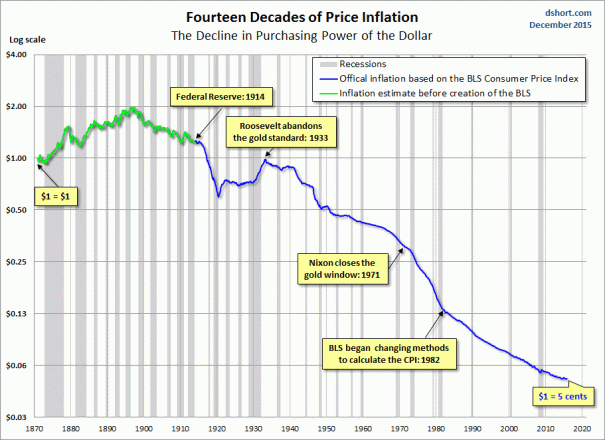
Recessions were much more frequent under the gold standard as you can see on the following graph from Jill Mislinski.  There were a lot more shaded vertical bars under the gold standard.

inflation recessions & gold standard

(Note that if you click on the link, you will get an updated version of the graph with the recession shading removed perhaps because it was embarrassing for Dshort which makes money marketing gold purchases to gold bugs and so has ulterior motives to advocate for returning to the gold standard.)

The above graph shows that recessions were longer and more frequent before the Fed was created, and after the gold standard was abandoned in 1933, recessions became dramatically less damaging. It also shows the real value of the dollar over time.  One dollar in 1870 was worth twenty times more than a dollar in 2018! 

Here is an even longer-term graph from Catherine Mulbrandon:

inflation before fed and after

This graph uses a log scale so that the slope of a line is the rate of growth of prices; in other words the inflation rate.  There was very slight deflation for the century before the gold standard was abandoned and modest inflation thereafter.  The graph seems to blame the creation of the Fed for higher inflation, but the Fed didn’t create higher inflation. It was WWI that created higher inflation because it created an economic crisis which caused the US to suspend the gold standard, just like what happened during both major prior wars, except that the Fed (intelligently) didn’t allow as much grinding deflation after WWI as had previously happened after the War of 1812 and the Civil War.  (The Spanish-American “war” didn’t cause economic problems because it was a super cheap, optional military adventure wherein the US acquired some colonial territory at very little cost. Most wars require at least doubling the military budget, but the Spanish-American “war” was accomplished almost entirely within the normal annual military budget.)

Advocates for the gold standard argue that the two graphs above show that the gold standard is beneficial because it keeps the inflation rate near zero because the value of the dollar stayed fairly constant between the late 1700s and 1933 whereas it lost 95% of its value after then because of abandoning the gold standard.

However, the long-run change in the price level as shown in the graphs above is not at all important for the functioning of the economy.  What is important is short-run changes in the price level.  That is called inflation and it is important because it is impossible for businesses to plan from year to year if inflation is unstable.  Jill Mislinski’s graph of inflation rates tells a more important story by showing the rate of inflation from month to month. 

Inflation Since 1872

Swings in the inflation rate were more than twice as severe under the gold standard compared with after it was abolished.  During the gold standard, the inflation rate commonly swung from -7% to +7%, (a total of 14 percentage points) within only five years of time.  After the gold standard was abolished, the inflation rate rarely went negative at all and the positive peaks gradually diminished until 1983 when the “Great Moderation” began.  In the four decades since then, inflation has rarely strayed below 1% and rarely risen above 4% (a total range of 3 percentage points). 

The only advantage of a gold standard in theory is that if governments stick with the gold standard, it would prevent hyperinflation by limiting monetary expansions somewhat, but they never stick with it during a crisis.  And even when governments do stick with the gold standard, there are still bigger swings in inflation than we have seen ever since.

The gold standard officially started in the US in 1900 although gold certificates began circulating as paper money in 1873 and silver started going out of fashion in 1834.  Before that, the US and most of Western nations were on the silver standard which looks even worse as a way to avoid inflation and keep prices stable.

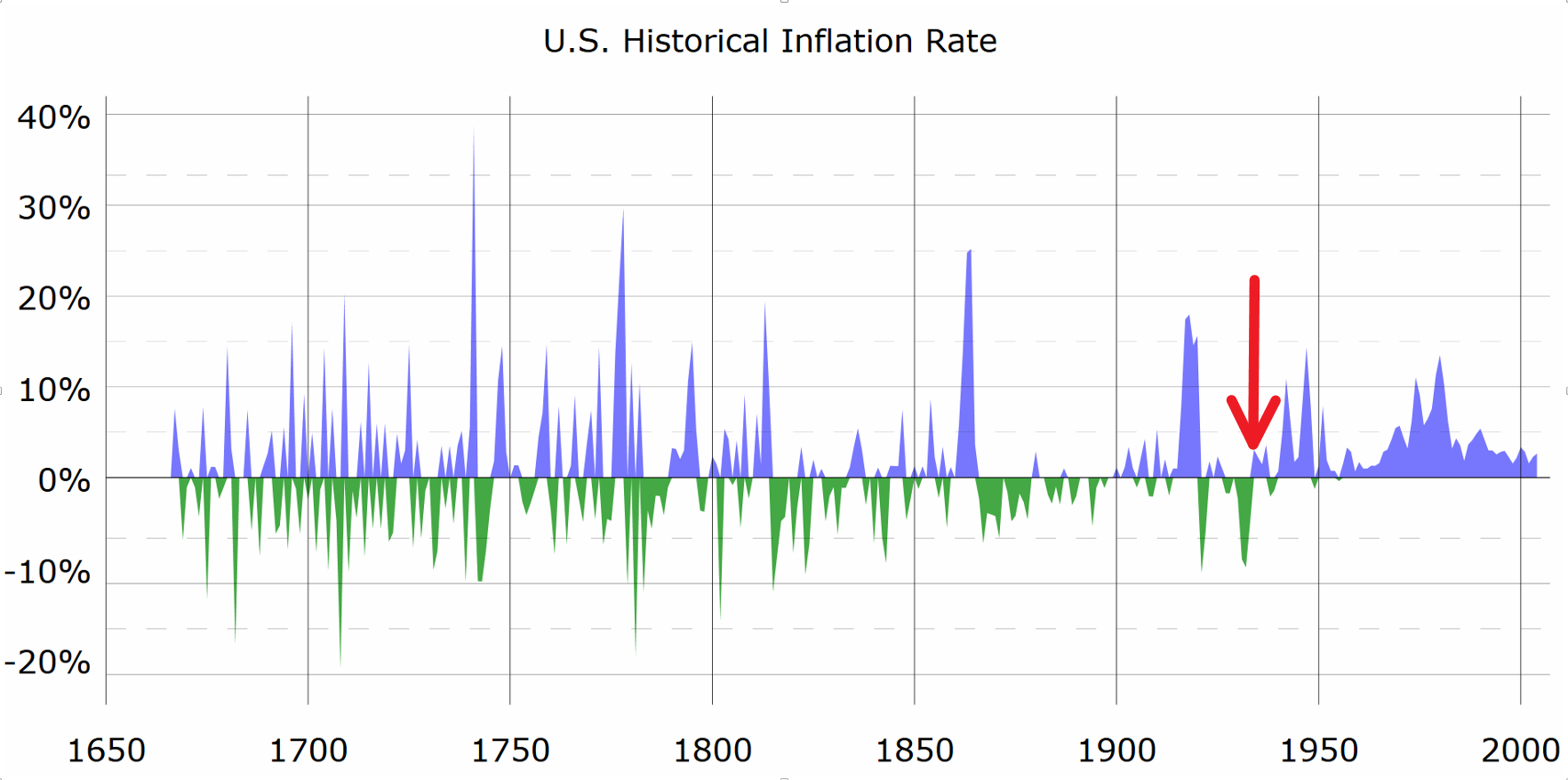
(Note that the following graph makes the very brief “classical gold standard” from 1880-1914 look a lot better than the other estimate in the graph above.)

Inflation us gold standard

The red arrow in the graph above marks the end of the gold standard during the Great Depression.  Although our data quality is poor for the era before fiat money was introduced during the Great Depression, inflation almost certainly reached higher peaks during the silver standard and then the gold standard than it has in the eighty years since.  Inflation regularly rose above 13% before fiat money was introduced and has never risen that high since.  Even more importantly, there was massive deflation every few years before abandoning the gold standard, and that was frequently accompanied by economic recessions.  Under fiat money, we have never had significant deflation and the variance of inflation (the up and down motion) has been MUCH less which helps everyone plan for their economic futures.

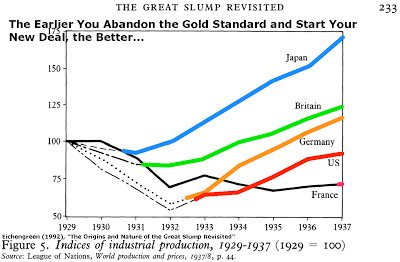
The gold standard created more frequent and more severe recessions than we have had with fiat money.  A major lesson of the Great Depression is that the gold standard made it Great.  Ben Bernanke and Harold James (PDF) found that the sooner each nation abandoned the gold standard the sooner they began their economic recovery from the Great Depression.

The following graph shows the point when each nation left the gold standard using colored lines.  Each nation recovered soon after abandoning the gold standard.  France had a milder depression than the other nations initially did and so it was able to hold on to the gold standard longer and that helps explain why France didn’t recover as soon as the other nations too. Note that the following graph is not completely accurate because the US did not suspend the gold standard until April of 1933, and what really matters is that the US did not do much to expand the money supply until 1934 which is when the graph shows industrial production finally taking off.

Gold Standard depression

…recovery from the Great Depression does not begin until countries give up on the… gold-standard… Those countries that have central banks willing to print up enough money so that people are willing to spend it–it is when you adopt such policies that your economy begins to recover. If you don’t, you become France, which sticks to the gold standard all the way up to 1937, and never gets a recovery. When World War II begins, Nazi Germany’s production–equal to France’s in 1933–had doubled between 1933 and 1939. French production had fallen by 15%.

If France had ended the gold standard as soon as Germany did, France’s economy would have been much healthier when WWII began and the war might have turned out differently!

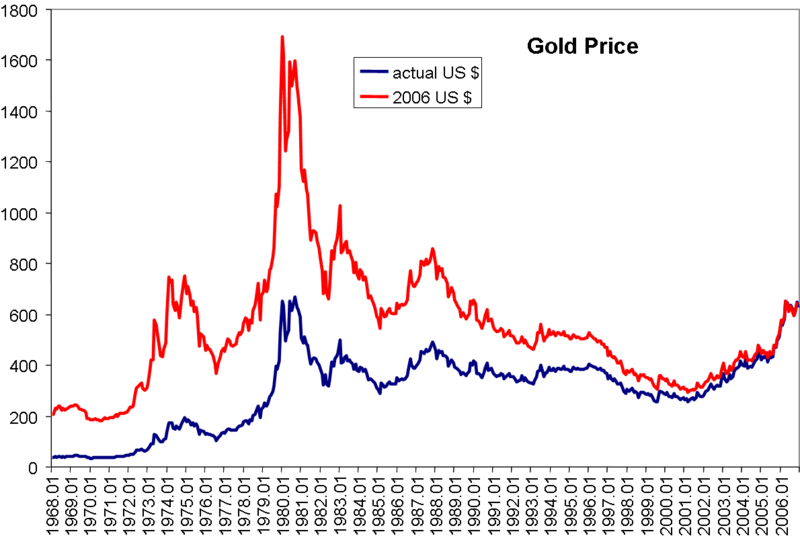
The red line in the following graph shows the real price of gold.  On the gold standard the value of gold would equal the value of money, so a rise in the gold price would be deflation and a fall in the price of gold would be inflation.  There would have been extreme deflation in the 1973 and 1979 on a gold standard and then hyperinflation in the mid 1970s and early 1980s.

gold price

That is no way to run a monetary system.  Of course, one reason why gold prices took off in the mid 1970s was that it had been illegal for American citizens to own gold bullion until 1974!  That bizarre restriction of American freedom had been a legacy of the efforts to maintain the gold standard.  Good riddance.

A monetary history of US gold

In response to calls to abolish the Fed and go back to the gold standard, in 2011 the US Congress ordered an analysis of how the gold standard actually worked in US history.  This is the conclusion:

U.S. monetary history is not one of steady commitment to gold suddenly abandoned in favor of a fiat standard. Nor were the metallic standards of the 19th and early 20th centuries without paper money or other characteristics abhorrent to some advocates of gold.

First, a genuine gold standard existed only from 1879 to 1933. Prior to that was a bimetallic standard in which silver was dominant from 1792 to 1834, a bimetallic standard with gold dominant from 1834 to 1862, and a fiat money system from 1862 to 1879. After 1933, it was a quasi-gold standard that gradually became a pure fiat standard over the period 1967-1973.

Second, even under the gold standard, the United States had paper money. For most of the time the standard was in operation, this money was issued by [private] banks. Until the Civil War, none of the paper money was legal tender; yet, it circulated [much more than gold]. Moreover, the gold reserve behind paper money was never more than a fraction of the total. This is a common characteristic of metallic standards.

Third, a metallic standard is no guarantee against currency devaluation. The definition of the unit of account can be changed. This was demonstrated by the currency depreciation of 1834, which occurred without ever leaving the standard. Similarly, under a bimetallic standard, depreciation can occur as a consequence of the changing availability of the two metals.  

Fourth, even under a metallic standard, the United States issued legal-tender coins that were [alloys of varying purity]. As early as 1853, coins were minted with less silver than called for by the official mint ratio.

Fifth, the Federal Reserve system did not replace the gold standard. The Fed operated under the gold standard for nearly 20 years. A central bank and a metallic standard are not mutually exclusive. Indeed, central banks historically were set up to help the gold standard operate.  

Sixth, the classic gold standard ended in 1933; what followed was only a partial—and not full gold standard. A definition of a dollar as a given amount of gold does not make a real gold standard. A genuine metallic standard is one in which the public is able to freely shift gold from exchange to other uses, and paper issued by the government freely convertible into gold. [Gold was only used for foreign exchange settlements to keep exchange rates fixed after 1933.]

Seventh, the final move to a fiat money was not deliberate or purposeful. It occurred by default as [the fixed exchange rates linked] to gold became impossible to maintain. Nor did the final abandonment of gold occur suddenly or cleanly. The United States began to halt its redemptions of dollars into gold for international transactions in 1967 and 1968. The actions of 1971 and 1973 were not the adoption of floating exchange rates and fiat money, but the loss of the ability to redeem dollars at a fixed price. Floating occurred by default.  

Posted in Macro

Entrepreneurialism is overrated.

What inputs are required for the production of goods and services?  All modern economics textbooks agree that labor and capital are fundamental factors of production.  Some textbooks also include land which is usually a shorthand for all natural resources including agriculture, minerals, fuels, and sometimes environmental resources like clean air and water.  Modern growth models typically ignore natural resources and include technology as the third factor of production.  Other growth models include human capital, a measure of labor quality that is mainly determined by education.

But the cult of the entrepreneur has infected some economics textbooks.  This tradition ignores human capital and technology and instead elevates an overly glorified entrepreneur.  For example, Wikipedia, the Fed, and several textbooks list four factors of production:  Land, Labor, Capital, and Entrepreneurship.

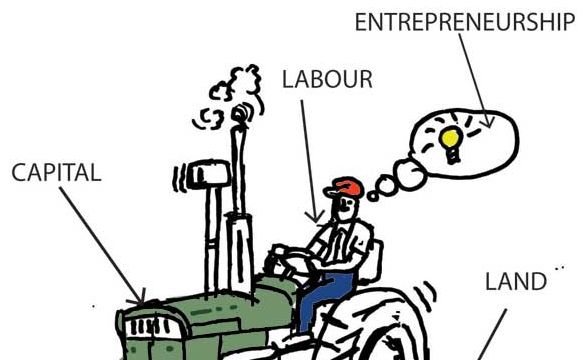
Entrepreneurship is also just a small fraction of another factor: labor.  For example, Roland Mortimer drew a picture of the four factors of production, but both ‘labor’ and ‘entrepreneur’ are embodied in the same person.

factors_of_production

Mortimer’s definition of entrepreneurship is also an odd departure from the dictionary definition.  What he describes is really more like technology and/or human capital both of which really are important determinants of economic growth.

Why elevate the status of entrepreneurship to be a fundamental means of production when technology and human capital are more important?   Karayiannis is a member of the cult of entrepreneurship who traces this tradition back to J.B. Clark in the late 1800s.  Karayiannis laments that the study of entrepreneurship was mostly abandoned by economists by the middle of the 20th century.  But there is good reason that economists stopped emphasizing entrepreneurship.  It is much less important than technology or education for explaining economic growth and there is no evidence that entrepreneurship was ever in scarce supply anywhere.

A small minority of economists still mistakenly think that barriers to entrepreneurship are the main impediment to economic growth.  This is one reason why Muhammad Yunus won the Nobel Peace Prize for helping encourage millions of entrepreneurs with microloans.  Unfortunately, his huge boost to entrepreneurship did not increase wages nor prosperity.  He succeeded in creating millions of entrepreneurs, but they just ended up competing with each other in low-profit businesses that didn’t increase productivity.

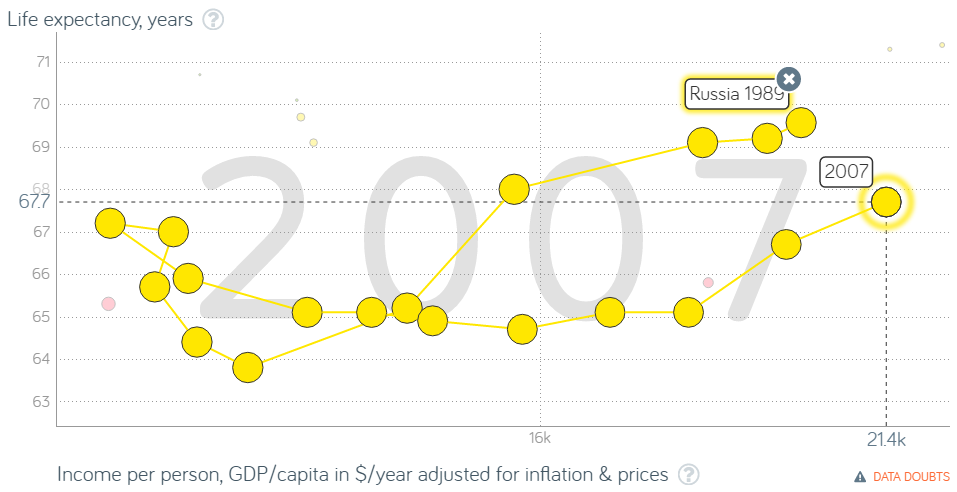
Similarly, when the Soviet Union collapsed, there was an explosion of entrepreneurship because overt entrepreneurialism had been illegal under communism and the huge state-run enterprises laid off millions of workers who became entrepreneurs out of necessity to feed their families.  Small businesses sprang up everywhere to fill market needs.  But this flourishing of entrepreneurship was part of an economic catastrophe.  Production and incomes plummeted and the economic depression was so bad that it even caused life expectancy to collapse.  As the graph below shows, it took eighteen years for incomes to recover back to where Russia had been in 1989 before the flourishing of entrepreneurship and even longer for life expectancy to swing back up.  No doubt an important part of Russia’s recovery has been the rebuilding of large organizations that have reduced entrepreneurship again by converting former entrepreneurs back into employees.

russia gdp vs lifespan

The big problem for devotees of the cult of the entrepreneur is that countries with a larger percentage of entrepreneurs are poorer and have lower economic growth.  This is because in economics, small is ugly.  The more entrepreneurs, the smaller the businesses and smaller businesses have lower average productivity per worker which means lower wages.

If anything, we need fewer entrepreneurs and bigger economic organizations with better central planners (managers), but nobody has figured out how to optimize central planning for society.  Economists should shift their focus from entrepreneurship to venerating the effective management of large organizations instead.

My list of the four most fundamental factors of production is simpler:

  • Technology:  Both physical technologies and social technologies like management, debt (financial capital), & government.
  • Labor (human capital).
  • Physical capital.
  • Natural resources (such as land, & energy).

Entrepreneurship is just one aspect of management skill.  I wouldn’t make it a separate category because it isn’t as important as management nor as scarce relative to the need. Nations with more entrepreneurs are poorer than nations with more managers.  Almost everyone is an entrepreneur in the poorest nations.

Entrepreneurship only helps grow the economy when entrepreneurs become managers and almost none achieve that goal.  According to Robert D. Atkinson and Michael Lind:

“it takes 43 start-ups to end up with just one company that employs anyone other than the founder after 10 years.” The average number employed by that surviving start-up: just nine.

There has to be a lot of innovative entrepreneurialism in growing economies to invent new business models, new products & inventions, and new services, but almost all of that innovation is done within existing firms that have a lot more than nine employees.  And probably most of the 1/43 entrepreneurs who end up with an average of nine employees after ten years actually achieve their success by getting a lot of help with management and finance from established firms too, so these statistics probably are overstating the contributions of the rare entrepreneur who achieves modest success.

Even more crucial than good management of big firms is the importance of good management at the biggest level of central planning in society of all: government.  When immigrants leave countries with poor governance and go to countries with better governance, their entrepreneurial abilities suddenly become far more productive because good government is required to make entrepreneurs productive.  And nations with good government don’t need as many entrepreneurs because large organizations are more efficient when a society is good at producing bureaucrats.  So there is no shortage of supply of entrepreneurs that holds back any nation.  A much bigger problem is developing quality management & governance.

Management is also the key skill for an entrepreneur to get rich.  Most entrepreneurs are poor and the most successful entrepreneurs that the business press admires are the ones who succeed in transitioning from being an entrepreneur to becoming a good manager of bureaucracies. That is much more difficult than just being an entrepreneur and very few entrepreneurs succeed at the transition.

Posted in Development, Managerial Micro

How Americans sabotage welfare programs

Joseph Stromberg wrote an explainer about why the US has worse public transit than any other rich nation in the world despite providing greater subsidies per rider.  It isn’t just because the US is more spread-out or more enthusiastic about automobiles.  Canada is much more spread out and every bit as much of an automobile culture and yet Stromberg says their public transit is much better than US transit:

“Canada just has more public transit,” says transit consultant Jarrett Walker. “Compare, say, Portland to Vancouver, or Salt Lake to Edmonton, or Des Moines to Winnipeg. Culturally and economically, they’re very similar cities, but in each case the Canadian city has two to five times as much transit service per capita, so there’s correspondingly more ridership per capita.”

Stromberg explains that city governments took over public transit from private companies in the 1950s because of thinking of transit as a welfare program.

When cities took over these companies… it was with the notion that they’d maintain these systems as a sort of welfare service — mostly for people who couldn’t afford to drive. Outside of a handful of cities like New York and DC, that mentality has remained in place. Nowadays, many local politicians don’t see transit as a vital transportation function — instead, they think of it as a government aid program to help poor people who lack cars.

On the one hand, this mentality has led cities to heavily subsidize public transit: In most cities, no more than 30 to 40 percent of operating costs are covered by fares, more than the vast majority of cities around the world. But there’s a huge downside to viewing public transportation as welfare — it prevents local agencies from charging high enough fares to provide efficient service, effectively limiting transit to those who are too poor to drive.

Because it’s often seen as welfare, investing in mass transit has become a politically charged issue — with conservatives unwilling to spend on what they see as a social program for the urban poor.

This doesn’t really happen in other countries, at least not to the same extent. While there’s some debate over transit spending in Canada and Europe, politicians on the right are much less hostile to the idea — it’s much more of a bipartisan cause, like, say, road building in the US.

“In attracting riders to transit, frequency is the biggest thing, followed very closely by reliability,” says King. “If you don’t have those, people won’t trust the system.”

Other countries have often managed to improve both these measures without spending more money — but in the US, the idea that transit is welfare has generally prevented this sort of innovation.

For instance, bus stops in the US are spaced very closely together, compared to elsewhere. Spreading them out would increase bus speed and frequency, but can be politically difficult because it’s seen as harming seniors and disabled riders.

Here is another example where a program intended to help the disadvantaged hurts the people it is intended to help.  Public transit would be better for poor people in the US if we treated it as a vital service for the average American like we view road construction.  That would reduce the stigma of transit and create greater reliability and ridership.  Plus, many Americans hate welfare programs and when their political leaders come into power, they are happy to make welfare programs dysfunctional in hope that they will collapse.

Posted in Discrimination

Are the Democrats poised to crush Republicans or will Republicans continue crushing Democrats?

Kevin Drum argues that demographic trends and political priorities are both conspiring to doom the Republican party to electoral defeat and that this helps explain the disarray of the Republican presidential campaigns so far.  To the contrary, Matt Yglesias argues that Republicans control most of the levers of power already and that Republicans have structural advantages that will entrench Republican power for the foreseeable future.  Yglesias argues that the “Democrats are in denial.  Their party is actually in deep trouble” because the Republican party could easily take over monolithic control over US government in the next election.

Drum is correct that demography is helping the Democrats because Americans are getting more liberal and less white every year.  And on the issues, he is correct that Republicans are the victims of their own success.  They have been cutting taxes for so many decades that that issue is no longer salient even for many Republicans.  Drum argues that even Republican voters are split about further restrictions on abortion, immigration, gun control, and health care and he says that Republicans are tired of hawkish foreign policy that could lead to more foreign wars.  One wedge issue Drum does not list is climate change which also divides Republicans and unites Democrats.  Moderate Republicans are increasingly worried about the issue whereas more conservative Republicans think it is a myth.  As more Americans come to believe in climate change, it is becoming a more difficult issue for Republicans to deal with.  They can either lose their base if they placate Republican moderates or vice versa.

climate politics

Randy Olson

But Yglesias is correct that Republicans dominate in almost every branch of government except the presidency and look set to continue this domination for many years despite changing demographics.  Republicans control all branches of the federal government except the presidency controlling the Supreme Court (5-4), Senate (54-46), and House (247-188).  Obama barely won a slim majority in the last election, and the next presidential election is expected to be another close one. There is almost no chance that the Democrats could get majority control of the Supreme Court, Senate or House in the next four years, but if a Republican wins the presidency in 2016, there will undoubtedly be two more Republican Supreme Court Justices which would give the Supreme Court a 7-2 Republican majority.

Yglesias also notes that Republicans utterly dominate state governments: “The vast majority — 70 percent of state legislatures, more than 60 percent of governors, 55 percent of attorneys general and secretaries of state — are in Republicans hands”.

2014-US-elections-state-legislatures-results-map

Arsenal for Democracy

This control over state governments is one important reason why Republicans have a structural advantage according to Ian Millhiser at Think Progress, and he argues that if the Republicans win the presidency they will appoint a 7-2 Republican Supreme Court which will give more ways to strengthen the structural political advantage that Republicans enjoy.

Posted in Public Finance

Enter your email address to follow this blog and receive notifications of new posts by email.

Join 75 other subscribers
Blog Archive
Pages