How The Fed Could Help The People Rather Than The Banks

Foreign Affairs magazine recently published an article by Mark Blyth and Eric Lonergan about how central banks should use “helicopter drops.”  That means to increase the money supply by giving money directly to households rather than by loaning money by buying bonds from banks.  It is worth a try.  Blyth and Lonergan start by explaining that Japan has been in a prolonged “secular stagnation” of low growth and high unemployment since 1990.  That is almost a quarter century already, and since 2008, the US and Europe seem to be repeating Japan’s economic experience.  Ironically, Ben Bernanke argued for trying “helicopter drops” in Japan before he became the chair of the US central bank and then seemed to forget his earlier prescription once he became a policymaker.

Ben Bernanke argued that central bankers could still turn the country around. Japan was essentially suffering from a deficiency of demand: interest rates were already low, but consumers were not buying, firms were not borrowing, and investors were not betting… Bernanke argued that the Bank of Japan needed to act more aggressively and suggested it consider an unconventional approach: give Japanese households cash directly. Consumers could use the new windfalls to spend their way out of the recession, driving up demand and raising prices.

As Bernanke made clear, the concept was not new: in the 1930s, the British economist John Maynard Keynes proposed [this]… The conservative economist Milton Friedman also saw the appeal of direct money transfers, which he likened to dropping cash out of a helicopter. Japan never tried using them, however, and the country’s economy has never fully recovered. Between 1993 and 2003, Japan’s annual growth rates averaged less than one percent…

Rather than trying to spur private-sector spending through asset purchases or interest-rate changes, central banks, such as the Fed, should hand consumers cash directly. In practice, this policy could take the form of giving central banks the ability to hand their countries’ tax-paying households a certain amount of money. The government could distribute cash equally to all households or, even better, aim for the bottom 80 percent of households in terms of income. Targeting those who earn the least would have two primary benefits. For one thing, lower-income households are more prone to consume, so they would provide a greater boost to spending. For another, the policy would offset rising income inequality.

Distributing cash equally to all households would also reduce inequality by almost as much because even a few thousand dollars per year would be a trivial change for the top 20% richest households.  Equal cash would be more politically popular and easier to administrate, so I would start there. Even though it would not be as efficient at reducing unemployment, it would be more politically feasible.  Blyth and Lonergan continue:

Such an approach would represent the first significant innovation in monetary policy since the inception of central banking, yet it would not be a radical departure from the status quo. Most citizens already trust their central banks to manipulate interest rates. And rate changes are just as redistributive as cash transfers. When interest rates go down, for example, those borrowing at adjustable rates end up benefiting, whereas those who save — and thus depend more on interest income — lose out…

critics warn that such helicopter drops could cause inflation. The transfers, however, would be a flexible tool. Central bankers could ramp them up whenever they saw fit and raise interest rates to offset any inflationary effects, although they probably wouldn’t have to do the latter: in recent years, low inflation rates have proved remarkably resilient…

There is no need, then, for central banks to abandon their traditional focus on keeping demand high and inflation on target. Cash transfers stand a better chance of achieving those goals than do interest-rate shifts and quantitative easing, and at a much lower cost. Because they are more efficient, helicopter drops would require the banks to print much less money. By depositing the funds directly into millions of individual accounts — spurring spending immediately — central bankers wouldn’t need to print quantities of money equivalent to 20 percent of GDP…

Using cash transfers, central banks could boost spending without assuming the risks of keeping interest rates low. But transfers would only marginally address growing income inequality, another major threat to economic growth over the long term…

beneficiaries could be required to retain the funds as savings or to use them to finance their education, pay off debts, start a business, or invest in a home. Such restrictions would encourage the recipients to think of the transfers as investments in the future rather than as lottery winnings. The goal, moreover, would be to increase wealth at the bottom end of the income distribution over the long run, which would do much to lower inequality.

I have to object about requiring beneficiaries to “retain the funds as savings” or use them to “pay off debts”.  That would be fine in times of low unemployment, but during a normal recession, it would reduce demand.  Of course, the 2008 crisis was not an ordinary recession.  It was a financial crisis and the US Treasury (TARP program) and the Fed flooded the banks with trillions of dollars to shore up their balance sheets.  In this sort of recession, funding the banks by letting ordinary households pay them could be a good idea.  Blyth and Lonergan:

If cash transfers represent such a sure thing, then why has no one tried them? The answer, in part, comes down to an accident of history: central banks were not designed to manage spending. The first central banks, many of which were founded in the late nineteenth century, were designed to carry out a few basic functions: issue currency, provide liquidity to the government bond market, and mitigate banking panics.

This is a good point.  Central banks originated as a way to help the banking system, not as a way to manage recessions.  It just so happened that helping the banking system also had a big effect on recessions, and as people have come to realize this, the role of central banks has gradually expanded.  However, Blyth and Lonergan’s article demonstrates that our political leaders still don’t understand the economic power of central banks to impact the economy.  Barack Obama is a key example.  His biggest mistake of his presidency has been to ignore Fed policy because he is ignorant of the power of monetary policy.

The fact that central banks grew out of the needs of the banking system is why the Fed’s real mission, which is written into its charter, is mostly to help the banks rather than its so-called “dual mandate” which was tacked on later.  The Fed mostly ignores the fight-unemployment part of its “dual mandate” because it’s governance and organizational form has always been structured to support the banks rather than to help workers. One of the organizational structures that prevents giving money to households is the Fed’s practice of using balance-sheet accounting, as Blyth and Lonergan point out:

A second factor explaining the persistence of the old way of doing business involves central banks’ balance sheets. Conventional accounting treats money — bank notes and reserves — as a liability. So if one of these banks were to issue cash transfers in excess of its assets, it could technically have a negative net worth. Yet it makes no sense to worry about the solvency of central banks: after all, they can always print  more money.

The positive side of the Fed’s balance sheet should also include the growth of the economy as a whole.  That is the real value of Fed activity.  And, it really makes no sense to worry about debts (the negative side of the balance sheet) when you can print money to pay them off.  The Fed is unique and deserves a unique form of accounting rather than pretending that it has the same kind of balance sheet as any other bank.

There is no technical reason nobody has tried using monetary policy to directly help households rather than banks.  The reason is purely ideological.  It isn’t politically popular yet.  Right now it is more popular for the Treasury and the Fed to directly help the banks with trillions of dollars that only trickles down to the rest of us through lower interest rates.  But why should that be more popular than helping ordinary people?  The banks aren’t politically popular, particularly after their irresponsible lending brought down the global economy in 2008.  It seems inevitable that the median voter will wake up in the long run and realize that Fed policy could be more powerful by using its money to directly help ordinary households and let that money trickle up to help the banks.  Although this ideology will undoubtedly change in the long run, that could take a century. In the long run we are dead.  So spread the idea and speed it up. There is nothing stopping us but the failure of our popular ideas.
Tagged with:
Posted in Macro, Medianism

Doctors Don’t Put Up With Much Moral Hazard From Medicaid Patients

I teach health economics to medical professionals and every year many of them say they perceive greater moral hazard among Medicaid recipients than among the rest of us.  I think this perception is partly due to the way the economics profession has influenced our thinking in mmutilitarian ways.  All the research I have been able to find about the matter indicates that Medicaid clearly increases health expenditures less than private insurance does and I can’t see any clear evidence that Medicaid recipients use a different amount of services than people with private insurance.

Unfortunately I haven’t found much solid research on the matter.  If you see any that I missed, please leave a comment.  One study in the Journal of Health Economics found no moral hazard in nursing home care when Medicaid is more generous than when it is stingy. Another study in Inquiry, found that health care spending is significantly lower under Medicaid than under private insurance due to lower provider payment rates and found little difference in services used. A paper in the American Journal of Public Health found that children on Medicaid get less physician visits than privately insured children although both get more than uninsured children.

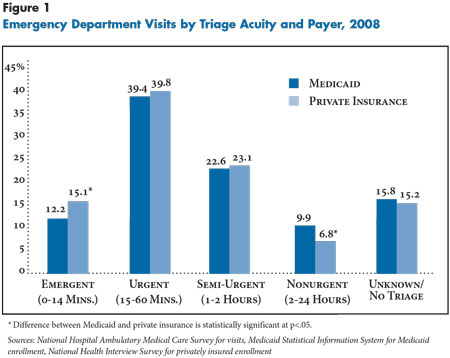
The only place I have found any evidence of greater moral hazard among Medicaid recipients is in a HSC Research Brief that suggests Medicaid recipients use about the same number of Emergency Room (ER) visits as people with private insurance, but it might show a bit more moral hazard here.  In the figure below, the only category of care that the ER has judged might be moral hazard is the non-urgent care because this does not require care within 2 hours and so is not worthy of being called an emergency.  Some of it is probably wasteful moral hazard, but most non-urgent care is not wasteful.  I have been forced to go to an ER when my child needed antibiotics on a Friday night and there was no alternative until Monday morning, 60 long hours later.  My kids always seem to get sick and have accidents on weekends and evenings when there are no office hours and I get stuck with ER bills.  Fortunately, our problems have rarely been urgently life-threatening, and we usually have had to wait because other patients were more urgent.  Nobody wants to sit around in an ER on a weekend for frivolous fun. Medicaid recipients are more concentrated in poor regions with less access to convenient doctor office hours and that could explain some of their reliance on emergency room visits for non-urgent care.

fig1

If you want to exaggerate the moral hazard in the above data, you could write the headline: “¡¿Medicaid recipients use 45% more non-urgent care than people with private insurance! ¡¿Forty-five percent more moral hazard!”

Forty-five percent sounds like a huge percentage increase, but compared to the total amount of ER care, it is insignificant.  Medicaid recipients only get 3 percentage points more non-urgent care than people with private insurance so if all the extra non-urgent care were eliminated, there would only be 3% fewer ER visits for Medicare patients.  And non-urgent care is the very cheapest kind of ER care so the dollars lost are probably much less than one percent of total ER expenditure.  In healthcare, 20% of patients typically account for at least 80% of the spending and non-urgent care is the very cheapest kind of care. A few expensive urgent ER patients probably cost almost all of the money.  People with private insurance get greater care in all the more urgent categories that cost more money because private insurance pays more generously.  There are several studies that show that Medicaid patients get inferior care partly because doctors prioritize patients with higher payments.

But the number of non-urgent patients sometimes looks overwhelming if you look around in any busy ER because the non-urgent care is triaged, so non-urgent patients have to wait.  A busy ER typically has many non-urgent patients impatiently waiting in various waiting areas until the ER doctors have the free time to deal with them.  That will make them much more visible than the urgent care that gets dealt with immediately and moves on.  Even though non-urgent ER patients are less than 10% of the people coming into the ER, they might make up more than 50% of the patients who are present in the ER because they have to wait longer.  In my experience in Chicago, I typically had to wait 2-8 hours to complete a brief visit with an ER doctor.

I’m surprised that Medicaid doesn’t account for a much bigger amount of ER patients.  Many Americans first get signed up for Medicaid by an ER because that is where uninsured people tend to go.  The ER is currently the universal health care system for all uninsured people in America.  President Reagan signed the EMTALA act in 1986 which was the first guarantee of universal healthcare for all people in America without regard to ability to pay.  Anyone can go to an American ER and be guaranteed of getting all the care that is medically necessary that a hospital can provide.  Hospitals have a big incentive to sign up these patients for Medicaid whenever possible.

The US healthcare system does rely excessively on ER care, but that is not due to the moral hazard of insurance.  It is because our system has a shortage of primary-care physicians which creates a shortage of regular office hours and our system has too many uninsured people whose primary access to care is through an ER via their EMTALA ‘insurance’.

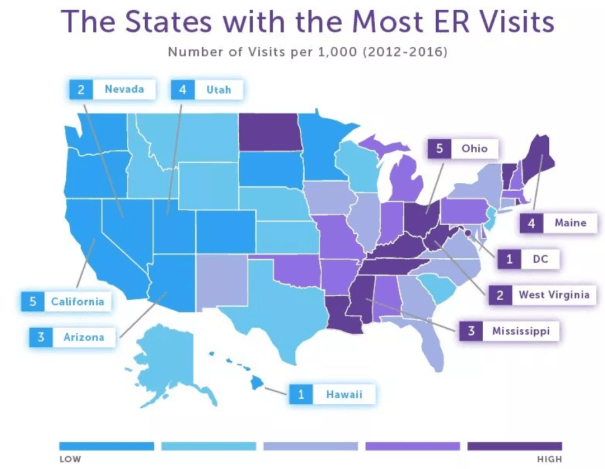
And ER utilization varies widely from region to region across the USA.  Some areas have well over double the rate of other areas:

er-visits.PNG

It seems like it must be inefficient to have such differences in ER usage.

Many American economists are obsessed with the idea that the moral hazard of patients is the most wasteful part of the US healthcare system, but that is wrong.  I have never seen statistical evidence that moral hazard are a significant problem in America, particularly when compared with over-treatment by providers or even our huge administrative costs. For example, more generous insurance coverage is supposed to produce moral hazard, but that can’t explain any of the differences in ER utilization shown on the above map.

This data seems to confirm that the moral hazard of Medicaid is not very important in the big picture.  Neither Medicaid recipients nor patients with private insurance use much frivolous, ER resources compared with the total volume of care, and in dollars spent, it is trivial.  And remember, even much of the non-urgent care is not frivolous.  Much is useful care that just happens to be outside of office hours.  It isn’t completely clear if any of this non-urgent care is wasteful moral hazard, but even if all non-urgent care were waste, it would not be anywhere near the biggest source of waste in our ER system.

Economists like Mark Pauly who focus on ‘moral’ hazard are usually using a warped mmulilitarian ethical system which defines morality according to ability to pay.  According to this version of the theory, insurance should never cause anyone to spend more on healthcare than they would spend without insurance.  Any expenditures that a patient would not pay out of pocket is moral hazard.  Under this definition of moral hazard, poor people are always more guilty of moral hazard than wealthier people because poor people have lower ability to pay than wealthy people.  But the whole point of health insurance is to increase your ability to pay if you get a mortal illness and need more money to survive.  People who are wealthy enough to pay for any possible health problem out-of-pocket have little need for insurance.  Insurance is the most useful when the ability to pay for healthcare could make a life-or-death difference.

This warped morality underlying ‘moral’ hazard explains why economists like Mark Pauly see greater moral hazard in insurance for poor people like Medicaid than in insurance for the rest of us.  Under the ‘moral’ hazard view, elites like Bill Gates should be able to get whatever they can afford, (whether insurance pays or not) but healthcare should be rationed for the middle classes and healthcare for the poorest people is pure moral hazard that should be eliminated.  According to the ‘moral’ hazard view, a billionaire alcoholic who burns through liver transplant after liver transplant at boutique, black-market hospitals is exercising his consumer sovereignty and efficiently maximizing consumer surplus whereas a homeless guy who gets a lifesaving $10 antibiotic at an ER is squandering society’s resources because his life is worth less than $10 if he isn’t willing to pay that much to save it.

Similarly, the wealthiest portion of society costs insurance considerably more than the poorest, but nobody complains that the wealthy have a bigger moral hazard problem.  I only know of two studies on this, but they both agree.  The Economist Magazine explains:

the wealthy use the system more intensively. Among individuals over 85, the wealthiest 10% of the population claim nearly 40% more in Medicare expenditures than the poorest 10%. (America is not alone in this; in a study of the British National Health Service, expenditures for each occurrence of an illness were 35% higher for the relatively wealthy.)

The wealthy cost more partly because they live in more expensive areas, but it is also because the wealthy simply demand more treatments and more expensive treatments.  Wealthy people get more healthcare, but they don’t need more.  They should need less because wealthy people are healthier and live longer than the median American.  I suspect that nobody complains about the moral hazard of the wealthy because the warped mmutilitarian ethics that underlies moral hazard theory judges that wealthy people deserve more medical care than the rest of us.

Although there is some wasteful treatment under every kind of insurance, doctors have more incentive to provide generous treatments to patients with private insurance than to Medicaid recipients. This is because Medicaid reimburses much less generously than any other form of insurance, so providers have more to gain from over prescribing for people with private insurance than for Medicaid patients.  Medicaid patients are so much less profitable that over 30% of doctors refuse to even see new Medicaid patients.  That is a lot less potential for moral hazard. Medicaid is the cheapest insurance because it pays lower prices than any other insurance in America which holds down expenditures and gives doctors an incentive to prescribe fewer services than for patients with any other kind of insurance.

Physicians have a bigger responsibility for healthcare costs than patients because physicians control most medical expenditures.  Patients simply cannot get anything more than a basic appointment without a doctors approval and simple appointments are relatively cheap compared with a surgery or MRI.  That is why over-treatment caused by supplier-induced demand is a much bigger problem in the US than the moral hazard of patients.  Even if Medicaid patients did try to ask for more treatment than wealthier patients (which is contrary to available evidence), the fact that Medicaid pays poorly means that doctors are much more reluctant to go along with frivolous treatments.

In reality, only mentally ill people want more medical treatment than the absolute minimum.  Psychologists diagnose people who want excessive medical care as having Munchausen syndrome, hypochondriasis, somatic symptom disorder, or factitious disorder imposed on another. The economists who accuse nearly everyone, but mostly people below median income) of moral hazard are actually diagnosing the public of suffering from an epidemic of these psychiatric disorders.

I haven’t found any statistical evidence to support the stereotype that there is more wasteful treatment among Medicaid recipients than anyone else, but please leave a comment if you see any research that has any bearing on this question.

UPDATE: A new paper found that, “The uninsured do not use the emergency department more—they use other care less.”  However, the study also showed that people on public insurance (such as Medicaid) do go to the ER more than the other two groups (29.3% vs. 11-12%), so perhaps the free care in the ER does create higher demand!  But it didn’t show whether that care was more useful or wasteful and that should be the real test of moral hazard.

Tagged with:
Posted in Health, Inequality

Popularizing Monetary Policy

Three community organizing groups have, “come together to try to do something that hasn’t really been done before: grassroots lobbying of the Fed.”  The groups are Minnesota Neighborhoods Organizing for Change, Action United in Philadelphia, and the Center for Popular Democracy and Dylan Matthews had a great article on Vox about it:

To some extent, the Fed is designed to be impervious to outside pressure like this. Many economists believe that central bank independence — that is, having a central bank that is not directly controlled by legislatures or other democratically elected officials — is crucial to effective monetary policy. In 1993, future Treasury Secretary Larry Summers and his Harvard colleague Alberto Alesina authored a hugely influential paper arguing that countries with more independent banks have less variable prices and lower inflation overall.

…But [The Center for Popular Democracy‘s senior attorney, Ady Barkan] argues that the independence the Fed currently enjoys is one-sided. “There are 108 board members across the 12 regional banks,” he notes. “Under the law, 72 of them are supposed to represent the public interest and 36 are supposed to represent banking and financial interests. But of the 108, 97 are from financial institutions or corporations. Only 9 are from nonprofits, and even those are from major, wealthy nonprofits. Only 2 of the 108 board members represent labor organizations and workers.”

“This desire for Fed independence really only goes in one direction,” he concludes. “It’s a desire for insulation from the needs of regular people.”

Barkan, Brooks, and Raino avoid endorsing specific proposals for the Fed to get tougher on unemployment, like setting a nominal GDP target or abolishing paper money or allowing “helicopter drops.” The emphasis is more on convincing the Fed that there is still a problem — that the labor market still has slack.

While some in the Fed worry that people are getting too many raises, Barkan argues that wage growth is still too slow — and that the labor market won’t be healthy until it’s significantly higher.

Very few people care about who controls the Fed even though it affects our economy much more than the White House or any other institution.  The Fed has a bizarre governance structure that is biased against the median American.  By law, almost 1/3 of the fed’s board members are designated to represent Wall Street.  So by law, almost a third of the control of the Fed is supposed to go to banksters who care more about bank profits than the public interest.  That is already a bad skew that is built in to the Fed’s governance, but it turns out that the other 2/3 of the Fed’s board has been almost entirely captured by Wall Street too.  Our money supply is controlled by 97 people from wealthy financial institutions and corporations versus 11 people from nonprofits or organizations that represent workers.  The minority of Fed leaders who we hope might represent the median American is too small to have much influence.  No wonder the Fed doesn’t care about unemployment and thinks that wage growth needs to be stopped.  For those 97 Fed board members who represent corporate America, wages are a cost that reduce their profits. But for the most Americans, wages are our main source of income and a little wage inflation could help us pay our bills.

This is why the Fed doesn’t care about the median American.  Better Fed governance would create more concern for ordinary Americans and better outcomes.


Tagged with:
Posted in Macro

Inequality vs Unemployment: Similar Causes, But Different Cures

David Autor has a new paper that he presented at the Federal Reserve conference in Jackson Hole, Wyoming last week where he argues that labor-saving robots (and other new technologies) won’t raise unemployment.  This has been a worry at least since the Luddites fought against new industrial-age technologies two centuries ago.  Mass unemployment is a cyclical thing that can be eliminated through effective monetary & fiscal policies like Willem Buiter explains in his new paper about helicopter money.  Autor’s paper shows that technological change helps explain why inequality has risen (and median income growth stagnated) in the past few decades.  This is not likely to change unless governments change policies in ways like Matt Yglesias suggested in an article about technology and inequality last spring.

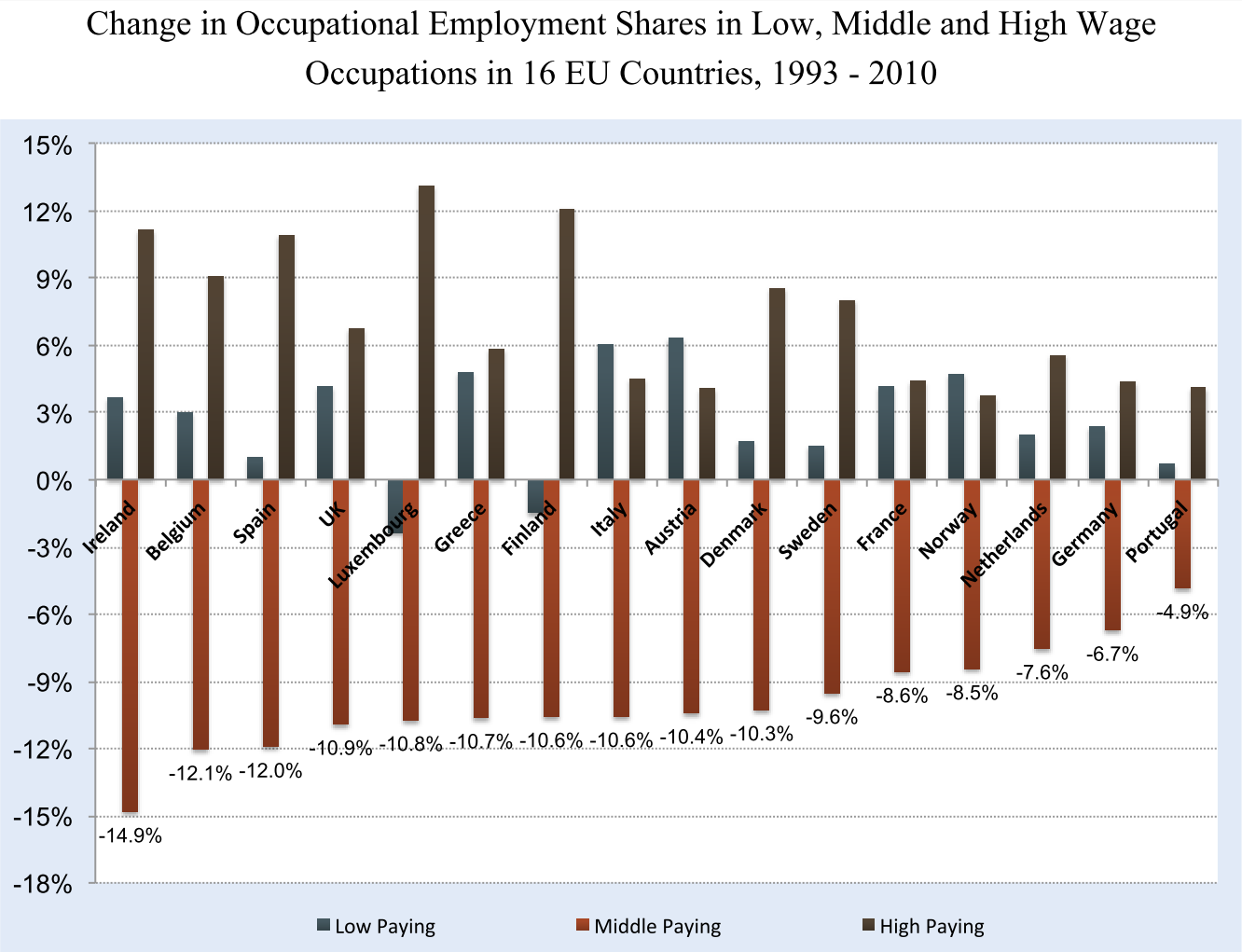
For example, Autor’s paper shows that low-wage jobs like fast food work has been growing rapidly all across the industrialized world and high-wage jobs like investment banking has also been growing.  But middle-income jobs have been shrinking.

employment growth

This is useful for two reasons.  First, it is yet another set of data that reinforce the fact that inequality is rising.  There are still some professional inequality denialists out there and they have been winning the popular sentiment in America.  The median American thinks that America is far more equal that it really is.  Secondly, a lot of people have always feared that productivity-increasing technology will cause mass unemployment.  For example, a lot of bright people in Silicon Valley were talking about it last week.  Autor’s paper reinforces the fact that new technologies have often changed the distribution of income, but they have never caused mass unemployment.

Right now we have an unemployment problem that could be fixed with better monetary policy and an inequality problem that will just keep getting worse if Thomas Piketty’s new book is correct.  These challenges will probably only keep growing due to the technological and demographic forces behind secular stagnation and rising inequality.

Posted in Inequality, Labor, Macro, Medianism

007 A License To Cut

Most US states require a license to cut hair.  This is basically a way for the barbershop lobby to restrict competition and raise wages.  This might be good for reducing American inequality because barbers are probably below the median wage and it helps raise their incomes up to the median.  But it also raises costs for the median American without any productivity gains, so I tend to think that licensure for barbers should be eliminated until there is some evidence that it creates clear benefit for anyone besides the licensure lobby.  It restricts basic freedoms and increases the opportunity for the kind of police overreach that we have seen in Ferguson this past week.  For example, in 2010 the Orange County police engaged in SWAT-style raids of barbershops that were suspected of harboring barbers who were allegedly serving their contented customers without licenses from the state barber syndicate.

“Deputies rushed into the businesses with their guns drawn, while wearing masks and vests and yelling obscenities and threats of violence,” the new complaint alleges.

“During these raids, Plaintiffs were arbitrarily detained, their persons searched, the premises were ransacked and left in total disarray and property such as doors, windows, cabinets, mirrors, and furniture was damaged or destroyed.”

…In a series of sweeps — conducted without warrants under the authority of the DBPR between August and October 2010 — 35 people were arrested on a charge of “barbering without an active license,” which is almost never used for custodial arrests in the state.

…Employees of the shops searched in the sweeps described them as SWAT-style raids, during which some barbers were handcuffed and their workstations searched.

A DBPR review, conducted after an Orlando Sentinel report brought the barbers’ complaints to light, found evidence of property damage, the use of police dogs during inspections and, in some cases, the failure of inspectors to plan or document entire operations.

…The suit alleges deputies performed “‘pat downs’ and criminal background checks, all of which were done without probable cause and without warrants.”
…The suit describes the barbershops in the latest lawsuit as “owned, operated and frequented by African-Americans and located in African-American communities” in Orlando.

“The selection of these businesses for ‘inspection’ based solely on the race and ethnicity of the owners, employees and customers, and the absence of appropriate search warrants, constitutes racial discrimination and unreasonable searches and seizures,” the complaint alleges.

Who exactly is this supposed to protect?  There is no evidence that anyone got a bad haircut before the police arrived. There have to be better ways to raise barber wages than requiring licensure for cutting hair.  Licensure is sometimes compared with unionization because both work in similar ways, but traditionally unions reduced inequality by transferring money from wealthy owners of capital to their workers.  That is why unionization is more politically controversial than licensure.  Business owners hate unions for taking some of their profits and the business lobby fights unionization.  Barber licensure is a way of extracting money from the general public rather than from the owners of capital and so licensure does less to reduce inequality than unionization.  In some cases licensure increases inequality by raising costs for the public and boosting incomes for elites.

Take taxicab licensure as an example.  Taxicab regulations in major cities have generally raised costs and created a floor on minimum service quality.  New competition from Uber and Lyft has been successful because these companies can offer lower fares because of loopholes that help them evade taxi regulations and offer lower fares. Or at least I have heard that they have good fares.  In my limited experience, they were more expensive than a regular cab.  They can maintain quality of customer service through online customer ratings and electronic GPS monitoring.  Before long I am sure our conventional taxicab companies will copy Uber and Lyft’s mobile phone apps to increase their service quality too.  Taxi regulations will need to change with the new technologies.

Taxicab regulations were historically designed by urban elites to try to guarantee a minimum level of service for a relatively elite section of the population who rely upon taxis.  This meant that taxi fares rose higher than the median person would like and taxis became something that poorer families avoided whenever possible.  The taxi regulations are fine for higher-income customers who worry more about reliable service than about the cost of a fare.

So taxi regulation arguably has not worked well for the median customer.  Also it has not worked well for the median worker in the taxi industry.  Most of the profits of taxi regulations haven’t gone to the workers who drive taxis, but to the owners of taxi medallions who are already rich. The drivers haven’t gained much from the rise in fares caused by regulations.  The most expensive regulation is the license to operate a taxi (often called the “medallion”) which are rarely owned by the drivers because they have been selling for over a million dollars each in places like New York City.  The owners of the licenses then rent cabs to drivers for a high price which squeezes the drivers’ incomes.

From the point of view of the median customer and the median worker, it is insanity, but it works well for elites on both sides of the market.  The relatively elite customers get more higher minimum quality than greater competition would bring and the elite owners get higher incomes than greater competition would bring.  Hopefully Uber and Lyft’s technology will provide a new way for elite customers to get the quality they desire and create a more democratic industry lobby to reduce the extractive rents that elite taxi owners have been sucking out of society. Then fares might decrease without reducing quality.  Time will tell.

Posted in Health, Labor

The Power Of Ideas

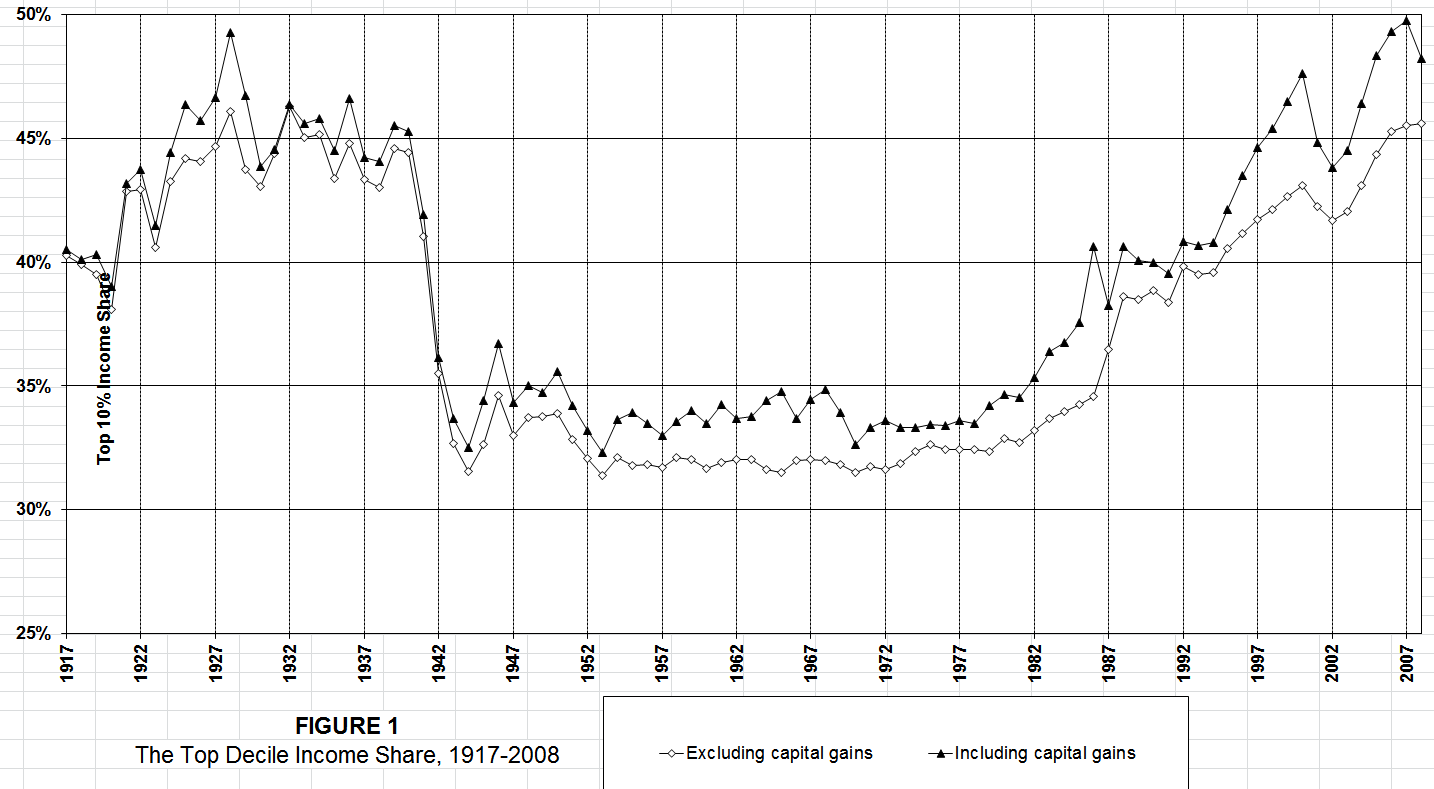
My last post highlighted Paul Krugman’s accusation that the top 1% richest people support bad monetary policy because they have more to gain from low inflation than the bottom 99%.  But I don’t think that bad monetary policy really helps the richest 1%.  I think everyone including the rich would benefit from better monetary policy because it would bring more GDP growth and it is almost impossible to have GDP growth without growth in the incomes of the richest 1% too. They claim so darn much of GDP that a rising tide of GDP almost always raises all their yachts even though growing GDP doesn’t always raise the little boats.  For example, according to Piketty and Saez’s data, the only year in US history since 1917 when GDP rose, but income for the elites declined was in 1941 when all the economic growth went to the bottom 90% and the income for the richest 10% dropped ever so slightly!  But it was a brief anomaly and the incomes of the richest 10% immediately rebounded the next year and continued growing robustly along with GDP ever since.  The early 1940s was the “great compression” when inequality dropped and the golden age of the American middle class began.  A graph of the decline in their income share is dramatic, but because total income was growing rapidly, their actual income didn’t change much.

top decline income shareYou can also play with this data using an interactive graphic at the State of Working America.  So even though better monetary policy is likely to decrease inequality, the rich have nothing to fear except fear itself.

The top 1% have much more influence over monetary policy than the rest of us, but they probably don’t have much worse views about monetary policy than anyone else.  As Kevin Drum says,

the sad truth is that virtually no one believes that high inflation helps economic growth when the economy is weak. I believe it. Krugman believes it. DeLong believes it. But among those who don’t follow the minutiae of economic research—i.e., nearly everyone—it sounds crazy. That goes for the top 0.1 percent as well as it does for everyone else. If they truly believed that higher inflation would get the economy roaring again, they might support it. (Might!) But they don’t….

It’s worth noting that hard money convictions are the norm virtually everywhere in the developed world, even in places that are a lot more egalitarian than the United States. Inflationary fears may be irrational, especially under our current economic conditions, but ancient fears are hard to deal with. As it happens, the erosion of assets during the 70s was unique to the conditions of the 70s, which included a lot more than just a few years of high inflation. But inflation is what people remember, so inflation is still what they fear.Bottom line: Even among non-hysterics, I’d say that hardly anyone really, truly believes in their hearts that high inflation would be good for economic growth. It’s the kind of thing that you have to convince yourself of by sheer mental effort, and even at that you’re probably still a little wobbly about the whole idea. It just seems so crazy. Until that changes, fear of inflation isn’t going anywhere.

The problem is more a problem of the power of ideas rather than the power of vested interests.  Until we economists can convince our rulers that higher inflation IS better monetary policy, nothing is going to change.  There are people at the Fed who realize that higher inflation would be better, but they are too timid to buck the popular will and the American selectorate’s conventional ‘wisdom’ prevents monetary policy radicals (like myself) from ever getting near the hallowed halls of the Fed to create more inflation.


Posted in Inequality, Macro

Who wins when monetary policy prioritizes low inflation over wage growth or unemployment?

I’ve previously argued many times that the Fed is overly worried about inflation and not worried enough about the wages of the median American and about unemployment.  Today Paul Krugman gives some back-of-the-envelope estimates of who benefits from the Fed’s inflation obsession.

Still, it is worth asking who benefits from low inflation or deflation, and from higher interest rates. And the answer, basically, is rich old men.

On the rich part: Using SIPP data, we can look at the comparison between financial assets and debt by household net worth:

Photo

Credit

Only the top end have more financial assets (as opposed to real assets like housing) than they have nominal debt; so they’re much more likely to be hurt by mild inflation and be helped by deflation than the rest.

Now, it’s true that some of these financial assets are stocks, which are claims on real assets. If we only look at interest-bearing assets, even the top group has more liabilities than assets:

Photo

Credit

But the SIPP top isn’t very high; in 2007 you needed a net worth of more than $8 million just to be in the top 1 percent.

Krugman’s estimates are crude and may not be accurate, but they make theoretical sense because financial wealth (as opposed to real wealth) is pure debt, so it is a zero-sum game.  For the purposes of analyzing monetary policy (interest rates and inflation), we can ignore real assets like vehicles and housing and just look at financial assets (which are debts).  Excluding real assets, most Americans have a net financial debt and we mostly owe it to the top one percent richest Americans who have the most financial assets.

Below is another estimate of the distribution of financial assets from inequality.org:

financial-wealth-inequality.org

This graph reflects a common confusion about what is a financial asset versus what is a real asset because it includes corporate stocks as part of ‘financial assets,’ but stocks are not purely financial.   Financial assets are pure debt, whereas a share of corporate stock is not purely a debt.  A stock is a share of ownership of the real assets (capital) of a corporation that gives a right to the future profits earned by that capital.  If stocks were excluded from the above graph, then all the bars would be much lower.  Most of the bottom 90% of families would probably have negative financial assets.

For this reason, higher inflation would probably help most people in the bottom 90% (if not the bottom 99%) because it would reduce the real value of our financial debts and stimulate higher employment that could raise wages.  If higher inflation would hurt anyone, it would manly hurt the top 1% who own most of the debt.  They are also the most to blame for creating the 2008 recession by hoarding their financial assets which has created a legacy of lingering unemployment

Most people don’t care about monetary policy even though it has a big impact on everyone.  Amazingly, a lot of the bottom 99% seem to have been convinced that higher inflation would be a terrible thing even though they would personally gain.


Tagged with:
Posted in Macro, Medianism

Enter your email address to follow this blog and receive notifications of new posts by email.

Join 75 other subscribers
Blog Archive
Pages